
Judge, 1913-08-23 · page 13 of 24
Judge — August 23, 1913 — page 13: what you’re looking at
What you’re looking at
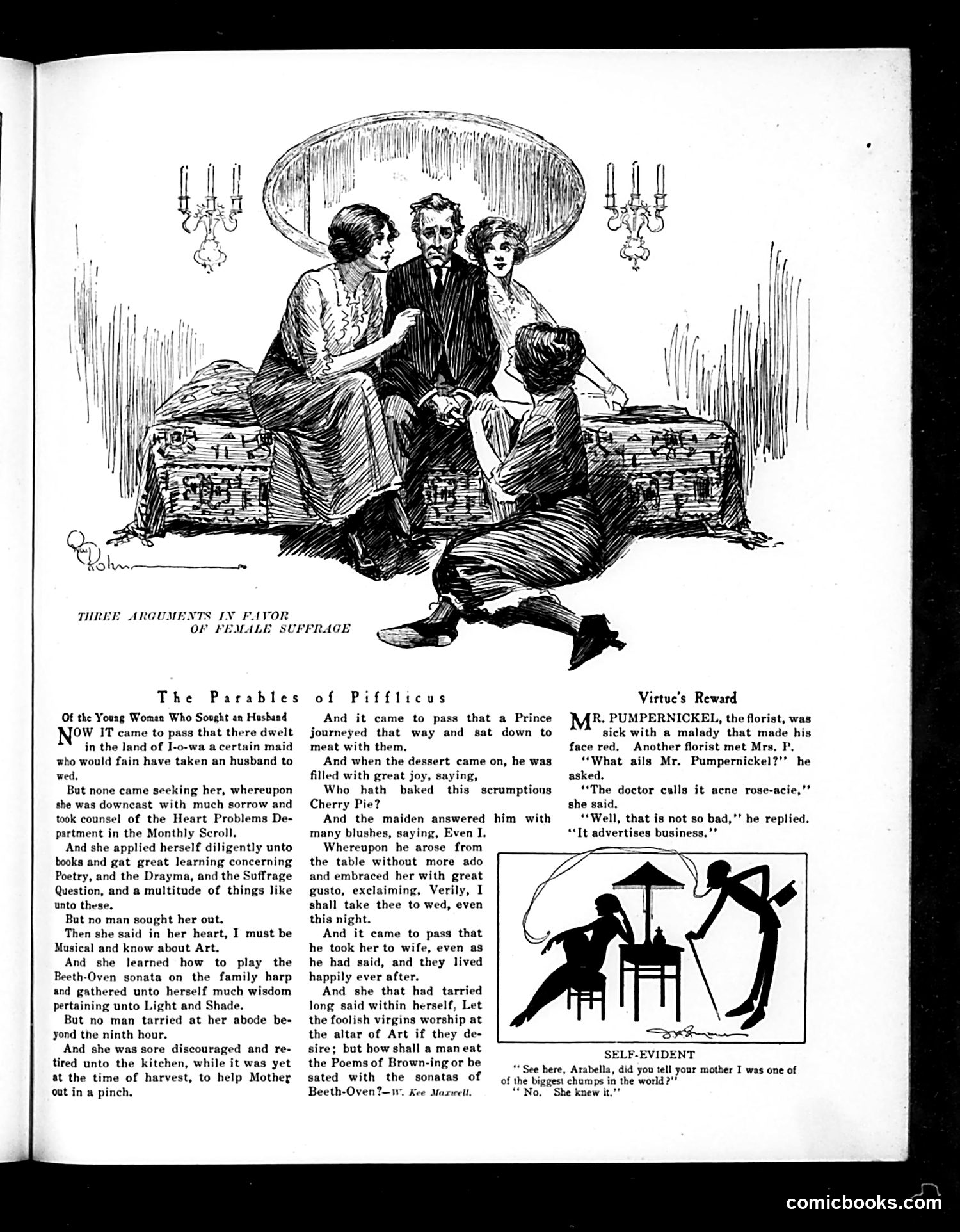
This page satirizes the women's suffrage movement through three pieces: **"Three Arguments in Favor of Female Suffrage"** (main illustration): Shows a man surrounded by women making appeals. The satire suggests that women's arguments for voting rights are frivolous or emotional rather than substantive. **"The Parables of Pifflicus"** (left story): A young Iowa woman studies serious subjects—poetry, drama, suffrage—seeking a husband, but remains unmarried. Only when she returns to domestic cooking (baking cherry pie) does a prince arrive and marry her immediately. The satire mocks educated women, suggesting their learning is useless and that men only value domestic skills. This attacks suffrage advocates by implying women's "proper place" is the home, not politics. **"Virtue's Reward"** and **"Self-Evident"** (right): These are light comedic shorts unrelated to suffrage. The overall message opposes female suffrage by suggesting educated, ambitious women are unattractive and unnatural—a common anti-suffrage argument of the era.
📄 Transcribed text from this page (OCR, searchable)
Machine-transcribed from the original scan — historical spelling and the odd misread are preserved.
THREE ARGUMENTS IN PAVOR aye fut He Ke \ Will Wt OF FEMALE SUFFRAGE The Parables Of the Young Woman Who Sought an Husband Now IT came to pass that there dwelt in the land of I-o-wa acertain maid who would fain have taken an husband to wed, But none came seeking her, whereupon she was downcast with much sorrow and took counsel of the Heart Problems De- partment in the Monthly Scroll. And she applied herself diligently unto books and gat great learning concerning Poetry, and the Drayma, and the Suffrage Question, and a multitude of things like unto these. But no man sought her out. Then she said in her heart, I must be Musical and know about Art. And she learned how to play the Beeth-Oven sonata on the family harp and gathered unto herself much wisdom pertaining unto Light and Shade. But no man tarried at her abode be- yond the ninth hour. And she was sore discouraged and re- tired unto the kitchen, while it was yet at the time of harvest, to help Mother out in a pinch, of Pifflicus And it came to pass that a Prince journeyed that way and sat down to meat with them. And when the dessert came on, he was filled with great joy, saying, Who hath baked this scrumptions Cherry Pie? And the maiden answered him with many blushes, saying, Even I. Whereupon he arose from Virtue’s Reward ME. PUMPERNICKEL, the florist, was sick with a malady that made his face red. Another florist met Mrs. P. “What ails Mr. Pumpernickel?” he asked. “The doctor calls it acne rose-acie,’’ she said. “Well, that is not so bad,” he replied. “It advertises business.’’ the table without more ado and embraced her with great gusto, exclaiming, Verily, I shall take thee to wed, even this night. And it came to pass that he took her to wife, even as he had said, and they lived happily ever after. And she that had tarried long said within herself, Let the foolish virgins worship at the altar of Art if they de- sire; but how shall a man eat the Poems of Brown-ing or be sated with the sonatas of Beeth-Oven?—1. Kee Maxwell. “No. SELF-EVIDENT “* See here, Arabella, did you tell your mother I was one of of the biggest chumps in the world 2" She knew it.” comicbooks.com