
Judge, 1913-08-23 · page 11 of 24
Judge — August 23, 1913 — page 11: what you’re looking at
What you’re looking at
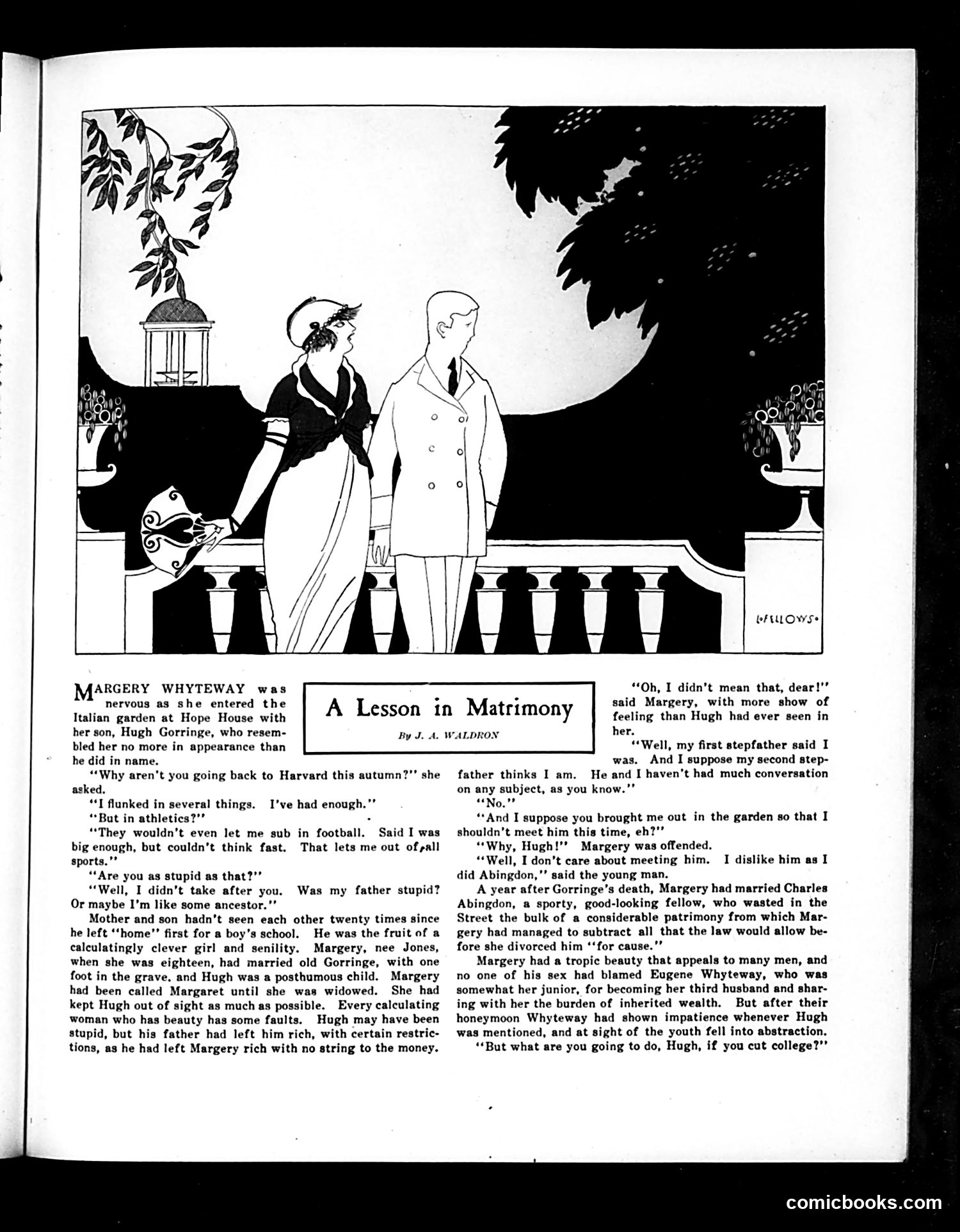
This is a satirical short story (not a political cartoon) about **Margery Whyteway**, a calculating woman of inherited wealth who has married three times. The narrative critiques her shallow materialism and serial marriages. **The premise**: Margery married an elderly man (Gorringe) while young, bore his posthumous son Hugh, then divorced him. She subsequently married Charles Abingdon (squandering his fortune) and is now married to Eugene Whyteway. Each husband represents progressively younger, wealthier targets. **The satire targets**: - Women who strategically marry for money rather than affection - The hypocrisy of "calculating" beautiful women who lack genuine maternal feeling (she kept Hugh hidden) - The legal system allowing women to extract maximum wealth during divorces **The social context**: This reflects 1920s anxieties about women's newfound independence post-suffrage, divorce accessibility, and fears that some women exploited marriage law for financial gain. Hugh—illegitimate, academically failed, and unwanted—serves as the sympathetic counterpoint to his mother's self-interested machinations.
📄 Transcribed text from this page (OCR, searchable)
Machine-transcribed from the original scan — historical spelling and the odd misread are preserved.
ARGERY WHYTEWAY was nervous as she entered the Italian garden at Hope House with her son, Hugh Gorringe, who resem- bled her no more in appearance than he did in name. “Why aren't you going back to Harvard this autumn?’’ she asked. “TI flunked in several things. I’ve had enough.’ “But in athletics?”” : “They wouldn’t even let me sub in football. Said I was big enough, but couldn’t think fast. That lets me out of,all Sports.’” “Are you as stupid as that?”’ “Well, I didn’t take after you. Or maybe I’m like some ancestor.’ Mother and son hadn’t seen each other twenty times since he left ‘‘home”’ first for a boy’s school. He was the fruit of a calculatingly clever girl and senility. Margery, nee Jones, when she was eighteen, had married old Gorringe, with one foot in the grave, and Hugh was a posthumous child. Margery had been called Margaret until she was widowed. She had kept Hugh out of sight as much as possible. Every calculating woman who has beauty has some faults. Hugh may have been stupid, but his father had left him rich, with certain restric- tions, as he had left Margery rich with no string to the money. A Lesson in Was my father stupid? By J. A. We “Oh, I didn’t mean that, dear!’ said Margery, with more show of feeling than Hugh had ever seen in her. “Well, my first stepfather said I was. And I suppose my second step- father thinks I am. He and I haven’t had much conversation on any subject, as you know.’’ “No.” **And I suppose you brought me out in the garden so that I shouldn’t meet him this time, eh?"’ “Why, Hugh!’? Margery was offended. “Well, I don’t care about meeting him. did Abingdon,’’ said the young man. A year after Gorringe’s death, Margery had married Charles Abingdon, a sporty, good-looking fellow, who wasted in the Street the bulk of a considerable patrimony from which Mar- gery had managed to subtract all that the law would allow be- fore she divorced him ‘‘for cause.’” Margery had a tropic beauty that appeals to many men, and no one of his sex had blamed Eugene Whyteway, who was somewhat her junior, for becoming her third husband and shar- ing with her the burden of inherited wealth. But after their honeymoon Whyteway had shown impatience whenever Hugh was mentioned, and at sight of the youth fell into abstraction. “But what are you going to do, Hugh, if you cut college?” Matrimony ALDRON I dislike him as I comicbooks.com