
Judge, 1913-08-23 · page 23 of 24
Judge — August 23, 1913 — page 23: what you’re looking at
What you’re looking at
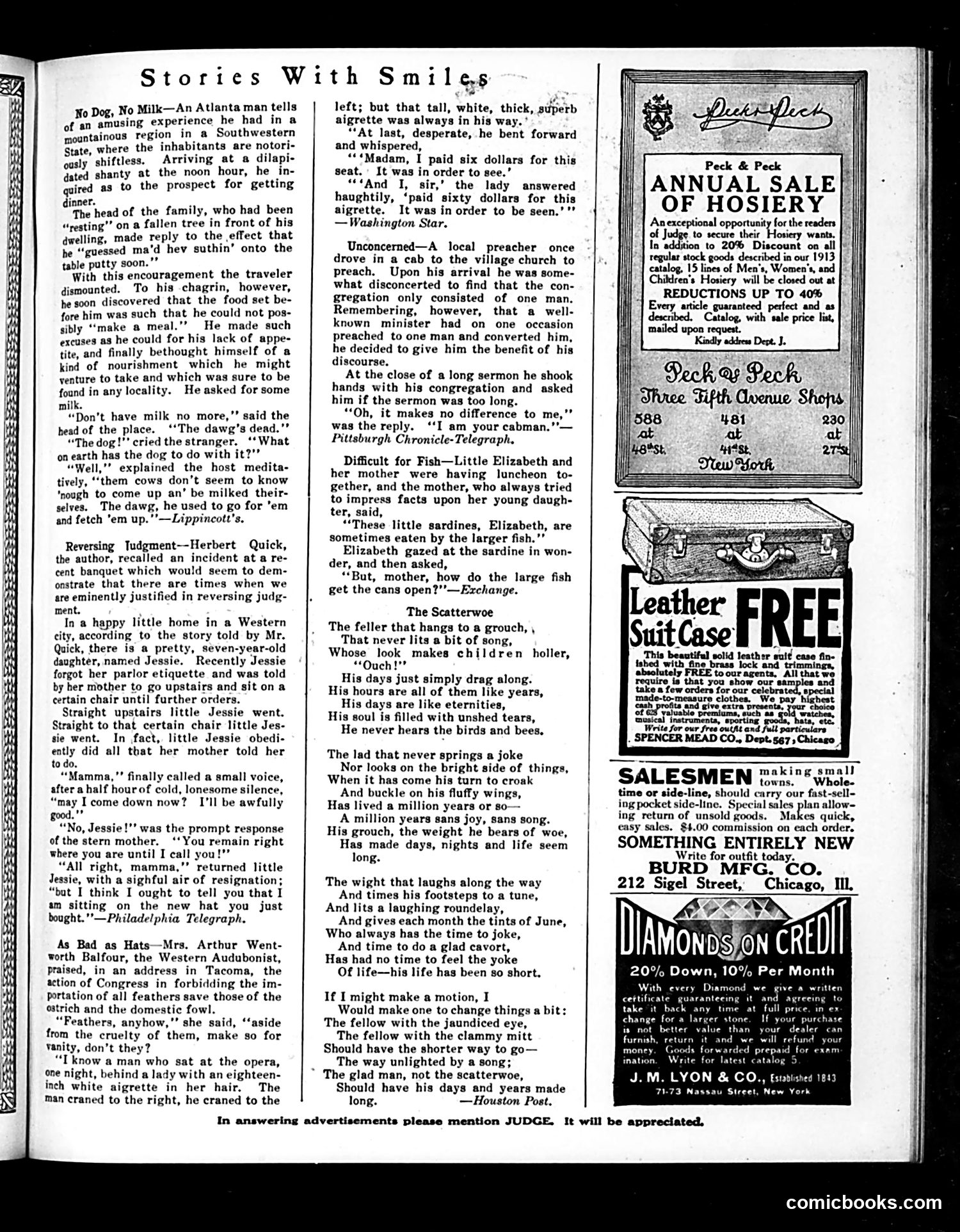
This page contains **humorous anecdotes** rather than political cartoons. The stories satirize rural/working-class American life and social conventions of the early 20th century: 1. **"No Milk"**: Mocks rural Southern poverty and ignorance—a shiftless farmer's cow won't produce milk because his dog (who herds them) is dead, illustrating comic incompetence. 2. **"Reversing Judgment"**: A child's innocent punishment backfires when she reveals she sat on her mother's expensive new hat—mildly satirizing parental authority. 3. **"As Bad as Hats"**: Uses a lady's enormous feathered hat as social satire. An opera patron paid for his seat to *see*; she paid for her hat to be *seen*—critiquing vanity and women's fashion priorities, also touching on the era's feather-trade controversy (note the Audubon reference above). The page is primarily **advertising** for hosiery, leather cases, and other goods. No specific political figures are identifiable; the humor targets class, gender, and fashion conventions of the period.
📄 Transcribed text from this page (OCR, searchable)
Machine-transcribed from the original scan — historical spelling and the odd misread are preserved.
Stories With Smiles o Milk—An Atlanta man tells Ak experience he had in a Sreantainous region in a Southwestern State, where the inhabitants are notori- ously shiftless. Arriving at a dilapi- dated shanty at the noon hour, he ine quired as to the prospect for getting Girtye head of the family, who had been “resting’”’ on a fallen tree in front of his dwelling, made reply to the effect that he ‘‘guessed ma’d hev suthin’ onto the utty soon.’” acs this encouragement the traveler dismounted. To his chagrin, however, he soon discovered that the food set be- fore him was such that he could not pos- sibly “make a meal."? He made such excuses as he could for his lack of appe- tite, and finally bethought himself of a kind of nourishment which he might venture to take and which was sure to be found in any locality. He asked for some ik. eeDon't have milk no more,”’ said the head of the place. ‘The dawg’s dead.”’ “The dog!’’ cried the stranger. ‘*What on earth has the dog to do with it?” “Well,’’ explained the host medita- tively, ‘them cows don’t seem to know ‘nough to come up an’ be milked their- selves. The dawg, he used to go for em and fetch em up.'’—Lippincott's. Reversing Tudgment--Herbert Quick, the author, recalled an incident at a re- cent banquet which would seem to dem- onstrate that there are times when we are eminently justified in reversing judg- ment. In a happy little home in a Western city, according to the story told by Mr. Quick, there is a pretty, seven-year-old daughter, named Jessie. Recently Jessie forgot her parlor etiquette and was told by her mother to go upstairs and sit ona certain chair until further orders. Straight upstairs little Jessie went. Straight to that certain chair little Jes- sie went. In fact, little Jessie obedi- ently did all that her mother told her to do. “Mamma,” finally called a small voice, after a half hour of cold, lonesome silence, “may I come down now? I'll be awfully “No, Jessie!" was the prompt response of the stern mother. ‘‘You remain right where you are until I call you!” “All right, mamma,’’ returned little Jessie, with a sighful air of resignation; “bat I think I ought to tell you that I am sitting on the new hat you just bought.""—Philadelphia Telegraph. As Bad as Hats—Mrs. Arthur Went- worth Balfour, the Western Audubonist, praised, in an address in Tacoma, the action of Congress in forbidding the im- portation of all feathers save those of the ostrich and the domestic fowl. “Feathers, anyhow,’’ she said, ‘aside from the cruelty of them, make so for vanity, don’t they? “I know a man who sat at the opera, one night, behind a lady with an eighteen- inch white aigrette in her hair. The man craned to the right, he craned to the left; but that tall, white, thick, superb aigrette was always in his way.° “At last, desperate, he bent forward and whispered, “Madam, I paid six dollars for this seat. It was in order to see.’ ““*And I, sir,’ the lady answered haughtily, ‘paid sixty dollars for this aigrette. It was in order to be seen.’” — Washington Star. Unconcerned—A local preacher once drove in a cab to the village church to preach. Upon his arrival he was some- what disconcerted to find that the con- gregation only consisted of one man. Remembering, however, that a well- known minister had on one occasion preached to one man and converted him, he decided to give him the benefit of his discourse. At the close of a long sermon he shook hands with his congregation and asked him if the sermon was too long. “Oh, it makes no difference to me,” was the reply. ‘‘I am your cabman.’’— Pittsburgh Chronicle-Telegraph. Difficult for Fish—Little Elizabeth and her mother were having luncheon to- gether, and the mother, who always tried to impress facts upon her young daugh- ter, said, “These little sardines, Elizabe sometimes eaten by the larger fish. Elizabeth gazed at the sardine in won- der, and then asked, “‘But, mother, how do the large fish get the cans open?’’—Exchange. The Scatterwoe The feller that hangs to a grouch, , That never lits a bit of song, Whose look makes children holler, “Ouch!” His days just simply drag along. His hours are all of them like years, His days are like eternities, His soul is filled with unshed tears, He never hears the birds and bees, The lad that never springs a joke Nor looks on the bright side of things, When it has come his turn to croak And buckle on his fluffy wings, Has lived a million years or so— A million years sans joy, sans song. His grouch, the weight he bears of woe, Has made days, nights and life seem long. The wight that laughs along the way And times his footsteps to a tune, And lits a laughing roundelay, And gives each month the tints of June, Who always has the time to joke, And time to do a glad cavort, Has had no time to feel the yoke Of life—his life has been so short. If I might make a motion, I Would make one to change things a bit: The fellow with the jaundiced eye, The fellow with the clammy mitt Should have the shorter way to go— The way unlighted by a song; * The glad man, not the scatterwoe, Should have his days and years made long. —Houston Post. Peck & Peck ANNUAL SALE OF HOSIERY Anexceptional opportunity for the readers | of Judge to secure theit Flos 5 regular stock goods descri catalog. 15 lines of Men's, Women's and Children’s Hosiery will be closed out at | ;z REDUCTIONS UP at 40% very article guarant fect as described. Catalog, with ‘sale price list mailed upon request. Kindly address Dept. J. ‘This beautifal solid leather suit case fin- ished with fine brass ine, lock and tri Write for our free outit and full particulars” SPENCER MEAD CO., Dept. 567 ; Chicago , SALESMEN making small towns. _Whole- time or side-line, should carry our fast-sell- ing pocket side-line. Special sales plan allow= ing return of unsold goods. Makes quick, easy sales. $4.00 commission on each order. SOMETHING ENTIRELY NEW Write for outfit today. BURD MFG. CO. 212 Sigel Street, Chicago, Ill. <4 AMonaston cREL 20% Down, 10% Per Month With every Diamond we give a written ceftificate guaranteeing it and agreeing to take it back any time at full price, in ex change for a larger stone. If your purchase is not better value than your dealer can furnish, return it and we will refund your money. Goods forwarded prepaid for exam ination. Write for latest catalog 5 J.M. LYON & CO.), Establishes 1843 71-73 Nassau Street, New York In answering advertisements please mention JUDGE. It will be appreciated. comicbooks.com