
Judge, 1913-08-23 · page 5 of 24
Judge — August 23, 1913 — page 5: what you’re looking at
What you’re looking at
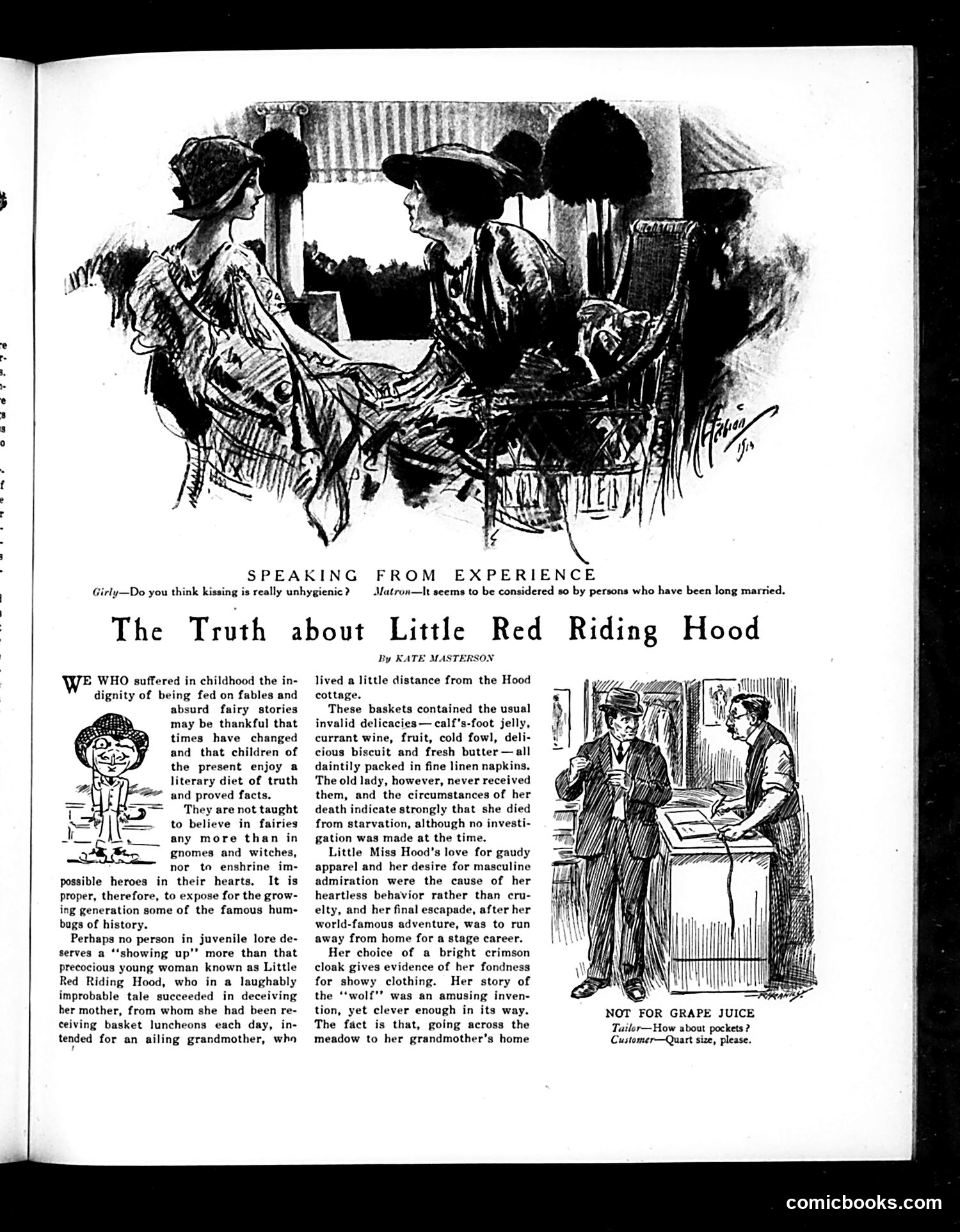
This page contains two separate pieces: **Top illustration**: A social commentary sketch titled "Speaking from Experience" showing women discussing kissing and hygiene. The matron's quip—that kissing seems unhygienic only to those *not* long married—is a wry joke about marital intimacy diminishing romantic ideals over time. **Main article**: "The Truth About Little Red Riding Hood" by Kate Masterson reinterprets the fairy tale as social critique. Rather than a cautionary story about strangers, Masterson argues the tale actually reflects a girl's desire for fashionable clothing and masculine attention, leading her to abandon home for a stage career. The satire mocks both the fairy tale's moral lessons and contemporary attitudes about women's ambitions and materialism. The page reflects early 20th-century anxieties about changing gender roles and female independence.
📄 Transcribed text from this page (OCR, searchable)
Machine-transcribed from the original scan — historical spelling and the odd misread are preserved.
SPEAKING FROM EXPERIENCE Girly—Do you think kissing is really unhygienic? —_-Matron—It seems to be considered so by persons who have been long married. The Truth about Little Red Riding Hood By KATE MAST! BY E WHO suffered in childhood the in- dignity of being fed on fables and absurd fairy stories may be thankful that times have changed and that children of the present enjoy a literary diet of truth and proved facts. They are not taught to believe in fairies any more than in gnomes and witches, nor to enshrine im- possible heroes in their hearts. It is proper, therefore, to expose for the grow- ing generation some of the famous hum- bags of history. Perhaps no person in juvenile lore de- serves a ‘‘showing up’’ more than that precocious young woman known as Little Red Riding Hood, who in a laughably improbable tale succeeded in deceiving her mother, from whom she had been re- ceiving basket luncheons each day, in- tended for an ailing grandmother, who lived a little distance from the Hood cottage. These baskets contained the usual invalid delicacies — calf’s-foot jelly, currant wine, fruit, cold fowl, deli- cious biscuit and fresh butter —all daintily packed in fine linen napkins. The old lady, however, never received them, and the circumstances of her death indicate strongly that she died from starvation, although no investi- gation was made at the time. Little Miss Hood’s love for gaudy apparel and her desire for masculine admiration were the cause of her heartless behavior rather than cru- elty, and her final escapade, after her world-famous adventure, was to run away from home for a stage career. Her choice of a bright crimson cloak gives evidence of her fondness for showy clothing. Her story of the ‘‘wolf’? was an amusing inven- tion, yet clever enough in its way. The fact is that, going across the meadow to her grandmother’s home NOT FOR GRAPE JUICE Tailor—How about pockets ? Customer—Quart size, please. comicbooks.com