
Judge, 1913-08-23 · page 6 of 24
Judge — August 23, 1913 — page 6: what you’re looking at
What you’re looking at
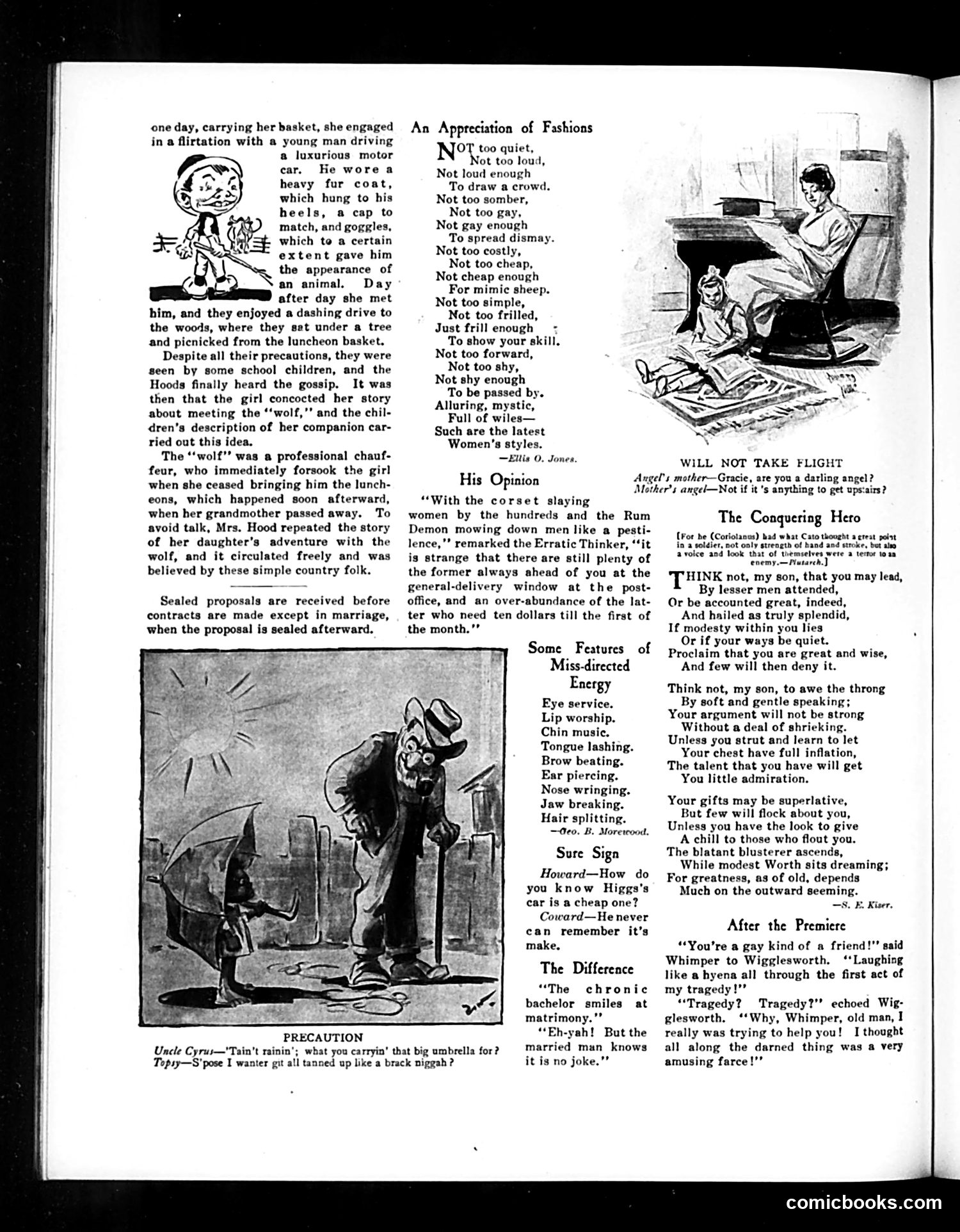
This page from *Judge* contains several satirical pieces typical of early 20th-century American humor: **Main narrative**: A cautionary tale about a country girl who meets a wealthy motorist in a fur coat and goggles. After he abandons her when her grandmother (who provided picnic lunches) dies, she spreads rumors calling him a "wolf"—a then-current slang term for a seducer. Credulous rural folk believe her fabricated story. **The satire**: Mocks both the girl's dishonesty and the gullibility of country people who accept gossip uncritically. **Other content includes**: - A poem on women's fashion paradoxes (must be alluring but not forward) - Social commentary on corsets and alcohol as public health crises, yet women and men remain plentiful - Humorous observations on bachelors versus married men - A poem mocking self-promotion and bluster as necessary for success—satirizing how appearance and noise matter more than actual merit The racist dialect joke at bottom reflects the regrettable conventions of the era. Overall, the page exemplifies *Judge*'s mix of social criticism with light comedy.
📄 Transcribed text from this page (OCR, searchable)
Machine-transcribed from the original scan — historical spelling and the odd misread are preserved.
one day, carrying her basket, she engaged in a flirtation with a young man driving a luxurious motor car. He wore a heavy fur coat, which hung to his heels, a cap to match, and goggles, which to a certain extent gave him the appearance of nn animal. Day after day she met him, and they enjoyed a dashing drive to the woods, where they set under a tree and picnicked from the luncheon basket. Despite all their precautions, they were seen by some school children, and the Hoods finally heard the gossip. It was then that the girl concocted her story about meeting the ‘‘wolf,’’ and the chil- dren’s description of her companion car- ried out this idea. The “‘wolf’’ was a professional chauf- feur, who immediately forsook the girl when she ceased bringing him the lunch- eons, which happened soon afterward, when her grandmother passed away. To avoid talk, Mrs. Hood repeated the story of her daughter’s adventure with the wolf, and it circulated freely and was believed by these simple country folk. Sealed proposals are received before contracts are made except in marriage, when the proposal is sealed afterward. Uncle Cyrus—'Tain't raini what you carryin’ that big umbrella for? Topsy—S' pose I wanter git all tanned up like a brack niggah ? An Appreciation of Fashions OT too quiet, N Noe tao loud, Not loud enough To draw a crowd. Not too somber, Not too gay, Not gay enough To spread dismay. Not too costly, Not too cheap, Not cheap enough For mimic sheep. Not too simple, Not too frilled, Just frill enough = = To show your skill. Not too forward, Not too shy, Not shy enough To be passed by. Alluring, mystic, Full of wiles— Such are the latest Women’s styles. Ellis O. Jones. His Opinion “With the corset slaying women by the hundreds and the Rum Demon mowing down men like a pesti- lence,’? remarked the Erratic Thinker, ‘‘it is strange that there are still plenty of the former always ahead of you at the general-delivery window at the post- office, and an over-abundance of the lat- ter who need ten dollars till the first of the month.”” Some Features of Miss-directed Energy Eye service. Lip worship. Chin music. Tongue lashing. Brow beating. Ear piercing. Nose wringing. Jaw breaking. Hair splitting. —Oeo. B. Morewood. Sure Sign Howard—How do you know Higgs's car is a cheap one? Coward—He never can remember it’s make. The Difference “The chronic bachelor smiles at matrimony.’’ “Eh-yah! But the married man knows it is no joke.”” WILL NOT TAKE FLIGHT Angel's mother—Gracie, are you a darling angel? Mother's angel—Not if 's anything to get ups:airs? The Conquering Hero (For be (Coriolanas) had what Cato thoug! in a soldier, not oaly strength of band and avoice and look that of themselves wei enemy.—Miutarch.) ‘THINK not, my son, that you may lead, By lesser men attended, Or be accounted great, indeed, And hailed as truly splendid, If modesty within you lies Or if your ways be quiet. Proclaim that you are great and wise, And few will then deny it. creat poltt 5 bet alsa jertor 10 a8 Think not, my son, to awe the throng By soft and gentle speaking; Your argument will not be strong Without a deal of shrieking. Unless you strut and learn to let Your chest have full inflation, The talent that you have will get You little admiration. Your gifts may be superlative, But few will flock about you, Unless you have the look to give A chill to those who flout you. The blatant blusterer ascends, While modest Worth sits dreaming; For greatness, as of old, depends Much on the outward seeming. . B. Kiser, After the Premiere “You're a gay kind of a friend!"’ said Whimper to Wigglesworth. ‘*Laughing like a hyena all through the first act of my tragedy !’’ “Tragedy? Tragedy?’? echoed Wig- glesworth. ‘Why, Whimper, old man, I really was trying to help you! I thought all along the darned thing was a very amusing farce!’’ comicbooks.com