
A complete issue · 24 pages · 1913
Judge — August 16, 1913
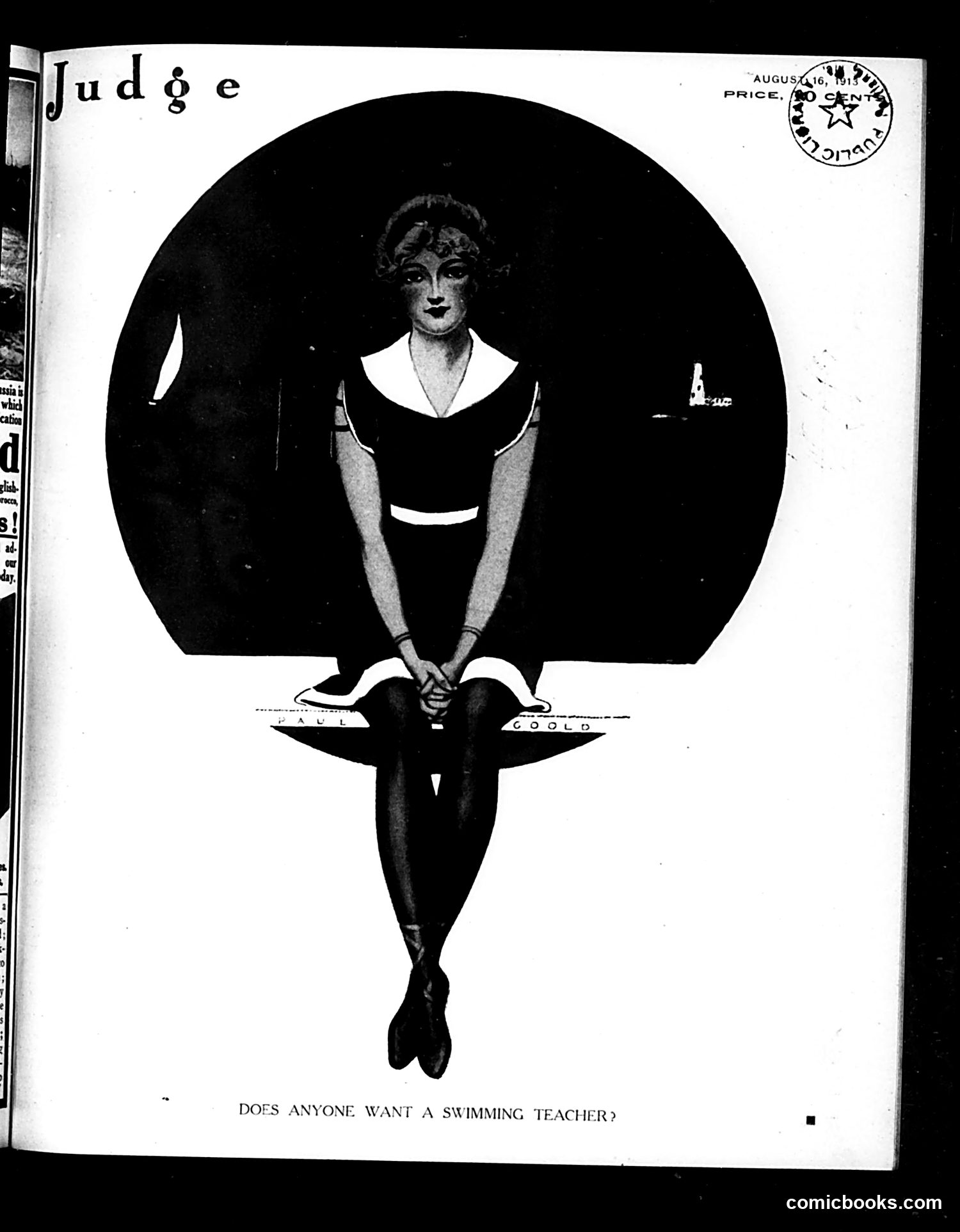
This is a Judge magazine cover featuring a swimming-related illustration. The image shows a woman in a vintage swimming costume (likely 1920s-1930s era based on the style) posed above a scale marked "FOUL" and "COLD." The caption reads: "DOES ANYONE WANT A SWIMMING TEACHER?" The satire appears to be a body-shaming or weight-related joke, common to this era's humor. The scale and the woman's posed position suggest commentary on physical appearance standards for swimming instructors. The terms "FOUL" and "COLD" may reference water conditions or serve as punchline elements. The magazine's masthead shows "AUGUST" and "PRICE, 20 CENTS," though the exact year is unclear from visible text. This represents period humor that would be considered offensive by modern standards.
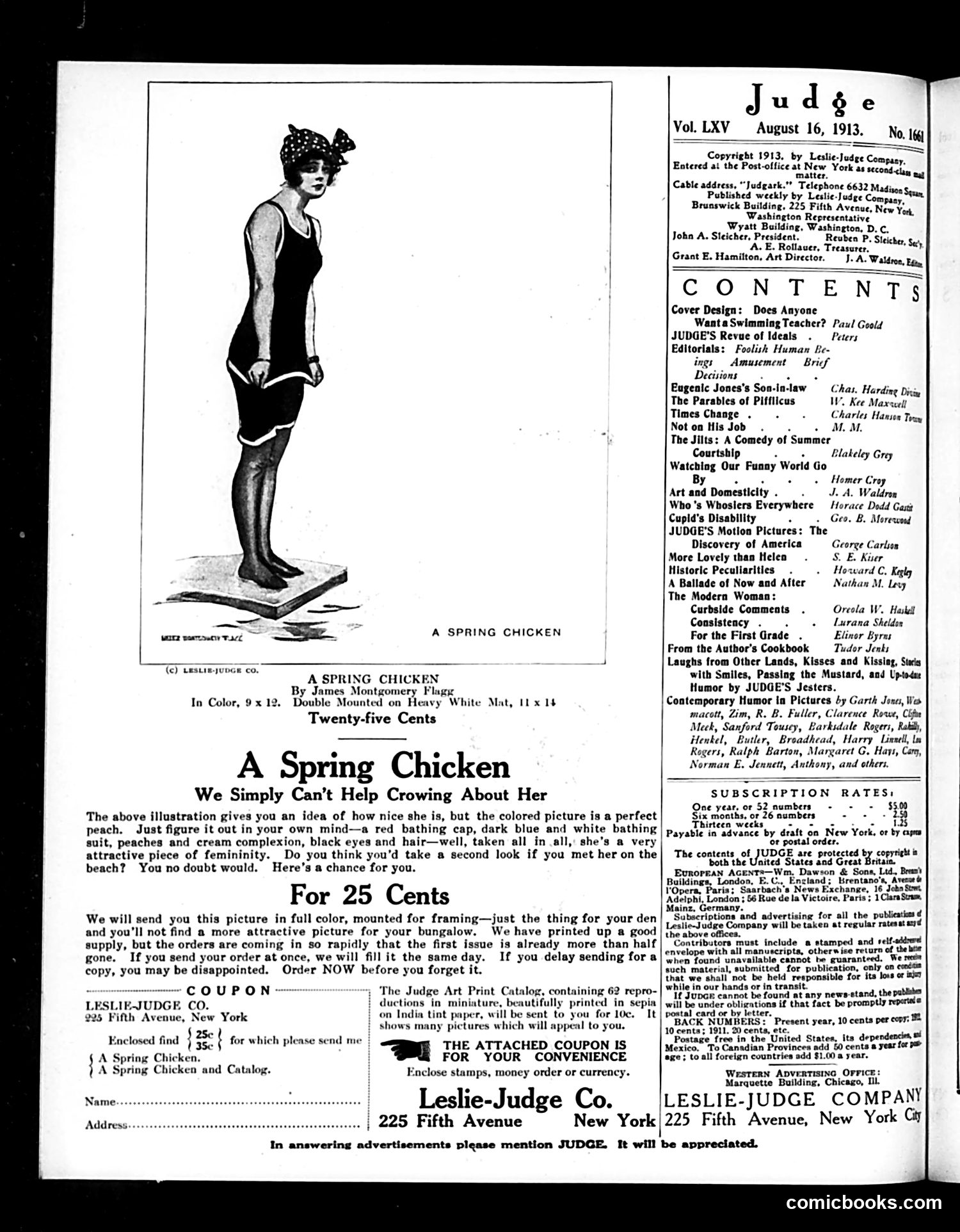
This page is primarily **advertising**, not political satire. The main content is a product advertisement for a colored art print titled "A Spring Chicken" by James Montgomery Flagg, priced at 25 cents. The illustration depicts an attractive young woman in a bathing suit. The accompanying text uses the phrase "spring chicken" (meaning a young, attractive person) as both the title and the basis for its sales pitch: the ad suggests readers purchase this print because the woman pictured is beautiful and would make nice decoration for a den or bungalow. The coupon allows customers to order the print and a Judge Art Catalog directly from Leslie-Judge Co. in New York. There is no political commentary—this is straightforward commercial advertising typical of Judge magazine's revenue model.
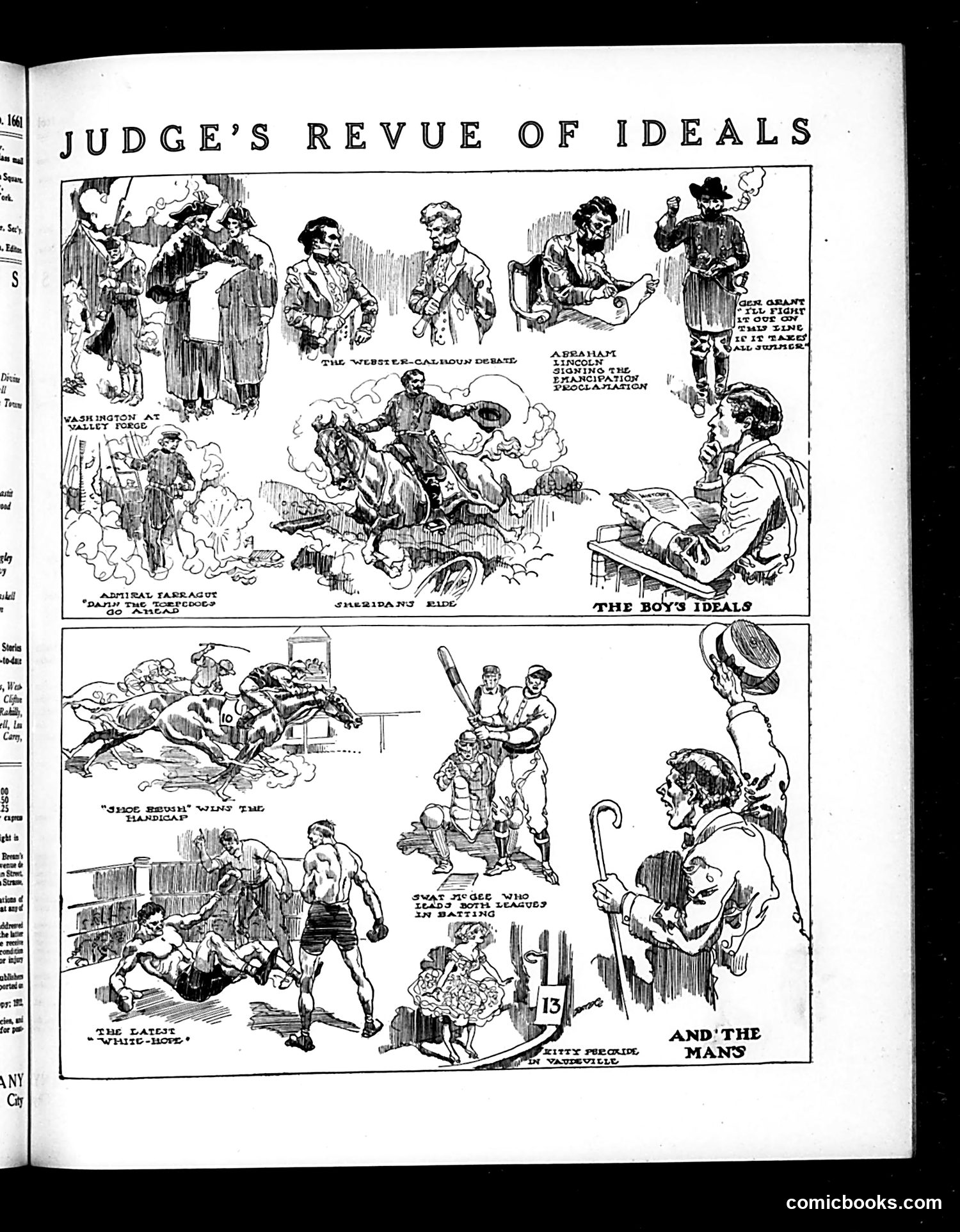
This satirical page from *Judge* magazine presents a series of vignettes mocking various American ideals and their gap from reality. The cartoons include: - **"Valley Forge"** and **"Abraham Lincoln"** panels: Likely contrasting historical heroic ideals with contemporary reality - **"The Boy's Ideals"**: A youth reading about adventure while sheltered indoors - **"The Latest Music-Hose"** and **"Baseball"**: Depicting common pursuits - **"Kitty Preckles of Nashville"**: Appears to reference a specific person or type The overall theme satirizes the disconnect between what Americans romanticize (historical valor, youthful adventure, American pastimes) and actual contemporary experience. The title "Judge's Revue of Ideals" frames this as social commentary on idealism versus reality in American life. The specific figures and references are difficult to identify with certainty without additional context.
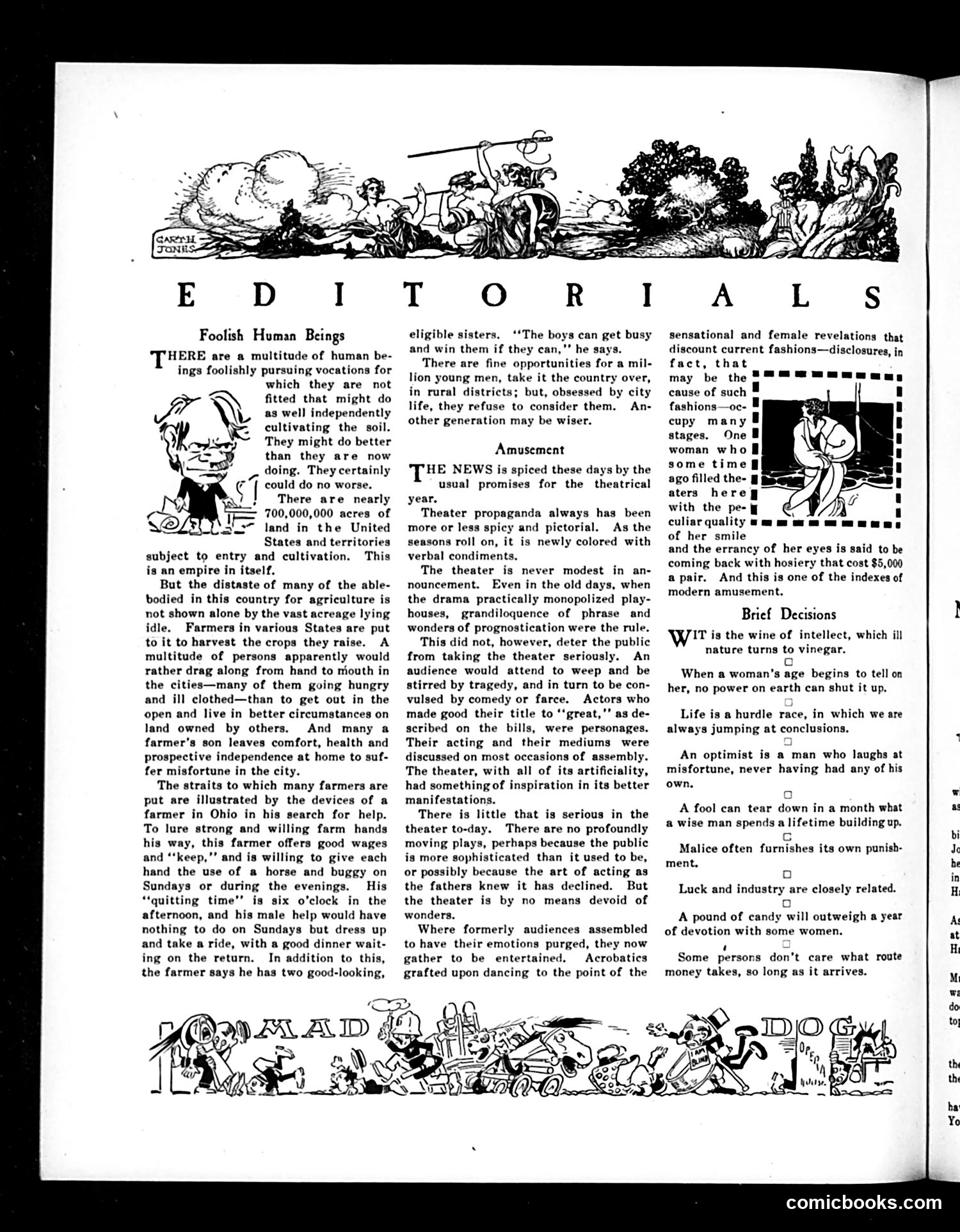
This "Editorials" page from *Judge* magazine contains opinion pieces rather than political cartoons. The main article, "Foolish Human Beings," criticizes Americans pursuing unsuitable vocations—particularly farmers abandoning agriculture for city life, despite lacking urban skills. The author argues this wastes farmland and creates social problems. The accompanying illustration shows a farmer figure, likely representing this demographic. The "Amusement" section mocks theatrical advertising's exaggerated claims, suggesting modern theater lacks substance compared to earlier drama. It critiques actors' inflated reputations and notes the public attends primarily for spectacle rather than art. The "Brief Decisions" section offers sardonic aphorisms about human nature, age, optimism, and materialism—typical satirical commentary on contemporary American society and values.
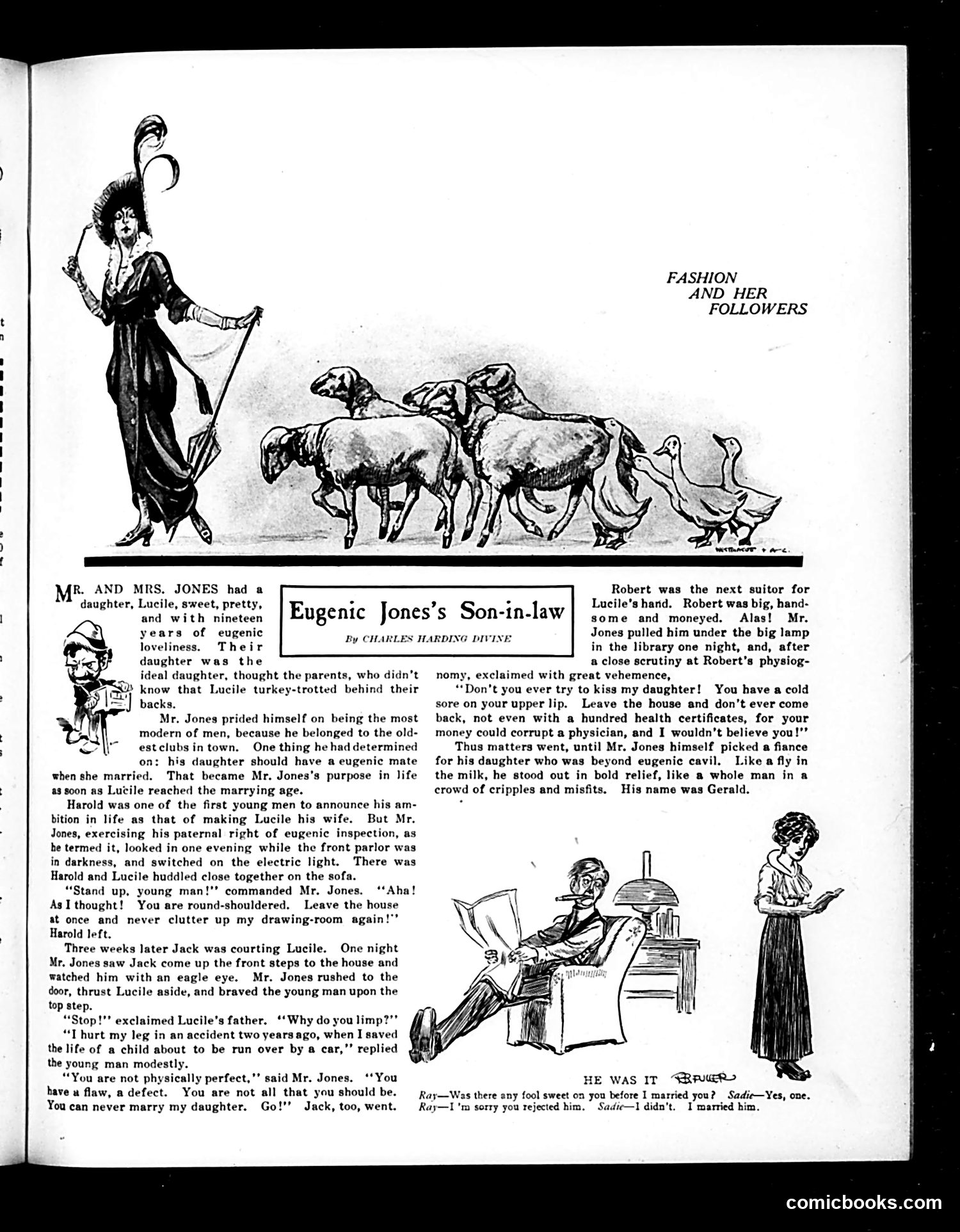
This page satirizes the early 20th-century eugenics movement through a story about Mr. Jones, a man obsessed with "eugenic inspection" of potential husbands for his daughter Lucile. Jones rejects a suitor named Jack for having a "flaw"—a limp from an old injury—deeming him physically imperfect for breeding purposes. The satire mocks Jones's pretentious application of eugenic pseudoscience to family matters. The top illustration shows "Fashion and Her Followers" as animals, suggesting those following fashion trends are less evolved than humans. The story ridicules the arrogance of eugenics advocates who believed they could scientifically determine human worth based on physical perfection—a popular but deeply flawed ideology of that era.
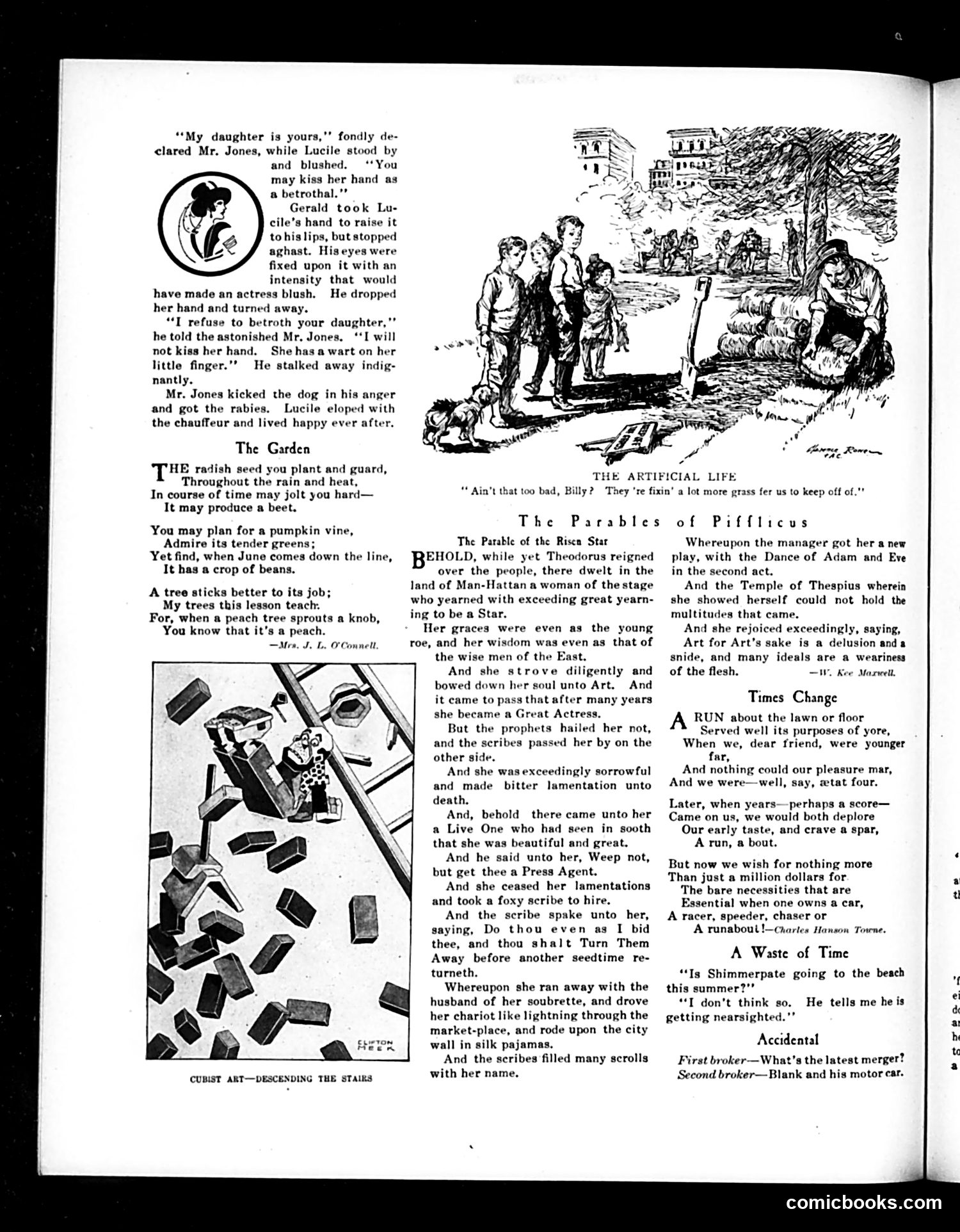
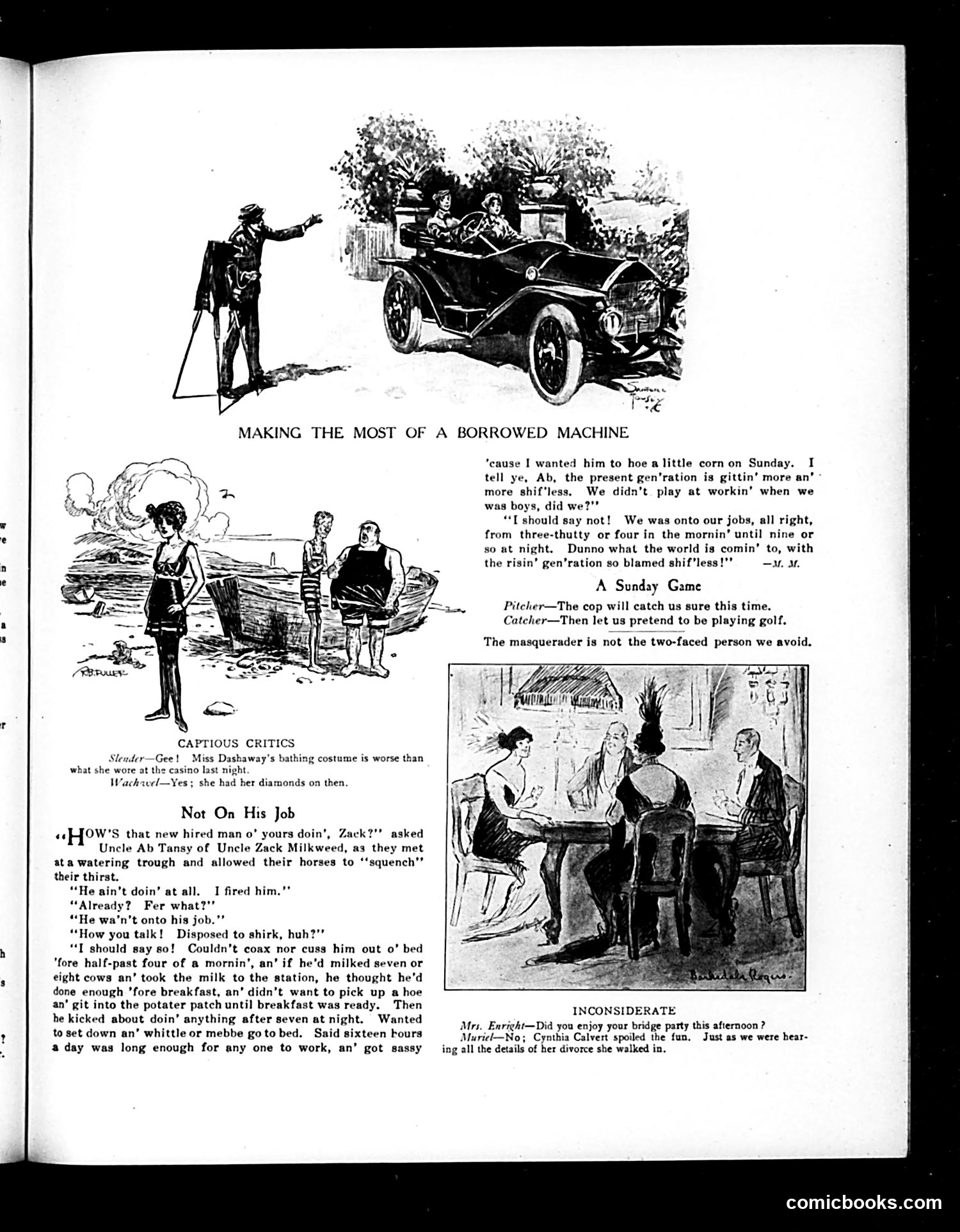
This page satirizes the generational divide and work ethic complaints common in early 20th-century America. The top cartoon shows older men (appearing to be rural farmers) lamenting that young people are "shiftless" and don't work as hard as their generation did—they worked from 3:30 AM to 9 PM without complaint. The "Not On His Job" story reinforces this theme: Uncle Zack fires a hired man who won't work before 4:30 AM and complains after a 16-hour day. The joke mocks the older generation's unrealistic expectations and their inability to recognize exploitative labor conditions. Other vignettes satirize hypocrisy: people breaking rules (playing baseball on Sunday while pretending it's golf to avoid police), and social pretense (a woman wearing diamonds to the beach to appear wealthy). The humor targets both generational clash and the absurdity of rigid Victorian work attitudes facing changing modern values.
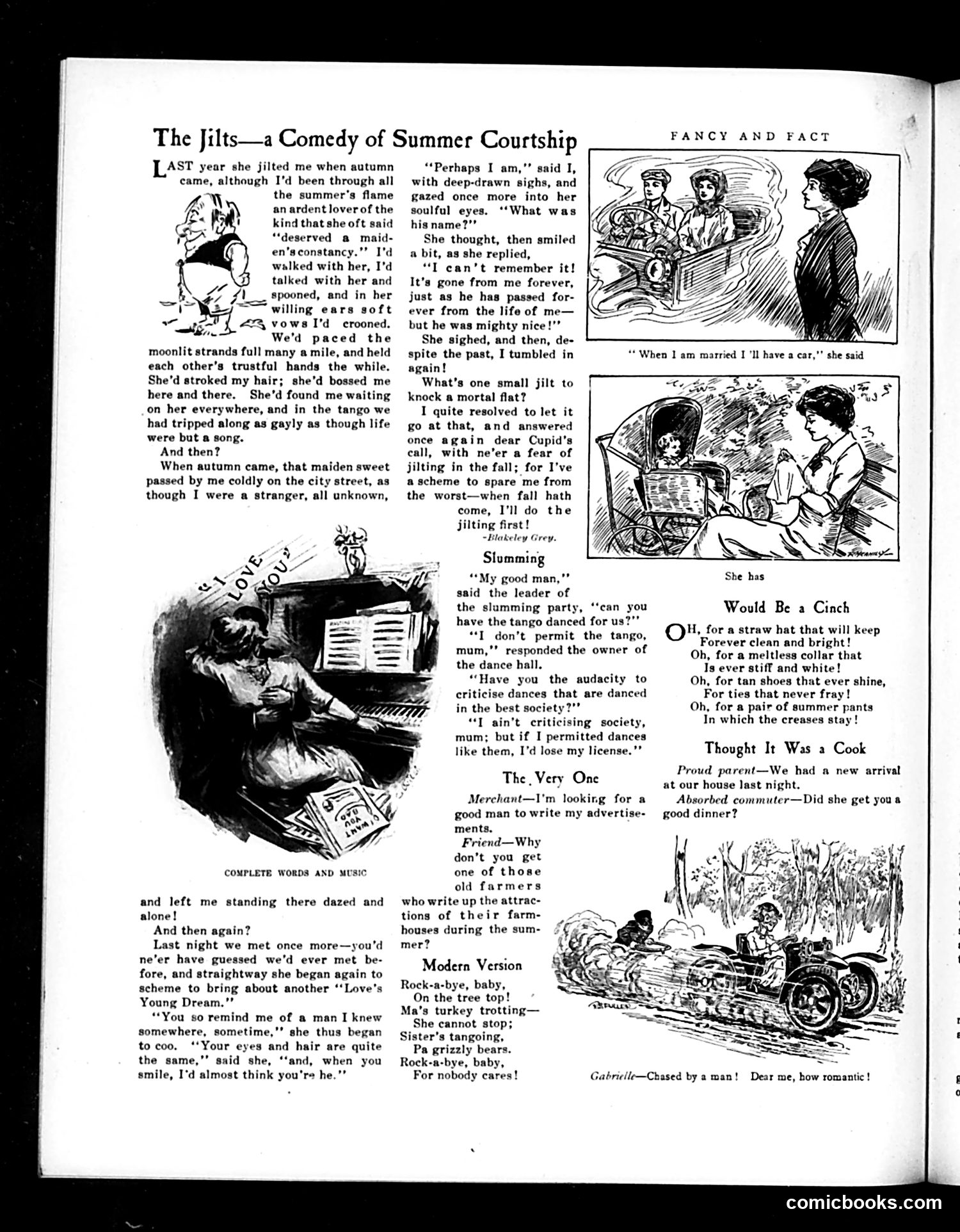
This page satirizes romantic fickleness and the cyclical nature of summer courtships. The main story depicts a man jilted in autumn by a woman who, upon reuniting the following summer, pretends not to remember him—yet still pursues him anew. He resolves to jilt *her* first next fall, mocking the shallow, repetitive nature of seasonal romances. The accompanying humor pieces target 1910s-era fads and social hypocrisy: "Slumming" mocks wealthy urbanites visiting working-class dance halls while criticizing the very dances popular there; the "Modern Version" of a lullaby jokes that parents are too busy dancing the tango and turkey trot (contemporary crazes) to care for their children; and final jokes poke fun at impossible laundry standards and distracted commuters. Overall, the page satirizes modern social pretension and the era's obsession with novelty and dance.
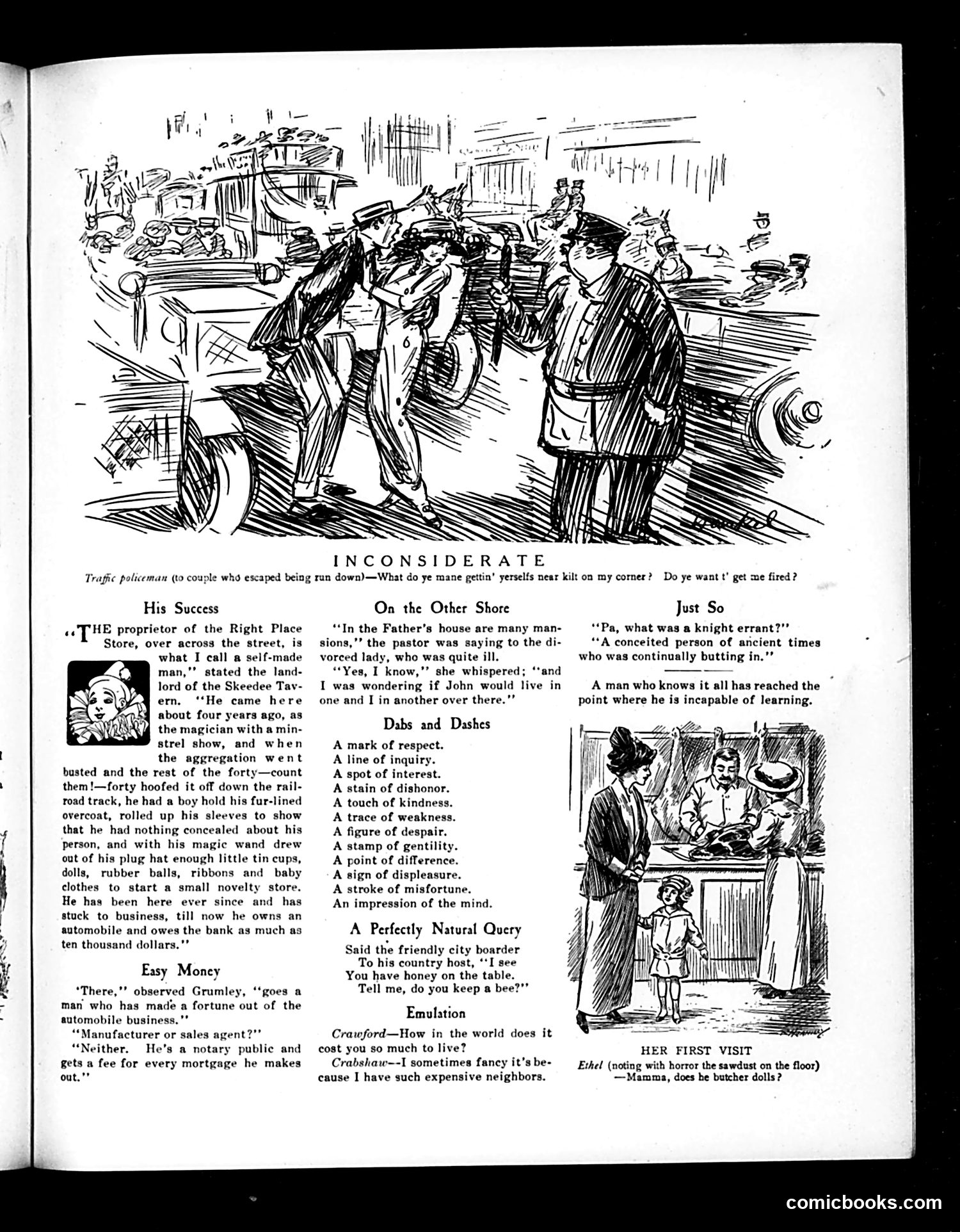
This page contains multiple brief satirical pieces typical of early 20th-century American humor: **"Inconsiderate"** (top cartoon): A traffic policeman scolds a couple for nearly being hit on his corner, fearing *he'll* get fired—satirizing bureaucratic self-interest over public safety. **"His Success"**: Celebrates an ex-magician turned shopkeeper who bootstrapped himself into business ownership, reflecting American self-made-man mythology. **"Easy Money"**: Mocks a notary public profiting from mortgage fees during what appears to be a housing/real estate boom. **"On the Other Shore"**: A divorced woman, hearing the pastor describe heaven's "many mansions," sardonically hopes she and her ex-husband will occupy separate ones—dark humor about marital discord. **"Her First Visit"**: A young woman's naive question whether her boyfriend "butchers dolls" (misunderstanding sawdust on a butcher shop floor) plays on class or cultural differences. The page reflects era concerns: social mobility, divorce, urban life, and commercial excess.
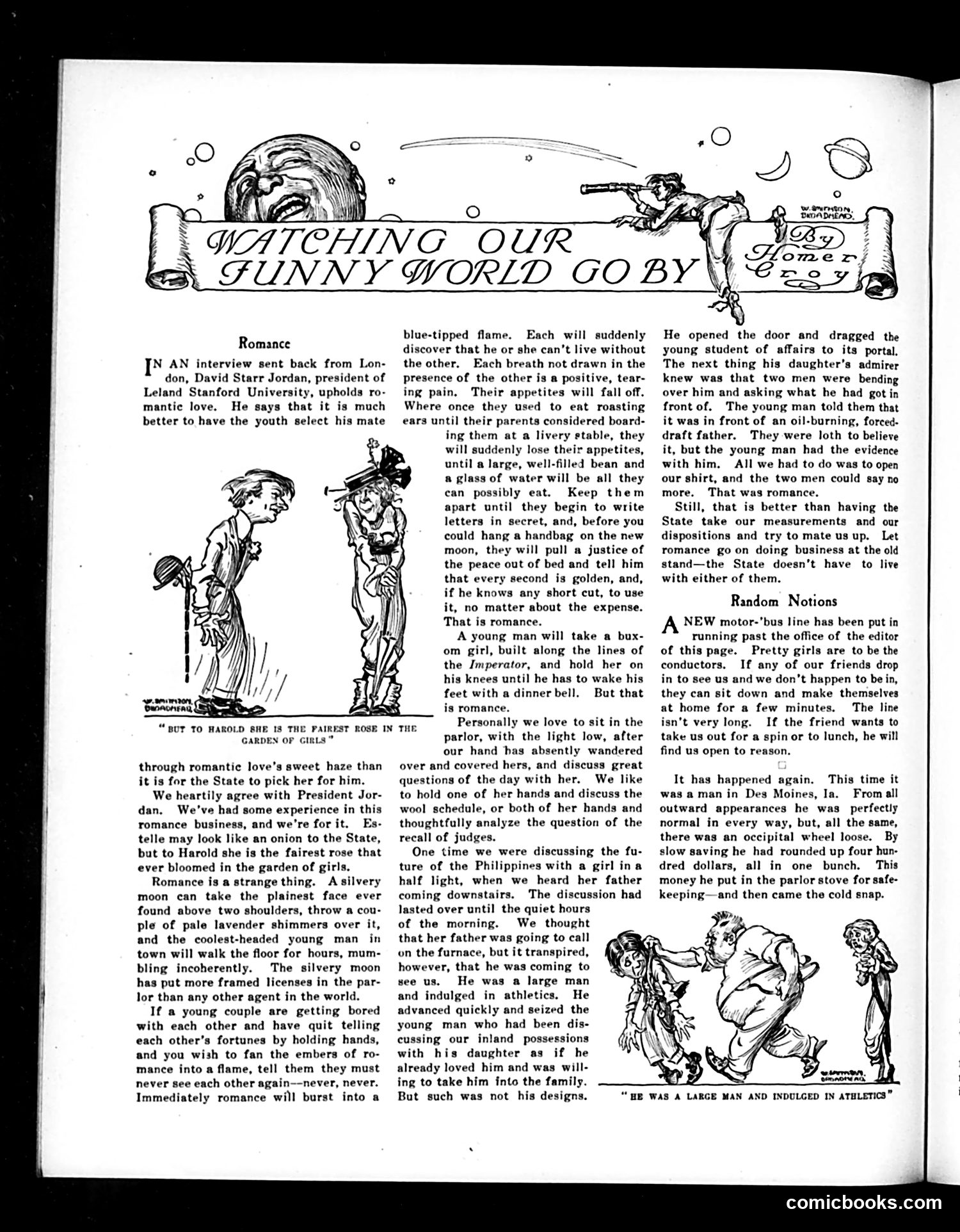
This page satirizes romantic love through commentary by David Starr Jordan (Stanford University president), who argued youth should choose mates by romantic love rather than state selection. The article humorously illustrates romance's illogical effects: how moonlight transforms plain faces into beauty, how separation intensifies desire, and how young couples lose appetite and behave irrationally. The author claims to appreciate romance personally—discussing "great questions of the day" (Philippine policy, judicial recall) while holding a girl's hand in dim lamplight. The joke's payoff: her athletic father appears, drags the young man downstairs, beats him, and the narrator must strip to show bruises as evidence of what happened. The cartoon lampoons both the absurdity of romantic passion and the real consequences when fathers discover young men courting their daughters late into the night.
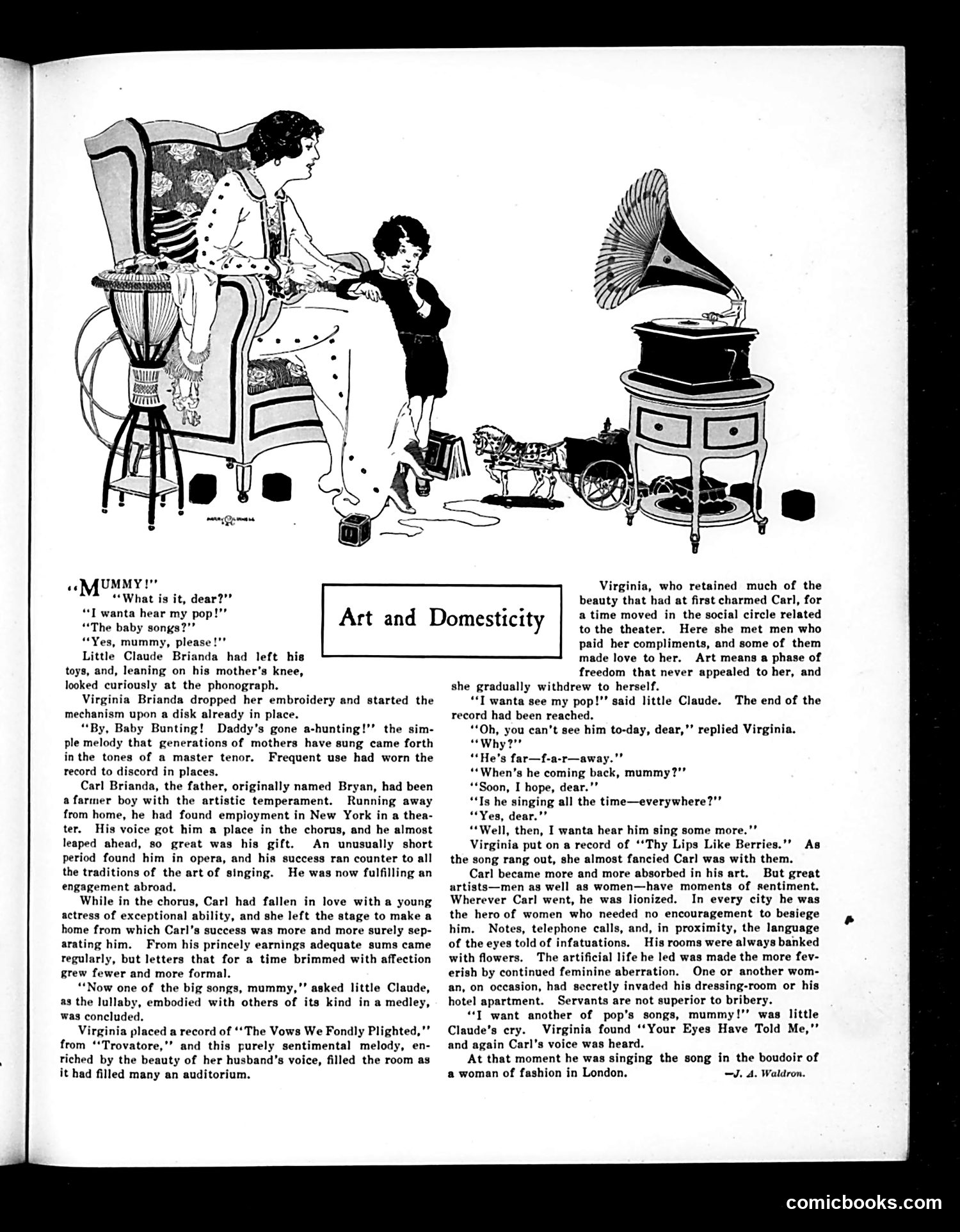
This is a narrative illustration (not a political cartoon) depicting the moral consequences of artistic ambition on family life. Carl Brianda, an opera singer of humble origins, has achieved great success abroad but is emotionally abandoning his wife Virginia and son Claude through prolonged absence and infidelity. The satire's point: while Carl performs sentimental love songs in grand theaters and in the boudoirs of society women in London, his own family listens to worn phonograph recordings of his voice—a poignant substitute for his actual presence. His young son knows him only through these scratched records. The irony is biting—Carl sings "The Vows We Fondly Plighted" and "Your Eyes Have Told Me" to admiring audiences and wealthy lovers, while his devoted wife and child are literally listening to the same recordings at home, unaware he's performing for another woman. This critiques the self-indulgent bohemian artist who sacrifices domestic duty for fame and romantic conquest, portraying "art" as an excuse for moral failure.
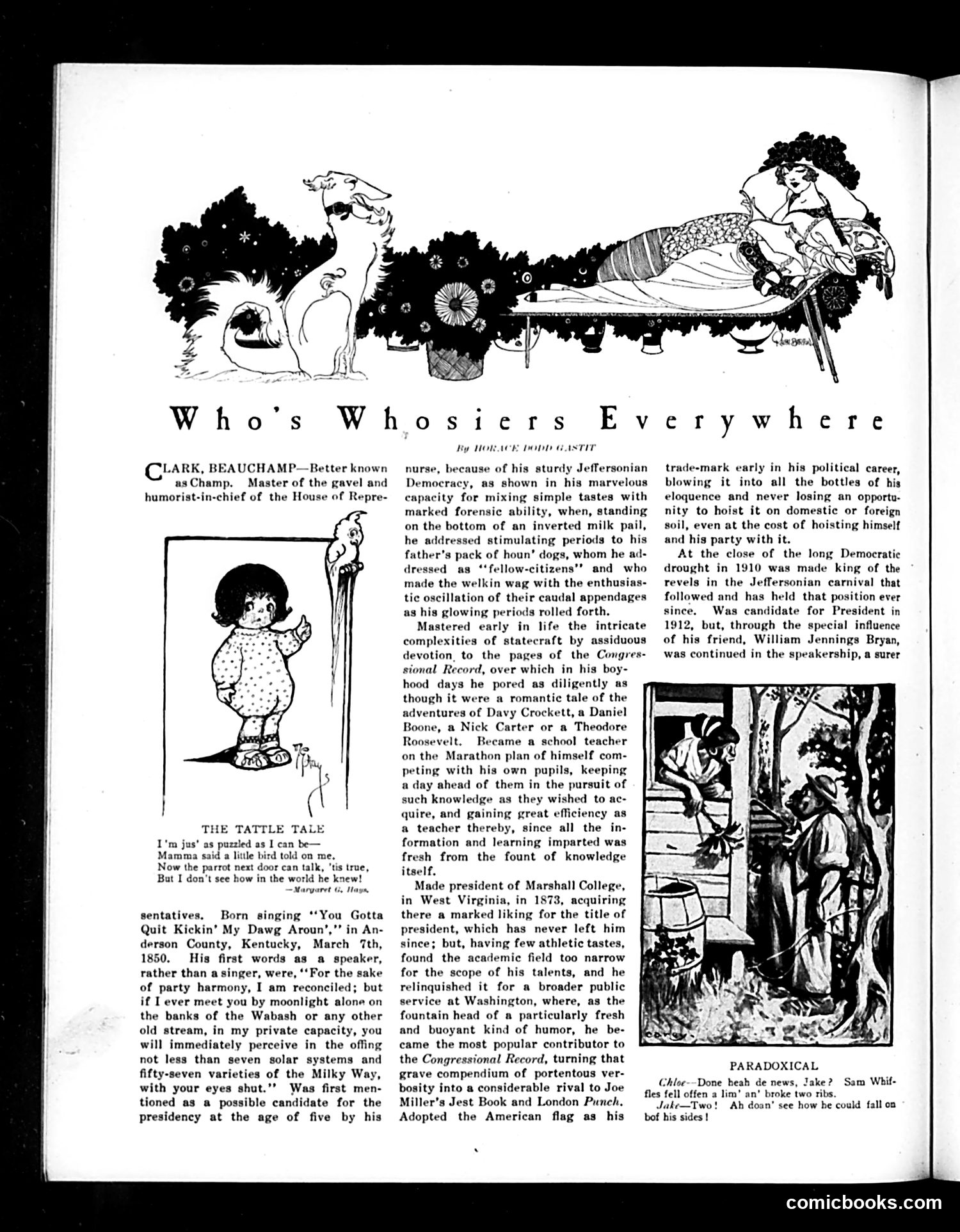
This page profiles **Champ Clark**, Speaker of the House of Representatives, through satirical biography. The text mocks his rise from a Kentucky singer (born 1850) who entertained his father's dogs with patriotic speeches to becoming a politician famous for injecting humor into Congressional Record proceedings—turning serious legislative documents into entertainment rivaling Joe Miller's Jest Book. The satire targets his constant flag-waving patriotism as performative opportunism. It notes he was a 1912 presidential candidate but retained his speakership instead through William Jennings Bryan's influence—implying his actual power came from party manipulation rather than merit. "The Tattle Tale" poem and "Paradoxical" joke are unrelated filler content typical of Judge magazine's mixed format. The upper illustration shows fashionable society figures, likely satirizing the contrast between Clark's humble origins and Washington elite circles.
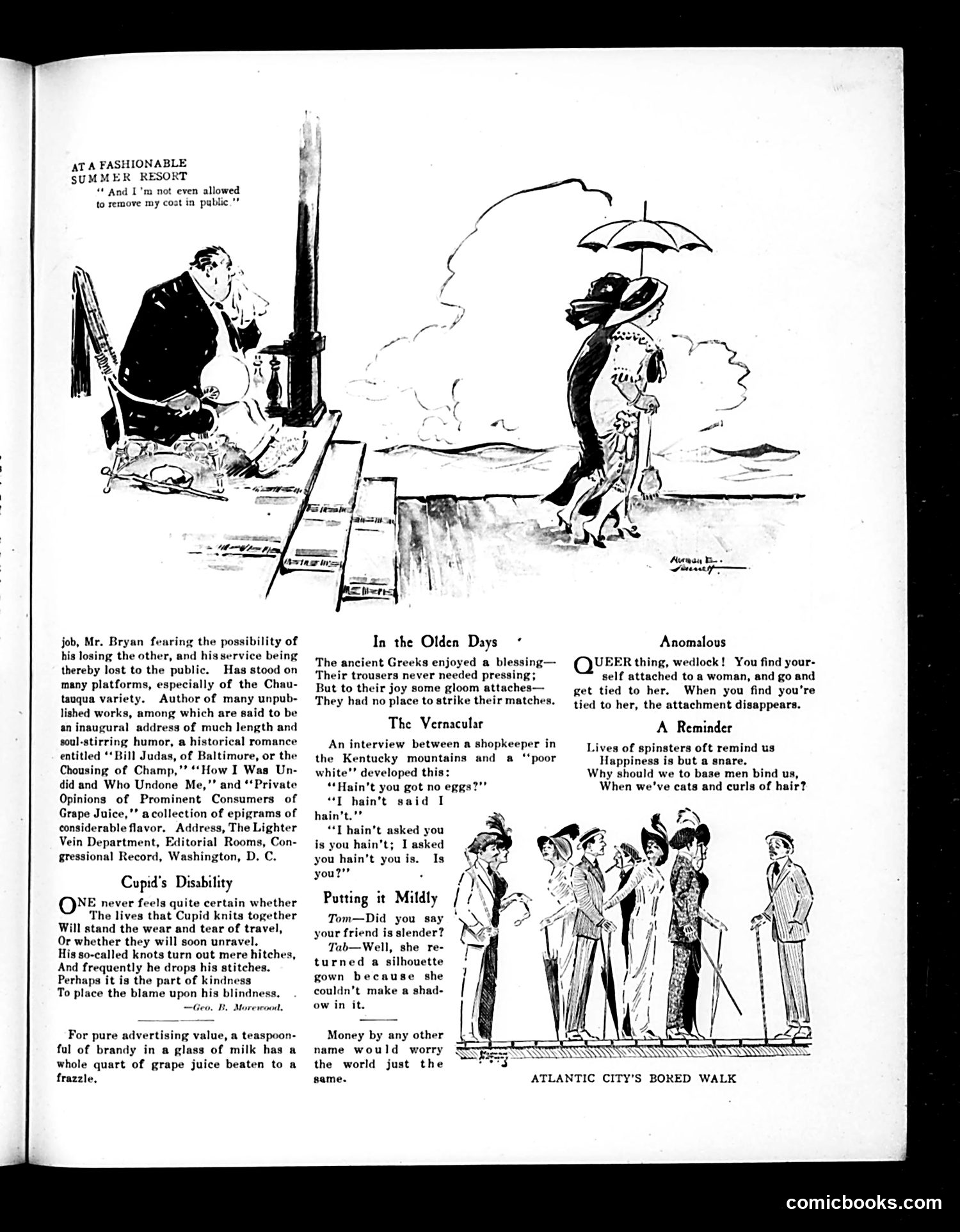
The top cartoon satirizes strict social conventions at fashionable summer resorts. A formally dressed man sits uncomfortably in full coat despite the beach setting, complaining he's "not even allowed to remove my coat in public"—mocking the rigid etiquette rules that wealthy resorts imposed on guests, even in casual vacation settings. The page contains mixed satirical content: "In the Olden Days" humorously contrasts ancient Greek comfort (no trouser pressing) with inconvenience (no match-striking surfaces). "The Vernacular" mocks rural Kentucky dialect and communication confusion. "Cupid's Disability" jokes about marriage's fragility using the metaphor of Cupid as an incompetent knitter. "Atlantic City's Bored Walk" depicts fashionable visitors looking utterly uninterested in the famous boardwalk. Throughout, Judge ridicules American social pretension, class anxieties, and marital cynicism typical of early-20th-century satirical humor targeting middle and upper-class readers.
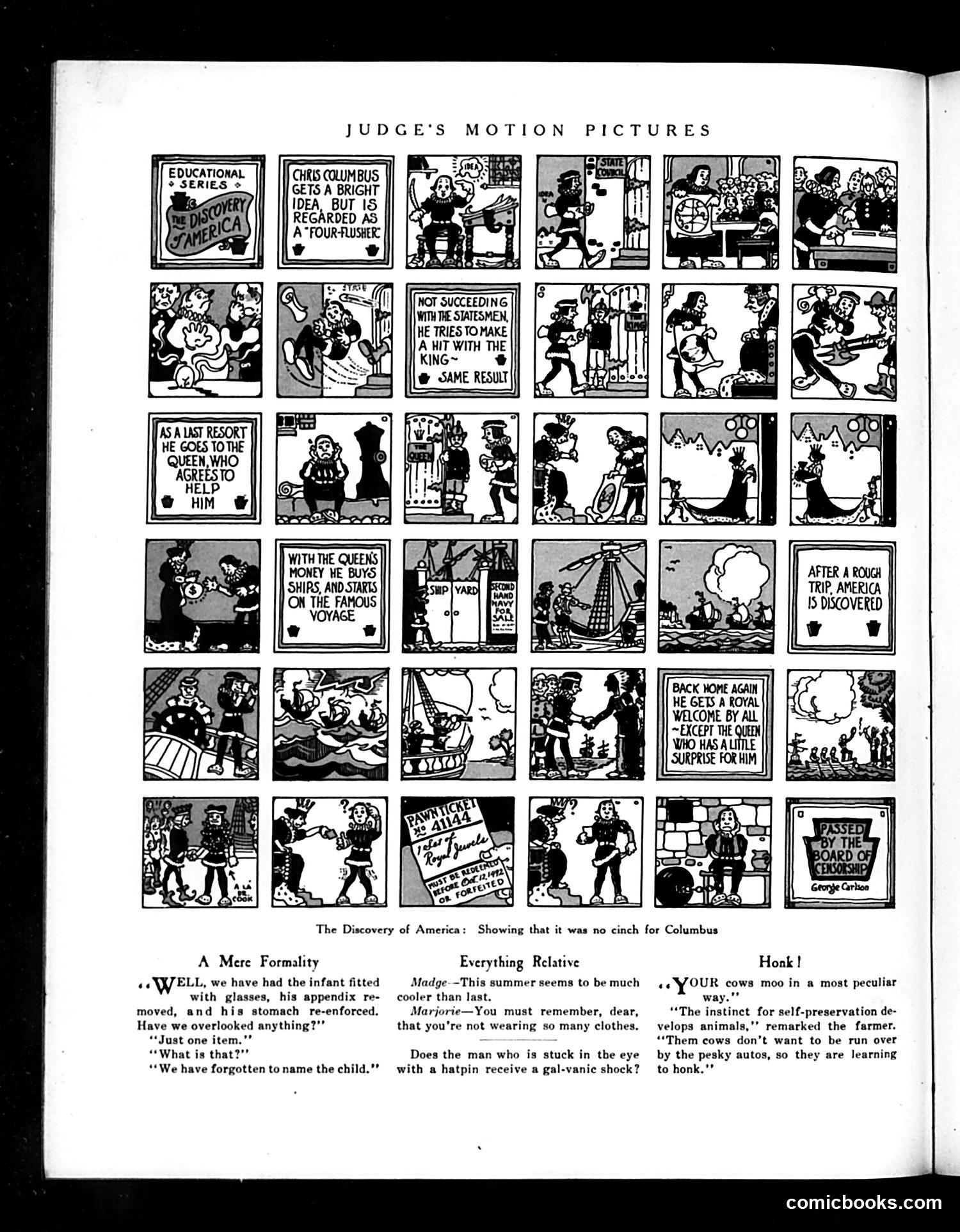
This page presents three brief satirical jokes typical of early 20th-century Judge magazine humor: **"A Mere Formality"** mocks modern parental obsession with children's health and medical intervention. Parents have subjected their infant to glasses, appendix removal, and stomach reinforcement—yet forgotten the most basic duty: naming the child. The satire critiques excessive medicalization while ignoring fundamental parental responsibilities. **"Everything Relative"** is a mild pun about perspective. One woman notes the summer feels cooler; her friend attributes this not to weather but to wearing fewer clothes—reframing the observation as relative to personal circumstance rather than objective fact. **"Honk!"** humorously suggests that cows have evolved to honk like automobiles to avoid being struck by "pesky autos." It satirizes both the rapid proliferation of motor vehicles in society and presents absurdist humor about animals adapting to modern dangers. The comic strip at top, "The Discovery of America," appears to retell Columbus's voyage satirically, though specific details are unclear from this image alone.
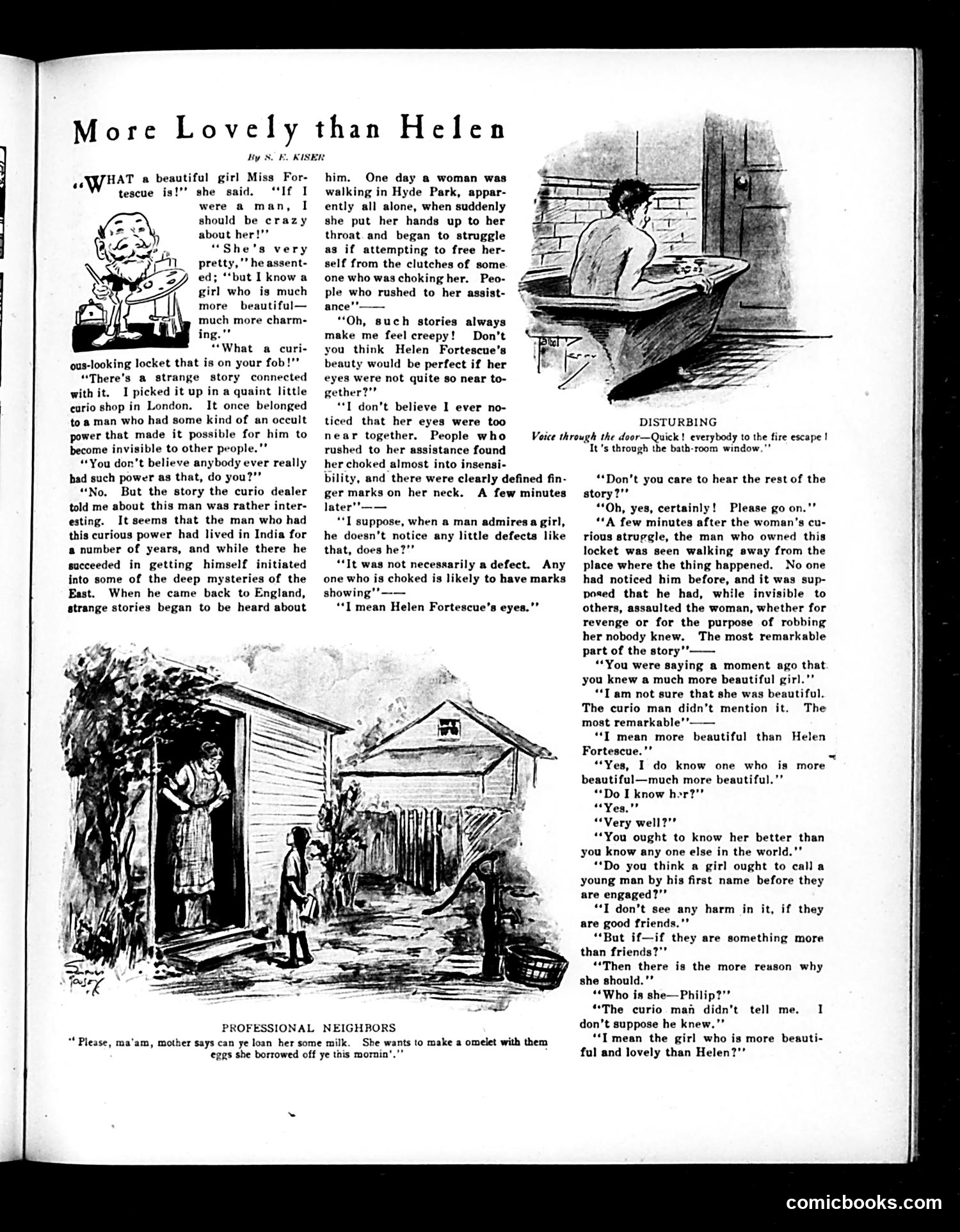
This story-within-a-story uses a classic framing device: two people discuss a woman's beauty, leading to a supernatural tale meant to distract from an uncomfortable truth. A man tells his companion about an occult locket involving an invisible assailant who attacked a woman in Hyde Park. The listener repeatedly interrupts, redirecting conversation to Helen Fortescue's appearance—her eyes are too close together. The man deflects each time, continuing his story. The satire targets social hypocrisy: the man is clearly infatuated with Helen but uses elaborate storytelling to avoid confronting uncomfortable realities about her looks or their relationship. When finally pressed, he reveals the "more beautiful girl" is the listener herself—his fiancée—implying he's been emotionally (or physically) unfaithful through his obsession with Helen. The joke mocks both masculine self-deception and the period's courtship conventions, where men avoided direct emotional honesty.
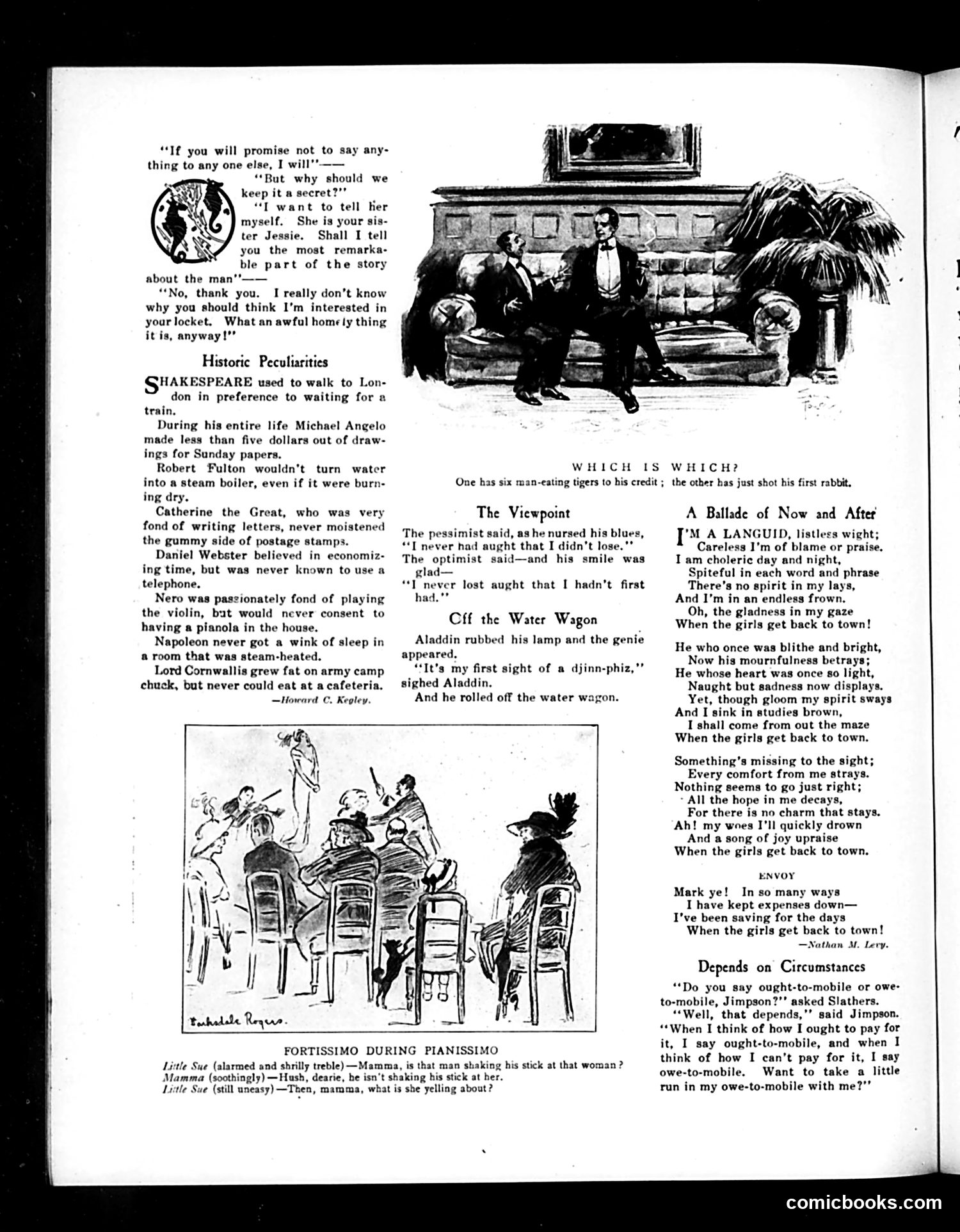
This page from *Judge* contains light satirical humor typical of early 20th-century American magazines: **"Historic Peculiarities"** mocks famous historical figures by inventing absurd personal quirks—Shakespeare avoiding trains, Nero refusing a pianola, Napoleon hating steam heat. The joke is the arbitrary, pointless nature of these invented eccentricities, satirizing how history often records trivial details about great men. **"Which Is Which?"** contrasts two hunters: one with six man-eating tigers versus another with one rabbit—a commentary on exaggeration and boasting. **"Off the Water Wagon"** plays on the phrase meaning sobriety; Aladdin's excitement at seeing a genie causes him to relapse. **"A Ballade of Now and After"** is sentimental poetry about a melancholy bachelor whose mood lifts when "the girls get back to town"—reflecting period attitudes about unmarried social life and leisure. **"Depends on Circumstances"** is a pun on "ought-to-mobile" versus "owe-to-mobile" regarding car payments—humor about automotive debt. The page is primarily entertainment humor rather than political satire.
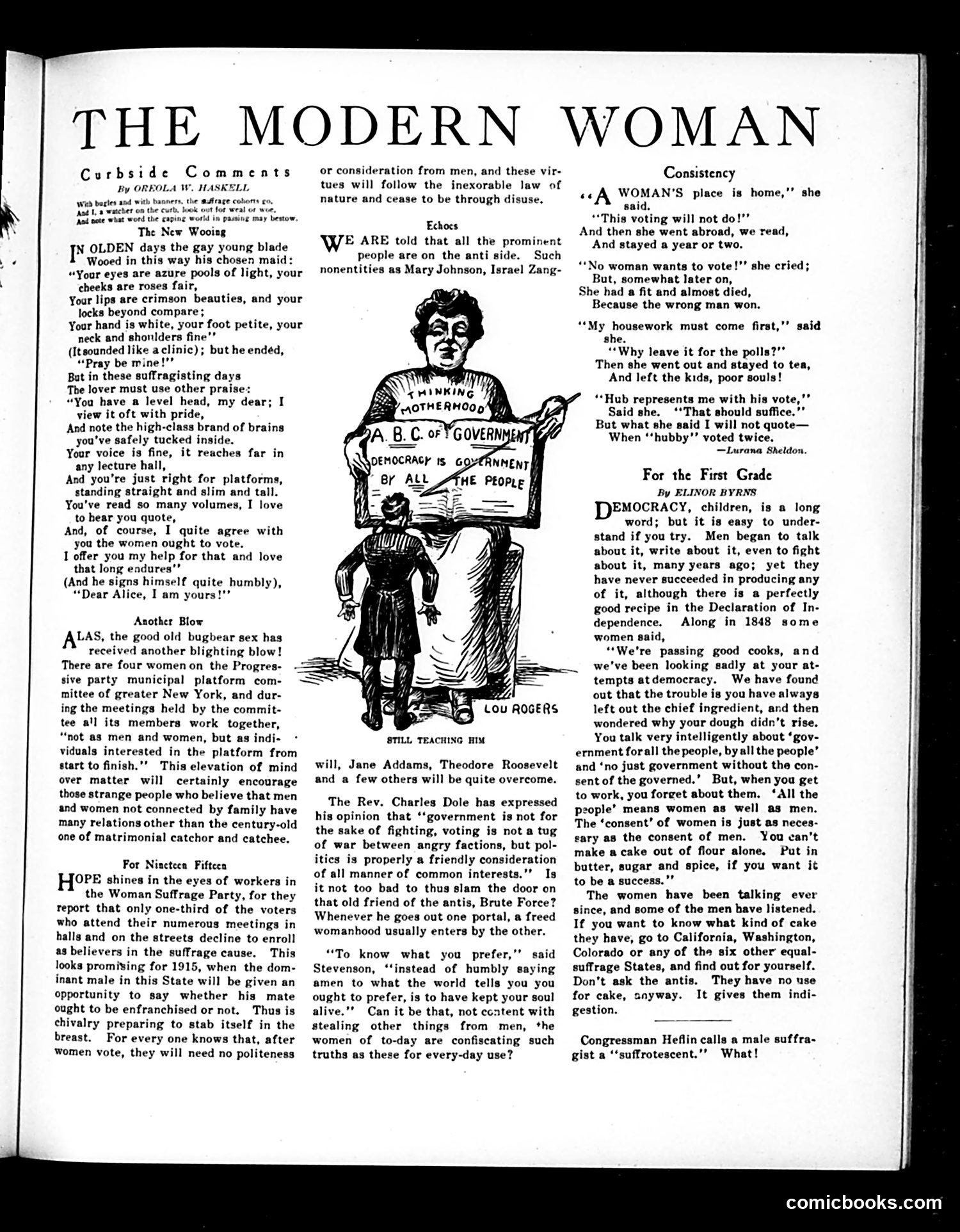
This page satirizes the women's suffrage movement through multiple angles. "The New Wooing" mocks how male suitors must now flatter women's intellect and political views rather than physical beauty—a jab at the "New Woman" prioritizing education and voting rights. The cartoon "Still Teaching Him" depicts a woman instructing a small man labeled with "ABC of Government" and "Democracy is Government by All the People," suggesting women are becoming politically aware and outpacing men. The other pieces—"Another Blow" and sections on voting—employ *ironic* anti-suffrage rhetoric. They claim women's enfranchisement will destroy chivalry and male courtesy, and that suffragists are hypocrites (the "Consistency" poem shows a woman demanding to stay home yet constantly leaving it). The satire mocks these anti-suffrage arguments while appearing to endorse them, a common Judge strategy supporting progressive causes through ridicule of their opponents.
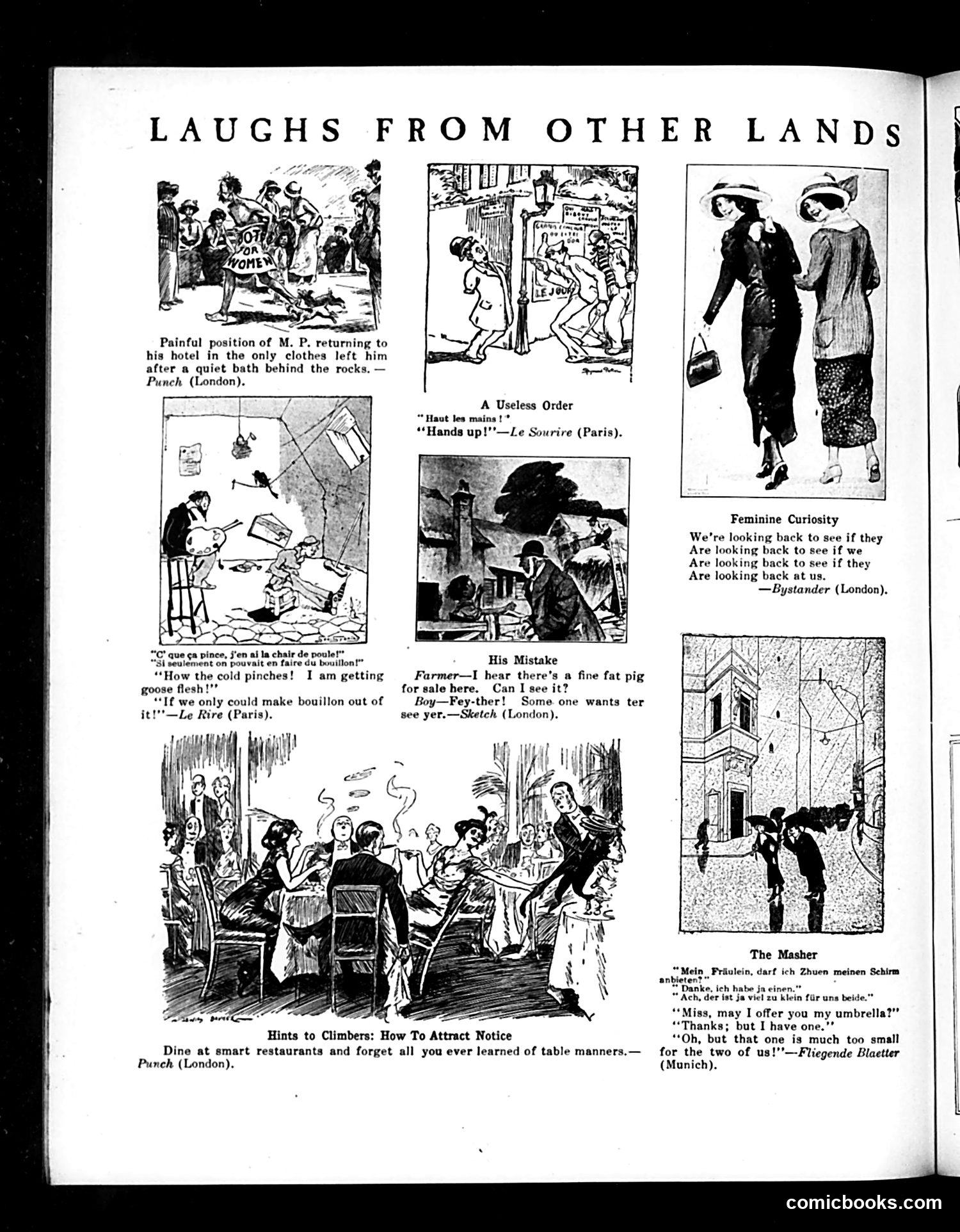
This page collects humorous cartoons from European satirical magazines (Punch, Le Rire, Sketch, etc.), showcasing international comedy for American Judge readers. The jokes reflect early 20th-century social humor: a British MP embarrassed after skinny-dipping; French soldiers in a useless military order; mutual romantic suspicion between strangers; a boy's misunderstanding about showing his father to a customer; and a German man's forward flirtation using the pretext of sharing an umbrella. The final cartoon mocks social climbers who adopt ostentatious dining behavior to appear sophisticated—advice presented ironically by abandoning proper table manners. These are largely apolitical, relying on physical comedy, gender dynamics, and class-based situations typical of pre-WWI period humor. The format demonstrates how American magazines circulated international comedy to suggest cosmopolitan sophistication.
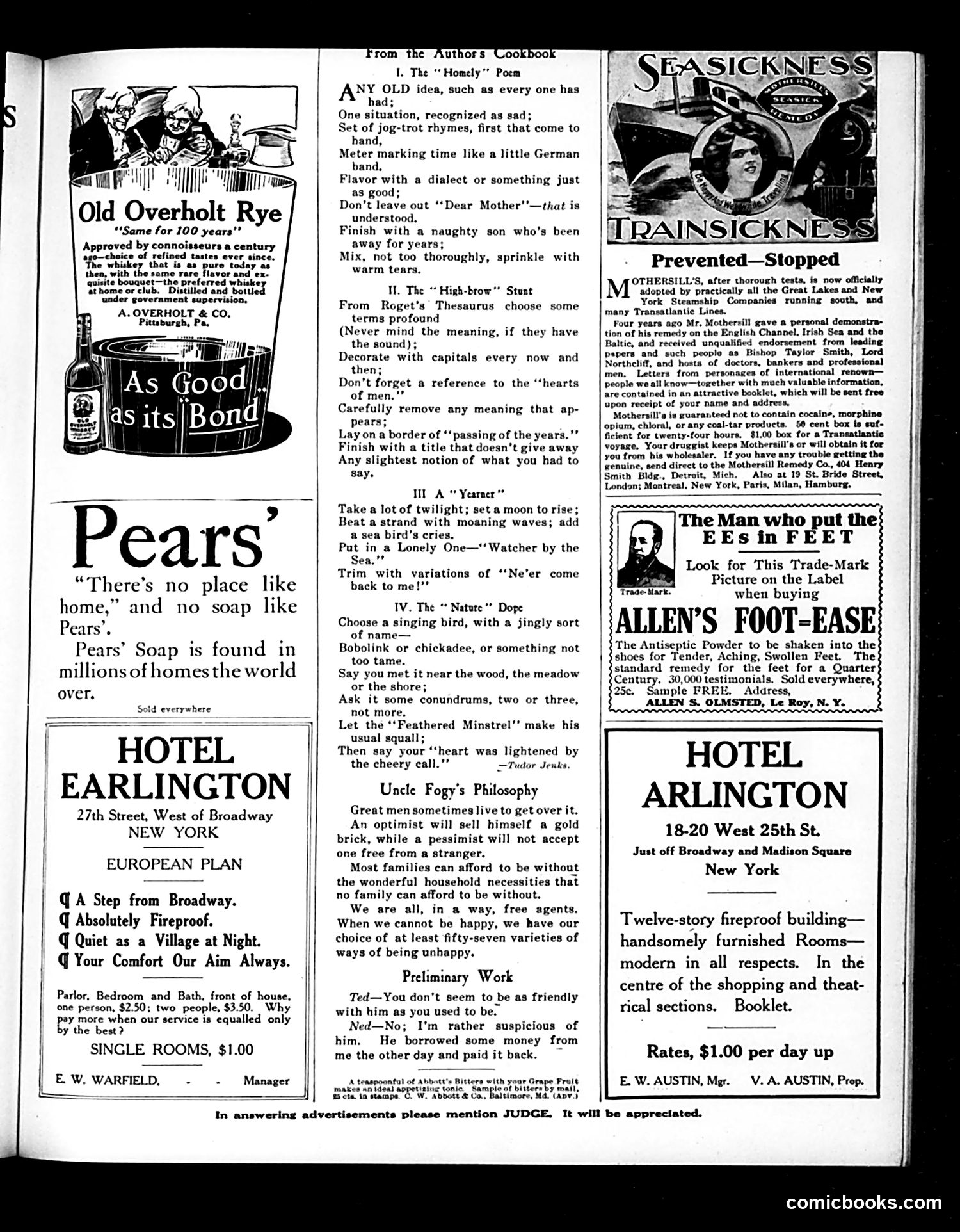
This page is primarily **advertising and light satirical content** rather than political commentary. The main satirical piece is "From the Author's Cookbook" — a humorous guide mocking formulaic poetry writing. It ridicules predictable "homely" verse (sentimental poems about mothers and absent sons), pretentious "high-brow" poetry (obscure words hiding empty meaning), melodramatic "yearner" poems (moonlight and lost love clichés), and nature poetry relying on stock imagery (singing birds, meadows, etc.). The satire targets the era's abundant sentimental and derivative poetry. "Uncle Fogy's Philosophy" offers dry observations on human nature — pessimists rejecting free items, families needing unnecessary luxuries, and people's creative ways of being unhappy. The remainder consists of period advertisements: whiskey (Old Overholt Rye), soap (Pears'), foot powder (Allen's Foot-Ease), remedies (Mothersill's seasickness cure), and hotels (Earlington, Arlington). These ads reflect early-20th-century consumer products and marketing approaches.
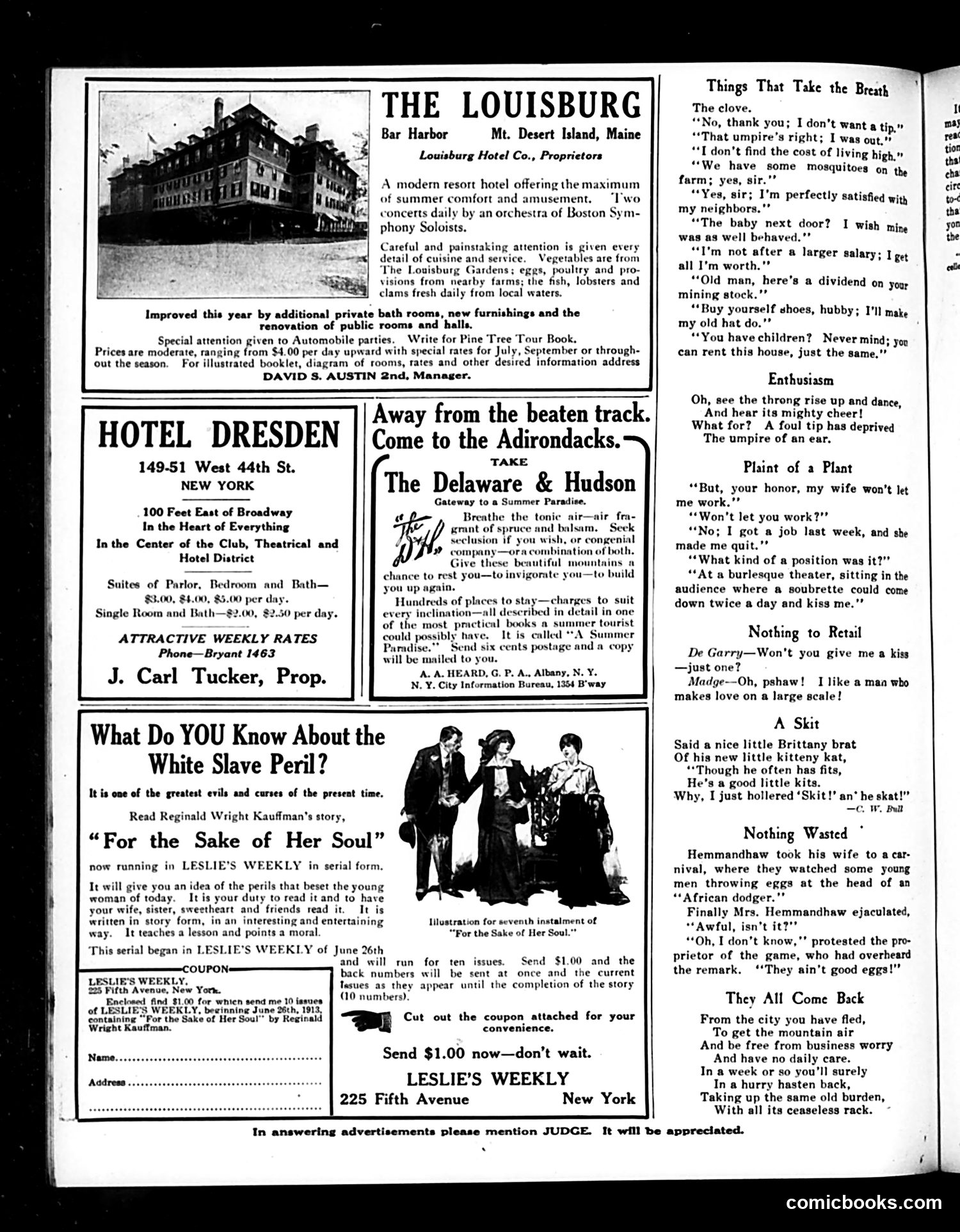
This page is **primarily advertising** for hotels and magazines, with minimal editorial content. The main satirical element appears in the right column: **"Things That Take the Breath"** — a humorous list of implausible statements nobody would actually make. Examples include "That umpire's right; I was out" and "I'm not after a larger salary; I get all I'm worth" — jokes about universal human behavior (self-interest, ambition, dishonesty). The humor relies on irony: these statements are so obviously false that readers find them amusing. The page also promotes a serial story, **"For the Sake of Her Soul,"** addressing the **"White Slave Peril"** — a genuine Progressive Era moral panic about young women trafficked into prostitution. Judge uses this sensational topic to drive magazine subscriptions. The hotel advertisements reflect leisure culture for affluent Americans — resort destinations in Maine and the Adirondacks marketed as escapes from urban life.
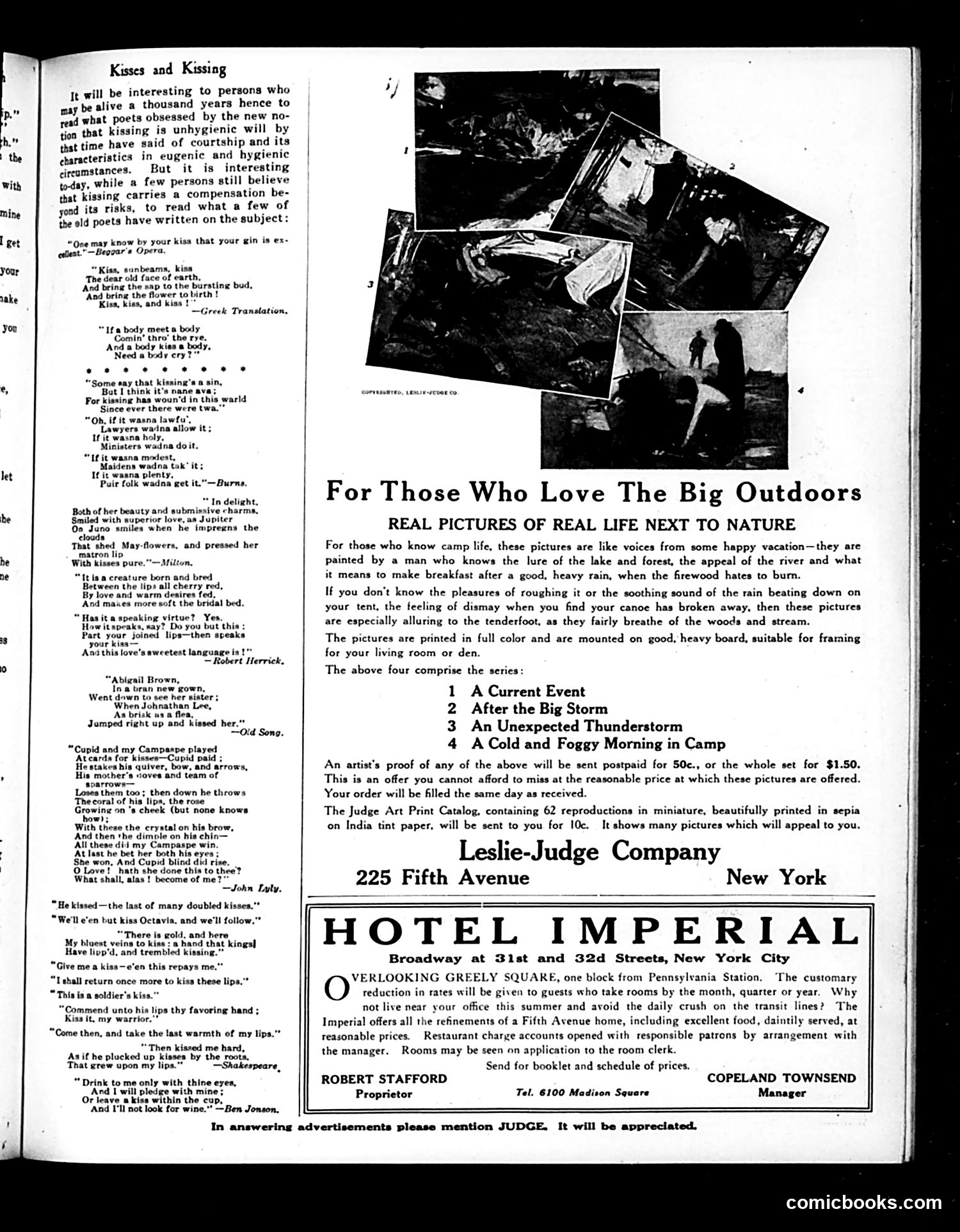
This page is primarily **literary content rather than political satire**. The left column presents a lengthy compilation of historical poetry about kissing, ranging from Shakespeare to Burns to Milton. The selections reflect a debate contemporary to Judge's publication: whether kissing is hygienic or unhygienic—a concern rooted in early 20th-century anxieties about germ theory and "scientific" approaches to romance. The satire is gentle: Judge frames these classical poets' romantic verses against modern concerns that kissing might be unsanitary, implying the "new notion" of hygienic courtship is foolishly prudish compared to centuries of poetic celebration. The right side features unrelated advertising: landscape paintings for sale and a hotel advertisement. **No specific political figures or events are referenced.** The page satirizes a social attitude (germaphobia regarding kissing) rather than a person or scandal.
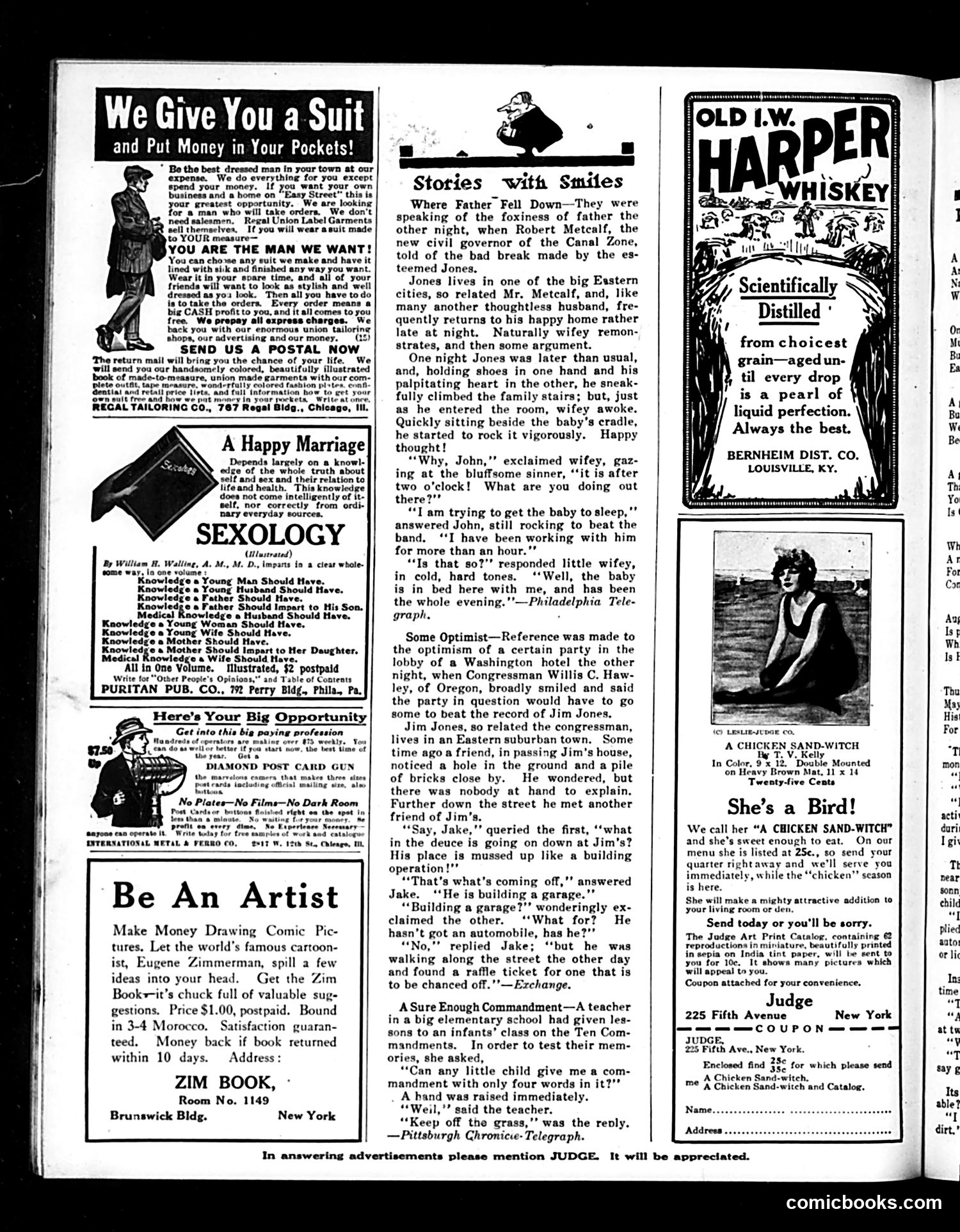
This page is primarily **advertisements and humorous anecdotes** rather than political cartoons. The content reflects early 20th-century American consumer culture and gender dynamics. **Key sections:** 1. **"We Give You a Suit"** - A mail-order tailoring scheme targeting men seeking easy money through door-to-door sales, promising wealth while wearing sample suits. 2. **"Stories with Smiles"** - Humorous anecdotes mocking domestic life, particularly husbands' poor excuses. The "Where Father Fell Down" story depicts a husband caught coming home late, caught in his own lie about rocking the baby. 3. **"Sexology" advertisement** - A book promising comprehensive sex education, suggesting contemporary anxiety about proper knowledge of "self and sex." 4. **"Be An Artist"** - A how-to book by cartoonist Eugene Zimmerman offering get-rich-quick schemes. The overall tone satirizes American consumerism and male behavior—husbands as bumbling fools, snake-oil business schemes, and earnest self-improvement promises. The page reflects Judge's satirical approach to contemporary social concerns.
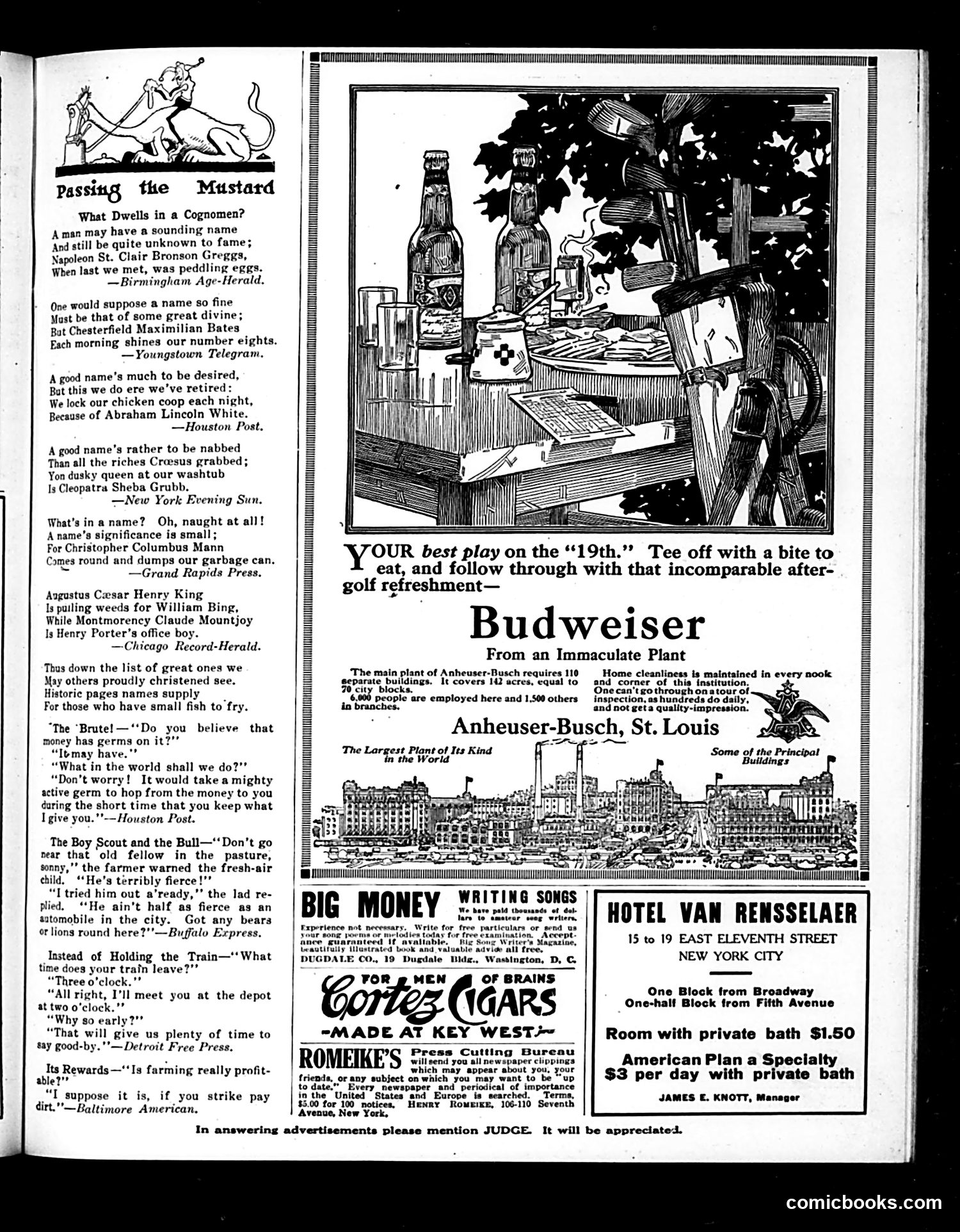
This is primarily a humor column, not a political cartoon. It collects brief satirical verses mocking the disconnect between grand names and humble occupations—a common early-20th-century theme. The jokes ridicule people with impressive, historically significant names (Napoleon, Cleopatra, Augustus Caesar, Christopher Columbus) who work menial jobs: selling eggs, shining shoes, dumping garbage, pulling weeds, or being office boys. The satire targets both the pretension of giving children grandiose names and the irony when such dignity proves meaningless. The page's remaining content is advertising (Budweiser beer, hotel, song-writing scheme, press clipping service). The bottom anecdotes about germs on money, aggressive bulls, and train schedules are separate comic bits unrelated to the main theme.
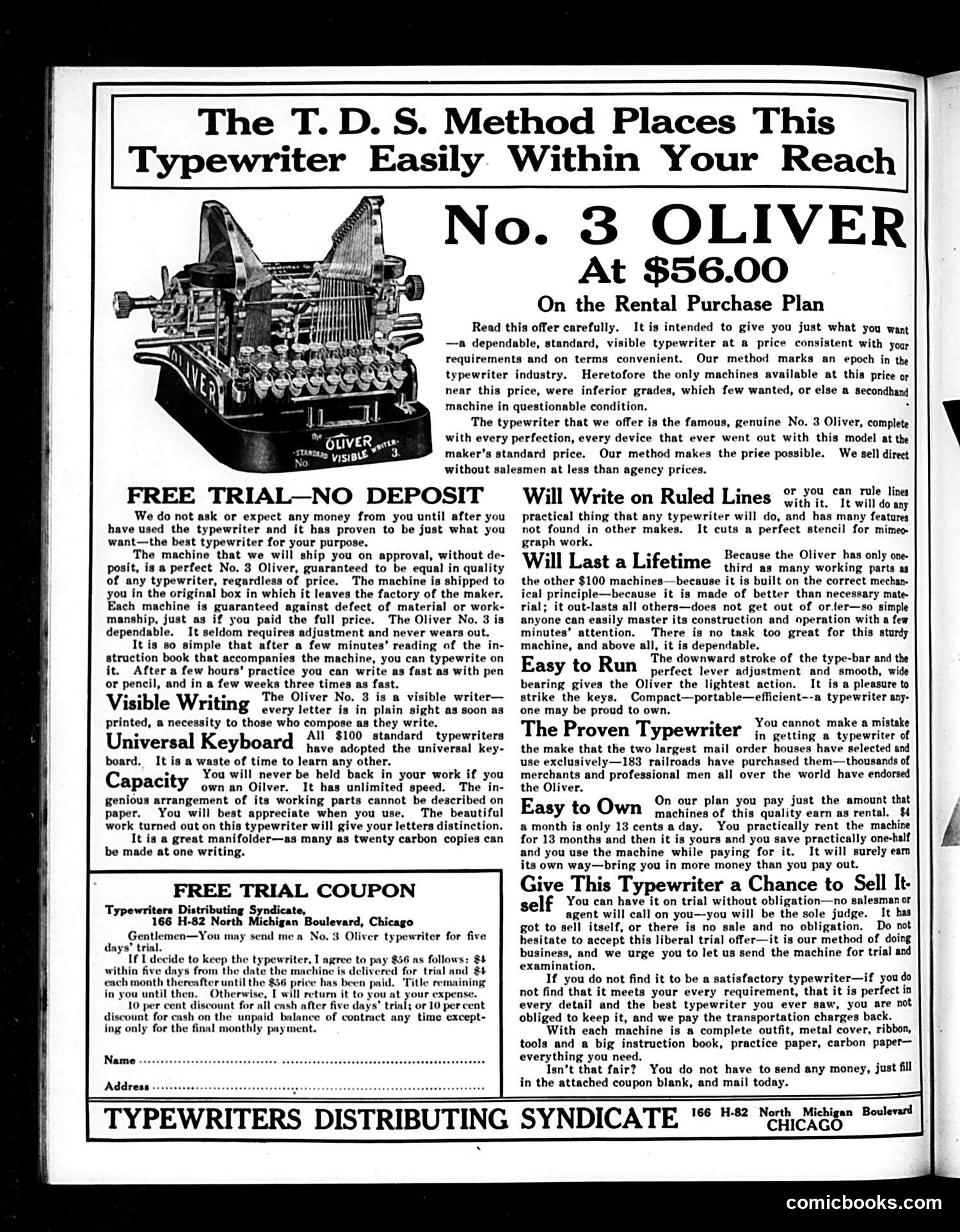
This is **entirely advertising copy**, not satirical content. The Typewriters Distributing Syndicate promotes the Oliver No. 3 typewriter at $56.00 through a rental-purchase plan. The "T.D.S. Method" is a direct-sales financing scheme: customers receive a free trial with no deposit, then pay $56 in installments over months rather than upfront. The ad emphasizes this makes quality typewriters "easily within your reach" for ordinary people—previously only inferior or secondhand machines were affordable at this price. Key selling points stress durability ("Will Last a Lifetime"), ease of use ("After a few hours' practice"), and features like visible writing and unlimited typing capacity. The coupon at bottom invites readers to request trial delivery. This reflects early 20th-century consumer capitalism: making luxury goods accessible through installment buying rather than large upfront costs.