
Judge, 1913-08-16 · page 10 of 24
Judge — August 16, 1913 — page 10: what you’re looking at
What you’re looking at
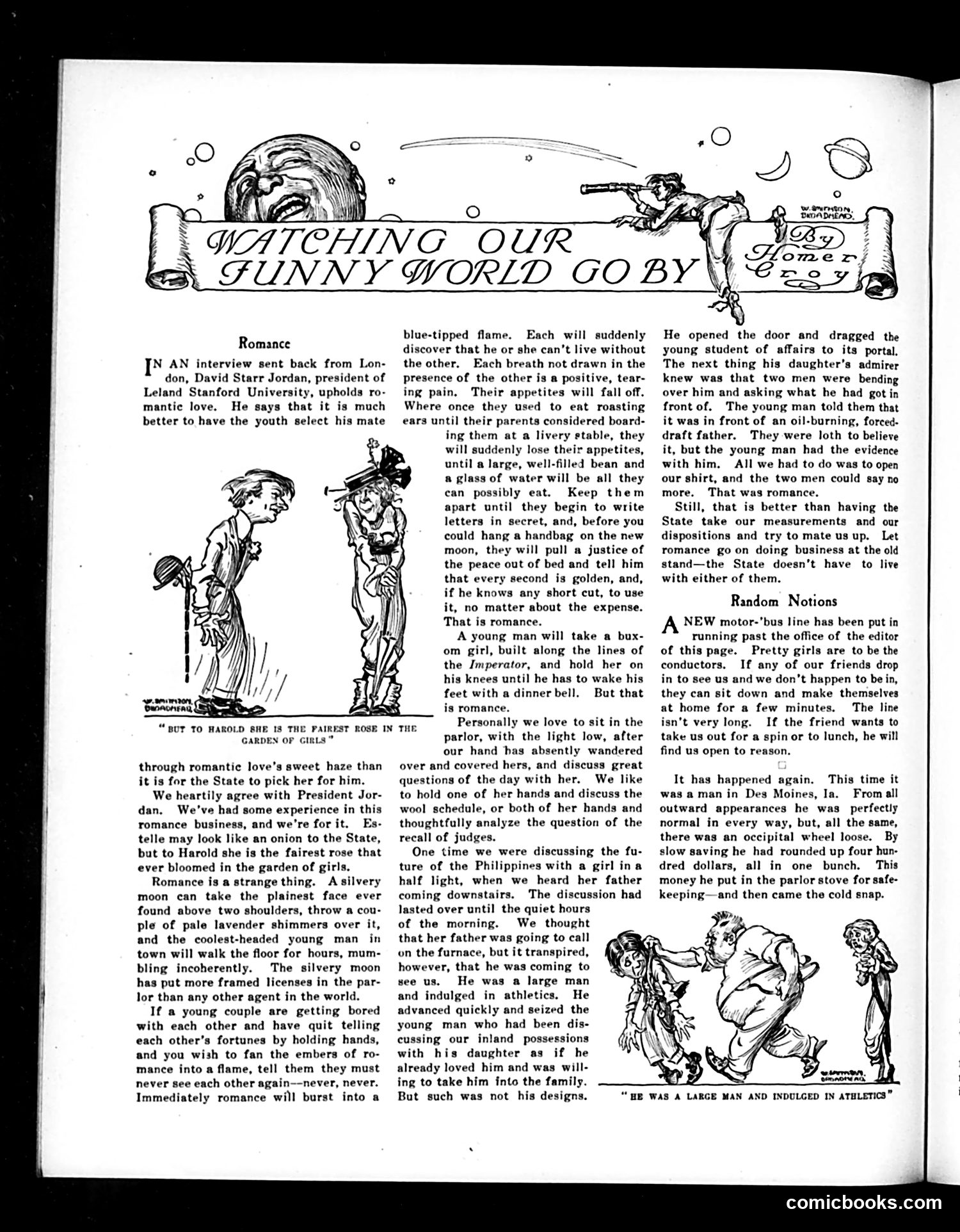
This page satirizes romantic love through commentary by David Starr Jordan (Stanford University president), who argued youth should choose mates by romantic love rather than state selection. The article humorously illustrates romance's illogical effects: how moonlight transforms plain faces into beauty, how separation intensifies desire, and how young couples lose appetite and behave irrationally. The author claims to appreciate romance personally—discussing "great questions of the day" (Philippine policy, judicial recall) while holding a girl's hand in dim lamplight. The joke's payoff: her athletic father appears, drags the young man downstairs, beats him, and the narrator must strip to show bruises as evidence of what happened. The cartoon lampoons both the absurdity of romantic passion and the real consequences when fathers discover young men courting their daughters late into the night.
📄 Transcribed text from this page (OCR, searchable)
Machine-transcribed from the original scan — historical spelling and the odd misread are preserved.
BS a fe) « WATCHING OUR FUNNY WORLD GO BY ' Romance N AN interview sent back from Lon- don, David Starr Jordan, president of Leland Stanford University, upholds ro- mantic love. He says that it is much better to have the youth select his mate “BUT TO HAROLD SHE 18 THE PAIREST ROSE IN THE GARDEN OF GIRLS” through romantic love's sweet haze than it is for the State to pick her for him. We heartily agree with President Jor- dan. We've had some experience in this romance business, and we're for it. Es- telle may look like an onion to the State, but to Harold she is the fairest rose that ever bloomed in the garden of girls. Romance is a strange thing. A silvery moon can take the plainest face ever found above two shoulders, throw a cou- ple of pale lavender shimmers over it, and the coolest-headed young man in town will walk the floor for hours, mum- bling incoherently. The silvery moon has put more framed licenses in the par- lor than any other agent in the world. If a young couple are getting bored with each other and have quit telling each other’s fortunes by holding hands, and you wish to fan the embers of ro- mance into a flame, tell them they must never see each other again-—never, never. Immediately romance will burst into a blue-tipped flame. Each will suddenly discover that he or she can’t live without the other. Each breath not drawn in the presence of the other is a positive, tear- ing pain, Their appetites will fall off. Where once they used to eat roasting ears until their parents considered board- ing them at a livery stable, they will suddenly lose their appetites, until a large, well-filled bean and a glass of water will be all they can possibly eat. Keep them apart until they begin to write letters in secret, and, before you could hang a handbag on the new moon, they will pull a justice of the peace out of bed and tell him that every second is golden, and, if he knows any short cut, to use it, no matter about the expense. That is romance. A young man will take a bux- om girl, built along the lines of the Imperator, and hold her on his knees until he has to wake his feet with a dinner bell. But that is romance. Personally we love to sit in the parlor, with the light low, after our hand has absently wandered over and covered hers, and discuss great questions of the day with her. We like to hold one of her hands and discuss the wool schedule, or both of her hands and thoughtfully analyze the question of the recall of judges. One time we were discussing the fu- ture of the Philippines with a girl ina half light, when we heard her father coming downstairs. The discussion had lasted over until the quiet hours of the morning. We thought that her father was going to call on the furnace, but it transpired, however, that he was coming to see us. He was a large man and indulged in athletics. He advanced quickly and seized the young man who had been dis- cussing our inland possessions with his daughter as if he already loved him and was will- ing to take him into the family. But such was not his designs. He opened the door and dragged the young student of affairs to its portal, The next thing his daughter's admirer knew was that two men were bending over him and asking what he had got in front of. The young man told them that it was in front of an oil-burning, forced- draft father. They were loth to believe it, but the young man had the evidence with him, All we had to do was to open our shirt, and the two men could say no more. That was romance. Still, that is better than having the State take our measurements and our dispositions and try to mate us up. Let romance go on doing business at the old stand—the State doesn’t have to live with either of them. Random Notions NEW motor-'bus line has been put in running past the office of the editor of this page. Pretty girls are to be the conductors. If any of our friends drop in to see us and we don’t happen to be in, they can sit down and make themselves at home for a few minutes. The line isn’t very long. If the friend wants to take us out for a spinor to lunch, he will find us open to reason, It has happened again. This time it was aman in Des Moines, Ia. From all outward appearances he was_ perfectly normal in every way, but, all the same, there was an occipital wheel loose. By slow saving he had rounded up four hun- dred dollars, all in one bunch. This money he put in the parlor stove for safe- keeping—and then came the cold snap. “HE WAS A LARGE MAN AND INDULGED IN ATHLETICS” comicbooks.com