
Judge, 1913-08-16 · page 11 of 24
Judge — August 16, 1913 — page 11: what you’re looking at
What you’re looking at
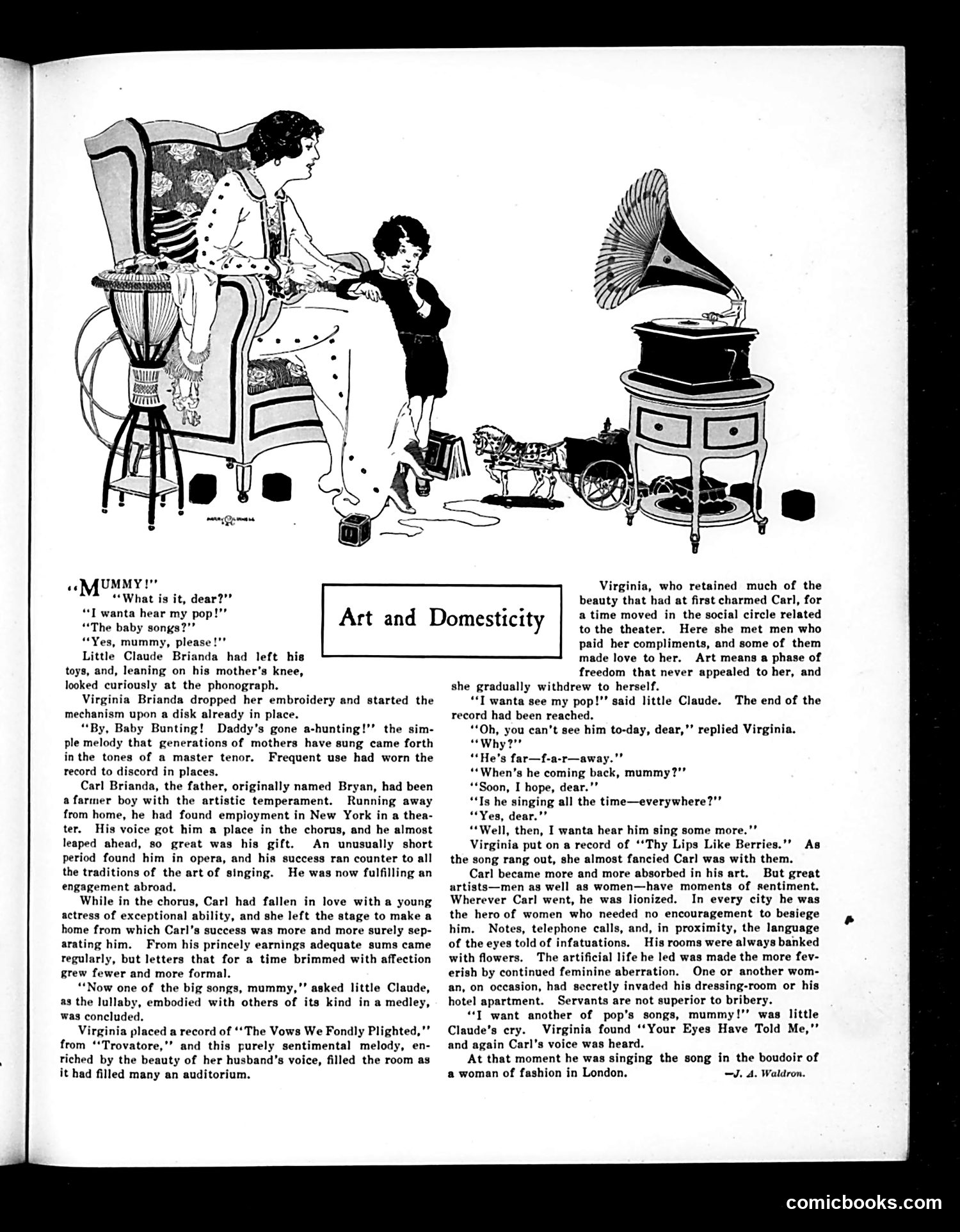
This is a narrative illustration (not a political cartoon) depicting the moral consequences of artistic ambition on family life. Carl Brianda, an opera singer of humble origins, has achieved great success abroad but is emotionally abandoning his wife Virginia and son Claude through prolonged absence and infidelity. The satire's point: while Carl performs sentimental love songs in grand theaters and in the boudoirs of society women in London, his own family listens to worn phonograph recordings of his voice—a poignant substitute for his actual presence. His young son knows him only through these scratched records. The irony is biting—Carl sings "The Vows We Fondly Plighted" and "Your Eyes Have Told Me" to admiring audiences and wealthy lovers, while his devoted wife and child are literally listening to the same recordings at home, unaware he's performing for another woman. This critiques the self-indulgent bohemian artist who sacrifices domestic duty for fame and romantic conquest, portraying "art" as an excuse for moral failure.
📄 Transcribed text from this page (OCR, searchable)
Machine-transcribed from the original scan — historical spelling and the odd misread are preserved.
«e\QuUMMY?!"" M “What is it, dear?” “T wanta hear my pop!’’ “The baby songs?” “Yes, mummy, please !"" Little Claude Brianda had left hie toys, and, leaning on his mother's knee, looked curiously at the phonograph. Virginia Brianda dropped her embroidery and started the mechanism upon a disk already in place. “By, Baby Bunting! Daddy's gone a-hunting!’’ the sim- ple melody that generations of mothers have sung came forth inthe tones of a master tenor. Frequent use had worn the record to discord in places. Carl Brianda, the father, originally named Bryan, had been afarmer boy with the artistic temperament. Running away from home, he had found empioyment in New York in a thea- ter. His voice got him a place in the chorus, and he almost leaped ahead, so great was his gift. An unusually short period found him in opera, and his success ran counter to all the traditions of the art of singing. He was now fulfilling an engagement abroad. While in the chorus, Carl had fallen in love with a young actress of exceptional ability, and she left the stage to make a home from which Carl’s success was more and more surely sep- arating him. From his princely earnings adequate sums came regularly, but letters that for a time brimmed with affection grew fewer and more formal. “Now one of the big songs, mummy,” asked little Claude, as the lullaby, embodied with others of its kind in a medley, was concluded, Virginia placed a record of ‘‘The Vows We Fondly Plighted,”” from ‘‘Trovatore,’’ and this purely sentimental melody, en- tiched by the beauty of her husband’s voice, filled the room as it had filled many an auditorium. Art and Domesticity Virginia, who retained much of the beauty that had at first charmed Carl, for a time moved in the social circle related to the theater. Here she met men who paid her compliments, and some of them made love to her. Art means a phase of freedom that never appealed to her, and she gradually withdrew to herself. “‘I wanta see my pop!’’ said little Claude. record had been reached. “Oh, you can’t see him to-day, dear,’’ replied Virginia. “Why?” “‘He’s far—f-a-r—away."” “*When’s he coming back, mummy ?’’ “Soon, I hope, dear.’” “Is he singing all the time—everywhere?”’ “*Yes, dear.’’ “Well, then, I wanta hear him sing some more.’’ Virginia put on a record of ‘‘Thy Lips Like Berries.’ As the song rang out, she almost fancied Carl was with them. Carl became more and more absorbed in his art. But great artists—men as well as women—have moments of sentiment. Wherever Car! went, he was lionized. In every city he was the hero of women who needed no encouragement to besiege him. Notes, telephone calls, and, in proximity, the language of the eyes told of infatuations. His rooms were always banked with flowers. The artificial life he led was made the more fev- erish by continued feminine aberration. One or another wom- an, on occasion, had secretly invaded his dressing-room or his hotel apartment. Servants are not superior to bribery. “IT want another of pop’s songs, mummy!” was little Claude's cry. Virginia found ‘‘Your Eyes Have Told Me,’’ and again Carl’s voice was heard. At that moment he was singing the song in the boudoir of a woman of fashion in London. J. A. Waldron. The end of the comicbooks.com