
Judge, 1913-08-16 · page 4 of 24
Judge — August 16, 1913 — page 4: what you’re looking at
What you’re looking at
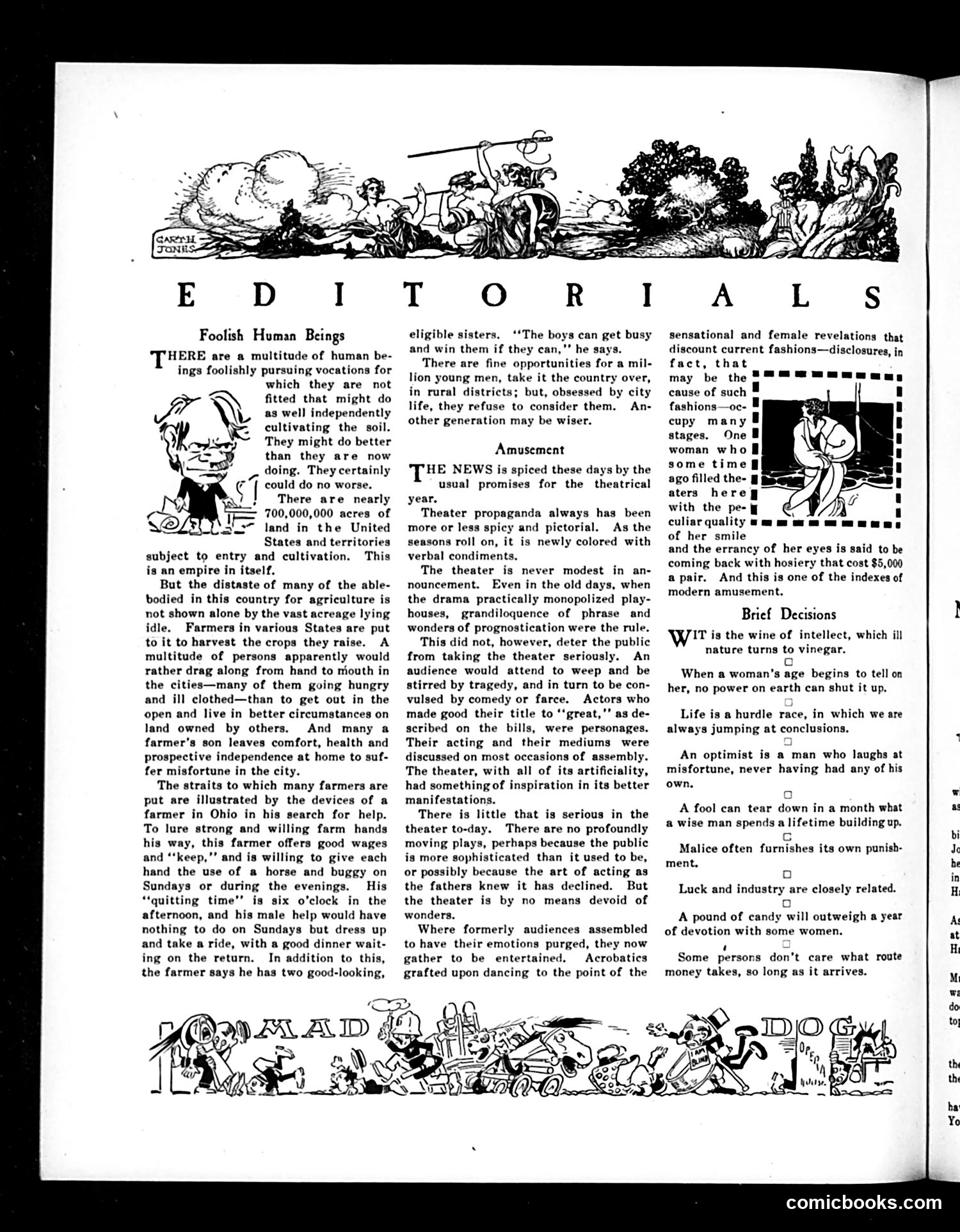
This "Editorials" page from *Judge* magazine contains opinion pieces rather than political cartoons. The main article, "Foolish Human Beings," criticizes Americans pursuing unsuitable vocations—particularly farmers abandoning agriculture for city life, despite lacking urban skills. The author argues this wastes farmland and creates social problems. The accompanying illustration shows a farmer figure, likely representing this demographic. The "Amusement" section mocks theatrical advertising's exaggerated claims, suggesting modern theater lacks substance compared to earlier drama. It critiques actors' inflated reputations and notes the public attends primarily for spectacle rather than art. The "Brief Decisions" section offers sardonic aphorisms about human nature, age, optimism, and materialism—typical satirical commentary on contemporary American society and values.
📄 Transcribed text from this page (OCR, searchable)
Machine-transcribed from the original scan — historical spelling and the odd misread are preserved.
HERE are a multitude of human be- ings foolishly pursuing vocations for = which they are not Vie i as well independently r, cultivating the soil. They might do better (—=" doing. They certainly 7 ¢ | could do no worse. N \) } There are nearly Cc Ws) ‘a'at7 land in the United States and territories subject to entry and cultivation. This But the distaste of many of the able- bodied in this country for agriculture is not shown alone by the vast acreage lying to it to harvest the crops they raise. A multitude of persons apparently would rather drag along from hand to mouth in and ill clothed—than to get out in the open and live in better circumstances on land owned by others. And many a prospective independence at home to suf- fer misfortune in the city. The straits to which many farmers are farmer in Ohio in his search for help. To lure strong and willing farm hands his way, this farmer offers good wages hand the use of a horse and buggy on Sundays or during the evenings. His “quitting time’’ is six o’clock in the nothing to do on Sundays but dress up and take a ride, with a good dinner wait- ing on the return. In addition to this, Foolish Human Beings fitted that might do VR Aa than they are now 700,000,000 acres of is an empire in itself. idle. Farmers in various States are put the cities—many of them going hungry farmer's son leaves comfort, health and put are illustrated by the devices of a and ‘‘keep,’’ and is willing to give each afternoon, and his male help would have the farmer says he has two good-looking, eligible sisters, ‘‘The boys can get busy and win them if they can,’ he says. There are fine opportunities for a mil- lion young men, take it the country over, in rural districts; but, obsessed by city life, they refuse to consider them. An- other generation may be wiser. Amusement HE NEWS is spiced these days by the usual promises for the theatrical year. Theater propaganda always has been more or less spicy and pictorial. As the seasons roll on, it is newly colored with verbal condiments. The theater is never modest in an- nouncement. Even in the old days, when the drama practically monopolized play- houses, grandiloquence of phrase and wonders of prognostication were the rule. This did not, however, deter the public from taking the theater seriously. An audience would attend to weep and be stirred by tragedy, and in turn to be con- vulsed by comedy or farce. Actors who made good their title to ‘‘great,’’ as de- scribed on the bills, were personages. Their acting and their mediums were discussed on most occasions of assembly. The theater, with all of its artificiality, had something of inspiration in its better manifestations. There is little that is serious in the theater to-day. There are no profoundly moving plays, perhaps because the public is more sophisticated than it used to be, or possibly because the art of acting as the fathers knew it has declined. But the theater is by no means devoid of wonders, Where formerly audiences assembled to have their emotions purged, they now gather to be entertained. Acrobatics grafted upon dancing to the point of the sensational and female revelations that discount current fashions—disclosures, in fact, that may be the cause of such fashions—oc- cupy many stages. One & woman who some time §™ ago filled the- aters hereg with the pe-g culiar quality © mo oo of her smile and the errancy of her eyes is said to be coming back with hosiery that cost $5,000 apair. And this is one of the indexes of modern amusement. Brief Decisions IT is the wine of intellect, which ill nature turns to vinegar. is] When a woman's age begins to tell on her, no power on earth can shut it up, Life is a hurdle race, in which we are always jumping at conclusions. An optimist is a man who laughs at misfortune, never having had any of his own. A fool can tear down in a month what a wise man spends a lifetime building up. Cc Malice often furnishes its own punish- ment. o Luck and industry are closely related. A pound of candy will outweigh a year of devotion with some women. ‘ O Some persons don’t care what route money takes, so long as it arrives. comicbooks.com