
Judge, 1913-08-16 · page 5 of 24
Judge — August 16, 1913 — page 5: what you’re looking at
What you’re looking at
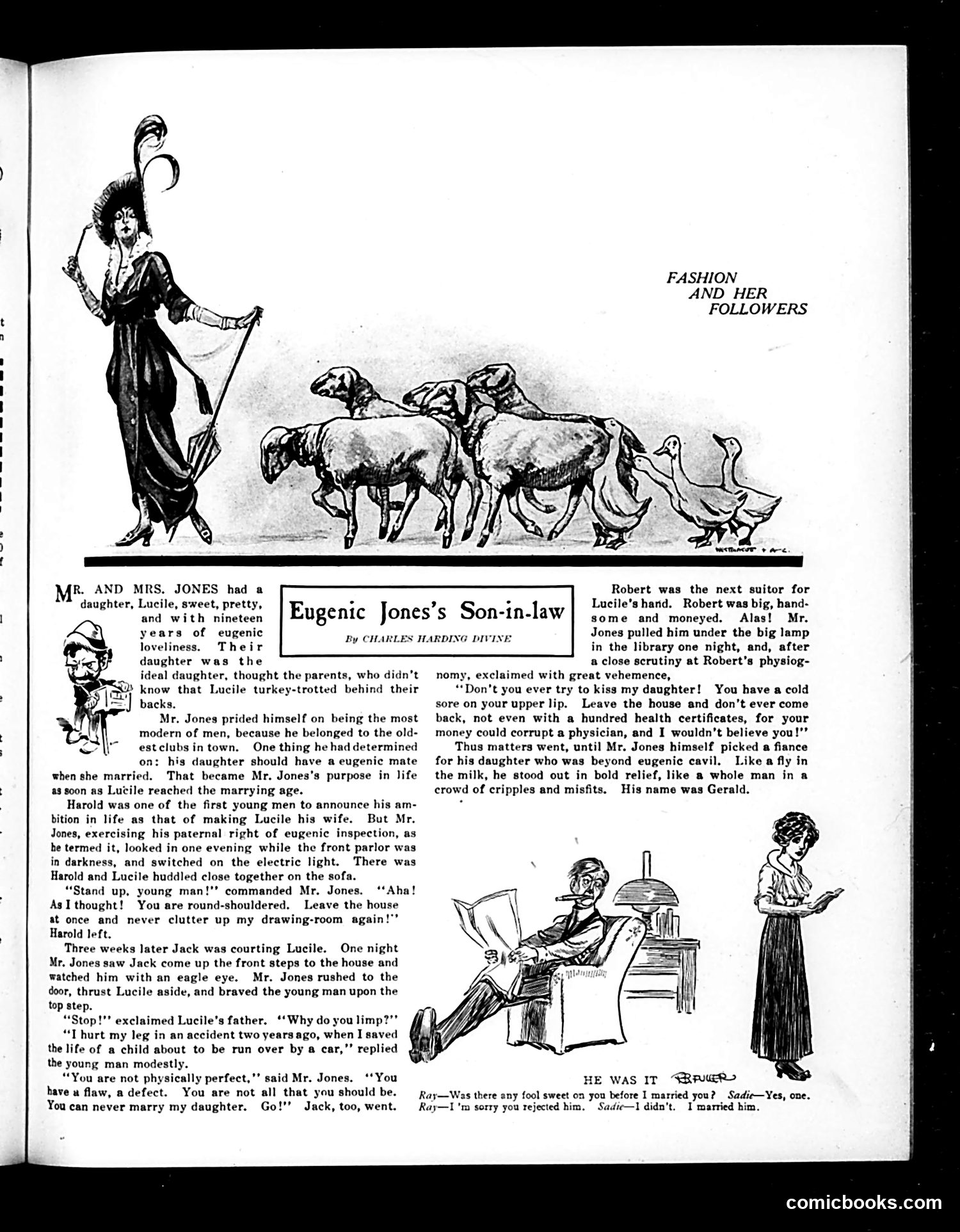
This page satirizes the early 20th-century eugenics movement through a story about Mr. Jones, a man obsessed with "eugenic inspection" of potential husbands for his daughter Lucile. Jones rejects a suitor named Jack for having a "flaw"—a limp from an old injury—deeming him physically imperfect for breeding purposes. The satire mocks Jones's pretentious application of eugenic pseudoscience to family matters. The top illustration shows "Fashion and Her Followers" as animals, suggesting those following fashion trends are less evolved than humans. The story ridicules the arrogance of eugenics advocates who believed they could scientifically determine human worth based on physical perfection—a popular but deeply flawed ideology of that era.
📄 Transcribed text from this page (OCR, searchable)
Machine-transcribed from the original scan — historical spelling and the odd misread are preserved.
Me. AND MRS. JONES had a FASHION AND HER FOLLOWERS Robert was the next suitor for Lucile’s hand. Robert was big, hand- daughter, Lucile, sweet, pretty, bs ’ Ps Eugenic Jones’s Son-in-law] some and moneyed. Alasi Mr. and with nineteen years of eugenic By CHARLES HARDING DIVINE loveliness. Their daughter was the ideal daughter, thought the parents, who didn’t know that Lucile turkey-trotted behind their backs. Mr. Jones prided himself on being the most modern of men, because he belonged to the old- estclubs in town. One thing he had determined on: his daughter should have a eugenic mate when she married. That became Mr. Jones’s purpose in life as soon as Lucile reached the marrying age. Harold was one of the first young men to announce his am- bition in life as that of making Lucile his wife. But Mr. Jones, exercising his paternal right of eugenic inspection, as he termed it, looked in one evening while the front parlor was in darkness, and switched on the electric light. There was Harold and Lucile huddled close together on the sofa. “Stand up, young man!'* commanded Mr. Jones. ‘‘Aha! AsI thought! You are round-shouldered. Leave the house at once and never clutter up my drawing-room again!’ Harold left. Three weeks later Jack was courting Lucile. One night Mr. Jones saw Jack come up the front steps to the house and watched him with an eagle eye. Mr. Jones rushed to the door, thrust Lucile aside, and braved the young man upon the top step. “Stop!’* exclaimed Lucile’s father. ‘*Why do you limp?”’ “Thurt my leg in an accident two years ago, when I saved the life of a child about to be run over by a car,”’ replied the young man modestly. “You are not physically perfect,"’ said Mr. Jones. ‘‘You have w flaw, adefect. You are not all that you should be. You can never marry my daughter. Go!’ Jack, too, went. Jones pulled him under the big lamp in the library one night, and, after a close scrutiny at Robert’s physiog- nomy, exclaimed with great vehemence, “Don’t you ever try to kiss my daughter! You have a cold sore on your upper lip. Leave the house and don’t ever come back, not even with a hundred health certificates, for your money could corrupt a physician, and I wouldn't believe you!’’ Thus matters went, until Mr. Jones himself picked a fiance for his daughter who was beyond eugenic cavil. Like a fly in the milk, he stood out in bold relief, like a whole man in a crowd of cripples and misfits. His name was Gerald. HE WAS IT @RRUERO Ray—Was there any fool sweet on you before I married you? Sadie—Yes, one. Ray—I 'm sorry you rejected him. Sadic—lI didn't. I married him. comicbooks.com