
A complete issue · 24 pages · 1913
Judge — August 9, 1913
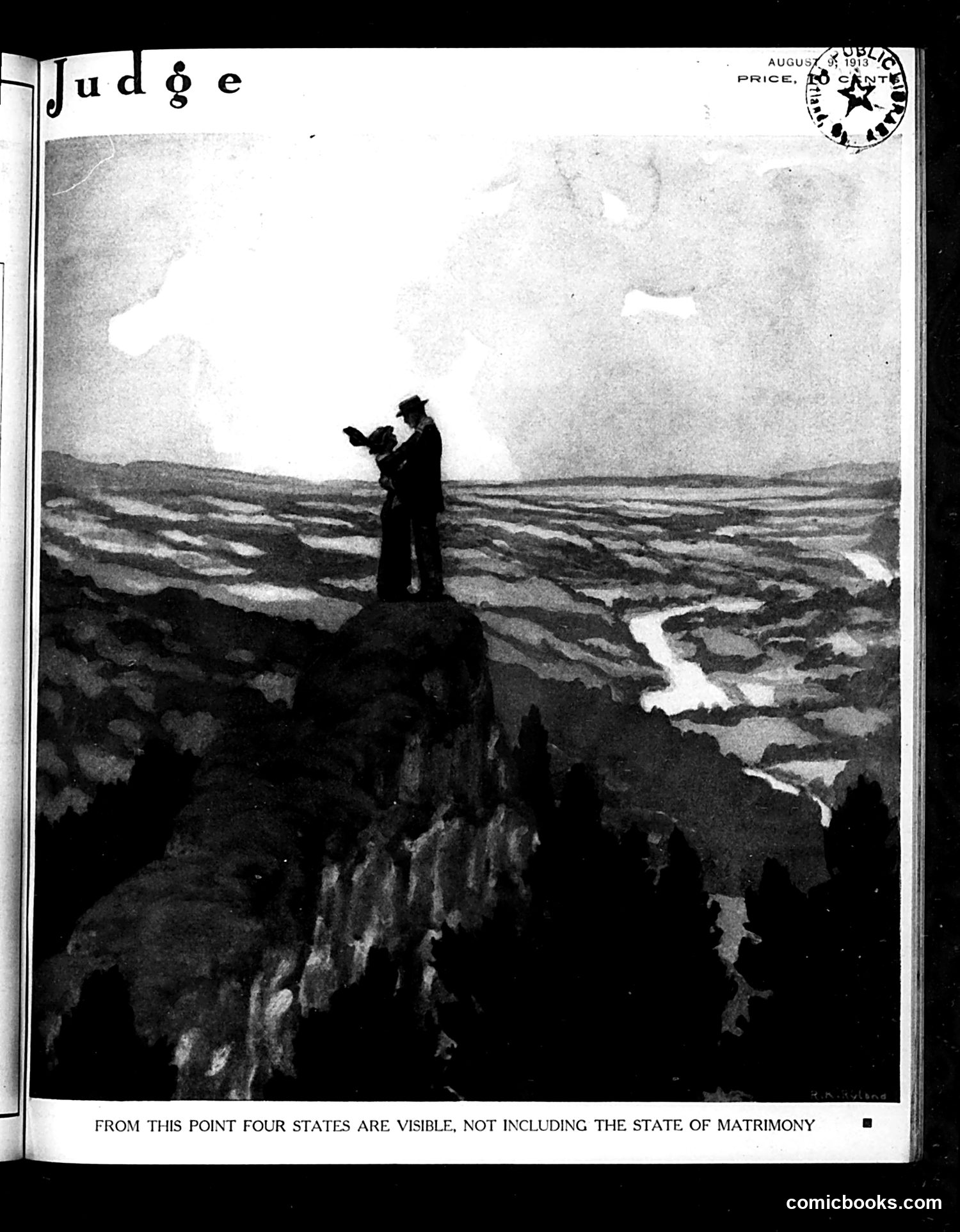
This is a satirical illustration from Judge magazine (August 15, 1913). The image shows a man standing on a high vantage point, surveying a landscape with rivers visible below. The caption reads: "FROM THIS POINT FOUR STATES ARE VISIBLE, NOT INCLUDING THE STATE OF MATRIMONY." The joke is a play on words. While the man can literally see four U.S. states from this elevated viewpoint, the caption humorously suggests he cannot see "the state of matrimony"—a pun treating marriage as if it were a geographical location. This implies the man (likely a newlywed or recently married person) is so absorbed in or blinded by marriage that he fails to notice the actual scenic view before him. The satire gently mocks how marriage can preoccupy one's attention.
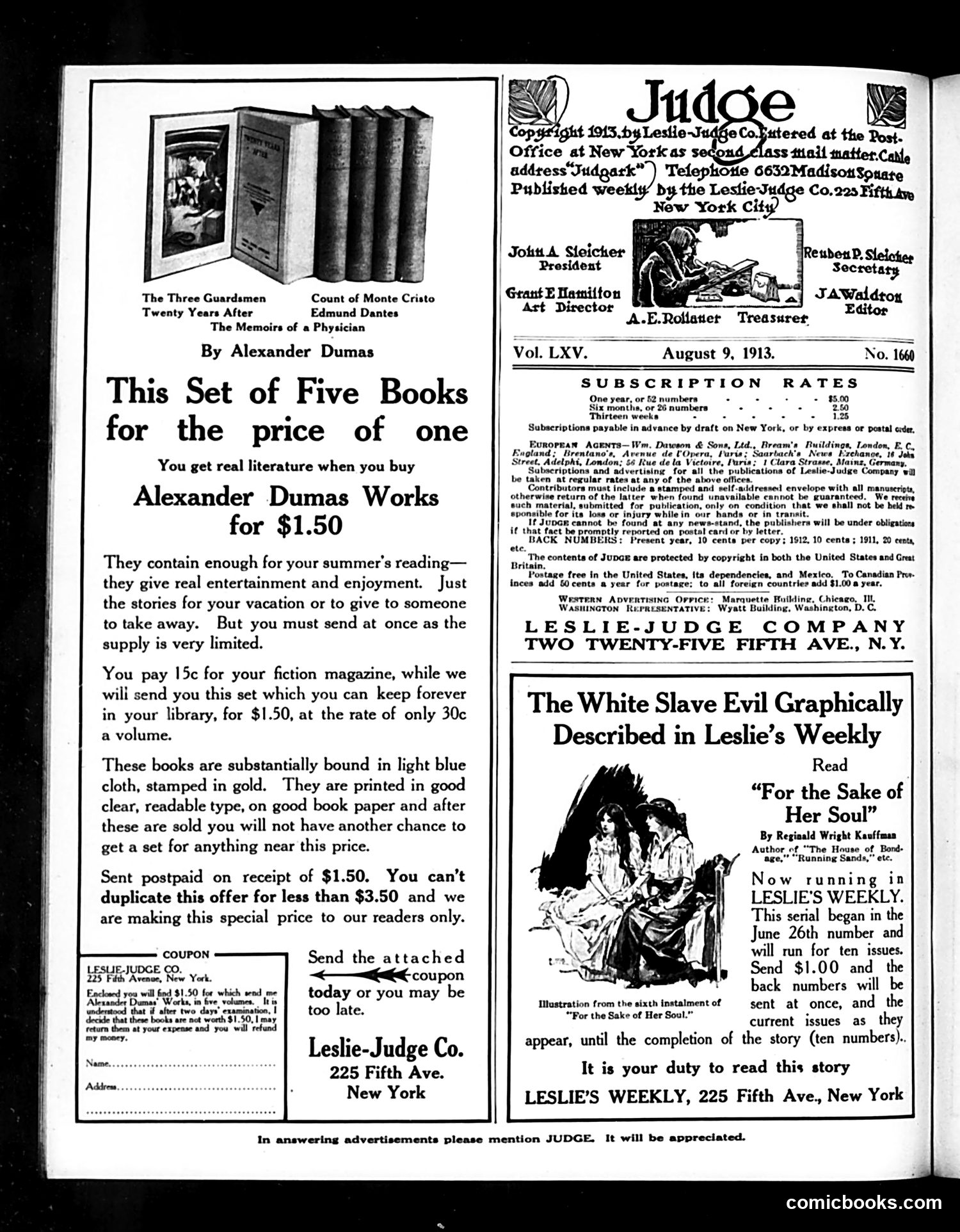
This page is primarily **advertising and editorial content** rather than political satire. The main visual elements are: 1. **Left side**: Advertisement for Alexander Dumas books—a five-volume set sold for $1.50, marketed as affordable summer reading. 2. **Right side**: Judge magazine masthead and publication details (August 9, 1913), plus an advertisement for a serialized story titled "For the Sake of Her Soul" by Harold MacGrath, described as addressing "The White Slave Evil Graphically." The illustration accompanying the story depicts two young women in distress—likely referencing the contemporary "white slavery" moral panic of the early 1900s, when reformers warned about forced prostitution. This was a genuine social concern of the era, though often sensationalized in popular media. The page contains **no political cartoons or satire**—it's a typical magazine page mixing literature promotion with serialized melodrama.
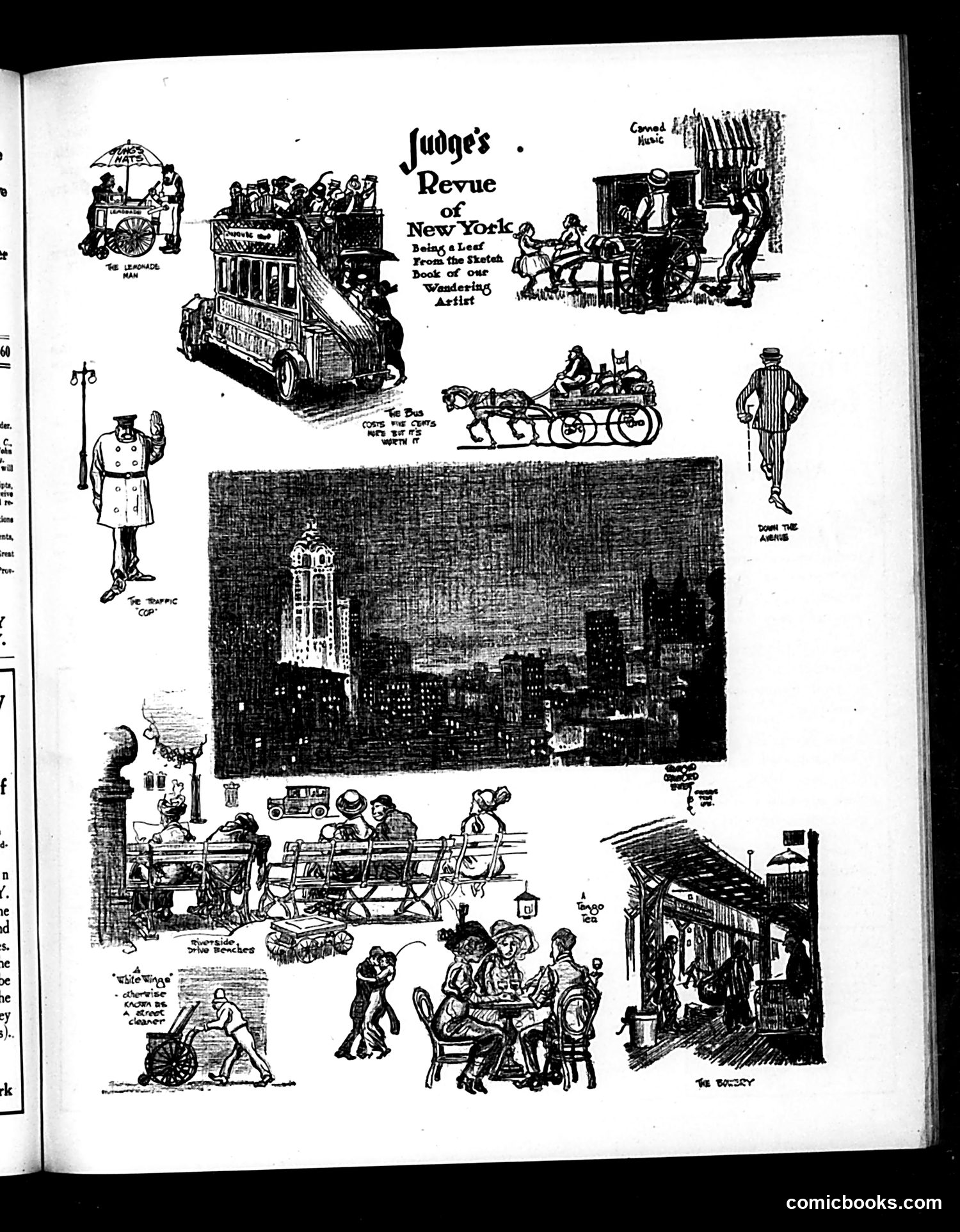
This page presents satirical sketches of New York City street life and characters. The central cityscape depicts Manhattan's skyline, likely from the 1920s-1930s based on the art deco architecture visible. The surrounding vignettes mock various urban types: a traffic cop, a street vendor, well-dressed pedestrians, and dock workers. The sketches appear to satirize the diversity of New York's population and social classes—from working-class laborers to fashionable flaneurs. The title indicates these are "Bits & Leaf from the Sketch Book of Our Wandering Artist," suggesting humorous observations of everyday metropolitan life. The overall satire targets the contrasts and characters that defined New York's bustling, multicultural street culture during the early 20th century.
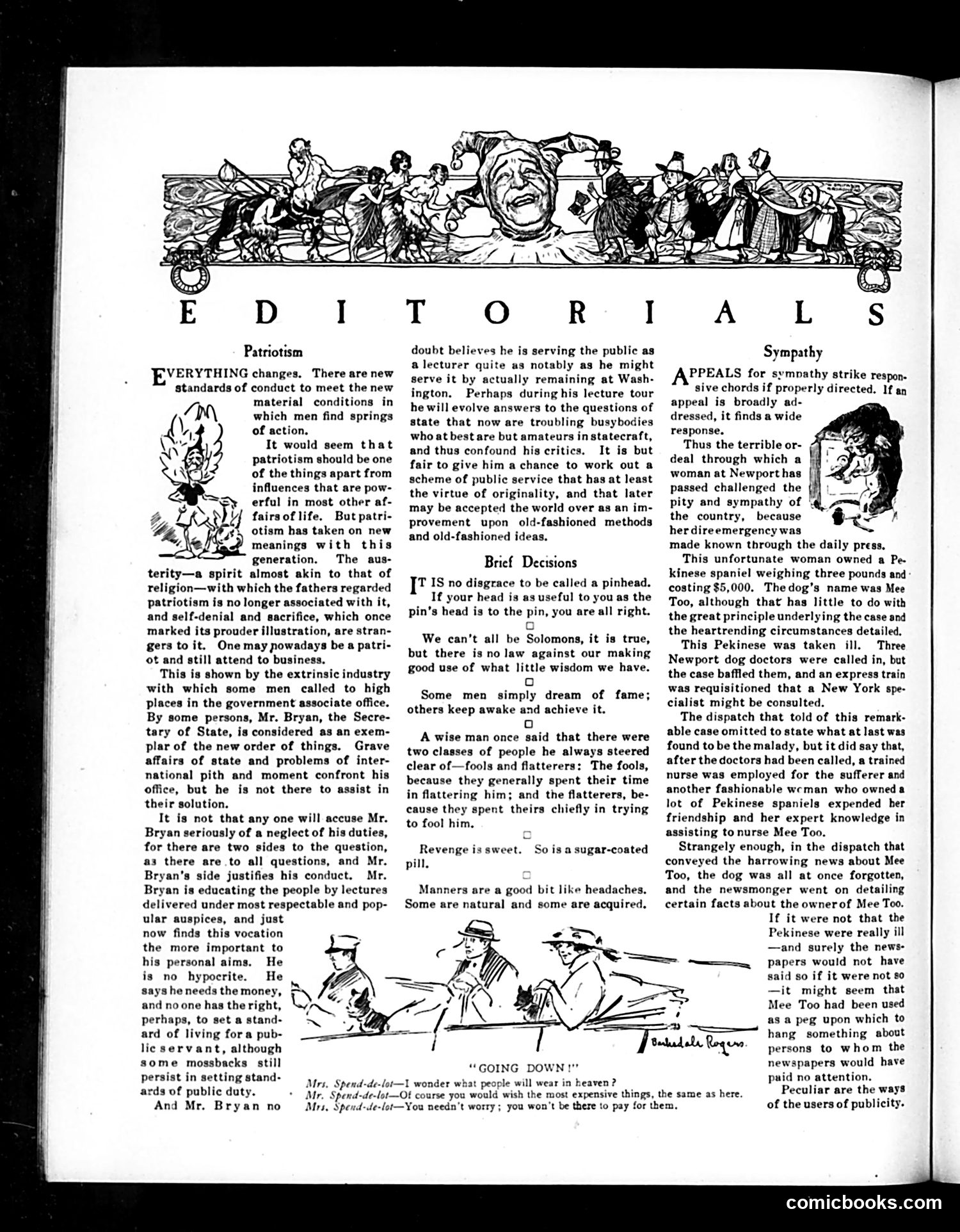
This editorial page critiques Secretary of State William Jennings Bryan's public lecture tours. The left column argues Bryan wrongly conflates patriotism with his personal political agenda, suggesting he uses his government position to promote himself rather than serve the public. The "Brief Decisions" section includes social commentary, particularly a story about a Pekinese dog named Miss Too whose owner faced embarrassment when the dog was involved in a scandal. The narrative satirizes how newspapers sensationalize trivial matters involving society figures. The bottom cartoon depicts three men discussing expensive clothing, likely mocking wealthy individuals' conspicuous consumption during a period when economic inequality was a social concern. Overall, the page attacks political self-promotion and media sensationalism.
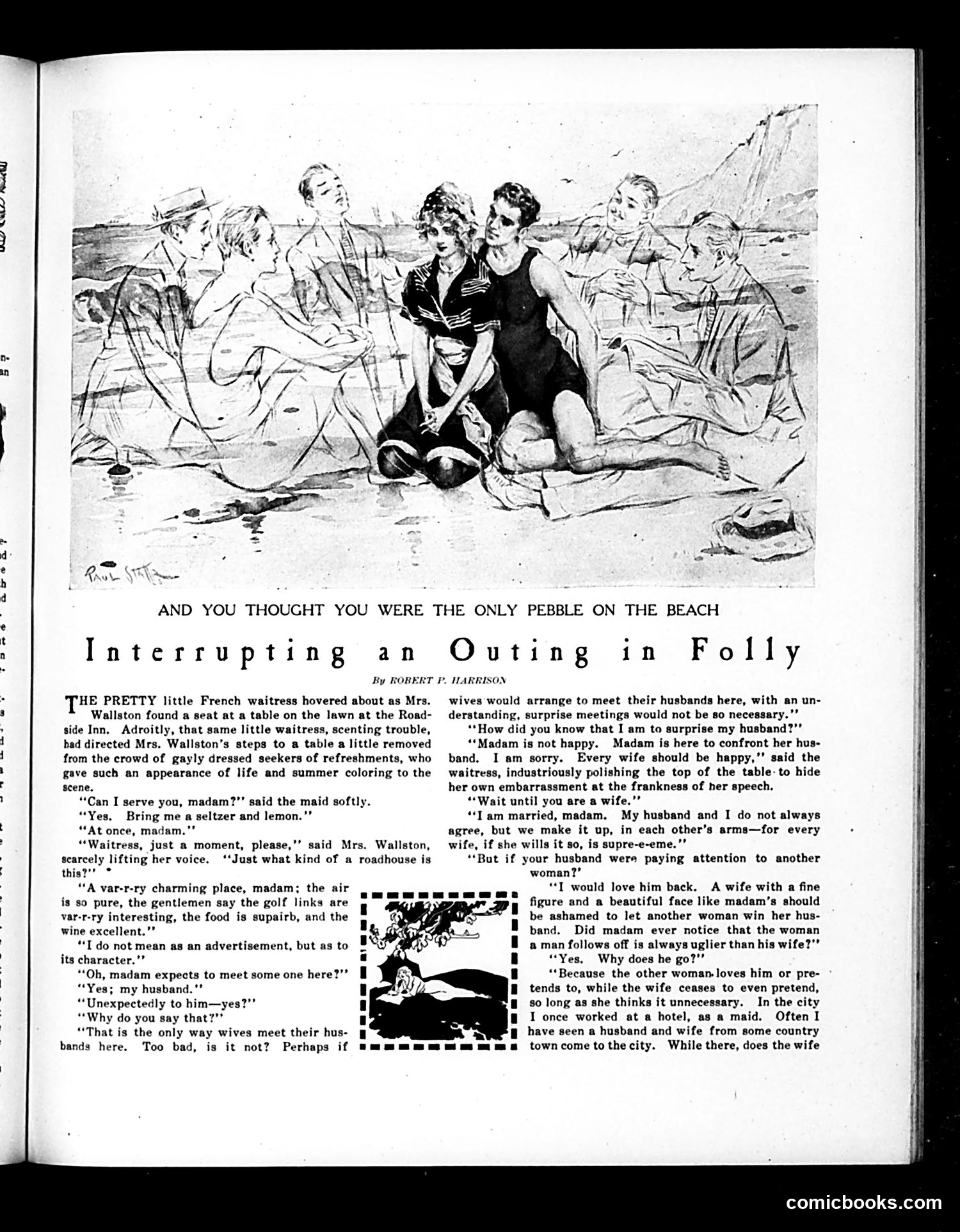
This satirical piece mocks the social awkwardness of chance encounters between married couples and their paramours at public beaches. The cartoon depicts a wife (in dark bathing suit, center) unexpectedly encountering her husband with another woman at a seaside gathering. The dialogue reveals the satire's target: wives who arrange beach meetings with lovers under the pretense of innocent outings, while condemning husbands for doing the same. The waitress character serves as a moral commentator, noting the hypocrisy—wives claim respectability yet engage in infidelity themselves. The piece satirizes early 20th-century marital double standards and the pretense of propriety among the leisure class, suggesting that infidelity was rampant across genders despite public morality.
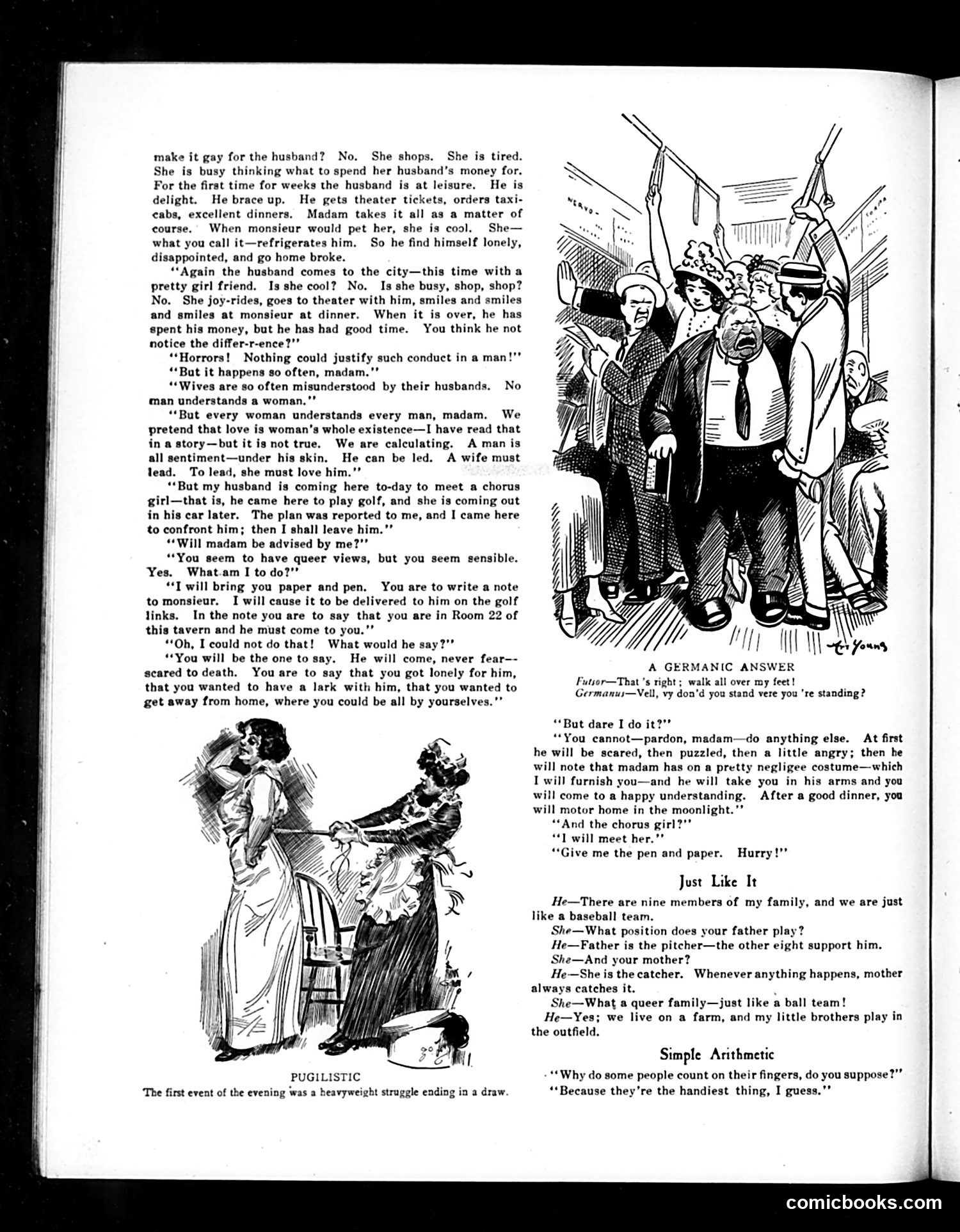
**Main Cartoon ("A Germanic Answer"):** This satirical narrative depicts a marital dispute involving a husband planning to meet a chorus girl under the guise of golf. A wise foreign advisor (suggested by the "Germanic" accent in dialogue) counsels the neglected wife to write a seductive note luring her husband to a tavern instead, where she'll wear negligee and reconcile with him over dinner. The satire targets both the husband's infidelity and the era's gender dynamics—portraying women as strategically manipulative yet emotionally justified, while men are depicted as easily deceived by romantic scheming. **Secondary Content:** Brief humor sketches ("Just Like It," "Pugilistic," "Simple Arithmetic") use baseball metaphors and wordplay typical of early 20th-century American humor magazines. **Social Context:** The page reflects period anxieties about urban leisure, marital fidelity, and the "chorus girl" phenomenon—actresses/performers associated with extramarital temptation. The foreign advisor character likely plays on contemporary ethnic stereotypes while delivering "worldly wisdom."
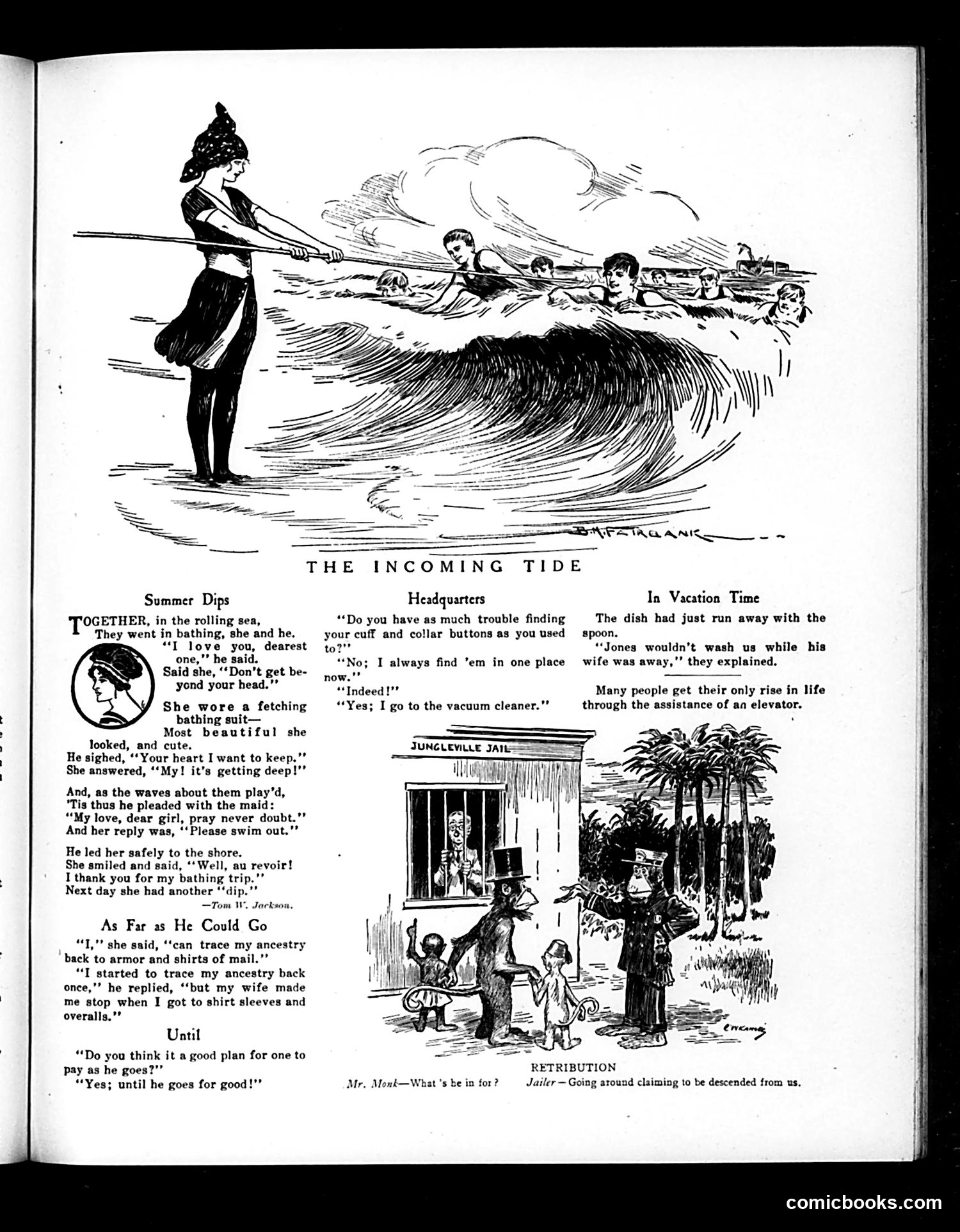
This page contains multiple brief humorous pieces typical of early 20th-century Judge magazine: **"The Incoming Tide"** (top): A woman on shore pulls a rope while children in the water hold on. The title suggests romantic entanglement—a man proposes love while bathing, but the woman keeps deflecting his advances, telling him to swim further out. The satire mocks both overwrought romantic declarations and women's indifference to male suitors. **Other pieces** include jokes about social class ("ancestry back to armor" versus "shirt sleeves"), domestic life (wives controlling husbands' habits), and urban modernity (vacuum cleaners collecting lost buttons). **"Jungleville Jail"** (bottom right): A jailer explains that a prisoner is imprisoned for falsely claiming descent from Black people. This reflects racist attitudes of the era, presenting such claims as inherently ridiculous. The page is typical Judge satire: light domestic comedy mixed with period social commentary and racial stereotypes reflecting its audience's attitudes.
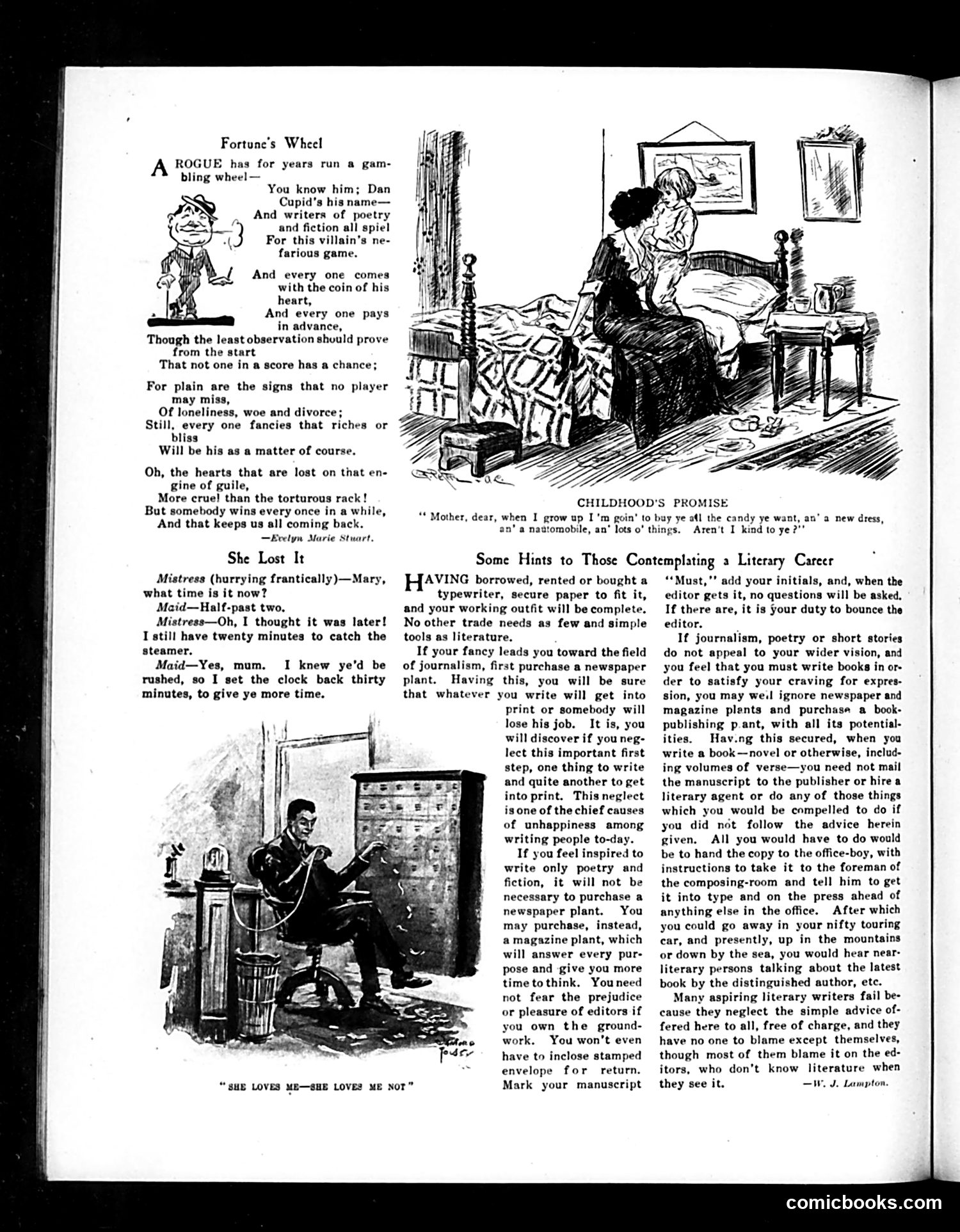
This page from Judge contains three distinct pieces: **"Fortune's Wheel"** — A poem satirizing romantic love as a rigged gambling game run by "Dan Cupid." The satire mocks how people desperately gamble their hearts despite obvious signs of failure (loneliness, divorce), yet keep returning hoping to be the rare winner. It's social commentary on the folly of romantic pursuit. **"She Lost It"** — A brief domestic comedy where a maid, trying to help her rushed mistress catch a steamer, sets the clock back thirty minutes—unknowingly making her *later*, not earlier. The joke relies on the maid's well-intentioned but misguided logic. **"Some Hints to Those Contemplating a Literary Career"** — Satirical advice for aspiring writers. The joke: to succeed in writing, you must *own* the publication outlet (newspaper plant, magazine plant, or book-publishing plant) rather than submit work to editors. It mocks both the difficulty of breaking into publishing and writers' naive assumptions about getting published.
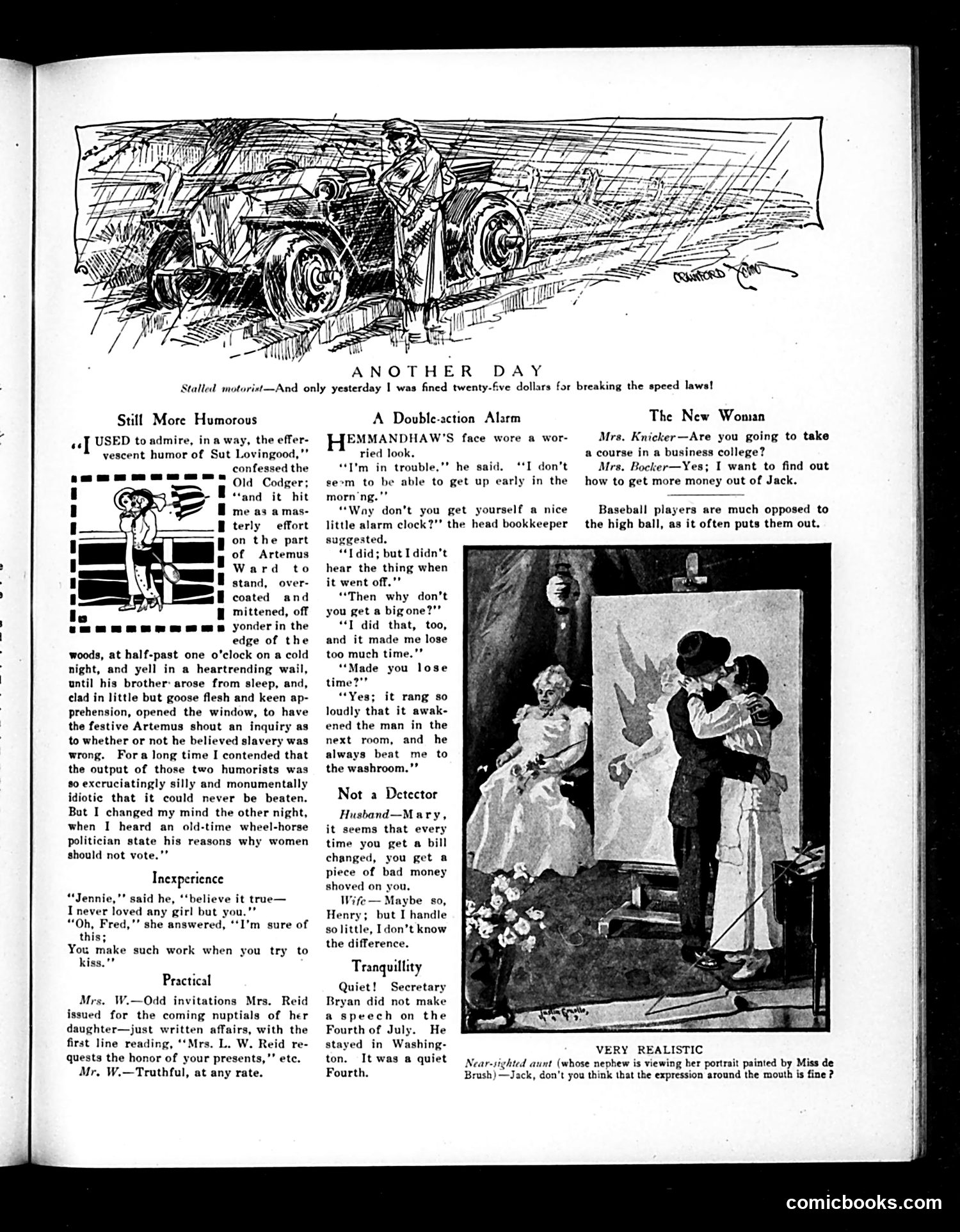
This page contains multiple brief humorous anecdotes typical of early 20th-century American satirical magazines. **Top cartoon**: A motorist whose car has stalled complains about receiving a $25 speeding fine the day before—ironic commentary on traffic law enforcement inconsistency. **Main anecdotes include**: - A discussion of 19th-century humorists (Sut Lovingood, Artemus Ward) compared unfavorably to a politician's reasons against women's suffrage - Dating/courtship humor about inexperience and kissing technique - A worker unable to wake early despite alarm clocks because a coworker beats him to the washroom - A wife's inability to detect counterfeit money due to handling little currency - A reference to Secretary William Jennings Bryan's quiet Fourth of July (no political speeches) - Jokes about business education for wives seeking household money control and baseball players avoiding high balls **The photograph** shows a near-sighted aunt admiring her portrait, with caption humor about the artist's rendering of her mouth expression. The humor reflects early 1900s concerns: women's rights debates, gender roles, workplace competition, and currency authenticity.
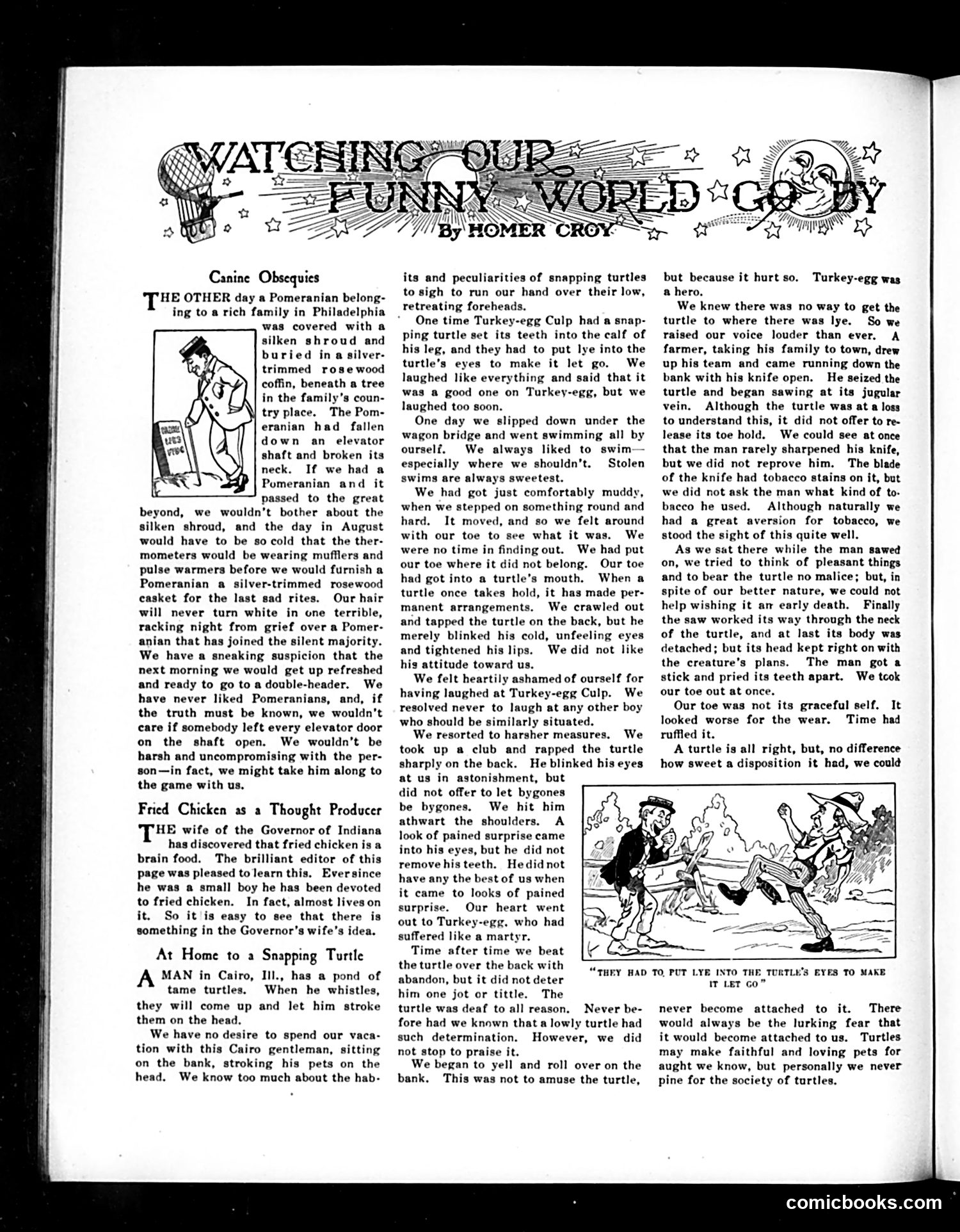
This page collects three humorous anecdotes satirizing upper-class sentimentality and human foolishness. **"Canine Obsequies"** mocks wealthy Philadelphia families for lavish pet funerals. A Pomeranian receives an elaborate silk-shrouded burial in a rosewood coffin after an accident. The author sneers at such ostentation, suggesting the dog barely merited concern and implying such grief is pretentious. **"Fried Chicken as a Thought Producer"** jokes that Indiana's governor's wife claims fried chicken aids brain function—the author claims he's eaten it constantly, sarcastically questioning whether his modest intellect proves her theory. **"At Home to a Snapping Turtle"** recounts the author's painful encounter with a snapping turtle while swimming, contrasting it with a Cairo man who claims his turtles respond peacefully to whistles. The author learns harsh lessons about nature's indifference and resolves never to mock others' similar misfortunes. The humor targets vanity, dubious folk wisdom, and underestimation of nature's dangers.
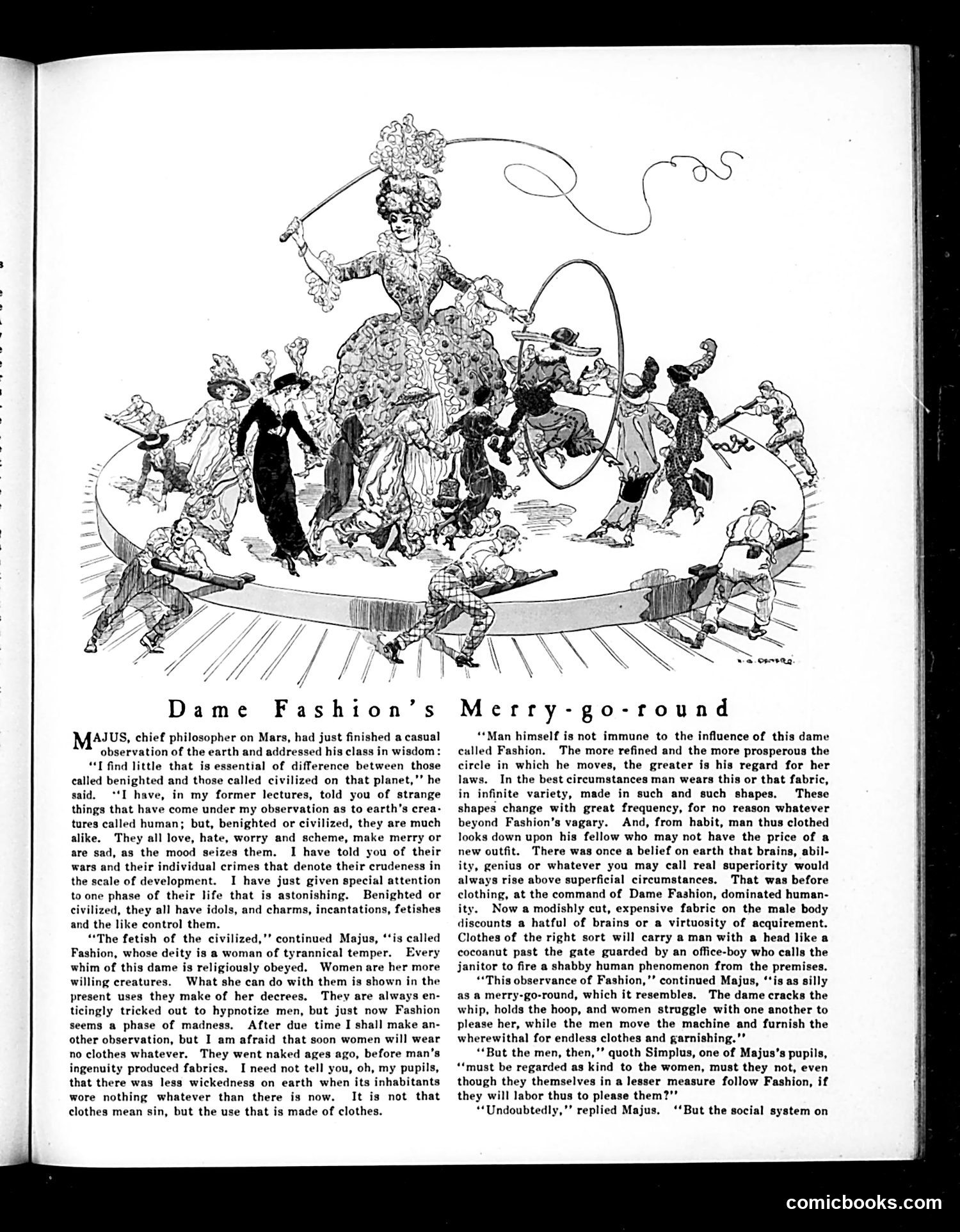
This satirical piece uses a Martian philosopher named Majus to critique fashion's grip on civilized society. The central conceit: a supposedly advanced Martian observes that "civilized" humans are no better than "benighted" peoples because both worship fetishes—and on Earth, that fetish is **Fashion**. The satire targets: - **Women's servitude to fashion**: depicted as mindlessly following a tyrannical "dame" who cracks a whip, making them competitors in an endless cycle - **Class materialism**: expensive clothes now trump talent or intelligence; a well-dressed fool beats a shabby genius - **Male complicity**: men enable this by funding women's endless wardrobe purchases, though they too follow fashion - **Circular absurdity**: the "merry-go-round" metaphor suggests fashion is pointless repetition—shapes change "for no reason whatever" The illustrated centerpiece shows elaborately dressed women and men in fashionable attire engaged in this circular dance, controlled by a large central female figure (Dame Fashion herself). The satire suggests civilized society's obsession with clothing and appearance is no more rational than primitive fetish worship.
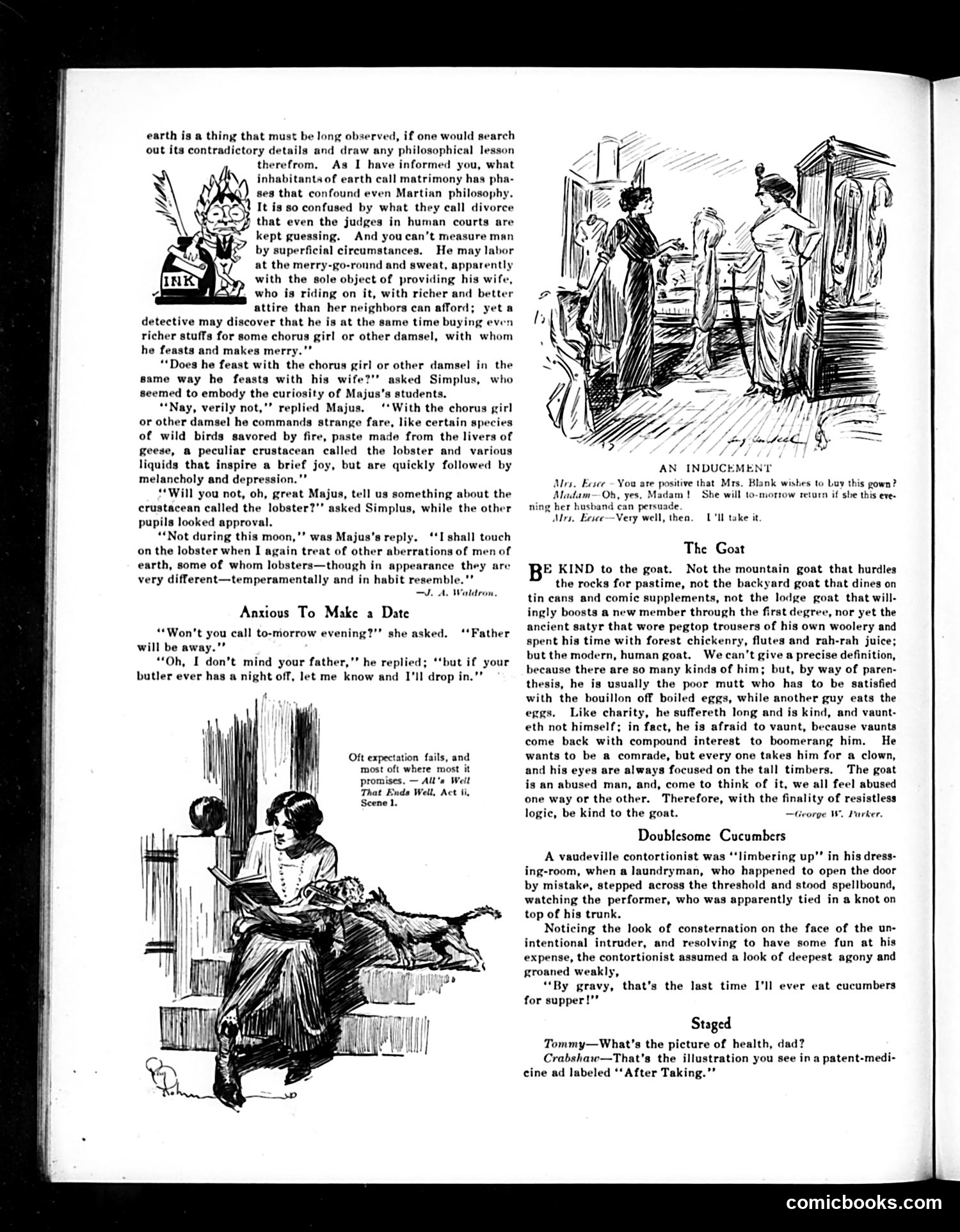
This Judge page contains multiple satirical pieces targeting early 20th-century social hypocrisy: **"Anxious To Make a Date"**: A young man courting a woman reveals his actual interest is the *butler*, not the father—suggesting he seeks opportunities with servants during time off. This mocks class pretense and infidelity. **"An Inducement"**: A shopkeeper manipulates a woman into buying a dress by implying her husband needs persuading. The satire targets both manipulative retail tactics and marital power dynamics. **"The Goat"**: Defines the "human goat" as the working-class man who sacrifices (eating cheap bouillon while others eat eggs) and accepts abuse without complaint. This sympathetic piece critiques how ordinary men absorb society's unfairness. **"Doublesome Cucumbers"**: A contortionist performing extreme positions is mistaken for someone in distress—satirizing vaudeville performers' physical extremity. The Martian dialogue frames matrimony and infidelity as absurd contradictions of human behavior, typical of Judge's observational humor about middle-class contradictions.
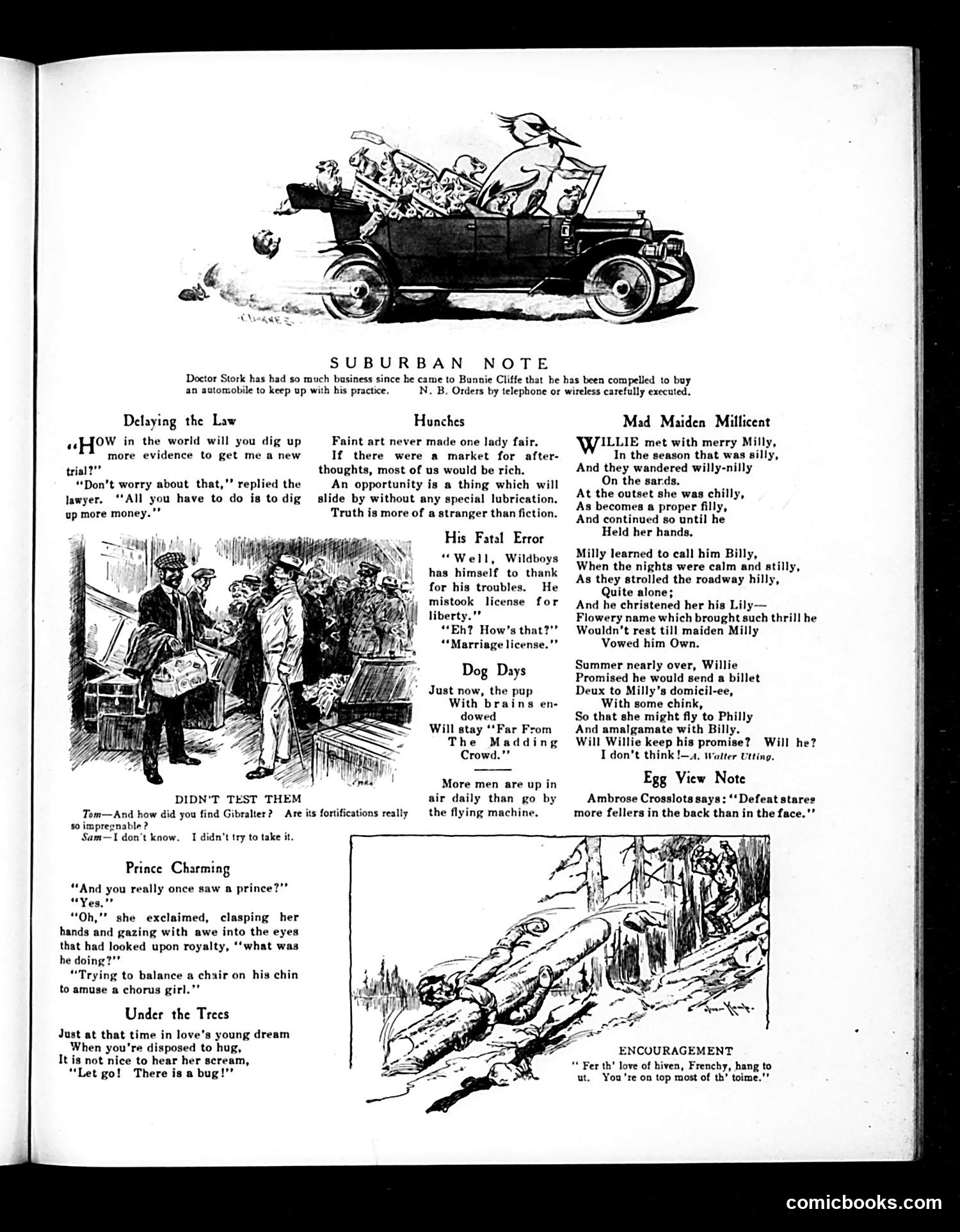
This Judge magazine page (date unclear) collects satirical vignettes and humorous observations typical of early 20th-century American humor. **Key content:** The "Suburban Note" opening cartoon shows Doctor Stork (the mythical delivery figure) needing an automobile because suburban birth rates are so high—satirizing rapid suburban expansion and fertility. **The jokes target:** - Legal corruption ("dig up more money" to win trials) - Pretense (a "prince" performing circus tricks for chorus girls) - Marriage as loss of freedom (licensing interpreted as loss of liberty) - Class and romance tropes (the long "Mad Maiden Millicent" poem mocks sentimental courtship narratives, ending cynically: "Will Willie keep his promise? I don't think!") **Overall tone:** Cynical, dismissive of authority, romance, and respectability. The humor relies on deflating expectations—legal systems are corrupt, royalty are frauds, marriage traps men, romantic promises are broken. This reflects early 20th-century urban sophistication and skepticism toward Victorian institutions.
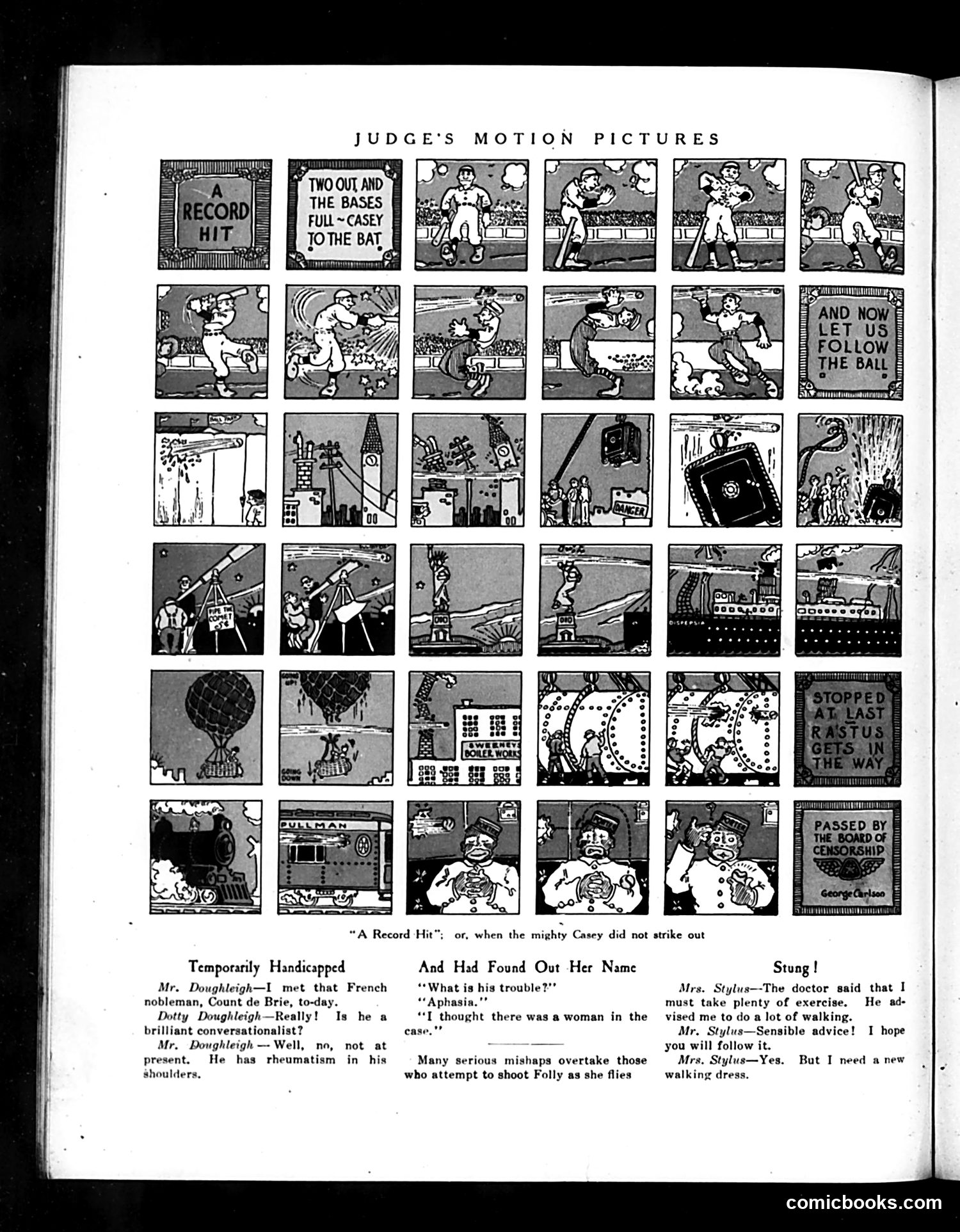
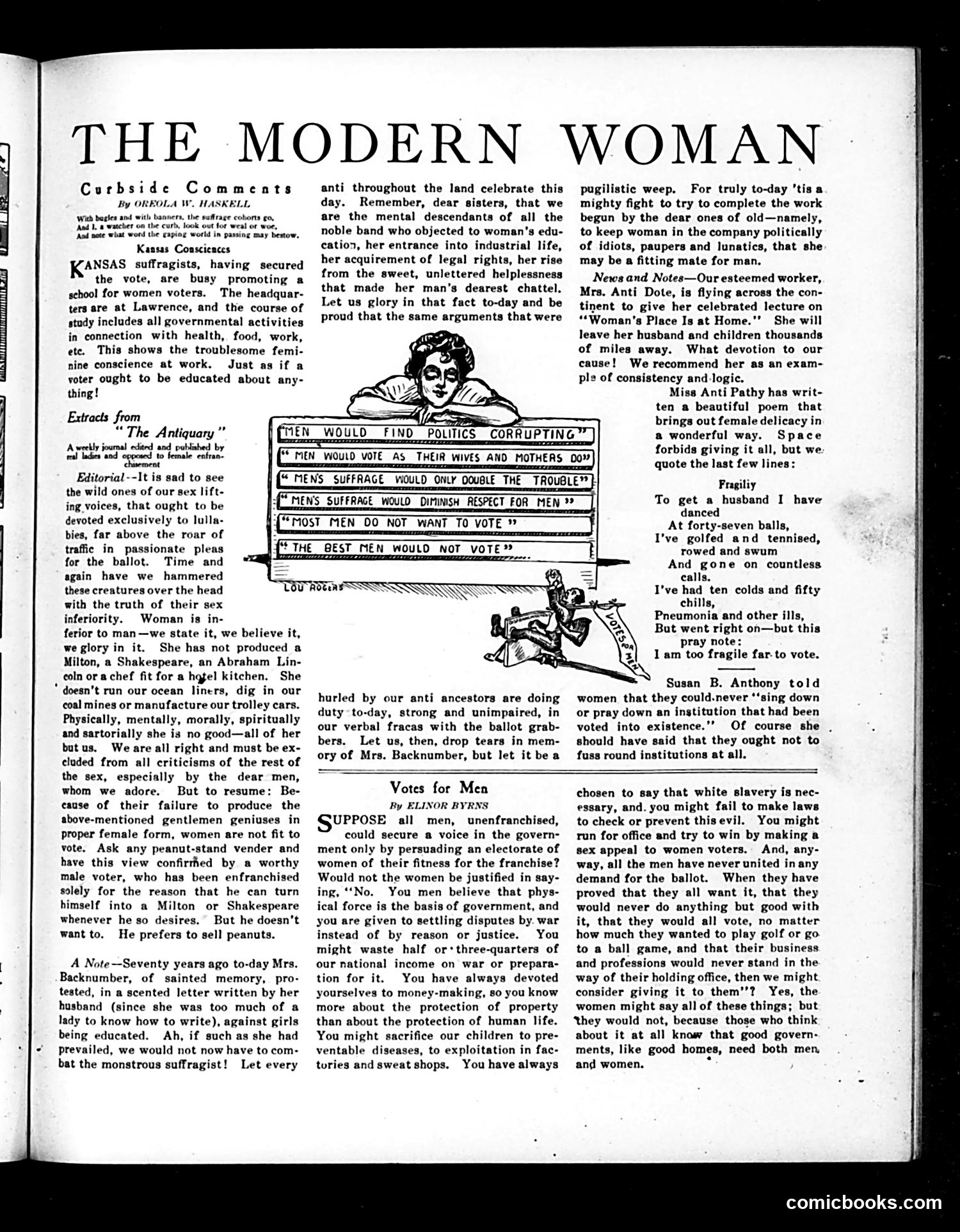
This Judge magazine page satirizes **anti-suffrage arguments** by inverting them—the editors mock opponents of women's voting rights by ironically celebrating their logic. The central cartoon (by Lou Rogers) shows a man spouting anti-suffrage talking points as if they're wisdom, with each statement progressively absurd: men voting as "their wives and mothers" would, suffrage "corrupting" men, etc. The satire exposes how these arguments contradict themselves. The "Curbside Comments" column attacks Kansas suffragists' voter-education efforts as evidence of "troublesome feminine conscience," sarcastically suggesting voters shouldn't need education. The "Editorial" mocks anti-suffragists' claims that women are mentally/morally inferior (producing no Miltons or Shakespeares, running no ships), yet uses this very "inferiority" as their justification for denying voting rights—a logical trap the magazine exposes. **The page's point**: Anti-suffrage rhetoric is contradictory nonsense, and Judge supports women's suffrage by making their opponents' arguments laughably transparent.
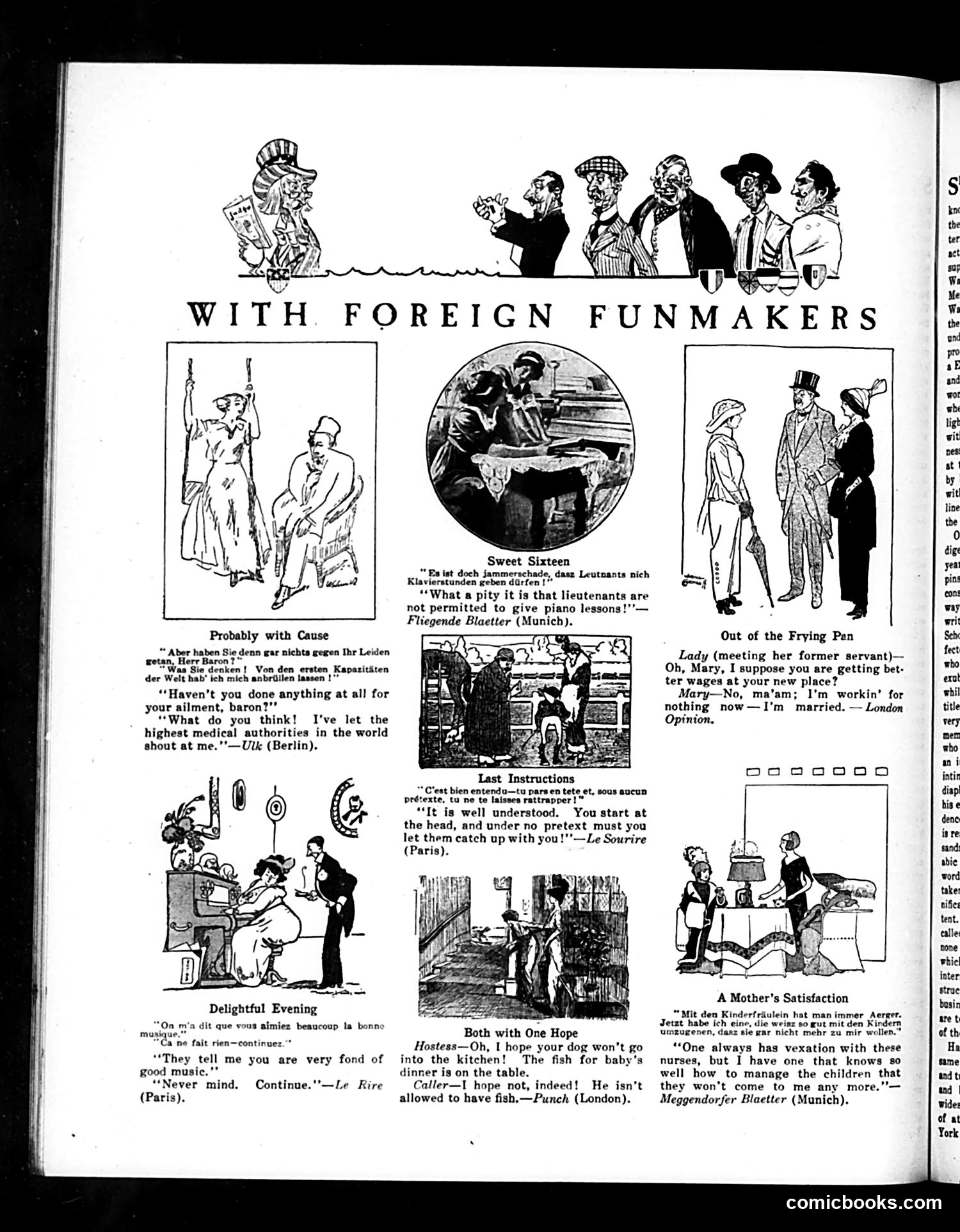
This page collects humorous cartoons translated from European satirical magazines (German *Ulk*, French *Le Rire* and *Le Sourire*, British *Punch*). The comics mock domestic and social frustrations recognizable across cultures: A baron complains doctors have merely "shouted" at his ailment. A man endures bad music rather than interrupt it. Officers are barred from giving piano lessons. A woman warns a child to flee without being caught (unclear context). A hostess and guest both hope a dog avoids fish. A former servant, now married, works "for nothing." A mother laments that her nanny is *too* good—the children prefer her. These are gentle satire on universal annoyances: medical quackery, politeness, military restrictions, marital economics, and domestic help. The translations demonstrate Judge's international perspective, showing American readers that complaints about life's small indignities transcend borders.
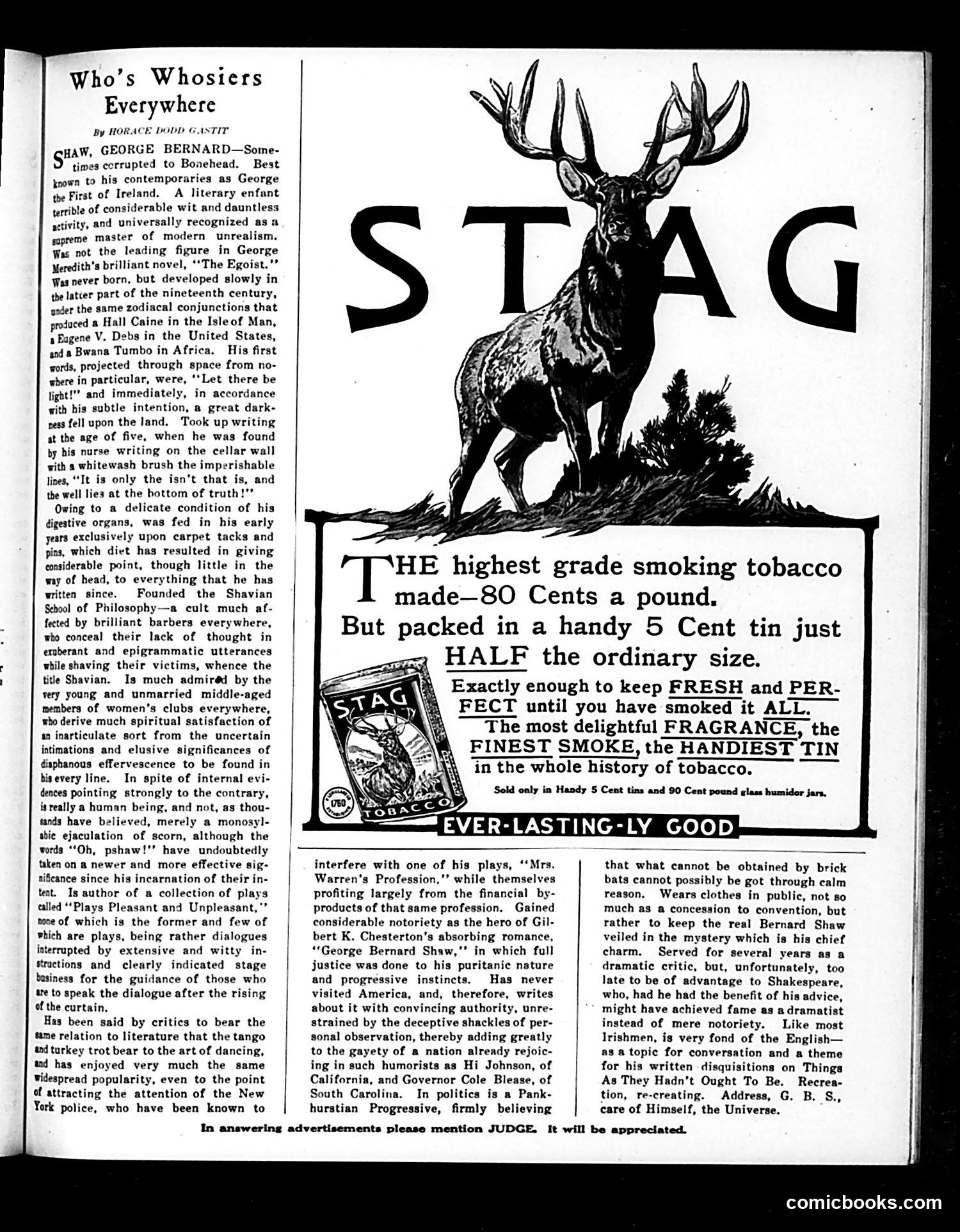
This page from *Judge* magazine contains a satirical biographical entry on **George Bernard Shaw**, the Irish playwright and critic. The "Who's Whosiers Everywhere" column mocks Shaw's reputation as a difficult, avant-garde intellectual. The satire targets Shaw's reputation for obscurity and pretension—he's described as developing "slowly" under astrological influences comparable to Eugene V. Debs and a fictional African character, suggesting absurd grandiosity. The column ridicules his philosophical "Shavian School" as mere "monosyllabic ejaculation of scorn," and his plays as barely distinguishable from lengthy stage directions. It sarcastically notes his appeal to "unmarried middle-aged members of women's clubs" seeking "elusive significances." The comparison to the tango and turkey trot—dances once considered scandalous—and mention of police interference with his plays (likely referencing censorship battles over sexually explicit content) positions Shaw as culturally transgressive. The **STAG tobacco advertisement** occupies the lower half, unrelated to the satirical content above.
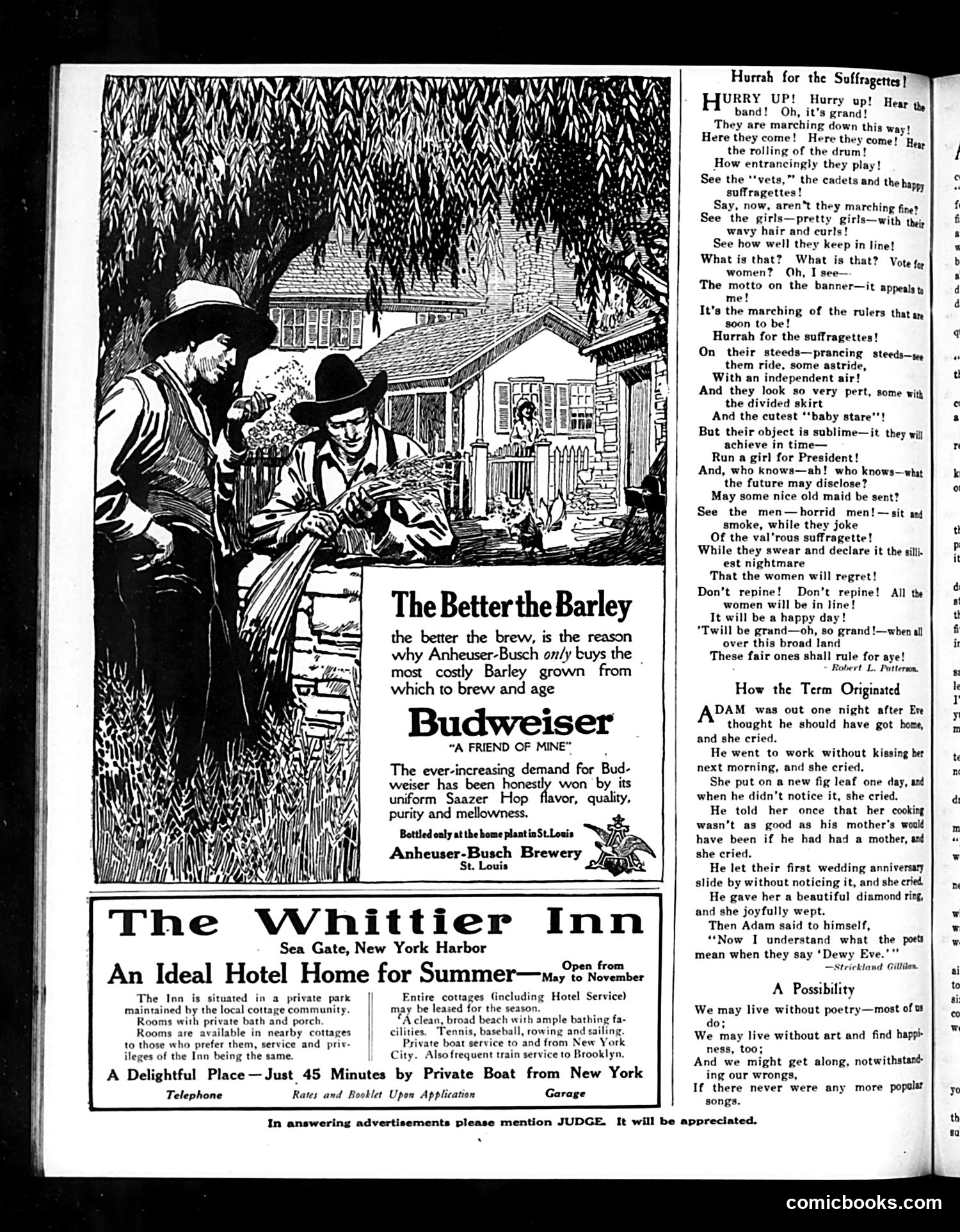
This page contains a satirical poem celebrating women's suffrage, a major political movement of the early 20th century. The verse depicts a suffragette parade with marching women on horseback, wearing divided skirts, described as "pretty girls" maintaining orderly lines while promoting "Vote for women." The satire operates on multiple levels: it mocks both suffragettes (portraying them as vain and seeking the presidency) and male opposition (depicting men as dismissive, smoking and joking while women march). The poem's closing couplet about potentially "running a girl for President" reads as absurdist exaggeration meant to ridicule the movement's ambitions. The accompanying prose joke, "How the Term Originated," uses Adam and Eve to mock women's emotionality, suggesting the term "Dewy Eve" derives from Eve's constant crying—a crude sexist punchline conflating women with irrationality. This reflects Judge's conservative editorial stance opposing women's suffrage, using humor to delegitimize the movement while appearing merely playful rather than serious.
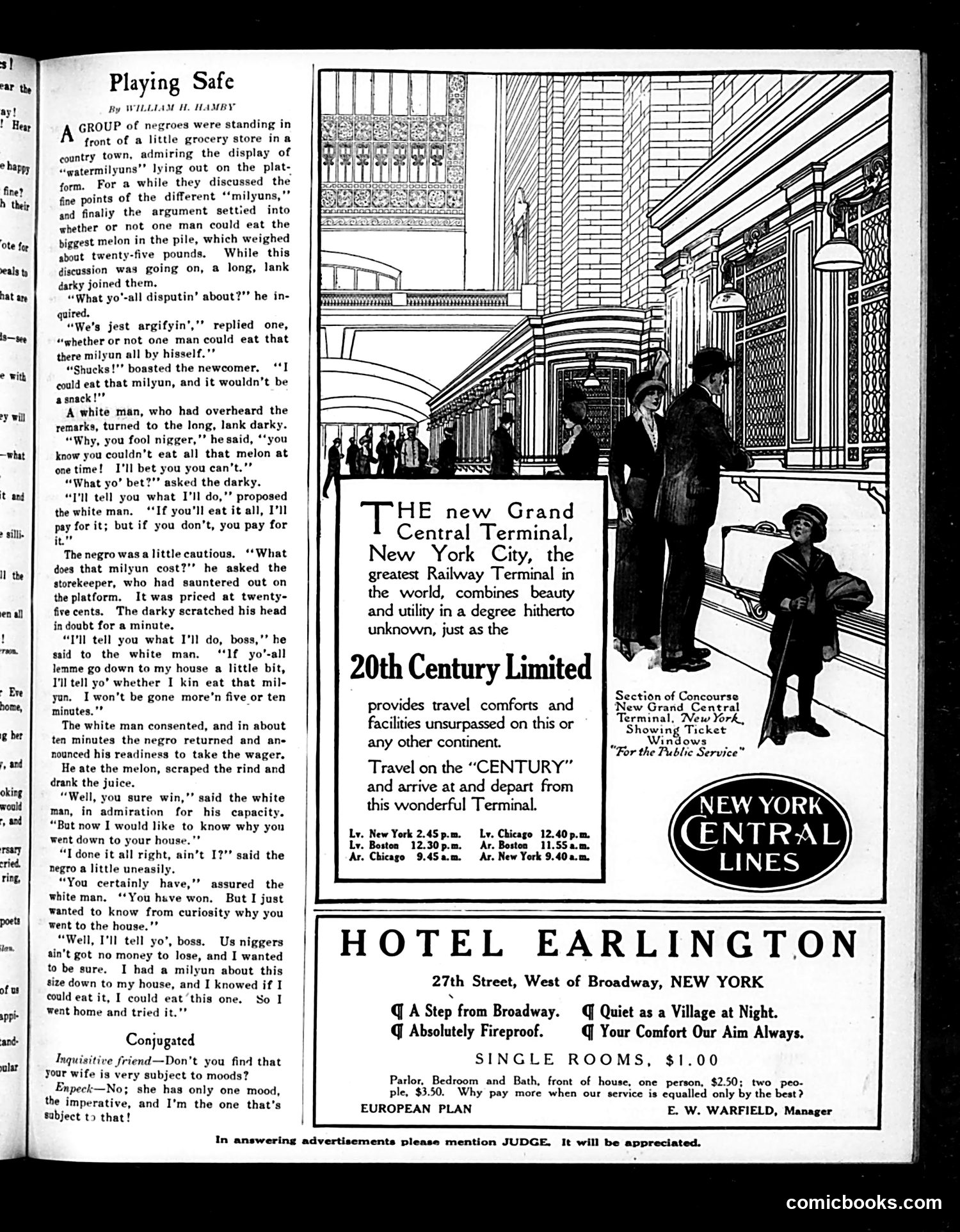
This is a racist dialect humor piece typical of early 20th-century American magazines. A group of Black men debate whether one person could eat a 25-pound watermelon. When a newcomer boasts he could, a white man wagers he cannot — offering to pay if he succeeds, but the Black man must pay if he fails. The Black man accepts but first goes home to test himself on a smaller watermelon. He succeeds at both, winning the bet. When asked why he went home first, he explains he wanted to be certain before risking money he couldn't afford to lose. The "joke" relies on racist stereotypes: the exaggerated dialect, the watermelon reference (a degrading caricature of Black people), and framing the Black character as cautiously clever rather than confident. The story's title, "Playing Safe," suggests the humor lies in his practical caution — though it also inadvertently portrays him as more sensible than the white man's reckless wager. The page also includes period advertisements for the 20th Century Limited train and Hotel Earlington.
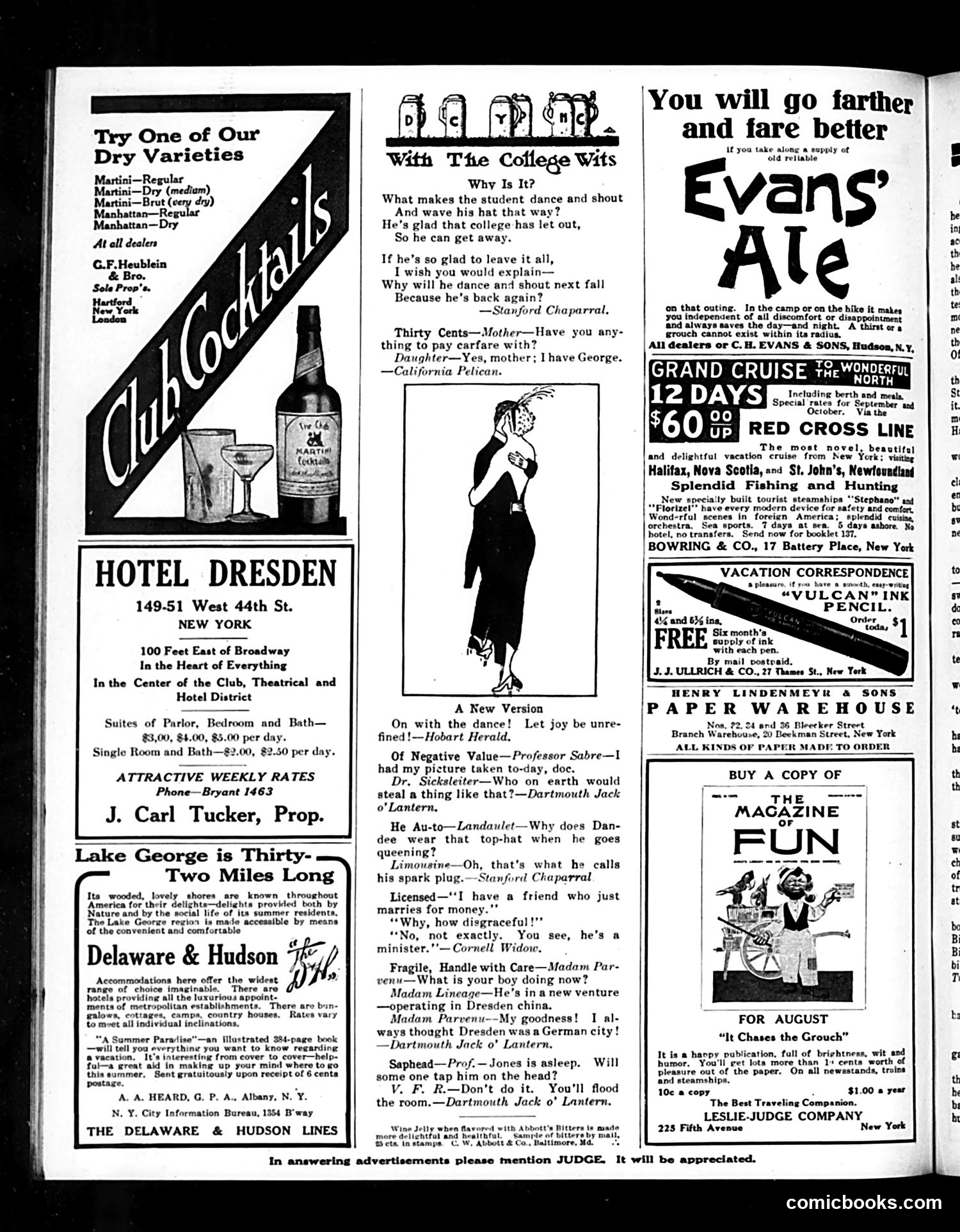
This is primarily an **advertising page** from Judge magazine, with minimal satirical content. The main cartoon depicts a flapper woman in 1920s dress, accompanying jokes about college students and social life. The humor reflects Jazz Age anxieties: college students eagerly leave for summer but paradoxically celebrate returning in fall (suggesting ambivalence about education). Other college-themed jokes mock student life and courtship—a girl using a boyfriend as "carfare," a minister who "marries for money," and various puns about automobiles and social pretension. The advertisements—for Hotel Dresden, Evans' Ale, cruise lines, and a paper warehouse—dominate the page. They target affluent readers planning vacations and social outings, typical of Judge's audience. The "College Wits" section reprints humorous submissions from college magazines (Stanford Chaparral, Cornell Widow, Dartmouth Jack o' Lantern), a common Judge feature. Overall, the page reflects 1920s consumer culture and youthful social trends rather than sustained political satire.
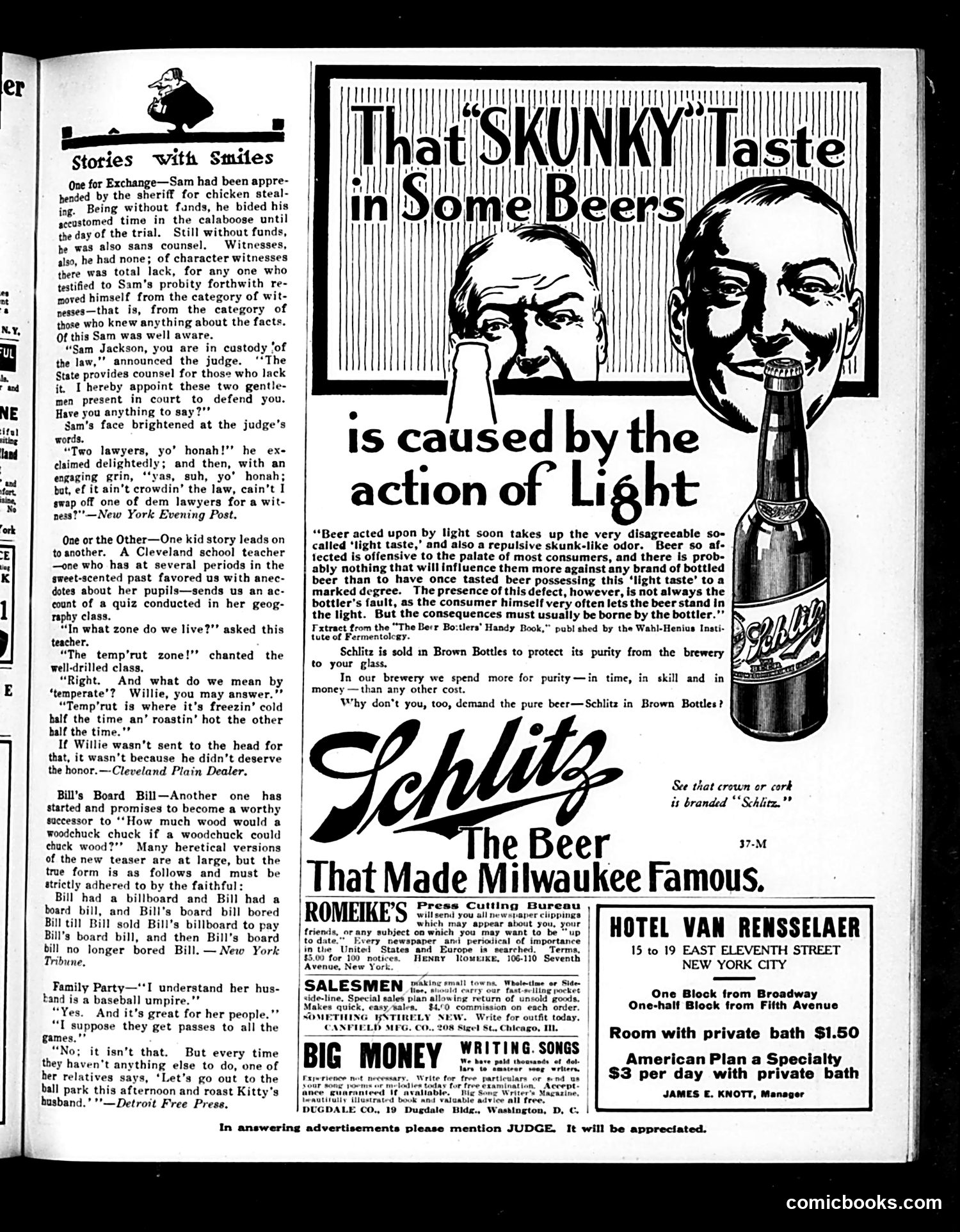
This page contains multiple unrelated elements typical of Judge's format: **"Stories with Smiles"** section: Three brief humorous anecdotes about everyday situations—a Black defendant offering to trade a lawyer for a witness (playing on the stereotype that he lacks eloquence), a geography student's literal definition of "temperate zone" (confusing temperature with temperament), and a tongue-twister about Bill's billboard and board bill. **Main Advertisement**: A Schlitz beer ad explaining that "skunky taste" in beer results from light exposure during storage/transport. The ad emphasizes Schlitz's use of brown bottles to protect beer quality and positions this as superior to competitors. This was a legitimate technical concern in beer distribution before modern refrigeration. **Other Advertisements**: Hotel Van Rensselaer lodging, writing songs opportunity, and other services fill remaining space. The page reflects early 20th-century advertising and humor conventions, with racial stereotypes presented matter-of-factly in the anecdotes section.
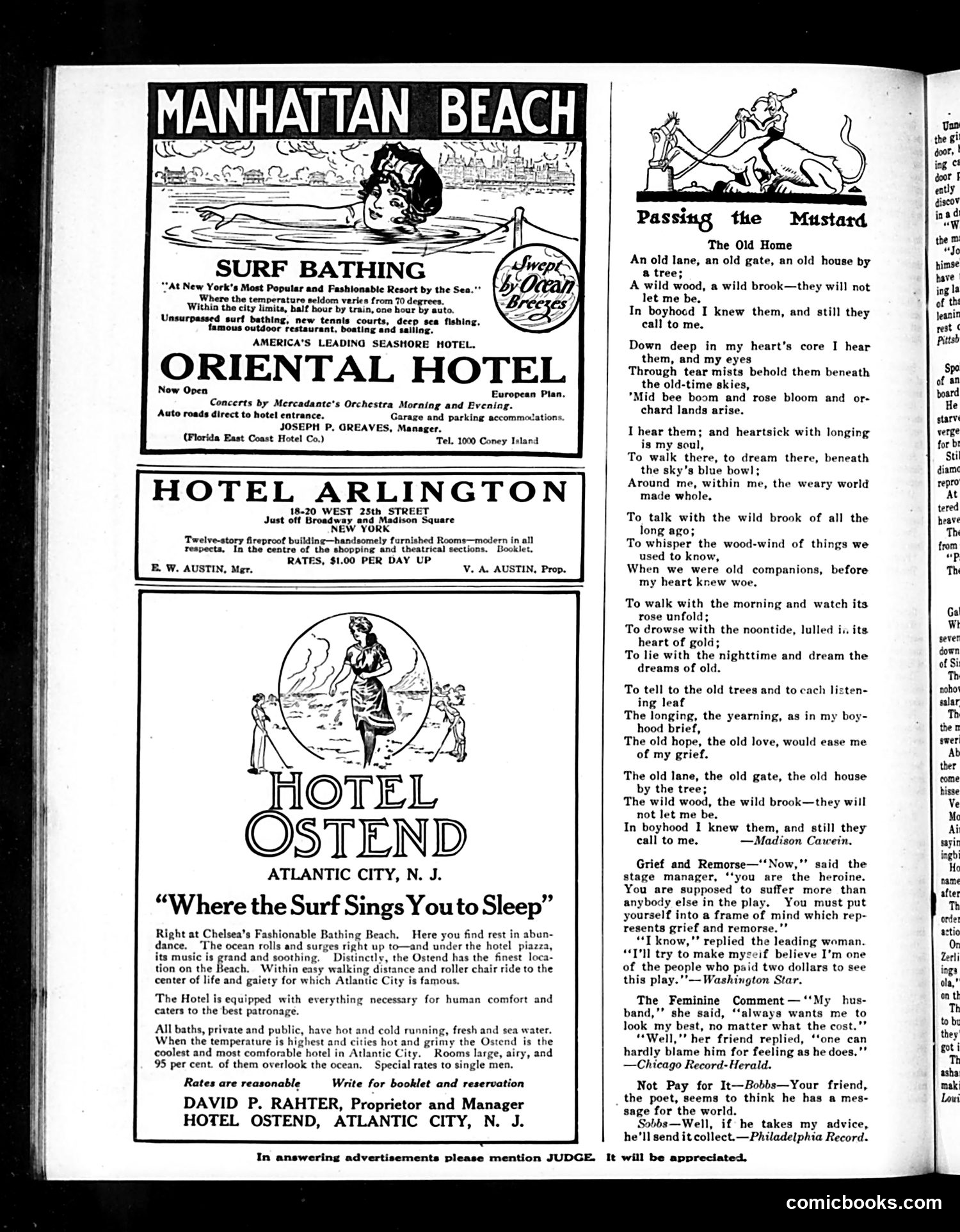
This page is primarily **advertisements for hotels and resorts** rather than political satire. The top features ads for Manhattan Beach's Oriental Hotel and Hotel Arlington in New York, emphasizing fashionable seaside leisure at the turn of the 20th century. The dominant ad is for **Hotel Ostend in Atlantic City**, using the poetic tagline "Where the Surf Sings You to Sleep"—typical period marketing targeting affluent tourists seeking relaxation and modern amenities (hot/cold running water, ocean views). The right column contains **"Passing the Mustard," a nostalgic poem by Madison Cawein** about yearning for childhood haunts, and two brief **theatrical jokes**: one about an actress feigning grief for a play, another about a wife maintaining appearance. These are light humor reflecting period gender dynamics and stage conventions. There is **no political satire or caricature visible**. This is essentially a lifestyle/entertainment page showcasing leisure culture and romantic sentimentality popular in early-1900s Judge magazine.
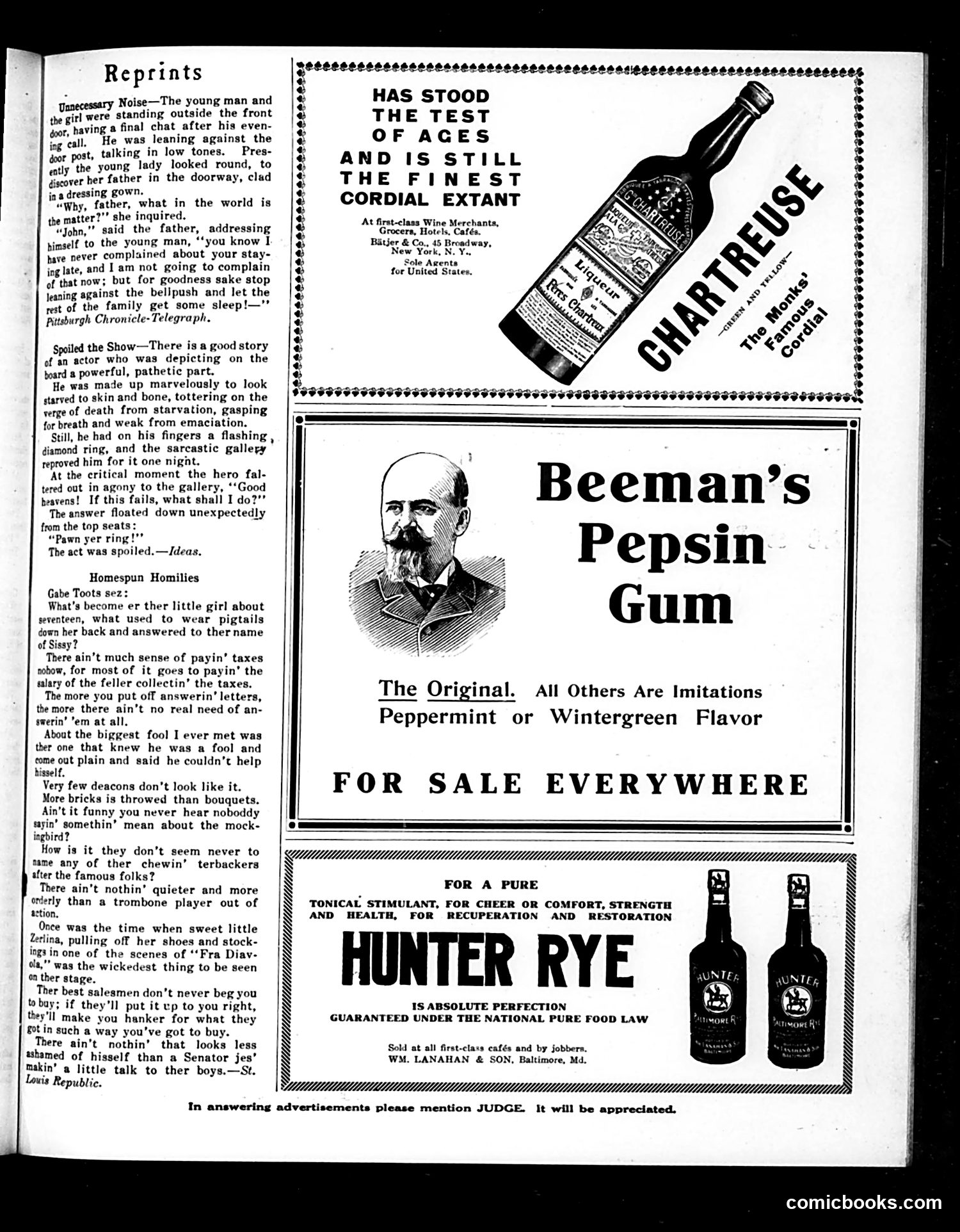
This page consists primarily of **advertisements and humor columns**, not political cartoons. The **content includes**: 1. **"Reprints" section**: Short humorous anecdotes—a father catching his daughter's boyfriend leaning against a doorbell, an actor's dramatic scene undermined by a visible diamond ring, and various folksy observations attributed to "Gabe Toots." 2. **Three advertisements**: - Chartreuse cordial (top right) - Beeman's Pensin Gum (center) - Hunter Rye whiskey (bottom) The humor is gentle, domestic comedy typical of early-20th-century periodicals—focusing on romantic situations, theatrical mishaps, and rural wisdom rather than political satire. The advertisements emphasize product longevity and quality ("stood the test of ages"). This appears to be a filler/reprint page designed to bridge editorial content while maximizing advertising revenue.
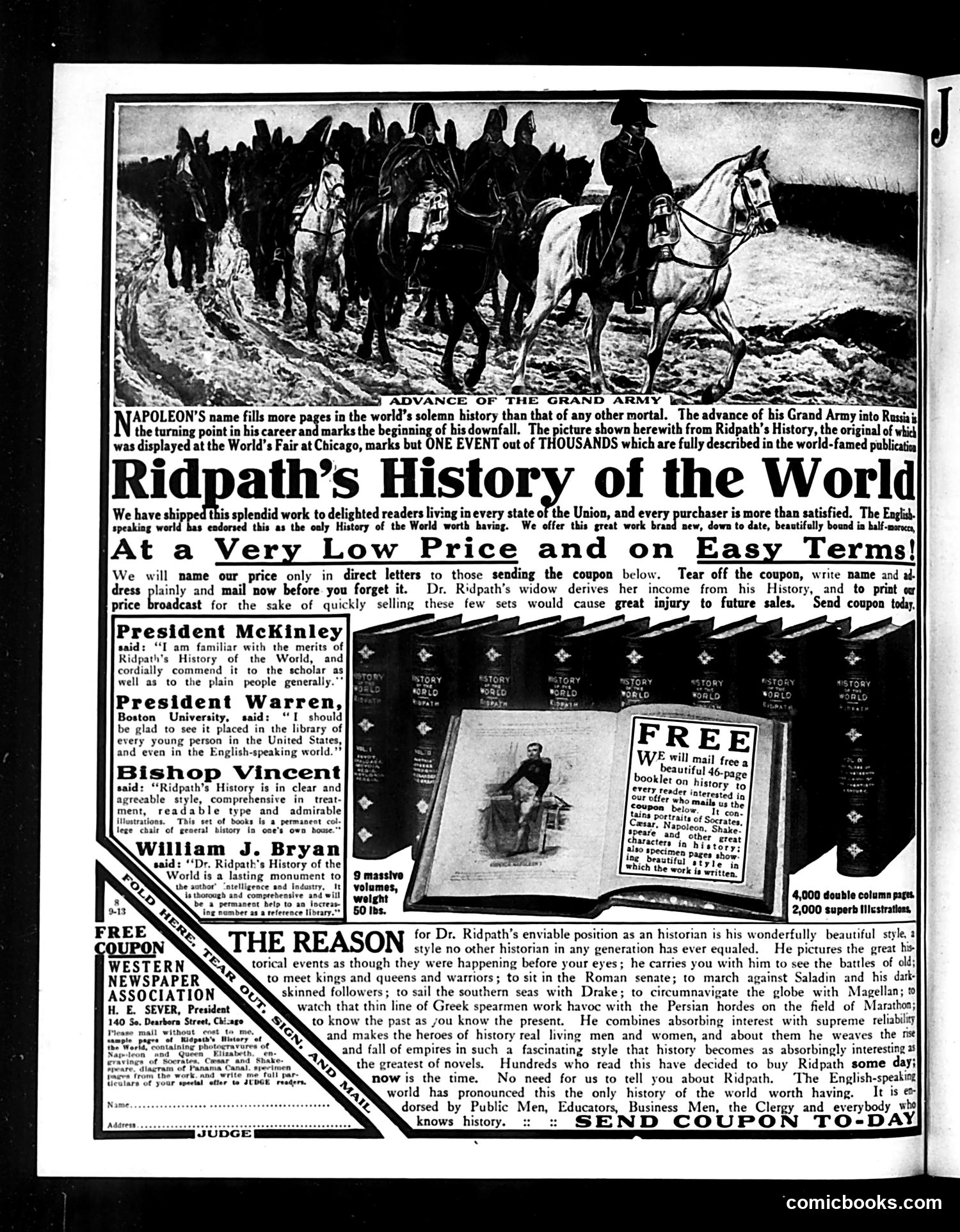
This is primarily **advertising**, not satire or political commentary. The page promotes "Ridpath's History of the World," a multi-volume encyclopedic history set. The top image depicts Napoleon's Grand Army—a historical illustration meant to exemplify the work's scope and quality. The text claims this single image represents "ONE EVENT out of THOUSANDS" described in Ridpath's comprehensive volumes. **The endorsements** from President McKinley, President Warren (Boston University), Bishop Vincent, and William J. Bryan serve as testimonials to the work's authority and appeal across educational, religious, and political spheres. These are real historical figures lending credibility. **The sales pitch** emphasizes affordability ("Very Low Price and on Easy Terms") while maintaining exclusivity by stating price is "only in direct letters"—a marketing tactic. A note that "Dr. Ridpath's widow derives her income from his History" adds emotional appeal and justification for the pricing strategy. This represents **early 20th-century direct-mail advertising** disguised within a magazine, targeting educated middle-class readers seeking comprehensive reference materials.