
Judge, 1913-08-09 · page 8 of 24
Judge — August 9, 1913 — page 8: what you’re looking at
What you’re looking at
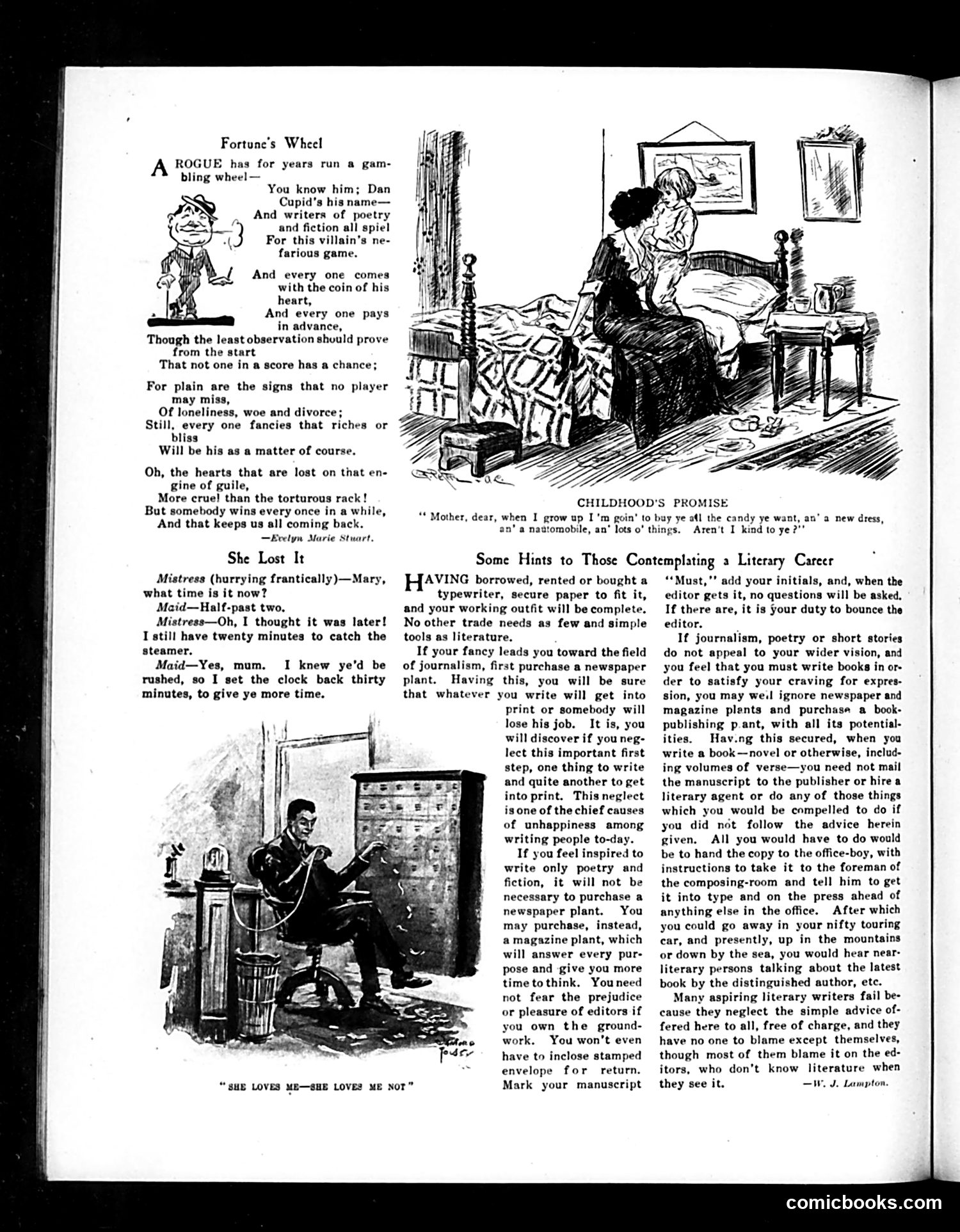
This page from Judge contains three distinct pieces: **"Fortune's Wheel"** — A poem satirizing romantic love as a rigged gambling game run by "Dan Cupid." The satire mocks how people desperately gamble their hearts despite obvious signs of failure (loneliness, divorce), yet keep returning hoping to be the rare winner. It's social commentary on the folly of romantic pursuit. **"She Lost It"** — A brief domestic comedy where a maid, trying to help her rushed mistress catch a steamer, sets the clock back thirty minutes—unknowingly making her *later*, not earlier. The joke relies on the maid's well-intentioned but misguided logic. **"Some Hints to Those Contemplating a Literary Career"** — Satirical advice for aspiring writers. The joke: to succeed in writing, you must *own* the publication outlet (newspaper plant, magazine plant, or book-publishing plant) rather than submit work to editors. It mocks both the difficulty of breaking into publishing and writers' naive assumptions about getting published.
📄 Transcribed text from this page (OCR, searchable)
Machine-transcribed from the original scan — historical spelling and the odd misread are preserved.
Fortune’s Wheel ROGUE has for years run a gam- bling wheel — You know him; Dan Cupid's his name— And writers of poetry and fiction all spiel For this v! "s ne- farious game. And every one comes with the coin of his heart, And every one pays in advance, Though the least observation should prove from the start That not one in a score has a chance; For plain are the signs that no player may miss, Of loneliness, woe and divorce; Still, every one fancies that riches or bliss Will be his as a matter of course. Oh, the hearts that are lost on that en- gine of guile, More crue! than the torturous rack! But somebody wins every once in a while, And that keeps us all coming back. —Evelyn Marie Stuart. She Lost It Mistress (hurrying frantically)—Mary, what time is it now? Maid—Half-past two. Mistress—Oh, I thought it was later! I still have twenty minutes to catch the steamer. Maid—Yes, mum. I knew ye'd be rushed, so I set the clock back thirty minutes, to give ye more time. “SHE LOVES ME—SHE LOVES ME NOT” CHILDHOOD'S PROMISE “* Mother, dear, when I grow up I'm goin’ to buy ye al the candy ye want, an’ a new dress, an’ a nautomobile, an’ lots o' things. Aren't I kind to ye?" Some Hints to Those Contemplating a Literary Career H4VvING borrowed, rented or bought a typewriter, secure paper to fit it, and your working outfit will be complete. No other trade needs as few and simple tools as literature, If your fancy leads you toward the field of journalism, first purchase a newspaper plant. Having this, you will be sure that whatever you write will get into print or somebody will lose his job. It is, you will discover if youneg- lect this important first step, one thing to write and quite another to get into print. This neglect is one of the chief causes of unhappiness among writing people to-day. If you feel inspired to write only poetry and fiction, it will not be necessary to purchase a newspaper plant. You may purchase, instead, a magazine plant, which will answer every pur- pose and give you more time tothink. Youneed not fear the prejudice or pleasure of editors if you own the ground- work. You won't even have to inclose stamped envelope for return. Mark your manuscript “*Must,”’ add your initials, and, when the editor gets it, no questions will be asked, If there are, it is your duty to bounce the editor. If journalism, poetry or short stories do not appeal to your wider vision, and you feel that you must write books in or- der to satisfy your craving for expres- sion, you may weil ignore newspaper and magazine plents and purchase a book- publishing p.ant, with all its potential- ities. Hav.ng this secured, when you write a book—novel or otherwise, includ- ing volumes of verse—you need not mail the manuscript to the publisher or hire a literary agent or do any of those things which you would be compelled to do if you did not follow the advice herein given, All you would have to do would be to hand the copy to the office-boy, with instructions to take it to the foreman of the composing-room and tell him to get it into type and on the press ahead of anything else in the office. After which you could go away in your nifty touring car, and presently, up in the mountains or down by the sea, you would hear near- literary persons talking about the latest book by the distinguished author, etc. Many aspiring literary writers fail be- cause they neglect the simple advice of- fered here to all, free of charge, and they have no one to blame except themselves, though most of them blame it on the ed- itors, who don’t know literature when they see it. —W. J. Lampton. comicbooks.com