
Judge, 1913-08-09 · page 12 of 24
Judge — August 9, 1913 — page 12: what you’re looking at
What you’re looking at
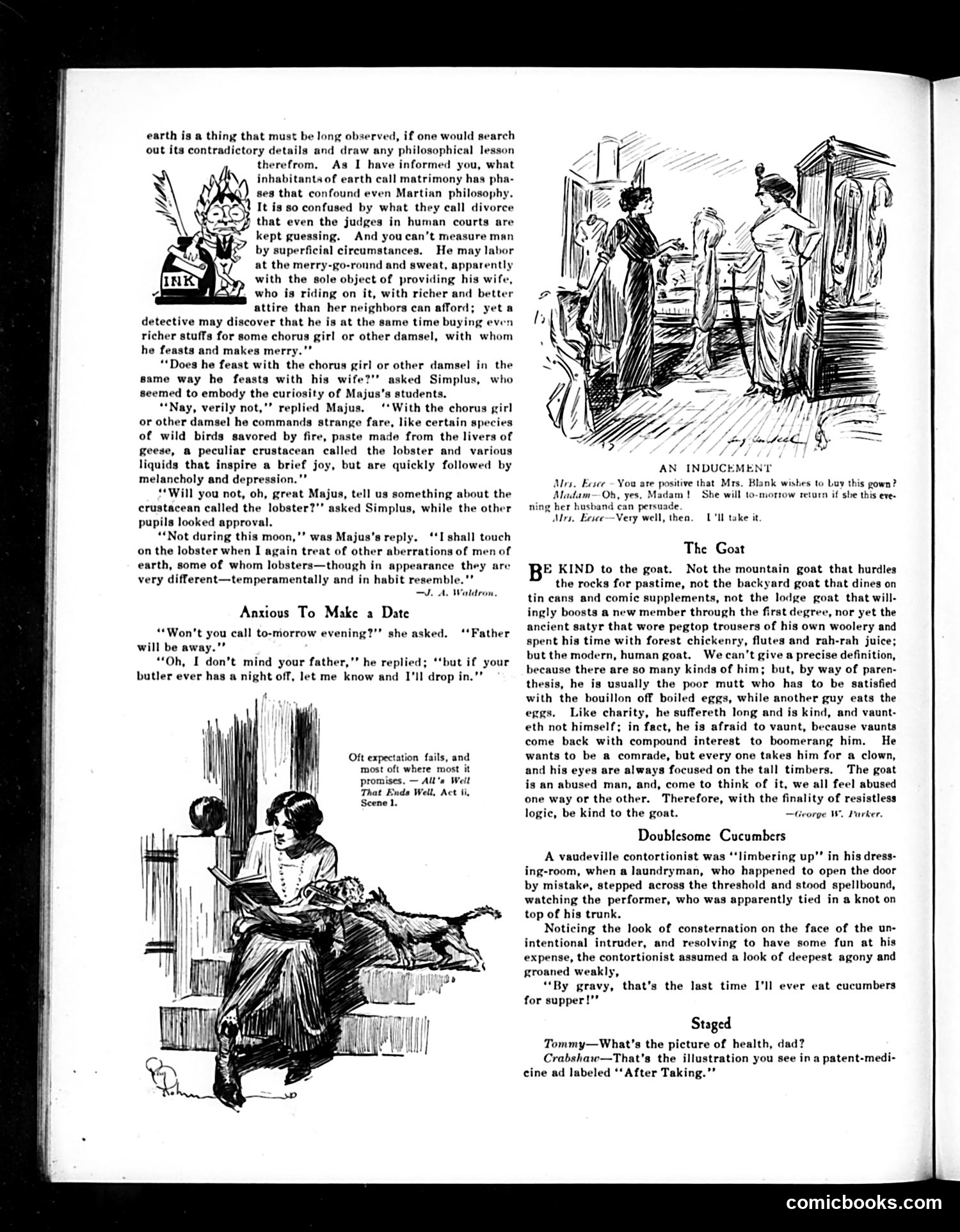
This Judge page contains multiple satirical pieces targeting early 20th-century social hypocrisy: **"Anxious To Make a Date"**: A young man courting a woman reveals his actual interest is the *butler*, not the father—suggesting he seeks opportunities with servants during time off. This mocks class pretense and infidelity. **"An Inducement"**: A shopkeeper manipulates a woman into buying a dress by implying her husband needs persuading. The satire targets both manipulative retail tactics and marital power dynamics. **"The Goat"**: Defines the "human goat" as the working-class man who sacrifices (eating cheap bouillon while others eat eggs) and accepts abuse without complaint. This sympathetic piece critiques how ordinary men absorb society's unfairness. **"Doublesome Cucumbers"**: A contortionist performing extreme positions is mistaken for someone in distress—satirizing vaudeville performers' physical extremity. The Martian dialogue frames matrimony and infidelity as absurd contradictions of human behavior, typical of Judge's observational humor about middle-class contradictions.
📄 Transcribed text from this page (OCR, searchable)
Machine-transcribed from the original scan — historical spelling and the odd misread are preserved.
earth is a thing that must be long observed, if one would search out its contradictory details and draw any philosophical lesson therefrom. As I have informed you, what inhabitants of earth call matrimony has pha- ses that confound even Martian philosophy. It is so confused by what they call divorce that even the judges in human courts are kept guessing. And youcan’t measure man by superficial circumstances. He may labor at the merry-go-round and sweat, apparently with the sole object of providing his wif who is riding on it, with richer and bett attire than her neighbors can afford; yeta detective may discover that he is at the same time buying even richer stuffs for some chorus girl or other damsel, with whom he feasts and makes merry."" ‘*Does he feast with the chorus girl or other damsel in the same way he feasts with his wife?” asked Simplus, who seemed to embody the curiosity of Majus’s students, “Nay, verily not,’ replied Majus. ‘*With the chorus girl or other damsel he commands strange fare, like certain species of wild birds savored by fire, paste made from the livers of geese, a peculiar crustacean called the lobster and various liquids that inspire a brief joy, but are quickly followed by melancholy and depression. ”” ‘Will you not, oh, great Majus, tell us something about the crustacean called the lobster?’’ asked Simplus, while the other pupils looked approval. “‘Not during this moon,’’ was Majus’s reply. ‘‘I shall touch on the lobster when I again treat of other aberrations of men of earth, some of whom lobsters—though in appearance they are very different—temperamentally and in habit resemble.’” —J. A, Waldron, Anxious To Make a Date “Won't you call to-morrow evening?’’ she asked. will be away. “Oh, I don’t mind your father,’’ he replied; ‘but ic Jour butler ever has a night off, let me know and I'll drop in. “Pather Oft expectation fails, and most oft where most it promises, — All's Weil That Enda Well, Act ti, Scene 1. AN INDUCEMENT You are positive that Mrs. Blank wishes to Luy this gown? Mrs, Exsee She will to-mortow return if she this eves Madam—Oh, yes, Madam ! ning her husband can persuade Mrs, Eesee—Nery well, then, L'll take it. The Goat BE KIND to the goat. Not the mountain goat that hurdles the rocks for pastime, not the backyard goat that dines on tin cans and comic supplements, not the lodge goat that will- ingly boosts a new member through the first degree, nor yet the ancient satyr that wore pegtop trousers of his own woolery and spent his time with forest chickenry, flutes and rah-rah juice; but the modern, human goat. We can't give a precise definition, because there are so many kinds of him; but, by way of paren- thesis, he is usually the poor mutt who has to be satisfied with the bouillon off boiled eggs, while another guy eats the eggs. Like charity, he suffereth long and is kind, and vaunt- eth not himself; in fact, he is afraid to vaunt, because vaunts come back with compound interest to boomerang him. He wants to be a comrade, but every one takes him for a clown, and his eyes are always focused on the tall timbers. The goat is an abused man, and, come to think of it, we all feel abused one way or the other. Therefore, with the finality of resistless logic, be kind to the goat. Parker. Doublesome Cucumbers A vaudeville contortionist was ‘‘limbering up’’ in his dress- ing-room, when a laundryman, who happened to open the door by mistake, stepped across the threshold and stood spellbound, watching the performer, who was apparently tied in a knot on top of his trunk. Noticing the look of consternation on the face of the un- intentional intruder, and resolving to have some fun at his expense, the contortionist assumed a look of deepest agony and groaned weakly, “By gravy, that’s the last time I'll ever eat cucumbers for supper !"’ George W. Staged Tommy—What's the picture of health, dad? Crabshaw—That's the illustration you see ina patent-medi- cine ad labeled ‘After Taking." comicbooks.com