
Judge, 1913-08-09 · page 11 of 24
Judge — August 9, 1913 — page 11: what you’re looking at
What you’re looking at
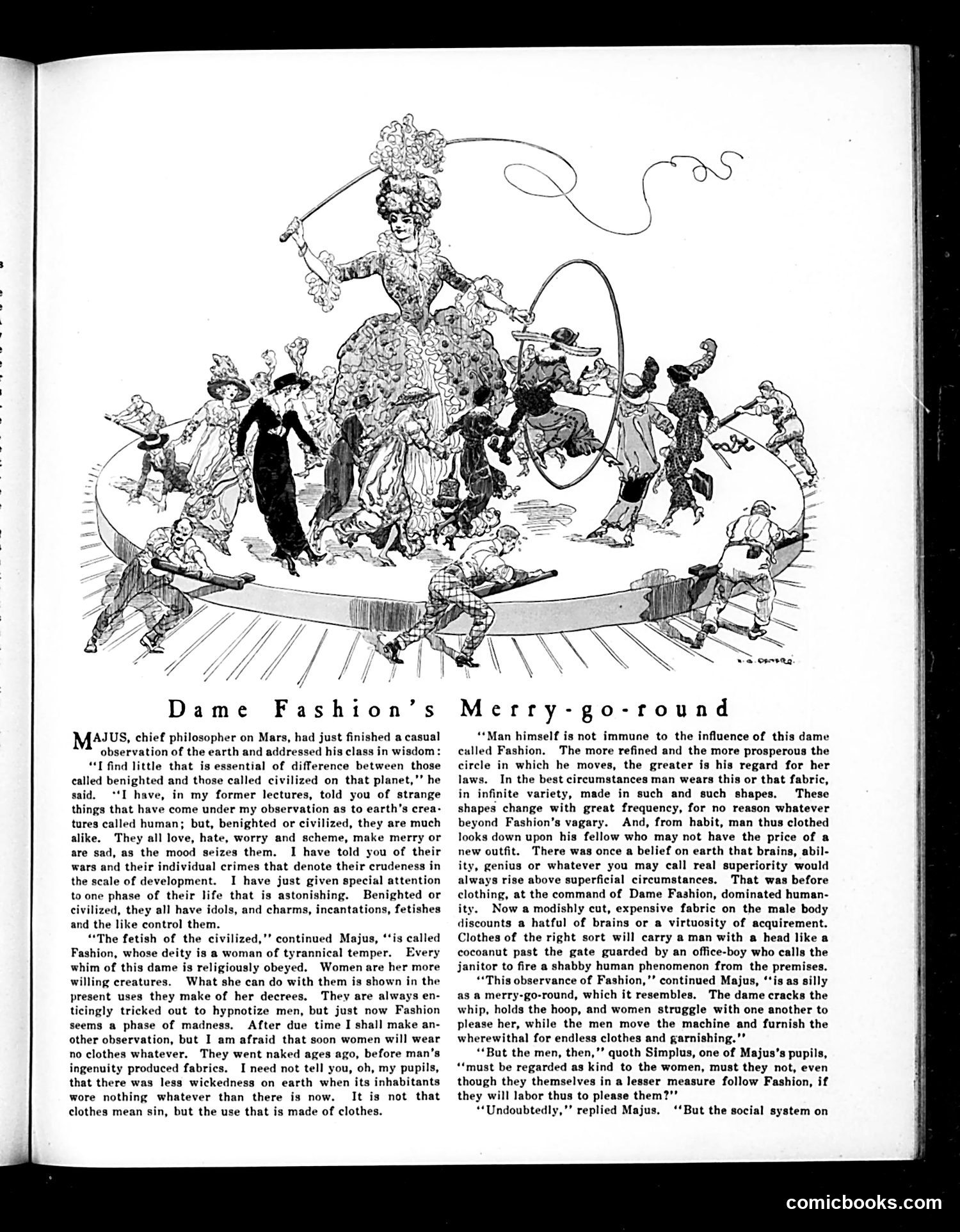
This satirical piece uses a Martian philosopher named Majus to critique fashion's grip on civilized society. The central conceit: a supposedly advanced Martian observes that "civilized" humans are no better than "benighted" peoples because both worship fetishes—and on Earth, that fetish is **Fashion**. The satire targets: - **Women's servitude to fashion**: depicted as mindlessly following a tyrannical "dame" who cracks a whip, making them competitors in an endless cycle - **Class materialism**: expensive clothes now trump talent or intelligence; a well-dressed fool beats a shabby genius - **Male complicity**: men enable this by funding women's endless wardrobe purchases, though they too follow fashion - **Circular absurdity**: the "merry-go-round" metaphor suggests fashion is pointless repetition—shapes change "for no reason whatever" The illustrated centerpiece shows elaborately dressed women and men in fashionable attire engaged in this circular dance, controlled by a large central female figure (Dame Fashion herself). The satire suggests civilized society's obsession with clothing and appearance is no more rational than primitive fetish worship.
📄 Transcribed text from this page (OCR, searchable)
Machine-transcribed from the original scan — historical spelling and the odd misread are preserved.
Dame Fashion’s AJUS, chief philosopher on Mars, had just finished a casual observation of the earth and addressed his class in wisdom: “I find little that is essential of difference between those called benighted and those called civilized on that planet,”’ he said. ‘tI have, in my former lectures, told you of strange things that have come under my observation as to earth's crea- tures called human; but, benighted or civilized, they are much alike. They all love, hate, worry and scheme, make merry or are sad, as the mood seizes them. I have told you of their wars and their individual crimes that denote their crudeness in the scale of development. I have just given special attention to one phase of their life that is astonishing. Benighted or civilized, they all have idols, and charms, incantations, fetishes and the like control them. “The fetish of the civilized,’’ continued Majus, ‘‘is called Fashion, whose deity is a woman of tyrannical temper. Every whim of this dame is religiously obeyed. Women are her more willing creatures. What she can do with them is shown in the present uses they make of her decrees. They are always en- ticingly tricked out to hypnotize men, but just now Fashion seems a phase of madness, After due time I shall make an- other observation, but I am afraid that soon women will wear no clothes whatever. They went naked ages ago, before man’s ingenuity produced fabrics. I need not tell you, oh, my pupils, that there was less wickedness on earth when its inhabitants wore nothing whatever than there is now. It is not that clothes mean sin, but the use that is made of clothes. Merry-go-round ‘Man himself is not immune to the influence of this dame culled Fashion. The more refined and the more prosperous the circle in which he moves, the greater is his regard for her laws. In the best circumstances man wears this or that fabric, in infinite variety, made in such and such shapes, These shapes change with great frequency, for no reason whatever beyond Fashion’s vagary. And, from habit, man thus clothed looks down upon his fellow who may not have the price of a new outfit. There was once a belief on earth that brains, abil- ity, genius or whatever you may call real superiority would always rise above superficial circumstances. That was before clothing, at the command of Dame Fashion, dominated human- ity. Now a modishly cut, expensive fabric on the male body discounts a hatful of brains or a virtuosity of acquirement. Clothes of the right sort will carry a man with a head like a cocoanut past the gate guarded by an office-boy who calls the janitor to fire a shabby human phenomenon from the premises. “This observance of Fashion,’’ continued Majus, ‘*is as silly as a merry-go-round, which it resembles. The dame cracks the whip, holds the hoop, and women struggle with one another to please her, while the men move the machine and furnish the wherewithal for endless clothes and garnishing.’’ ‘But the men, then,’’ quoth Simplus, one of Majus’s pupils, “must be regarded as kind to the women, must they not, even though they themselves in a lesser measure follow Fashion, if they will labor thus to please them?"’ “Undoubtedly,’’ replied Majus. ‘‘But the social system on comicbooks.com