
Judge, 1913-08-09 · page 4 of 24
Judge — August 9, 1913 — page 4: what you’re looking at
What you’re looking at
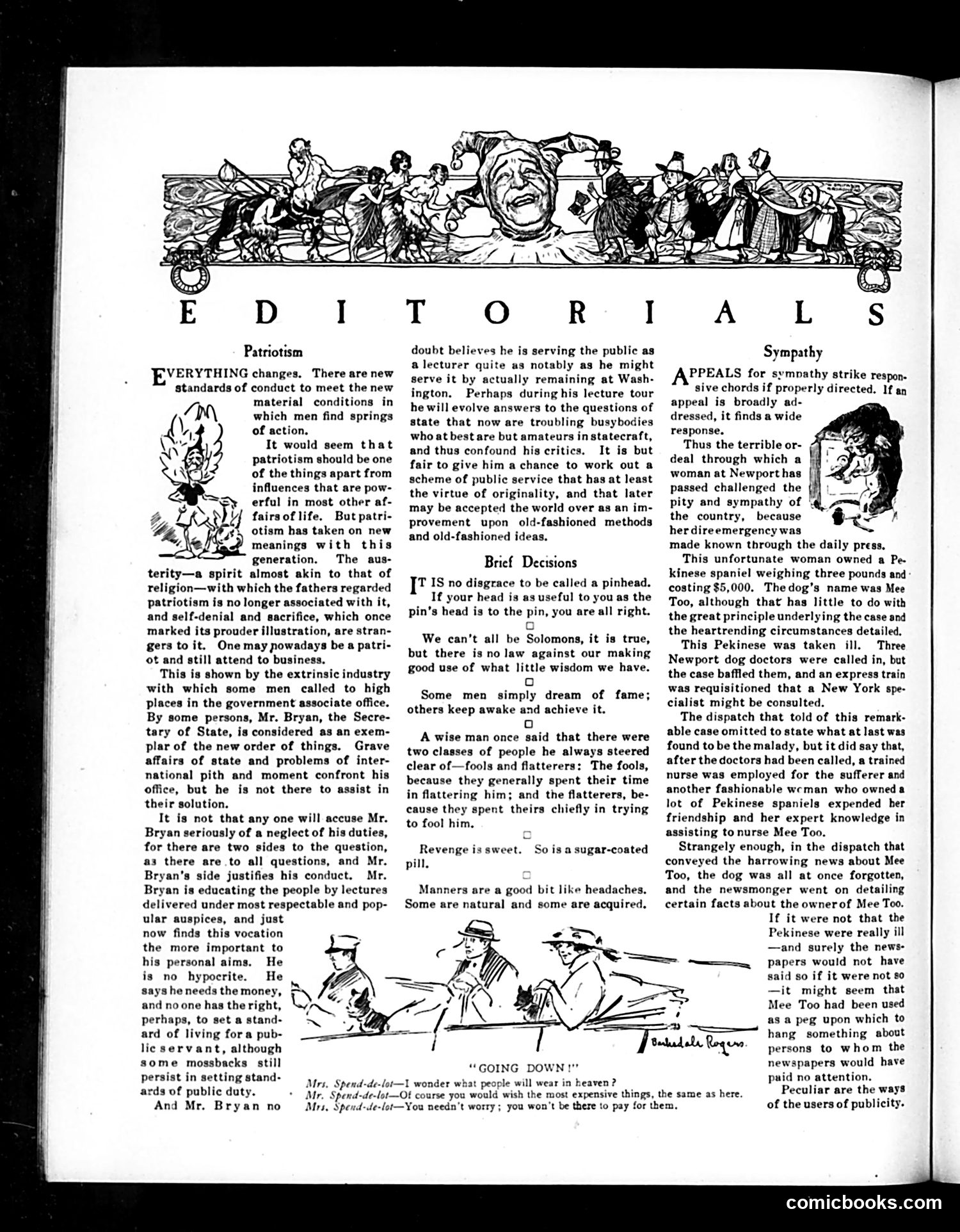
This editorial page critiques Secretary of State William Jennings Bryan's public lecture tours. The left column argues Bryan wrongly conflates patriotism with his personal political agenda, suggesting he uses his government position to promote himself rather than serve the public. The "Brief Decisions" section includes social commentary, particularly a story about a Pekinese dog named Miss Too whose owner faced embarrassment when the dog was involved in a scandal. The narrative satirizes how newspapers sensationalize trivial matters involving society figures. The bottom cartoon depicts three men discussing expensive clothing, likely mocking wealthy individuals' conspicuous consumption during a period when economic inequality was a social concern. Overall, the page attacks political self-promotion and media sensationalism.
📄 Transcribed text from this page (OCR, searchable)
Machine-transcribed from the original scan — historical spelling and the odd misread are preserved.
Patriotism EVERYTHING changes. There are new standards of conduct to meet the new material conditions in which men find springs of action. It would seem that patriotism should be one of the things apart from influences that are pow- erful in most other a’ fairsoflife. But patri- otism has taken on new meanings with this generation. The aus- terity—a spirit almost akin to that of religion—with which the fathers regarded patriotism is no longer associated with it, and self-denial and sacrifice, which once marked its prouder illustration, are stran- gers to it. One may nowadays be a patri- ot and still attend to business. This is shown by the extrinsic industry with which some men called to high places in the government associate office. By some persons, Mr. Bryan, the Secre- tary of State, is considered as an exem- plar of the new order of things. Grave affairs of state and problems of inter- national pith and moment confront his office, but he is not there to assist in their solution. It is not that any one will accuse Mr. Bryan seriously of a neglect of his duties, for there are two sides to the question, as there are to all questions, and Mr. Bryan's side justifies his conduct. Mr. Bryan is educating the people by lectures delivered under most respectable and pop- ular auspices, and just now finds this vocation the more important to his personal aims. He is no hypocrite. He says he needs the money, and noone has the right, perhaps, to set a stand- ard of living fora pub- lic servant, although some mossbacks still persist in setting stand- ards of public duty. And Mr. Bryan no doubt believes he is serving the public as a lecturer quite as notably as he might serve it by actually remaining at Wash- ington. Perhaps during his lecture tour he will evolve answers to the questions of state that now are troubling busybodies who at best are but amateurs instatecraft, and thus confound his critics. It is but fair to give him a chance to work out a scheme of public service that has at least the virtue of originality, and that later may be accepted the world over as an im- provement upon old-fashioned methods and old-fashioned ideas. Brief Decisions It IS no disgrace to be called a pinhead. If your head is as useful to you as the pin’s head is to the pin, you are all right. We can’t all be Solomons, it is true, but there is no law against our making good use of what little wisdom we have. 2] Some men simply dream of fame; others keep awake and achieve it. o A wise man once said that there were two classes of people he always steered clear of—fools and flatterers: The fools, because they generally spent their time in flattering him; and the flatterers, be- cause they spent theirs chiefly in trying to fool him. Revenge is sweet. pill. So is a sugar-coated Manners are a good bit like headaches, Some are natural and some are acquired, “GOING DOWN!" Mrs, Spend-de-lot—1 wonder what people will wear in heaven ? Mr. Spend-de-lot—Ot course you would wish the most expensive things, the same as here. Mrs, Spend-de-lot-—You needn't worry ; you won't be there to pay for them. Sympathy APPEALS for sympathy strike respon- sive chords if properly directed. If an appeal is broadly ad- dressed, it finds a wide response. Thus the terrible or- deal through which a i" woman at Newporthas [) passed challenged the { pity and sympathy of the country, because herdireemergency was made known through the daily press. This unfortunate woman owned a Pe. kinese spaniel weighing three pounds and costing $5,000. Thedog’s name was Mee Too, although that has little to do with the great principle underlying the case and the heartrending circumstances detailed, This Pekinese was taken ill. Three Newport dog doctors were called in, but the case baffled them, and an express train was requisitioned that a New York spe- cialist might be consulted. The dispatch that told of this remark- able case omitted to state what at last was found to be the malady, but it did say that, after the doctors had been called, a trained nurse was employed for the sufferer and another fashionable weman who owned a lot of Pekinese spaniels expended her friendship and her expert knowledge in assisting to nurse Mee Too. Strangely enough, in the dispatch that conveyed the harrowing news about Mee Too, the dog was all at once forgotten, and the newsmonger went on detailing certain facts about the ownerof Mee Too. If it were not that the Pekinese were really ill —and surely the news- papers would not have said so if it were not so it might seem that Mee Too had been used as a peg upon which to hang something about persons to whom the newspapers would have paid no attention. Peculiar are the ways of the users of publicity. comicbooks.com