
A complete issue · 24 pages · 1913
Judge — August 2, 1913
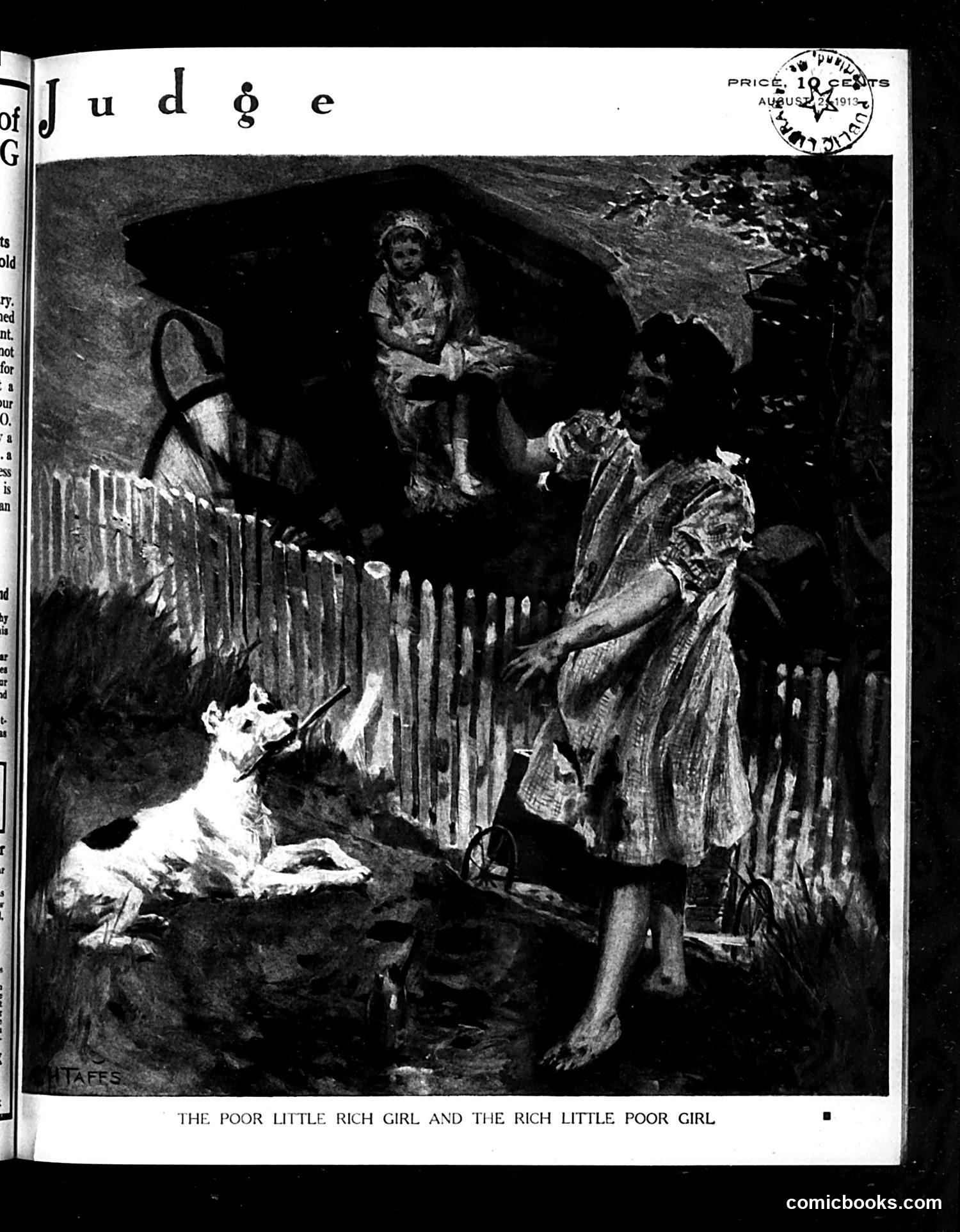
This illustration satirizes class inequality through a visual paradox. Two girls are shown meeting across a fence: one appears well-dressed but confined/constrained (the "poor little rich girl"), while the other, barefoot and in simple clothes (the "rich little poor girl"), appears freer and more comfortable despite material poverty. The dog and domestic setting suggest this contrasts a wealthy child's restricted, supervised life with a poor child's greater liberty and natural happiness. The satire suggests that wealth doesn't guarantee childhood joy or freedom—that emotional and social richness matter more than financial status. This reflects Progressive-era critiques of how wealthy families sometimes isolated children through excessive rules and discipline.
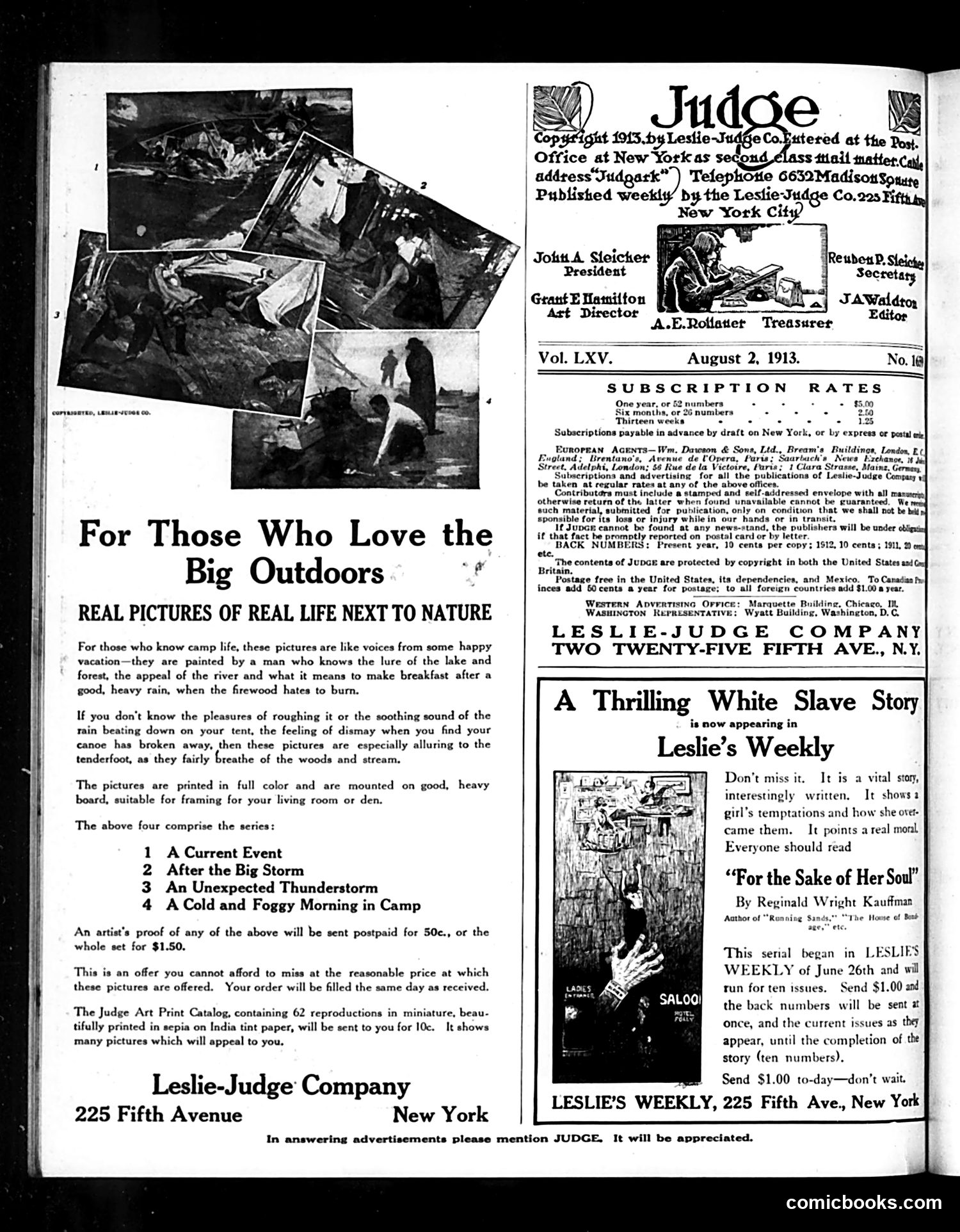
This page is primarily **advertising and editorial content** rather than political satire. The left side advertises outdoor camping pictures sold by Leslie-Judge Company—four color prints depicting nature scenes ("A Current Event," "After the Big Storm," etc.). The right side contains standard magazine masthead information and subscription rates, plus an advertisement for a serial story titled "A Thrilling White Slave Story" in Leslie's Weekly, authored by Reginald Wright Kauffman. The only visual element is a dramatic illustration accompanying the white slave story advertisement, showing a woman in distress at what appears to be a saloon. There is no political cartoon or satire evident on this particular page.
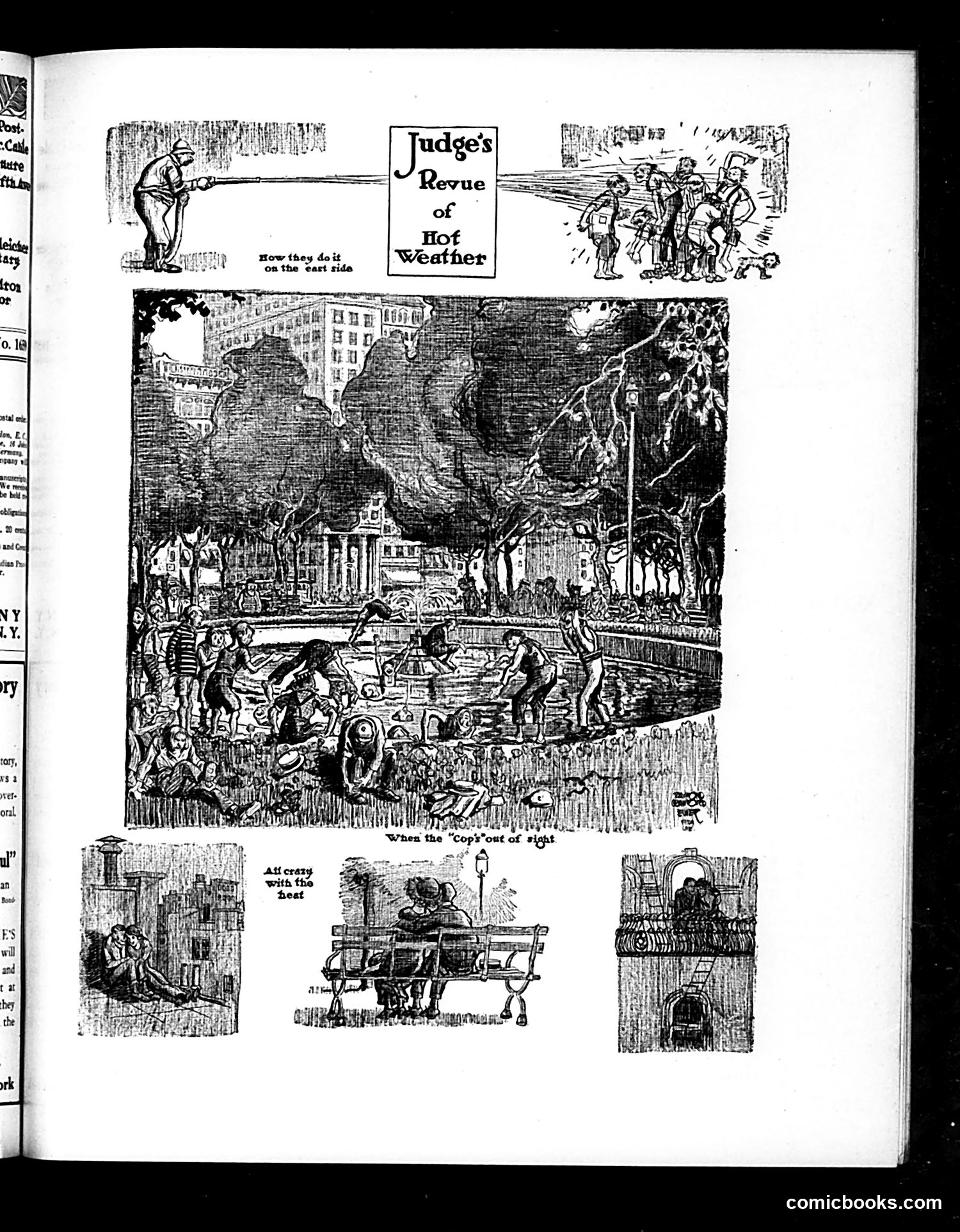
This satirical feature showcases how people cope during summer heat. The large central illustration depicts a public pool or bathing area packed with crowds seeking relief—men, women, and children in period swimming attire. The caption "When the 'Cops' out of sight" suggests people are swimming in unauthorized or restricted areas when police aren't watching, poking fun at urban heat-relief practices and rule-breaking during oppressive temperatures. The smaller vignettes below illustrate other hot-weather scenarios: someone suffering indoors ("All cozy with the heat"), people lounging on benches, and what appears to be city life during summer. The overall satire mocks how desperately people abandon propriety and rules to escape sweltering conditions—a relatable social commentary on summer behavior across class lines.
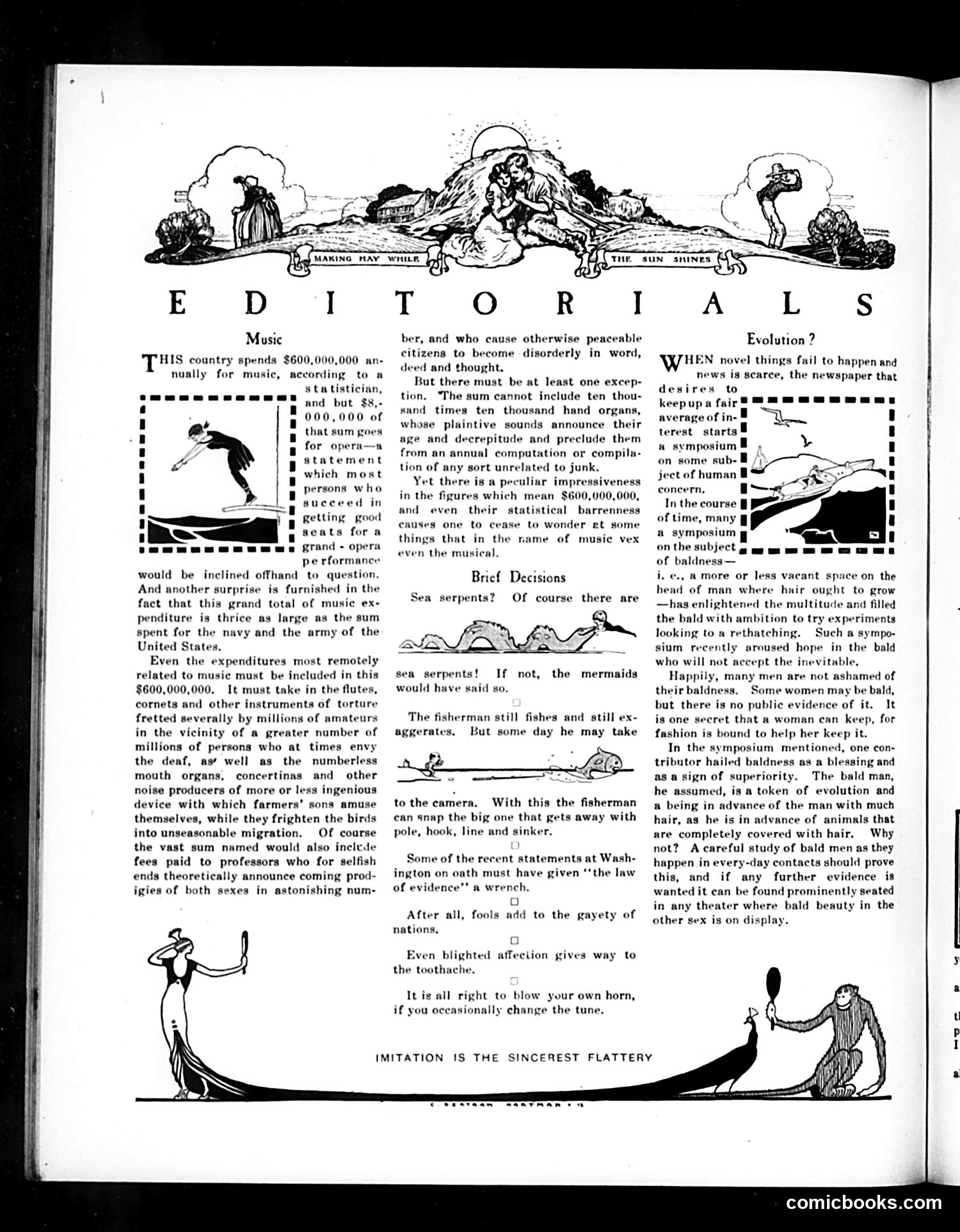
This page contains satirical commentary on several topics. The "Music" section mocks America's extravagant spending on opera and musical performance—$600 million annually—while criticizing the inclusion of "torture instruments" played by millions of musicians. It suggests this vast expenditure is disproportionate to actual cultural benefit. The "Evolution?" section satirizes debates about baldness, suggesting that if men evolved hair loss, women should accept male baldness as a sign of superiority and evolution. This appears to ridicule pseudo-scientific justifications for physical traits. "Brief Decisions" uses humorous vignettes (sea serpents, fishermen) and commentary on Washington oath-taking to make light observations about contemporary news and politics. The illustrations throughout employ Judge's characteristic satirical cartooning style.
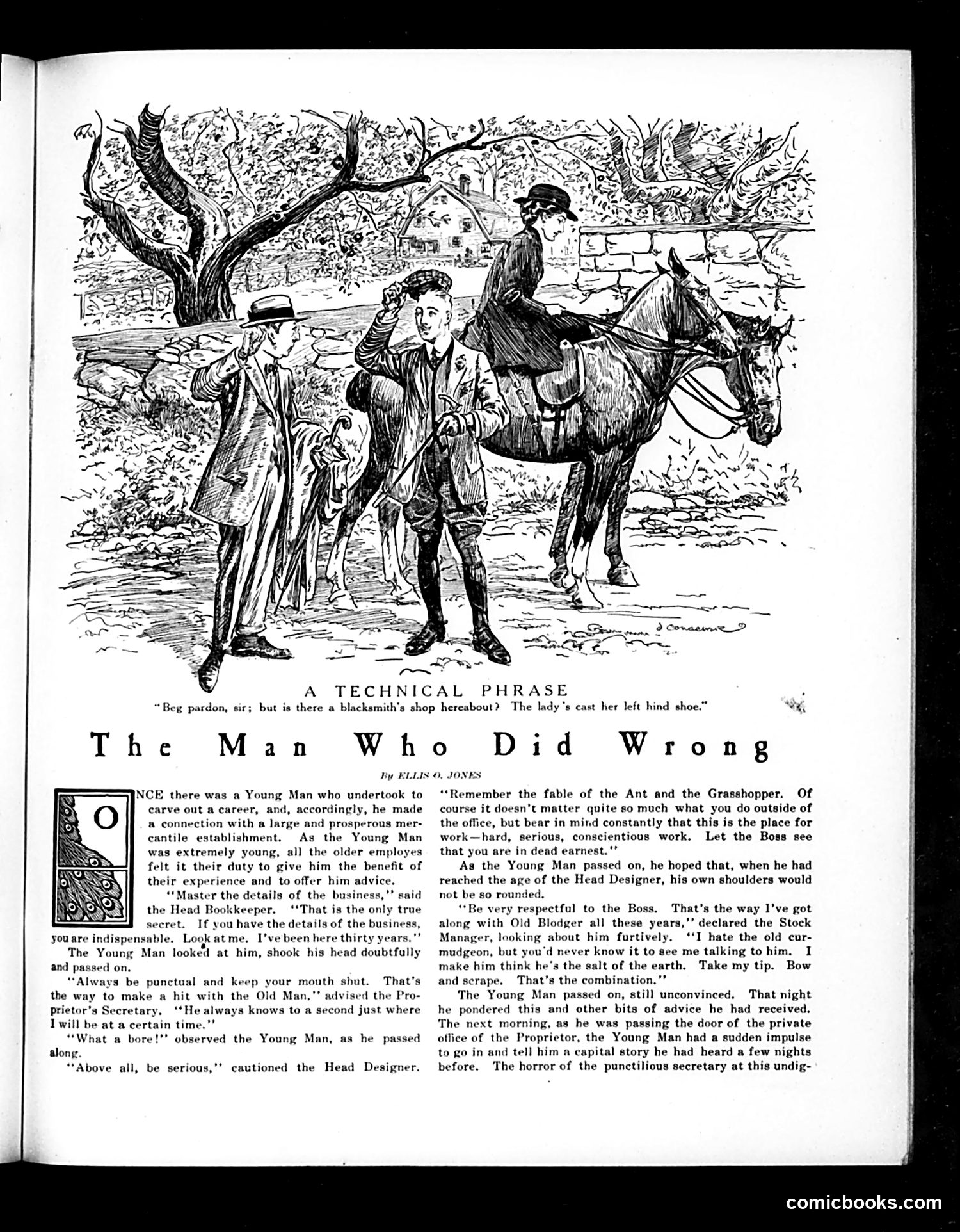
**The Cartoon:** The top illustration titled "A Technical Phrase" depicts a man asking a blacksmith for directions, with the caption: "Beg pardon, sir; but is there a blacksmith's shop hereabout? The lady's cast her left hind shoe." **The Joke:** This is a pun on equestrian terminology. "Cast a shoe" means a horse lost its horseshoe—a literal, practical problem. The humor lies in the man's overly formal, technical phrasing of a simple situation, making it sound more serious or dramatic than it is. The woman on horseback appears unimpressed with his verbose language. **The Story Below:** Ellis O. Jones's story follows a young man receiving conflicting workplace advice from superiors—"master the details," "be serious," "keep quiet"—setting up what appears to be a cautionary tale about navigating office politics.
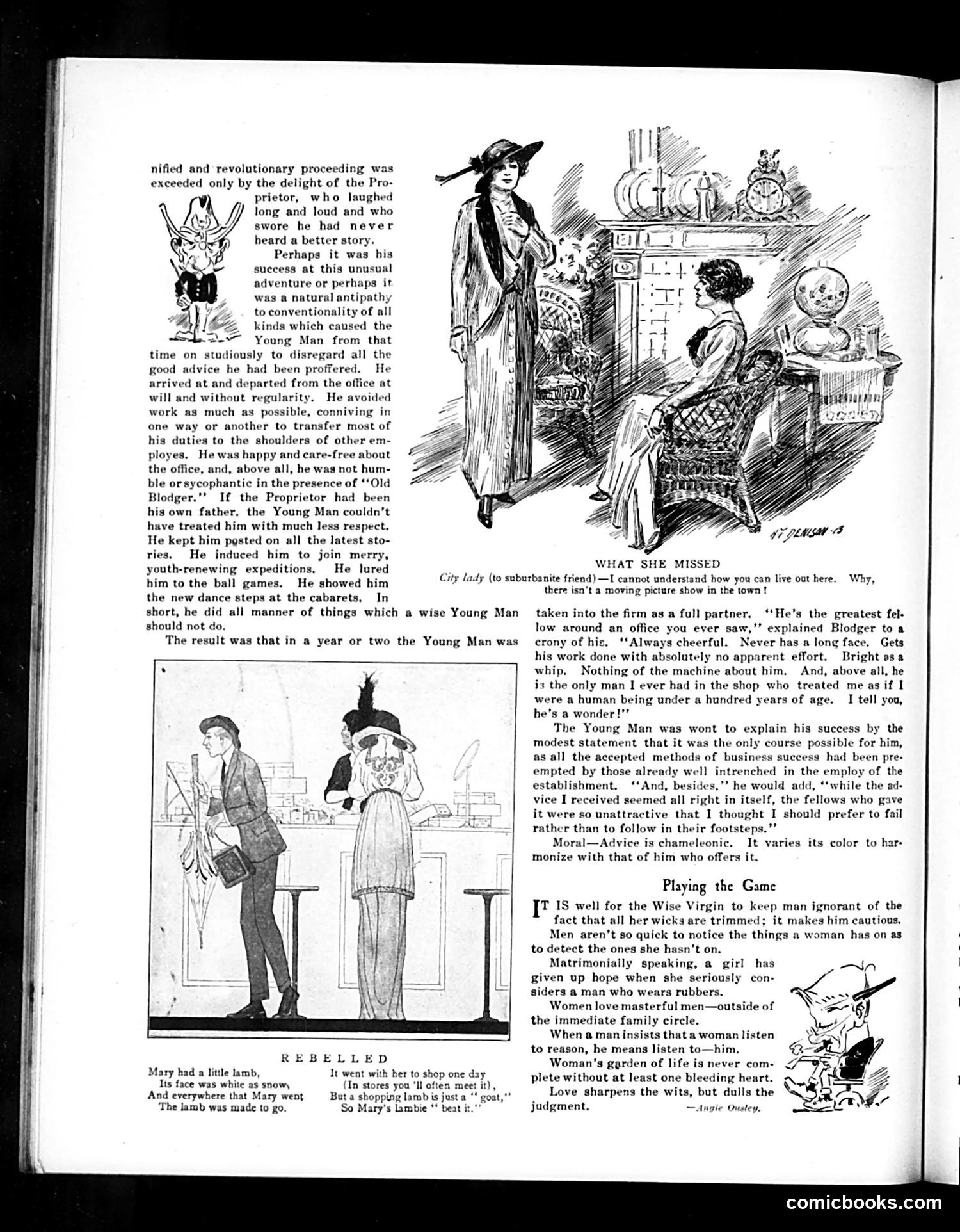
This *Judge* magazine page satirizes workplace social dynamics and gender relations in early 20th-century America. **Main Story ("Rebelled"):** A young office worker succeeds by deliberately *ignoring* conventional business advice—avoiding formality, shirking duties, treating his boss as a friend rather than authority figure. His proprietor "Old Blodger" rewards this irreverence, eventually making him a partner. The satire mocks both the young man's insubordination and the boss's weakness for flattery and camaraderie over professional propriety. The moral warns that advice's value depends on the adviser's character, not universal principles. **Secondary Cartoons:** "What She Missed" jokes that city women prioritize entertainment (movies) over suburban life. "Mary Had a Little Lamb" plays on the nursery rhyme, suggesting the "lamb" is actually a "goat"—urban slang for a dupe. **"Playing the Game":** Satirical aphorisms about courtship and marriage, reflecting period attitudes: women hide their artifices, men miss obvious details, and matrimonial success requires feminine strategy and male obtuseness. The overall tone mocks workplace hierarchies and romantic conventions.
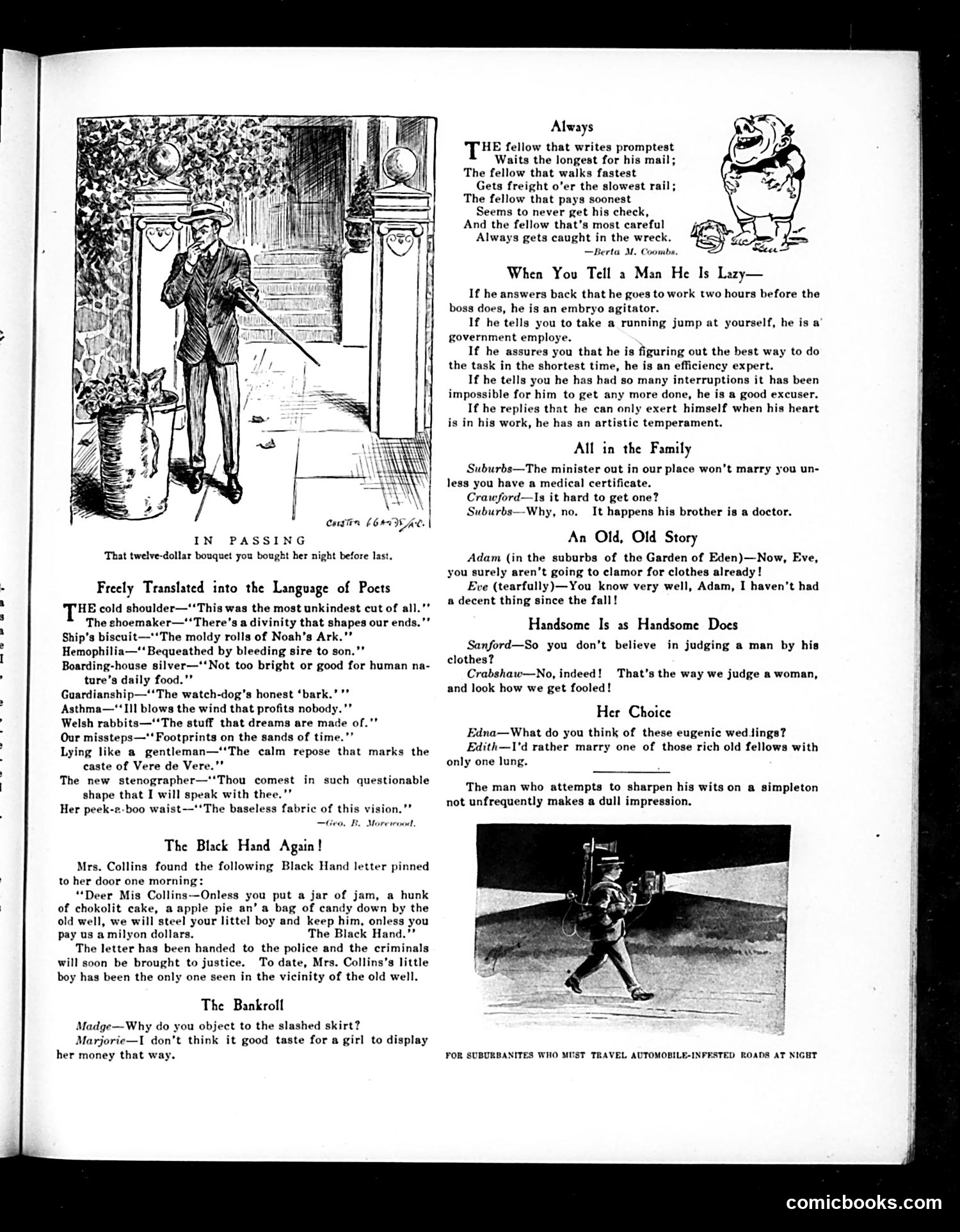
This page from the satirical magazine *Judge* contains several types of humor typical of early 20th-century American satire: **Main Cartoon ("In Passing"):** A well-dressed man holds a potted plant, illustrating the joke that an expensive bouquet wilts quickly—a commentary on wasted money on ephemeral romantic gestures. **"Freely Translated into the Language of Poets":** A series of humorous redefinitions using flowery language to mock everyday annoyances (boarding-house silverware, stenographers, revealing fashion). **"The Black Hand Again!":** Parodies extortion threats from the "Black Hand" mafia organization by presenting an absurdly illiterate ransom note. The joke: the kidnapper is so incompetent that only the boy has been spotted near the well—implying the threat is hollow. **Social Commentary:** Other pieces mock suburban pretension, gender stereotypes (women caring about displaying wealth through fashion), and marriage customs. The material reflects early 1900s anxieties about labor ("embryo agitators," government workers), efficiency movements, and class distinctions. The humor relies on observational satire about daily life rather than specific political events.
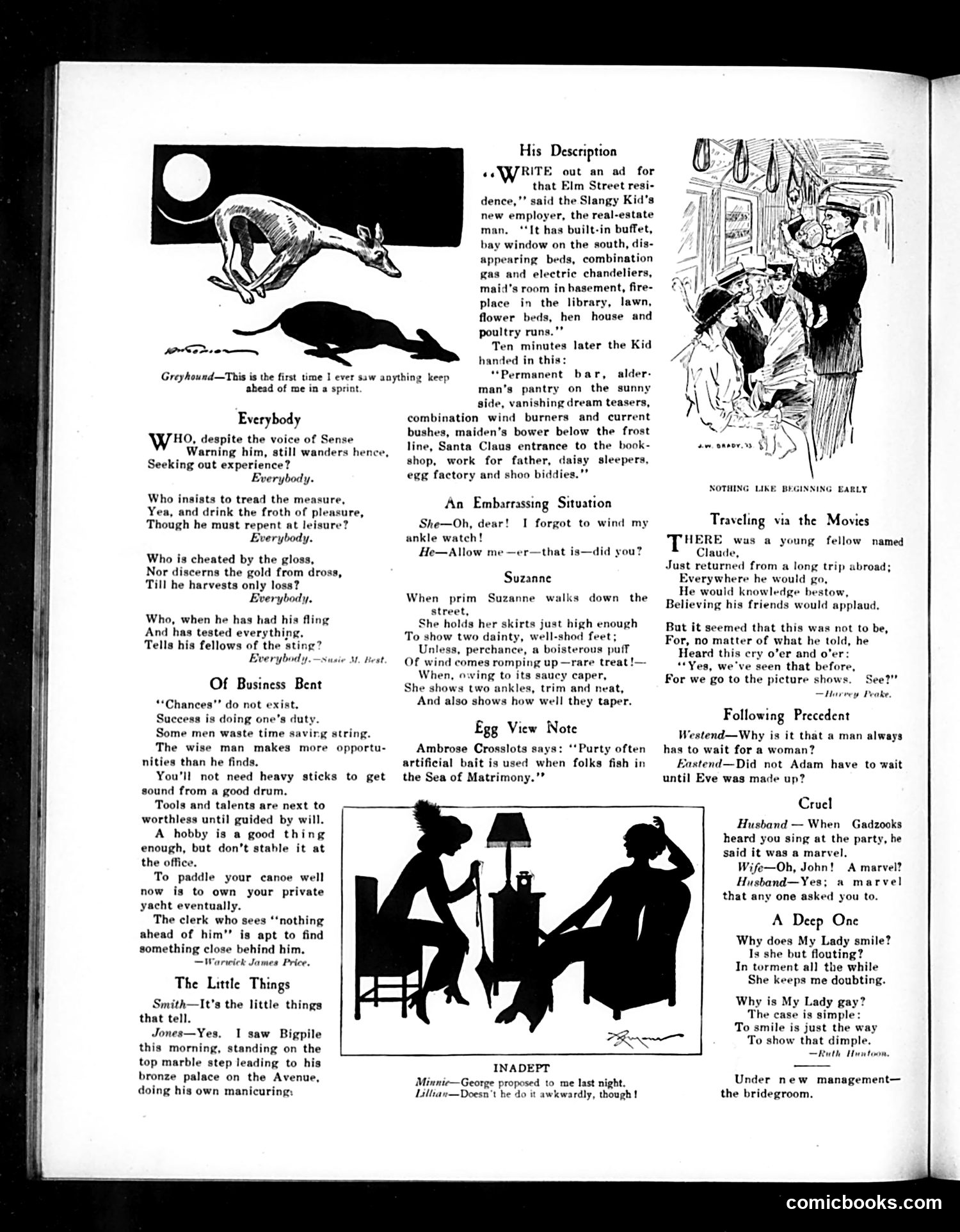
This page contains multiple satirical pieces typical of early 20th-century humor magazine content: **"His Description"**: A real estate agent's ad gets humorously rewritten by a "Slangy Kid" employee. The original polite real estate language ("built-in buffet," "disappearing beds") becomes crude colloquialisms ("permanent bar," "vanishing dream teasers," "shoo bidies"). The satire mocks both poor copywriting and working-class slang. **"Suzanne" poem**: Light social commentary on women's modesty and fashion—how Suzanne carefully controls her skirt length until wind exposes her ankles, which she then reveals don't look bad. **"Traveling via the Movies"**: A young man returning from abroad constantly name-drops his travels, but friends interrupt with "we saw that before—we go to picture shows," suggesting cinema had made the world accessible even to those who'd never traveled. **Remaining pieces**: Brief jokes about waiting for women, marriage, singing talent, and proposals—typical domestic humor of the era. The page reflects early cinema's cultural impact and period attitudes toward gender and class.
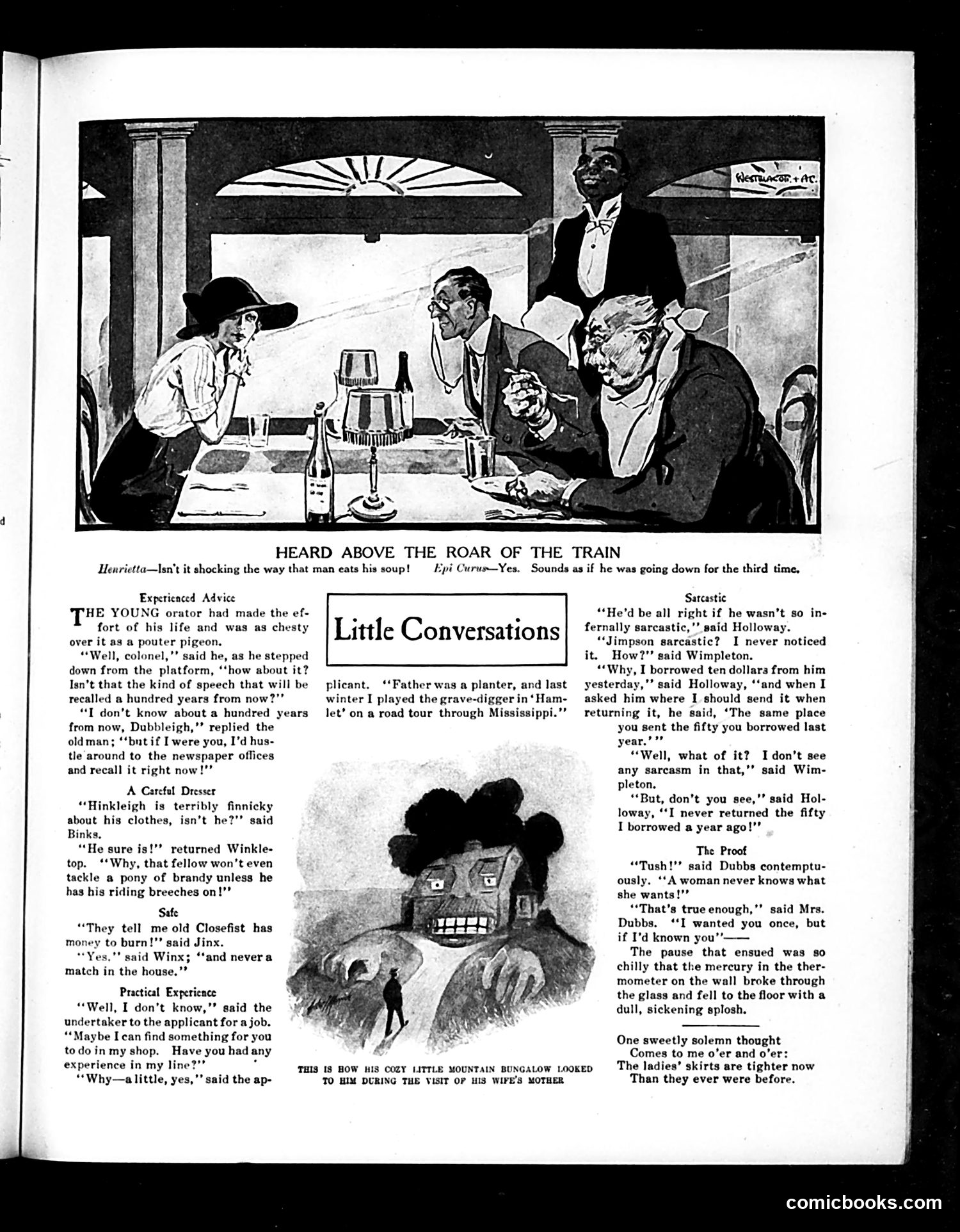
This is a collection of brief joke vignettes typical of early-20th-century American humor magazines. The page satirizes social pretension and marital dynamics: **Top cartoon**: Mocks etiquette obsession—a woman criticizes a man's soup-eating technique while traveling by train, the implication being her own manners are equally questionable. **Individual jokes** target: - **Inexperienced speakers** seeking validation ("recall it right now") - **Excessive fastidiousness** (a man won't drink brandy without proper riding clothes) - **Miserliness** (wealthy but won't buy matches) - **Sarcasm in lending** (a man's cutting remark about unpaid debts) - **Women's indecision** (though Mrs. Dubbs delivers a witty comeback) **Bottom illustration**: Shows a mountain bungalow that appears grotesquely distorted—captioned as how it looked to the husband during his mother-in-law's visit, humorously exaggerating domestic stress. **Final joke**: Observes women's fashion (tighter skirts), treating it as a social phenomenon worth commentary. The humor relies on recognizable social types and domestic annoyances of the era.
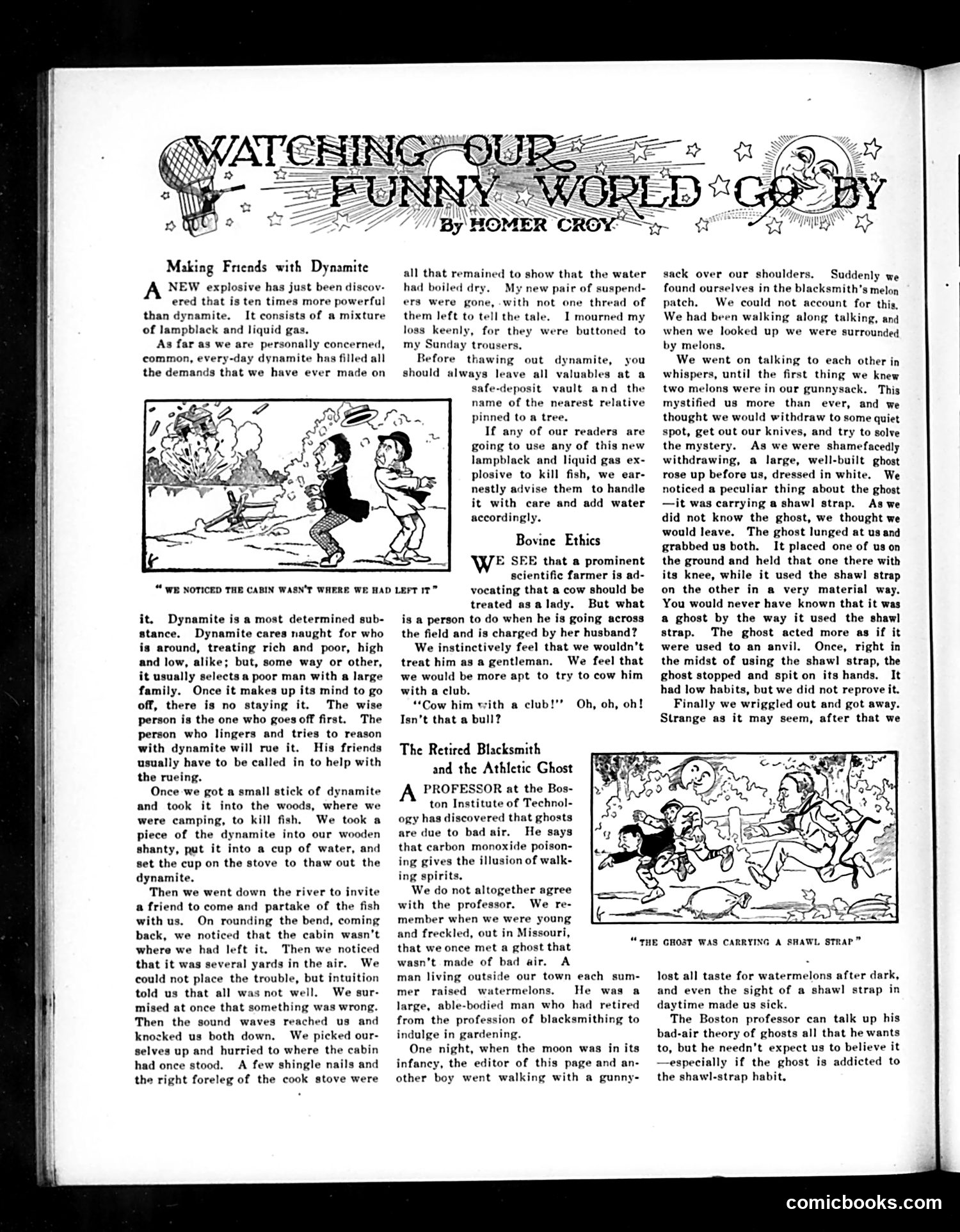
This is a humorous essay-and-cartoon page from Judge magazine featuring three unrelated comic pieces by Homer Croy. **"Making Friends with Dynamite"** tells a slapstick anecdote about the author attempting to thaw dynamite on a stove while camping—the cabin explodes while he's away. The joke relies on readers understanding dynamite's unpredictability and the physical comedy of the explosion destroying everything except "the right foreleg of the cook stove." **"Bovine Ethics"** satirizes a scientist's suggestion that cows deserve genteel treatment. The author argues you can't treat a charging bull like a gentleman, then makes a pun: "Cow him with a club!"—a play on the phrase "cow him" (intimidate) versus actual cattle. **"The Retired Blacksmith and the Athletic Ghost"** mocks a Boston professor's theory that ghosts result from carbon monoxide poisoning. The author recounts sneaking into a melon patch as a youth with a gunny sack (presumably to steal melons) and encountering the retired blacksmith-turned-farmer acting as a "ghost" to protect his crop. All three pieces use exaggeration and wordplay typical of early-20th-century American humor magazines.
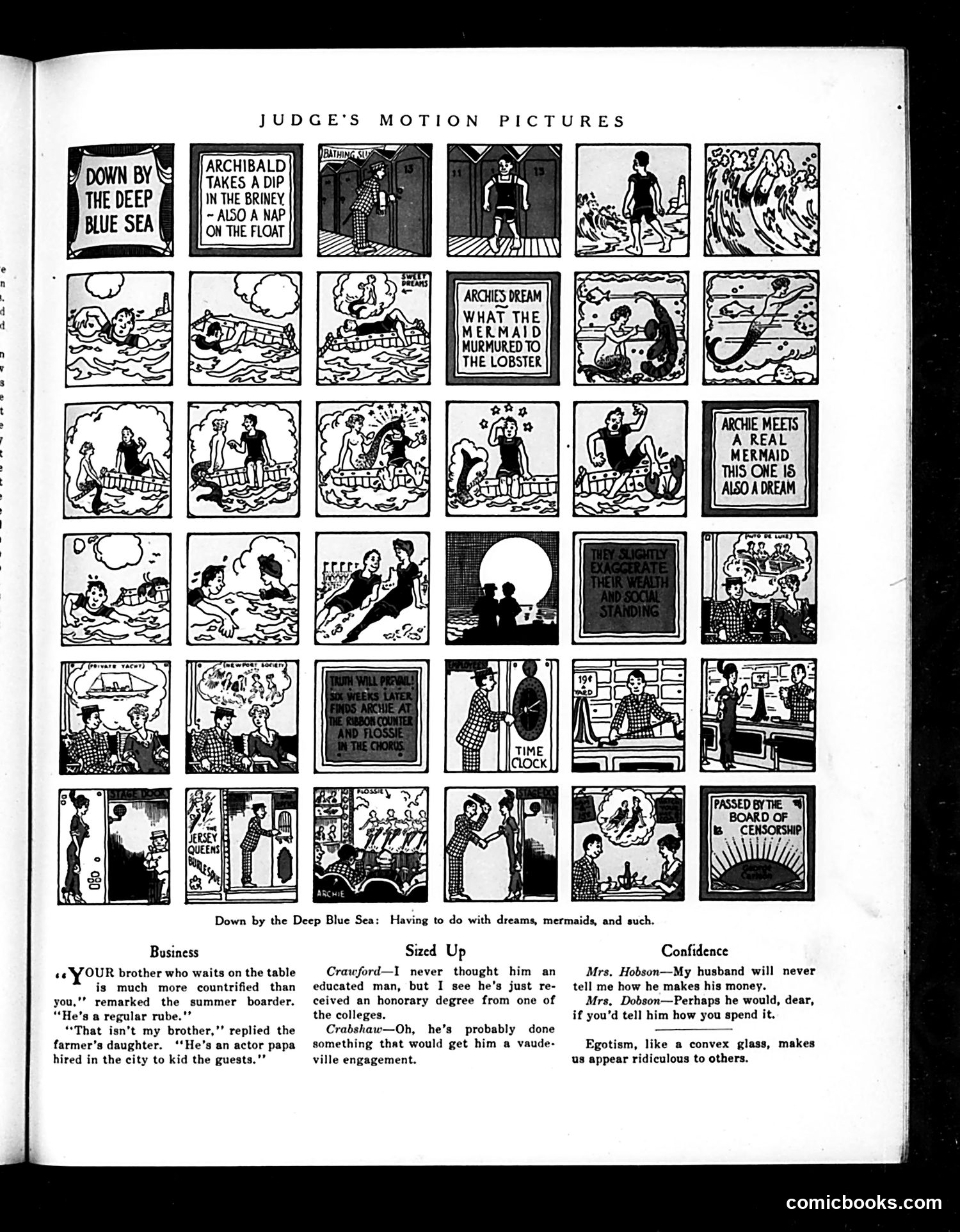
This page presents a silent-film-style comic strip showing a dreamlike narrative involving mermaids and underwater adventures. The sequential panels follow characters encountering fantastical sea creatures and scenarios, including what appears to be Archie's dream sequence and encounter with an actual mermaid. Below are three brief satirical dialogue jokes typical of Judge's humor: **"Business"** mocks social pretension: a summer boarder dismisses a waiter as "countrified," but the farmer's daughter reveals the waiter is actually a hired actor—suggesting city people are gullible and easily fooled by appearance. **"Sized Up"** satirizes empty credentials: someone receives an honorary college degree despite being uneducated, likely through vaudeville connections rather than merit. **"Confidence"** uses ironic wordplay about marital finances and secrecy, suggesting both spouses hide their spending habits from each other. The overall tone reflects early 20th-century middle-class anxieties about social climbing, education's value, and domestic relationships.
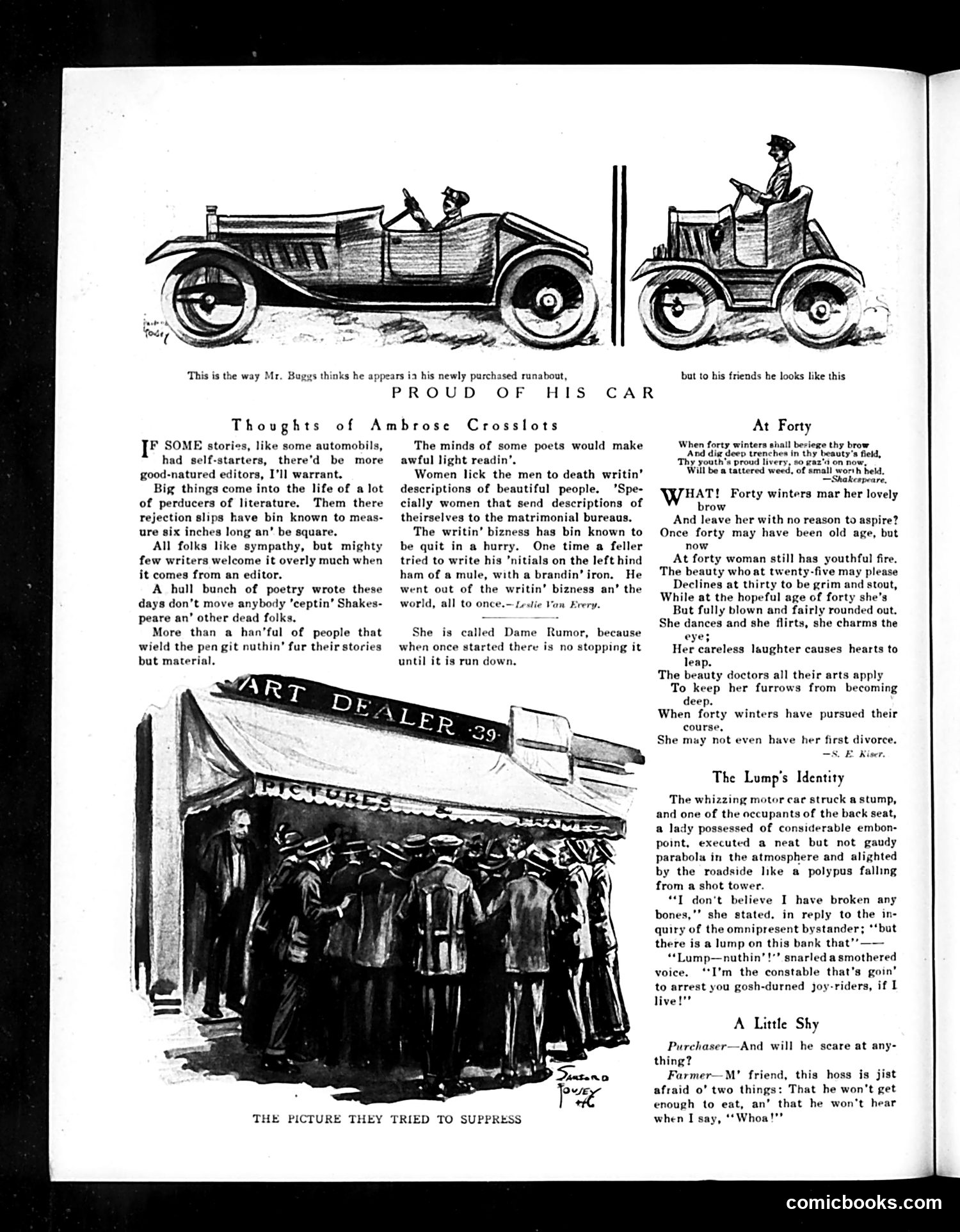
This page satirizes early automobile culture and contains several unrelated humorous pieces typical of Judge magazine. **Top cartoon**: "Proud of His Car" contrasts Mr. Buggs's self-image (left—dignified in his new runabout) with how his friends actually perceive him (right—comically cramped and awkward). It mocks nouveau riche automobile owners and their pretensions. **Left illustration**: "The Picture They Tried to Suppress" depicts a crowded art dealer's window, likely satirizing censorship or public controversy around displayed artwork, though the specific reference is unclear. **Text pieces**: "Thoughts of Ambrose Crosslots" offers folksy editorial commentary on writers and poets using dialect humor. "At Forty" is a poem celebrating women's vitality at middle age, countering Shakespeare's pessimism about aging. "The Lump's Identity" and "A Little Shy" are brief comic anecdotes about motor-car accidents and horse trading. The page reflects Judge's mix of automotive satire, literary commentary, and rural Americana humor typical of early 20th-century American satirical magazines.
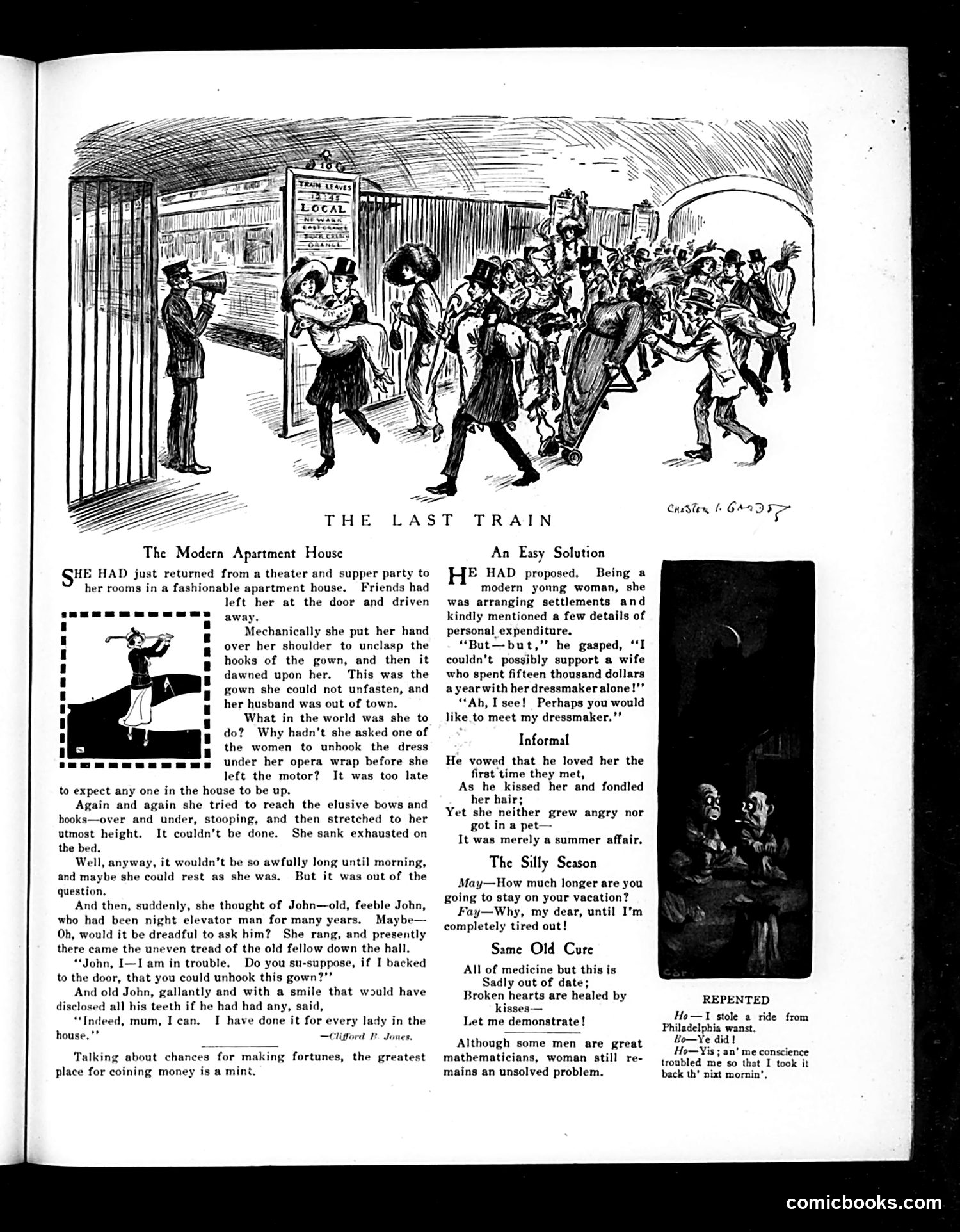
This page from *Judge* contains three satirical pieces mocking early 20th-century gender and courtship norms: **"The Modern Apartment House"** depicts a woman unable to unfasten her dress after an evening out, with her husband away. The joke's twist: the elderly elevator operator cheerfully admits he's unhooked dresses for "every lady in the house"—implying widespread infidelity among fashionable apartment dwellers. The satire targets both the supposed moral looseness of modern urban life and the absurdity of women's impractical fashion. **"An Easy Solution"** mocks a young woman proposing a solution to her fiancé's concerns about her fifteen-thousand-dollar annual dressmaking budget: he should simply meet her dressmaker—implying the dressmaker (not the woman) is the real relationship. The satire targets women's extravagant spending habits and the emerging "modern woman." **"The Silly Season"** and minor pieces offer quick jokes about vacation length, heartbreak cures, and conscience—typical filler humor. The cartoons collectively satirize urban modernity, women's independence, and changing courtship practices as socially destabilizing.
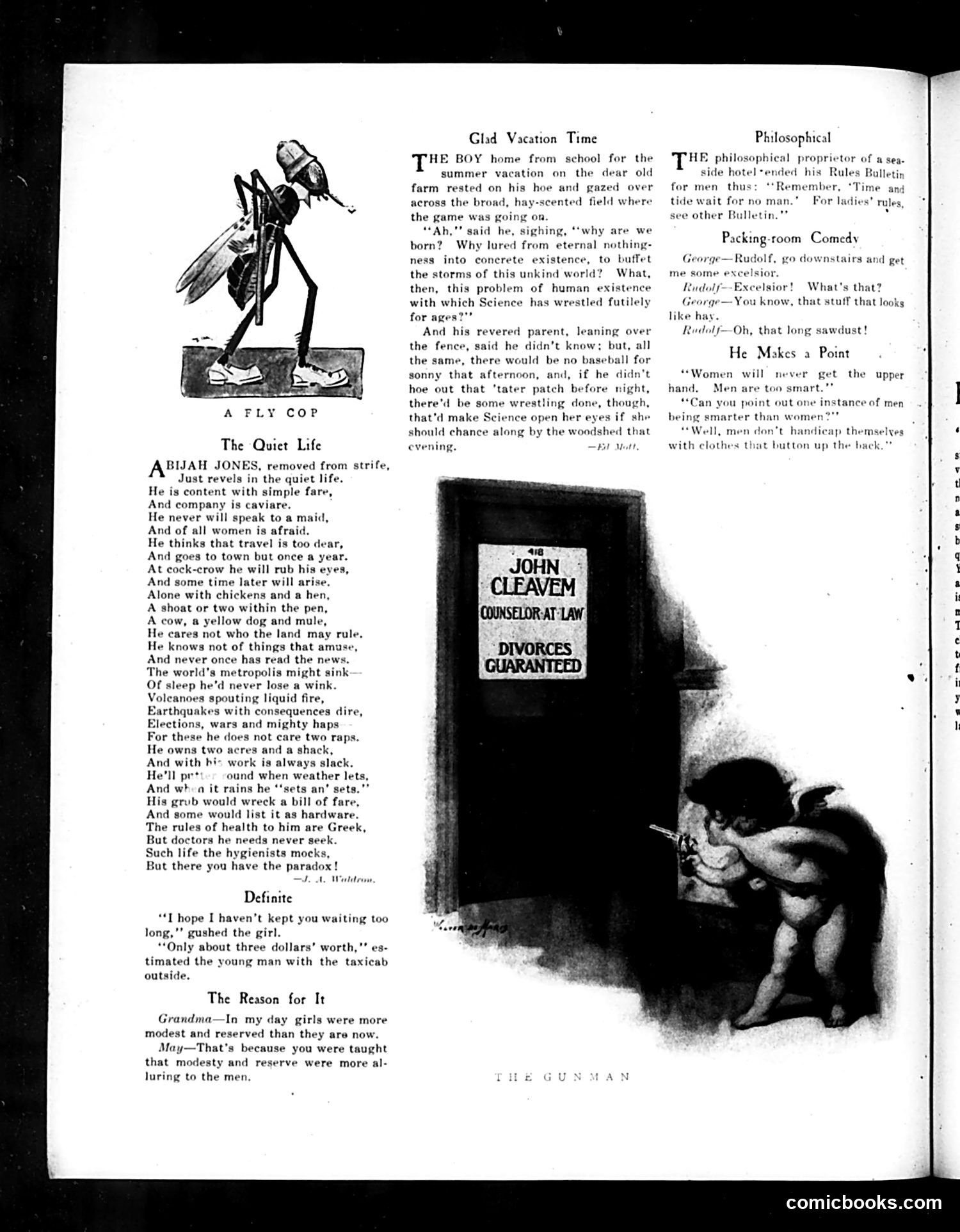
This page contains several short humorous pieces typical of early 20th-century American satirical magazines: **"A Fly Cop"** shows an illustration of a fly on a human foot—a visual pun on the term "cop" (police officer). **"The Quiet Life"** is a poem celebrating Obijah Jones, a rural farmer who deliberately avoids modern life's anxieties—newspapers, elections, wars, volcanoes. The satire targets both urban anxiety and rural simplicity, presenting his deliberate ignorance as paradoxically peaceful yet absurd. **Other brief pieces** mock dating customs ("Definite"), generational debates about female modesty ("The Reason for It"), and gender relations ("He Makes a Point"). The last joke suggests men claim superiority while being unable to button their own clothing—a jab at masculine pretension. **"Glad Vacation Time"** depicts a boy's philosophical musings interrupted by farm chores, satirizing both youthful existentialism and parental discipline. The advertisements for divorce and legal services appear standard for the era. Overall, the page reflects early-1900s preoccupations with urbanization, changing social mores, and gender dynamics.
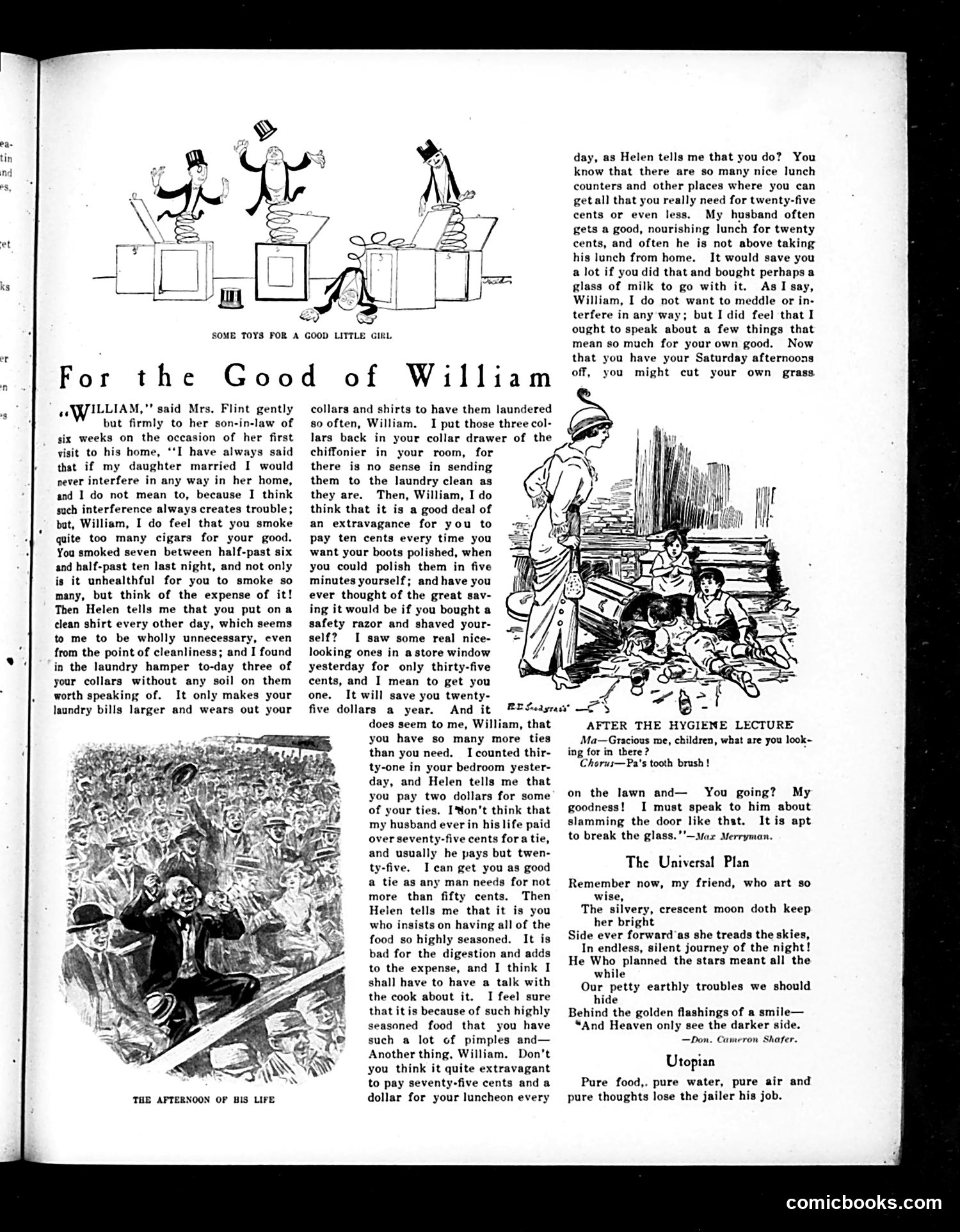
This satirical piece lampoons **overbearing mother-in-law interference** in newlyweds' lives. Mrs. Flint, visiting her son-in-law William for the first time, delivers an extended lecture criticizing his spending habits: too many cigars, frequent shirt laundering, paid shoe-polishing, expensive ties, and restaurant lunches. She positions herself as a "helpful" advisor while actually micromanaging his personal choices and expenses. The humor targets **interfering relatives** and the tension between household independence and family expectations—a common domestic comedy theme of the era. The accompanying cartoon showing toys labeled "For a Good Little Girl" reinforces the satire: William is being treated like a child requiring correction, not an adult married man. The closing illustration, "After the Hygiene Lecture," shows children searching for their father's toothbrush—implying even his oral hygiene is now under scrutiny. The satire mocks both Mrs. Flint's relentless busybodying and the powerlessness of men facing determined female relatives.
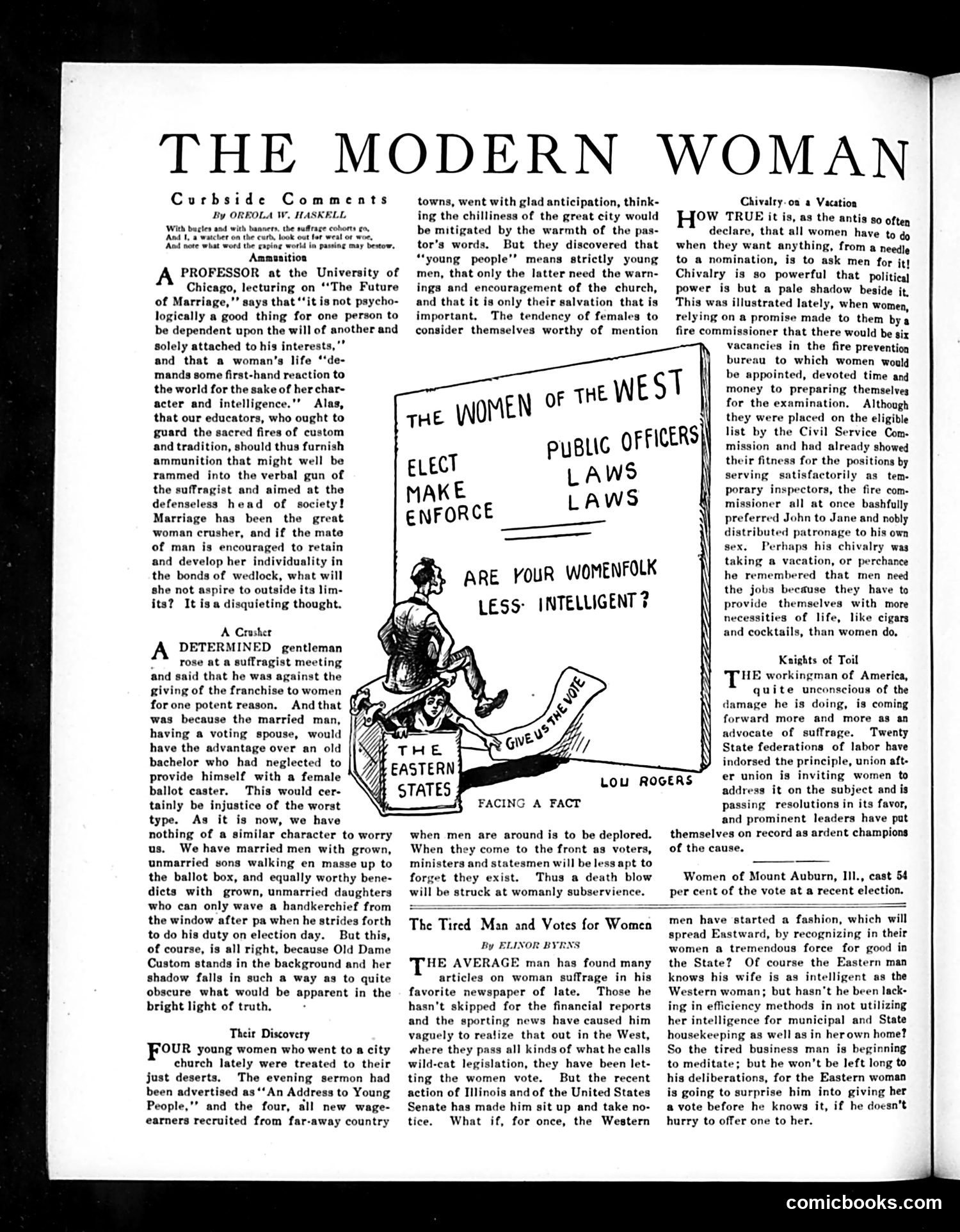
This page combines anti-suffrage commentary with pro-suffrage arguments presented ironically. The content criticizes opponents of women's voting through **satirical endorsement of anti-suffrage positions**. A central cartoon by Lou Rogers depicts a woman confronting "Eastern States," asking whether women are "less intelligent" than men—directly mocking the anti-suffrage claim. The text above advocates for women to "elect public officers" and "make enforce laws." Articles use sarcasm to expose suffrage opponents' hypocrisy: a professor supporting women's intellectual development contradicts traditional arguments; a bachelor's concern about married men gaining voting advantage through wives reveals the logical absurdity of denying women the vote; a church sermon titled "Address to Young People" that excludes young women demonstrates female invisibility. The final section describes promised fire department positions withheld from qualified women—illustrating how "chivalry" fails when competing against male institutional power. The **satire's point**: anti-suffrage arguments, when examined honestly, collapse under their own illogic.
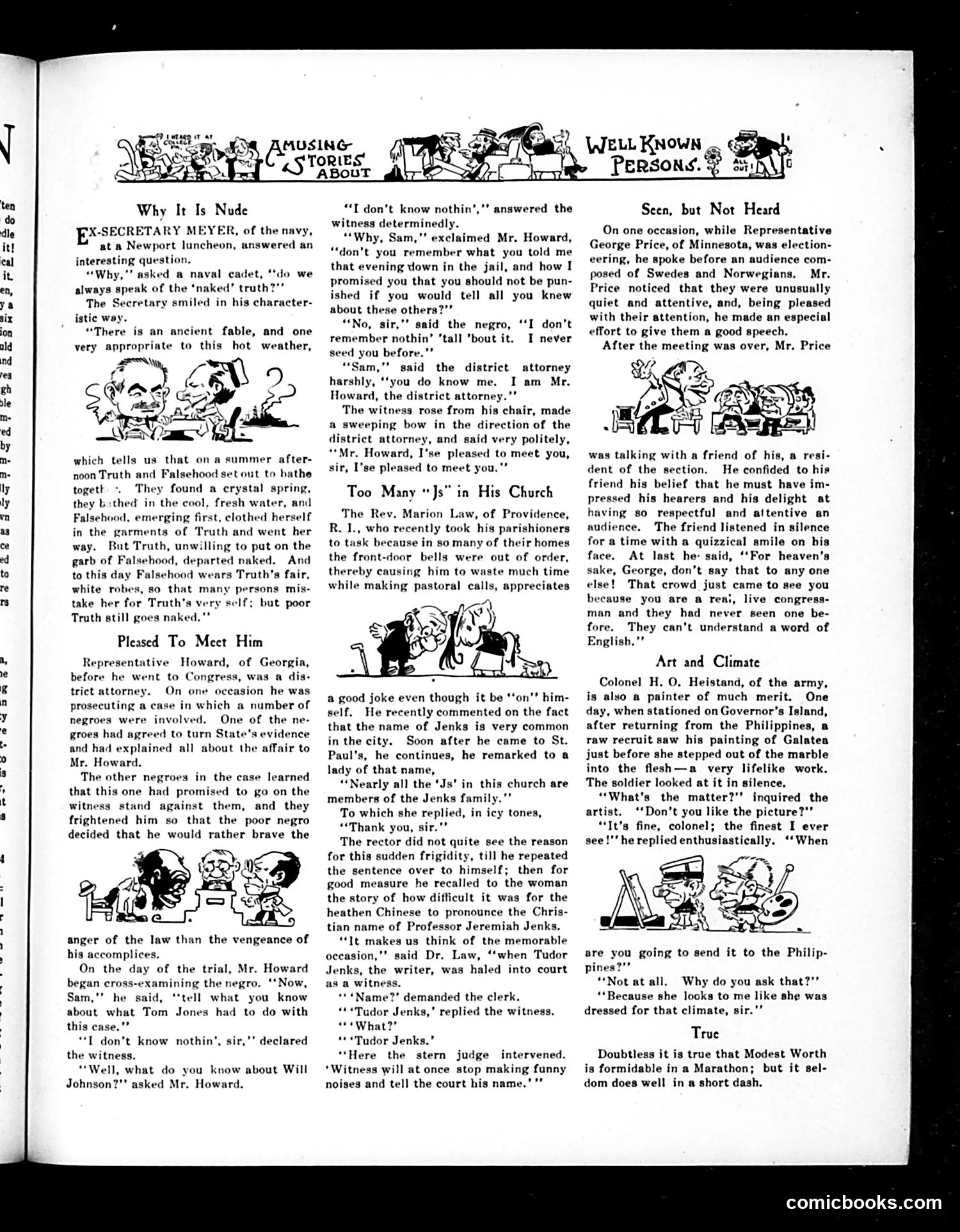
This page from the satirical magazine *Judge* contains three separate humorous anecdotes about prominent Americans: **"Why It Is Nude"**: Ex-Navy Secretary Meyer explains why "truth" is called "naked" through an Aesop's fable—Falsehood stole Truth's clothes and has worn them ever since, while Truth remains unclothed. This is a philosophical joke about deception masquerading as honesty. **"Pleased To Meet Him"**: Representative Howard (Georgia) prosecutes a case involving Black defendants. A witness who'd promised to testify refuses, claiming amnesia about their jail conversation. When confronted, the witness simply says he's "pleased to meet" Howard—a joke mocking the witness's pretended ignorance and fear of retaliation from accomplices. **"Too Many 'Js' in His Church"**: Reverend Marion Law of Providence remarks that nearly all the "Js" in his church are Jenks family members. A parishioner responds coldly—he's made an unfortunate double entendre. The anecdote includes a related story about writer Tudor Jenks being repeatedly misheard in court. These are mild social humor pieces typical of early *Judge* magazine's format.
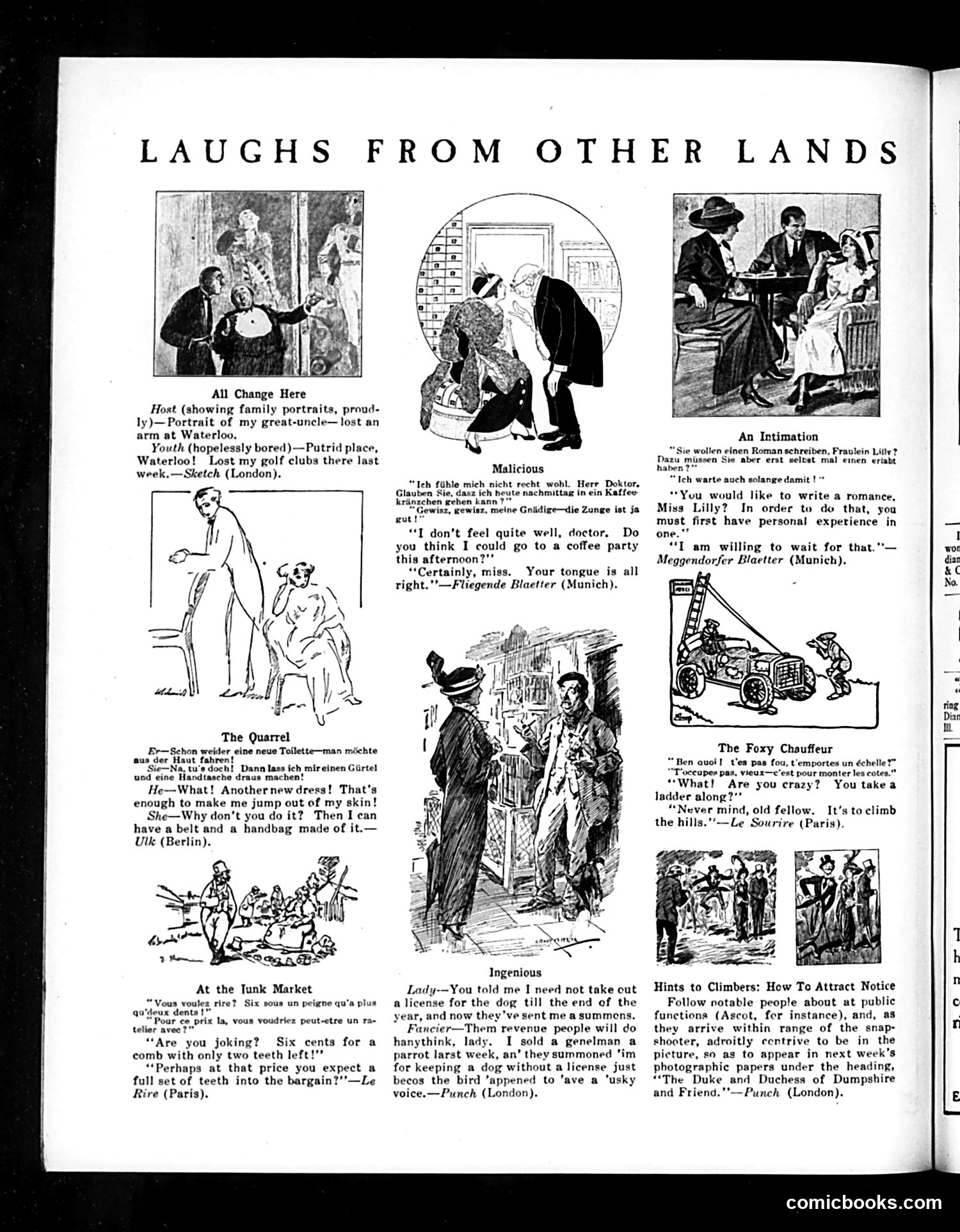
This is a **collection of international humor** reprinted from European satirical magazines (Sketch, Ulk, Fliegende Blaetter, Punch, Le Rire, Meggendorfer Blaetter, Le Sourire). Each cartoon mocks everyday social situations across cultures: **Key satire themes:** - **"All Change Here"**: British youth's casual disrespect for historical military sacrifice (Waterloo) - **"The Quarrel"**: German domestic comedy about wives' extravagant clothing demands - **"At the Junk Market"**: French haggling humor over a worthless comb - **"Malicious"**: Doctor's crude diagnosis based only on examining a patient's tongue - **"The Foxy Chauffeur"**: French driver's absurd logic for carrying a ladder uphill - **"An Intimation"**: German gender commentary—woman advised she needs romantic experience before writing romance novels The page demonstrates early 20th-century **cross-cultural magazine sharing**, presenting European working-class and bourgeois life with gentle ridicule of human foibles—marital conflict, social climbing, commercialism, and pretension.
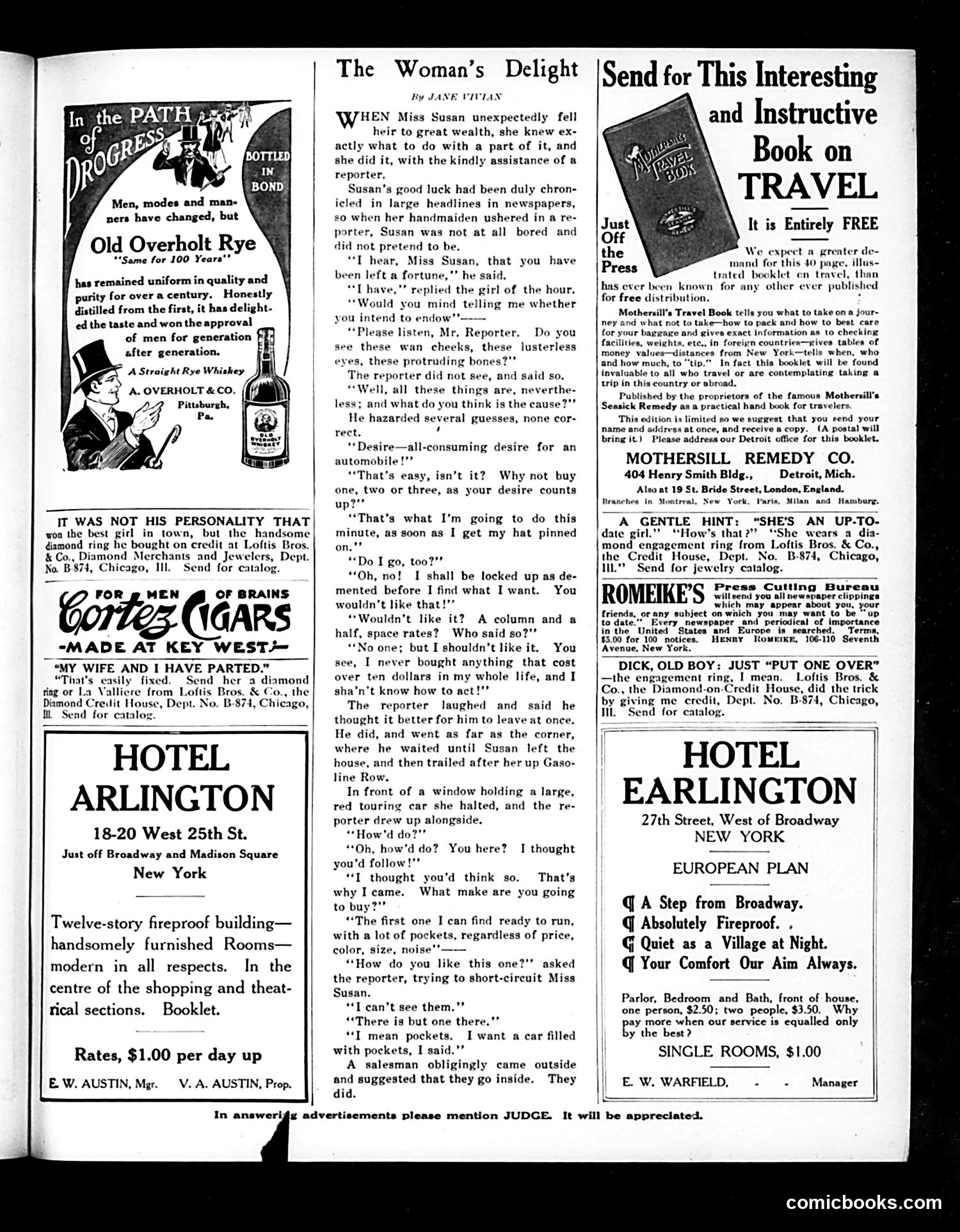
This page contains primarily **advertisements and a short humorous story** rather than political satire. **"The Woman's Delight"** by Jane Vivian is a light comedy sketch about Susan, a newly wealthy woman who inherits a fortune and impulsively decides to buy an automobile. The joke hinges on early-1900s gender expectations: a woman with sudden wealth and desire is portrayed as impulsive and indecisive, unable to make purchasing decisions without male guidance. The reporter follows her, suggesting she lacks judgment ("locked up as demented"). The humor relies on the stereotype of frivolous female consumers—a common trope of the era. The surrounding ads reinforce this: diamonds and jewelry are marketed as ways to win women's affection ("the handsome diamond ring...won the best girl in town"), while whiskey and cigars appeal to male readers. **There is no clear political cartoon on this page.** The content reflects period attitudes about gender, consumption, and courtship rather than political commentary.
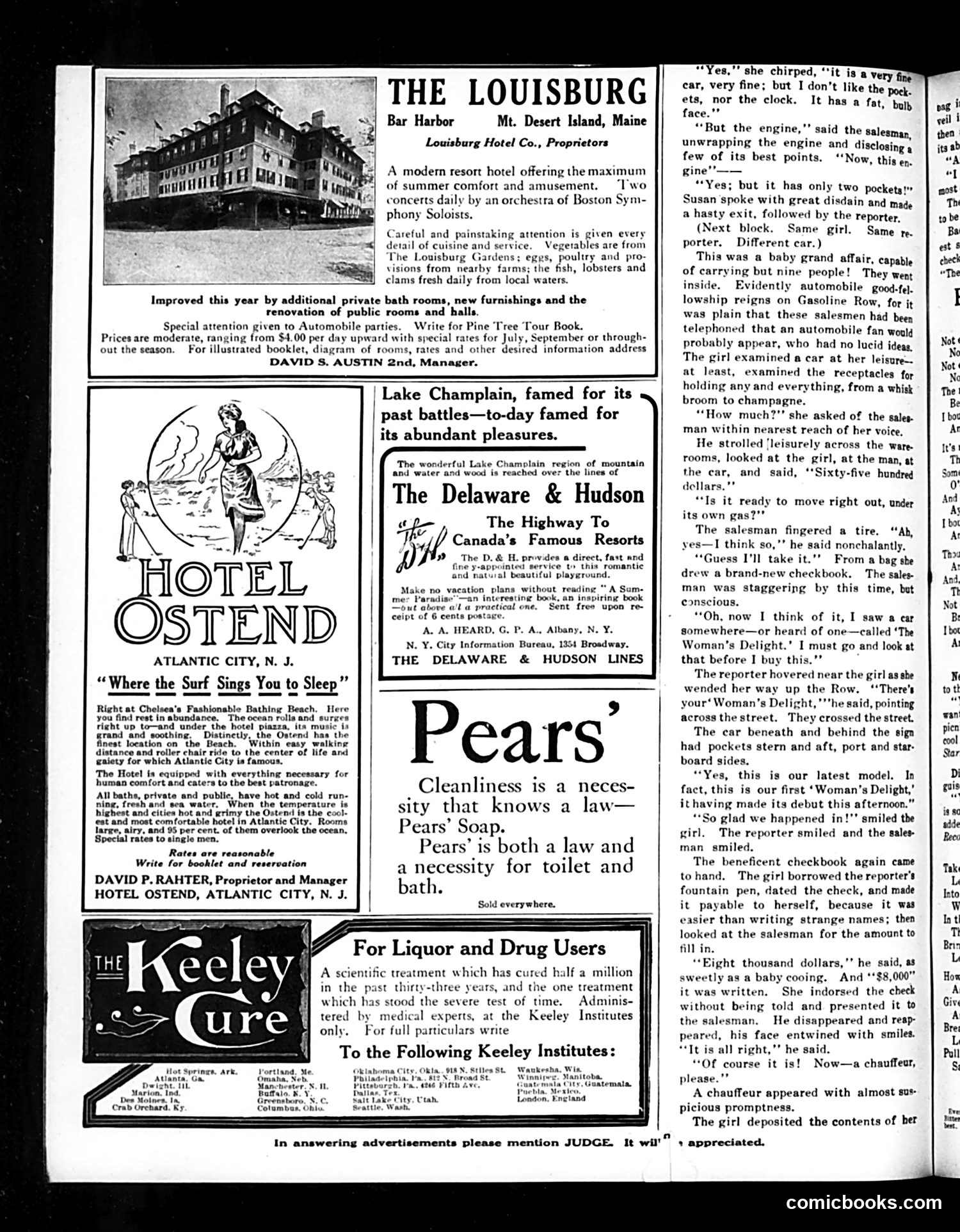
This page is **primarily advertising** for early 20th-century hotels and tourist destinations (The Louisburg in Maine, Hotel Ostend in Atlantic City, The Delaware & Hudson railway line, and Pears' Soap), with one embedded humorous narrative. The narrative piece (right column) satirizes **automobile salesmen and female car shoppers**. A woman named Susan inspects cars with a reporter, judging vehicles by impractical standards—she dismisses one car for lacking "pockets" and "a clock," and another for its small passenger capacity. The joke mocks both the saleswoman's absurd priorities (treating a car like a handbag) and the obsequious salesmen who, having been warned of her arrival, humor her nonsensical demands. The satire likely reflects early 1900s anxiety about automobiles as novel luxury goods and changing gender roles—depicting a frivolous female consumer driving exasperated (male) salesmen to comedic desperation.
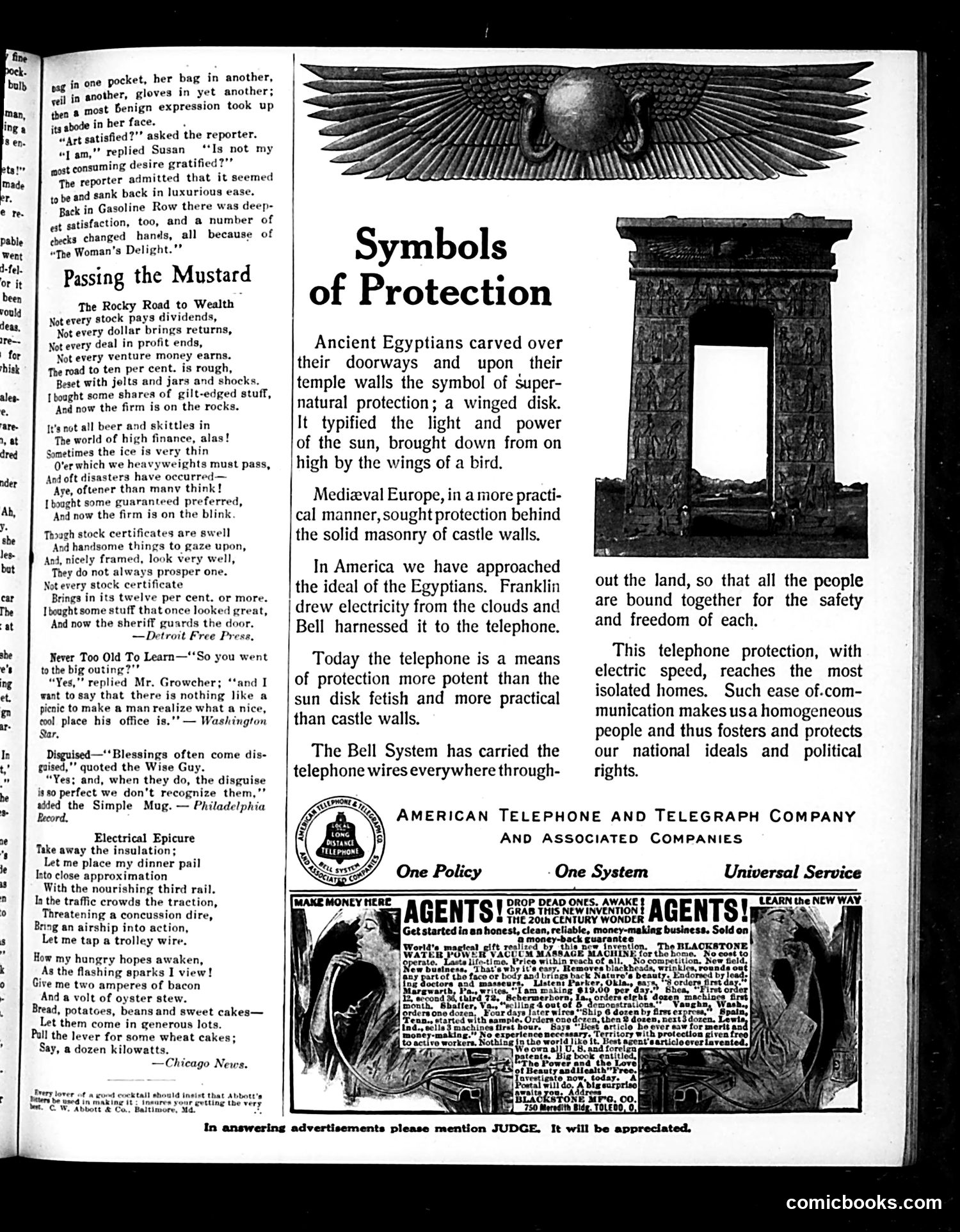
This Judge magazine page contains multiple distinct elements: **Main Advertisement: "Symbols of Protection"** A Bell Telephone Company ad equates the telephone system with historical protective structures. It compares ancient Egyptian winged-disk talismans and Medieval castle walls to modern telephone technology as a form of "protection"—arguing that Bell's nationwide telephone network creates national cohesion and safeguards "our national ideals and political rights." This appears to be corporate propaganda framing telephony as essential to American security and unity. **Satirical Poems & Jokes** The surrounding content mocks stock-market investing ("Passing the Mustard," "Rocky Road to Wealth"), depicting ordinary investors losing money in failed ventures. "Electrical Epicure" is absurdist humor imagining eating electrified foods. These pieces satirize get-rich-quick schemes and financial speculation. **Recruitment Advertisement** Lower section advertises agent positions for unspecified products or schemes—typical of era advertising that often promised easy money. The page juxtaposes corporate messaging with satirical commentary on American capitalism and financial delusion.
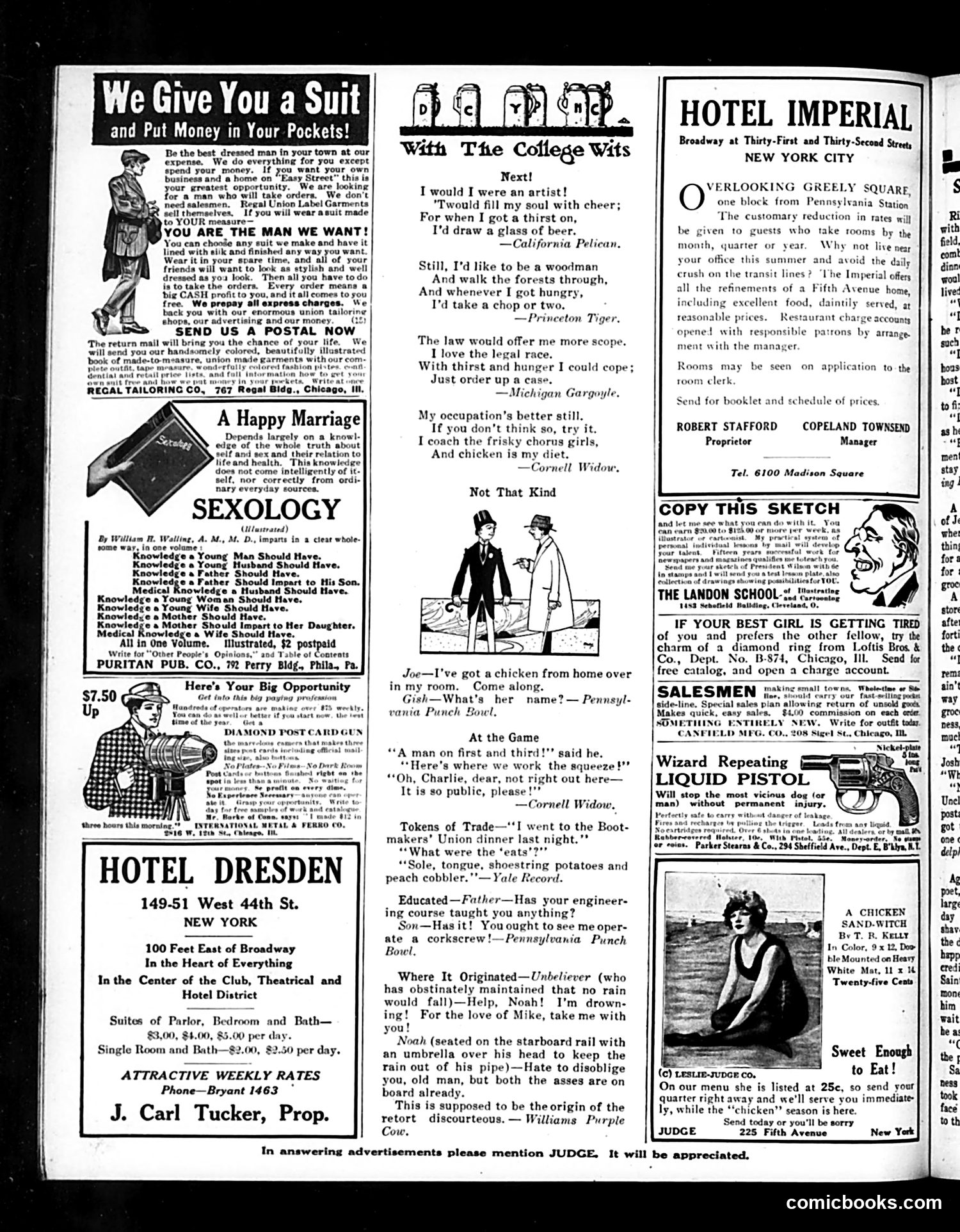
This page from *Judge* magazine (appears early 20th century) is primarily **advertising and humor**, not political satire. The main content includes: **Ads**: Clothing tailors, self-help books on sexuality/marriage, hotels, and job opportunities targeting working-class men seeking income and respectability. **"College Wits" humor section**: Jokes from university humor magazines (Pelican, Tiger, Gargoyle, Widow, etc.) with recurring punchy themes: alcohol (drinking jokes disguised as artistry or profession), food ("chops," "case" of liquor), and sexual innuendo (coaching "chorus girls," the "chicken" double entendre about a woman). **The satire**: These jokes mock college students' obsession with drinking and chasing women while pretending to sophistication. The "Noah" joke at bottom is wordplay about asses (donkeys). No specific political figures or events are referenced. This is light social humor reflecting early 1900s attitudes toward alcohol, class, and gender.
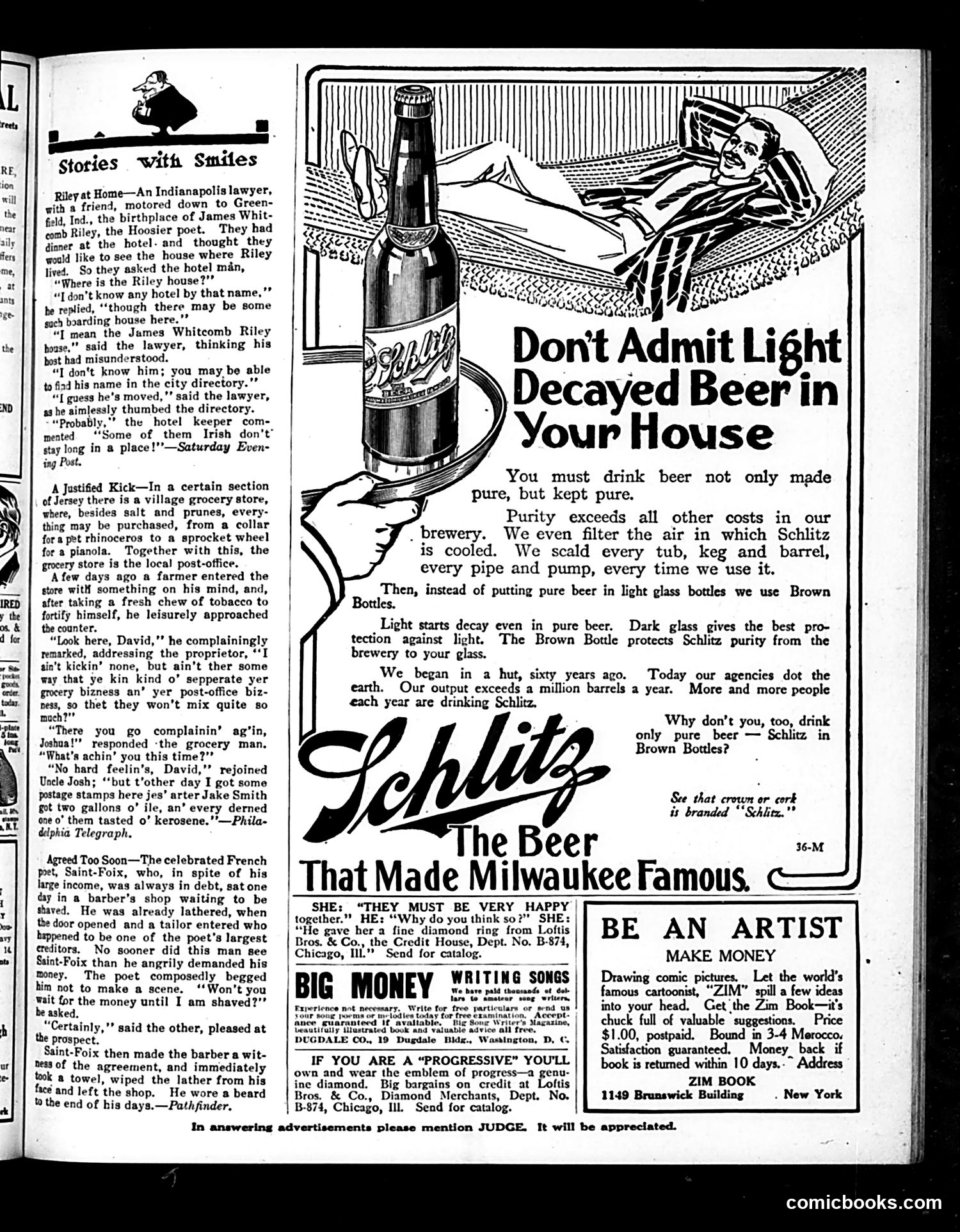
This page contains humorous short stories and advertisements typical of early 20th-century Judge magazine. **"Stories With Smiles"** presents three brief anecdotes mocking small-town ignorance and literal-mindedness: a hotel clerk who doesn't know poet James Whitcomb Riley by name; a farmer complaining that postage stamps taste like kerosene after being stored near lamp oil; and a clever French poet who escapes a creditor by removing his lather mid-shave. **The Schlitz Beer Advertisement** (main visual) warns against "light-decayed beer," arguing that brown bottles protect beer from light damage better than clear ones. It emphasizes purity and manufacturing standards—a selling point in an era before refrigeration and quality control were standardized. The image shows a man relaxing with a Schlitz bottle, suggesting domestic leisure. **Minor advertisements** include offers for songwriting services, comic art instruction, and jewelry credit. The satire targets provincial attitudes and commercial competition, not political figures or events.
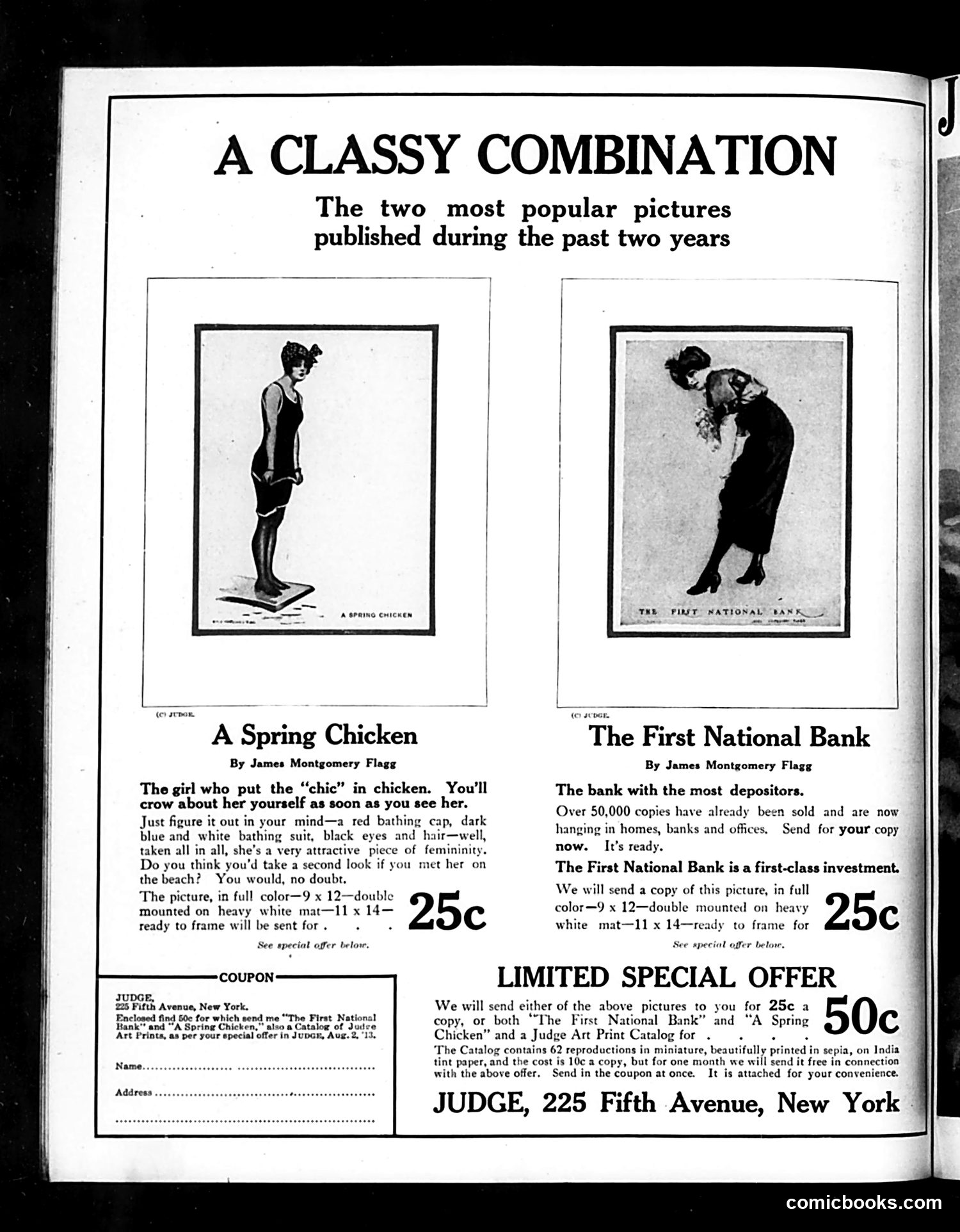
This is primarily an **advertisement**, not a political cartoon. Judge magazine is promoting two popular prints by illustrator James Montgomery Flagg. **"A Spring Chicken"** depicts a young woman in a bathing suit—the phrase "spring chicken" means an attractive young woman. The ad plays on her physical appeal, describing her as "a very attractive piece of femininity." **"The First National Bank"** shows a woman bowing or bending forward, marketed as a "first-class investment" with appeal to depositors and offices. Both prints cost 25¢ individually or 50¢ for both, plus a Judge catalog. The ads emphasize their popularity and suitability for framing in homes and businesses. The "satire" here is subtle: Judge juxtaposes an objectified woman with a serious financial institution under the heading "A Classy Combination," perhaps gently mocking how both exploit mass appeal and investor confidence through attractive presentation.