
Judge, 1913-08-02 · page 17 of 24
Judge — August 2, 1913 — page 17: what you’re looking at
What you’re looking at
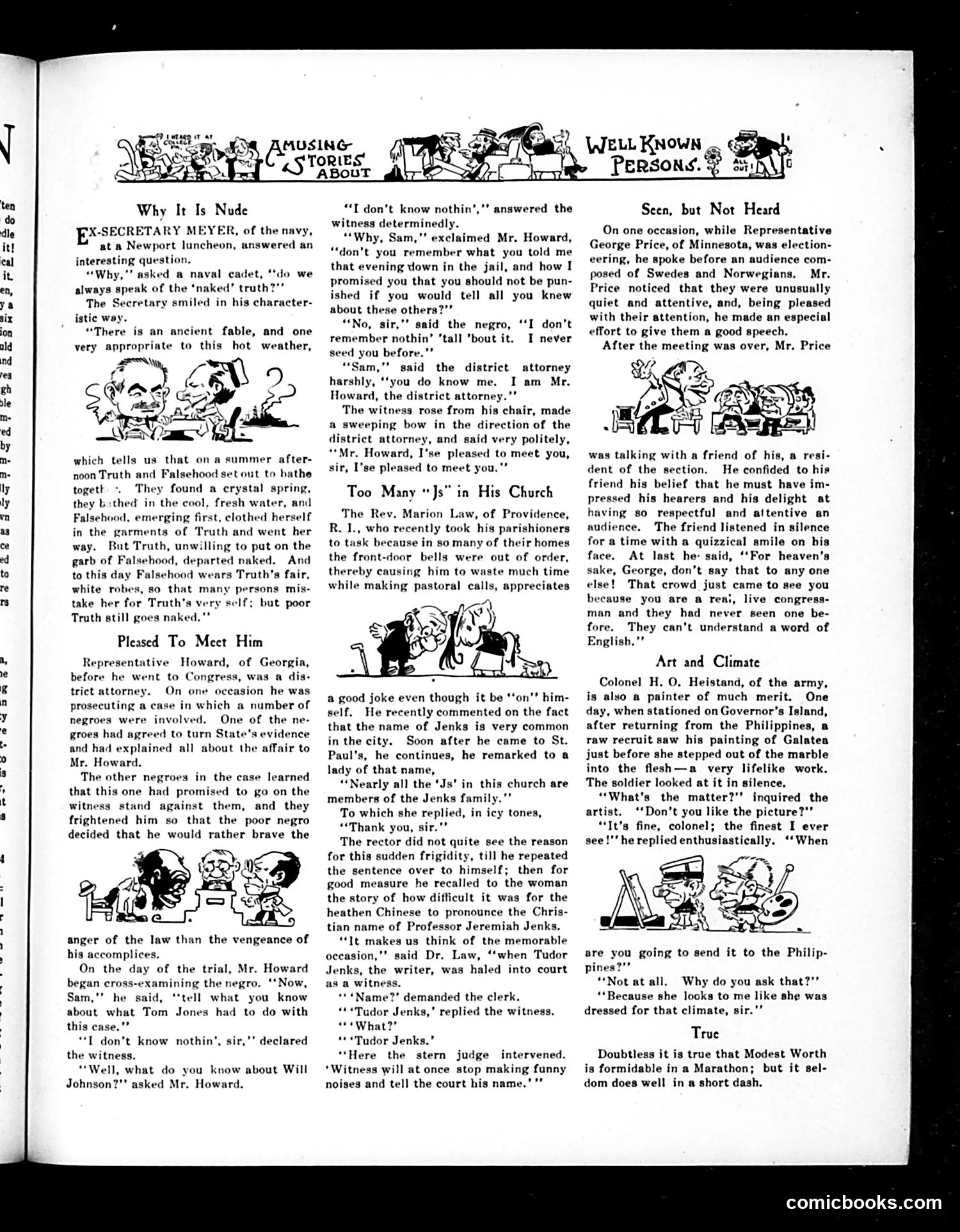
This page from the satirical magazine *Judge* contains three separate humorous anecdotes about prominent Americans: **"Why It Is Nude"**: Ex-Navy Secretary Meyer explains why "truth" is called "naked" through an Aesop's fable—Falsehood stole Truth's clothes and has worn them ever since, while Truth remains unclothed. This is a philosophical joke about deception masquerading as honesty. **"Pleased To Meet Him"**: Representative Howard (Georgia) prosecutes a case involving Black defendants. A witness who'd promised to testify refuses, claiming amnesia about their jail conversation. When confronted, the witness simply says he's "pleased to meet" Howard—a joke mocking the witness's pretended ignorance and fear of retaliation from accomplices. **"Too Many 'Js' in His Church"**: Reverend Marion Law of Providence remarks that nearly all the "Js" in his church are Jenks family members. A parishioner responds coldly—he's made an unfortunate double entendre. The anecdote includes a related story about writer Tudor Jenks being repeatedly misheard in court. These are mild social humor pieces typical of early *Judge* magazine's format.
📄 Transcribed text from this page (OCR, searchable)
Machine-transcribed from the original scan — historical spelling and the odd misread are preserved.
Why It Is Nude EXSECRETARY MEYER, of the navy, at a Newport luncheon, answered an interesting question. “Why,” asked a naval cadet, “do we always speak of the ‘naked’ truth?” The Secretary smiled in his character- istic way. “There is an ancient fable, and one very appropriate to this c\ weather, Fy aN a EA —Waand?, which tells us that on a summer after- noon Truth and Falsehood set out to bathe togett They found a crystal spring, they bsthed in the cool, fresh water, and Falsehood, emerging first, clothed herself in the garments of Truth and went her way. But Truth, unwilling to put on the garb of Falsehood, departed naked. And to this day Falsehood wears Truth’s fair, white robes, so that many persons mis- take her for Truth’s If; but poor Truth still goes naked." Pleased To Meet Him Representative Howard, of Georgia, before he went to Congress, was a d trict attorney. On one occasion he was prosecuting a case in which a number of negroes were involved. One of the ne- groes had agreed to turn State's evidence and had explained all about the affair to Mr. Howard. The other negroes in the case learned that this one had promised to go on the witness stand against them, and they frightened him so that the poor negro decided that he would rather brave the anger of the law than the vengeance of his accomplices. On the day of the trial, Mr. Howard began cross-examining the negro. ‘*Now, Sam,"’ he said, “tell what you know about what Tom Jones had to do with this case."” “IT don't know nothin’, sir,’’ declared the witness. “Well, what do you know about Will Johnson?"’ asked Mr. Howard. E) WELL KNown PERSONS. ' I don’t know nothin’,”’ answered the witness determinedly. “Why, Sam,” exclaimed Mr. Howard, “don't you remember what you told me that evening down in the jail, and how I promised you that you should not be pun- ished if you would tell all you knew about these others?’’ “No, sir,’’ said the negro, remember nothin’ ’tall "bout it. seed you before."* “Sam,” said the district harshly, ‘‘you do know me. Howard, the district attorn The witness rose from his chair, made a sweeping bow in the direction of the district attorney, and said very politely, Mr. Howard, I’se pleased to meet you, ir, I’se pleased to meet you.” Too Many “Js” in His Church The Rev. Marion Law, of Providence, R. I., who recently took his parishioners to task because in so many of their homes the front-door bells were out of order, thereby causing him to waste much time while making pastoral calls, appreciates “T don’t I never attorney I am Mr. a good joke even though it be ‘‘on’? him- self. He recently commented on the fact that the name of Jenks is very common in the city. Soon after he came to St. Paul's, he continues, he remarked to a lady of that name, “Nearly all the ‘Js’ in this church are members of the Jenks family." To which she replied, in icy tones, “Thank you, sir."” The rector did not quite see the reason for this sudden frigidity, till he repeated the sentence over to himself; then for good measure he recalled to the woman the story of how difficult it was for the heathen Chinese to pronounce the Chris- tian name of Professor Jeremiah Jenks. “It makes us think of the memorable occasion,’’ said Dr. Law, ‘‘when Tudor Jenks, the writer, was haled into court as a witnes ***Name?’ demanded the clerk. “¢*Tudor Jenks,’ replied the witness. “What?” “**Tudor Jenks.’ “Here the stern judge intervened. ‘Witness will at once stop making funny noises and tell the court his name.’ ’’ Seen, but Not Heard On one occasion, while Representative George Price, of Minnesota, was election- eering, he spoke before an audience com- posed of Swedes and Norwegians. Mr. Price noticed that they were unusually quiet and attentive, and, being pleased with their attention, he made an especial effort to give them a good speech, After the meeting was over, Mr. Price 4 was talking with a friend of his, a resi- dent of the section. He confided to his friend his belief that he must have im- pressed his hearers and his delight at having so respectful and attentive an audience, The friend listened in silence for a time with a quizzical smile on bis face. At last he: said, ‘‘For heaven's sake, George, don’t say that to any one else! That crowd just came to see you because you are a reai, live congress- man and they had never seen one be- fore. They can't understand a word of English.”” Art and Climate Colonel H. O. Heistand, of the army, is also a painter of much merit. One day, when stationed on Governor's Island, after returning from the Philippines, a raw recruit saw his painting of Galatea just before she stepped out of the marble into the flesh—a very lifelike work. The soldier looked at it in silence. ‘‘What’s the matter?’’ inquired the artist. ‘*Don’t you like the picture?" “It’s fine, colonel; the finest I ever see!’’ he replied enthusiastically. ‘‘When af are you going to send it to the Philip- pin “Not at all. Why do you ask that?" ‘*Because she looks to me like she was dressed for that climate, sir.'’ True Doubtless it is true that Modest Worth is formidable in a Marathon; but it sel- dom does well in a short dash. comicbooks.com