
A complete issue · 24 pages · 1913
Judge — July 26, 1913
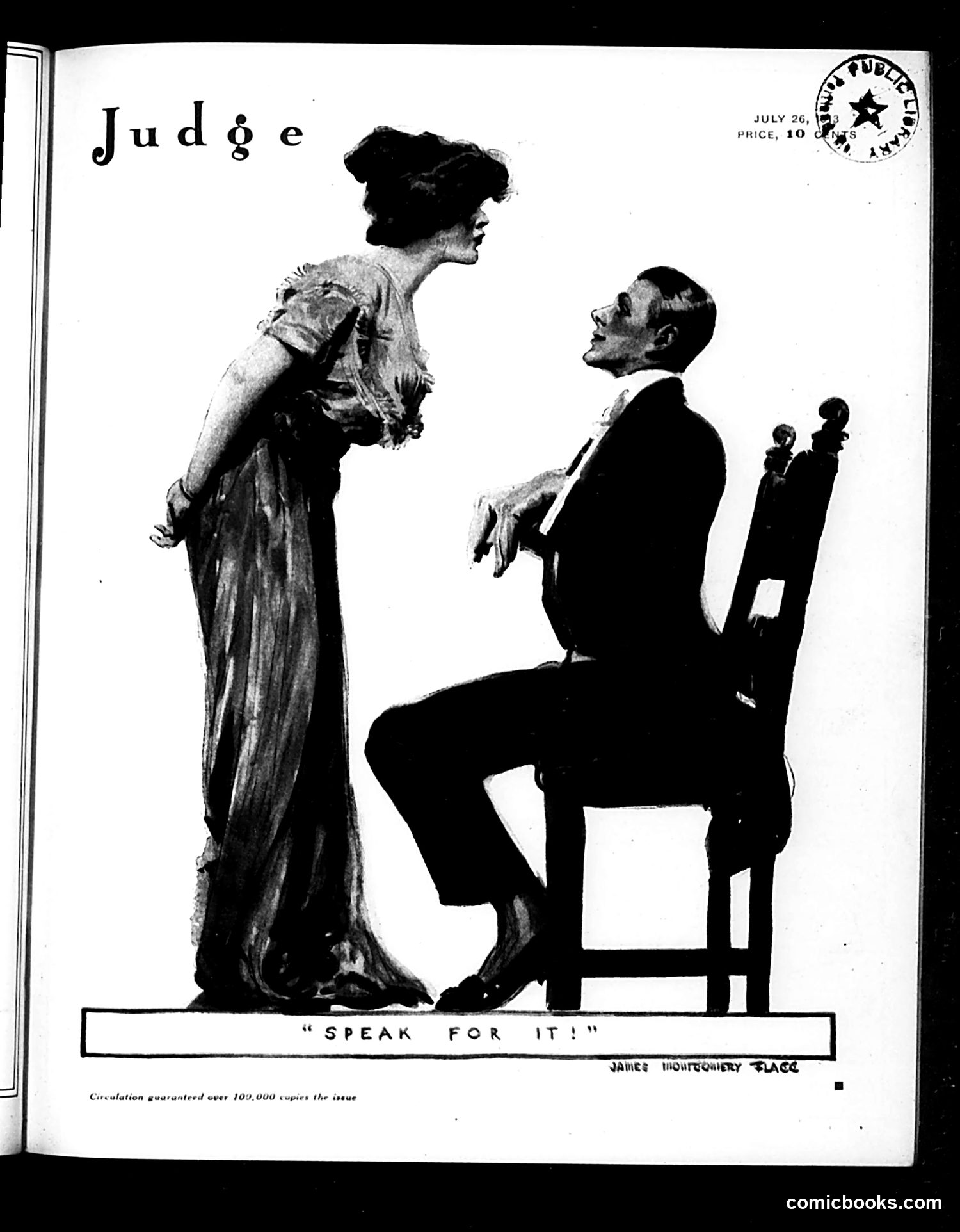
This early 20th-century satirical cartoon depicts a man in formal attire kneeling before a woman in an elegant gown, apparently proposing marriage. The caption "Speak FOR IT!!" suggests ironic commentary on courtship or marital dynamics. The cartoon likely satirizes contemporary gender relations or marriage customs. The man's posture and the woman's commanding stance suggest role reversal or commentary on female assertiveness—a timely topic during the women's suffrage movement era. The artist is credited as James Montgomery Flagg, a prominent illustrator of the period. Without additional context about the specific issue date or accompanying articles, the precise political or social reference remains unclear, though it likely comments on changing attitudes toward women's rights or romantic conventions of that era.
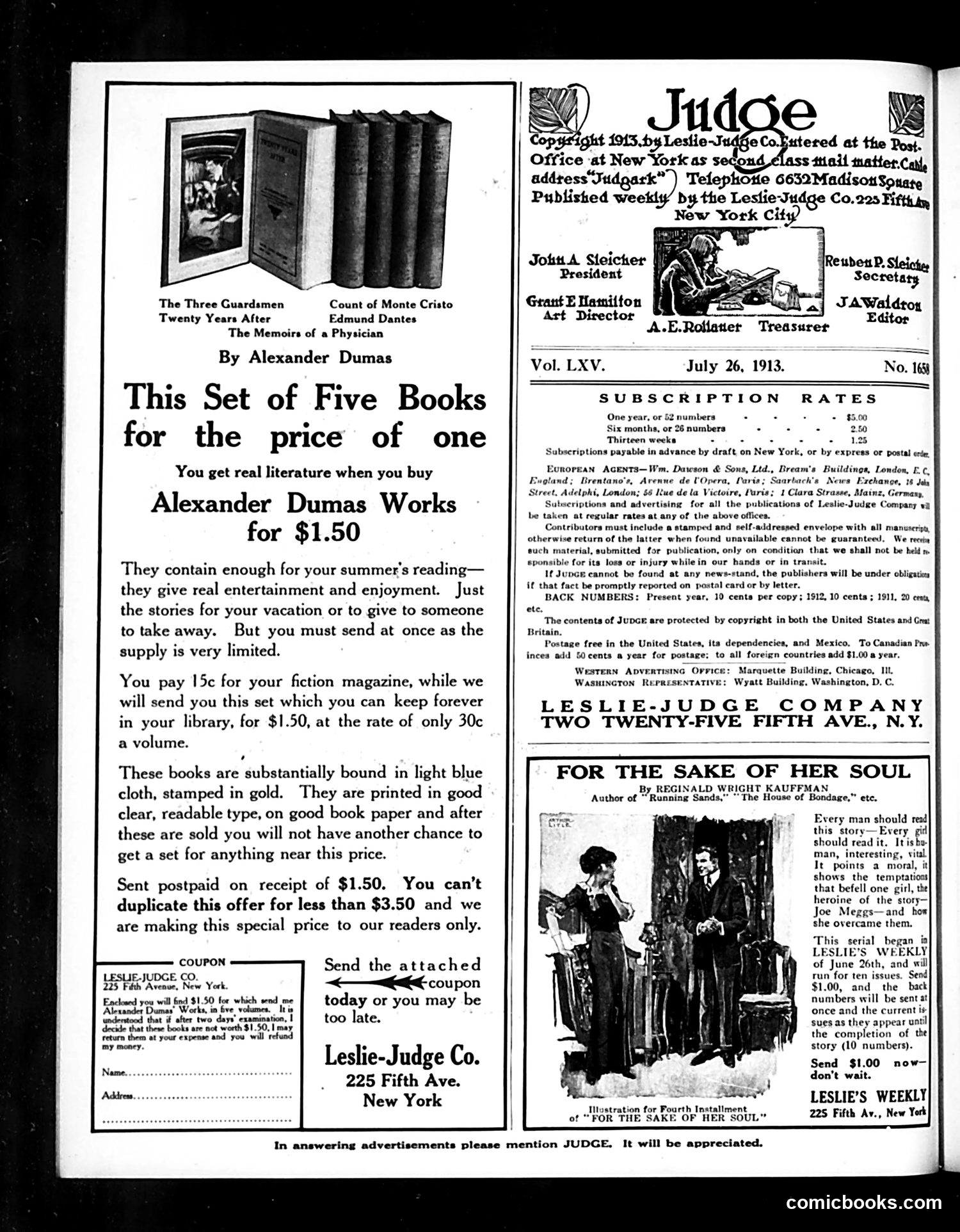
This page is primarily **advertising content** rather than satirical cartoons. The dominant feature is a Leslie-Judge Company advertisement promoting a five-book set of Alexander Dumas works (including *The Three Guardsmen*, *Count of Monte Cristo*, and *The Memoirs of a Physician*) for $1.50—marketed as an exceptional bargain. The lower right section advertises a serialized story, "For the Sake of Her Soul" by Reginald Wright Kauffman, featuring an illustration of what appears to be a dramatic confrontation scene typical of early 20th-century melodrama. The page reflects Judge's dual function as both satirical publication and **commercial vehicle**, with advertising subsidizing editorial content. No significant political satire or social commentary appears on this particular page.
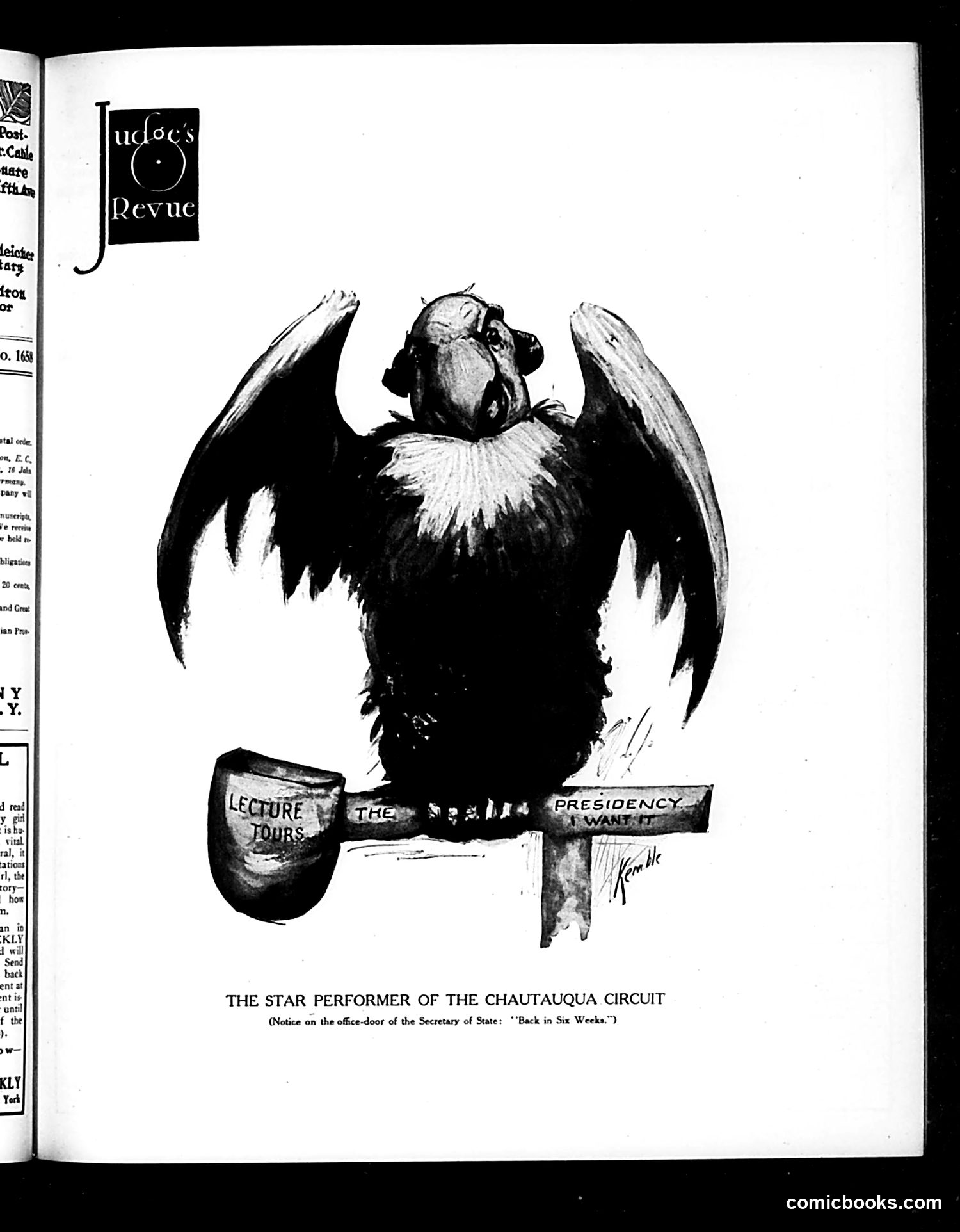
This political cartoon from *Judge* magazine satirizes a figure (likely a political candidate or speaker) who tours the Chautauqua Circuit—a popular American lecture and entertainment circuit of the early 20th century. The bird-like creature holds signs reading "LECTURE TOURS" and "PRESIDENCY—WANT IT," suggesting someone using speaking engagements to build political ambition or campaign for office. The caricature appears mocking: the figure is depicted as grotesque and bird-like, implying the subject is performative, artificially constructed, or untrustworthy. The subtitle's reference to a notice "on the office-door of the Secretary of State: 'Back in Six Weeks'" suggests the person is frequently absent from official duties while pursuing lecture tours. The satire critiques using public speaking circuits for political self-promotion rather than serious governance.
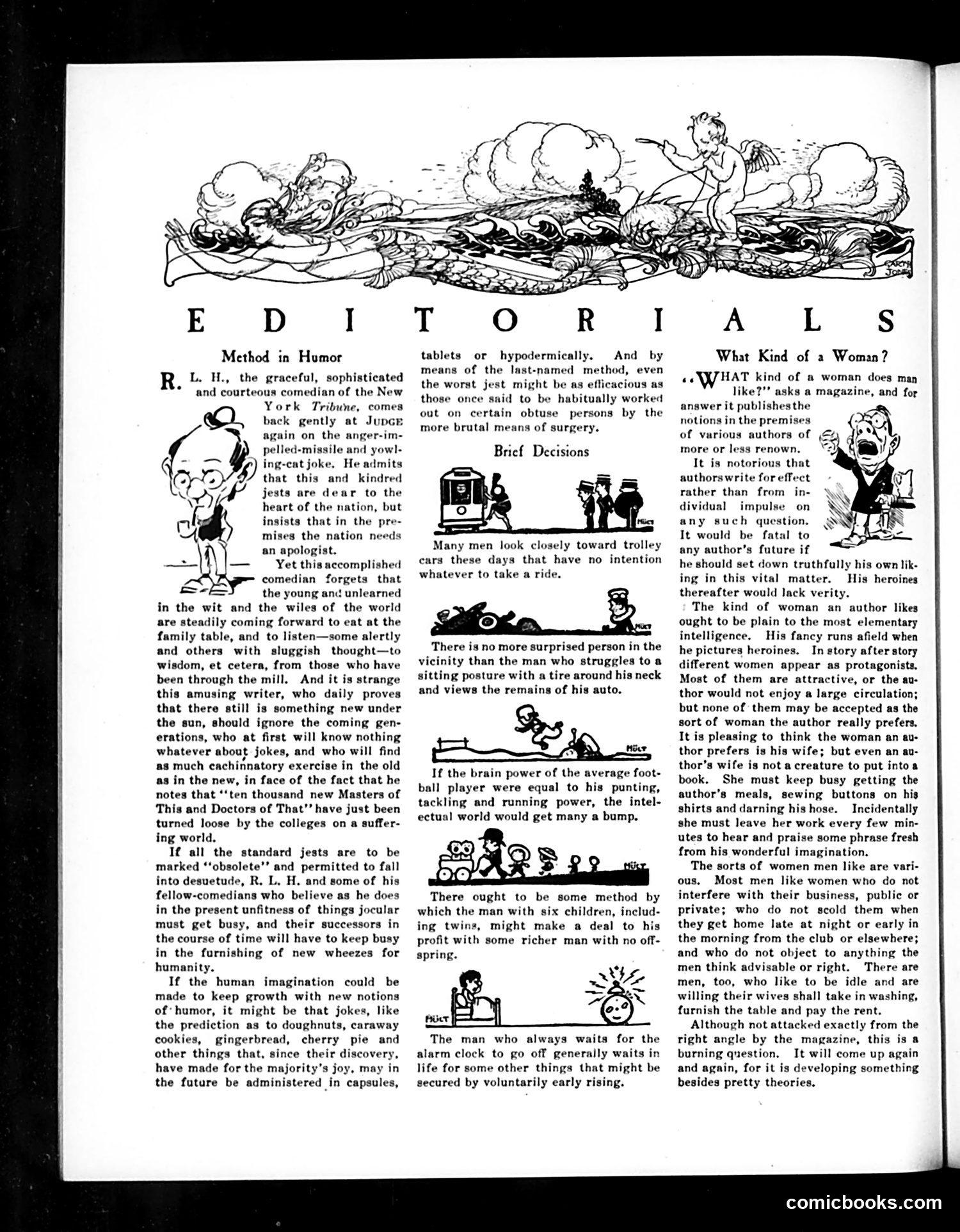
This page contains editorial commentary on contemporary issues, though specific figures and events are difficult to identify with certainty from the image alone. The left column features a caricatured portrait (captioned "R.L.H.") of what appears to be a theater or vaudeville personality, praising their comedic wit. The text celebrates their "graceful, sophisticated" humor while critiquing other comedians for failing to meet similar standards. The right section, titled "What Kind of a Woman?", discusses how authors depict female characters in literature. It argues that most male authors write women as either attractive or plain, rarely showing complexity. The piece advocates for more realistic, nuanced female characterization in fiction. The scattered small cartoons throughout appear to illustrate everyday humorous situations involving domestic life and social behaviors, consistent with Judge's satirical mission.
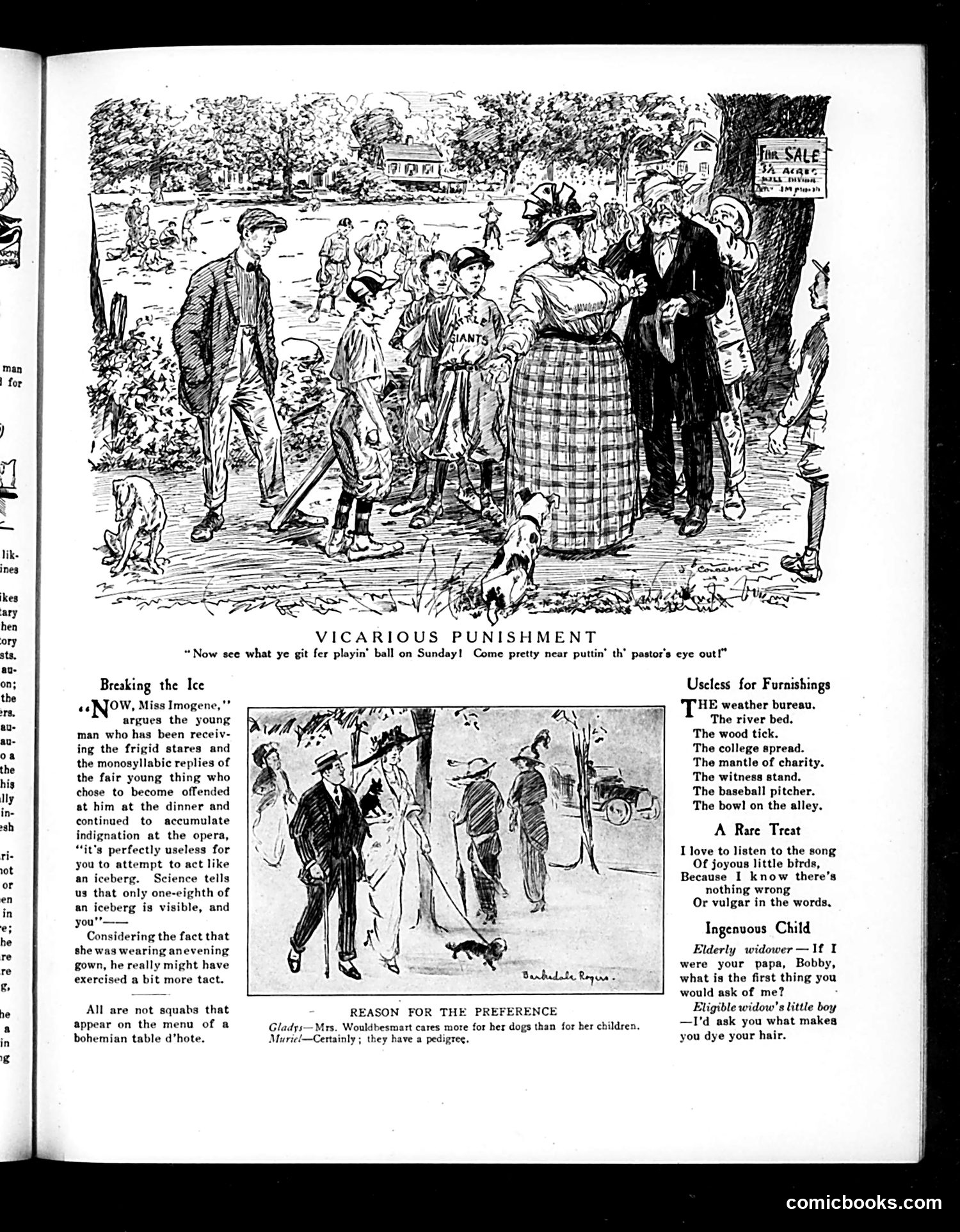
The top cartoon, "Vicarious Punishment," depicts a woman scolding children caught playing baseball on Sunday, threatening the pastor will learn of their transgression. This satirizes strict religious enforcement of Sabbath observance—a social debate of the era when Sunday recreation was considered sinful by religious conservatives. The middle section, "Breaking the Ice," presents a dialogue mocking a wealthy woman's pretentious dinner conversation about "monosyllabic replies" and "icebergs." It's social satire about upper-class affectation and tedious bohemian table talk. The remaining items are short humor pieces and poetry—"Useless for Furnishings," "A Rare Treat," and "Ingenuous Child"—typical filler content of satirical magazines, poking fun at everyday social conventions and family dynamics.
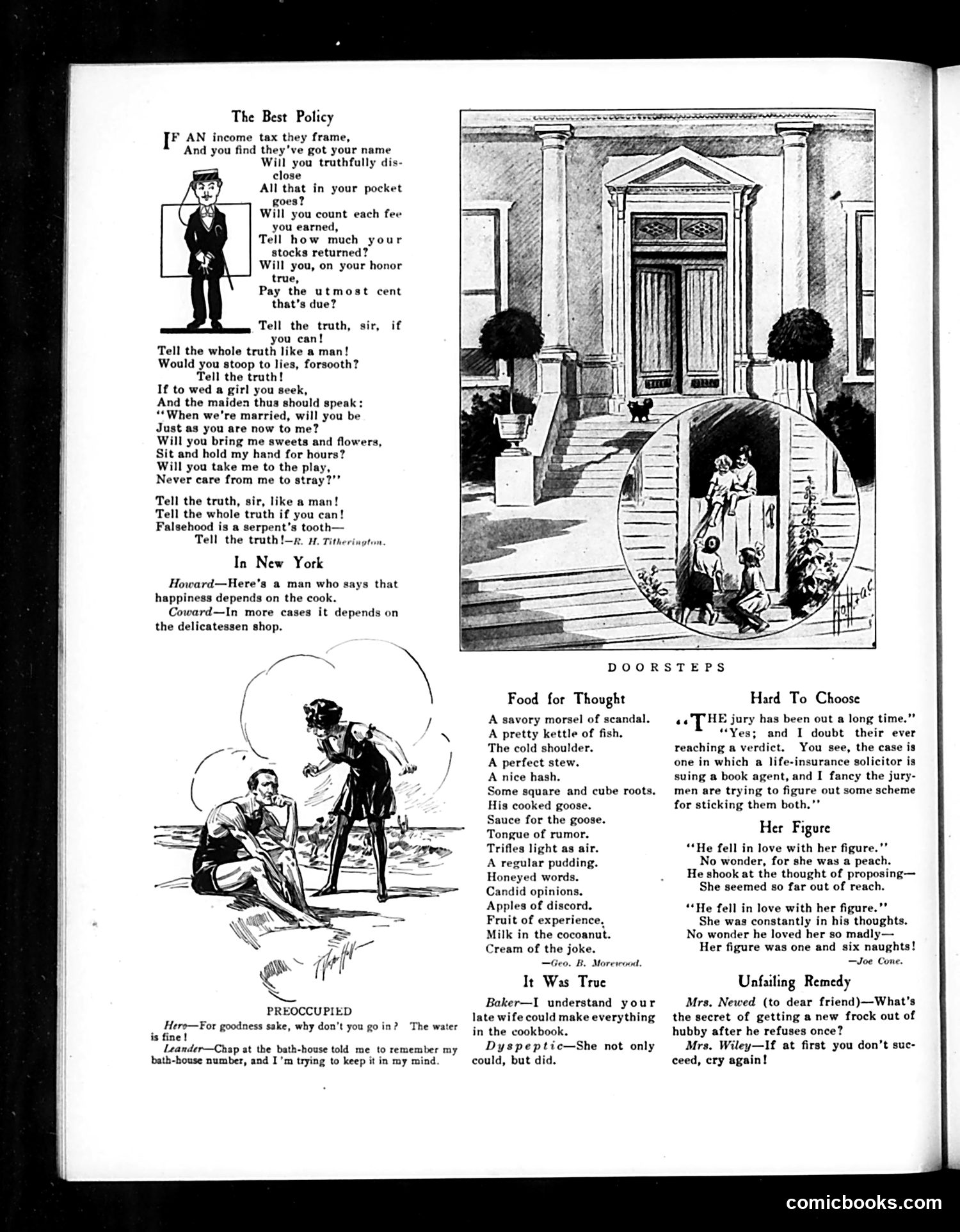
This page satirizes the newly-implemented income tax (likely the 1913 federal income tax) through a poem questioning whether citizens will honestly report their finances. The main cartoon contrasts the government's demand for truthfulness about income with the hypocrisy of everyday life—a man won't tell his fiancée the truth about his constancy, yet is expected to truthfully declare every penny earned and stock return. The satire's point: Americans habitually lie in personal matters but are suddenly expected to be scrupulously honest with tax authorities. The repeated refrain "Tell the truth!" emphasizes this absurd double standard. The surrounding "Doorsteps" section contains humorous quips and puns unrelated to the main theme, while other jokes mock marital dynamics and insurance solicitors—typical Judge magazine filler content.
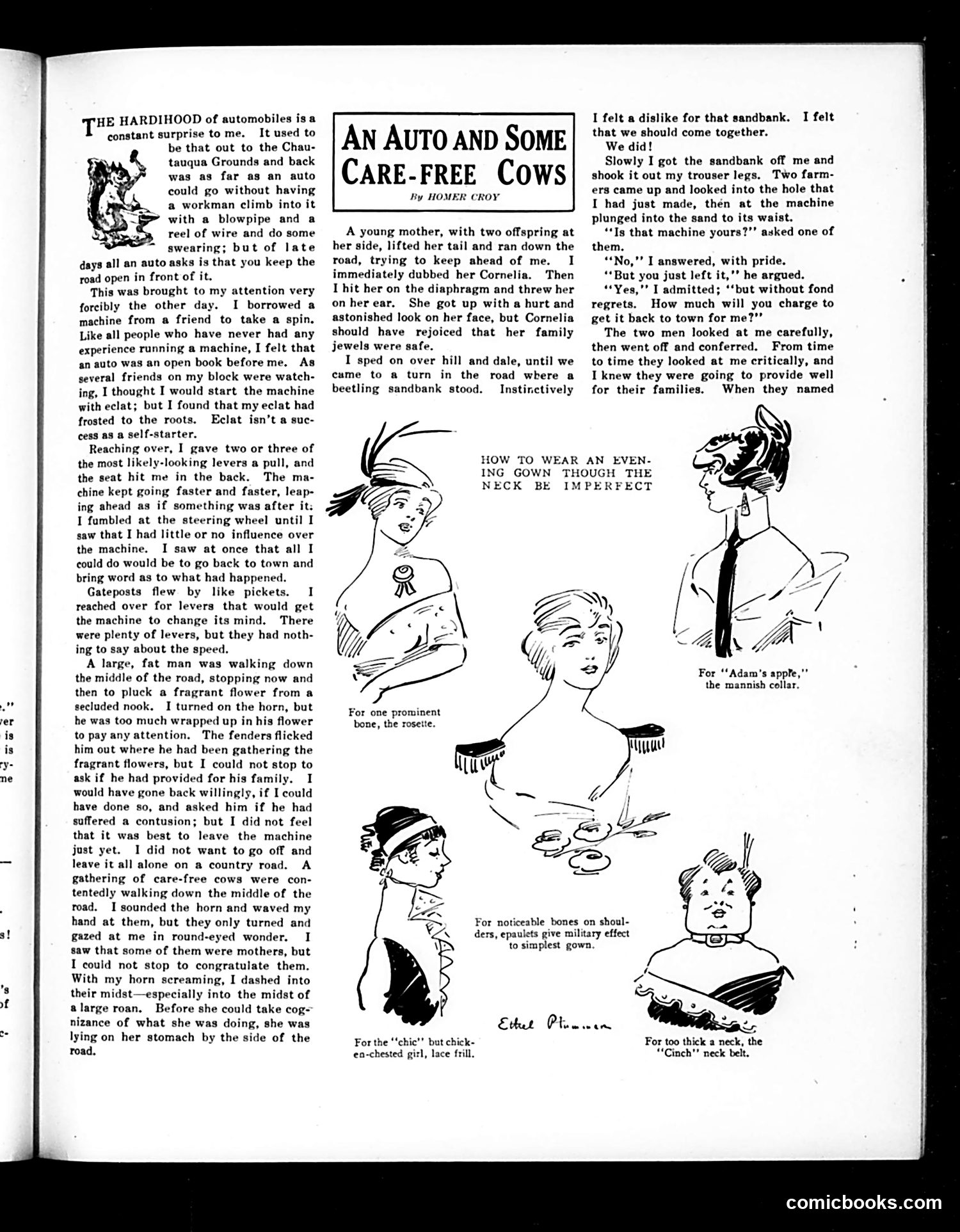
This is a humorous essay by Homer Croy about an out-of-control automobile ride, illustrated with fashion sketches on the side. The satire targets early automobiles' notoriously unreliable mechanics and the narrator's incompetence operating one. The joke: A borrowed car becomes uncontrollable—accelerating wildly, refusing to respond to steering or brakes. The hapless driver careens through the countryside, hitting a pedestrian, scattering cattle (including one named "Cornelia"), and finally crashes into a sandbank. The narrator's prideful claim that the wrecked car isn't his, followed by casual negotiation with farmers over retrieval costs, underscores the absurdity. The satire reflects contemporary frustration with automobiles as temperamental, dangerous machines requiring constant mechanical intervention—not yet reliable transportation. The fashion sketches ("How to wear an evening gown...") are unrelated sidebar content typical of Judge magazine.
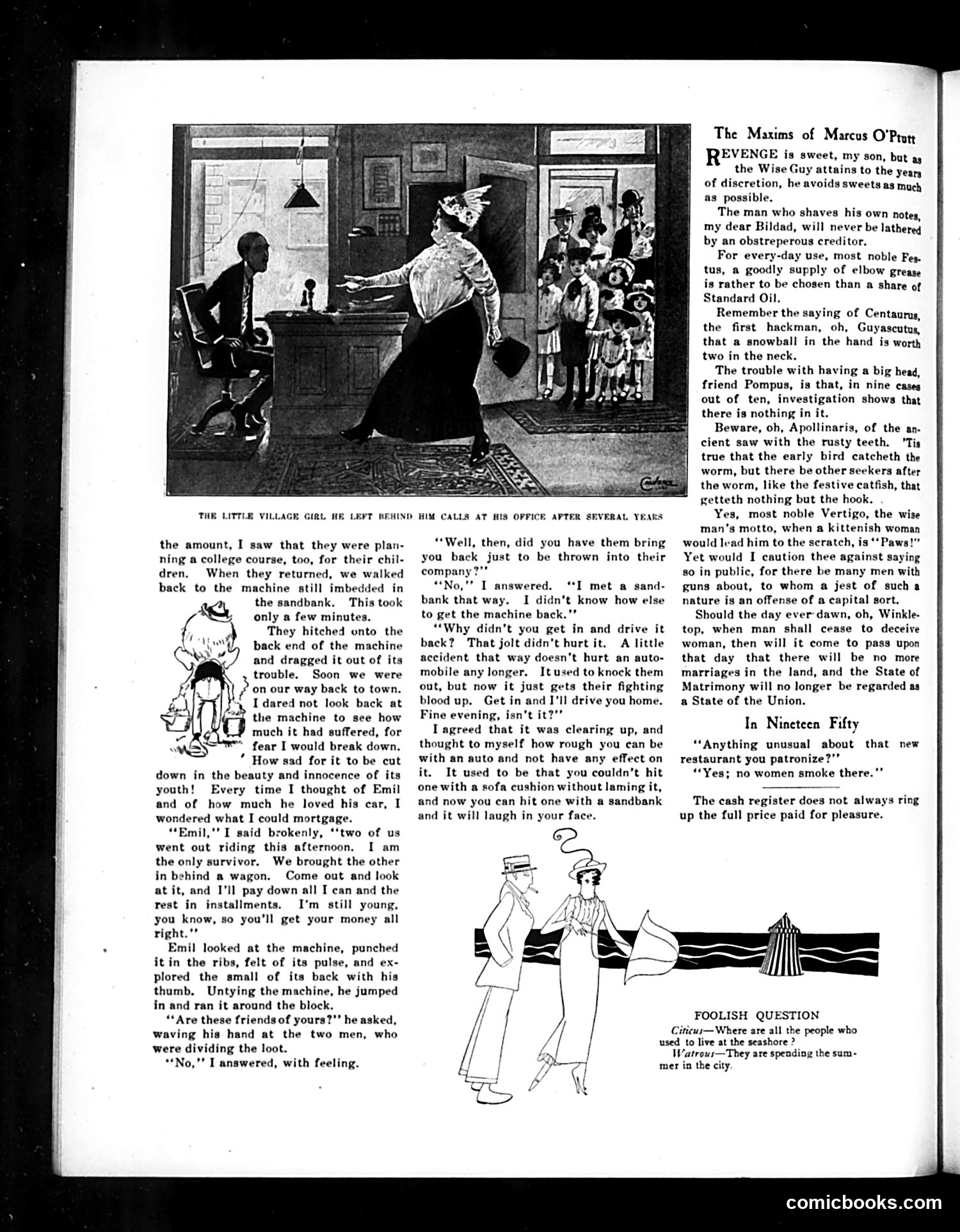
This page contains two distinct pieces of satire: **The Main Story ("The Little Village Girl"):** A humorous narrative about an automobile accident. The narrator crashes a borrowed car into a sandbank and must confess to the owner, Emil. The satire targets early automotive culture—specifically how quickly cars evolved from fragile machines requiring careful handling to durable vehicles that could withstand rough treatment. Emil's blasé response to the damaged car ("It used to knock them out, but now it just gets their fighting blood up") mocks both the rapid technological advancement and owners' casual attitudes toward destruction. **"The Maxims of Marcus O'Pratt":** Mock-philosophical aphorisms in the style of ancient wisdom literature, but addressing modern concerns: revenge, creditors, financial products (Standard Oil stock), and notably, a final section joking that if men stopped deceiving women, marriage would disappear—satirizing contemporary gender relations and suggesting deception as marriage's foundation. **Bottom cartoon ("Foolish Question"):** A brief joke about urban leisure habits, contrasting seaside vacations with city summers. The overall tone mocks contemporary materialism, technological obsession, and social pretension.
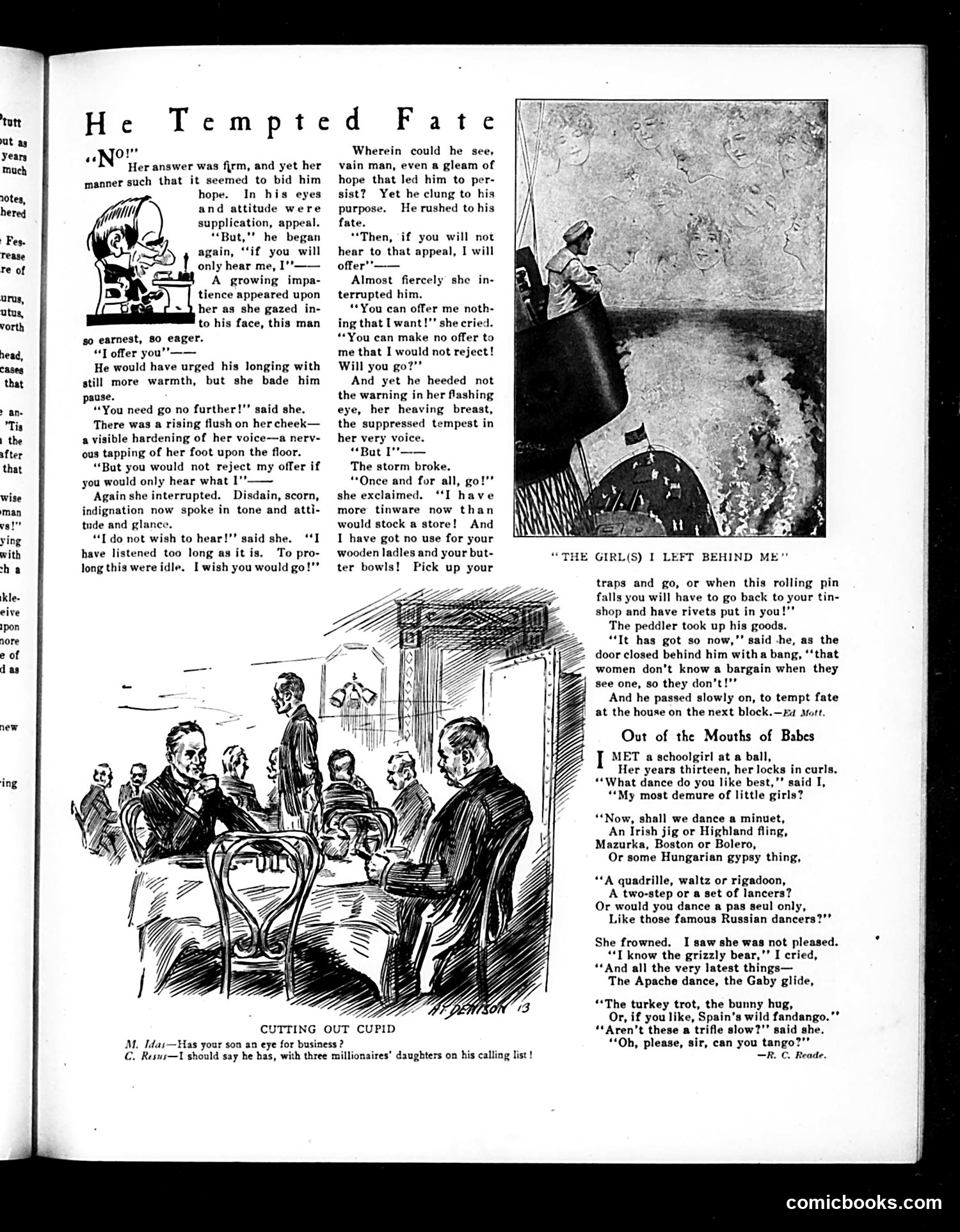
A traveling tin peddler persistently pitches his wares to a woman despite her increasingly furious rejection. She explicitly refuses multiple times with growing anger, but he continues pushing his "offer." The joke's punchline reveals she's rejecting not a romantic proposal but *tinware*—the humor lies in his obliviousness to her clear refusal and his determination to make a sales pitch. The satire mocks both aggressive salesmanship and male persistence in ignoring women's explicit "no." The woman's threat to hit him with a rolling pin emphasizes the absurdity of his refusal to accept rejection. The phrase "tempted fate" proves apt when she finally explodes. The secondary cartoon "Cutting Out Cupid" depicts a dinner party and plays on romantic matchmaking, while "Out of the Mouths of Babes" satirizes a young girl's demand for the modern "tango" dance over old-fashioned options—likely critiquing contemporary youth culture circa 1910s.
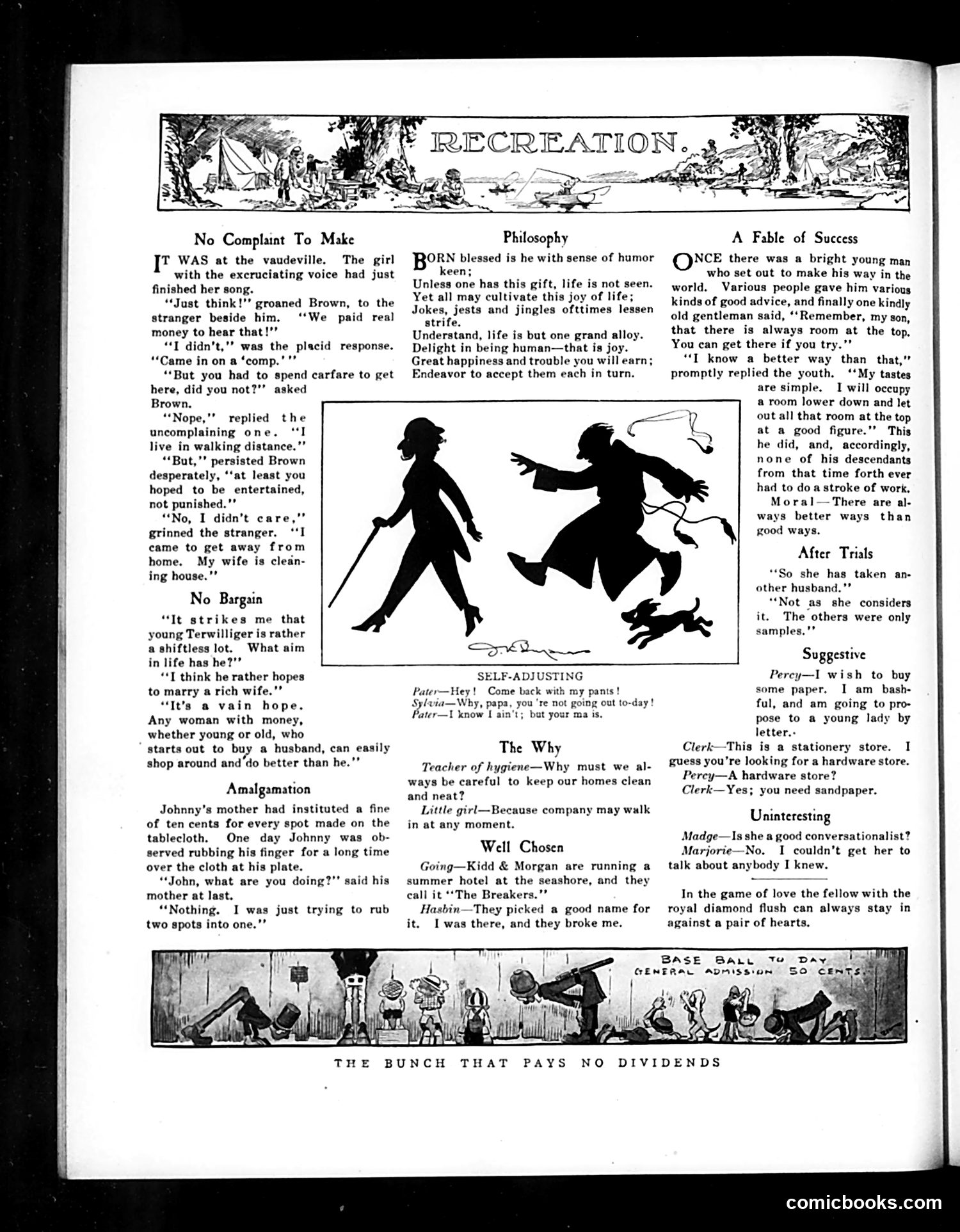
This is a **humor and satire page** from Judge magazine featuring short jokes, witty observations, and social commentary typical of early 20th-century American periodical humor. ## Key Content: **The cartoons and jokes satirize:** - **Urban entertainment culture** ("No Complaint to Make"): A man escaping his wife's housecleaning by attending vaudeville - **Class and economics** ("No Bargain," "Well Chosen"): Jabs at lazy young men and overpriced services; a hotel called "The Breakers" where customers get financially "broken" - **Marriage and courtship** ("After Trials," romantic quip): Women serial-marrying or men proposing via sandpaper jokes - **Middle-class domestic life**: Parents, cleaning, companionship expectations **The silhouette illustration** ("Self-Adjusting") shows a family dispute over clothing/going out—likely commentary on domestic management. **The "Philosophy" section** offers platitudes about humor and acceptance common to period advice literature. **Bottom panel** ("Base Ball 'Tu Day") depicts baseball spectators—leisure culture of the era. The humor targets **everyday frustrations** of middle-class American life: spouses, work avoidance, social pretension, and courtship—largely unchanged themes.
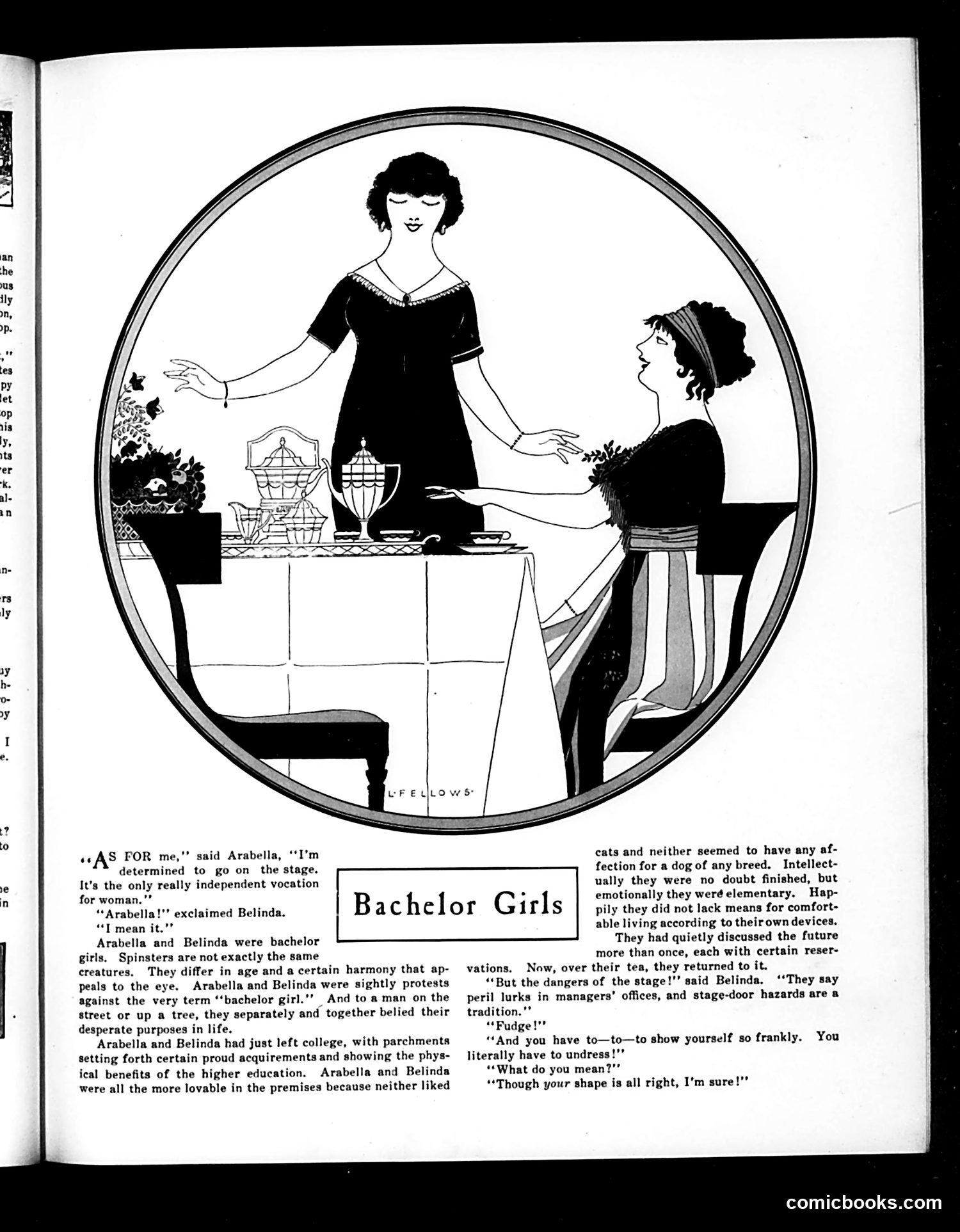
This satirical illustration and story from *Judge* magazine critique the "New Woman" of the early 20th century—specifically educated, unmarried women seeking independence. **The Setup:** Two college-educated women, Arabella and Belinda, are "bachelor girls" (unmarried women living independently). Arabella declares she'll pursue stage acting as the only "independent vocation for woman." **The Satire:** The text presents their situation with mock-earnest sympathy while highlighting the anxieties surrounding female independence. Belinda warns of "dangers" in theatrical life—predatory managers and stage-door "hazards" (sexual threats)—reflecting period concerns about women's safety and respectability in public work. The humor targets both the women's naïveté and society's contradictory attitudes: these well-educated, financially secure women are treated as fragile despite their stated independence. The illustration shows them in an intimate domestic scene, emphasizing that their rebellion against traditional roles remains constrained by social expectations about femininity and propriety.
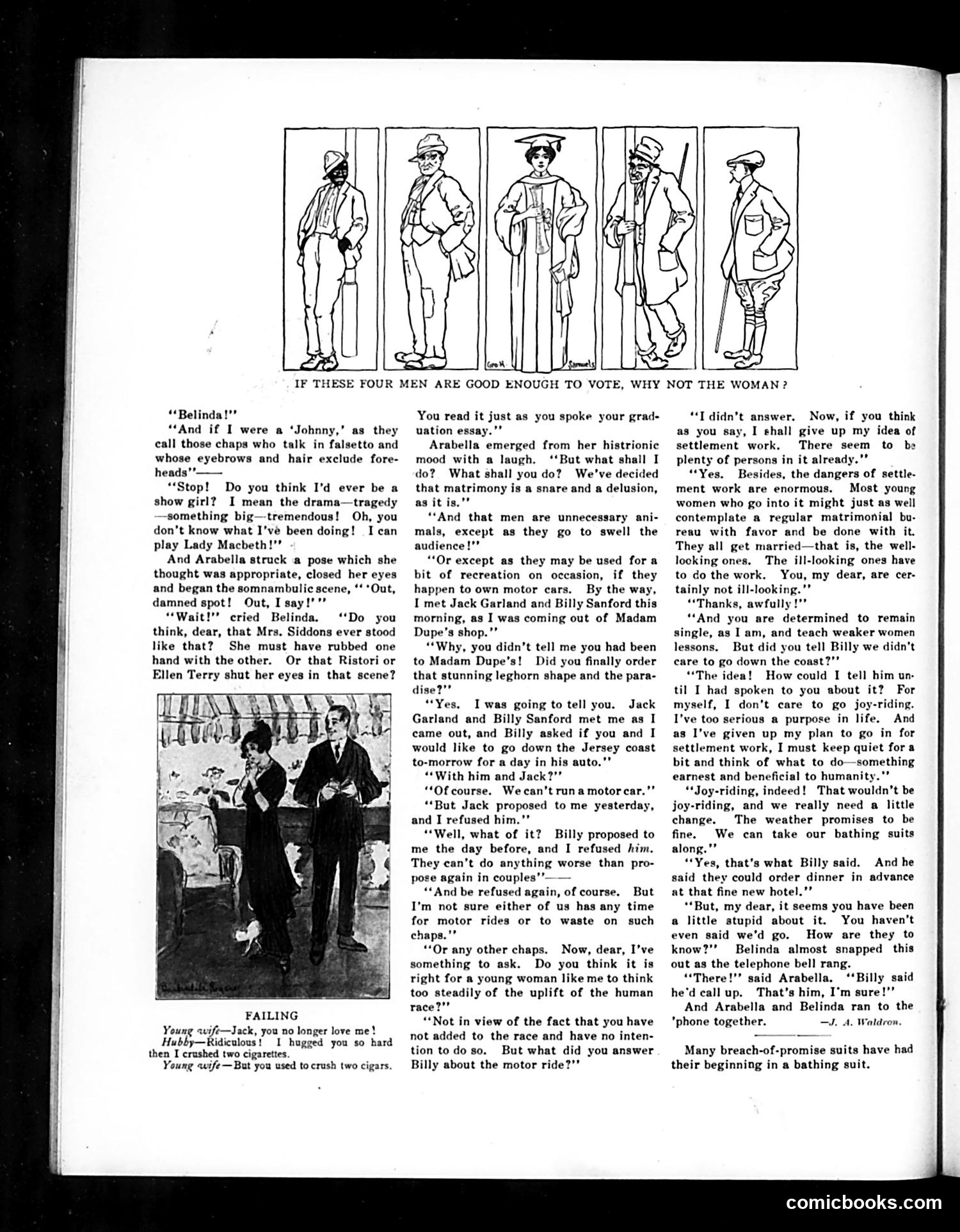
The top cartoon critiques women's suffrage opposition by showing five identically-dressed men with the caption "IF THESE FOUR MEN ARE GOOD ENOUGH TO VOTE, WHY NOT THE WOMAN?" The satire is direct: if men are qualified voters despite appearing interchangeable and undistinguished, women possess equal capacity. The main story ridicules "New Woman" hypocrisy—two unmarried women who claim to reject matrimony as "a snare and delusion" and espouse serious pursuits like "settlement work" (Progressive Era social reform), yet immediately accept motor-car invitations from men who've proposed to them. The text exposes their contradictions: they dismiss men as "unnecessary animals" while eagerly seeking their company and entertainment. The small "Failing" cartoon at bottom satirizes changing marital dynamics, suggesting husbands' romantic gestures have diminished (crushing one cigar instead of two). **Context:** This reflects early-1900s anxieties about women's independence, changing social roles, and the seeming gap between feminist rhetoric and actual behavior—portrayed as shallow opportunism.
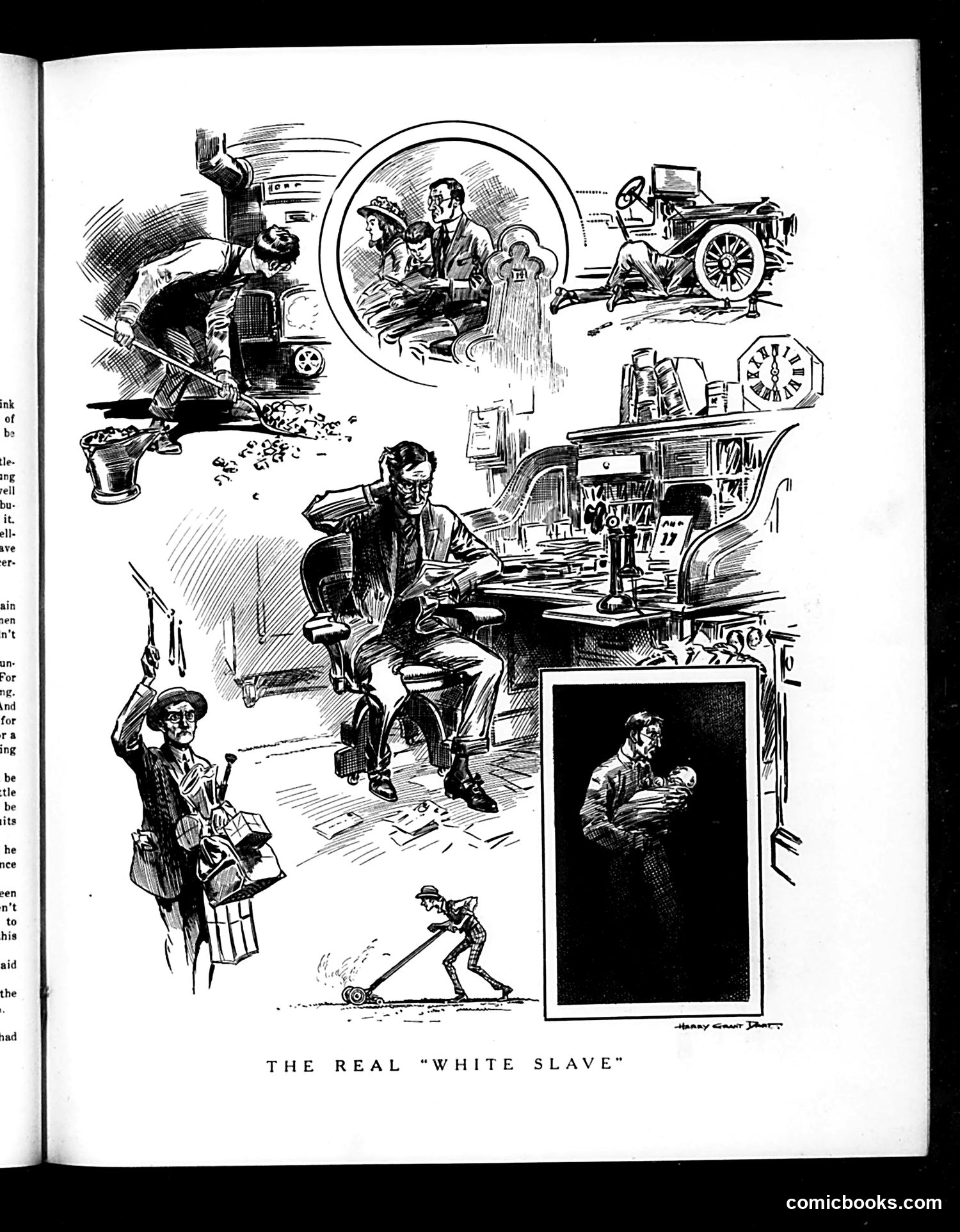
This satirical cartoon is titled "The Real 'White Slave'" and depicts various forms of labor exploitation in early industrial America. The central figure appears to be a working-class man surrounded by scenes of grueling labor: factory work, automobile repair, manual construction, and domestic drudgery. The imagery contrasts with contemporary "white slave" narratives that focused on trafficking victims. The satire argues that the true exploitation of white workers occurred through industrial labor conditions—long hours, dangerous machinery, low wages—rather than the sensationalized crime narratives dominating public discourse. By ironically reclaiming "white slave" terminology, the cartoon critiques how society sensationalized certain forms of victimization while ignoring the systemic exploitation of working-class laborers. This reflects Progressive Era concerns about worker safety and fair labor practices.
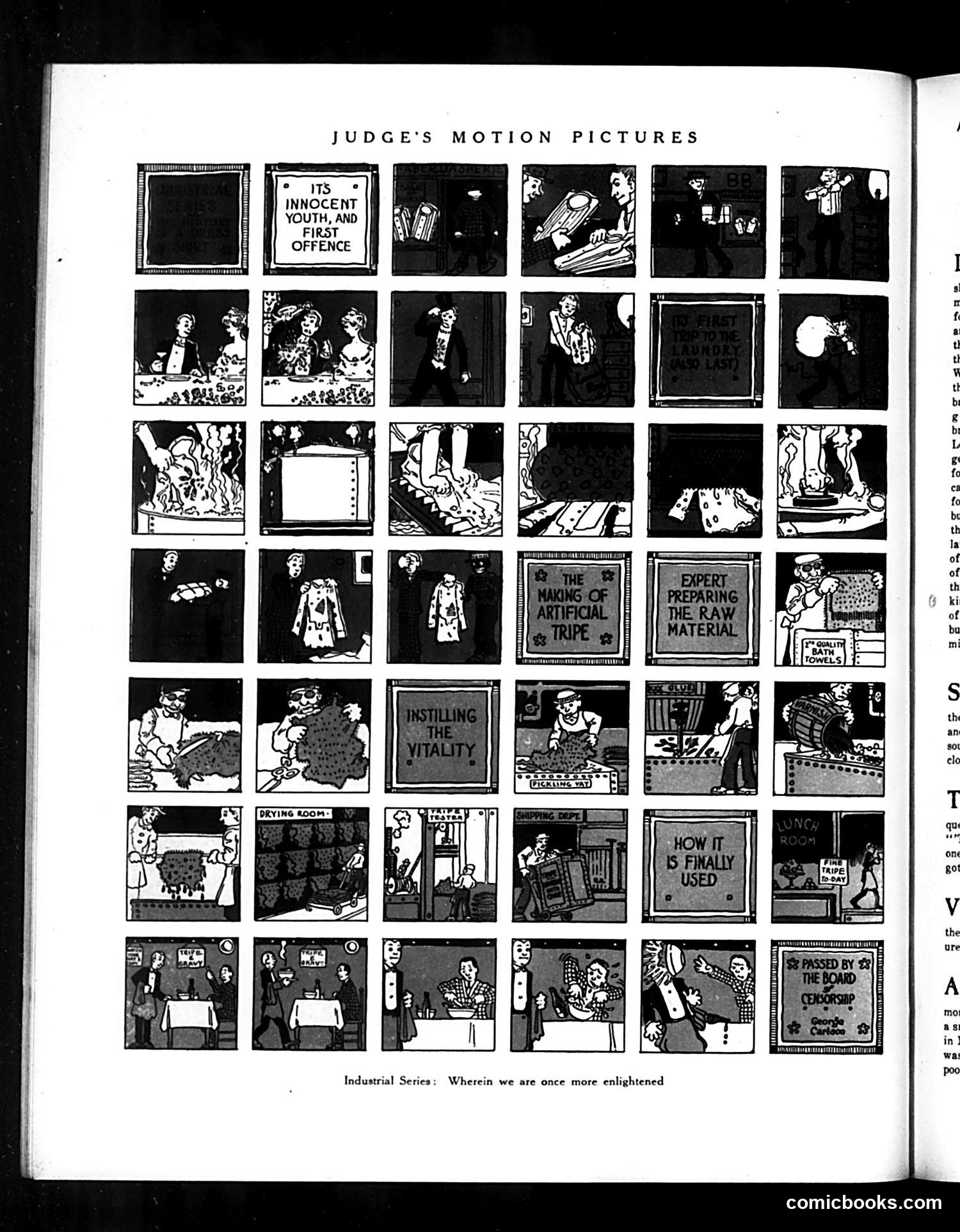
This page displays a grid of silent-film-style motion picture stills from Judge magazine's "Industrial Series," subtitled "Wherein we are once more enlightened." The sequence appears to satirize industrial manufacturing processes, showing various stages of production with title cards like "The Making of Artificial Tripe," "Expert Preparing the Raw Material," "Installing the Vitality," and "How It Finally Is Used." The progression mocks both factory automation and mass-produced consumer goods through exaggerated, comedic scenes of workers handling mysterious materials. The opening card references "Its Innocent Youth, First Offence," suggesting the satire targets how industrial processes transform raw materials into finished products—with dark humor about the transformation's questionable nature. The final card "Passed by the Board" likely mocks regulatory approval of such manufacturing practices.
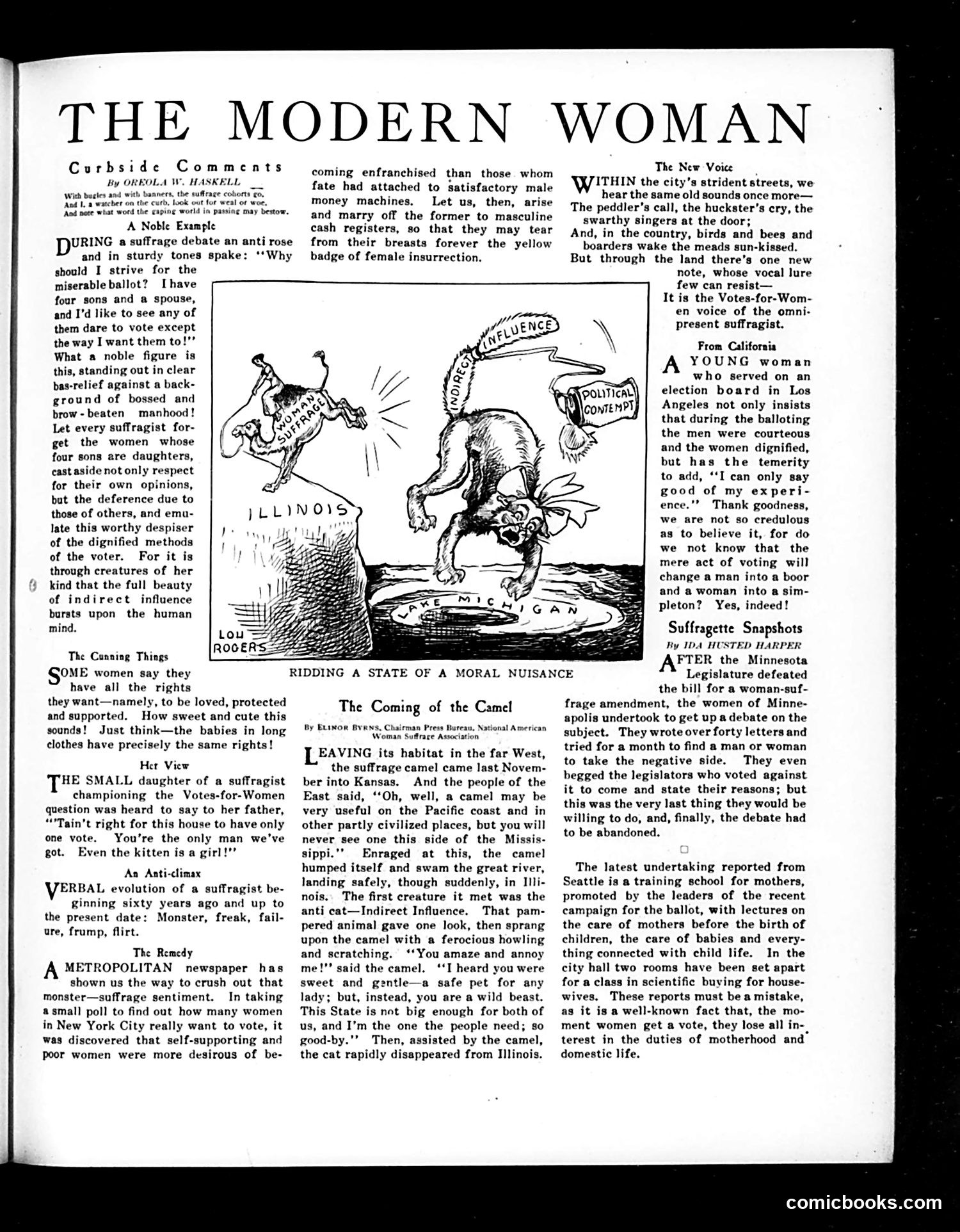
This anti-suffrage page uses satire to mock women's voting rights advocates. The central cartoon depicts a camel (representing women's suffrage) battling a cat labeled "Indirect Influence" (the anti-suffragist argument that women already wield power through men). States "Illinois" and "Lou Rogers" are marked, showing suffrage spreading despite opposition. The accompanying text ridicules common anti-suffrage claims: that women don't need votes because they already influence men, that voting will destroy femininity, and that self-supporting women's desire for enfranchisement proves they're motivated by discontent rather than principle. A quote mocks a man boasting his wife and sons vote only as he dictates, presented ironically as "noble." The pieces collectively argue suffragists are unwelcome "nuisances" spreading like invasive species. Judge's satire here defends the status quo against expanding women's political participation.
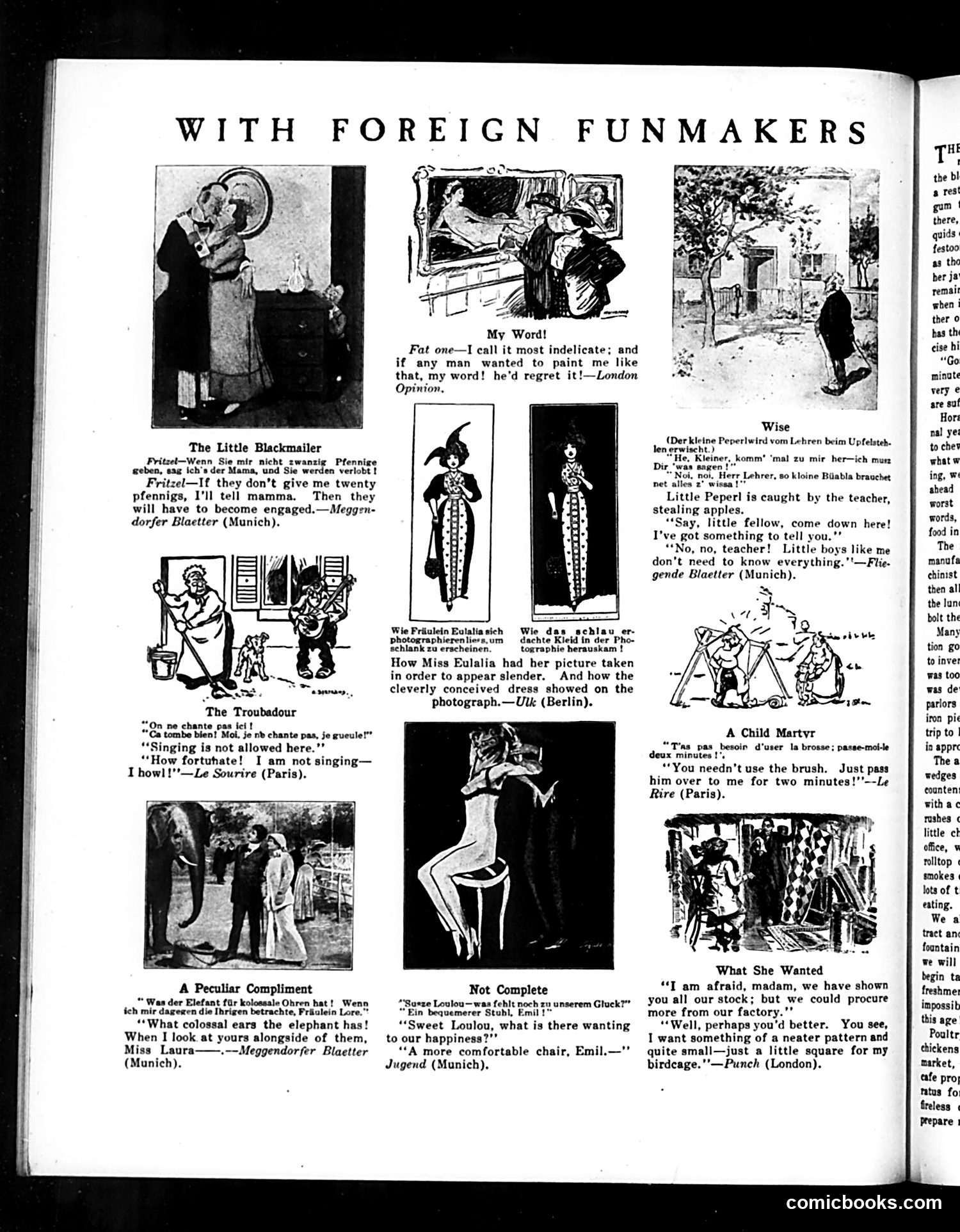
This page reprints satirical cartoons from European publications, showcasing humor across different cultures. The content targets universal subjects: childhood mischief, vanity, courtship, and domestic life. **Key cartoons:** - **"The Little Blackmailer"** (Munich): A child threatens to tell his mother about improper behavior unless given money—implying adults' fear of marital entanglement. - **"Wise"**: A student caught stealing apples cleverly argues children needn't know everything, dodging punishment through cheek. - **"My Word!"**: Body-shaming satire on vanity and artistic representation. - **"Not Complete"**: A woman's marital happiness depends on furniture comfort, not her husband. **The satire's point:** Judge presents European humor as relatable—the jokes don't require specific political knowledge. They mock human nature: greed, vanity, laziness, and materialism across borders. By juxtaposing German, French, and British cartoons, the page suggests sophisticated American readers appreciate cosmopolitan wit, not just parochial politics.
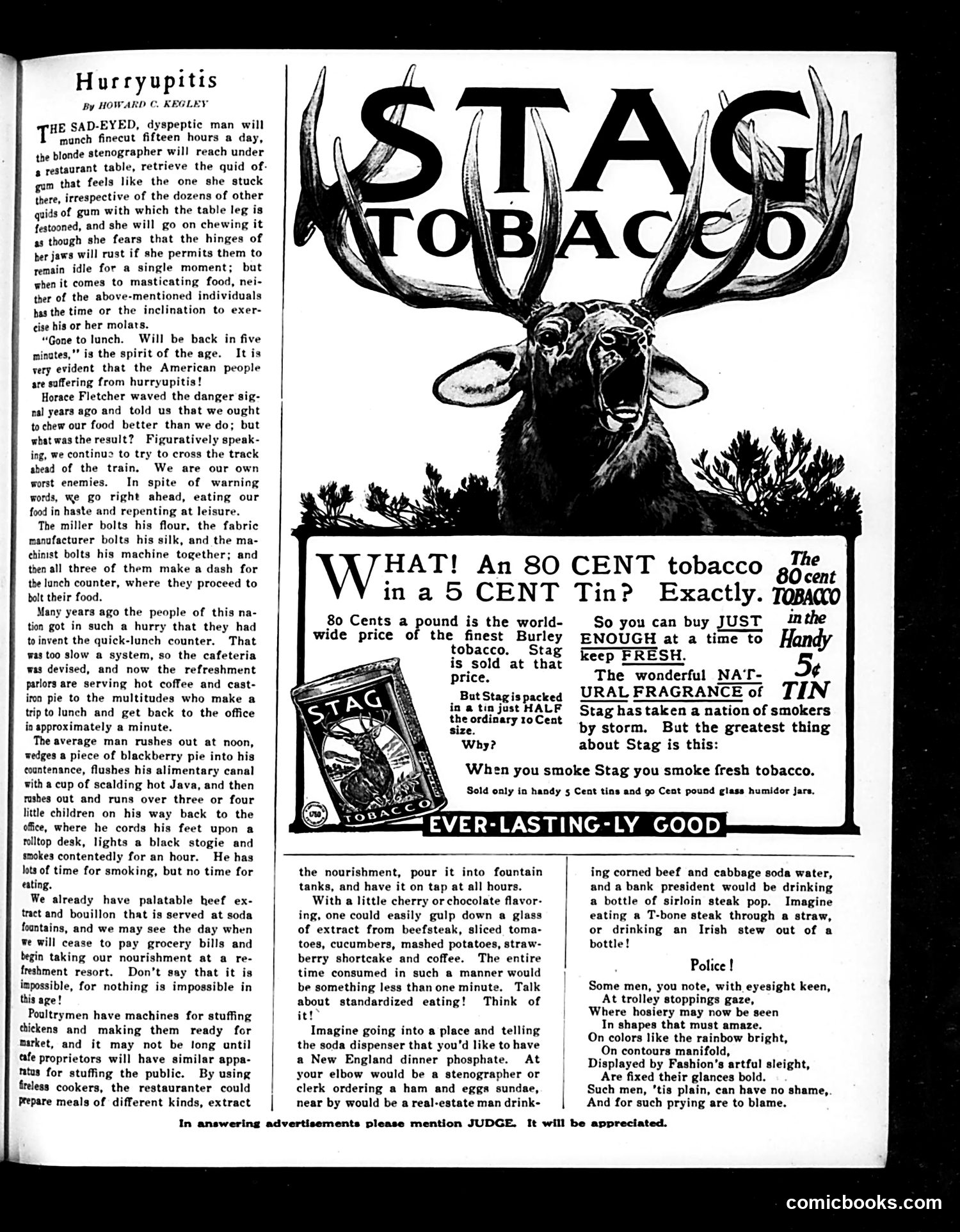
This article satirizes what the author calls "hurryupitis"—a widespread American disease of eating too fast. The piece mocks the modern worker's lifestyle: the dyspeptic businessman and blonde stenographer who chew gum constantly but gulp food without proper mastication. The author references Horace Fletcher (a real nutritionist who advocated thorough chewing) to highlight how Americans ignore health advice in favor of speed. The satire escalates absurdly, imagining a future where people consume meals as liquid extracts dispensed from fountain taps—reducing eating to mere refueling. The piece critiques American industrial culture's values: workers have time to smoke leisurely but rush meals, suggesting misplaced priorities. It's a commentary on how mechanization and workplace efficiency have corrupted basic human functions like eating into hurried, unhealthy habits. The accompanying **Stag tobacco advertisement** is unrelated product marketing.
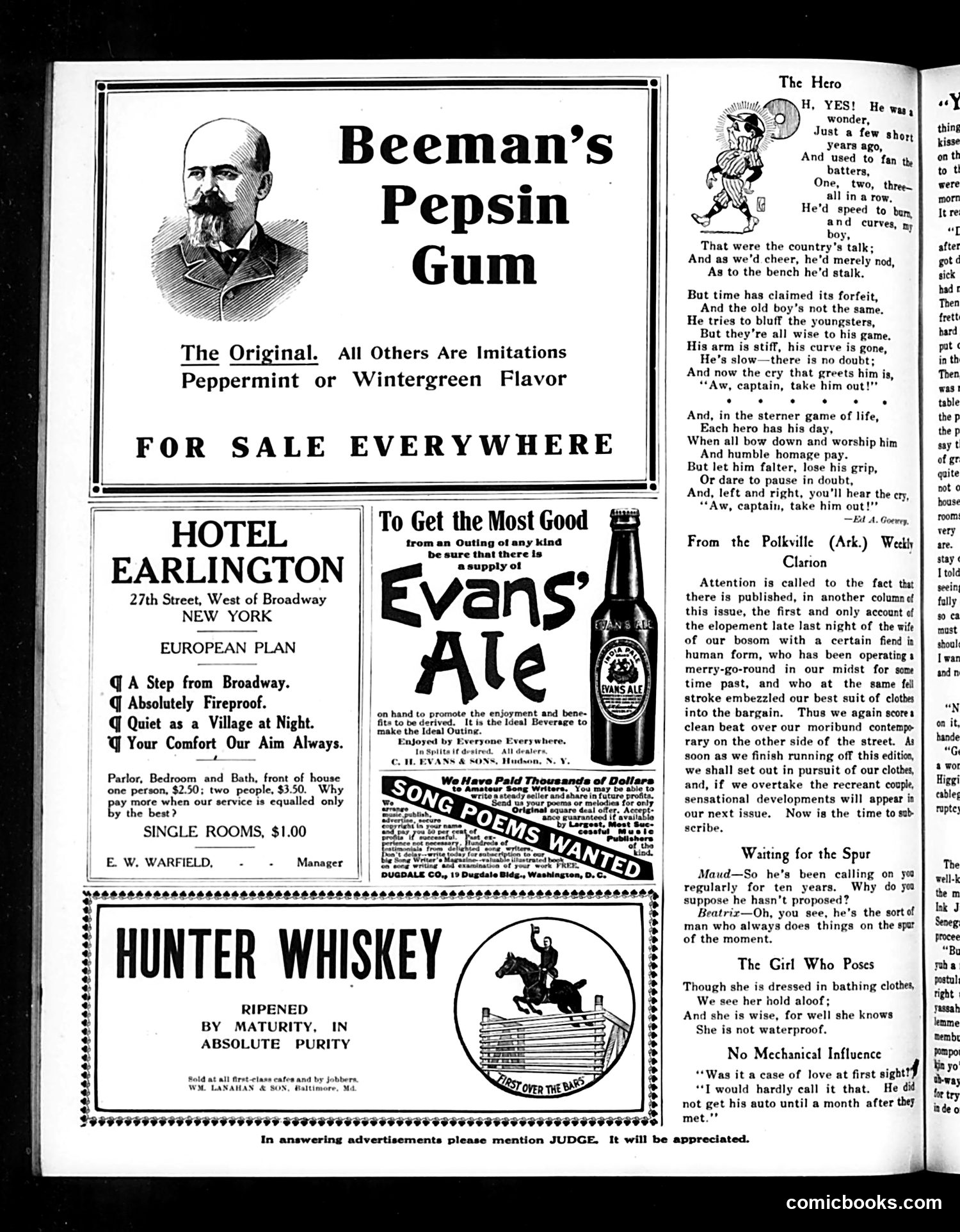
This page is primarily **advertising**, featuring prominent ads for Beeman's Pepsin Gum, Hotel Earlington, Evans' Ale, Hunter Whiskey, and song poem submissions. The editorial content includes several short humorous pieces: **"The Hero"** is a sentimental poem about an aging baseball player whose glory days have passed. Once celebrated for his pitching prowess, he's now slow and ineffective, with crowds calling "Aw, captain, take him out!" The piece uses baseball as metaphor for life's inevitable decline—even admired figures fade and lose public sympathy when they can no longer perform. The remaining items are brief comedic vignettes typical of Judge's humor: a small-town newspaper editor's self-congratulatory account of covering a local scandal, and several short jokes about courtship and modern life (a woman in bathing clothes who isn't waterproof; a man who proposes only after buying an automobile). The overall tone reflects early 20th-century American magazine humor—sentimental, mildly satirical about social pretension, and focused on domestic/romantic comedy.
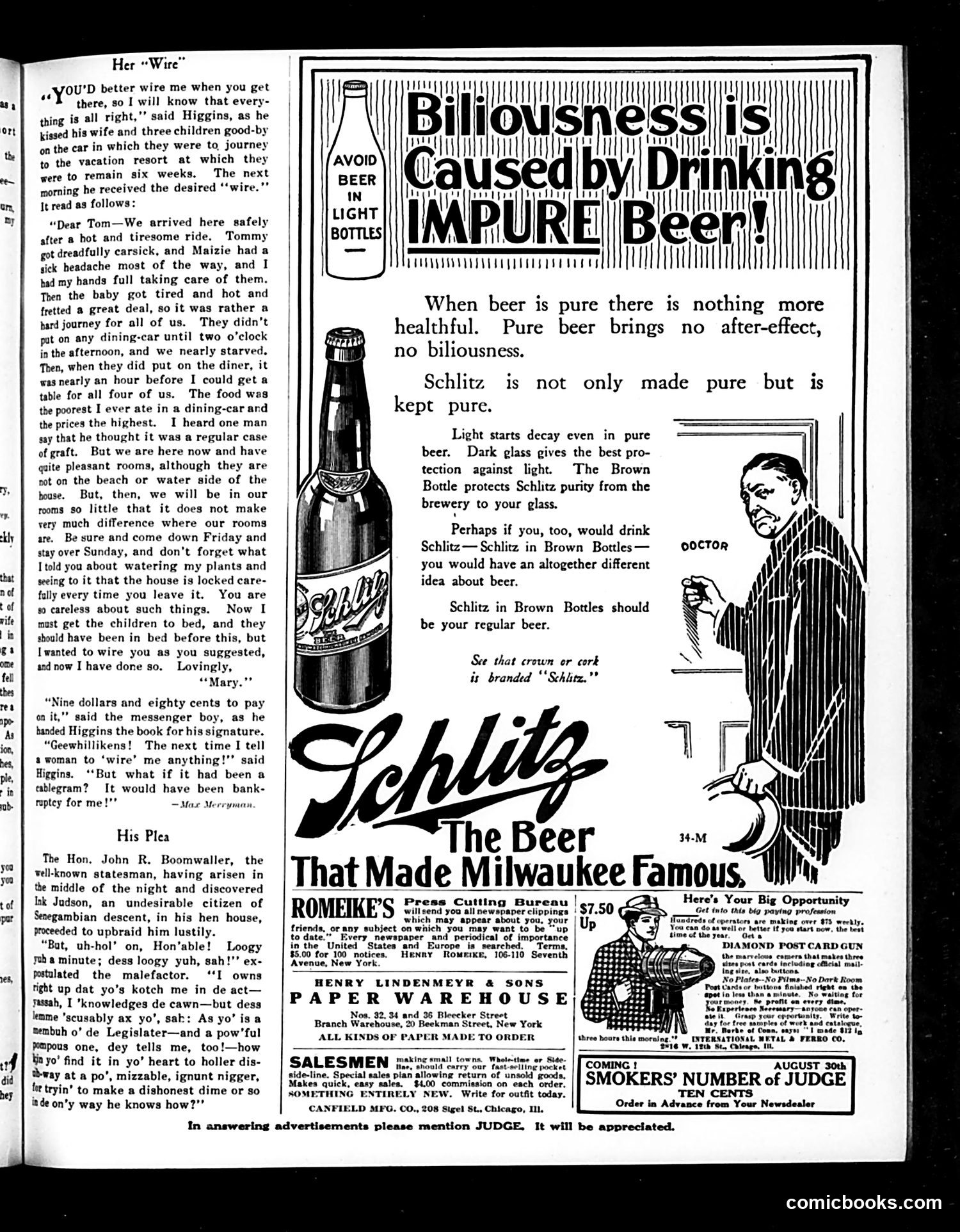
This page contains two unrelated humor pieces and multiple advertisements, typical of Judge magazine's format. **"Her Wire"** satirizes the gap between husbands' and wives' communication styles. When a businessman asks his wife to "wire" updates during vacation, he expects brief, reassuring messages. Instead, she sends an exhaustive telegram detailing every family complaint—sick children, poor train food, overpriced dining cars, household instructions—then charges him $9.80 in telegraph fees. The joke mocks both her verbosity and the impracticality of his request, suggesting wives cannot be concise even when paying by the word. **"His Plea"** (incomplete on this page) appears to be a dialect humor piece featuring a Black man caught stealing chickens attempting to negotiate with a white legislator. **The Schlitz Advertisement** dominates the right side, claiming brown bottles protect beer from light decay and that pure Schlitz causes no "biliousness" (digestive upset)—a common beer complaint of the era.
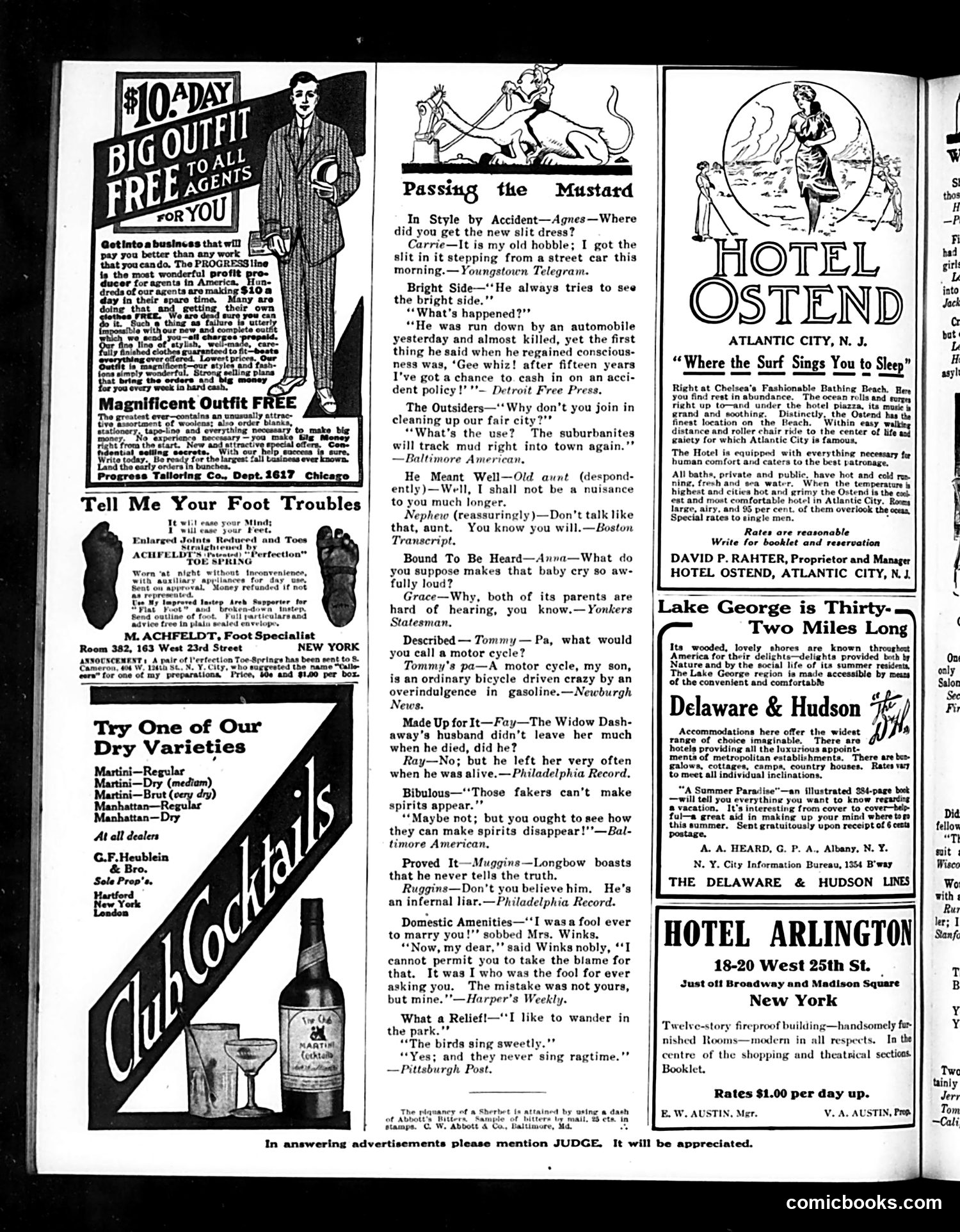
This page is primarily **advertisements and humor columns**, not political cartoons. The content includes: **Humor Sections:** Brief jokes on domestic life, wordplay, and social observations—typical of Judge's satirical humor. Examples: a woman's dress accidentally slit by a street car, a man finding silver linings in accidents, suburban complaints about mud. **Advertisements:** The page features hotel promotions (Hotel Ostend, Hotel Arlington, Delaware & Hudson Line), a tailoring business outfit scheme, foot care products, and Chianti wine—representing early 20th-century consumer marketing. **No clear political content** is visible. The jokes target everyday absurdities (motorized bicycles, marriage complaints, spiritualist "fakers") rather than specific political figures or events. This appears to be a typical leisure/lifestyle page mixing light satire with period advertising.
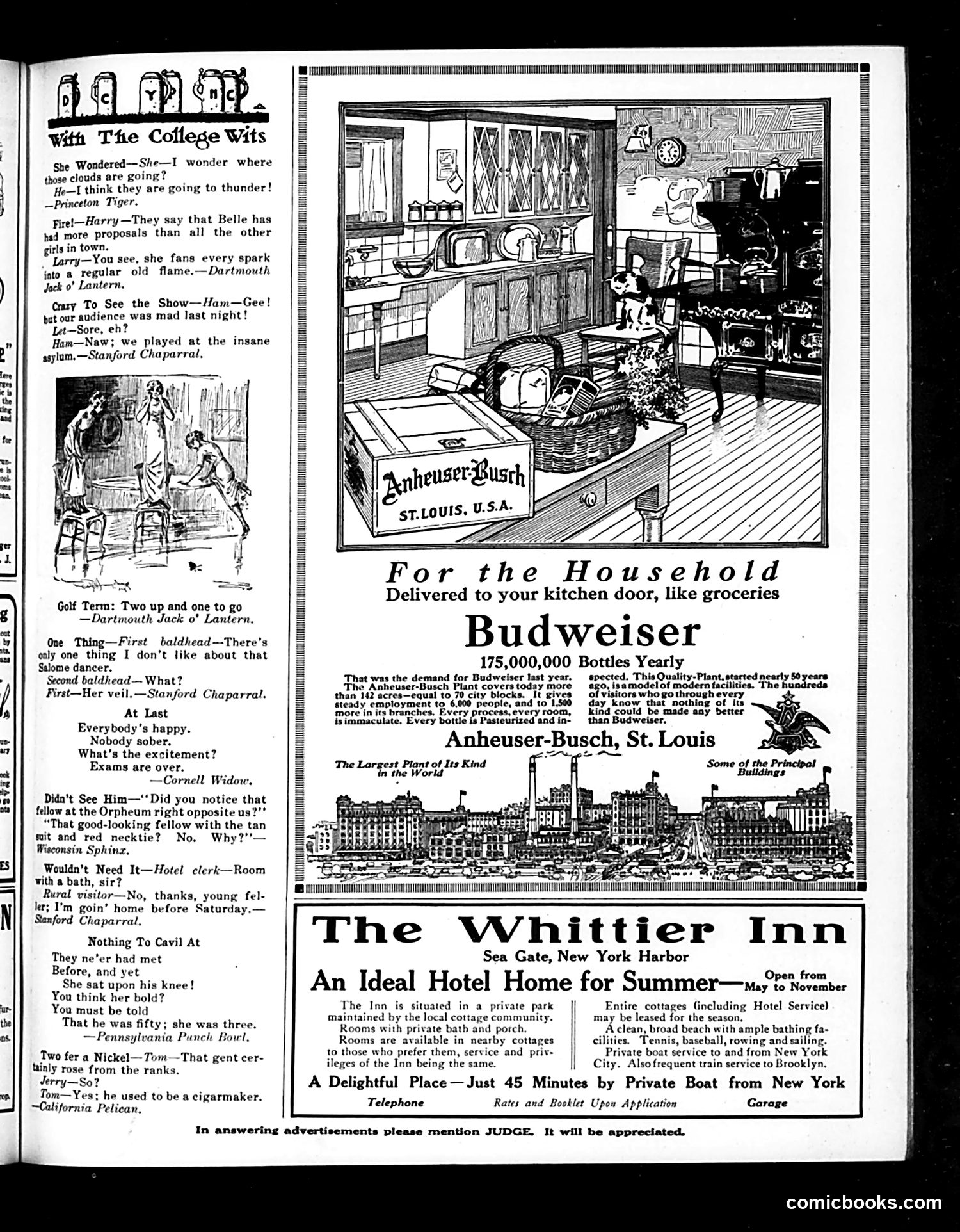
This page contains **mostly advertisements** with small college humor columns interspersed. The main satirical content is minimal. **The College Wit jokes** are brief, harmless campus humor from various university publications (Princeton Tiger, Dartmouth Jack o'Lantern, etc.). They mock predictable targets: romantic proposals, theater audiences, and physical appearance. Nothing politically pointed. **The advertisements** dominate: Budweiser beer promotes delivery "like groceries" to households, emphasizing its massive St. Louis plant and employment; The Whittier Inn advertises summer resort accommodations in New York Harbor. **One notable joke** pairs a fifty-year-old man with a three-year-old child sitting on his knee—a crude gag about age difference that would be considered inappropriate today, though it appears meant as innocent absurdist humor for the era. The page reflects **1920s consumer culture** and college-magazine lightheartedness rather than serious political satire. No identifiable public figures or significant social commentary appear.
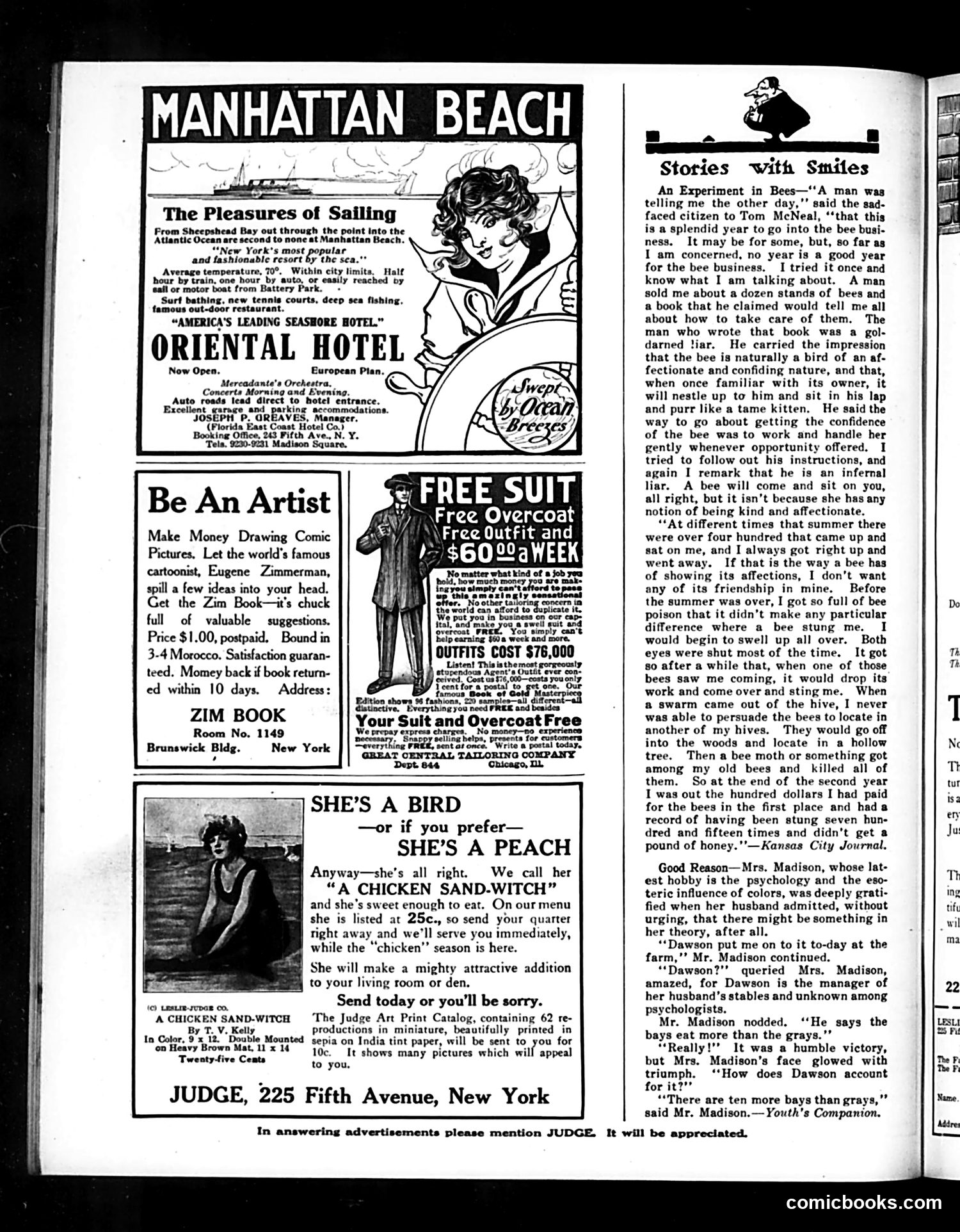
This page primarily contains **advertisements and humor columns** rather than political satire. The main content includes: 1. **Resort/Hotel Ads** (Oriental Hotel, Manhattan Beach) - promoting leisure travel to New York seashore destinations 2. **"Be An Artist" Ad** - soliciting comic book aspirants to buy Eugene Zimmerman's instructional book 3. **Tailoring Company Ad** - promising free suits and overcoats (likely a scam) 4. **"Chicken Sand-Witch" Ad** - a restaurant pun where a woman is humorously marketed as a sandwich item, playing on period slang ("bird," "peach") 5. **"Stories with Smiles" Column** - a humorous anecdote about a man's disastrous experience with beekeeping. The joke mocks romantic notions about nature: the beekeeper's manual claimed bees were affectionate creatures that would "nestle up" like kittens, but the man discovers bees are aggressive and he gets stung repeatedly—a satirical critique of unrealistic how-to guides. The page reflects early 20th-century advertising and popular humor rather than political commentary.
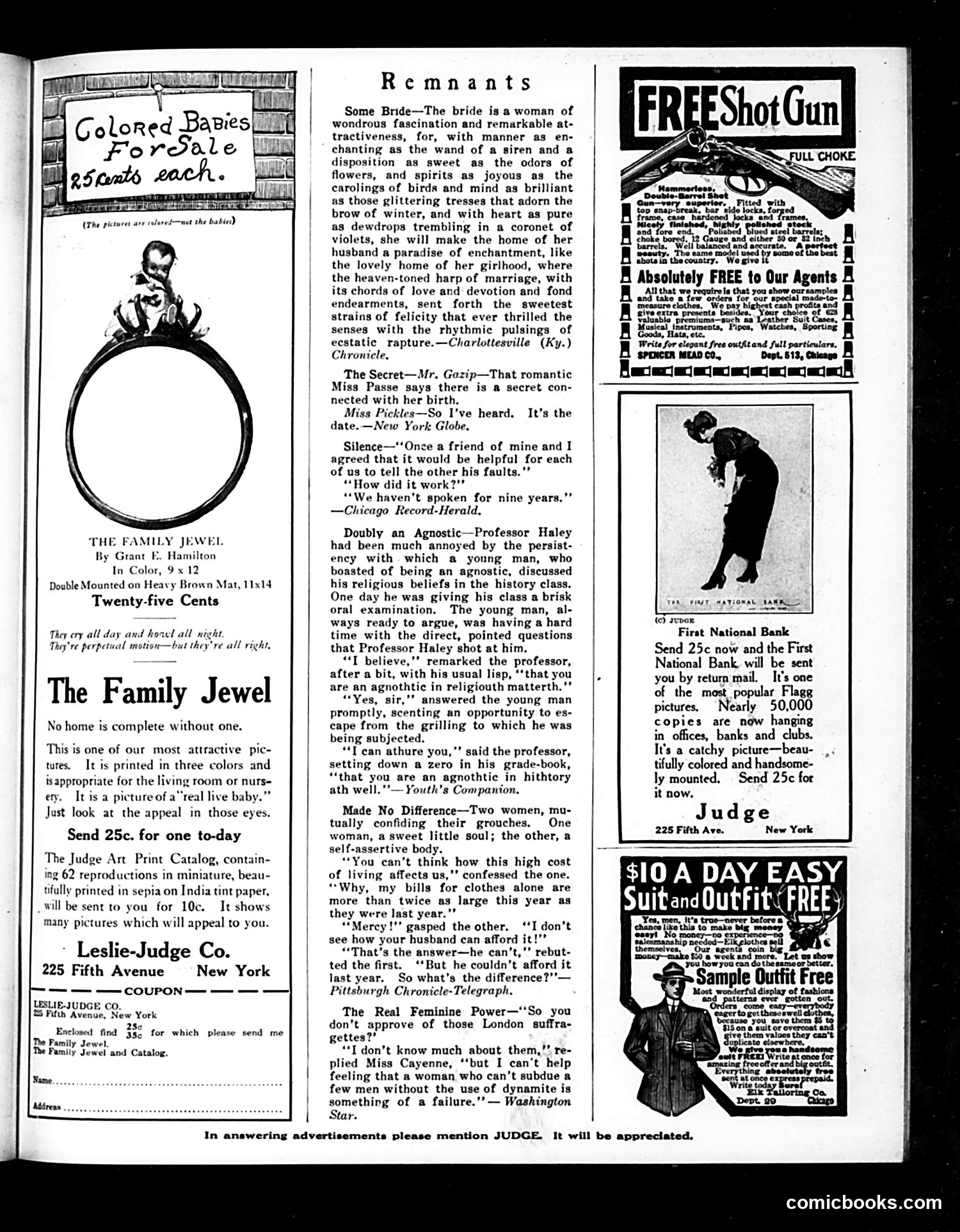
This page features an illustration titled "The Family Jewel" by Grant E. Hamilton, depicting a baby's face emerging from a wedding ring. The accompanying verse ("They cry all day and howl all night") presents a humorous, affectionate portrait of infants as perpetual sources of noise and motion—yet ultimately precious family treasures. The image satirizes sentimental Victorian attitudes toward children and marriage. Judge marketed this as an attractive print for living rooms or nurseries, selling reproductions for 25 cents. The juxtaposition of the romantic symbol (wedding ring) with the decidedly unromantic reality of a crying baby captures the magazine's blend of gentle mockery and domestic humor typical of early 20th-century American satire. The surrounding "Remnants" section contains various short humorous anecdotes about relationships, religion, and social behavior—standard filler content for the era.
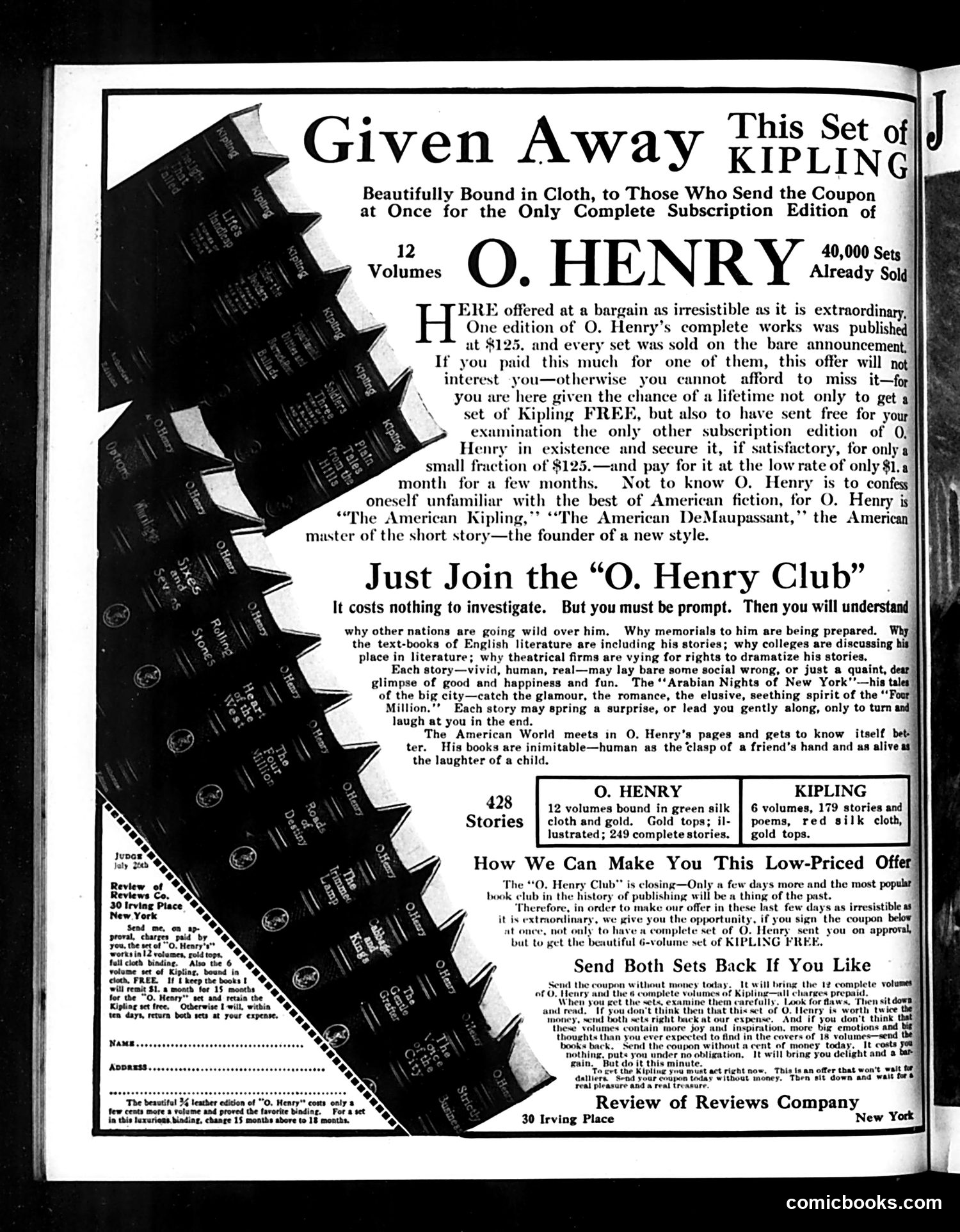
This is primarily a **book-club advertisement**, not a political cartoon. It promotes subscription editions of O. Henry's complete works (12 volumes) paired with a free Rudyard Kipling collection (6 volumes). **Key appeals to modern readers:** The ad positions **O. Henry as "The American Kipling"**—comparing a contemporary American short-story writer to the already-famous British author Kipling. This suggests O. Henry's literary status was still being established in the early 20th century. **Sales tactics visible:** The copy emphasizes scarcity ("40,000 Sets Already Sold"), urgency ("Only a few days more"), and risk-free trial ("Send Both Sets Back If You Like"), strategies familiar to modern direct marketing. **Cultural context:** The enthusiastic tone about O. Henry's stories—particularly "The Arabian Nights of New York"—reflects period fascination with urban American life as literary subject matter. The page reflects early subscription-edition publishing models before mass-market paperbacks existed.