
Judge, 1913-07-26 · page 7 of 24
Judge — July 26, 1913 — page 7: what you’re looking at
What you’re looking at
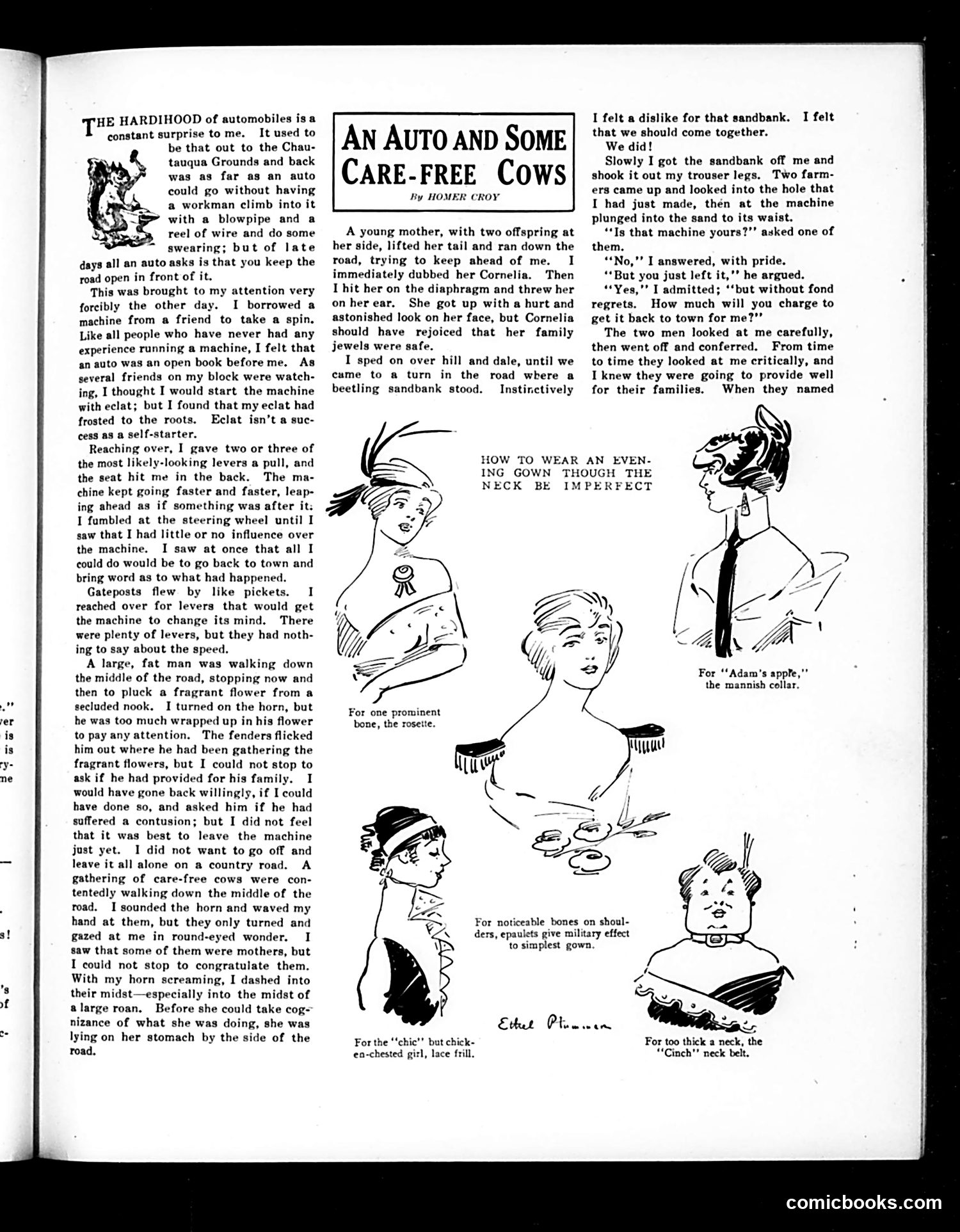
This is a humorous essay by Homer Croy about an out-of-control automobile ride, illustrated with fashion sketches on the side. The satire targets early automobiles' notoriously unreliable mechanics and the narrator's incompetence operating one. The joke: A borrowed car becomes uncontrollable—accelerating wildly, refusing to respond to steering or brakes. The hapless driver careens through the countryside, hitting a pedestrian, scattering cattle (including one named "Cornelia"), and finally crashes into a sandbank. The narrator's prideful claim that the wrecked car isn't his, followed by casual negotiation with farmers over retrieval costs, underscores the absurdity. The satire reflects contemporary frustration with automobiles as temperamental, dangerous machines requiring constant mechanical intervention—not yet reliable transportation. The fashion sketches ("How to wear an evening gown...") are unrelated sidebar content typical of Judge magazine.
📄 Transcribed text from this page (OCR, searchable)
Machine-transcribed from the original scan — historical spelling and the odd misread are preserved.
THE HARDIHOOD of automobiles is a constant surprise tome. It used to be that out to the Chau- tauqua Grounds and back was as far as an auto could go without having a workman climb into it with a blowpipe and a reel of wire and do some swearing; but of late days all an auto asks is that you keep the road open in front of it. This was brought to my attention very forcibly the other day. I borrowed a machine from a friend to take a spin, Like all people who have never had any experience running a machine, I felt that an auto was an open book before me. As several friends on my block were watch- ing, I thought I would start the machine with eclat; but I found that my eclat had frosted to the roots. Eclat isn’t a suc- cess as a self-starter. Reaching over, I gave two or three of the most likely-looking levers a pull, and the seat hit me in the back. The ma- chine kept going faster and faster, leap- ing ahead as if something was after it: I fumbled at the steering wheel until I saw that I had little or no influence over the machine. I saw at once that all I could do would be to go back to town and bring word as to what had happened. Gateposts flew by like pickets. I reached over for levers that would get the machine to change its mind. There were plenty of levers, but they had noth- ing to say about the speed, A large, fat man was walking down the middle of the road, stopping now and then to pluck a fragrant flower from a secluded nook. I turned on the horn, but he was too much wrapped up in his flower to pay any attention. The fenders flicked him out where he had been gathering the fragrant flowers, but I could not stop to ask if he had provided for his family. I would have gone back willingly, if I could have done so, and asked him if he had suffered a contusion; but I did not feel that it was best to leave the machine just yet. I did not want to go off and leave it all alone on a country road. A gathering of care-free cows were con- tentedly walking down the middle of the road. I sounded the horn and waved my hand at them, but they only turned and gazed at me in round-eyed wonder. I saw that some of them were mothers, but I could not stop to congratulate them. With my horn screaming, I dashed into their midst—especially into the midst of alarge roan. Before she could take cog- nizance of what she was doing, she was lying on her stomach by the side of the road. AN AUTO AND SOME CARE-FREE Cows By HOMER CROY A young mother, with two offspring at her side, lifted her tail and ran down the road, trying to keep ahead of me. I immediately dubbed her Cornelia. Then I hit her on the diaphragm and threw her onherear. She got up with a hurt and astonished look on her face, but Cornelia should have rejoiced that her family jewels were safe. I sped on over hill and dale, until we came to a turn in the road where a beetling sandbank stood. Instinctively I felt a dislike for that sandbank. I felt that we should come together. We did! Slowly I got the sandbank off me and shook it out my trouser legs. Two farm- ers came up and looked into the hole that I had just made, thén at the machine plunged into the sand to its waist. “Is that machine yours?’’ asked one of them. **No,’’ I answered, with pride. “But you just left it,’’ he argued. “Yes,’’ I admitted; ‘‘but without fond regrets. How much will you charge to get it back to town for me?"’ The two men looked at me carefully, then went off and conferred. From time to time they looked at me critically, and I knew they were going to provide well for their families. When they named HOW TO WEAR AN EVEN- ING GOWN THOUGH THE NECK BE For one prominent bone, the rosette. IMPERFECT For ‘Adam's appte,"” the mannish collar. For noticeable bones on shoul- ders, epaulets give military effect to simplest gown. 2 sm? Ethel Phew wen Ss For the ‘‘chic’” but chick- ea-chested gisl, lace frill. For too thick a neck, the “Cinch'’ neck belt. comicbooks.com