
Judge, 1913-07-26 · page 4 of 24
Judge — July 26, 1913 — page 4: what you’re looking at
What you’re looking at
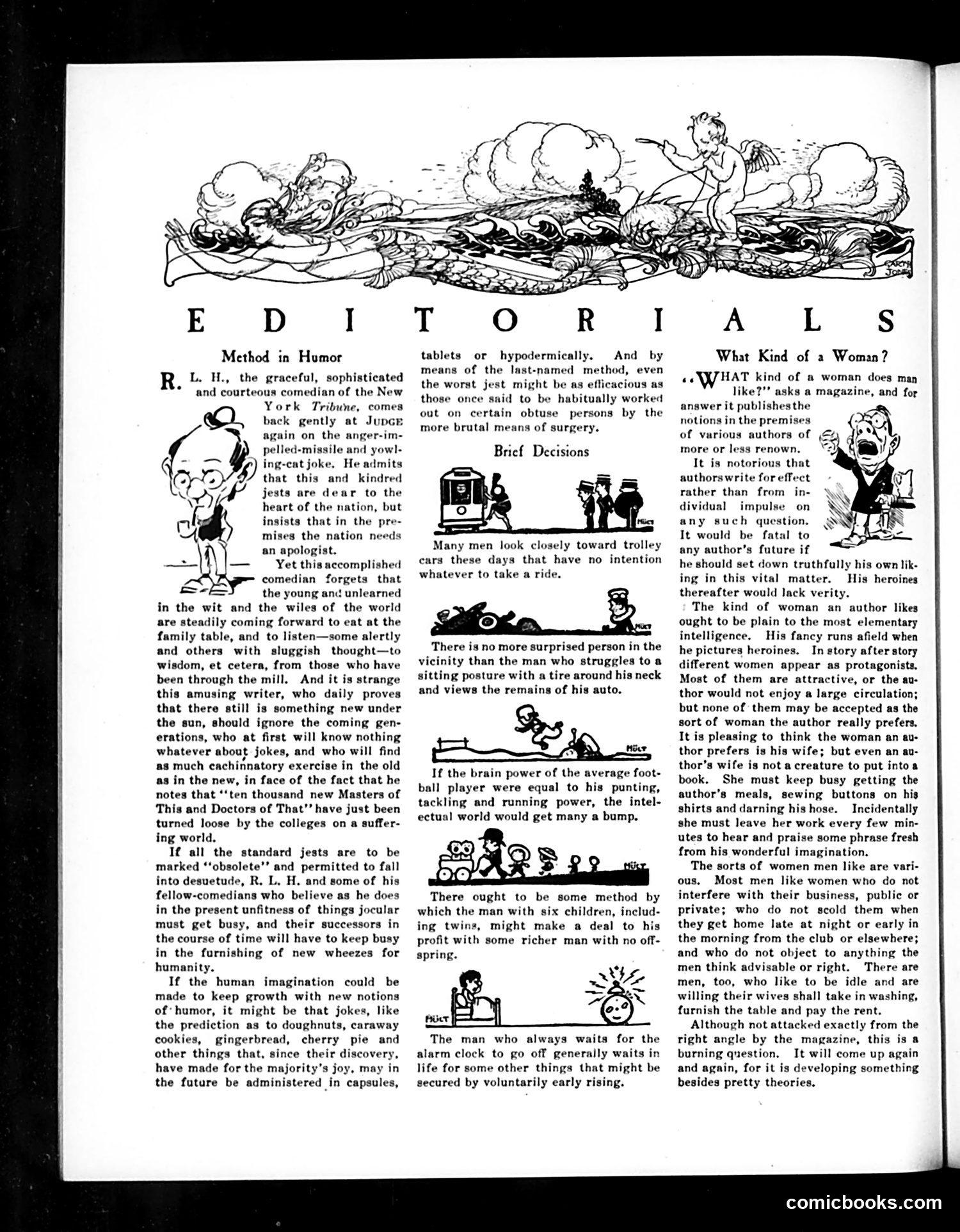
This page contains editorial commentary on contemporary issues, though specific figures and events are difficult to identify with certainty from the image alone. The left column features a caricatured portrait (captioned "R.L.H.") of what appears to be a theater or vaudeville personality, praising their comedic wit. The text celebrates their "graceful, sophisticated" humor while critiquing other comedians for failing to meet similar standards. The right section, titled "What Kind of a Woman?", discusses how authors depict female characters in literature. It argues that most male authors write women as either attractive or plain, rarely showing complexity. The piece advocates for more realistic, nuanced female characterization in fiction. The scattered small cartoons throughout appear to illustrate everyday humorous situations involving domestic life and social behaviors, consistent with Judge's satirical mission.
📄 Transcribed text from this page (OCR, searchable)
Machine-transcribed from the original scan — historical spelling and the odd misread are preserved.
Method in Humor R L. H., the graceful, sophisticated * and courteous comedian of the New York Tribune, comes oO. back gently at Jupce again on the anger-im- pelled-missile and yow!- SS ing-cat joke, He admits OY Stone this and kindred Z Xl ¥) wi jests are dear to the heart of the nation, but insists that the pre- mises the nation needs f\ an apologist. ——|1\|— Yet this accomplished any comedian forgets that e-=> the young and unlearned in the wit and the wiles of the world are steadily coming forward to eat at the family table, and to listen—some alertly and others with sluggish thought—to wisdom, et cetera, from those who have been through the mill. And it is strange this amusing writer, who daily proves that there still is something new under the sun, should ignore the coming gen- erations, who at first will know nothing whatever about jokes, and who will find as much cachinnatory exercise in the old as in the new, in face of the fact that he notes that ‘‘ten thousand new Masters of This and Doctors of That’’ have just been turned loose by the colleges on a suffer- ing world. If all the standard jests are to be marked ‘‘obsolete’’ and permitted to fall into desuetude, R. L. H. and some of his fellow-comedians who believe as he does in the present unfitness of things jocular must get busy, and their successors in the course of time will have to keep busy in the furnishing of new wheezes for humanity. If the human imagination could be made to keep growth with new notions of: humor, it might be that jokes, like the prediction as to doughnuts, caraway cookies, gingerbread, cherry pie and other things that, since their discovery, have made for the majority’s joy, may in the future be administered in capsules, tablets or hypodermically. And by means of the last-named method, even the worst jest might be as efficacious as those once said to be habitually worked out on certain obtuse persons by the more brutal means of surgery. Brief Decisions Many men look closely toward trolley cars these days that have no intention whatever to take a ride. There is no more surprised person in the vicinity than the man who struggles to a sitting posture with a tire around his neck and views the remains of his auto. ne, NOS If the brain power of the average foot- ball player were equal to his punting, tackling and running power, the intel- ectual world would get many a bump. There ought to be some method by which the man with six children, includ- ing twins, might make a deal to his profit with some richer man with no off- spring. The man who always waits for the alarm clock to go off generally waits in life for some other things that might be secured by voluntarily early rising. What Kind of a Woman? ce QVHAT kind of a woman does man like?”’ asks a magazine, and for answer it publishesthe notions in the premises of various authors of more or less renown. It is notorious that authors write for effect rather than from in- dividual impulse on any such question. It would be fatal to any author's future if he should set down truthfully his own lik- ing in this vital matter. His heroines thereafter would lack verity. The kind of woman an author likes ought to be plain to the most elementary intelligence. His fancy runs afield when he pictures heroines. In story after story different women appear as protagonists, Most of them are attractive, or the au- thor would not enjoy a large circulation; but none of them may be accepted as the sort of woman the author really prefers. It is pleasing to think the woman an au- thor prefers is his wife; but even an au- thor’s wife is not a creature to put intoa book. She must keep busy getting the author’s meals, sewing buttons on his shirts and darning his hose. Incidentally she must leave her work every few min- utes to hear and praise some phrase fresh from his wonderful imagination. The sorts of women men like are vari- ous. Most men like women who do not interfere with their business, public or private; who do not scold them when they get home late at night or early in the morning from the club or elsewhere; and who do not object to anything the men think advisable or right. There are men, too, who like to be idle and are willing their wives shall take in washing, furnish the table and pay the rent. Although not attacked exactly from the right angle by the magazine, this is a burning question. It will come up again and again, for it is developing something besides pretty theories. comicbooks.com