
A complete issue · 24 pages · 1913
Judge — July 19, 1913
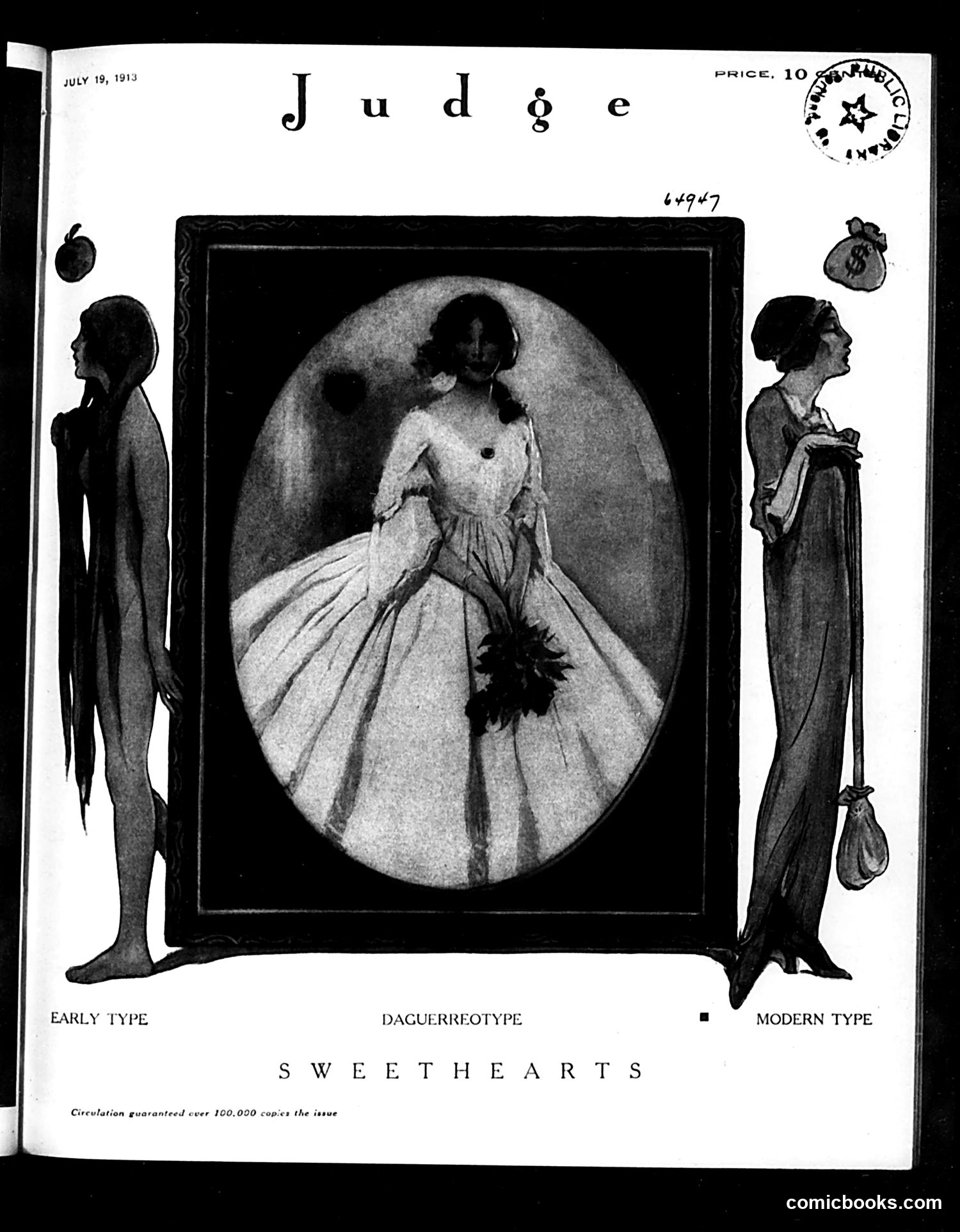
This page presents three female silhouettes labeled "Early Type," "Daguerreotype," and "Modern Type," arranged around a central oval portrait of a woman in classical dress holding a dark feathered fan or plume. The satire appears to track evolving standards of female beauty and fashion across eras. The "Early Type" shows an extremely thin, angular figure; the "Daguerreotype" (central image) depicts idealized classical femininity; the "Modern Type" shows a tall, slender figure in draped clothing. The joke likely mocks how contemporary beauty standards—represented by the "Modern Type"—differ dramatically from historical ideals, suggesting the fickleness of fashion and aesthetic preferences. The comparison implies that what society deems attractive constantly shifts, making any standard ultimately arbitrary.
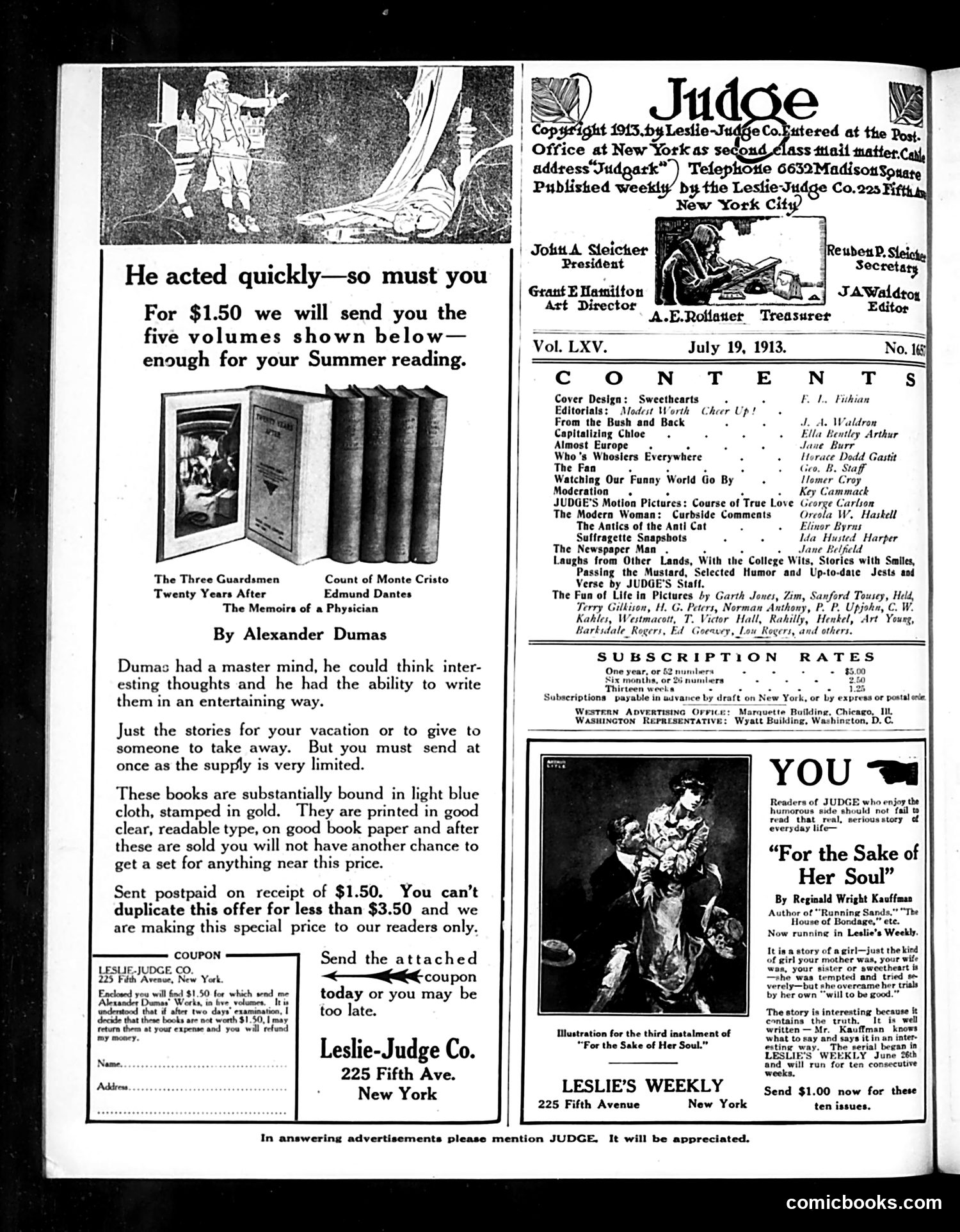
This page is primarily **advertising and editorial content** rather than political satire. The main feature is a book promotion for Alexander Dumas's classical novels (The Three Guardsmen, Count of Monte Cristo, etc.), offered as a five-volume set for $1.50 as summer reading. The page includes a table of contents listing various articles and humor pieces typical of Judge magazine's satirical approach to contemporary life. A separate advertisement promotes "For the Sake of Her Soul," a serialized story appearing in Leslie's Weekly, appealing to readers interested in romantic drama. The overall page reflects early 20th-century magazine layout and publishing practices rather than containing specific political commentary requiring historical context.
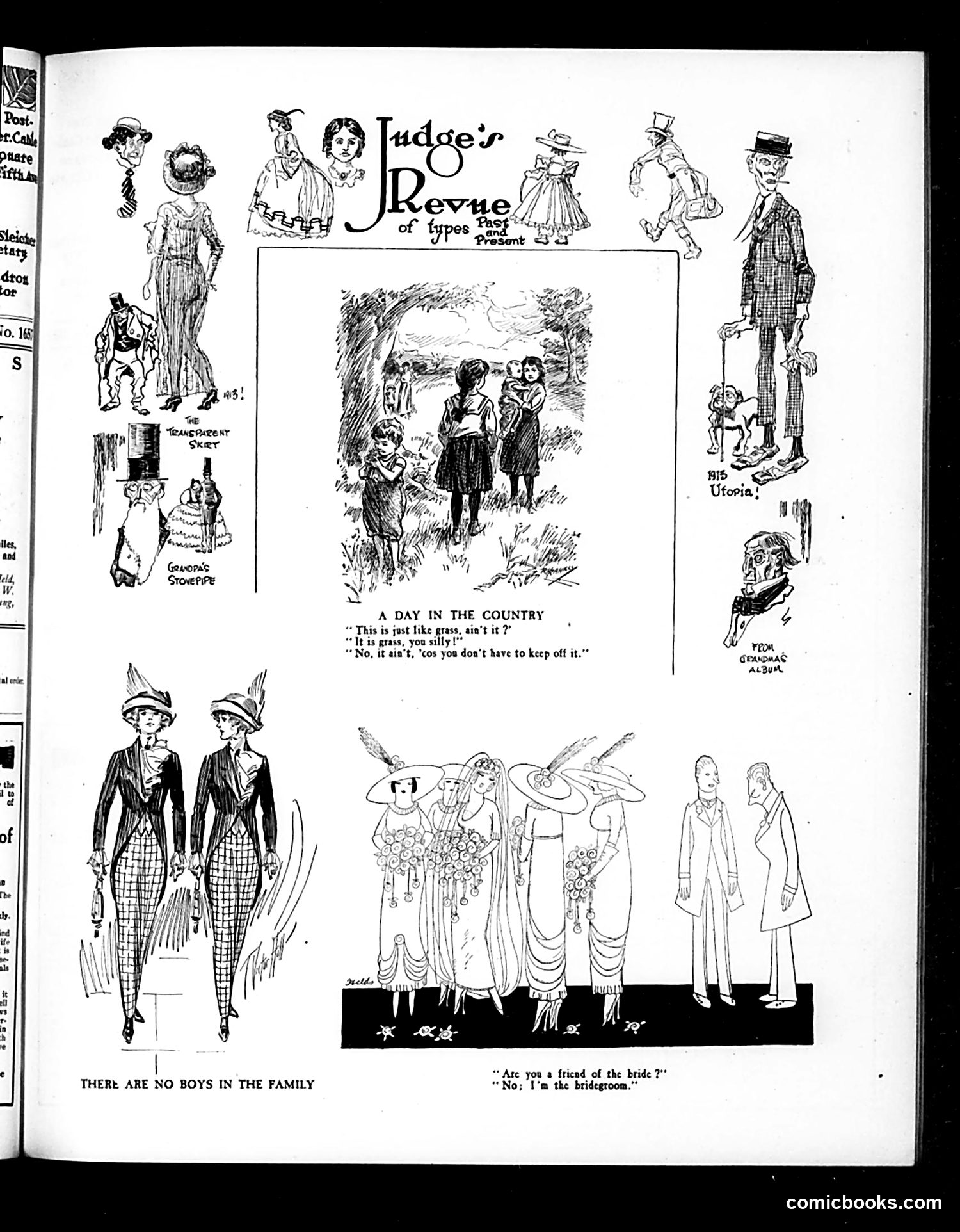
This page presents satirical character sketches typical of Judge magazine's social humor. The central panel, "A Day in the Country," depicts urban visitors encountering rural life, with dialogue mocking city people's unfamiliarity with pastoral simplicity ("just like grass, ain't it?"). Side panels showcase various social "types": "His Utopia" shows a tall man with a small child (likely satirizing paternal pretension); "There Are No Boys in the Family" depicts fashionable women in masculine-styled clothing, probably mocking 1920s gender-norm shifts; and a wedding scene jokes about the bridegroom's exhaustion ("Are you tired of the bride?"). The sketches employ exaggerated features and postures typical of early 20th-century satirical cartooning, targeting middle-class social anxieties around changing gender roles and urban-rural cultural divides.
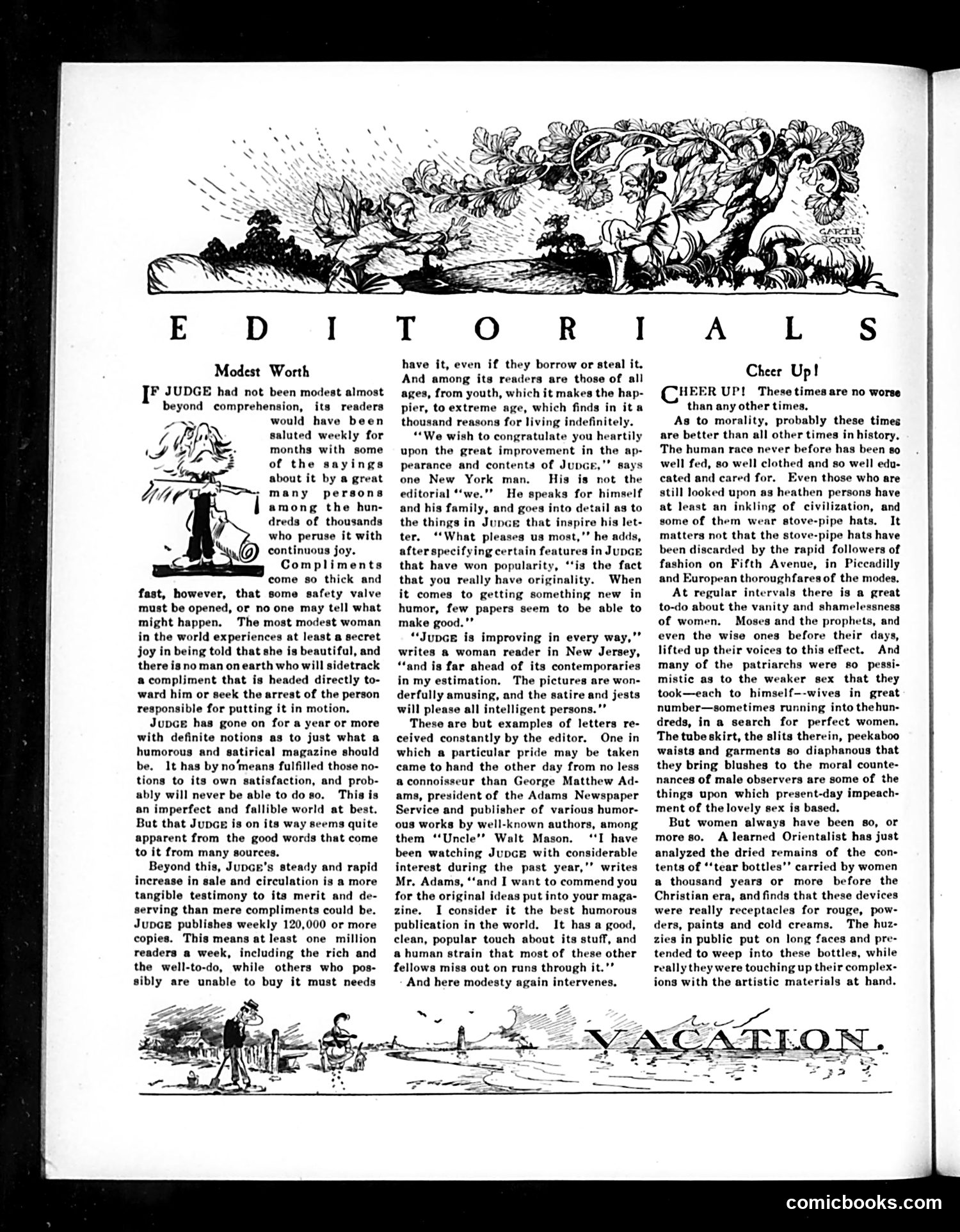
This page contains two editorial sections. "Modest Worth" discusses Judge magazine's merits, claiming it publishes 120,000+ copies weekly with broad readership. The editor defends the magazine's humor as having "definite notions" about what constitutes good satire, rejecting purely arbitrary or meaningless jokes. "Cheer Up!" addresses women's fashion and moral concerns, specifically critiquing the "stove-pipe hat" trend on Fifth Avenue and Piccadilly. The author argues that while some worry these fashions corrupt morality, women have always influenced society positively. The piece dismisses moral panic about women's clothing choices as exaggerated. The accompanying illustrations appear decorative rather than depicting specific political figures or events. The content reflects early-20th-century debates about fashion, women's agency, and magazine editorial standards.
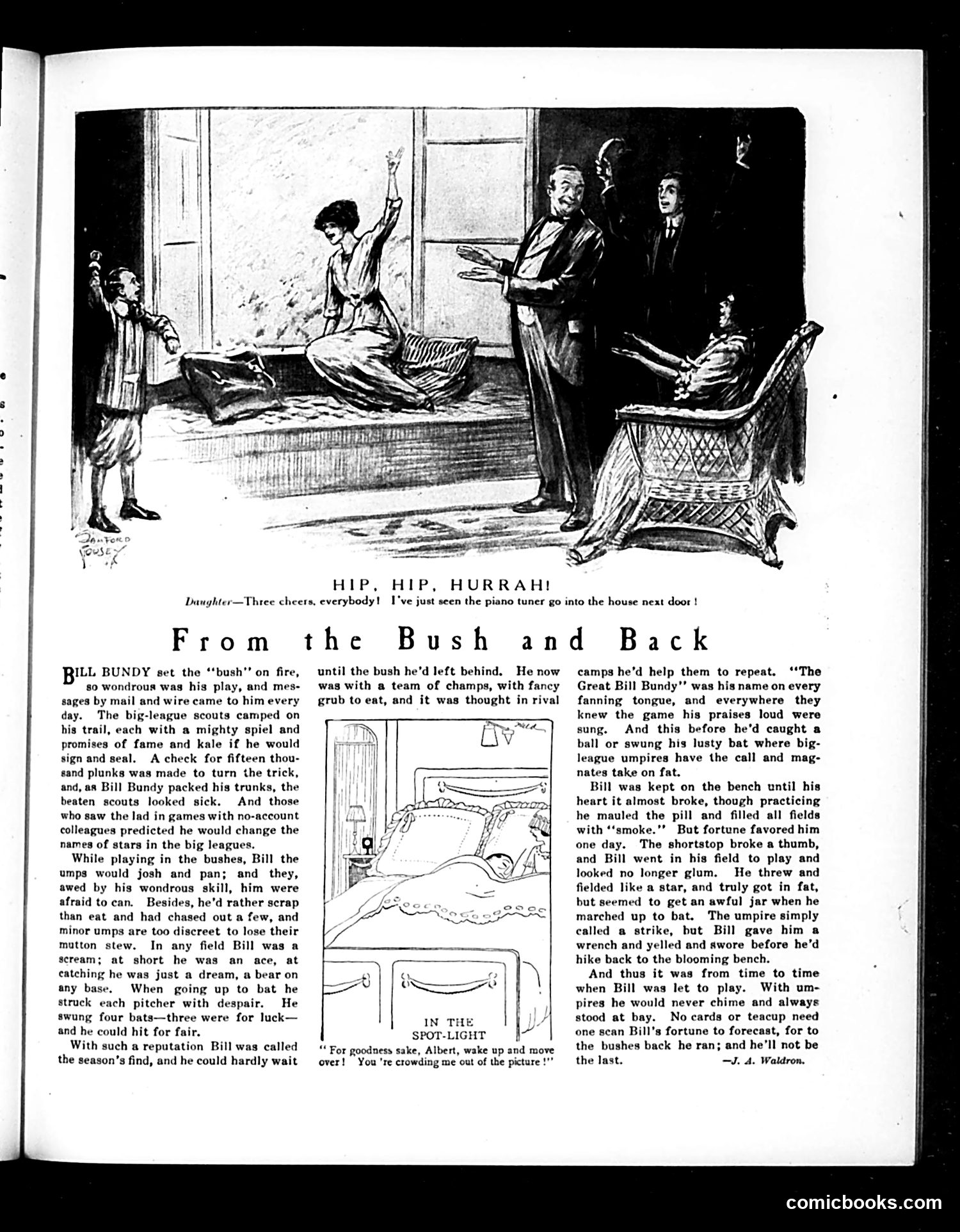
The top cartoon depicts a celebratory domestic scene where a woman sits triumphantly on the floor while men cheer. The caption suggests someone has announced a piano tuner's arrival—a mundane household event treated as major excitement ("Three cheers, everybody!"). This appears to satirize domestic life and perhaps the limited scope of middle-class women's concerns. The longer story "From the Bush and Back" chronicles Bill Bundy, a minor league baseball player. The narrative details his rough playing style, injuries, and eventual redemption through perseverance. The accompanying sketch shows a player in a batting stance. The overall page celebrates working-class American sports culture and determination, presenting baseball as character-building despite physical hardship.
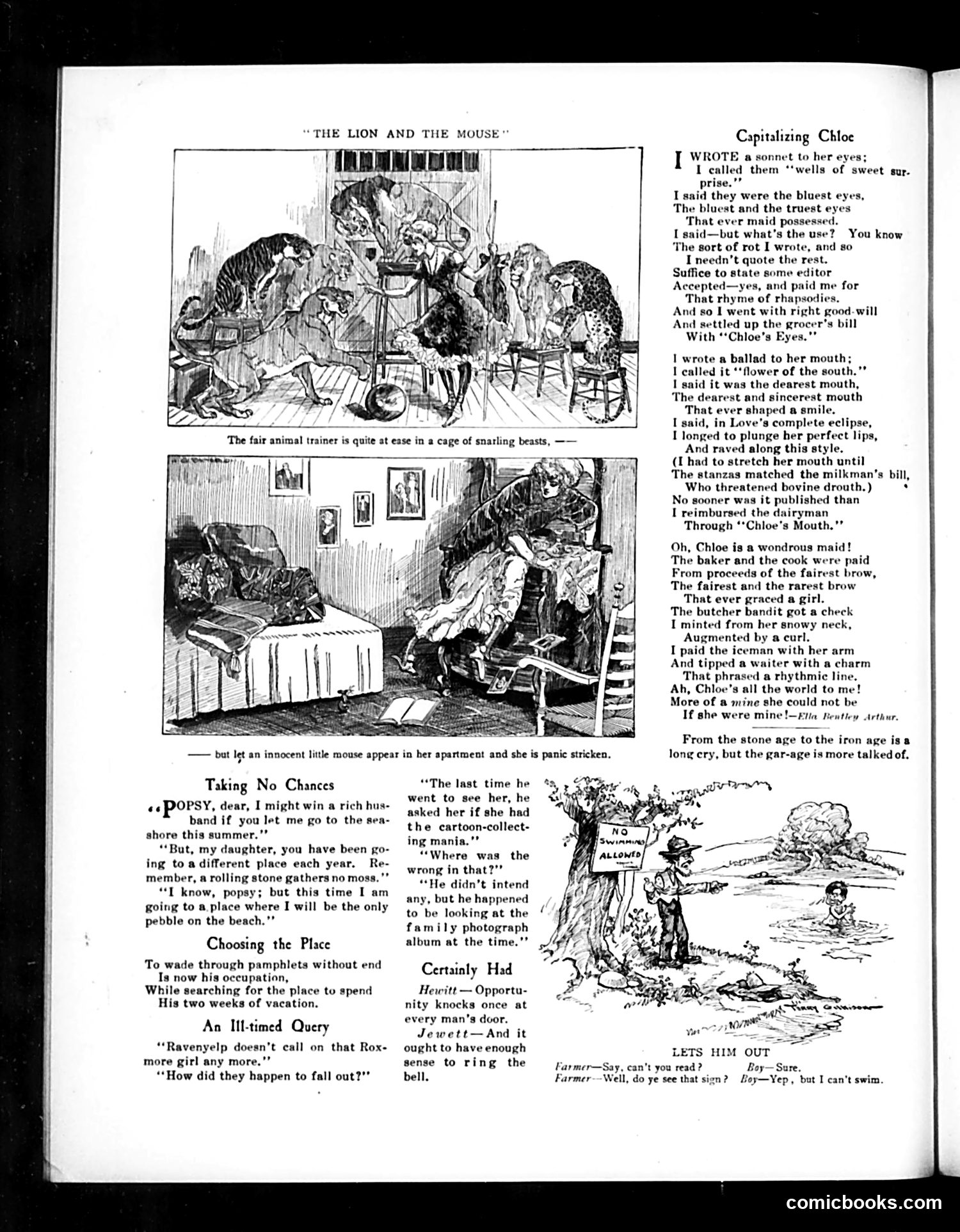
**Main Feature: "Capitalizing Chloe"** A poet monetizes romantic verses about a woman named Chloe by selling them to publications, then using the payment to settle debts with tradespeople (grocer, dairyman, baker, butcher, iceman). The satire mocks both literary sentimentality and commercial exploitation—the poet cynically transforms flowery praise of Chloe's physical features (eyes, mouth, brow, neck, arm) into literal currency, reducing her to a collection of commodities. The joke ridicules: (1) overwrought Victorian romantic poetry, (2) editors' willingness to publish such verse, and (3) the poet's shameless scheme to turn flattery into cash. **Smaller Pieces:** Additional brief satirical items address courtship strategies, vacation planning, and opportunity—typical Judge humor targeting contemporary social conventions and human foibles. The page exemplifies Judge's characteristic blend of literary parody and social commentary aimed at educated, urban readers.
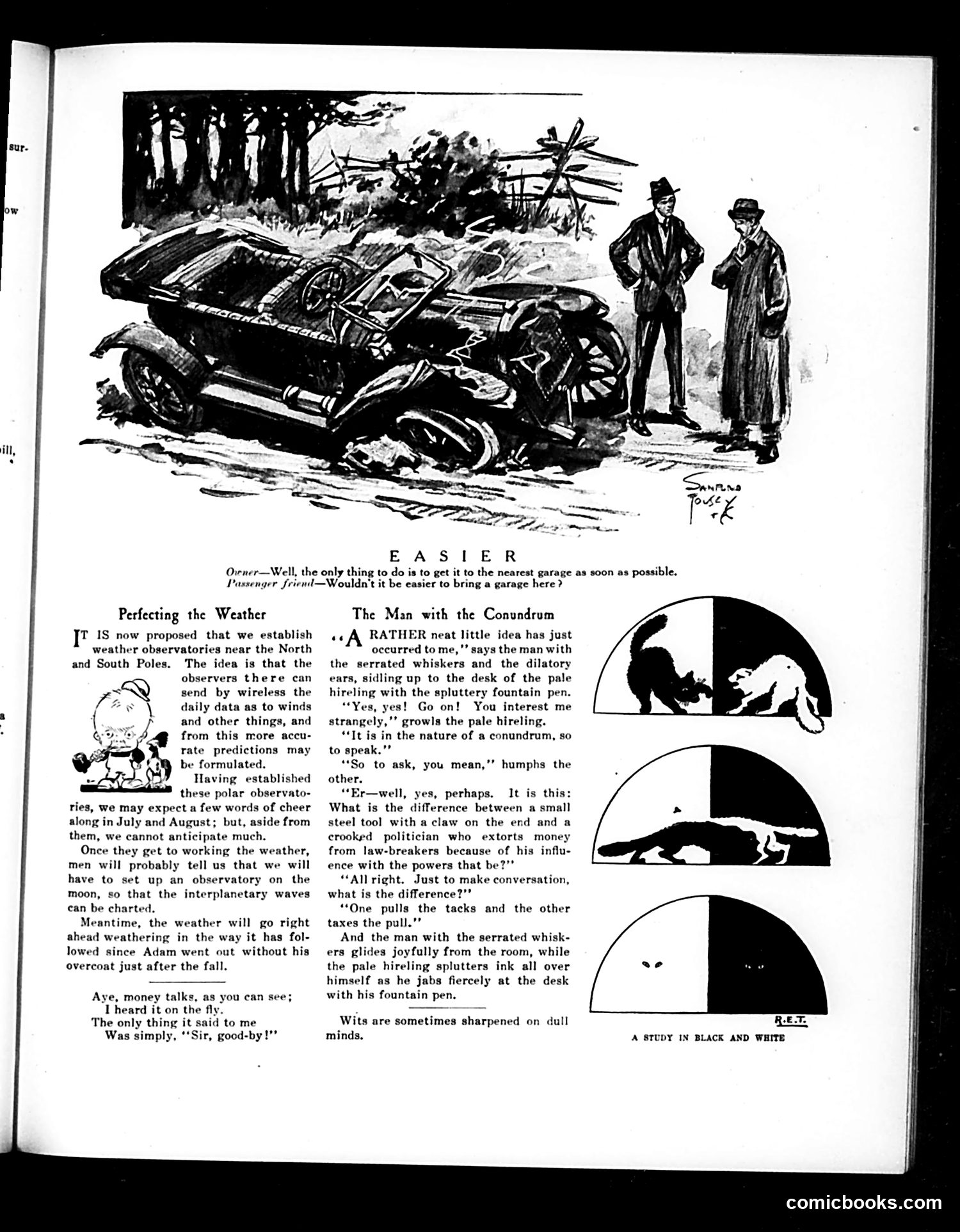
**"Easier" cartoon (top):** Shows a wrecked automobile with two well-dressed men observing it. The joke plays on impracticality—when the car owner says they need to get it to a garage quickly, the passenger suggests it would be "easier" to bring the garage to the car. This satirizes absurd logic and early 20th-century automobile culture's growing pains. **"Perfecting the Weather" article:** Mocks the then-contemporary proposal to establish polar weather observatories for better forecasting via wireless transmission. The satire suggests this technological optimism is misplaced—nature will behave as it always has regardless of human measurement efforts. It's skepticism toward emerging scientific hubris. **"The Man with the Conundrum":** Features wordplay—a riddle comparing a claw tool to a corrupt politician who "taxes the pull" (extorts from lawbreakers). The pale clerk's frustrated reaction suggests the joke landed as intended: clever but perhaps groan-worthy. **Context:** These pieces reflect early 1900s concerns: automobile proliferation, scientific advancement's promises, and urban corruption.
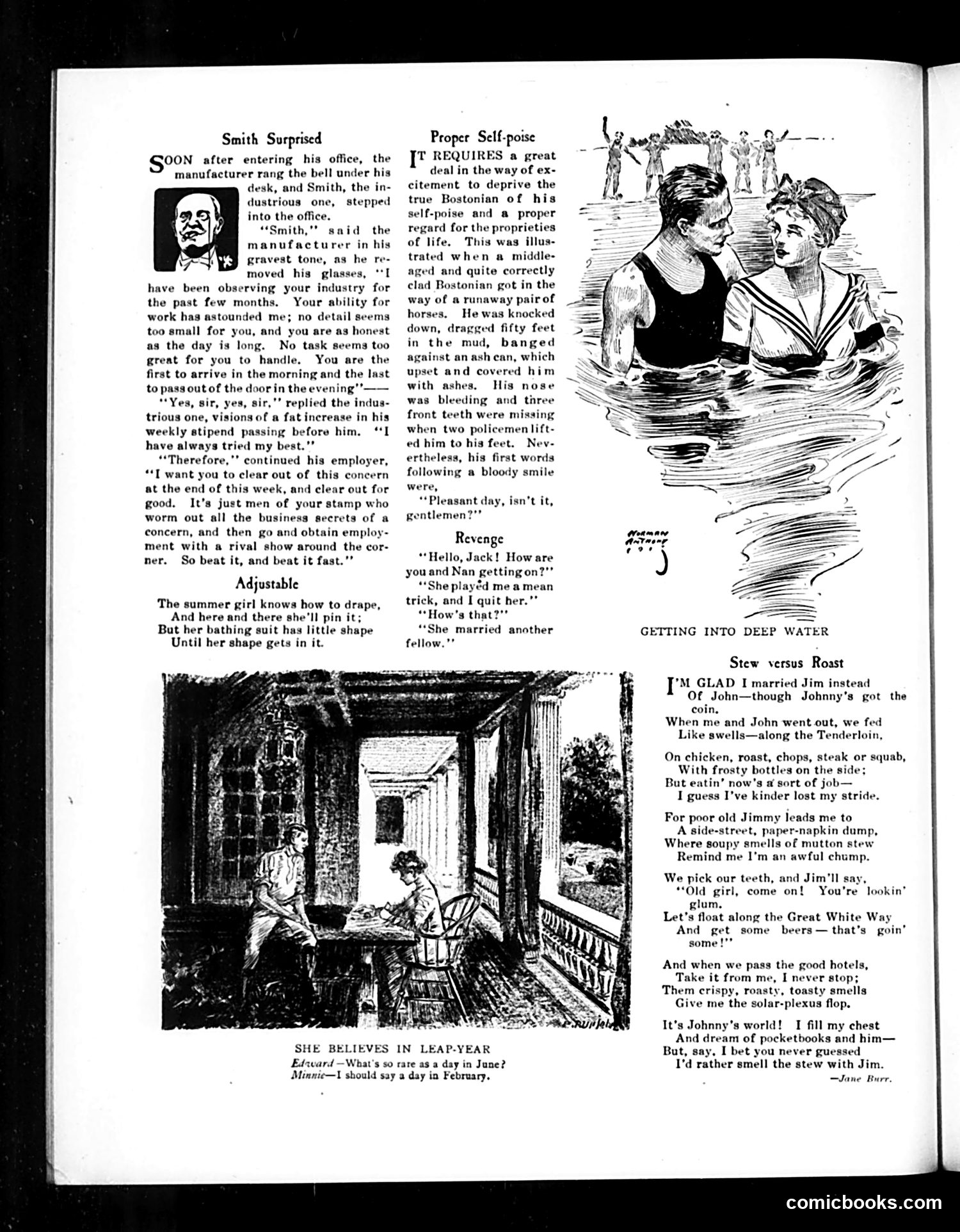
This page contains several satirical pieces typical of early 20th-century American humor: **"Smith Surprised"** mocks workplace exploitation. A manufacturer praises an exemplary employee for his honesty and diligence, then fires him—reasoning that such conscientious workers are security risks who will steal company secrets for competitors. The satire critiques ruthless industrial practices. **"Proper Self-poise"** stereotypes Bostonians as emotionally reserved. A well-dressed Bostonian is knocked down by runaway horses, dragged through mud, and loses teeth, yet maintains composure enough to politely greet his rescuers with "Pleasant day, isn't it, gentlemen?"—satirizing excessive propriety. **"Stew versus Roast"** contrasts marriage choices. A woman chose poor but devoted Jim over wealthy John, trading fancy restaurant meals for cheap stew joints. She misses the food but prefers Jim's company—a sentimental take on love versus money. The remaining pieces are light social humor about summer fashion and leap-year dating customs.
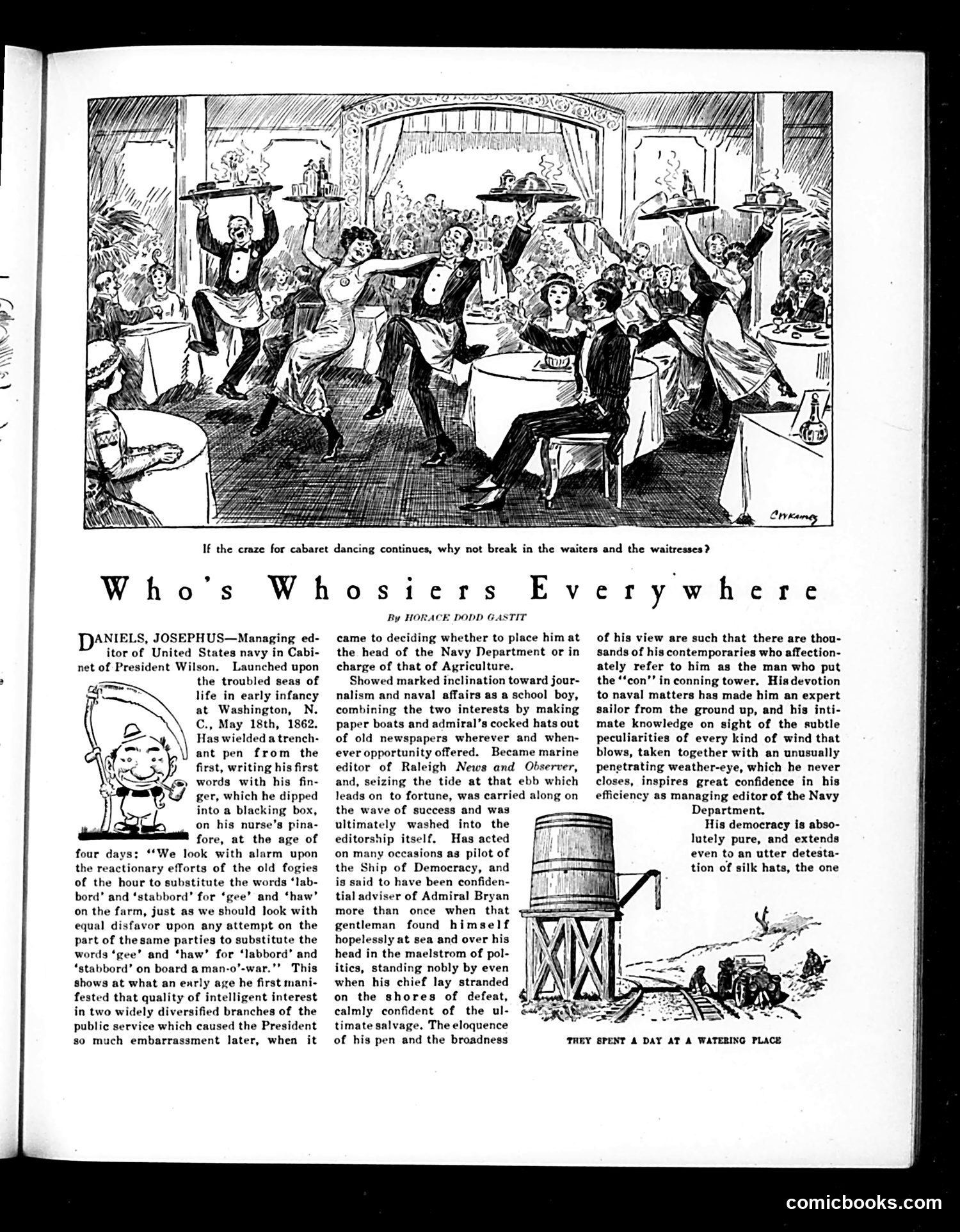
The top cartoon mocks the "cabaret dancing craze" by suggesting waiters and waitresses join in—satirizing both the fad's pervasiveness and working-class participation in fashionable entertainment. The main article is a mock biographical profile of **Josephus Daniels**, Secretary of the Navy under President Wilson. The satire ridicules Daniels through exaggerated praise, claiming he showed naval interest from infancy (writing farm language like "gee" and "haw" at four days old). The piece mocks his dual interests in journalism and naval affairs, his role as "pilot of the Ship of Democracy," and his supposed relationship with "Admiral Bryan" (William Jennings Bryan, Wilson's Secretary of State). The humor targets Daniels' apparent lack of genuine naval expertise despite his prominent position, suggesting he achieved power through political connections rather than qualification. His alleged "detestation of silk hats" mocks his populist pretensions.
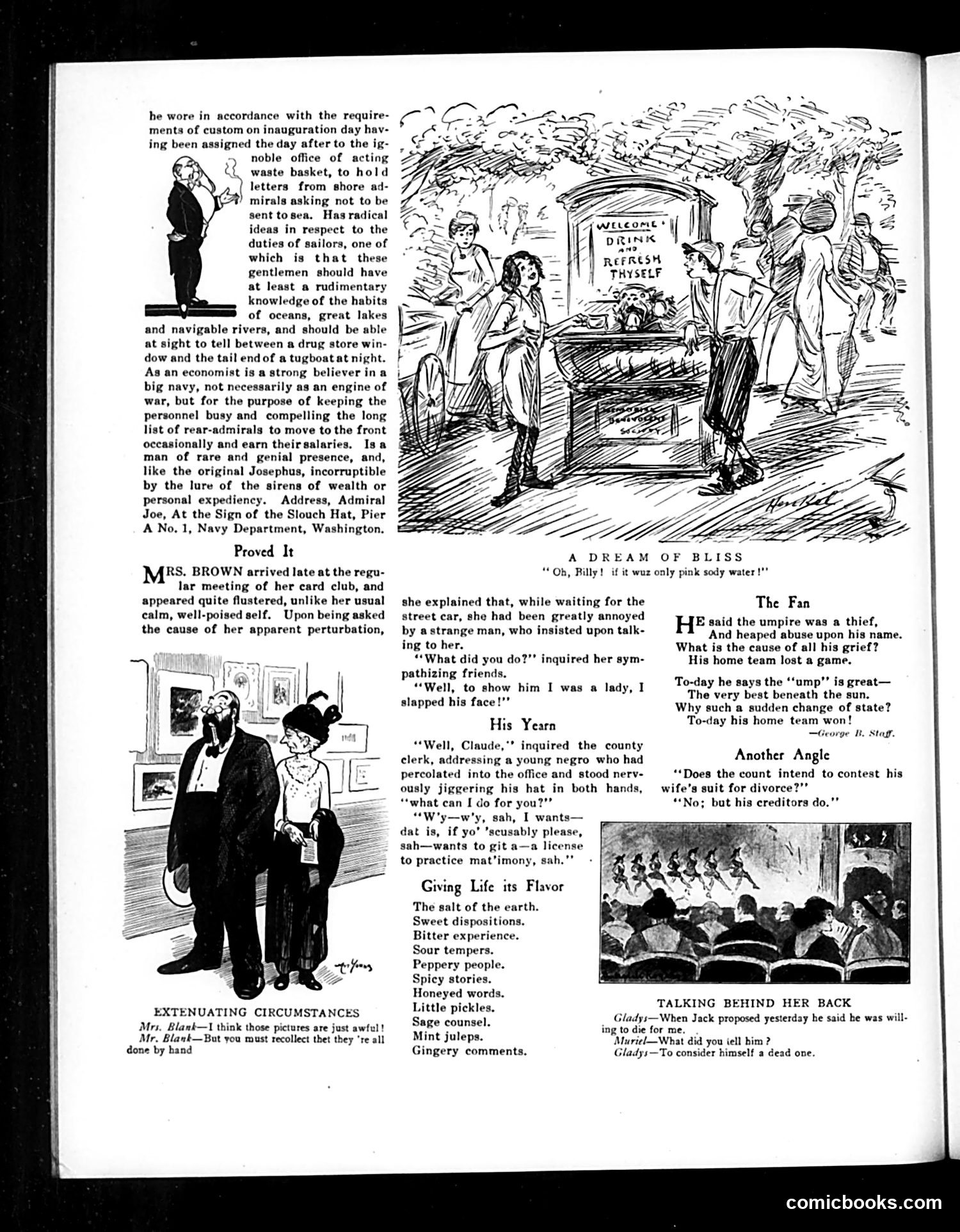
This page contains several brief humorous items typical of early 20th-century American satirical magazines: **"The Fan"** mocks sports fans' hypocrisy—the man calls the umpire a "thief" when his team loses, then praises him as "great" when his team wins. The satire targets inconsistent judgment based on self-interest rather than objective evaluation. **"Another Angle"** presents a cynical joke about divorce: the count won't contest his wife's suit, but his creditors will—implying his financial situation makes the divorce settlement less important than his debts. **"Talking Behind Her Back"** shows Gladys as clever and dismissive: when Jack proposes and says he'd die for her, she responds by telling him to consider himself dead, rejecting his romantic sentiment with wit. **"His Yearn"** depicts dialect humor involving a young Black man seeking a marriage license, typical of the period's problematic racial stereotyping. The remaining items ("Extenuating Circumstances," "A Dream of Bliss," "Giving Life Its Flavor") offer short gags about domestic life and social situations.
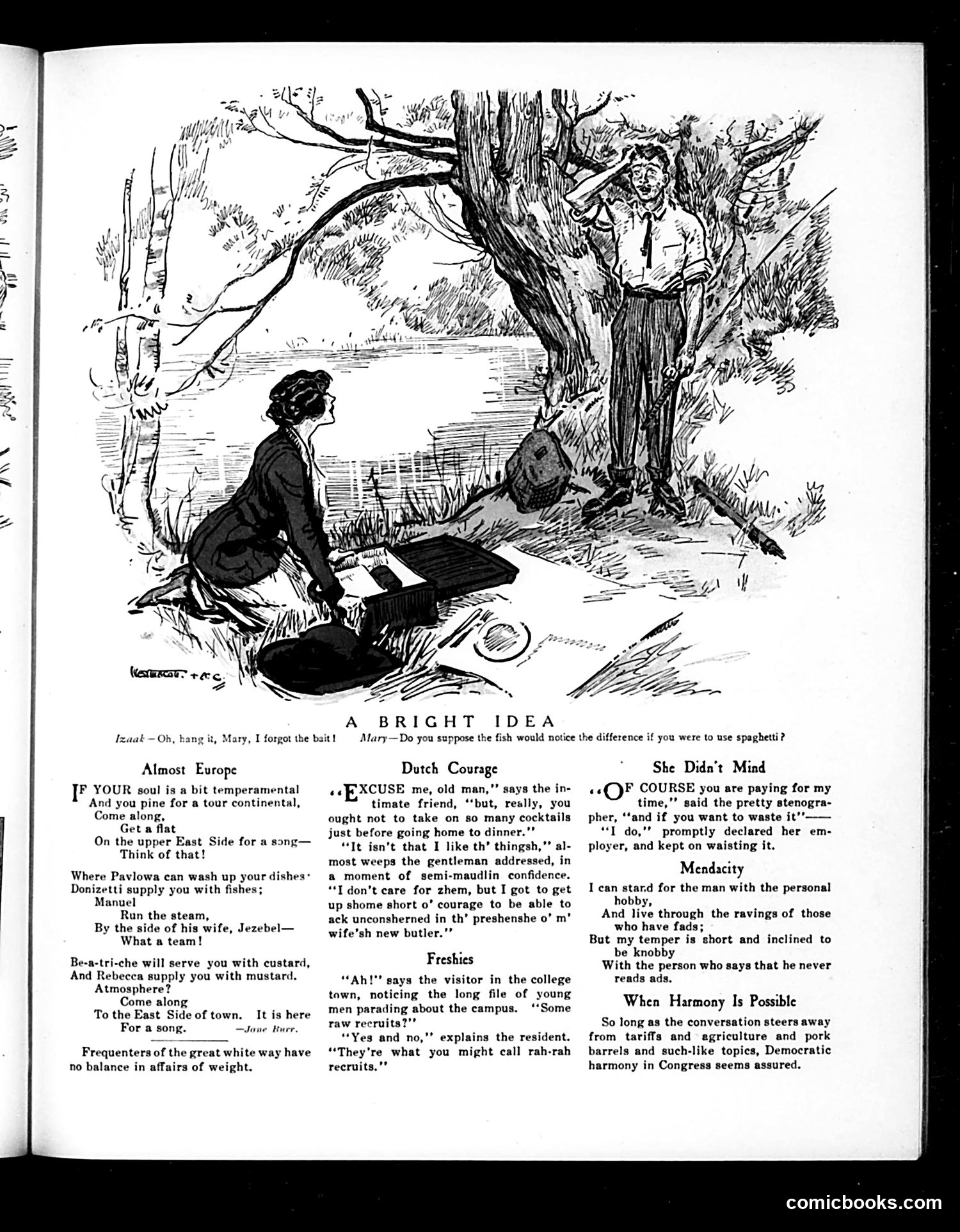
This page contains multiple satirical pieces typical of Judge's humor: **"A Bright Idea"** (top cartoon): Shows a man fishing by a river while a woman in a tree suggests using spaghetti as bait—a visual pun on impractical solutions. **"Almost Europe"** features satirical verse mocking wealthy New Yorkers who rent expensive apartments on the Upper East Side and employ immigrant servants (named Pavlowa, Donizetti, Manuel, Jezebel, Beatrice, Rebecca)—suggesting they're playing at Continental sophistication while remaining in Manhattan. **"Dutch Courage"** jokes about a man drinking cocktails before facing his wife's new butler, using alcohol for false bravery. **"Freshies"** puns on "rah-rah recruits"—college freshmen. **Other pieces** satirize stenographers wasting time, people who don't read advertisements, and Congressional Democrats achieving harmony only by avoiding divisive topics like tariffs and agriculture. The page reflects early 20th-century American social attitudes: mockery of immigrant workers, drinking culture, and political gridlock.
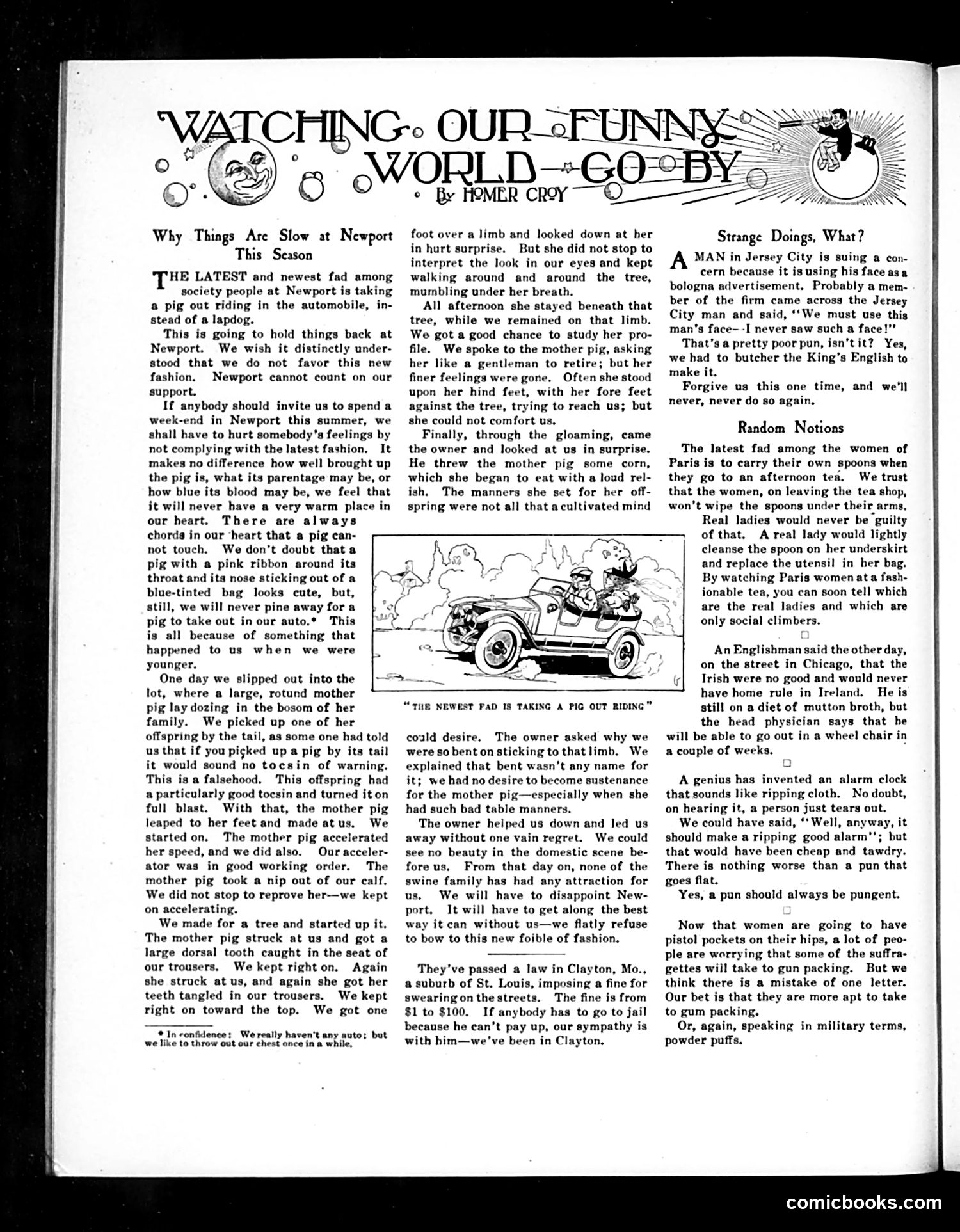
This humor column satirizes two fashionable absurdities of early 20th-century wealthy society. **Main Article**: The author mocks Newport's ultra-wealthy elite for replacing lap dogs with pigs as automobile accessories—the latest status symbol. The piece is humorous social commentary: the author claims pigs will never be truly fashionable, then reveals why through a childhood anecdote where an angry mother pig chased him up a tree after he grabbed her piglet by the tail. The joke is that such ridiculous fashion trends stem from shallow social posturing rather than genuine taste. **The Illustration** shows a wealthy couple riding in an automobile with a pig, labeled "The Newest Fad is Taking a Pig Out Riding"—visually confirming the absurd trend. **"Random Notions"** section continues the satire by mocking Parisian women carrying personal spoons to tea and lampooning Jersey City's use of an ugly man's face in bologna advertisements. The overall tone critiques wealthy society's mindless pursuit of novelty and status symbols, implying such frivolous behavior indicates intellectual and moral shallowness.
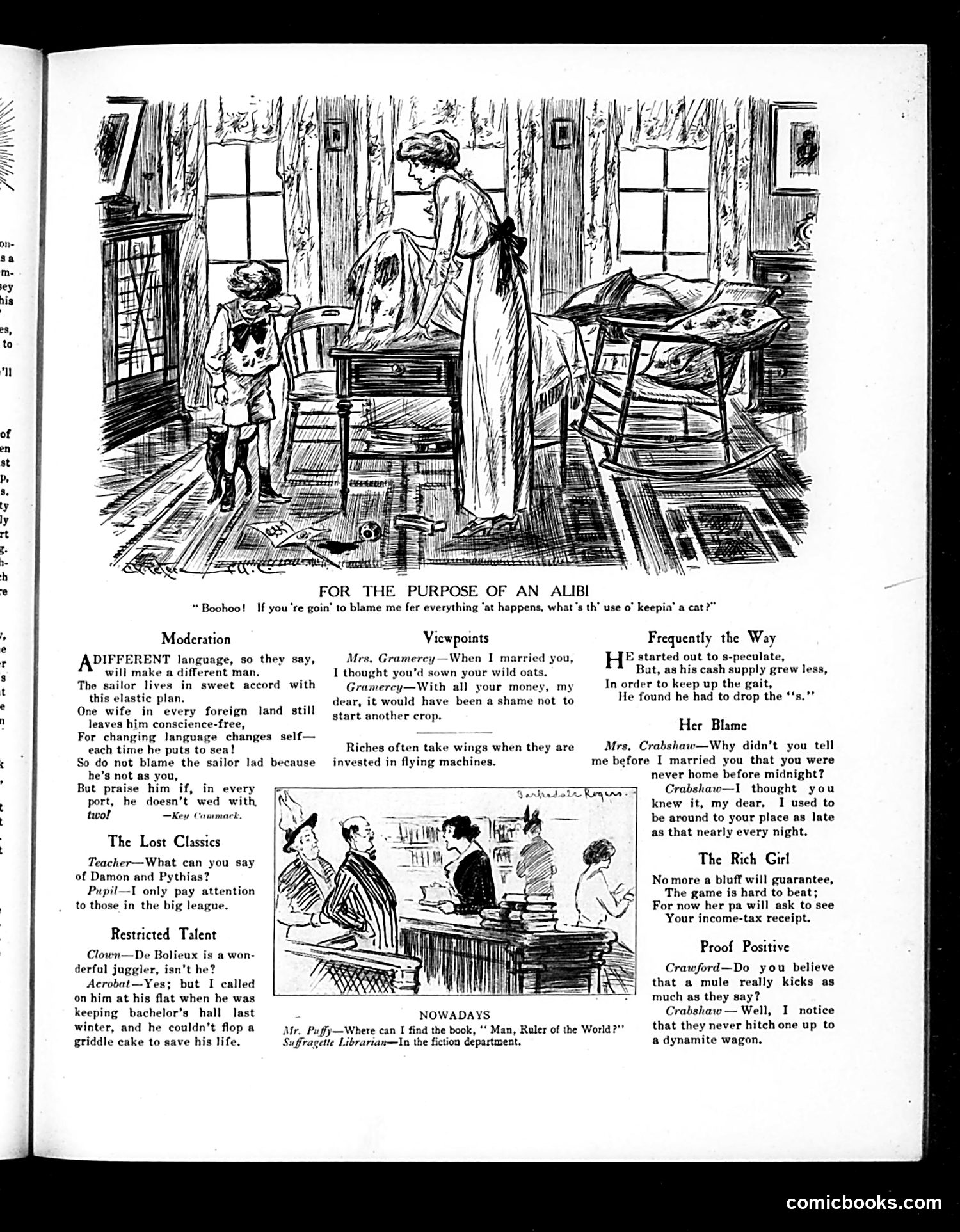
This page contains multiple short humor pieces mocking early 20th-century social attitudes and relationships: **Main cartoon (top):** A woman confronts a man about blame-shifting, using a cat as metaphor—if you keep blaming the cat for everything, why keep it? The satire targets husbands who avoid responsibility. **"Moderation":** Mocks sailors who maintain wives in multiple ports, claiming changing languages justifies changing morals. **"Viewpoints":** A wealthy husband spent his wife's money on "another crop" of wild oats rather than settling down—satirizing fortune hunters. **"The Rich Girl":** Wealth no longer guarantees marriage prospects; suitors now demand proof of income-tax receipts, suggesting economic anxiety and women's changing financial status. **"Nowadays":** A suffragette librarian places a book about male dominance in fiction—commentary on women's growing demands for equality and the magazine's skepticism about their claims. The humor reflects anxieties about changing gender roles, women's independence, and economic uncertainty in the early modern era.
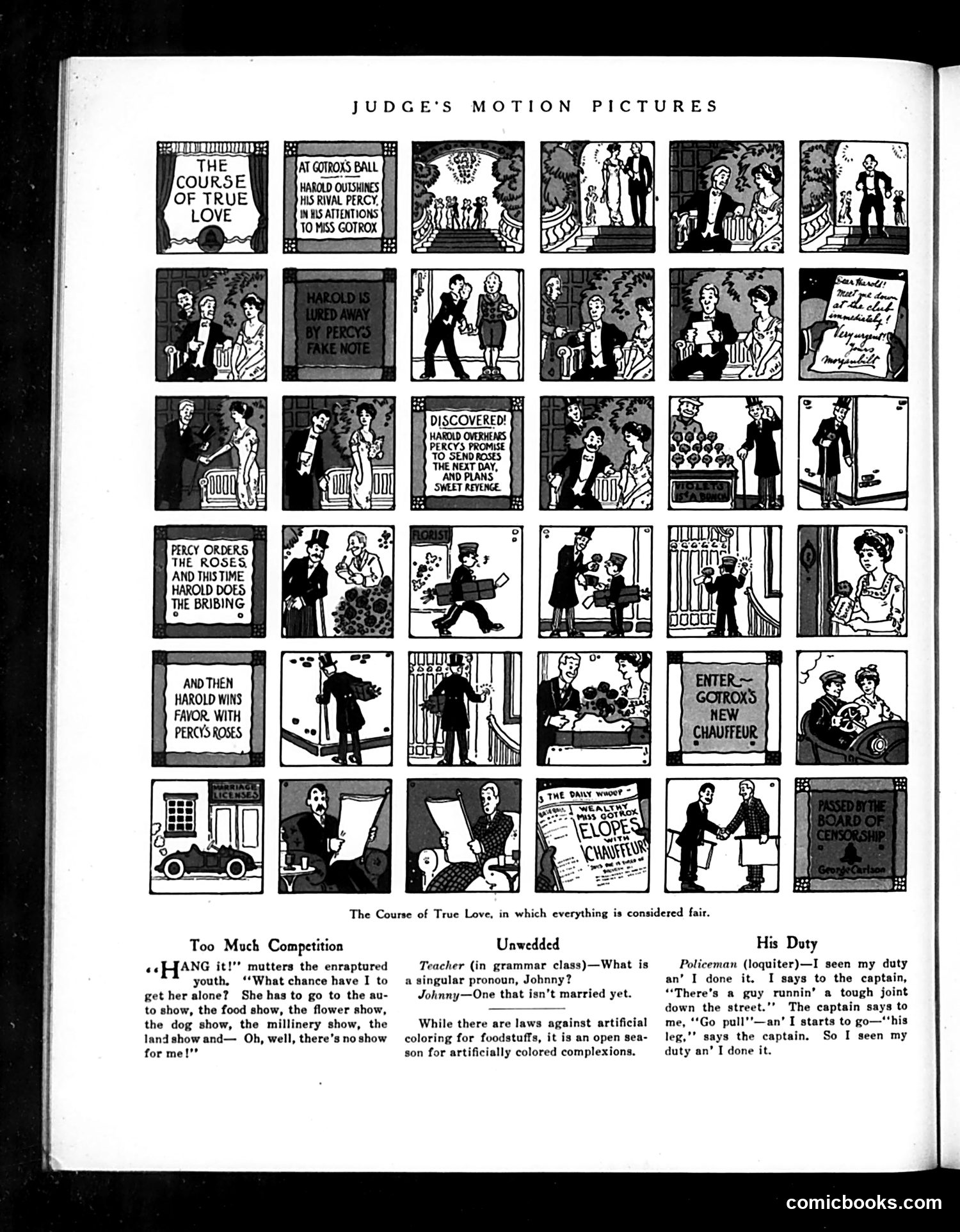
This is a silent-film-style comic strip mocking romantic courtship conventions of the early 20th century. The narrative follows Harold, who attempts to win a woman's affection by bribing her suitor Percy with roses. Harold then uses those same roses to court the woman himself—suggesting that romantic "gestures" are merely commodities exchanged rather than genuine expressions of feeling. The three accompanying jokes satirize contemporary social anxieties: the first mocks how women's participation in public activities (auto shows, flower shows) limits romantic opportunities for men; the second puns on unmarried women as "singular pronouns"; the third ridicules a police officer's misunderstanding of his duties through a crude pun on "pull his leg." The humor targets gender dynamics and social competition in the era, presenting romance as transactional rather than meaningful.
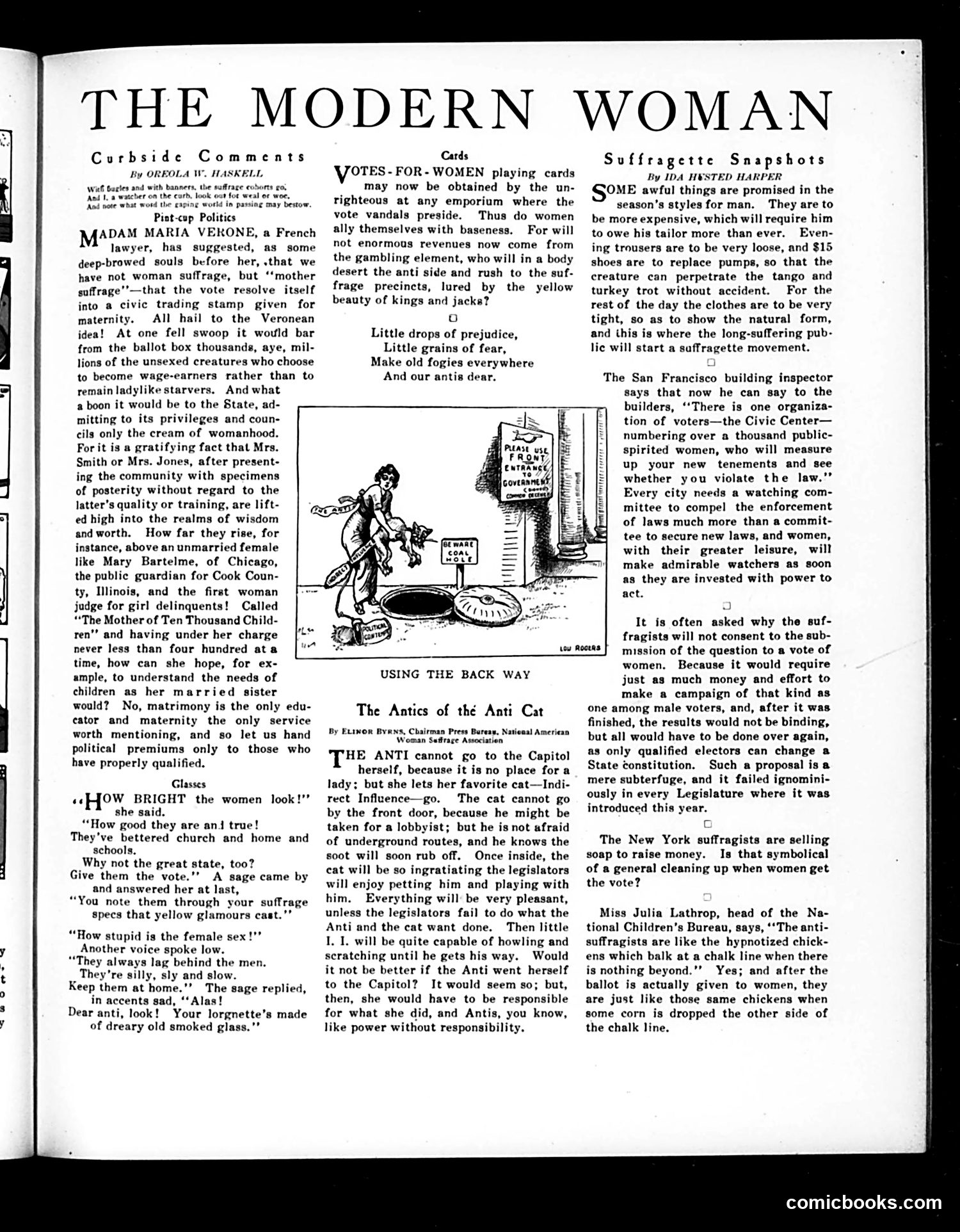
This Judge magazine page satirizes **anti-suffragists** ("Antis") who opposed women's voting rights. **Key satirical targets:** 1. **"Pint-cup Politics"**: Mocks French lawyer Maria Verone's suggestion that only mothers deserve votes. The piece sarcastically elevates this, then undermines it by noting unmarried women like Judge Mary Bartelme accomplish more for society than many mothers. 2. **"The Antics of the Anti Cat"**: An allegory where anti-suffragists use "Indirect Influence" (a cat) to lobby legislators behind closed doors, avoiding public responsibility. The satire: Antis claim women shouldn't vote because politics is unsuitable for ladies, yet they themselves lobby indirectly—proving their real objection is women acting openly, not women's political involvement itself. 3. **"Glasses"**: Compares anti-suffragists' perspective to looking through distorted lenses ("smoked glass" lorgnettes), suggesting their opposition stems from prejudice and fear, not rational argument. The page argues anti-suffragists are hypocritical: they oppose women's direct political power while exercising indirect influence themselves.
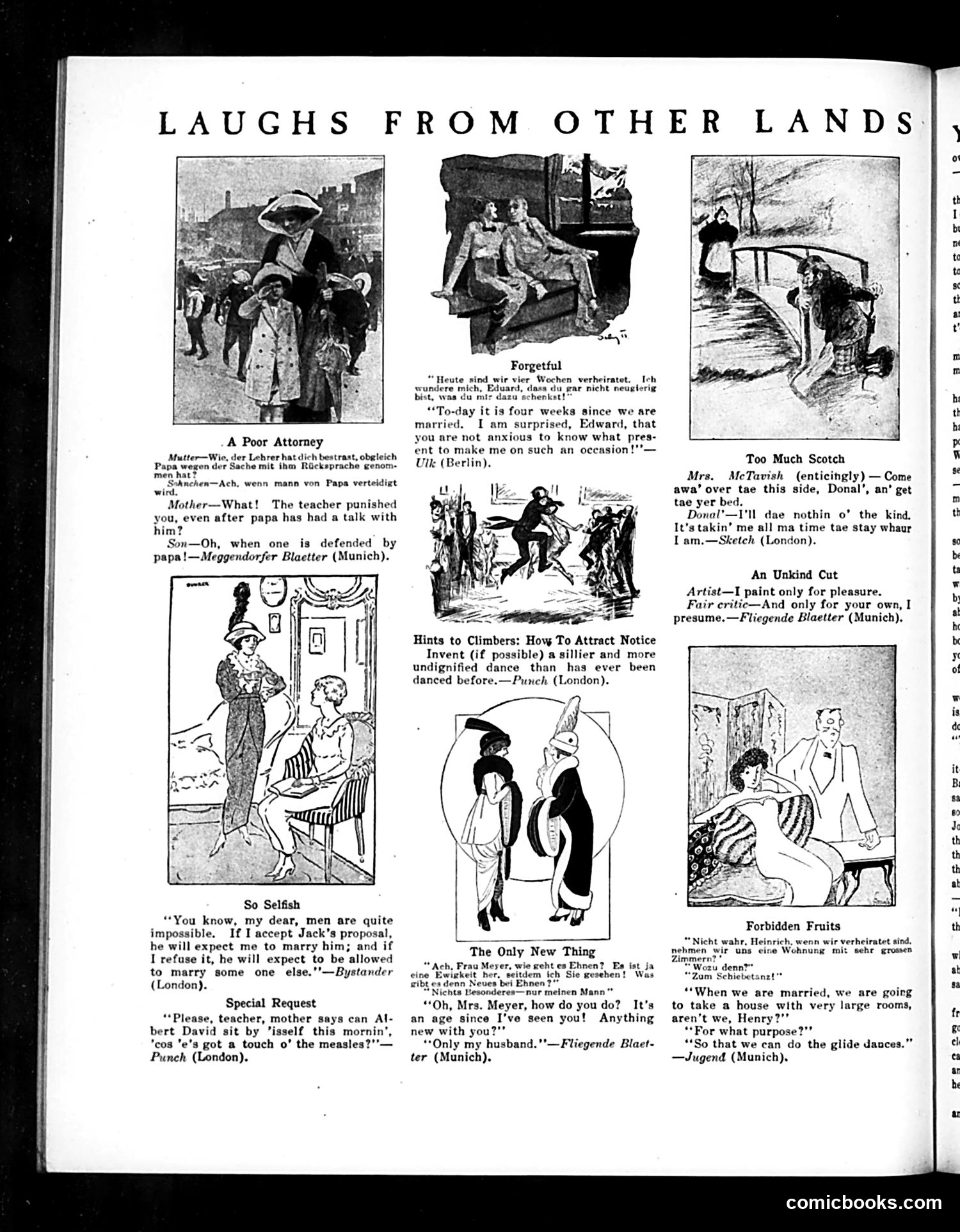
This page collects humorous short comics and jokes translated from European satirical magazines (German, British, Scottish publications). The humor targets common domestic and social situations: **Key themes:** - **Marital dynamics**: Husbands as disappointing or burdensome (the wife wanting large rooms for dancing to escape); wives as illogical (the "selfish" woman complaining about proposals either way) - **Parental authority**: A father's attempt to defend his son from school punishment backfires—being defended by papa is worse than punishment itself - **Class/professional satire**: A poor attorney is so ineffective that his defense hurts rather than helps - **Gender roles**: Women portrayed as vain (seeking notice through silly dances) or absurd (complaining husbands won't "notice" gift-giving) The humor relies on stereotypes about marriage as an unfortunate trap, incompetent professionals, and irrational behavior—typical early-20th-century magazine comedy aimed at middle-class readers. The translations preserve dialect (Scottish accent in "Too Much Scotch") for comedic effect.
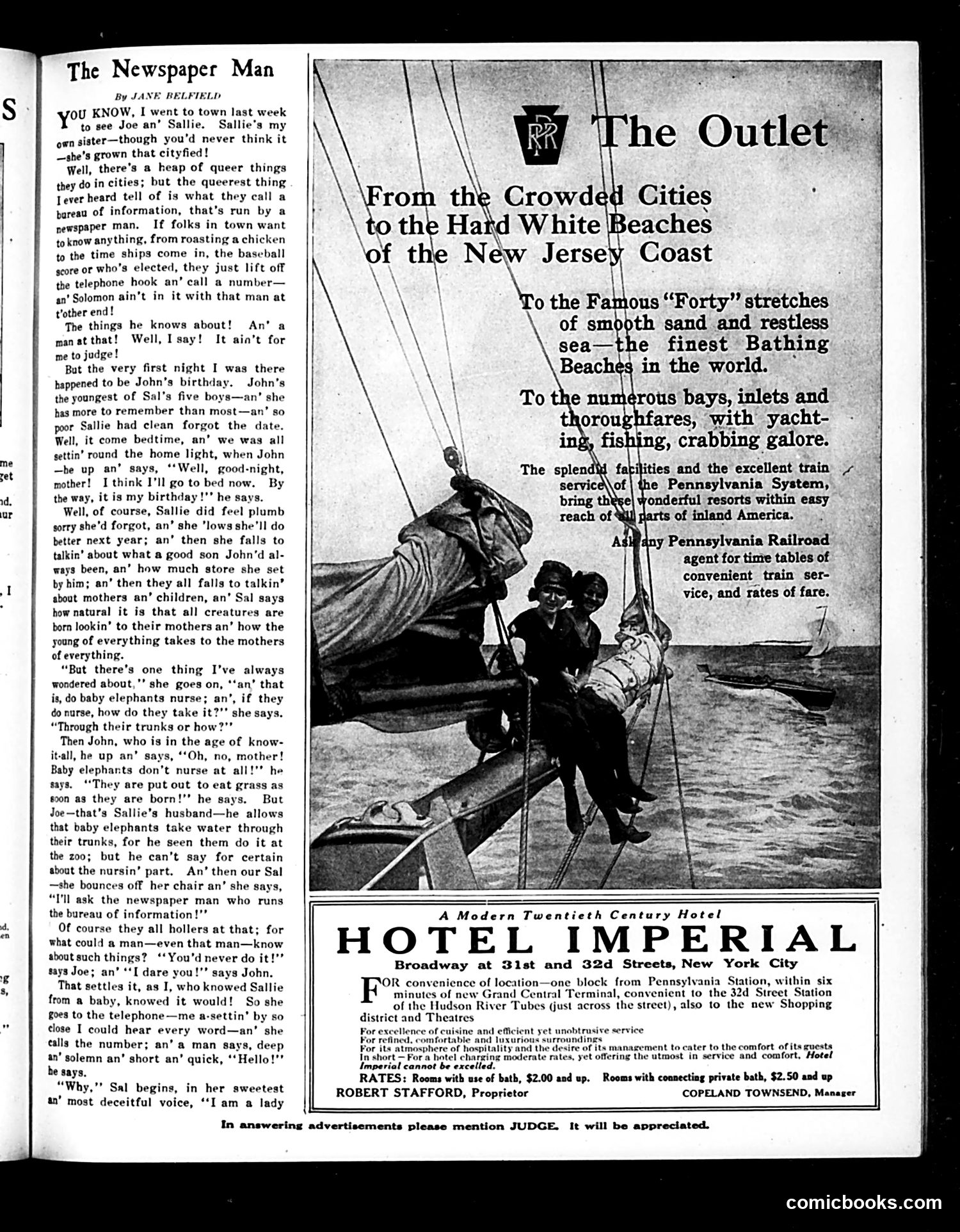
This is a humorous short story by Jane Belfield satirizing the newspaper industry's "information bureau" services—a real early-20th-century phenomenon where newspapers employed staff to answer reader questions on any topic. The narrative follows a rural woman visiting her city sister Sallie, whose family challenges a newspaper man's knowledge by asking him whether baby elephants nurse. The setup mocks how urbanites have come to rely on newspapers as omniscient sources, treating them almost like oracles. The satire targets two things: (1) the newspaper industry's grandiose claims about the breadth of information available through their bureaus, and (2) the growing dependency of city dwellers on newspapers to answer everyday questions they might previously have solved through experience or community knowledge. The story is incomplete on this page, leaving the newspaper man's answer unresolved—itself a joke about whether such an obscure fact could actually be answered.
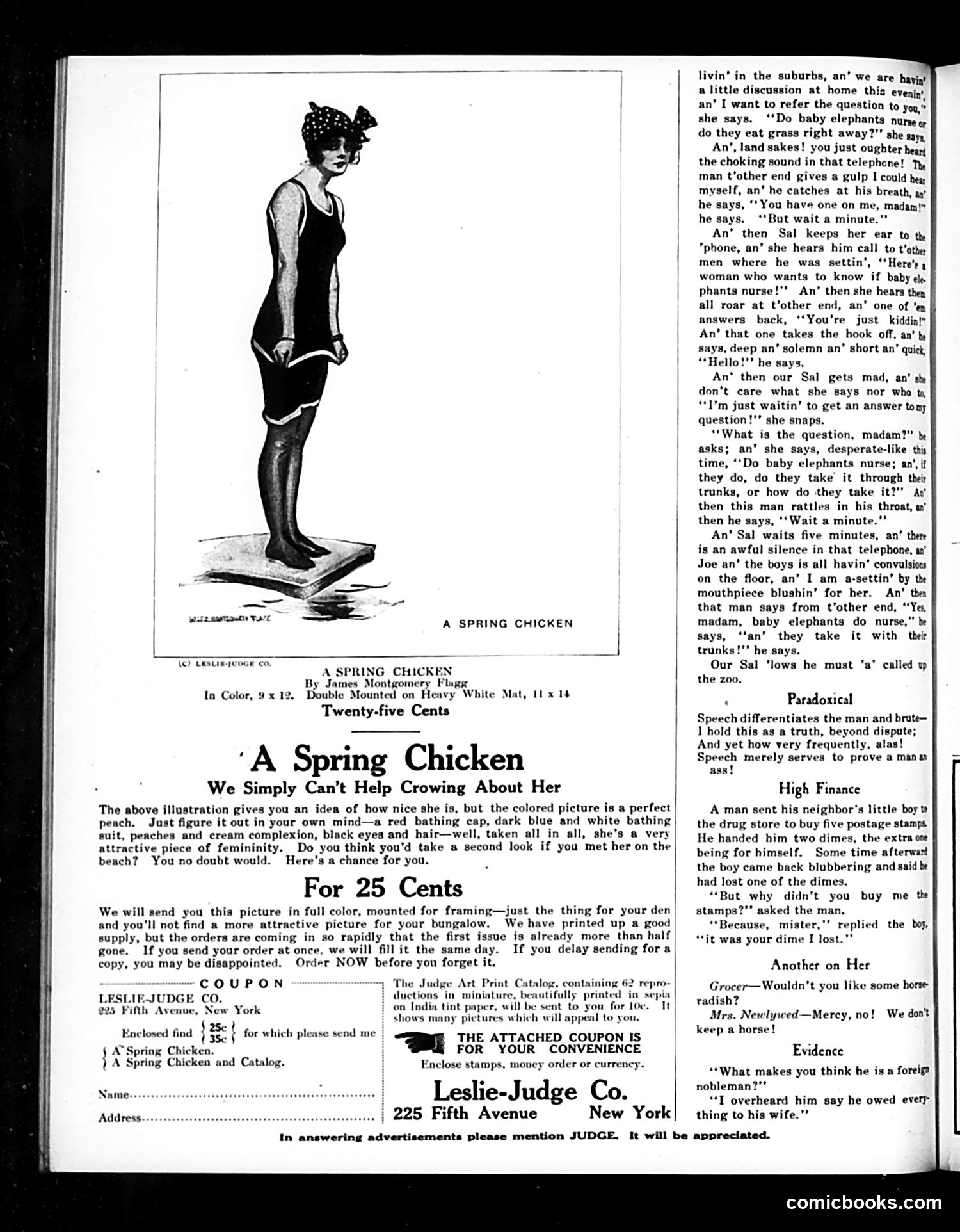
This page is primarily a **commercial advertisement** rather than political satire. It promotes a portrait illustration by James Montgomery Flagg titled "A Spring Chicken"—a pin-up style drawing of an attractive young woman in a bathing suit. The illustration depicts a conventionally beautiful woman in 1910s-era beachwear. "Spring chicken" was period slang for an attractive young woman. The ad uses flattering language ("peaches and cream complexion") to entice male readers to purchase the colored print for 25 cents, marketed as suitable decoration for dens or bungalows. The page also contains unrelated humor columns ("Paradoxical," "High Finance," "Another on Her," "Evidence") typical of Judge's content. This represents early-20th-century consumer culture targeting men with idealized female imagery—a precursor to modern advertising aesthetics.
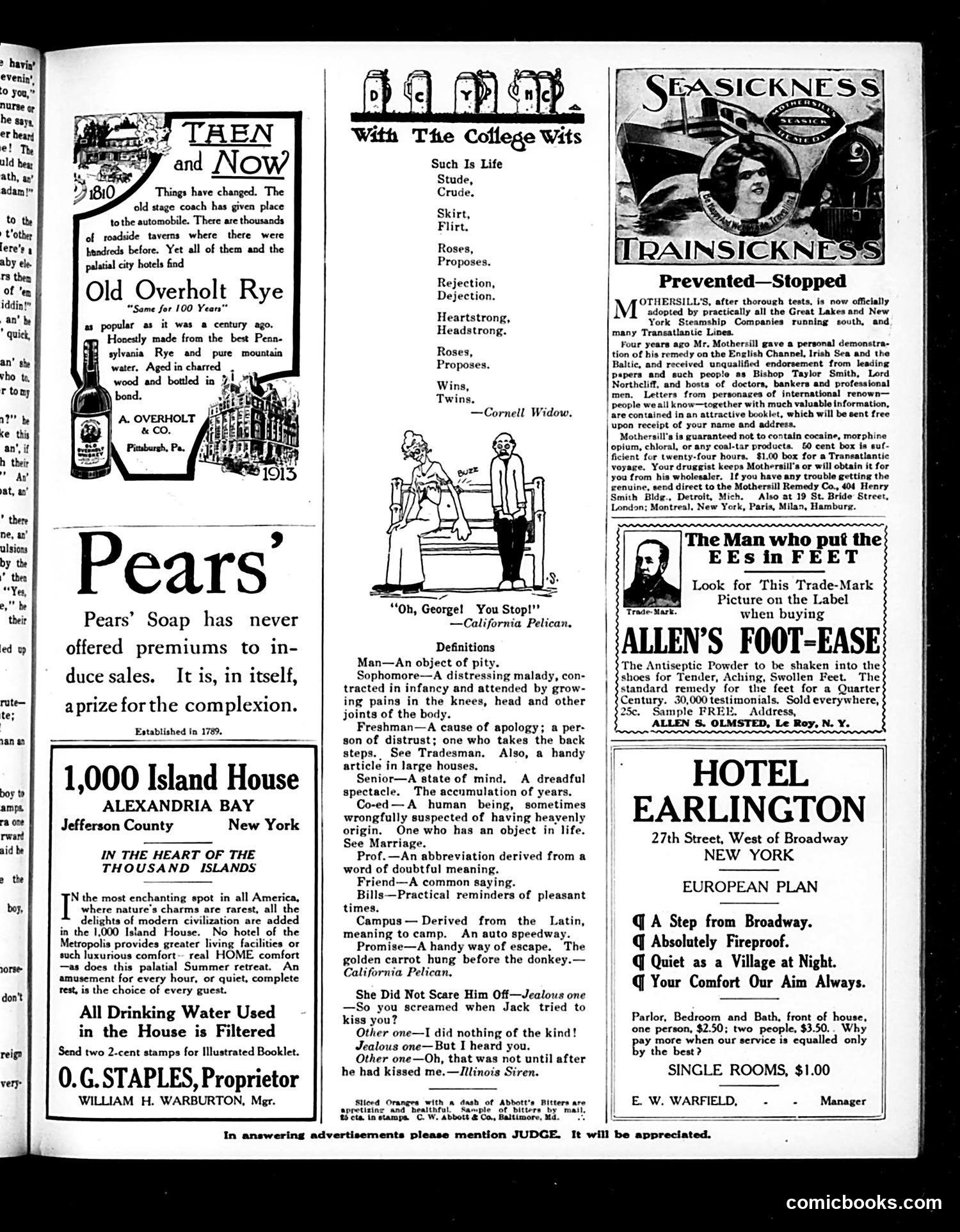
This page is primarily **advertisements and filler content**, not political satire. The main section, "With The College Wits," contains **humor definitions and jokes about college life**—targeting early 20th-century university experiences. The "Definitions" mock student types: freshmen as anxious newcomers, sophomores as insufferable, seniors as burned-out, and co-eds (female students) as marriage-focused. The jokes are mild romantic humor typical of the era. The cartoon "Oh, George! You Stop!" depicts a **flirtation scenario**, playing on the tension between romantic advance and social propriety—standard college dating humor of the period. Surrounding this are genuine advertisements for whiskey, soap, hotels, and patent medicines (Mothersill's seasickness remedy, Allen's Foot-Ease), reflecting Judge's revenue model. There is **no discernible political content** on this page—it's entertainment and advertising targeting an educated, affluent readership.
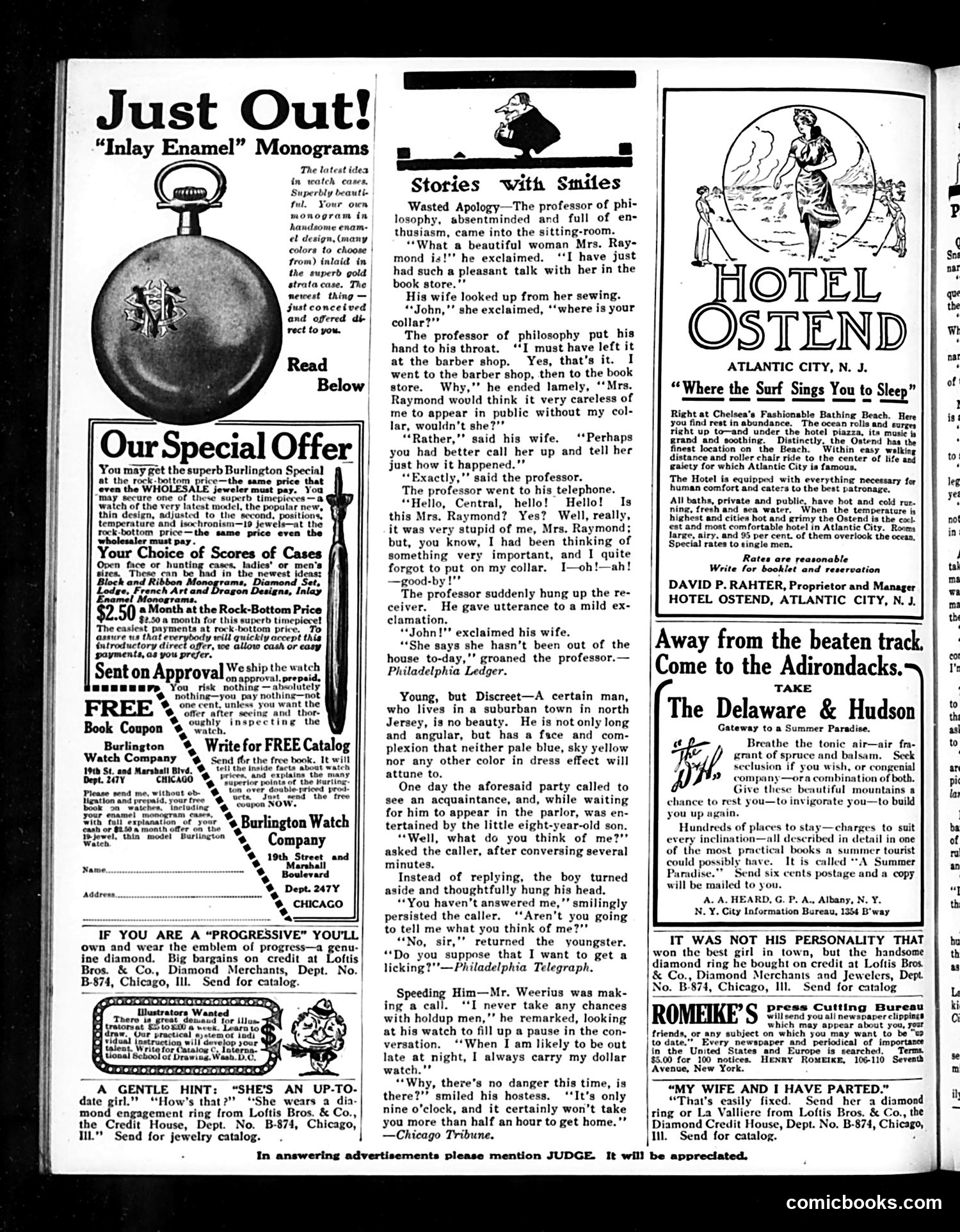
This page is primarily **advertising and humor content**, not political satire. The main cartoons are in the "Stories with Smiles" section—mild comedic anecdotes rather than political commentary: 1. **"Wasted Apology"**: A forgetful professor calls a woman to apologize for appearing collarless, only to discover she wasn't even out of the house that day. The humor relies on absent-minded-professor stereotypes. 2. **"Young, but Discreet"**: An unattractive visitor asks a child's opinion of his appearance; the child tactfully avoids answering. The joke plays on social awkwardness and children's honesty. The page is dominated by **commercial advertisements**—watch cases, jewelry, and travel promotions. The Burlington Watch Company ad emphasizes affordable payment plans ($2.50/month), typical of early 20th-century installment purchasing marketing. **No significant political references or social satire appears here.** This represents Judge's lighter content focused on domestic humor and consumer advertising rather than the satirical political commentary the magazine was known for.
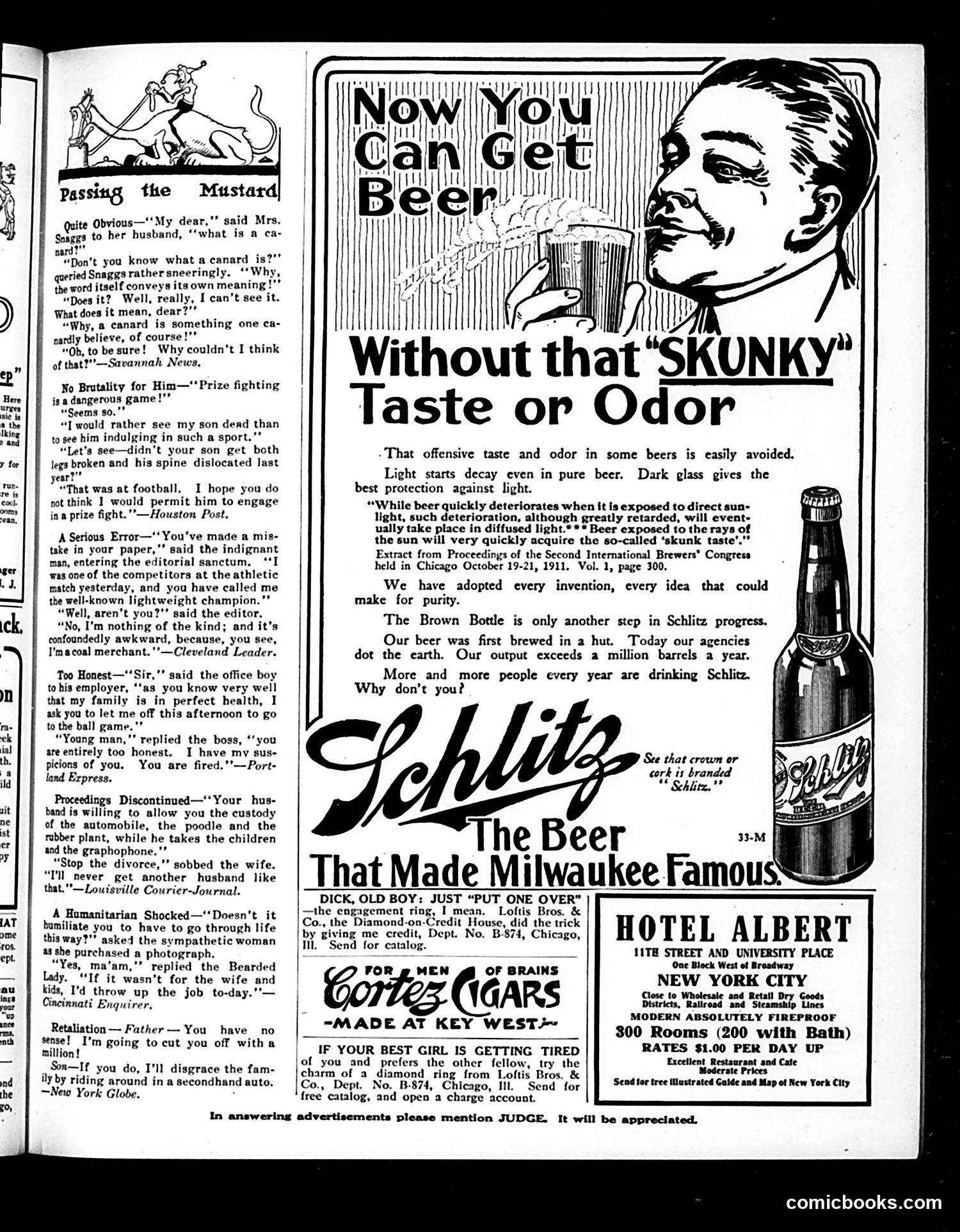
This page contains primarily **humor columns and advertisements** rather than political cartoons. The left column features joke anecdotes (titled sections like "Quite Obvious," "No Brutality for Him," "A Serious Error") that play on misunderstandings or hypocrisy—typical of *Judge's* satirical humor. For example, a father claims boxing is dangerous but accepts his son's spinal injury from football. These reflect **early 1910s American attitudes** toward class, honesty, and masculinity. The dominant content is **advertising**: a large Schlitz beer ad explaining that dark brown bottles prevent "skunky taste" caused by light exposure, citing a 1911 brewers' congress. Below are smaller ads for Cortez cigars, Hotel Albert in New York, and Loftis Brothers jewelry (credit for engagement rings). These ads indicate *Judge* served an affluent male readership interested in luxury goods. No identifiable political figures or events appear on this page.
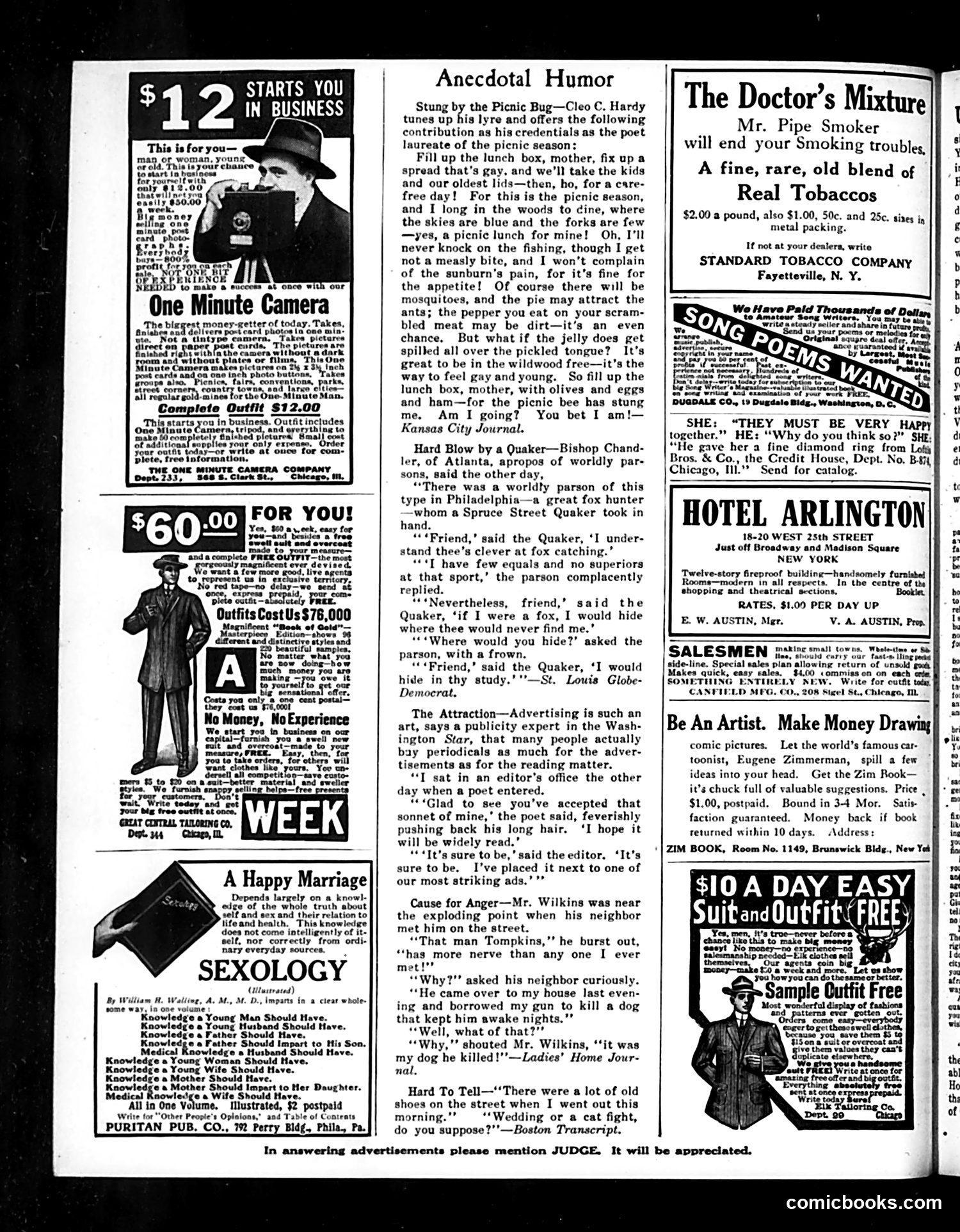
This page is primarily **advertising and light humor content**, not political satire. ## The Advertisements The page features various business opportunity ads typical of early 20th-century magazines: a "One Minute Camera" for $12, a $60 outfit offer, and a mail-order "Sexology" book promising marital happiness through sexual knowledge. ## The Humor Content The "Anecdotal Humor" section contains four brief, gentle jokes: 1. **"Stung by the Picnic Bug"** — A cheerful poem celebrating outdoor picnics despite minor annoyances (mosquitoes, dirt, ants) 2. **Quaker vs. Worldly Parson** — A witty anecdote where a Quaker outsmarts a boastful fox-hunting clergyman, suggesting the parson would never find a fox hiding "in thy study" (implying the parson doesn't study scripture) 3. **Advertising Appeal** — An editor convinces a poet his sonnet will be widely read because it's placed next to striking advertisements 4. **Mistaken Identity** — A man angrily tells his neighbor that the neighbor killed *his* dog (not the neighbor's) with a borrowed gun These are gentle, pun-based humor pieces with no political content—typical light reading for Judge's audience.
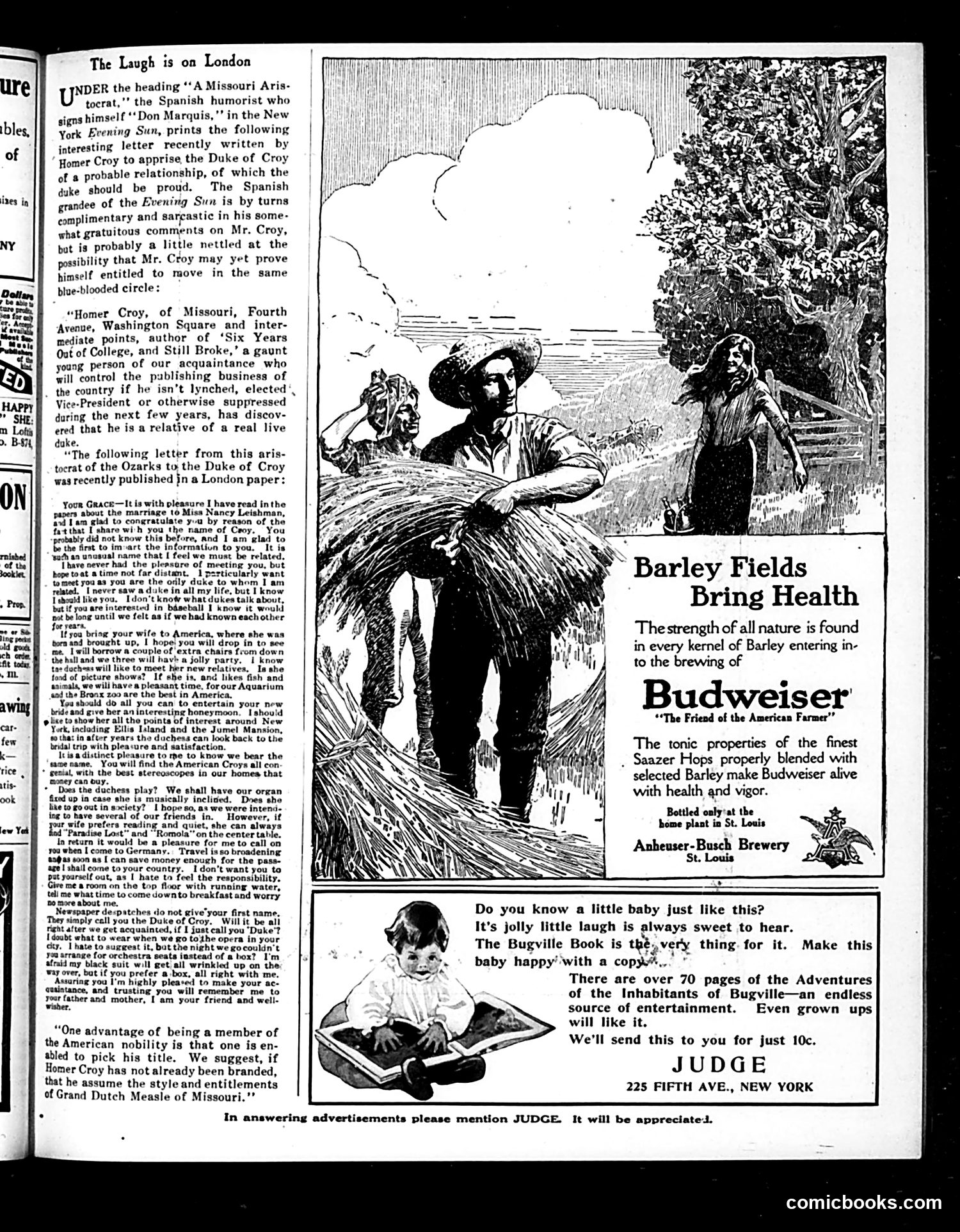
This piece satirizes American social pretension and the obsession with European nobility. Homer Croy, a Missouri writer, claims distant kinship to an actual British duke (the Duke of Croy) who married American Nancy Leishman. The satire works on multiple levels: Croy's obsequious letter hilariously conflates aristocratic dignity with American casualness—offering baseball talk, the Bronx Zoo, and borrowed chairs as entertainment. The Spanish humorist "Don Marquis" (who frames this) mocks both Croy's presumption of kinship and American eagerness to boast of any European connection, however tenuous. The joke reveals how American social climbers manufacture legitimacy through invented aristocratic links. By treating a distant name-sharing as grounds for kinship, Croy embodies the period's anxious yearning for old-world status. Judge's readers would recognize this as quintessentially American social climbing—trying to access "blue-blooded circles" through the thinnest possible pretense.
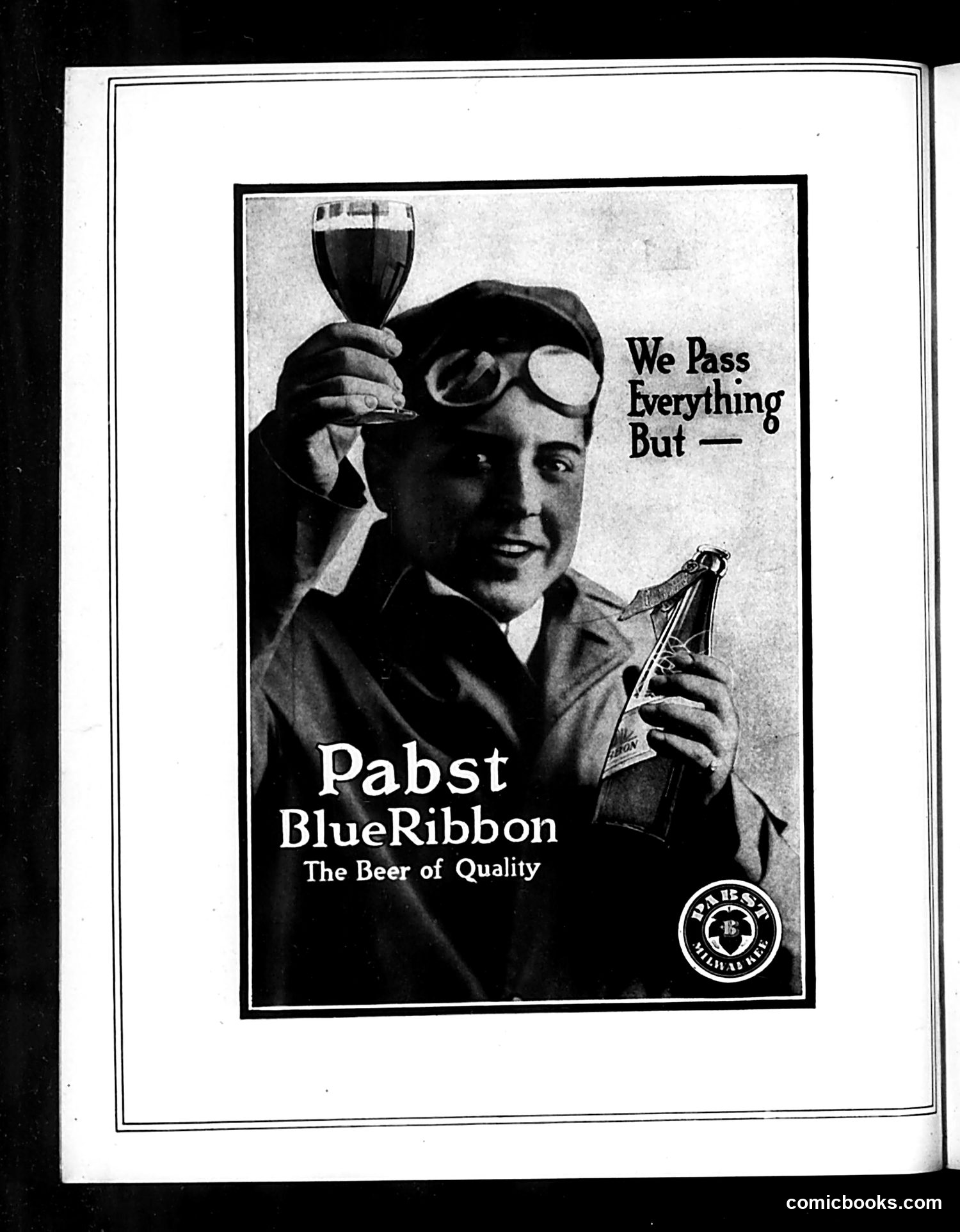
This is a **Pabst Blue Ribbon beer advertisement**, not a political cartoon. The image shows a man in aviator gear (goggles pushed up on his forehead) holding a beer bottle and a glass aloft, with the tagline "We Pass Everything But—Pabst Blue Ribbon." The advertisement likely references **aviation culture**, which was popular and glamorous in the early-to-mid 20th century. The "pass everything but" phrase appears to be a boast about the beer's superiority—implying that while other products might be passed over or inferior, Pabst Blue Ribbon would not be skipped. The circular Pabst logo appears in the lower right. This is commercial advertising rather than satirical editorial content.