
Judge, 1913-07-19 · page 4 of 24
Judge — July 19, 1913 — page 4: what you’re looking at
What you’re looking at
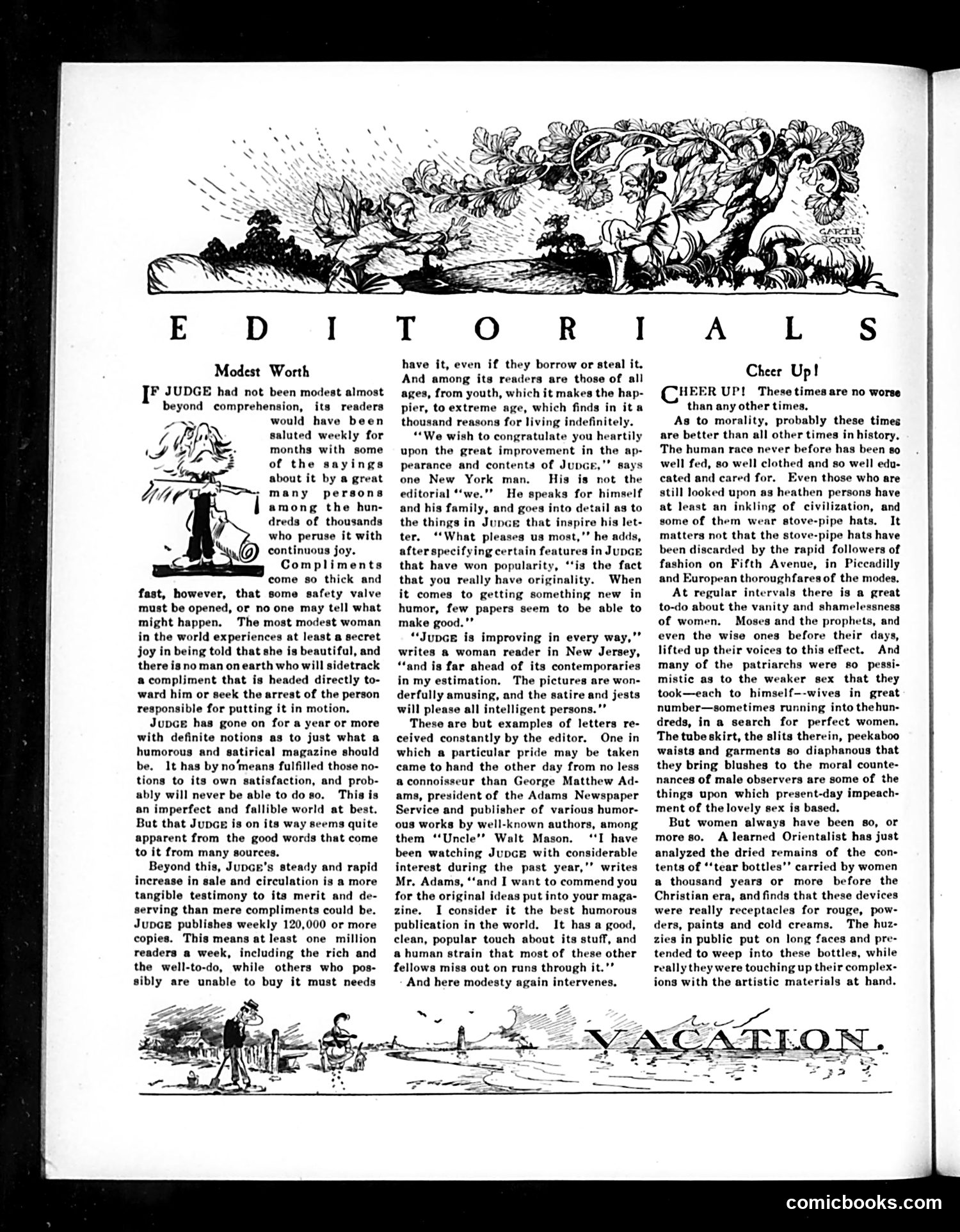
This page contains two editorial sections. "Modest Worth" discusses Judge magazine's merits, claiming it publishes 120,000+ copies weekly with broad readership. The editor defends the magazine's humor as having "definite notions" about what constitutes good satire, rejecting purely arbitrary or meaningless jokes. "Cheer Up!" addresses women's fashion and moral concerns, specifically critiquing the "stove-pipe hat" trend on Fifth Avenue and Piccadilly. The author argues that while some worry these fashions corrupt morality, women have always influenced society positively. The piece dismisses moral panic about women's clothing choices as exaggerated. The accompanying illustrations appear decorative rather than depicting specific political figures or events. The content reflects early-20th-century debates about fashion, women's agency, and magazine editorial standards.
📄 Transcribed text from this page (OCR, searchable)
Machine-transcribed from the original scan — historical spelling and the odd misread are preserved.
Modest Worth F JUDGE had not been modest almost beyond comprehension, its readers would have been saluted weekly for months with some of the sayings about it by a great many persons among the hun- dreds of thousands who peruse it with continuous joy. Compliments come so thick and fast, however, that some safety valve must be opened, or no one may tell what might happen. The most modest woman in the world experiences at least a secret joy in being told that she is beautiful, and there is no man on earth who will sidetrack acompliment that is headed directly to- ward him or seek the arrest of the person responsible for putting it in motion. JupGe has gone on for a year or more with definite notions as to just what a humorous and satirical magazine should be. It has by no‘means fulfilled those no- tions to its own satisfaction, and prob- ably will never be able to do so. This is an imperfect and fallible world at best. But that Jupce is on its way seems quite apparent from the good words that come to it from many sources. Beyond this, Jupce’s steady and rapid increase in sale and circulation is a more tangible testimony to its merit and de- serving than mere compliments could be. Jupce publishes weekly 120,000 or more copies. This means at least one million readers a week, including the rich and the well-to-do, while others who pos- sibly are unable to buy it must needs have it, even if they borrow or steal it. And among its readers are those of all ages, from youth, which it makes the hap- pier, to extreme age, which finds in ita thousand reasons for living indefinitely. “*We wish to congratulate you heartily upon the great improvement in the ap- pearance and contents of Jupce,"’ says one New York man. His is not the editorial ‘‘we.'’ He speaks for himself and his family, and goes into detail as to the things in Jur that inspire his let- ter. us most,”’ he adds, after specifying certain features in JuDGE that have won popularity, the fact that you really have originality. When it comes to getting something new in humor, few papers seem to be able to make good.’’ “Jupce is improving in every way, writes a woman reader in New Jersey, “tand is far ahead of its contemporaries in my estimation. The pictures are won- derfully amusing, and the satire and jests will please all intelligent persons.’" These are but examples of letters re- ceived constantly by the editor. One in which a particular pride may be taken came to hand the other day from no less aconnoisseur than George Matthew Ad- ams, president of the Adams Newspaper Service and publisher of various humor- ous works by well-known authors, among them ‘Uncle’? Walt Mason. ‘‘I have been watching JupGE with considerable interest during the past year,’’ writes Mr. Adams, ind I want to commend you for the original ideas put into your maga- zine. I consider it the best humorous publication in the world. It has a good, clean, popular touch about its stuff, and a human strain that most of these other fellows miss out on runs through it.’” And here modesty again intervenes, Cheer Up! CHEER UP! These times are no worse than any other times, As to morality, probably these times are better than all other times in history, The human race never before has been 80 well fed, so well clothed and so well edu- cated and cared for. Even those who are still looked upon as heathen persons have at least an inkling of civilization, and some of them wear stove-pipe hats. It matters not that the stove-pipe hats have been discarded by the rapid followers of fashion on Fifth Avenue, in Piccadilly and European thoroughfares of the modes, At regular intervals there is a great to-do about the vanity and shamelessness of women. Moses and the prophets, and even the wise ones before their days, lifted up their voices to this effect. And many of the patriarchs were so pessi- mistic ag to the weaker sex that they took—each to himself—-wives in great number—sometimes running into thehun- dreds, in a search for perfect women, The tube skirt, the slits therein, peekaboo waists and garments so diaphanous that they bring blushes to the moral counte- nances of male observers are some of the things upon which present-day impeach- ment of the lovely sex is based. But women always have been so, or more so. A learned Orientalist has just analyzed the dried remains of the con- tents of ‘‘tear bottles’’ carried by women a thousand years or more before the Christian era, and finds that these devices were really receptacles for rouge, pow- ders, paints and cold creams, The huz- zies in public put on long faces and pre- tended to weep into these bottles, while really they were touching up their complex- ions with the artistic materials at hand. comicbooks.com