
Judge, 1913-07-19 · page 9 of 24
Judge — July 19, 1913 — page 9: what you’re looking at
What you’re looking at
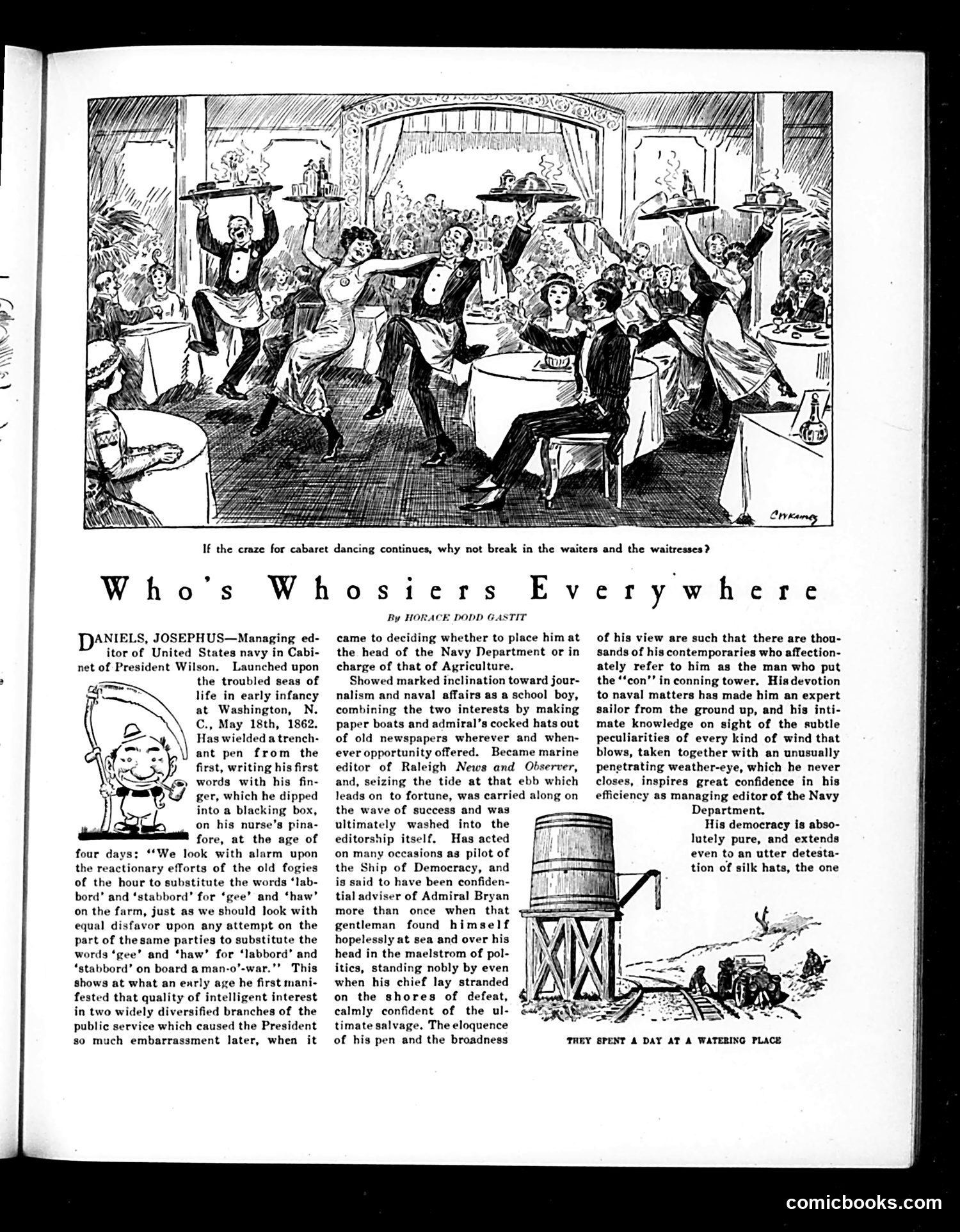
The top cartoon mocks the "cabaret dancing craze" by suggesting waiters and waitresses join in—satirizing both the fad's pervasiveness and working-class participation in fashionable entertainment. The main article is a mock biographical profile of **Josephus Daniels**, Secretary of the Navy under President Wilson. The satire ridicules Daniels through exaggerated praise, claiming he showed naval interest from infancy (writing farm language like "gee" and "haw" at four days old). The piece mocks his dual interests in journalism and naval affairs, his role as "pilot of the Ship of Democracy," and his supposed relationship with "Admiral Bryan" (William Jennings Bryan, Wilson's Secretary of State). The humor targets Daniels' apparent lack of genuine naval expertise despite his prominent position, suggesting he achieved power through political connections rather than qualification. His alleged "detestation of silk hats" mocks his populist pretensions.
📄 Transcribed text from this page (OCR, searchable)
Machine-transcribed from the original scan — historical spelling and the odd misread are preserved.
If the craze for cabaret dancing continues, why not break in the waiters and the waitresses? Who’s Whosiers Everywhere DANIELS, JOSEPH US—Managing ed- itor of United States navy in Cabi- net of President Wilson. Launched upon —_ the troubled seas of | aay life in early infancy at Washington, N. C., May 18th, 1862. Has wielded a trench- ant pen from the first, writing his first words with his fin- ger, which he dipped into a blacking box, on his nurse’s pina- fore, at the age of four days: ‘‘We look with alarm upon the reactionary efforts of the old fogies of the hour to substitute the words ‘lab- bord’ and ‘stabbord’ for ‘gee’ and ‘haw’ on the farm, just as we should look with equal disfavor upon any attempt on the part of thesame parties to substitute the words ‘gee’ and ‘haw’ for ‘labbord’ and ‘stabbord’ on board a man-o’-war.’’ This shows at what an enrly age he first mani- fested that quality of intelligent interest in two widely diversified branches of the public service which caused the President 80 much embarrassment later, when it By HORACE DODD GASTIT came to deciding whether to place him at the head of the Navy Department or in charge of that of Agriculture. Showed marked inclination toward jour- nalism and naval affairs as a school boy, combining the two interests by making paper boats and admiral’s cocked hats out of old newspapers wherever and when- ever opportunity offered. Became marine editor of Raleigh News and Observer, and, seizing the tide at that ebb which leads on to fortune, was carried along on the wave of success and was ultimately washed into the editorship itself, Has acted on many occasions as pilot of the Ship of Democracy, and is said to have been confiden- tial adviser of Admiral Bryan more than once when that gentleman found himself hopelessly at sea and over his head in the maelstrom of pol- ities, standing nobly by even when his chief lay stranded on the shores of defeat, calmly confident of the ul- timate salvage. The eloquence of his pen and the broadness of his view are such that there are thou- sands of his contemporaries who affection- ately refer to him as the man who put the ‘‘con’’ in conning tower. His devotion to naval matters has made him an expert sailor from the ground up, and his inti- mate knowledge on sight of the subtle peculiarities of every kind of wind that blows, taken together with an unusually penetrating weather-eye, which he never closes, inspires great confidence in his efficiency as managing editor of the Navy Department. His democracy is abso- lutely pure, and extends even to an utter detesta- tion of silk hats, the one THEY SPENT A DAY AT A WATERING PLACE comicbooks.com