
Judge, 1913-07-19 · page 17 of 24
Judge — July 19, 1913 — page 17: what you’re looking at
What you’re looking at
This is a humorous short story by Jane Belfield satirizing the newspaper industry's "information bureau" services—a real early-20th-century phenomenon where newspapers employed staff to answer reader questions on any topic. The narrative follows a rural woman visiting her city sister Sallie, whose family challenges a newspaper man's knowledge by asking him whether baby elephants nurse. The setup mocks how urbanites have come to rely on newspapers as omniscient sources, treating them almost like oracles. The satire targets two things: (1) the newspaper industry's grandiose claims about the breadth of information available through their bureaus, and (2) the growing dependency of city dwellers on newspapers to answer everyday questions they might previously have solved through experience or community knowledge. The story is incomplete on this page, leaving the newspaper man's answer unresolved—itself a joke about whether such an obscure fact could actually be answered.
📄 Transcribed text from this page (OCR, searchable)
Machine-transcribed from the original scan — historical spelling and the odd misread are preserved.
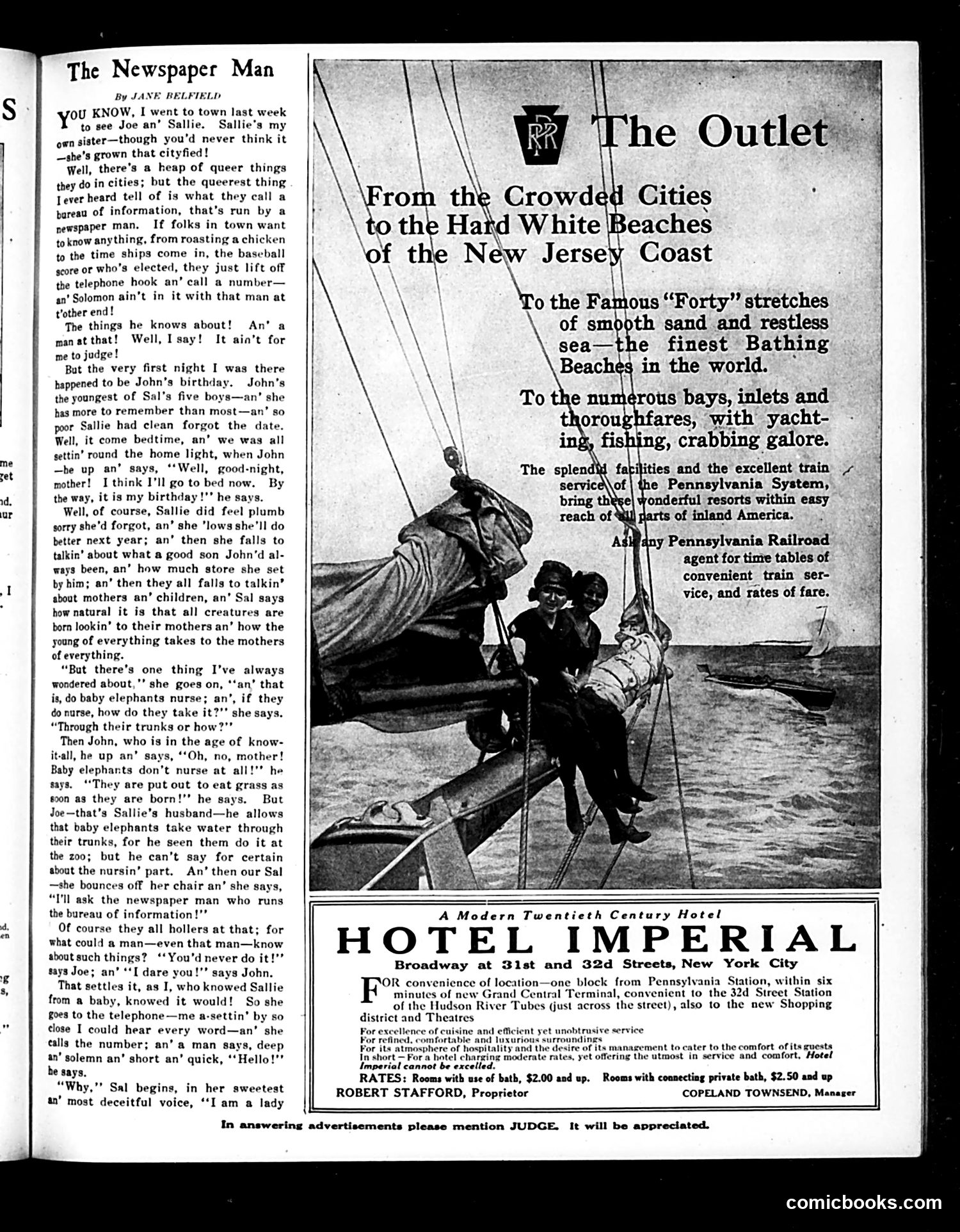
The Newspaper Man By JANE BELFIELD you KNOW, I went to town last week to see Joe an’ Sallie. Sallie’s my own sister—though you'd never think it —she’s grown that cityfied! Well, there’s a heap of queer things they do in cities; but the queerest thing Iever heard tell of is what they call a pareau of information, that’s run by a newspaper man. If folks in town want toknow anything, from roasting a chicken to the time ships come in, the baseball score or who’s elected, they just lift off the telephone hook an’ call a number— an’ Solomon ain’t in it with that man at t’other end! The things he knows about! An’ a manatthat! Well, Tsay! It ain’t for me to judge! But the very first night I was there happened to be John’s birthday. John’s the youngest of Sal’s five boys—an’ she has more to remember than most—an’ so poor Sallie had clean forgot the date. Well, it come bedtime, an’ we was all settin’ round the home light, when John —he up an’ says, ‘Well, good-night, mother! I think I'll go to bed now. By the way, it is my birthday !"* he says. Well, of course, Sallie did feel plumb sorry she'd forgot, an’ she "lows she'll do better next year; an’ then she falls to talkin’ about what a good son John'd al- ways been, an’ how much store she set by him; an’ then they all falls to talkin’ about mothers an’ children, an’ Sal says how natural it is that all creatures are born lookin’ to their mothers an’ how the young of everything takes to the mothers of everything. “But there’s one thing I’ve always wondered about,’’ she goes on, ‘‘an’ that is, do baby elephants nurse; an’, if they do nurse, how do they take it?’’ she says. “Through their trunks or how?"’ Then John, who is in the age of know- it-all, he up an’ says, ‘Oh, no, mother! Baby elephants don’t nurse at all!’? he says. ‘They are put out to eat grass as foon as they are born!’’ he says. But Joe—that’s Sallie’s husband—he allows that baby elephants take water through their trunks, for he seen them do it at the zoo; but he can’t say for certain about the nursin’ part. An’ then our Sal —she bounces off her chair an’ she says, “I'll ask the newspaper man who runs the bureau of information!" Of course they all hollers at that; for what could a man—even that man—know about such things? ‘‘ You'd never do it!"* says Joe; an’ ‘‘I dare you!"’ says John. That settles it, as I, who knowed Sallie from a baby, knowed it would! So she goes to the telephone—me a-settin’ by so close I could hear every word—an’ she calls the number; an’ a man says, deep an’ solemn an’ short an’ quick, ‘‘Hello!"’ he says. “Why,’’ Sal begins, in her sweetest 4’ most deceitful voice, ‘I am a lady \ \ ‘o the Hat White Beaches of oe New Jersey Coast ous “Forty” stretches of smooth sand and restless sea—the finest Bathing Beaches in the world. To the numerous bays, inlets and horoughfares, with yacht- ing, fishing, crabbing galore. othe Fal ities and the excellent train he Pennsylvania System, The splendyi fal service\of ts of inland America. dny Pennsylvania Railroad agent for time tables of convenient train ser- vice, and rates of fare. ROBERT STAFFORD, Proprietor A Modern Twentieth Century Hotel HOTEL IMPERIAL Broadway at 31st and 32d Streets, New York City OR convenience of location—one block from Pennsylvania Station, within six minutes of new Grand Central Terminal, convenient to the 32d Street Station of the Hudson River Tubes (just across the street), also to the new Shopping district and Theatres For excellence of cuisine and efficient yet unobtrusive service For refined, comfortable and luxurious undings For its sphere of hospitality and the desire of its management to cater to the comfort of its guests In short — For a hotel charging moderate rates, yet offering the utmost in service and comfort, Hotel Imperial cannot be excelled. RATES: Rooms with use of bath, $2.00 and up. Rooms with connecting private bath, $2.50 and up In answering advertisements please mention JUDGE. It will be appreciated. comicbooks.com COPELAND TOWNSEND, Manager