
Judge, 1913-07-19 · page 5 of 24
Judge — July 19, 1913 — page 5: what you’re looking at
What you’re looking at
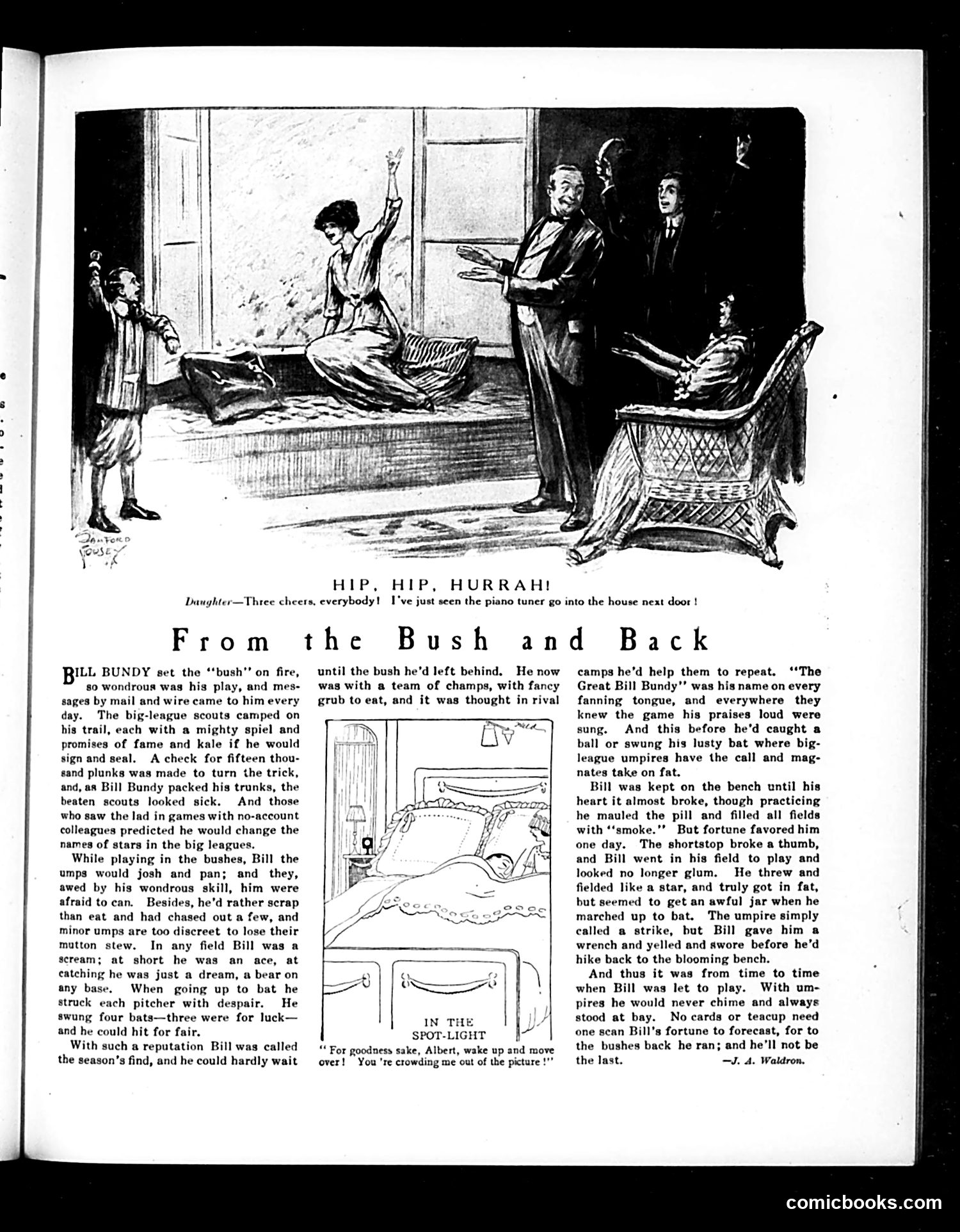
The top cartoon depicts a celebratory domestic scene where a woman sits triumphantly on the floor while men cheer. The caption suggests someone has announced a piano tuner's arrival—a mundane household event treated as major excitement ("Three cheers, everybody!"). This appears to satirize domestic life and perhaps the limited scope of middle-class women's concerns. The longer story "From the Bush and Back" chronicles Bill Bundy, a minor league baseball player. The narrative details his rough playing style, injuries, and eventual redemption through perseverance. The accompanying sketch shows a player in a batting stance. The overall page celebrates working-class American sports culture and determination, presenting baseball as character-building despite physical hardship.
📄 Transcribed text from this page (OCR, searchable)
Machine-transcribed from the original scan — historical spelling and the odd misread are preserved.
HIP, HIP, HURRAH! Daughter—Three cheers, everybody! I've just seen the piano tuner go into the house next door ! From ILL BUNDY set the ‘‘bush’’ on fire, 80 wondrous was his play, and mes- sages by mail and wire came to him every day. The big-league scouts camped on his trail, each with a mighty spiel and promises of fame and kale if he would sign and seal. A check for fifteen thou- sand plunks was made to turn the trick, and, as Bill Bundy packed his trunks, the beaten scouts looked sick. And those who saw the lad in games with no-account colleagues predicted he would change the names of stars in the big leagues. While playing in the bushes, Bill the umps would josh and pan; and they, awed by his wondrous skill, him were afraid to can. Besides, he’d rather scrap than eat and had chased out a few, and minor umps are too discreet to lose their mutton stew. In any field Bill was a scream; at short he was an ace, at catching he was just a dream, a bear on any base, When going up to bat he struck each pitcher with despair. He swung four bats—three were for luck— and he could hit for fair. With such a reputation Bill was called the season’s find, and he could hardly wait the Bush until the bush he'd left behind. He now was with a team of champs, with fancy grub to eat, and it was thought in rival IN THE SPOT-LIGHT “For goodness sake, Albert, wake up and move over! ad You 're crowding me out of the picture ! and Back camps he’d help them to repeat. ‘‘The Great Bill Bundy’’ was his name on every fanning tongue, and everywhere they knew the game his praises loud were sung. And this before he'd caught a ball or swung his lusty bat where big- league umpires have the call and mag- nates take on fat. Bill was kept on the bench until his heart it almost broke, though practicing he mauled the pill and filled all fields with ‘‘smoke.’’ But fortune favored him one day. The shortstop broke a thumb, and Bill went in his field to play and looked no longer glum. He threw and fielded like a star, and truly got in fat, but seemed to get an awful jar when he marched up to bat. The umpire simply called a strike, but Bill gave him a wrench and yelled and swore before he’d hike back to the blooming bench. And thus it was from time to time when Bill was let to play. With um- pires he would never chime and always stood at bay. No cards or teacup need one scan Bill's fortune to forecast, for to the bushes back he ran; and he’ll not be the last. —J. A. Waldron, comicbooks.com