
A complete issue · 24 pages · 1913
Judge — June 14, 1913
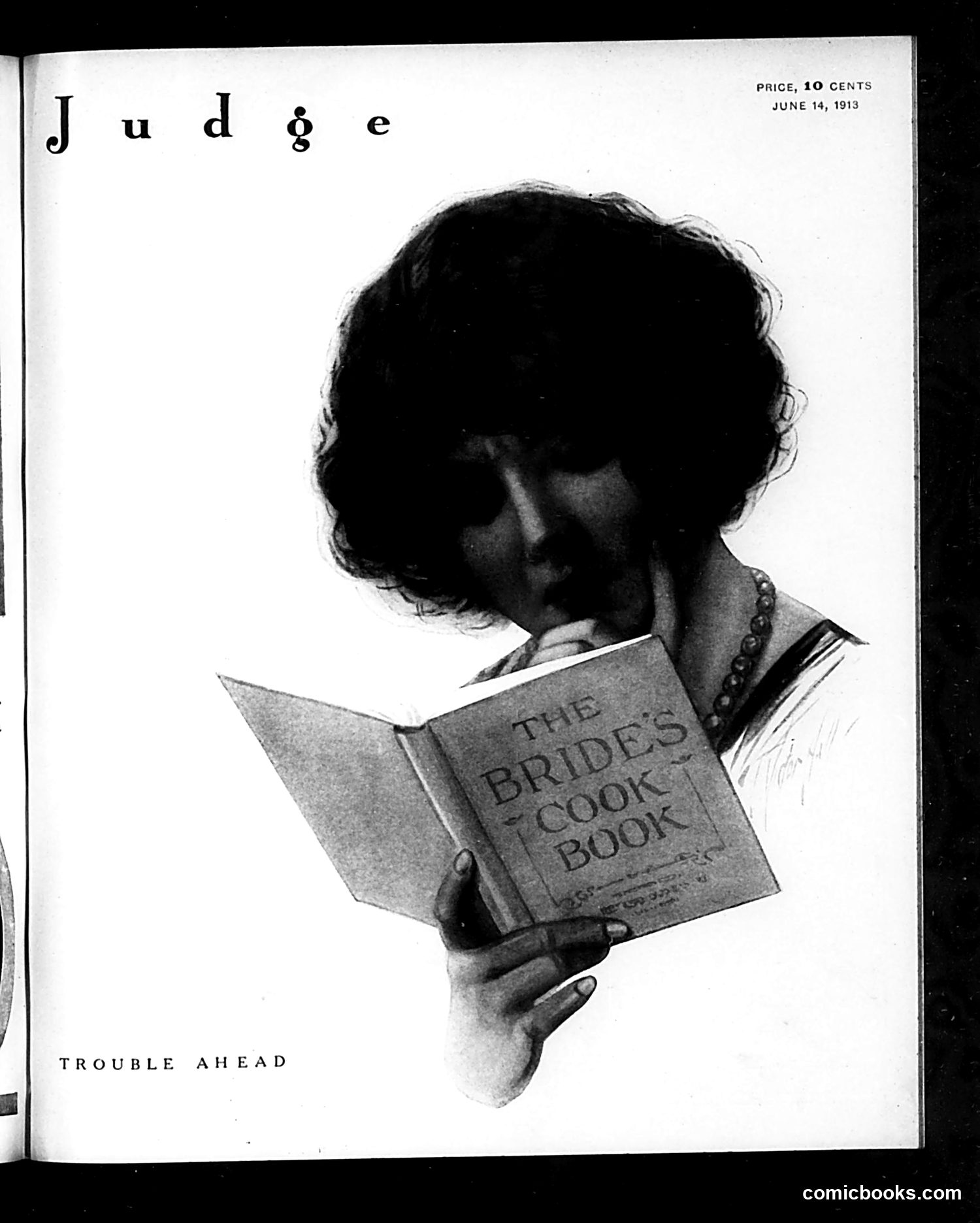
This satirical cover depicts a young woman reading "The Bride's Cook Book," her face shadowed with worry or concern. The caption "Trouble Ahead" suggests the joke: marriage looms, and she's anxious about her domestic responsibilities—specifically cooking. The satire targets early-20th-century gender expectations. A bride was expected to master household duties immediately upon marriage, and cooking competence was central to wifely duties. Her troubled expression implies she fears inadequacy in this role, which could jeopardize her marriage. The image mocks both the woman's presumed anxiety and the social pressure placed on new brides to perform domestic labor flawlessly from day one. Judge's readership would have recognized this as commentary on rigid gender roles and marital expectations of the era.
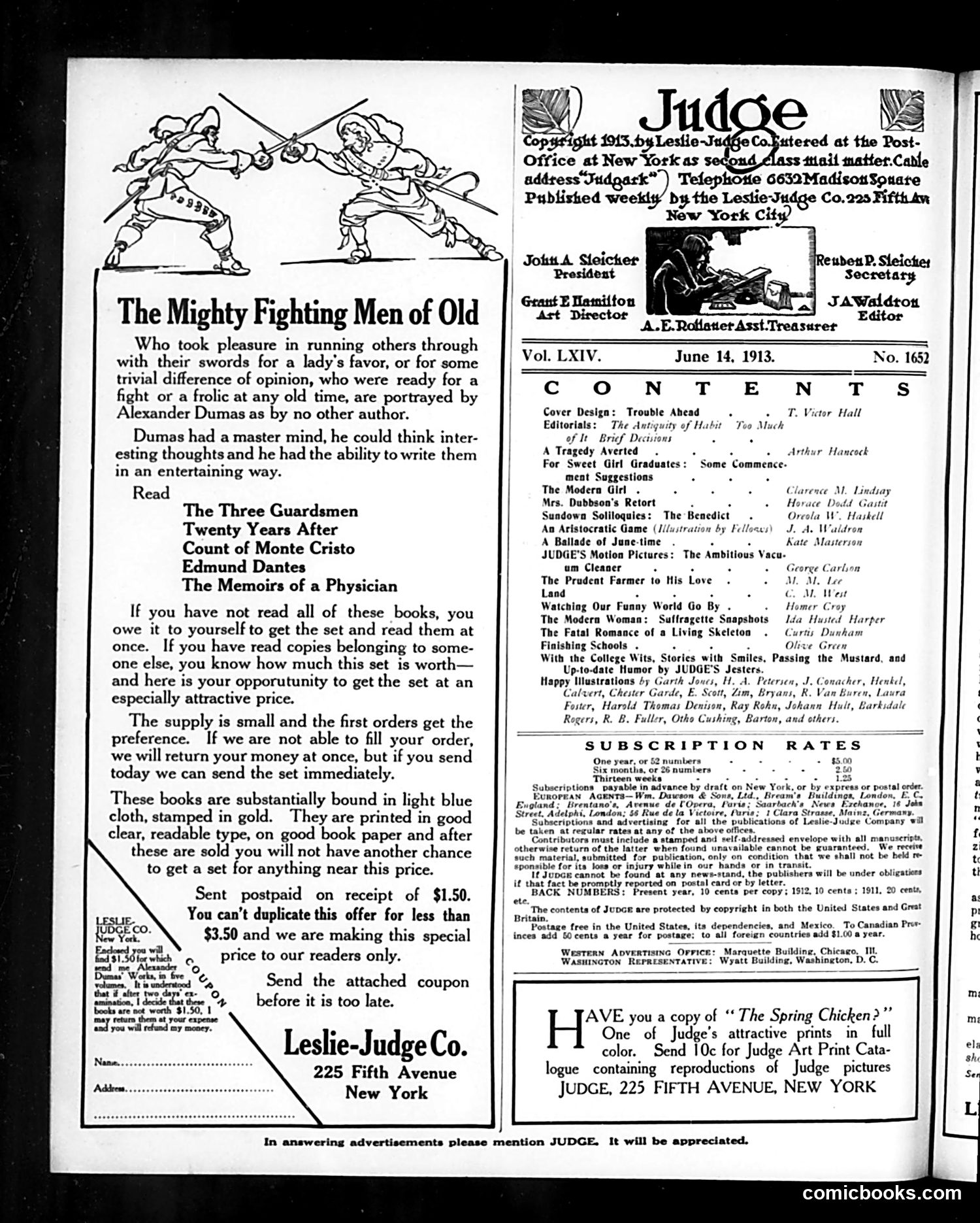
This page is primarily **advertising and editorial content** rather than political satire. The masthead illustration shows two swordsmen dueling, introducing a serialized fiction section titled "The Mighty Fighting Men of Old"—a literary promotion for adventure novels by Alexandre Dumas and others. The dominant feature is a **book advertisement** from Leslie-Judge Co. promoting bound collections of classic literature at discounted prices ($3.50 instead of $1.50 per set). The company emphasizes the books' quality binding and printing. The bottom contains a modest advertisement for Judge's print catalog. **No identifiable political figures or satirical commentary** appears on this page. It reflects Judge's dual role as both satirical magazine and publisher of bound literature to middle-class readers in 1913.
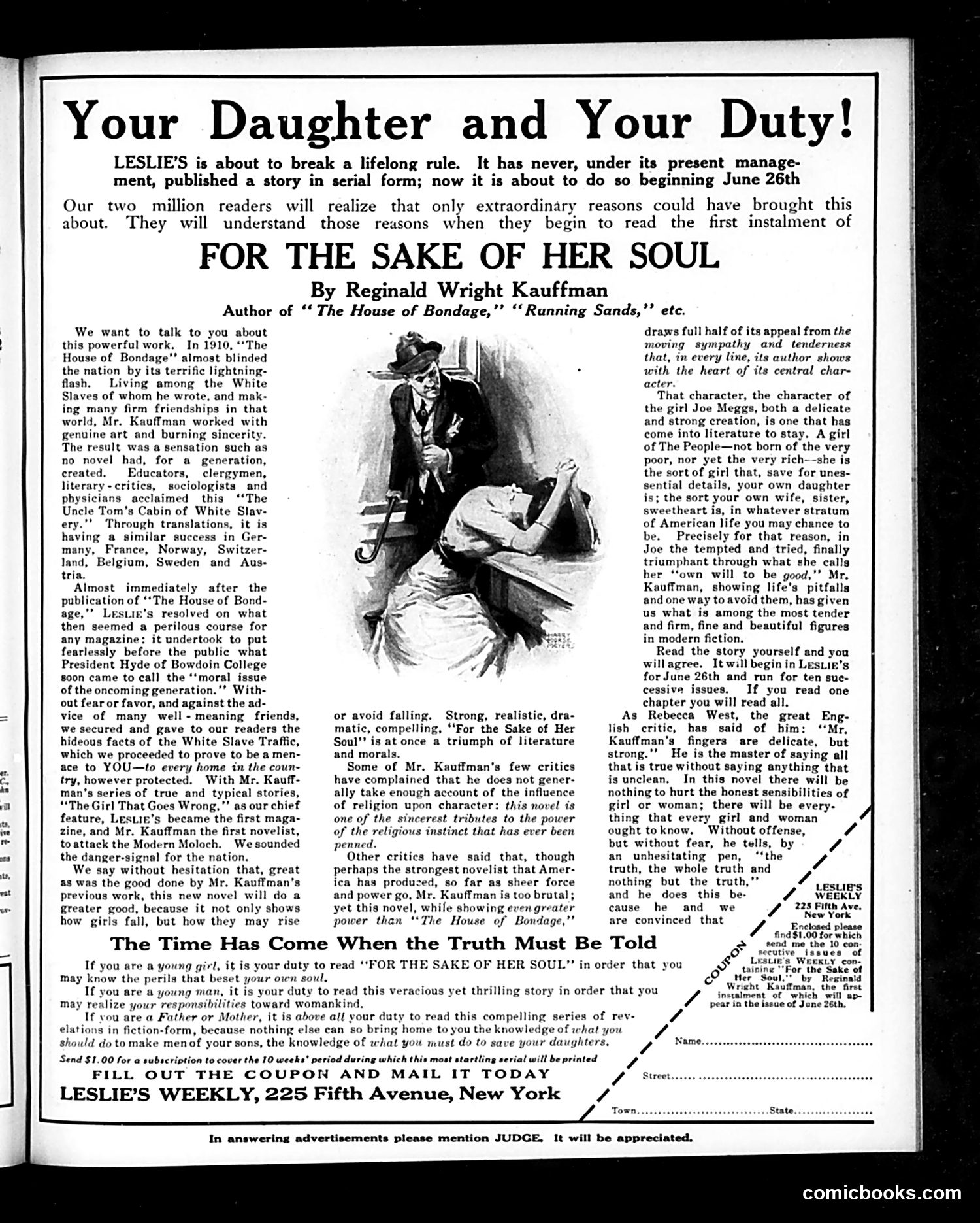
This page is primarily an **advertisement for a serialized story**, not political satire. It announces that *Leslie's Weekly* magazine will begin publishing "For the Sake of Her Soul" by Reginald Wright Kauffman starting June 26th. The advertisement uses moral appeals to parents—particularly fathers and mothers—urging them to read the story to understand "perils" facing their daughters. It emphasizes the narrative will reveal "life's pitfalls" and provide knowledge "to save your daughters." The illustration shows a woman in apparent distress or danger, reinforcing the melodramatic tone. This marketing strategy exploits contemporary anxieties about young women's safety and morality, a common sales tactic in early 20th-century publishing. The coupon at bottom invites readers to subscribe.
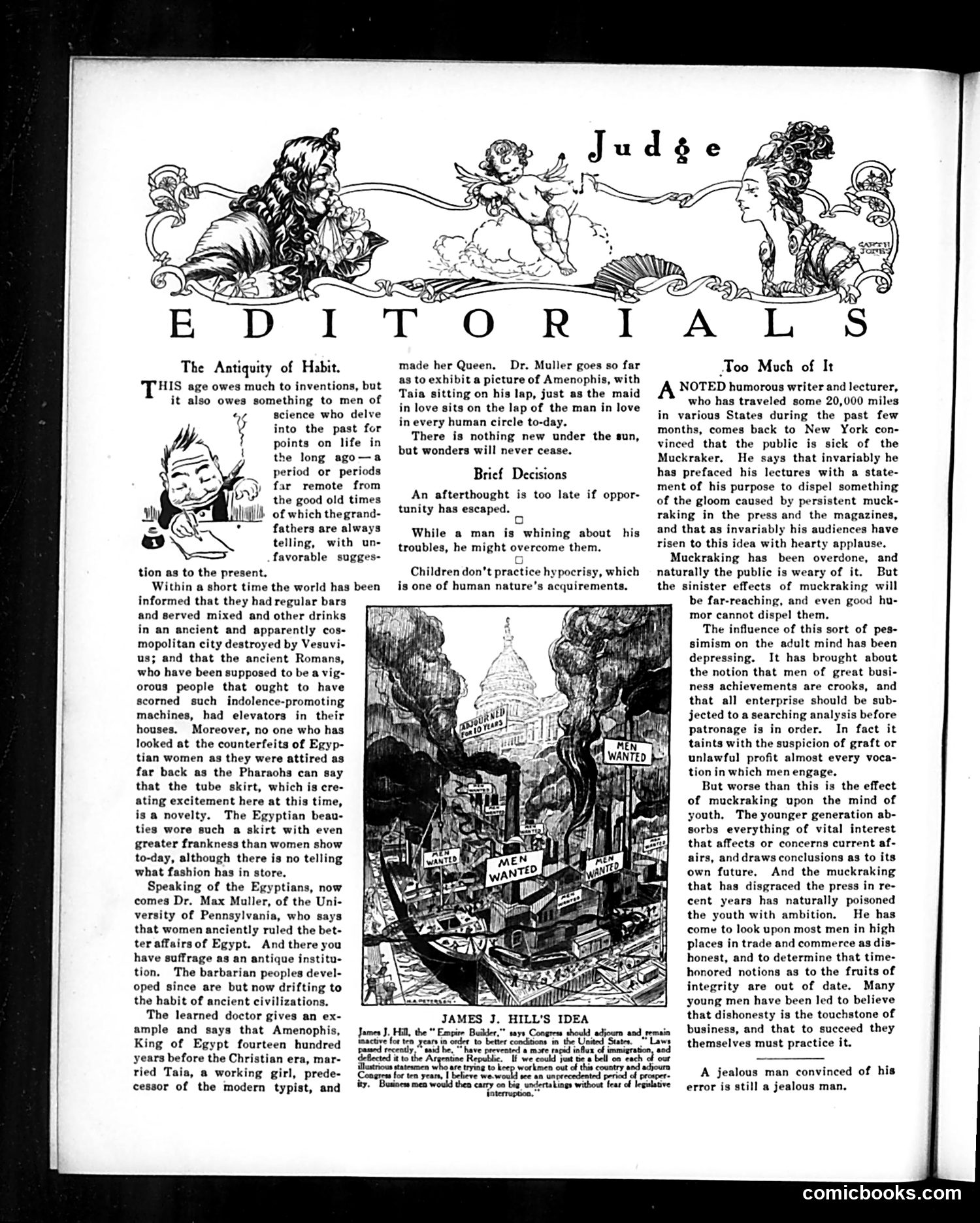
This page contains three distinct editorial sections criticizing social trends. "The Antiquity of Habit" argues that women's fashion (tube skirts) represents nothing new, citing ancient Egyptian precedent. "Brief Decisions" offers aphoristic commentary on human nature. The main cartoon, "James J. Hill's Idea," depicts a crowded urban street with "Men Wanted" signs. It references James J. Hill, a prominent railroad magnate, apparently satirizing labor shortages or immigration policy debates of the era. The caption suggests Hill's proposal involved bringing workers to improve U.S. labor conditions. "Too Much of It" critiques a traveling lecturer's muckraking journalism, arguing such relentless exposés of corruption have poisoned youth's ambition and made honest business seem impossible. The satire targets excessive progressive-era investigative reporting as counterproductive.
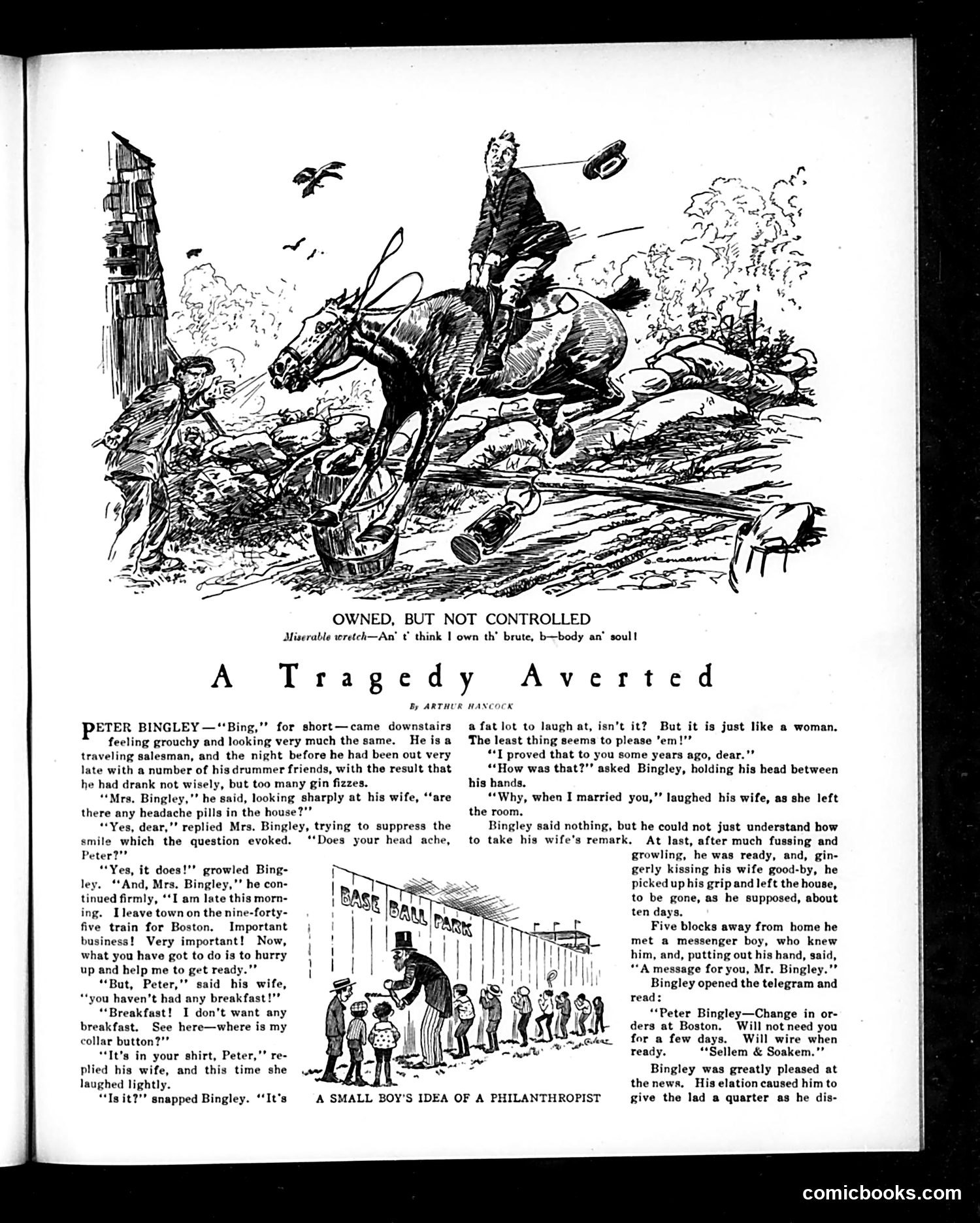
This story satirizes a henpecked husband named Peter Bingley. The top illustration shows him riding wildly on a horse while his wife attempts to control him—visualizing the caption "Owned, but not controlled." The narrative mocks Bingley's domesticated state: his wife criticizes his appearance, controls his breakfast, and decides his schedule. When she leaves him for ten days, he escapes to Boston on important business. A messenger boy interrupts with a telegram recalling him home for "a few days," which Bingley interprets as his wife's attempt to recapture control. The humor targets the popular turn-of-century anxiety about wives dominating husbands—a common theme in *Judge*'s satirical commentary on American marriage and masculinity.
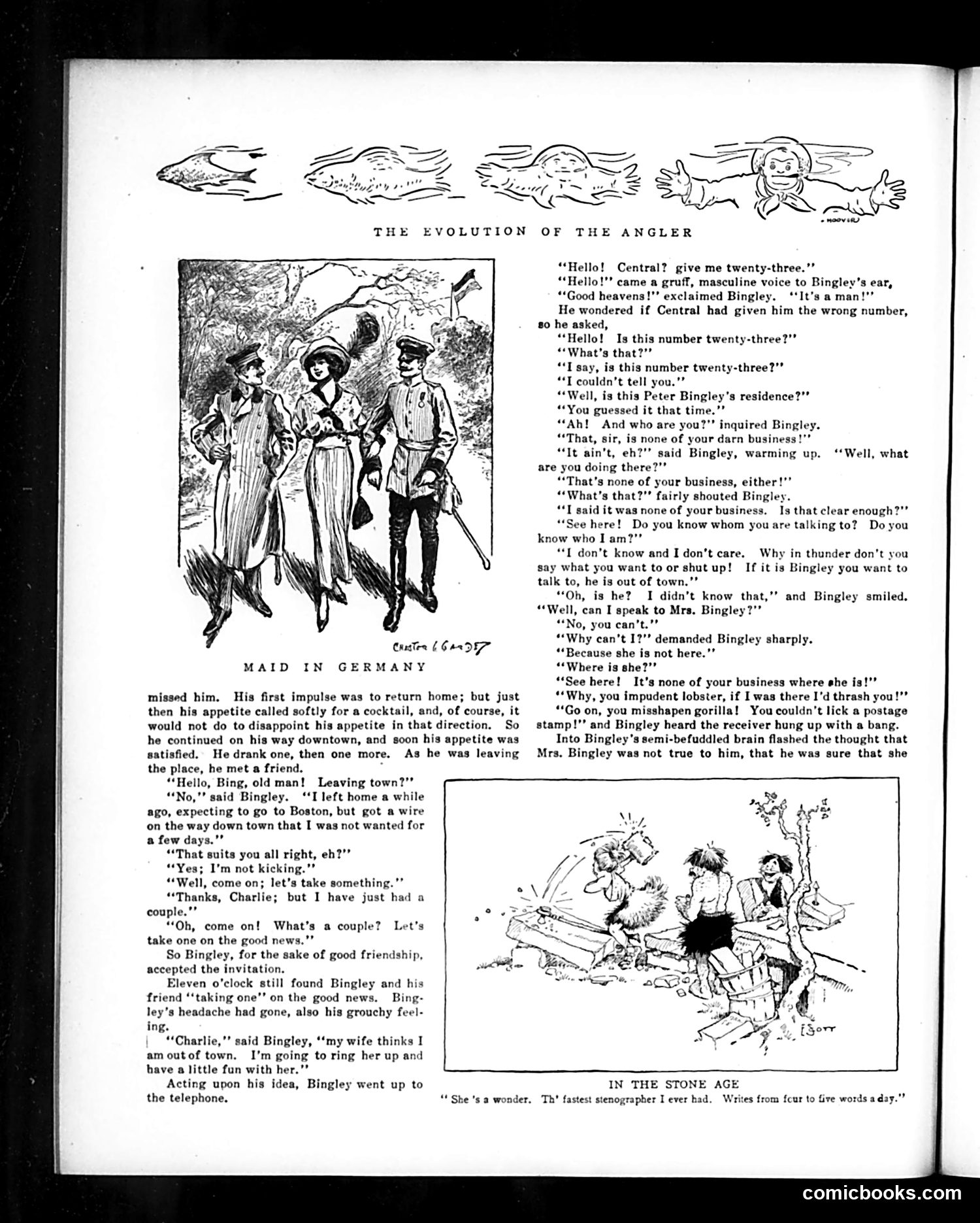
This page contains two unrelated satirical pieces from Judge magazine. **"The Evolution of the Angler"** (top) is a visual joke showing fish gradually evolving into increasingly human forms, culminating in a person fishing—a humorous take on Darwin's evolution theory, suggesting humans are just evolved fish/anglers. **"Maid in Germany"** (main story) depicts a drunk man named Bingley who, after drinking heavily, calls his own home pretending to be someone else as a "prank." A rude servant (likely German, given the title) answers and insults him repeatedly. Bingley becomes convinced his wife is unfaithful based on the servant's evasiveness. The satire mocks both drunken foolishness and the absurdity of jumping to conclusions—Bingley creates his own marital crisis through intoxication and a misguided "joke." **"In the Stone Age"** (bottom right) is a caption joke about prehistoric inefficiency. The humor relies on period-specific drinking culture and gender/servant dynamics unfamiliar to modern readers.
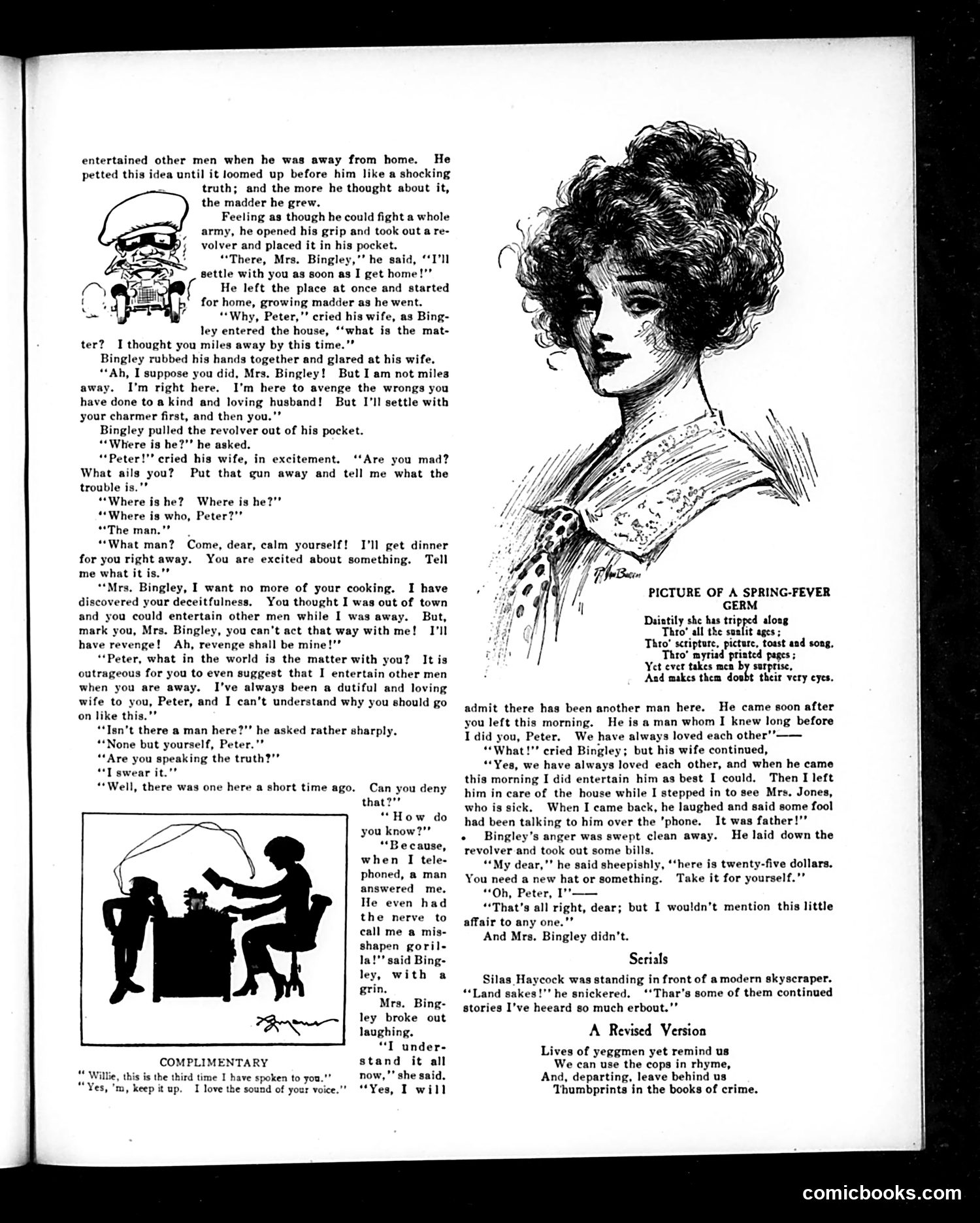
This page contains a domestic comedy story mocking male jealousy and paranoia. Peter Bingley, furious after someone answers his wife's phone while he's supposedly out of town, rushes home with a revolver, convinced she's entertaining a lover. His wife calmly denies the accusation, but then admits she *did* entertain a man that morning—her father, whom she's "always loved." The joke: Bingley's violent jealousy evaporates instantly upon learning the "other man" was merely her father. He sheepishly gives her money for a hat and asks her not to mention "this little affair" to anyone—suggesting his absurd overreaction embarrasses him. The satire targets masculine insecurity and the era's anxieties about wives' independence when husbands traveled. The story ridicules how quickly male rage dissolves when confronted with innocent explanations, while also implying men's desire to control women's social interactions.
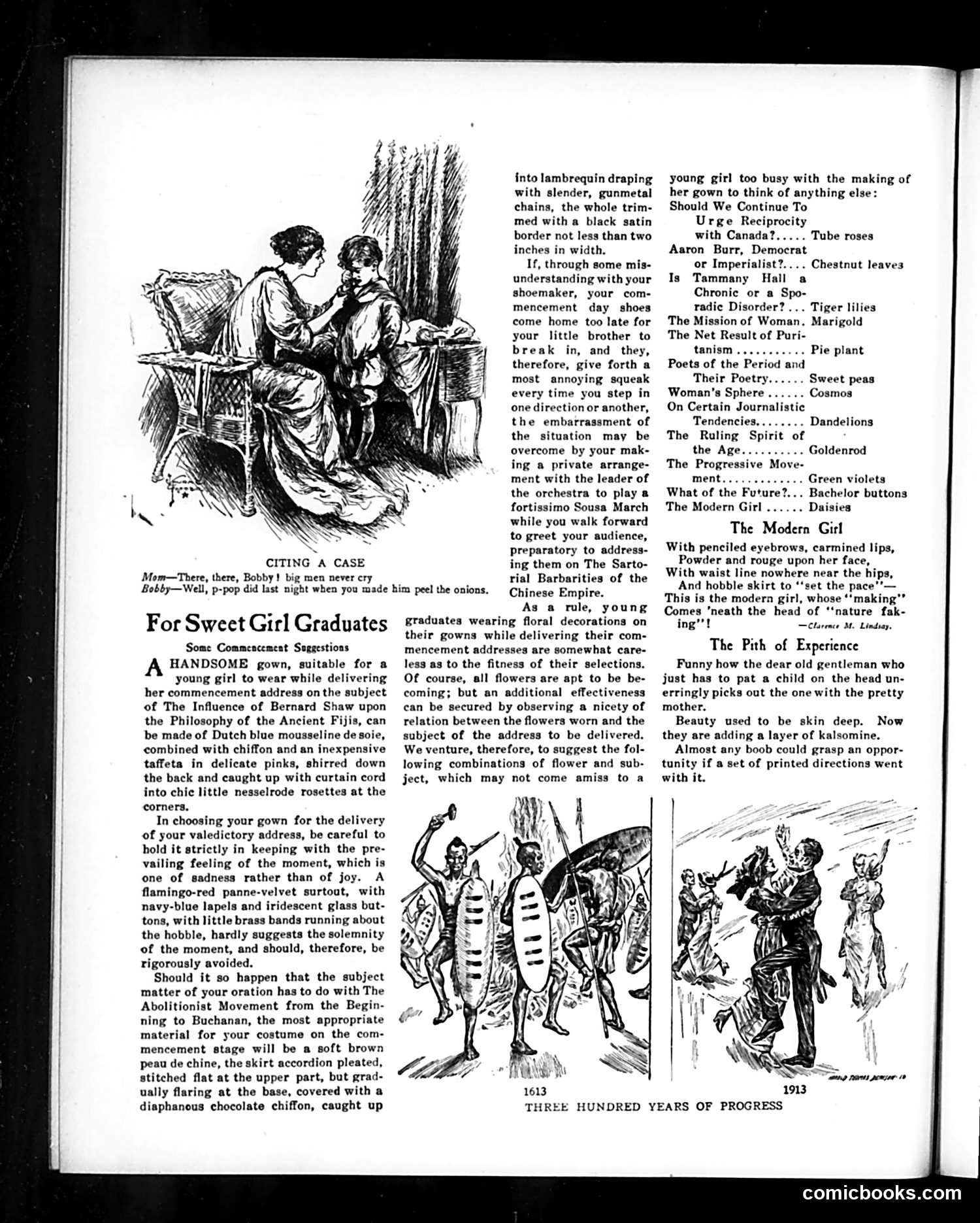
**Main Content:** This page satirizes commencement speaker fashion and contemporary women's behavior through mock-earnest advice. **The Satire:** The piece ridicules young women graduates by offering elaborate, absurdly overwrought dress recommendations for delivering commencement addresses on serious topics (Bernard Shaw's influence, the Abolitionist Movement, etc.). The humor lies in treating trivial fashion details with mock-scholarly gravity while the actual substance of their speeches appears irrelevant. **Social Critique:** The "Modern Girl" section at bottom mocks the "New Woman" of the 1910s era—specifically her cosmetics, fashion (penciled eyebrows, rouge, the hobble skirt), and divergence from traditional appearance. The phrase "nature faking" sarcastically suggests women's self-presentation is artificial/fraudulent. **Context:** This reflects early 20th-century anxieties about changing women's roles, increased female education (commencement addresses), and evolving beauty standards and fashion. The tone is dismissive toward women's intellectual pretensions and their modernizing appearance.
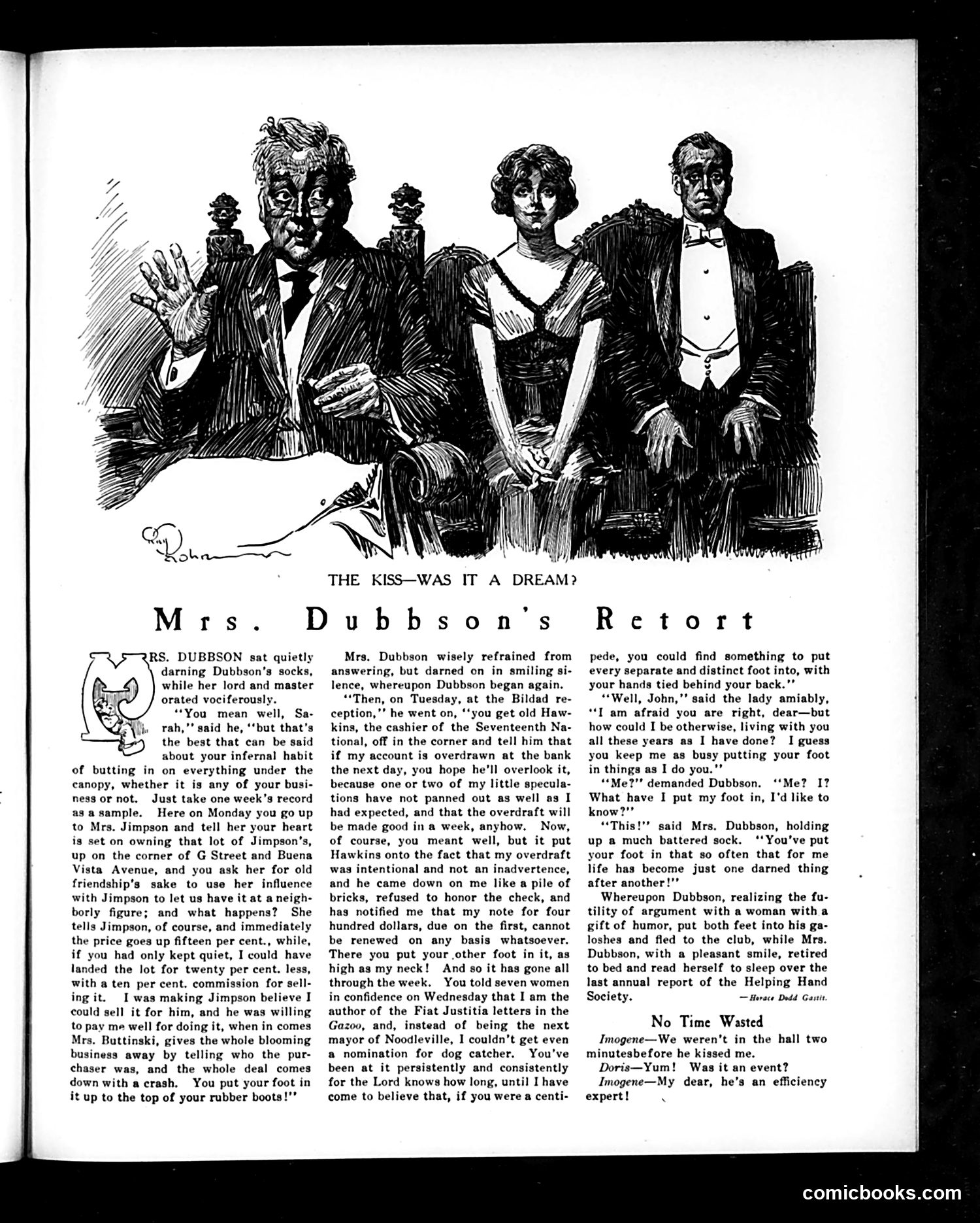
This is a domestic humor piece satirizing marital dynamics. Mr. Dubbson complains that his wife constantly meddles in his business affairs, ruining deals through indiscreet interference—she's disclosed his real estate interest to the Jimpsons, revealed his bank overdraft to a cashier, and exposed his authorship of political letters meant to help his mayoral ambitions. The satire mocks both parties: Dubbson's self-serving schemes (the bank overdraft, ghostwriting for political gain) while his wife undermines them through well-meaning gossip. Mrs. Dubbson's devastating retort—that she's merely keeping busy darning his socks, which he constantly "puts his foot in"—turns the tables through wordplay, suggesting his own mistakes are the real problem, not her meddling. Dubbson retreats to his club, defeated by her wit. The piece humorously explores how a clever wife can win arguments through humor rather than confrontation.
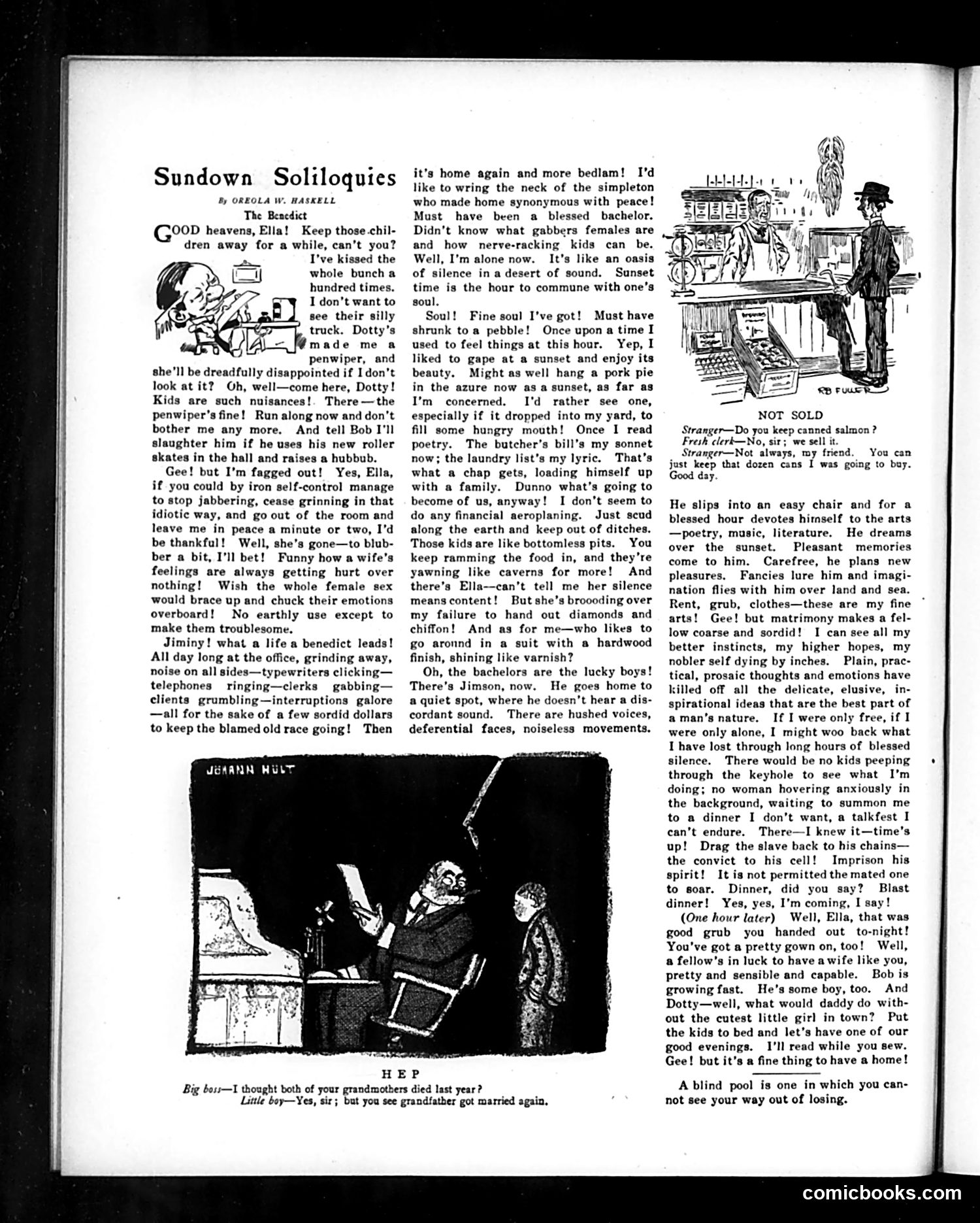
This is a satirical monologue by a married man ("The Benedict"—a husband) complaining about domesticity. The piece mocks his self-pitying hypocrisy: he resents his children's affection, his wife's presence, and family expenses, yet envies his bachelor friend Jimson's peaceful evenings devoted to art and contemplation. The satire targets the narrator's shallow ingratitude. He claims marriage has killed his soul and "nobler instincts," yet his actual concerns are trivial—a child's homemade penwiper, laundry bills, food costs. He romanticizes bachelorhood while overlooking that Jimson's "hushed voices" and "deferential faces" suggest servants, not freedom. The side comics (credited to Johann Hult) provide lighter relief: one jokes about a grandfather remarrying after both grandmothers died; another mocks a customer's picky demands about canned salmon. The overall message: Judge criticizes men who blame wives and children for their lost idealism, suggesting their discontent reflects spiritual emptiness rather than genuine hardship.
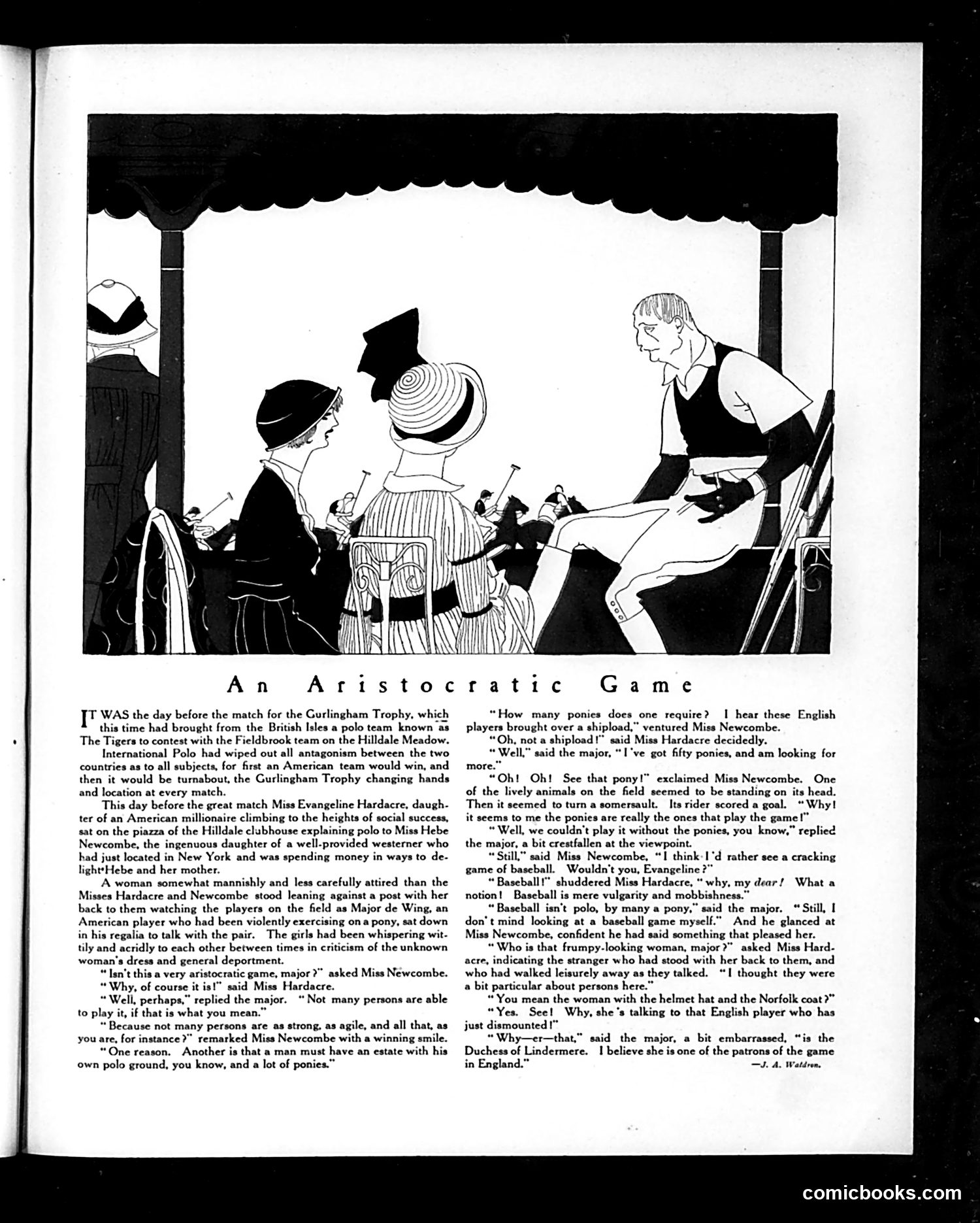
This page satirizes American social climbing and pretension around polo in the early 20th century. Two wealthy American women—Miss Hardacre (daughter of a "millionaire climbing to heights of social success") and Miss Newcombe—discuss polo's exclusivity with Major de Wing, emphasizing its requirement for estates and fifty ponies. The joke targets their snobbery: they dismiss baseball as "mere vulgarity and mobbishness" while celebrating polo's aristocratic status. The punchline mocks their pretensions when they sneer at an unfashionably dressed woman watching from the sidelines, only to learn she's the "Duchess of Lindermere"—an actual British aristocrat patronizing the sport. The satire suggests that American wealth cannot automatically purchase genuine social standing, and that judging people by appearance rather than actual status is foolish.
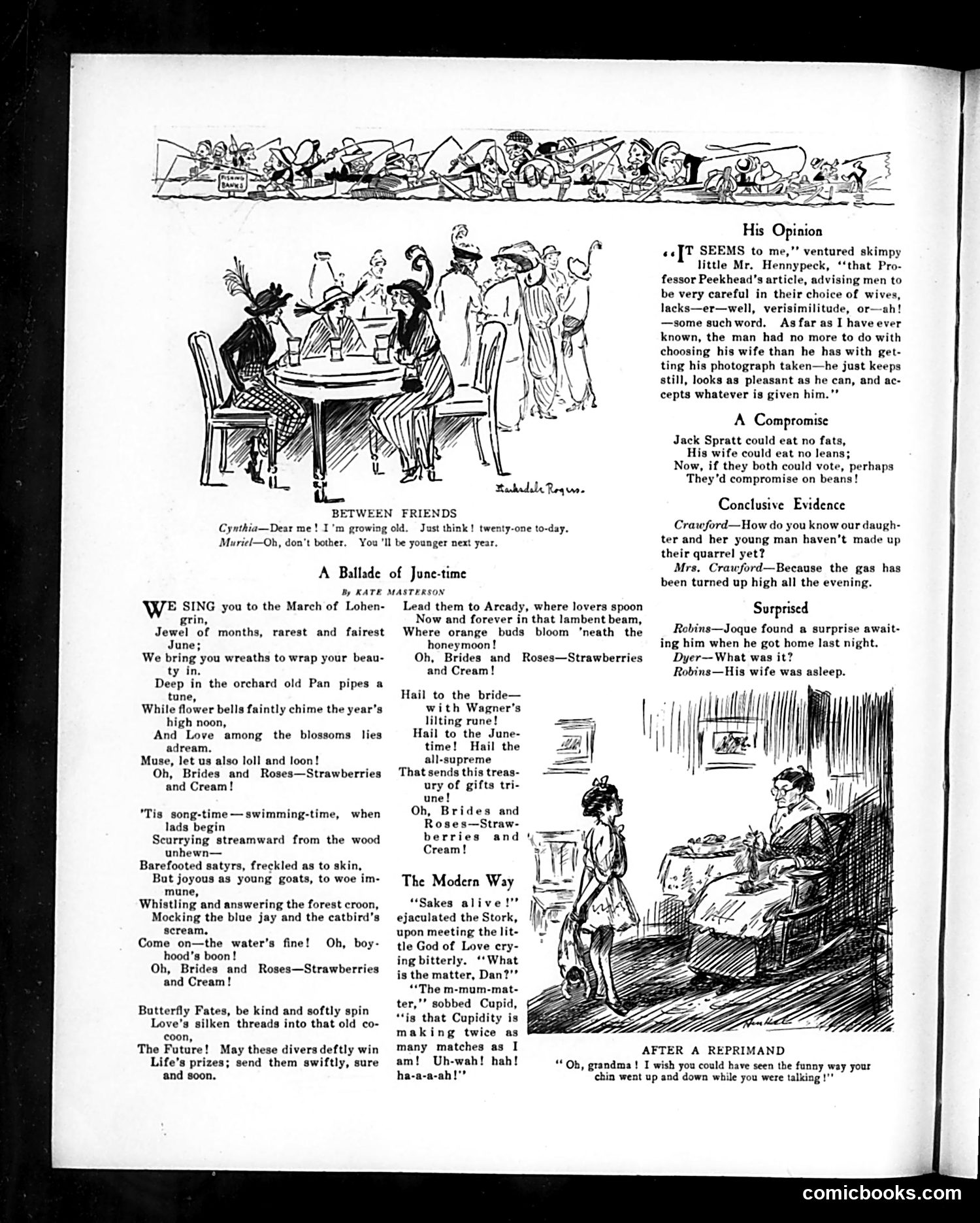
This page from *Judge* magazine contains several short humorous pieces reflecting early 20th-century domestic life and gender politics: **"Between Friends"** jokes about aging—a woman turning 21 claims she's "growing old," her friend reassures her she'll be "younger next year," a paradoxical quip about women's anxiety over appearance. **"A Ballad of June-time"** is sentimental poetry celebrating June weddings, romance, and idealized domesticity—typical period sentimentality. **"The Modern Way"** satirizes commercialism overtaking romance: Cupid (god of love) weeps because "Cupidity" (greed/materialism) is making twice as many matches, suggesting marriages are increasingly driven by money rather than emotion. **"A Compromise"** applies the Jack Spratt nursery rhyme to voting rights—if a couple compromises on food, perhaps they could compromise politically. This likely references women's suffrage debates of the era. **Minor jokes** mock henpecked husbands and marital indifference, standard early 1900s humor stereotypes. The overall tone reflects anxieties about modernization, commercialism, and changing gender roles.
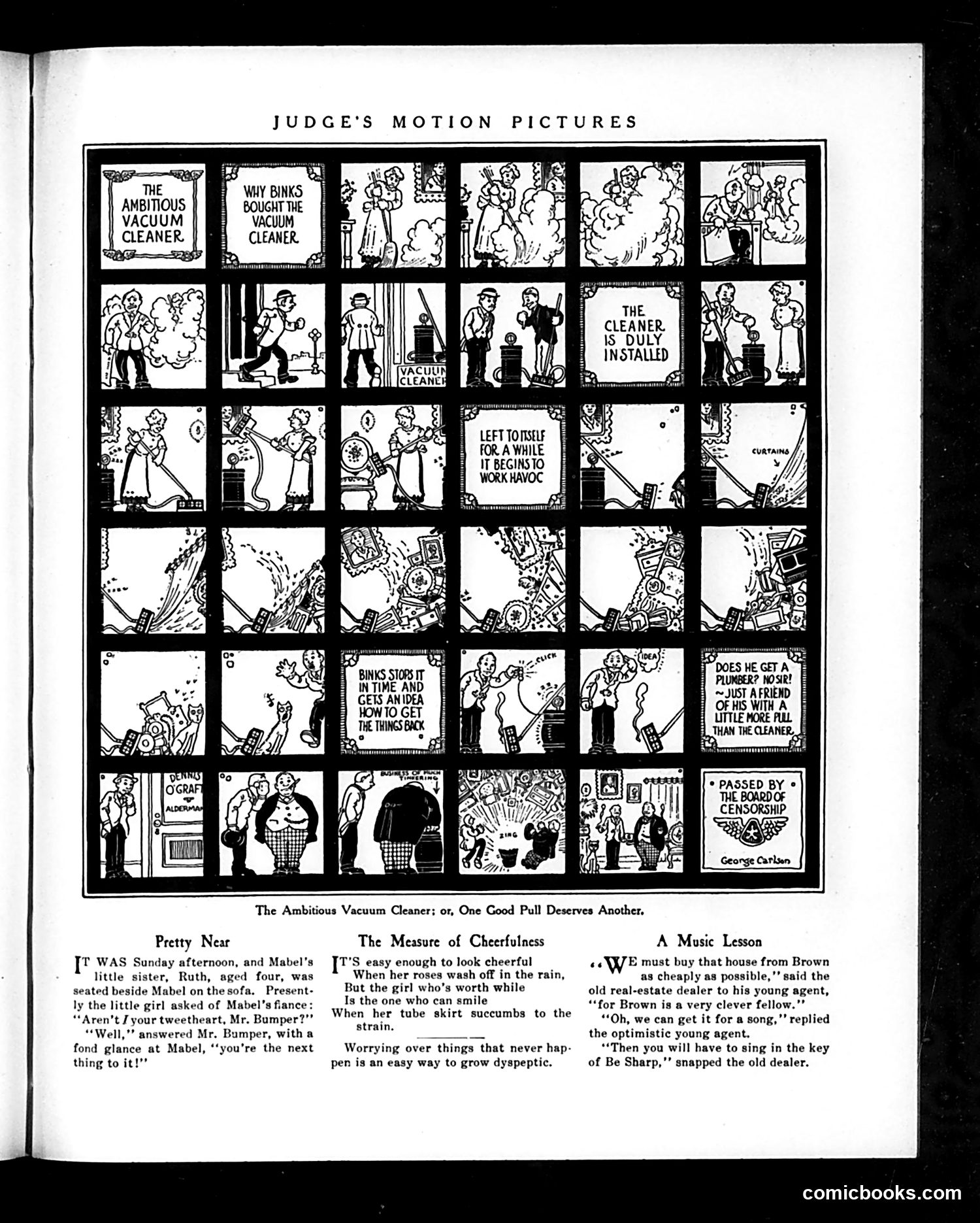
This is a comic strip satirizing the then-newfangled **vacuum cleaner** as an unreliable household appliance. The narrative shows Mr. Binks purchasing a vacuum cleaner, which subsequently causes domestic chaos when left unattended—the machine apparently creates destruction around the home. A friend must physically pull harder on the device to stop it, playing on the double meaning of "pull" (to operate/stop the machine). The satire targets early 20th-century consumer enthusiasm for modern technology that often failed to deliver as promised. The three accompanying short humorous pieces use wordplay: one about romantic commitment, one about stoicism during fashion mishaps (note the "tube skirt" reference—a contemporary silhouette), and one using musical puns in a real-estate negotiation. The "Passed by the Board of Censorship" credit suggests Judge was proud the comic survived review—likely ironic commentary on censorship itself.
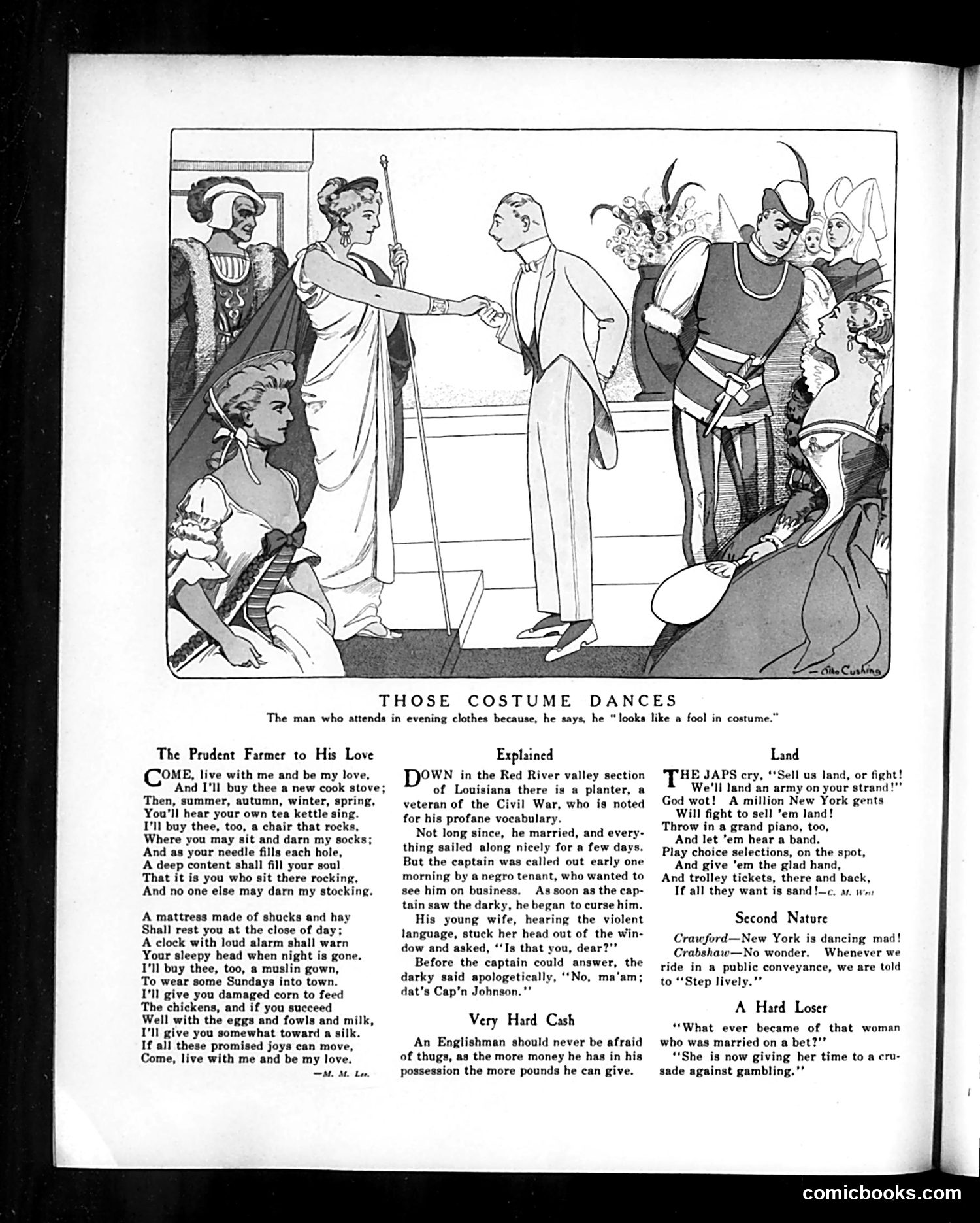
The top cartoon satirizes men who attend costume balls in regular evening clothes, claiming costumes make them look foolish—thereby missing the point of the event entirely. Below are several humorous pieces: **"The Prudent Farmer"** mocks rustic suitors by presenting an ungainly marriage proposal emphasizing domestic drudgery (cooking stoves, darning socks, damaged corn) rather than romance—a parody of courtly love poetry. **"Explained"** jokes about a Louisiana planter and Civil War veteran so profane that his new wife mistakes his cursing at a Black tenant for marital discord; the tenant politely clarifies it's just the captain's natural speech. **"Land"** appears to satirize Japanese territorial ambitions (likely early 1900s), suggesting Americans would eagerly sell land to Japan rather than fight—mocking American commercialism and cowardice. The remaining pieces are brief satirical vignettes on urban life, gambling, and social behavior, typical of Judge's light humor.
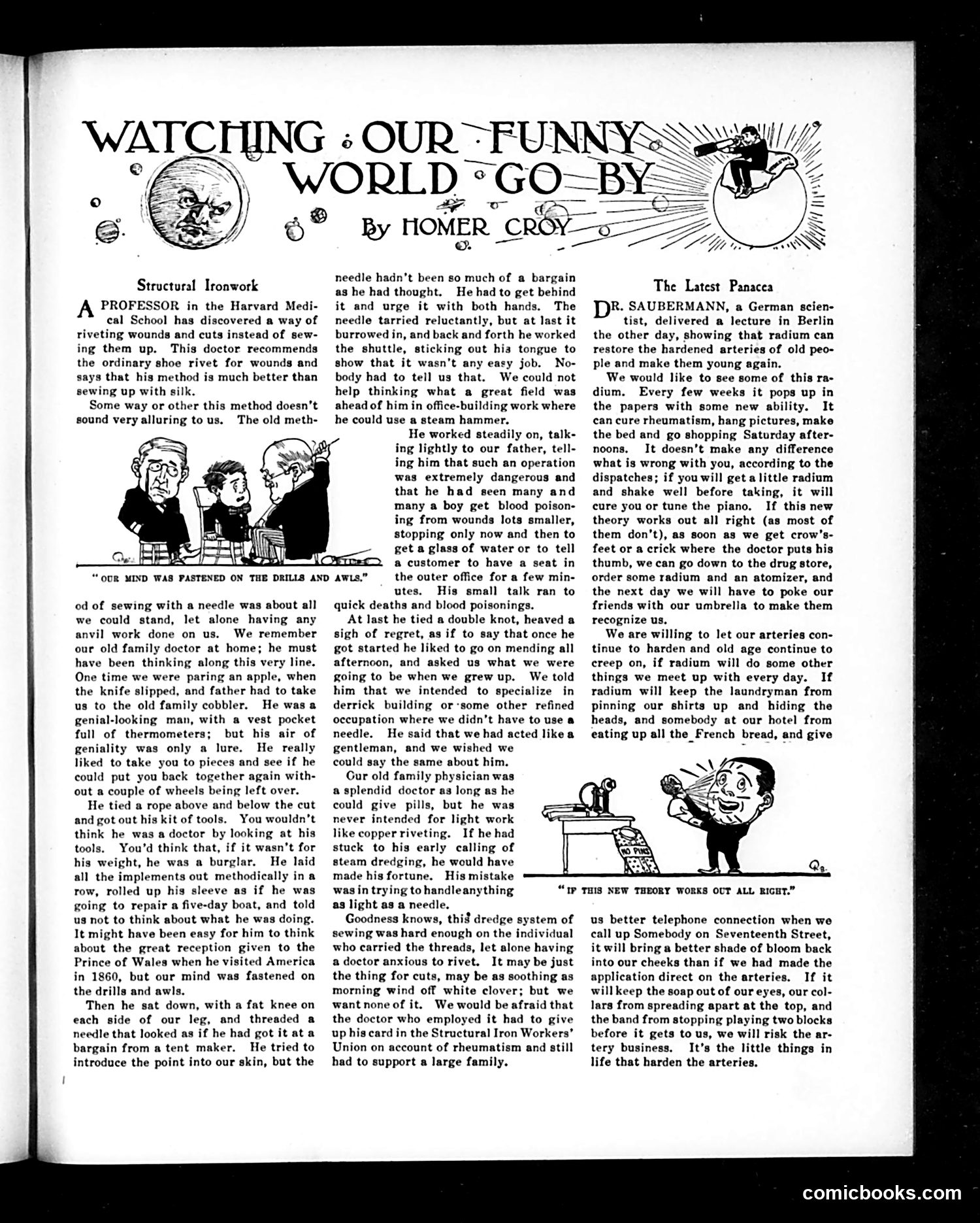
This humoristic essay by Homer Croy satirizes a Harvard Medical School professor's proposal to rivet wounds shut instead of sewing them—a genuinely proposed medical innovation from the early 20th century. The satire operates through extended analogy: the author compares wound treatment to manual labor, suggesting the rivet method is grotesquely inappropriate. The central joke contrasts a childhood visit to a cobbler (misidentified as a doctor) who treated the author's apple-knife wound like carpentry work—using tools, rope restraints, and heavy-handed techniques—with modern medical pretensions. The cartoon panels show this cobbler-as-doctor using actual construction equipment (drills, awls) on the child's leg, with the caption "Our mind was fastened on the drills and awls." This visualizes the author's critique: applying industrial riveting technology to delicate medical work is absurdly inappropriate, mixing manual trades with medical practice. The piece gently mocks both the medical profession's eagerness to adopt new technology and period anxieties about "light work" versus proper trades.
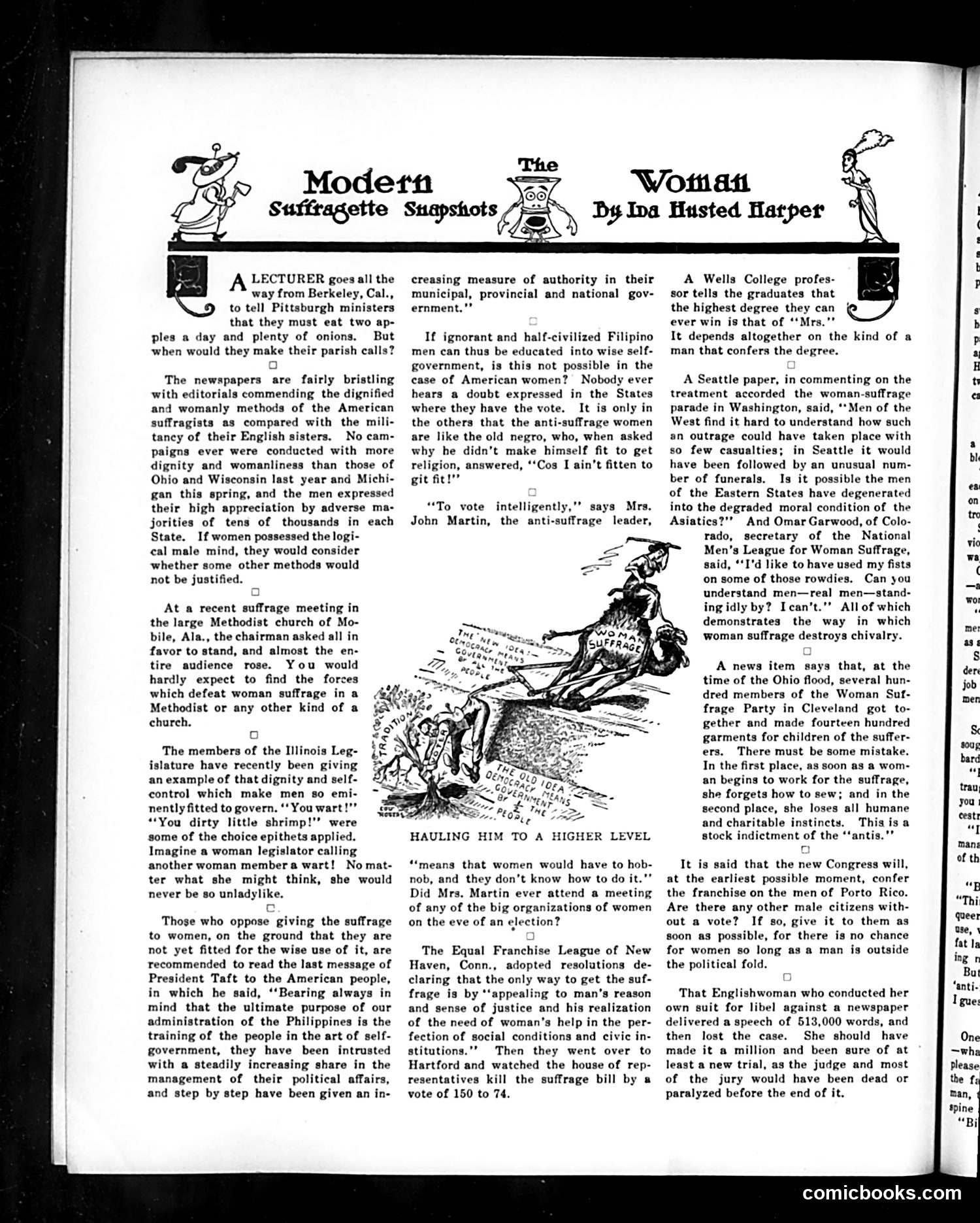
This anti-suffrage article uses sarcasm to mock women's suffrage advocates. The central cartoon depicts a woman being "hauled to a higher level"—likely representing the patronizing male view of women needing male guidance. The text employs ironic arguments against suffrage: it praises American suffragists' "dignity" while noting they lost decisively in Ohio, Michigan, and Wisconsin, suggesting peaceful methods don't work. It sarcastically compares Filipino men—described as "ignorant and half-civilized"—being trusted with government to American women being denied the vote. It ridicules anti-suffrage women like "Mrs. John Martin" for claiming women lack the sophistication to vote, yet acknowledges their effective political organizing. The piece also contrasts women's supposed unfitness to govern with male legislators' vulgarity ("You dirty little shrimp!"), exposing the hypocrisy of denying capable women voting rights. The satire undercuts its own anti-suffrage position, inadvertently supporting women's enfranchisement through logical absurdity.
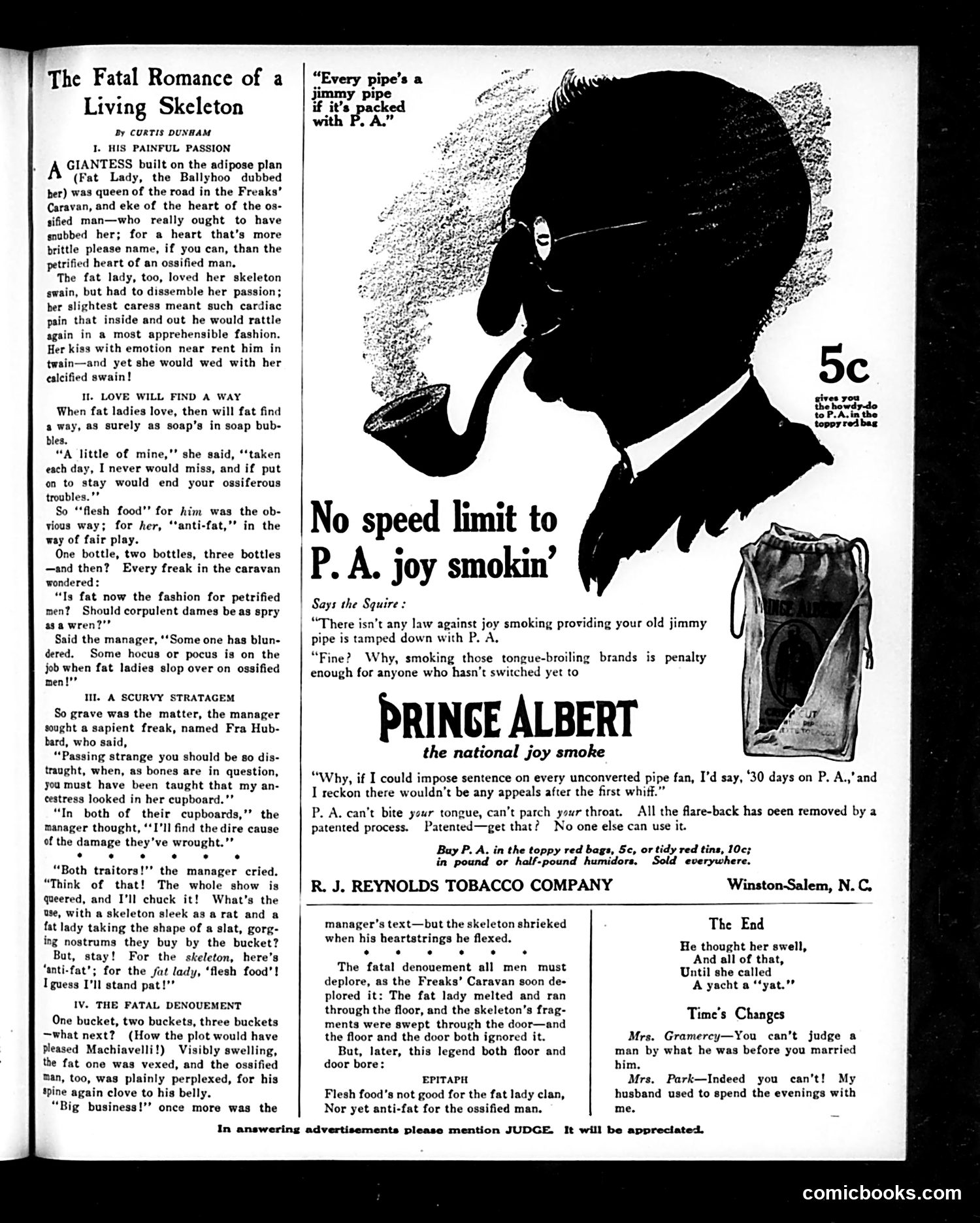
This page satirizes carnival freaks and "self-improvement" products. The main story concerns a skeletal man and obese "Fat Lady" from a traveling freak show who fall in love. When the manager discovers they're secretly consuming opposite remedies—she takes "anti-fat" pills while he eats "flesh food"—disaster ensues: she melts through the floor while his bones fall apart. The satire targets two things: the absurdity of carnival attractions that exploit human bodies, and the era's obsession with patent medicines and diet products promising bodily transformation. The tragic ending—both lovers literally dissolving—mocks the false promises of these remedies. The *Prince Albert* tobacco advertisement alongside reinforces the period's broader faith in commercial products as solutions to personal problems, though satirized here as dangerous and ridiculous.
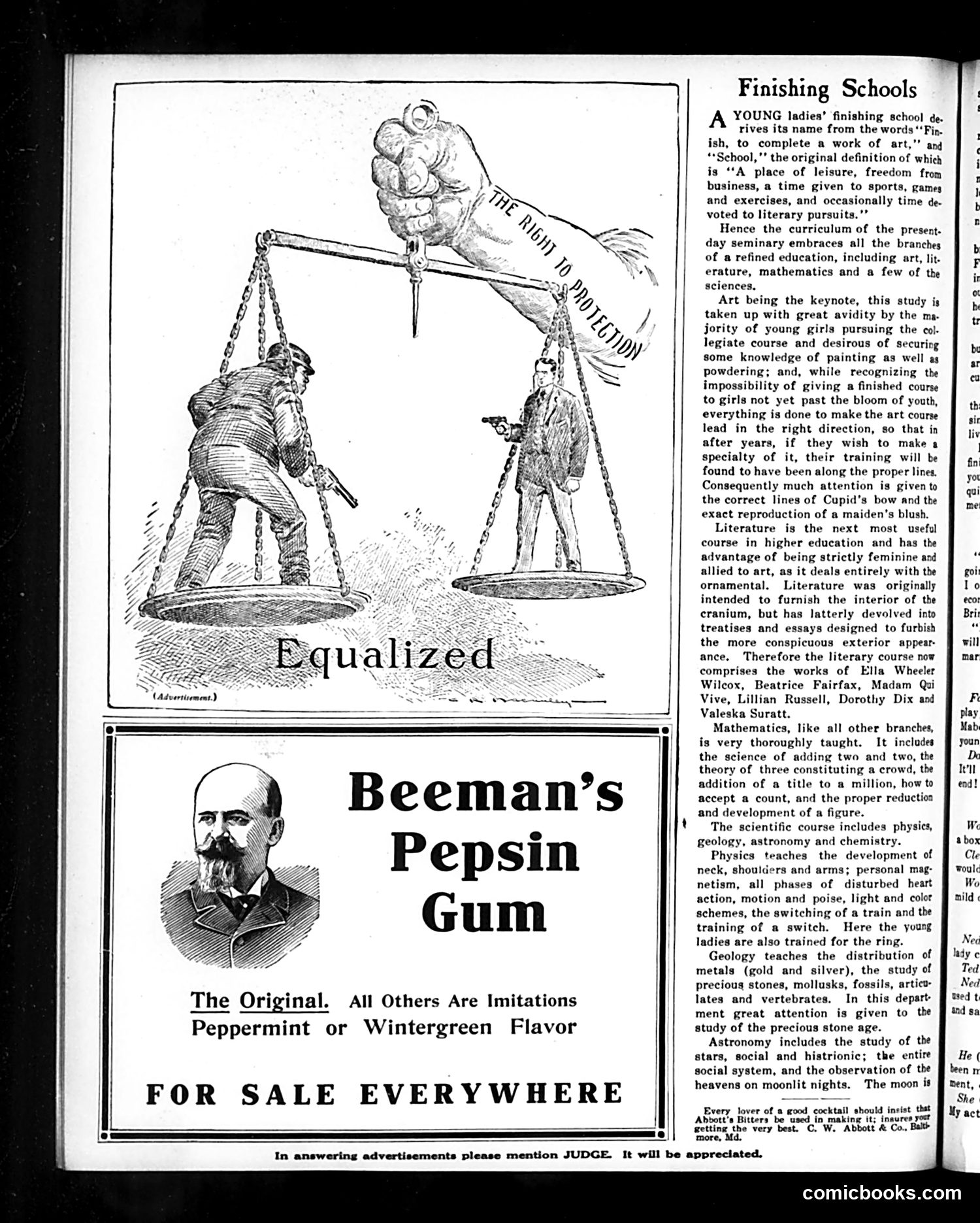
The top cartoon satirizes women's education at "finishing schools"—institutions designed to polish young ladies for marriage rather than genuine learning. The image shows a scale being manipulated by a hand labeled "THE RIGHT TO EDUCATE," with unequal weights (representing students or their education) being artificially balanced. The title "Equalized" mocks the pretense that these schools provide equal or meaningful education. The accompanying text elaborates the satire, describing curricula focused on superficial accomplishments: drawing "Cupid's bow" lips and maiden's blushes instead of real art; reading popular female columnists instead of literature; mathematics reduced to simple addition. "Physics" means developing "neck, shoulders and arms"; geology involves studying jewelry. The satire suggests finishing schools don't truly educate girls but merely prepare them as ornamental marriage prospects, all while claiming educational legitimacy.
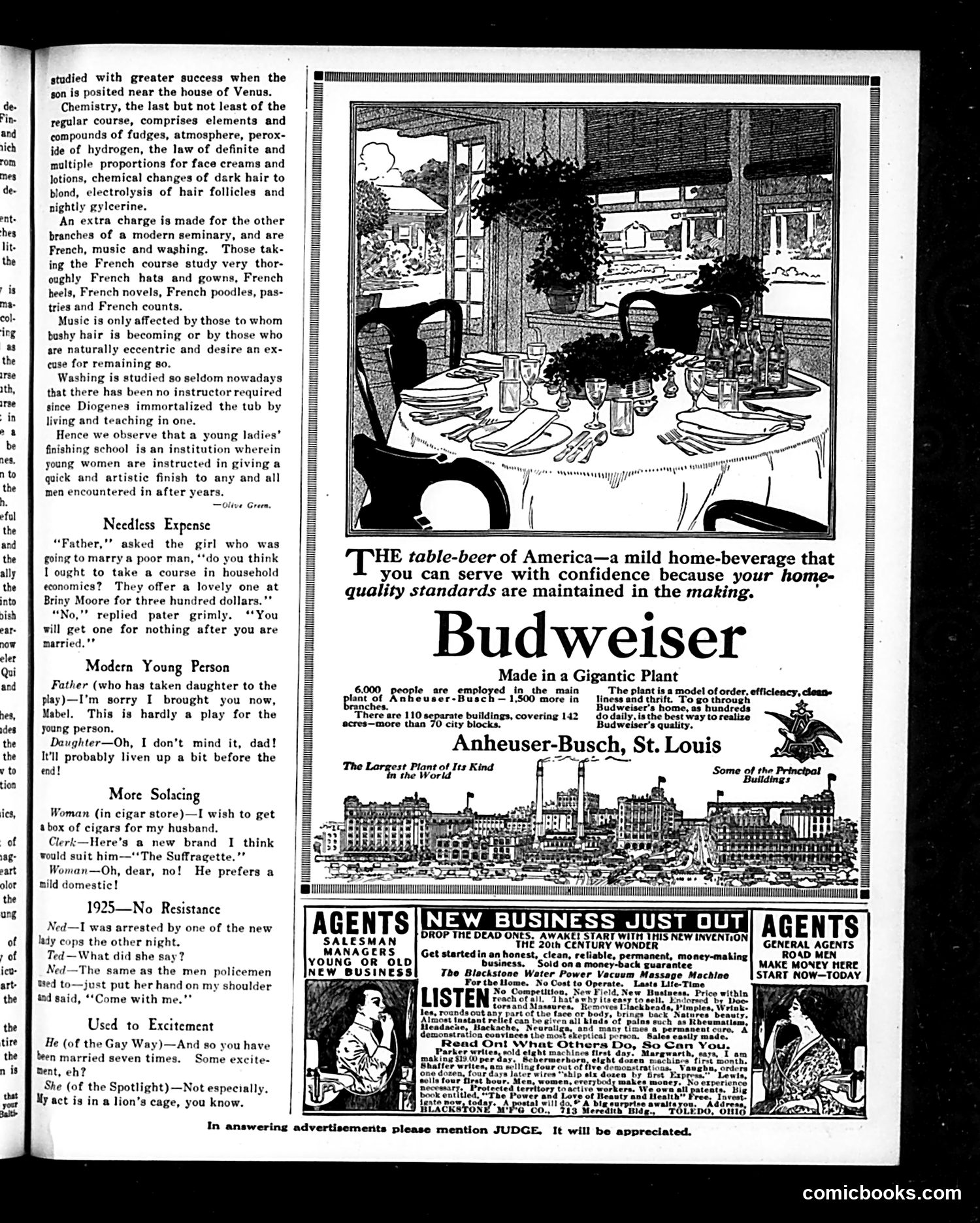
This page contains satirical humor sections and advertisements typical of 1920s Judge magazine. **The Cartoons/Humor Sections:** The text includes several brief jokes mocking contemporary social conventions: a father dismissing the need for his daughter to study "household economics" before marrying a poor man; gentle mockery of young women's finishing schools as places where girls learn to "finish" men they encounter; and jokes about gender dynamics (a female police officer, marital difficulties). **Main Advertisement:** The dominant feature is a large Budweiser beer advertisement showing a formal dining scene. It emphasizes Budweiser as "the table-beer of America—a mild home-beverage" made in a "gigantic plant" by Anheuser-Busch in St. Louis. The ad stresses quality control and manufacturing scale. **Context:** This predates Prohibition's repeal (1933), so advertising beer was legally permissible. The ad's emphasis on "mild" and "home-beverage" suggests an attempt to position beer as respectable domestic consumption rather than saloon culture. The page also advertises business opportunities—salesmen agents wanted for various ventures, typical of 1920s advertising.
This page is primarily **advertising with some humor content** interspersed. The ads promote alcohol (Chartreuse cordial, Hunter Baltimore Rye whiskey), a collapsible silk hat, a hotel, and cocktail varieties—typical of Judge magazine's commercial content. The right column contains college humor jokes under "With The College Wits," attributing quips to various universities (Yale, Cornell, Stanford, etc.). These are mild, dating-appropriate jokes about courtship, studying, and student life—nothing requiring historical context to understand. The satirical or political content is **minimal on this page**. No identifiable caricatures or political figures appear. The humor is generic collegiate comedy reflecting 1920s social attitudes (young women, romance, academic life). The page's main interest today is **historical**: it documents early 20th-century advertising practices, drinking culture during Prohibition's era, and college publication humor conventions—but contains no specific satire or political commentary requiring explanation.
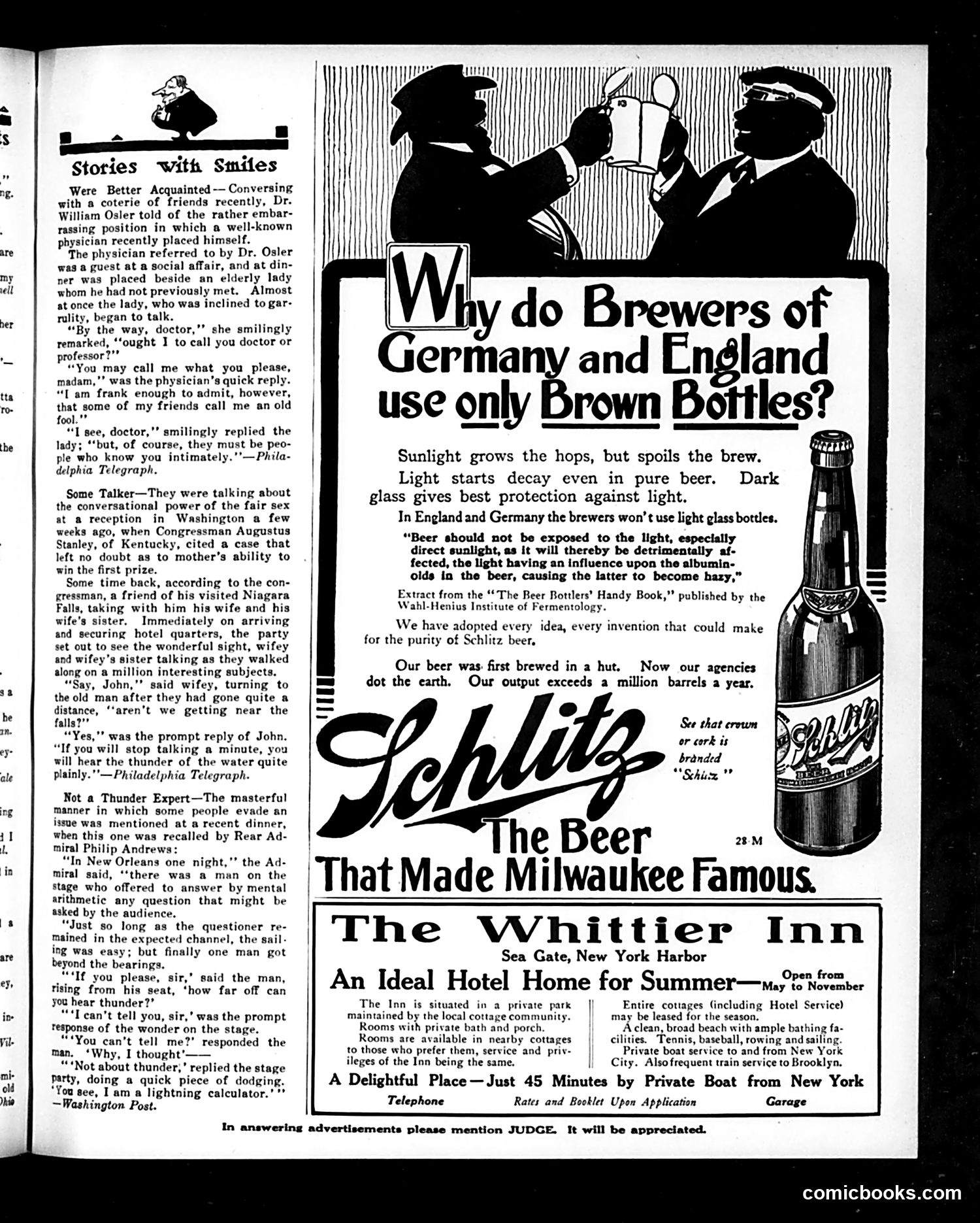
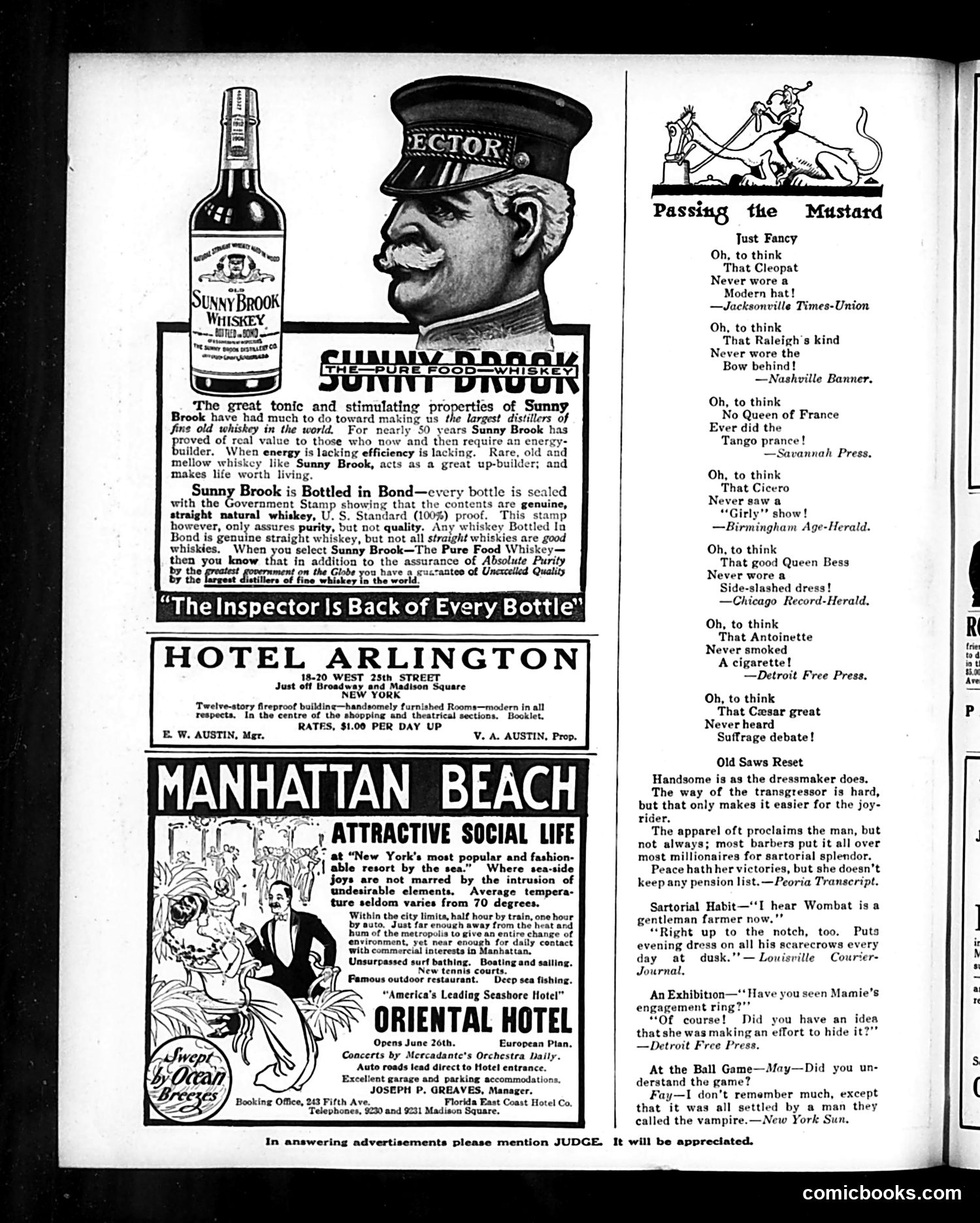
This page is primarily **advertisements** interspersed with light satirical content, typical of Judge's format. The main visual is a **whiskey advertisement** featuring a mustachioed "Inspector" character (appears to be a customs/government official based on his cap), promoting Sunny Brook whiskey as "The Pure Food Whiskey" with government quality assurance. The right column contains **"Passing the Mustard,"** a humor section mocking outdated historical figures. The satire contrasts famous historical women (Cleopat, Raleigh, Marie Antoinette, Queen Bess) with modern fashion and behavior—suggesting these women "never" wore modern hats, smoked cigarettes, or witnessed suffrage debates. This gently mocks both the novelty of women's changing roles and modern women's adoption of previously "unladylike" behaviors. Additional filler includes hotel advertisements and miscellaneous jokes about fashion, dressmakers, and baseball games. The page reflects early 20th-century attitudes toward women's modernization and changing social norms.
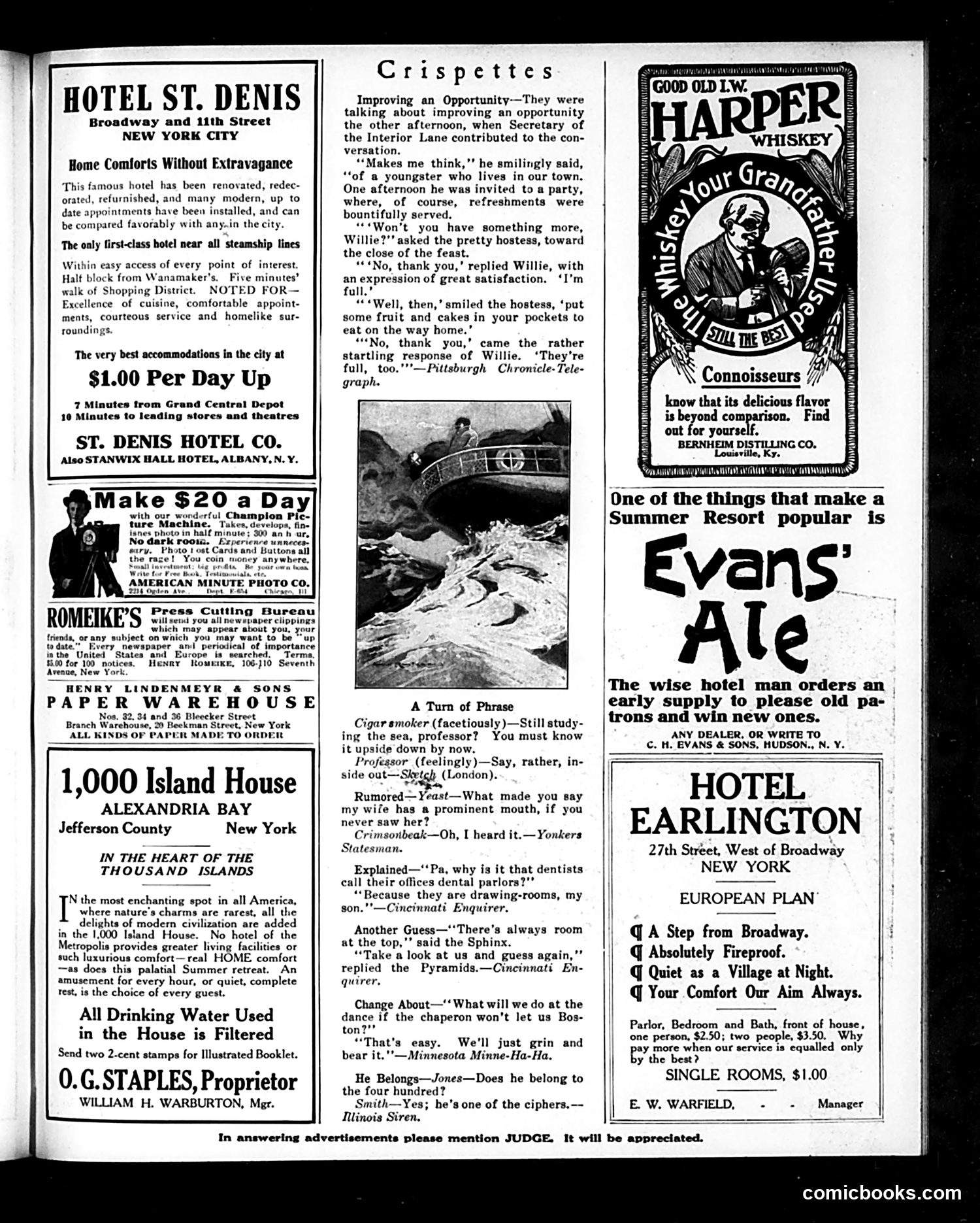
This page is primarily **advertising**, featuring hotel and business promotions from early 20th-century New York City. The small illustrations and jokes are filler material typical of magazines from this era. The central image shows a man in a boat on a river—likely illustrating the "1,000 Island House" resort advertisement below it, promoting a vacation destination in upstate New York's scenic Thousand Islands region. The "Crispettes" section contains period humor: a joke by Interior Secretary Lane about a boy at a party whose pockets are already full of food. The other jokes are mild wordplay—a professor tired of studying the sea, jokes about dentists' "parlors," and a quip about "the four hundred" (the wealthy New York social elite) where someone is "one of the ciphers" (a nobody pretending to belong). These jokes reflect early-20th-century sensibilities about manners, social class, and mild domestic situations. The satirical content is minimal; this is primarily a commercial publication.
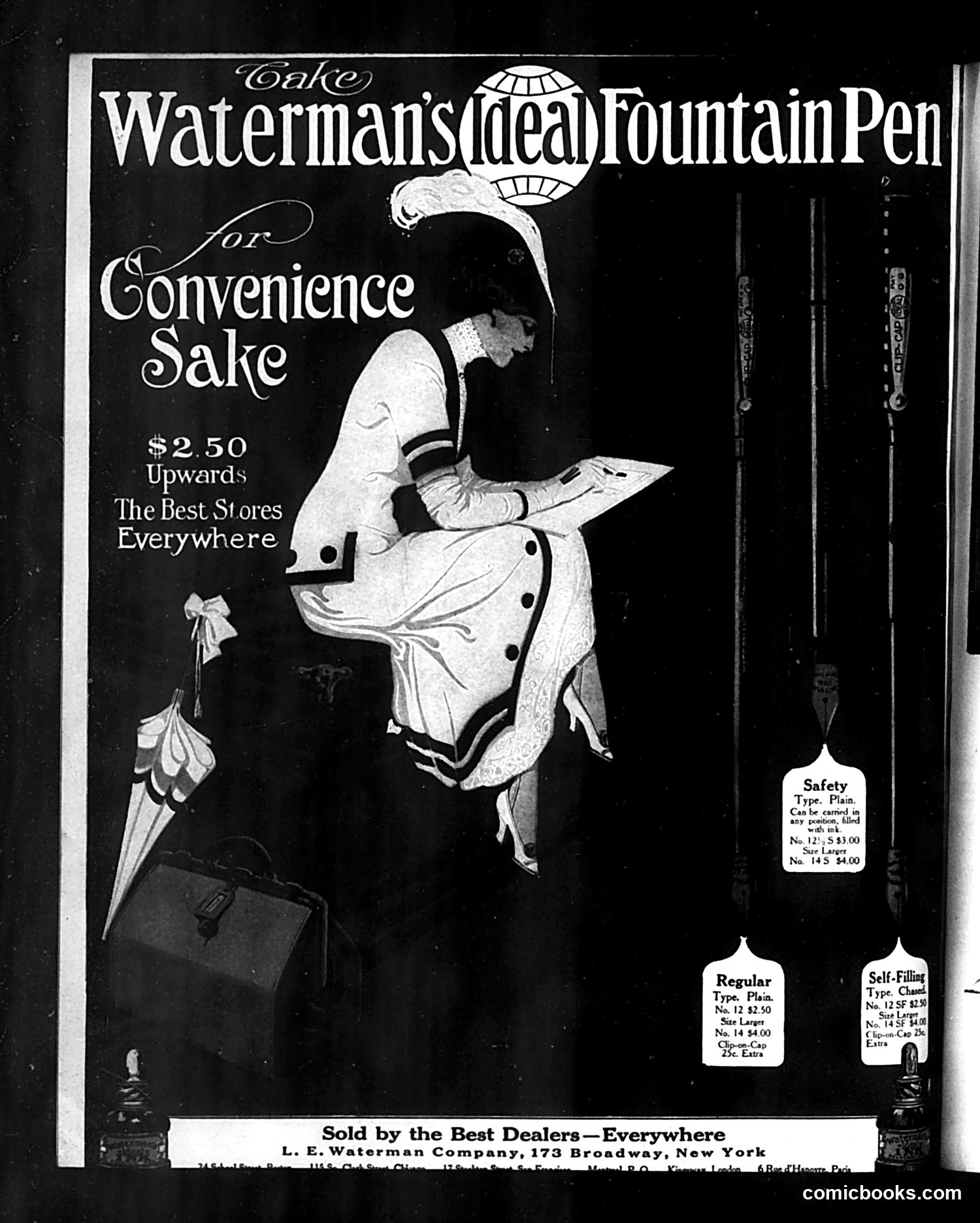
This page is primarily a **product advertisement**, not political satire. It advertises Waterman's Ideal Fountain Pen, positioned as convenient and affordable (starting at $2.50). The illustration shows a stylishly dressed woman in early 20th-century attire writing or taking notes—depicting the pen as a practical tool for modern, convenience-minded consumers. The three product variants shown (Safety Type, Regular Type, and Self-Filling Type) emphasize practical innovation. The "for Convenience Sake" tagline appeals to efficiency-conscious buyers. The elegant Art Deco design and fashionable female figure suggest aspirational consumer culture rather than social commentary. This represents typical Judge magazine advertising content alongside satirical cartoons—commercial material marketed to the magazine's educated, affluent readership.