
Judge, 1913-06-14 · page 11 of 24
Judge — June 14, 1913 — page 11: what you’re looking at
What you’re looking at
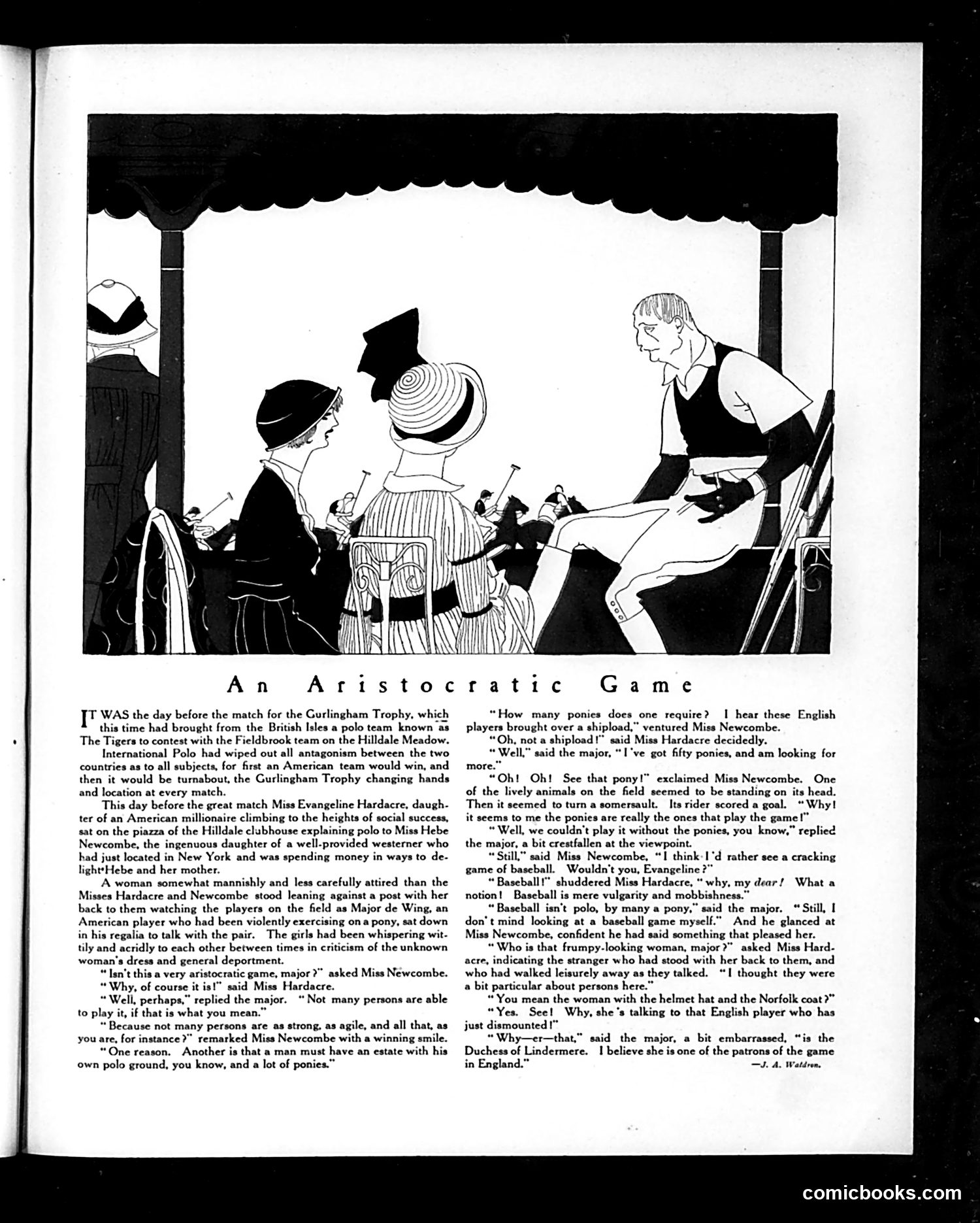
This page satirizes American social climbing and pretension around polo in the early 20th century. Two wealthy American women—Miss Hardacre (daughter of a "millionaire climbing to heights of social success") and Miss Newcombe—discuss polo's exclusivity with Major de Wing, emphasizing its requirement for estates and fifty ponies. The joke targets their snobbery: they dismiss baseball as "mere vulgarity and mobbishness" while celebrating polo's aristocratic status. The punchline mocks their pretensions when they sneer at an unfashionably dressed woman watching from the sidelines, only to learn she's the "Duchess of Lindermere"—an actual British aristocrat patronizing the sport. The satire suggests that American wealth cannot automatically purchase genuine social standing, and that judging people by appearance rather than actual status is foolish.
📄 Transcribed text from this page (OCR, searchable)
Machine-transcribed from the original scan — historical spelling and the odd misread are preserved.
An [7 WAS the day before the match for the Gurlingham Trophy, which this time had brought from the British Isles a polo team known as The Tigers to contest with the Fieldbrook team on the Hilldale Meadow. International Polo had wiped out all antagonism between the two countries as to all subjects, for first an American team would win, and then it would be turnabout, the Gurlingham Trophy changing hands and location at every match. This day before the great match Miss Evangeline Hardacre, daugh- ter of an American millionaire climbing to the heights of social success, sat on the piazza of the Hilldale clubhouse explaining polo to Miss Hebe Newcombe, the ingenuous daughter of a well-provided westerner who had just located in New York and was spending money in ways to de- light"Hebe and her mother. ‘A woman somewhat mannishly and less carefully attired than the Misses Hardacre and Newcombe stood leaning against a post with her back to them watching the players on the field as Major de Wing, an American player who had been violently exercising on a pony, sat down in his regalia to talk with the pair. The girls had been whispering wit- tily and acridly to each other between times in criticism of the unknown woman's dress and general deportment. “ Isn‘t this a very aristocratic game, major ?” asked Miss Newcombe. “Why, of course it is!” said Miss Hardacre. “Well. perhaps,” replied the major. “Not many persons are able to play it, if that is what you mean. “Because not many persons are as strong, as agile, and all that, as you are, for instance?” remarked Miss Newcombe with a winning smile. “One reason. Another is that a man must have an estate with his own polo ground, you know, and a lot of ponies.” Aristocratic Game “How many ponies does one require? I hear these English players brought over a shipload,” ventured Miss Newcombe. “Oh, not a shipload!” said Miss Hardacre decidedly. “Well,” said the major, “I've got fifty ponies, and am looking for more. “Oh! Oh! See that pony!” exclaimed Miss Newcombe. One of the lively animals on the field seemed to be standing on its head. Then it seemed to turn a somersault. Its rider scored a goal. “Why! it seems to me the ponies are really the ones that play the game!” “Well, we couldn't play it without the ponies, you know,” replied the major, a bit crestfallen at the viewpoint. “Still,” said Miss Newcombe, “I think-I'd rather see a cracking game of baseball. Wouldn't you, Evangeline?” “Baseball!” shuddered Miss Hardacre, “ why, my dear! What a notion! Baseball is mere vulgarity and mobbishness.”” “Baseball isn’t polo, by many a pony,” said the major. “Still, | don't mind looking at a baseball game myself.” And he glanced at Miss Newcombe, confident he had said something that pleased her. Who is that frumpy-looking woman, major?” asked Miss Hard- dicating the stranger who had stood with her back to them, and “I thought they were acre, who had walked leisurely away as they talked. a bit particular about persons here.” “You mean the woman with the helmet hat and the Norfolk coat ?” “Yes. See! Why, she’s talking to that English player who has just dismounted I” “ Why—er—that,” said the major, a bit embarrassed, “is the Duchess of Lindermere. I believe she is one of the patrons of the game in England.” J. A, Watdren. comicbooks.com