
Judge, 1913-06-14 · page 15 of 24
Judge — June 14, 1913 — page 15: what you’re looking at
What you’re looking at
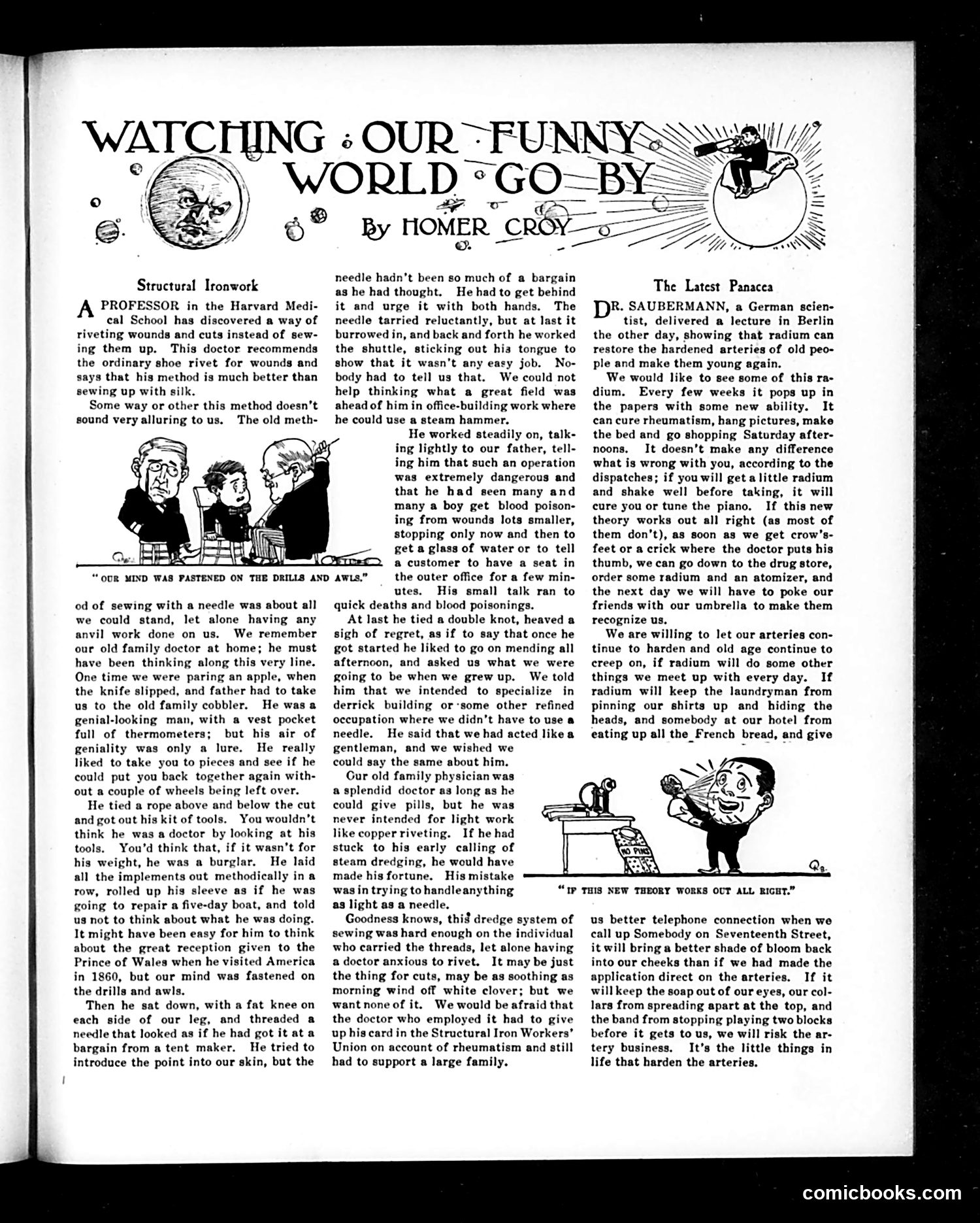
This humoristic essay by Homer Croy satirizes a Harvard Medical School professor's proposal to rivet wounds shut instead of sewing them—a genuinely proposed medical innovation from the early 20th century. The satire operates through extended analogy: the author compares wound treatment to manual labor, suggesting the rivet method is grotesquely inappropriate. The central joke contrasts a childhood visit to a cobbler (misidentified as a doctor) who treated the author's apple-knife wound like carpentry work—using tools, rope restraints, and heavy-handed techniques—with modern medical pretensions. The cartoon panels show this cobbler-as-doctor using actual construction equipment (drills, awls) on the child's leg, with the caption "Our mind was fastened on the drills and awls." This visualizes the author's critique: applying industrial riveting technology to delicate medical work is absurdly inappropriate, mixing manual trades with medical practice. The piece gently mocks both the medical profession's eagerness to adopt new technology and period anxieties about "light work" versus proper trades.
📄 Transcribed text from this page (OCR, searchable)
Machine-transcribed from the original scan — historical spelling and the odd misread are preserved.
WATCHING : OUR=FUN \; WORLD =GO-BY Structural Ironwork A PROFESSOR in the Harvard Medi- cal School has discovered a way of riveting wounds and cuts instead of sew- ing them up. This doctor recommends the ordinary shoe rivet for wounds and says that his method is much better than sewing up with silk. Some way or other this method doesn’t sound very alluring to us. The old meth- “OUR MIND WAS PASTENED ON THE DRILLS AND AWLS,” od of sewing with a needle was about all we could stand, let alone having any anvil work done on us. We remember our old family doctor at home; he must have been thinking along this very line. One time we were paring an apple, when the knife slipped, and father had to take us to the old family cobbler. He was a genial-looking man, with a vest pocket full of thermometers; but his air of geniality was only a lure. He really liked to take you to pieces and see if he could put you back together again with- out a couple of wheels being left over. He tied a rope above and below the cut and got out his kit of tools. You wouldn’t think he was a doctor by looking at his tools. You'd think that, if it wasn’t for his weight, he was a burglar. He laid all the implements out methodically in a row, rolled up his sleeve as if he was going to repair a five-day boat, and told us not to think about what he was doing. It might have been easy for him to think about the great reception given to the Prince of Wales when he visited America in 1860, but our mind was fastened on the drills and awls. Then he sat down, with a fat knee on each side of our leg, and threaded a needle that looked as if he had got it ata bargain from a tent maker. He tried to introduce the point into our skin, but the ae ao By HOMER _CROY—o = “Ga? needle hadn't been so much of a bargain as he had thought. He had to get behind it and urge it with both hands. The needle tarried reluctantly, but at last it burrowed in, and back and forth he worked the shuttle, sticking out hia tongue to show that it wasn’t any easy job. No- body had to tell us that. We could not help thinking what a great field was ahead of him in office-building work where he could use a steam hammer. He worked steadily on, talk- ing lightly to our father, tell- ing him that such an operation was extremely dangerous and that he had seen many and many a boy get blood poison- ing from wounds lots smaller, stopping only now and then to get a glass of water or to tell a customer to have a seat in the outer office for a few min- utes. His small talk ran to quick deaths and blood poisonings. At last he tied a double knot, heaved a sigh of regret, as if to say that once he got started he liked to go on mending all afternoon, and asked us what we were going to be when we grew up. We told him that we intended to specialize in derrick building or-some other refined occupation where we didn’t have to use a needle. He said that we had acted likea gentleman, and we wished we could say the same about him. Cur old family physician was a splendid doctor as long as he could give pills, but he was never intended for light work like copper riveting. If he had stuck to his early calling of steam dredging, he would have made his fortune. His mistake was in trying to handleanything as light as a needle. Goodness knows, thi$ dredge system of sewing was hard enough on the individual who carried the threads, let alone having a doctor anxious to rivet. It may be just the thing for cuts, may be as soothing as morning wind off white clover; but we want none of it. We would be afraid that the doctor who employed it had to give up his card in the Structural Iron Workers’ Union on account of rheumatism and still had to support a large family. The Latest Panacea IR. SAUBERMANN, a German scien- tist, delivered a lecture in Berlin the other day, showing that radium can restore the hardened arteries of old peo- ple and make them young again. We would like to see some of this ra- dium. Every few weeks it pops up in the papers with some new ability. It can cure rheumatism, hang pictures, make the bed and go shopping Saturday after- noons. It doesn’t make any difference what is wrong with you, according to the dispatches; if you will get alittle radium and shake well before taking, it will cure you or tune the piano. If this new theory works out all ht (as most of them don’t), as soon as we get crow’s- feet or a crick where the doctor puts his thumb, we can go down to the drug store, order some radium and an atomizer, and the next day we will have to poke our friends with our umbrella to make them recognize us, We are willing to let our arteries con- tinue to harden and old age continue to creep on, if radium will do some other things we meet up with every day. If radium will keep the laundr; from pinning our shirts up and hiding the heads, and somebody at our hotel from eating up all the French bread, and give “IP THIS NEW THEORY WORKS OUT ALL RIGHT.” us better telephone connection when we call up Somebody on Seventeenth Street, it will bring a better shade of bloom back into our cheeks than if we had made the application direct on the arteries. If it willkeep the soap out of our eyes, our col- lars from spreading apart at the top, and the band from stopping playing two blocks before it gets to us, we will risk the ar- tery business. It’s the little things in life that harden the arteries, comicbooks.com