
A complete issue · 24 pages · 1913
Judge — May 3, 1913
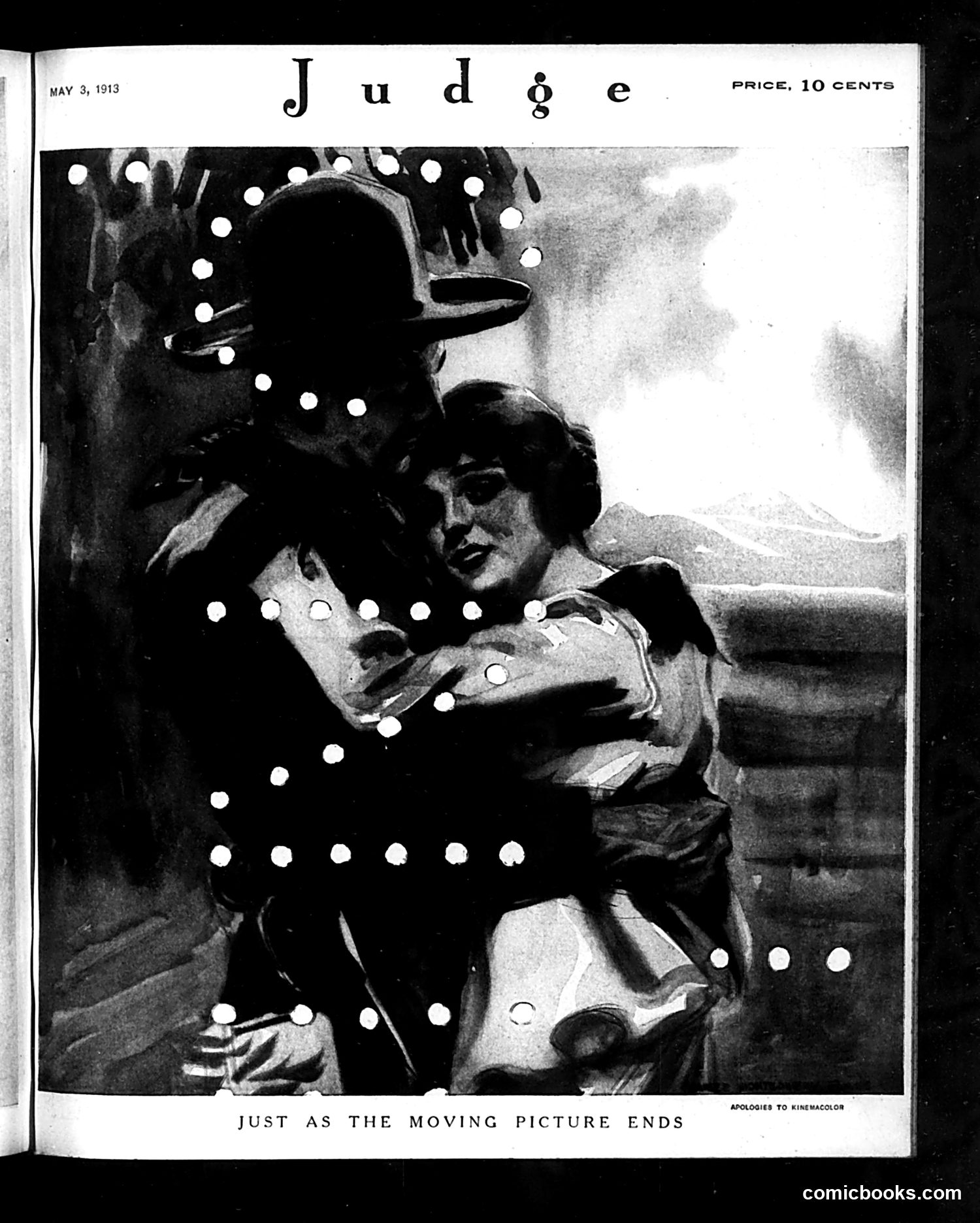
This satirical image, captioned "JUST AS THE MOVING PICTURE ENDS," appears to depict a scene from early cinema. The silhouetted figures suggest a romantic or dramatic moment being filmed, with the elaborate costume and lighting suggesting a period drama or melodramatic production—likely a Kinetoscope or early film scenario. The white dots overlaid on the image appear to be artistic additions representing stage lights or film studio equipment, emphasizing the artificial nature of movie production. The humor likely mocks either: the exaggerated emotionalism of early cinema, the contrast between on-screen drama and off-screen reality, or possibly critiques the burgeoning film industry itself. The satire targets the theatrical excess of early moving pictures popular with American audiences in 1913.
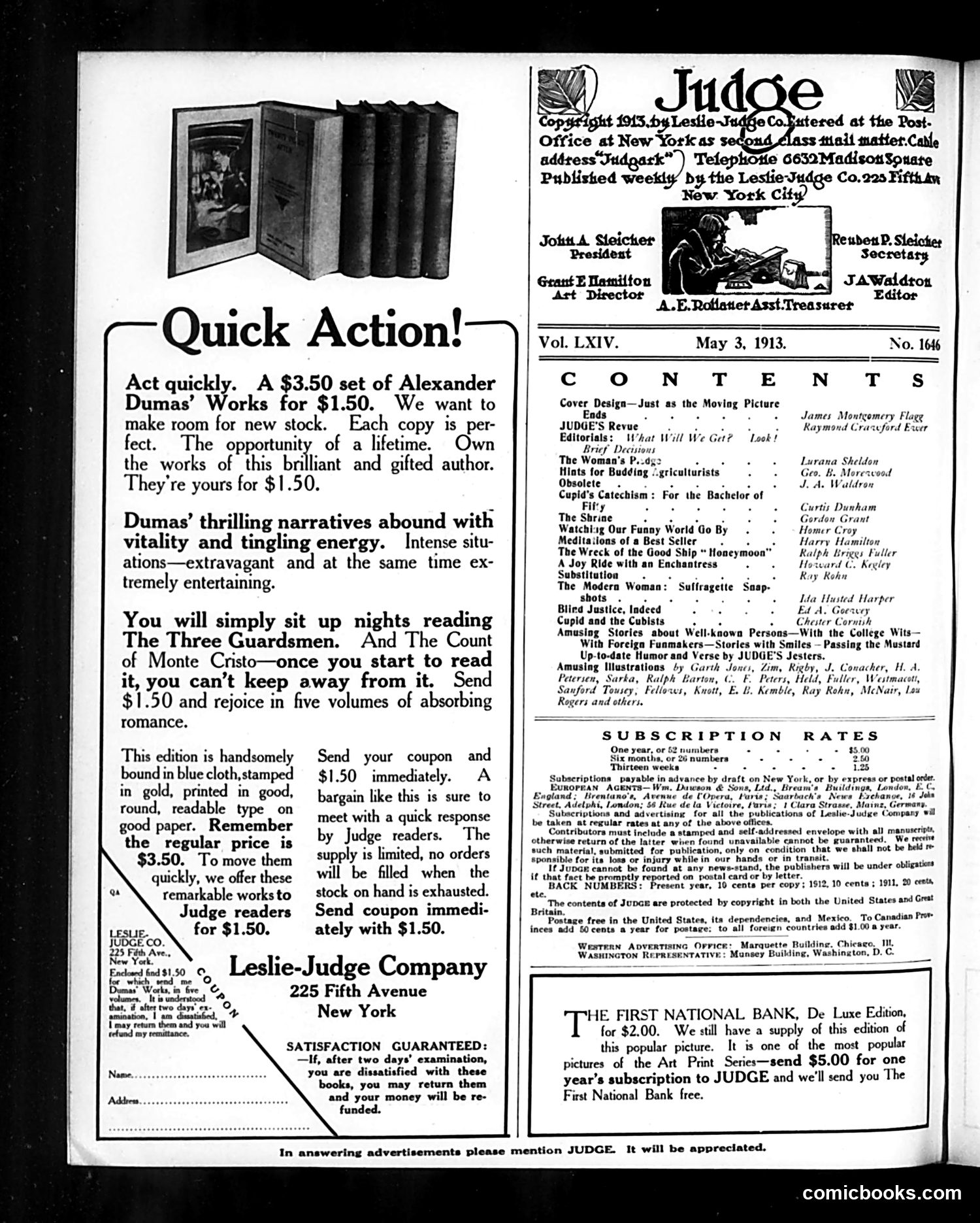
This page is primarily **advertising** rather than political satire. The left side features a "Quick Action!" ad from Leslie-Judge Company promoting a $1.50 set of Alexander Dumas' Works—a clearance sale to make room for new stock. The copy emphasizes the entertainment value of Dumas' "thrilling narratives" and promises five volumes of "absorbing romance." The right side contains the magazine's masthead, table of contents, and subscription information. There is a small illustration of someone at a desk (possibly editorial staff), but no significant political cartoon or satirical commentary is visible on this particular page. The content reflects typical early 20th-century magazine layout and advertising practices.
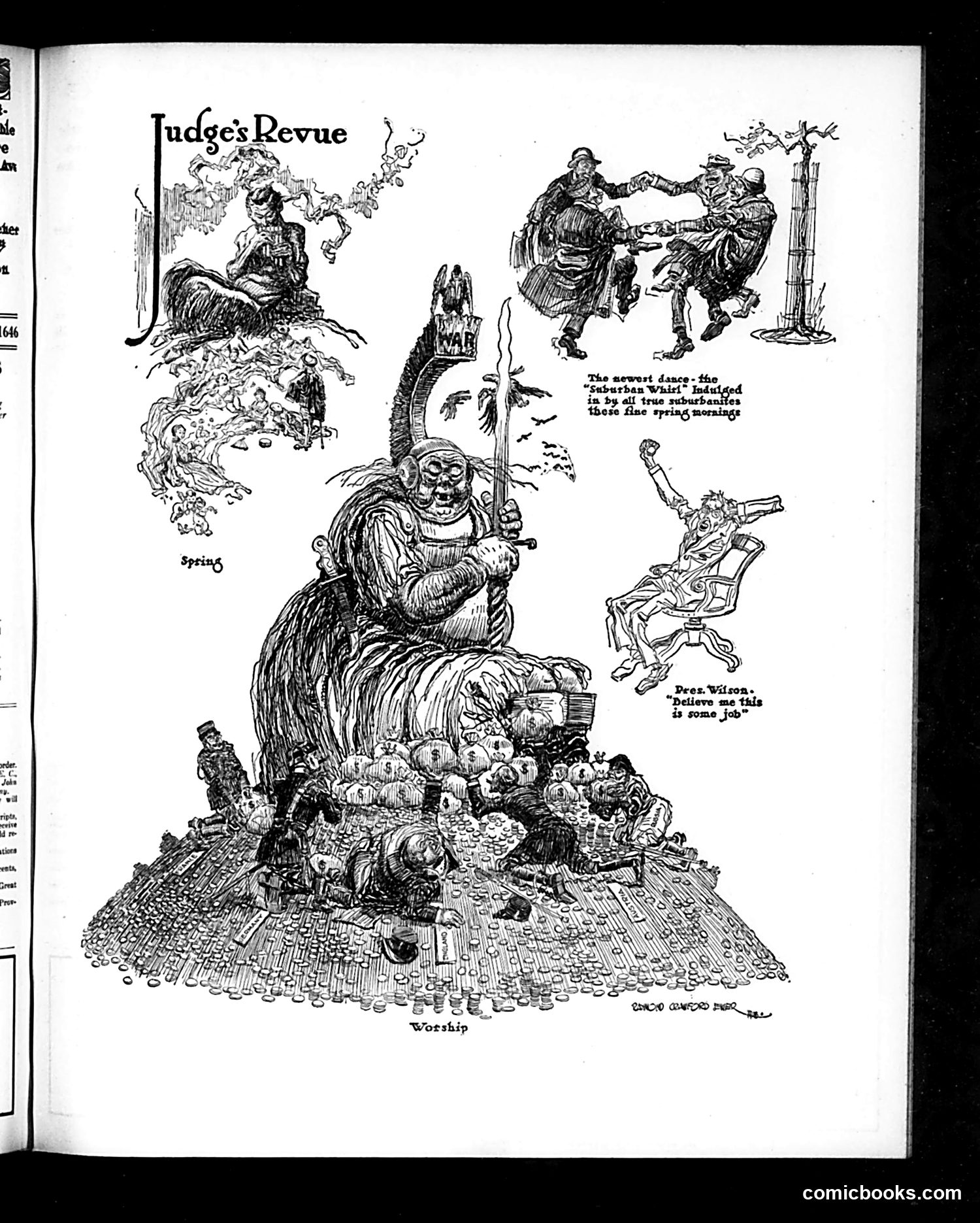
This page presents four seasonal satirical vignettes labeled "Spring," "Worship," and others. The central figure appears to be a demonic or monstrous character labeled "War," depicted as an idol being worshipped by crowds below. The accompanying text reads: "The newest dance—the 'suburban Waltz'—in by all true suburbanites those fine spring mornings." The cartoon satirizes American society's relationship with war and militarism, suggesting that war has become a form of worship or cultural obsession. The "suburban Waltz" reference likely mocks how middle-class Americans embrace militaristic values. The separate scene labeled "Dear Wilson—Believe me this is some job" appears to address President Woodrow Wilson, possibly critiquing his wartime leadership or policies. The overall tone is darkly humorous, depicting war as an grotesque deity commanding public devotion.
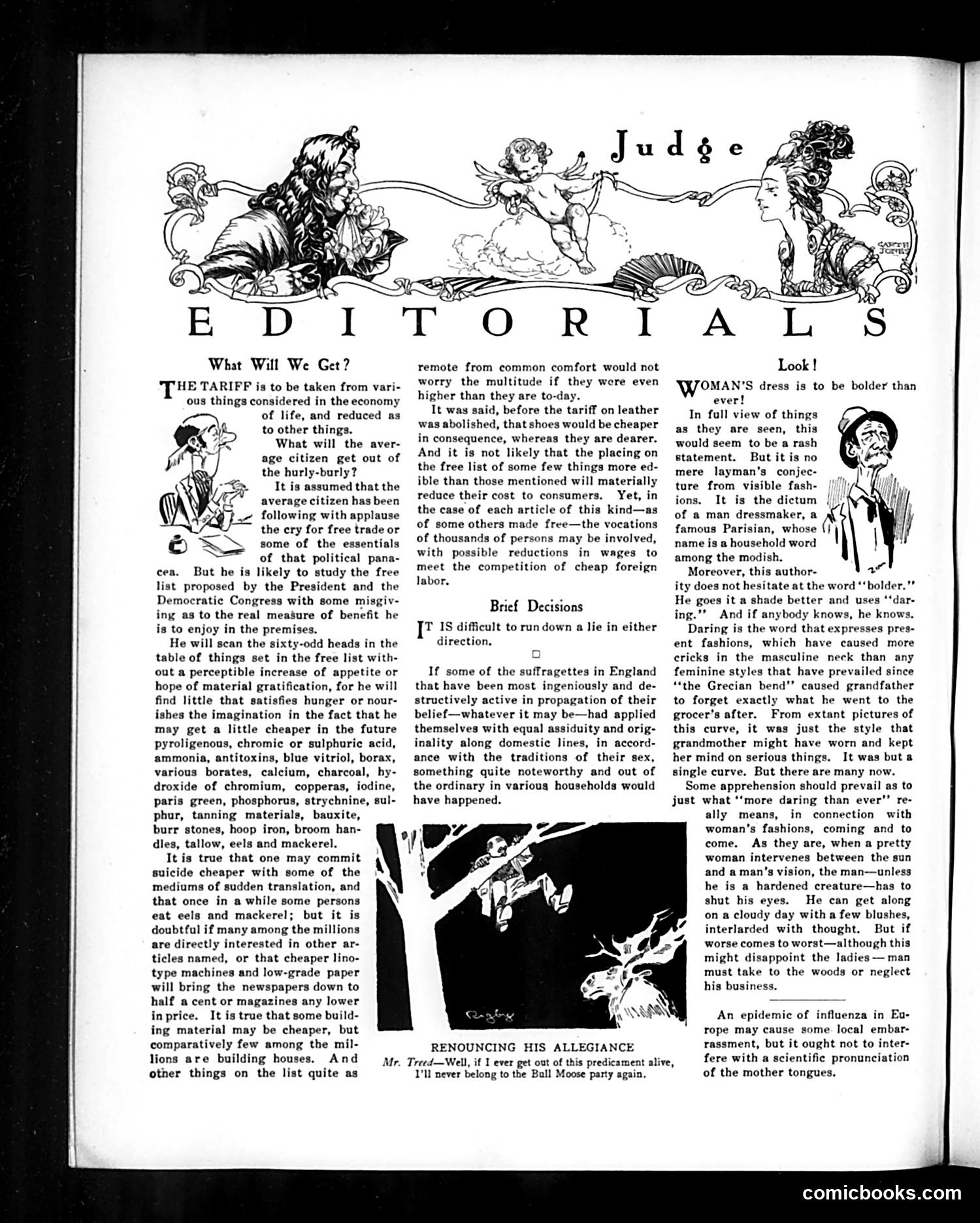
This page contains editorial commentary on tariff policy and fashion rather than traditional political cartoons. The main article "What Will We Get?" debates whether free trade or protective tariffs benefit consumers—arguing that cheap imports might reduce prices but could eliminate American jobs across industries (chemicals, metals, textiles, etc.). The sidebar "Look!" mocks women's fashion, specifically criticizing the "bolder" silhouettes and masculine styling of contemporary dresses. It suggests a Persian dressmaker deserves credit for these unflattering trends, humorously implying women's fashion has become absurdly exaggerated. The cartoon "Renouncing His Allegiance" shows someone abandoning the Bull Moose party—likely referencing Theodore Roosevelt's 1912 Progressive ("Bull Moose") Party split from Republicans.
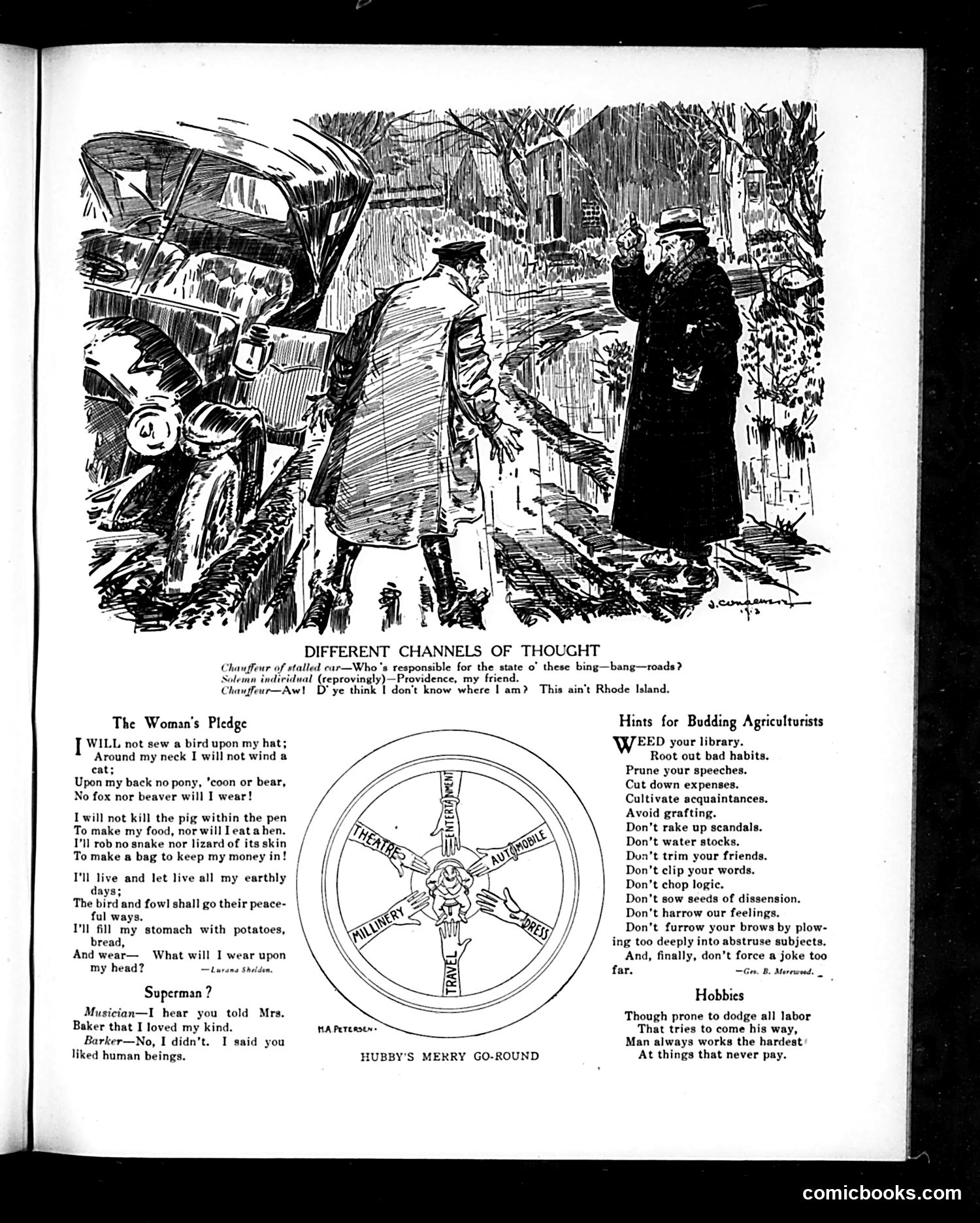
**Top Cartoon - "Different Channels of Thought":** This depicts a street accident scene with a damaged automobile. Three men debate responsibility for the road's poor condition. The satire critiques how people reflexively blame different entities—here, one character suggests "Providence" caused the damage, another blames poor road infrastructure. It's social commentary on how accidents get rationalized through convenient scapegoating rather than addressing actual systemic problems like inadequate road maintenance. **Other Content:** The page includes "The Woman's Pledge" (a humorous list of domestic commitments), "Hubby's Merry Go-Round" (a circular diagram about household duties), "Supermen" (a brief joke), "Hints for Budding Agriculturists," and "Hobbies" (poetry). These are typical light satirical and comedic filler content common in Judge magazine's format.
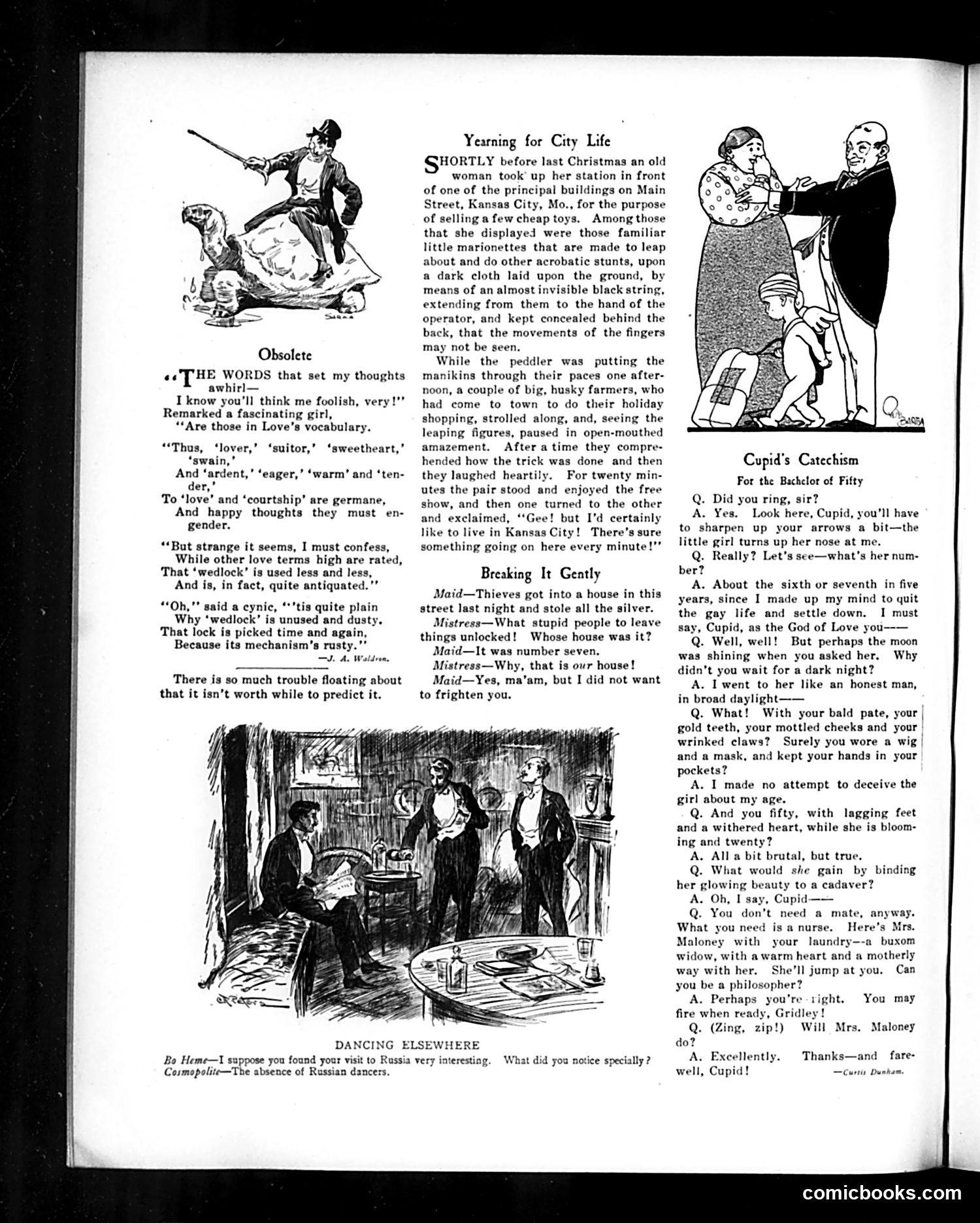
This page contains three satirical pieces mocking romantic conventions and urban pretension: **"Obsolete"**: A poem about outdated courtship vocabulary. A woman notes that "wedlock" is rarely used anymore. A cynic responds that the word persists because "that lock is picked time and again"—a crude joke suggesting marital infidelity and failed marriages are so common the term has lost meaning. **"Yearning for City Life"**: A humorous anecdote about Kansas City. Two rural farmers watch a street vendor operate marionettes. Amazed by the puppet trick, one farmer exclaims he'd love to live in the city because "something going on here every minute"—satirizing rural perceptions of urban sophistication and entertainment. **"Cupid's Catechism"**: A dialogue mocking a fifty-year-old bachelor's romantic pursuits. Cupid interrogates him about courting a twenty-year-old woman, highlighting the absurdity and indecency of the age gap. The piece concludes that instead of a wife, the elderly man needs a nurse—sardonically suggesting his romantic aspirations are ridiculous and pathetic.
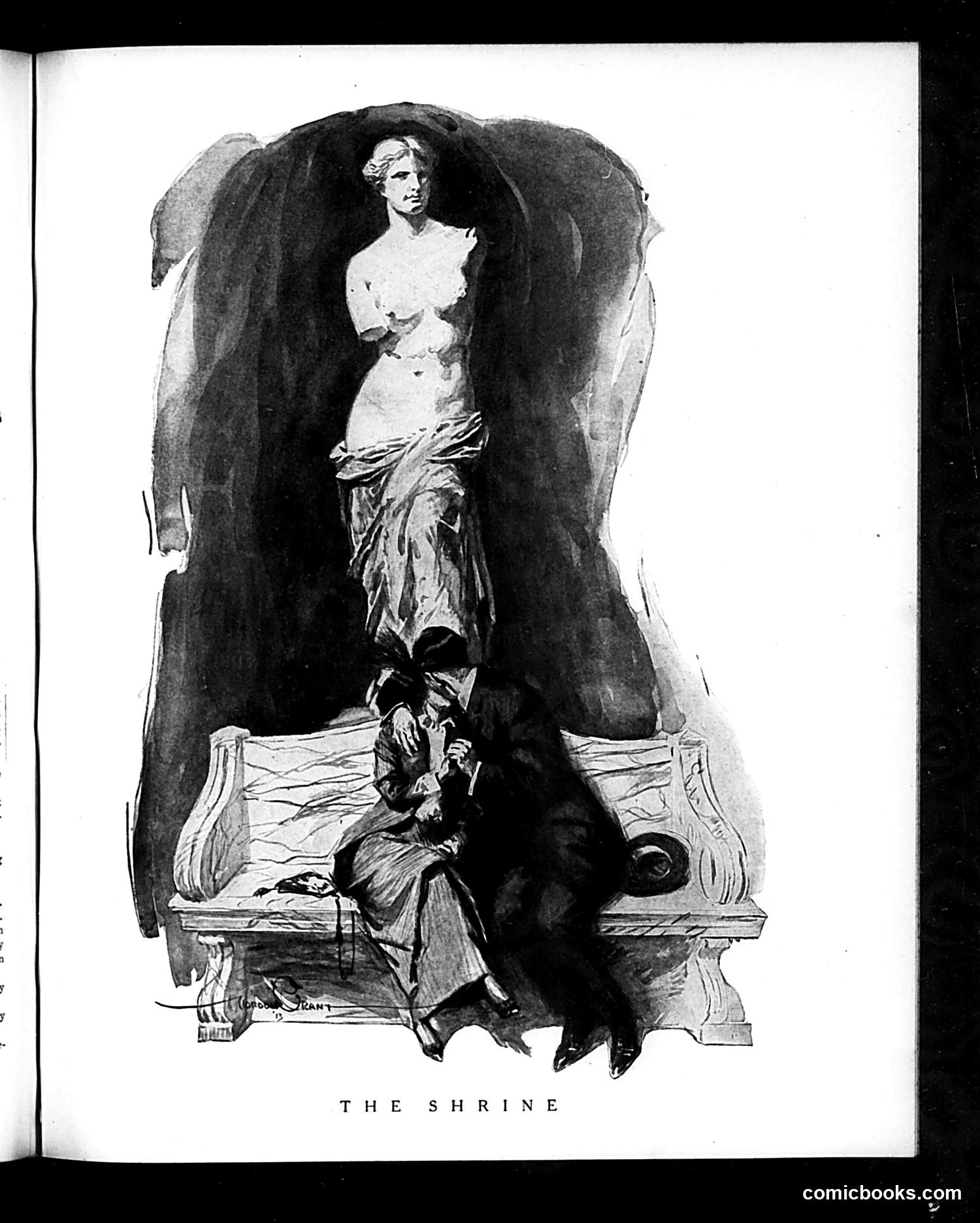
This illustration from *Judge* magazine depicts a classical female nude figure standing on a pedestal within an ornate shrine-like structure. A figure in dark clothing kneels before it in reverence. The satire likely critiques the idealization or "worship" of female beauty in contemporary society—depicting how aesthetic standards were elevated to quasi-religious status. The shrine framing suggests mockery of this cultural devotion, treating beauty as an object of veneration rather than a human quality. The specific historical context remains unclear without additional publication details, but the artwork reflects *Judge*'s typical social commentary on contemporary attitudes toward women, art, and cultural values during the magazine's era.
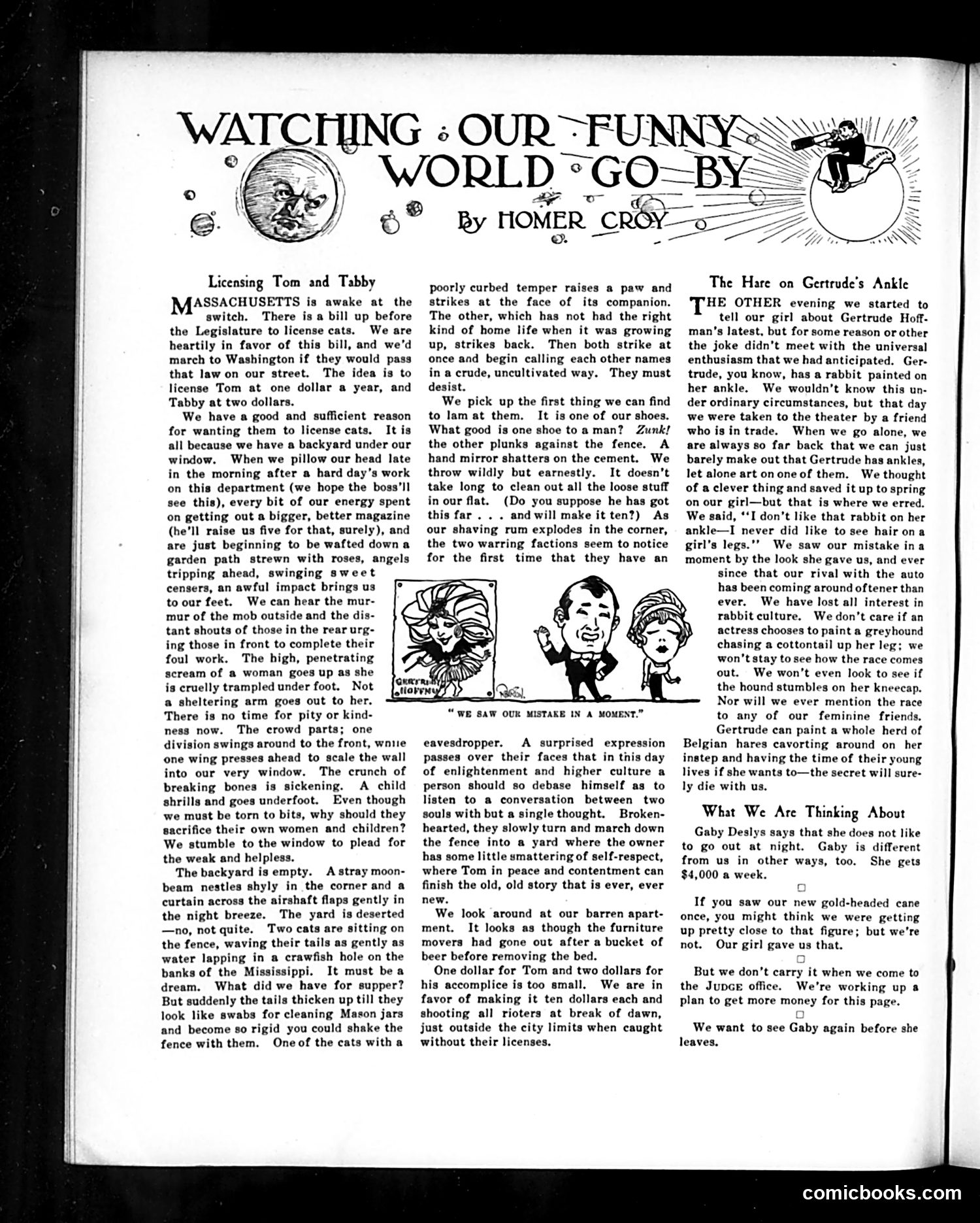
This is a humorous complaint disguised as social commentary. The author describes being awakened by a violent catfight in his backyard—the dramatic language ("scream of a woman," "breaking bones," "child shrills") parodies sensational newspaper coverage of urban riots or mob violence. The joke: cats fighting sound catastrophic, but the "tragedy" is just two cats quarreling. The author throws household items (shoes, mirror, shaving rum) trying to stop them, destroying his apartment in the process. The satire targets Massachusetts's proposed cat-licensing bill (requiring payment to own cats legally). The author supports it, arguing that licensing fees—one dollar for tom cats, two for females—are absurdly low compensation for the chaos cats cause. The cats, indifferent to the destruction, simply relocate to a neighbor's yard. It's gentle domestic humor about nuisance pets, not political satire, though it uses exaggerated riot-language for comic effect.
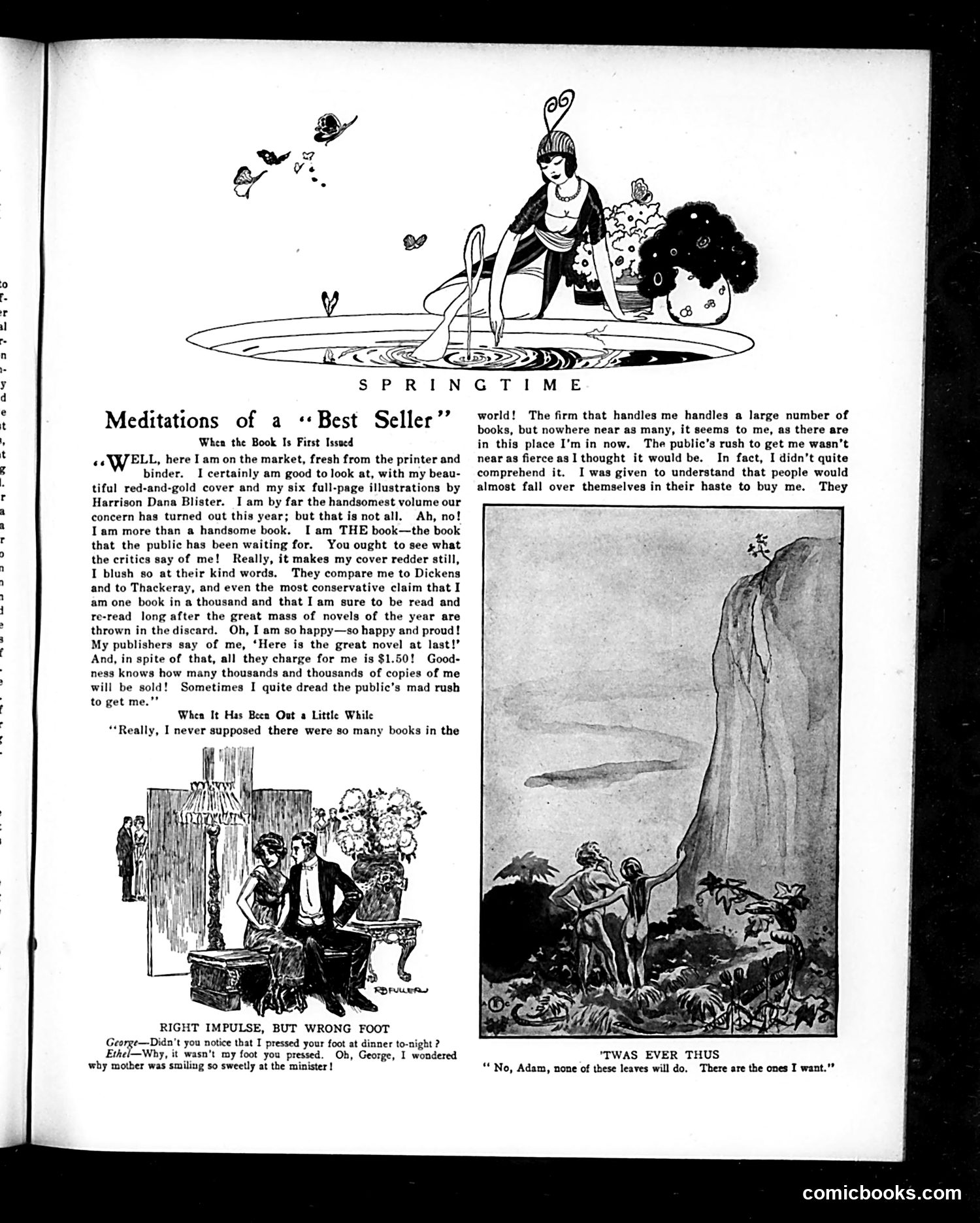
This page satirizes the publishing industry and vanity through personified objects and romantic mishaps. **"Meditations of a Best Seller"** uses a first-person narrative from a newly published book's perspective. The satire mocks the inflated expectations and ego of debut novels: the book boasts of critical praise comparing it to literary giants (Dickens, Thackeray) and predicts massive sales at $1.50, then deflates when it discovers the marketplace is crowded and sales disappoint. The joke targets both the publishing industry's hype and authors' unrealistic optimism about their work's significance. **"Right Impulse, But Wrong Foot"** depicts a domestic comedy: at dinner, George intended to flirt with his wife Ethel by pressing her foot under the table, but accidentally pressed her mother's foot instead—who interpreted it as flirtation from him, hence her pleased smile. The humor lies in the embarrassing mistaken identity and implied scandal. The bottom cartoon references the Biblical Adam and Eve choosing forbidden fruit, captioned "Twas Ever Thus," suggesting temptation's timeless nature.
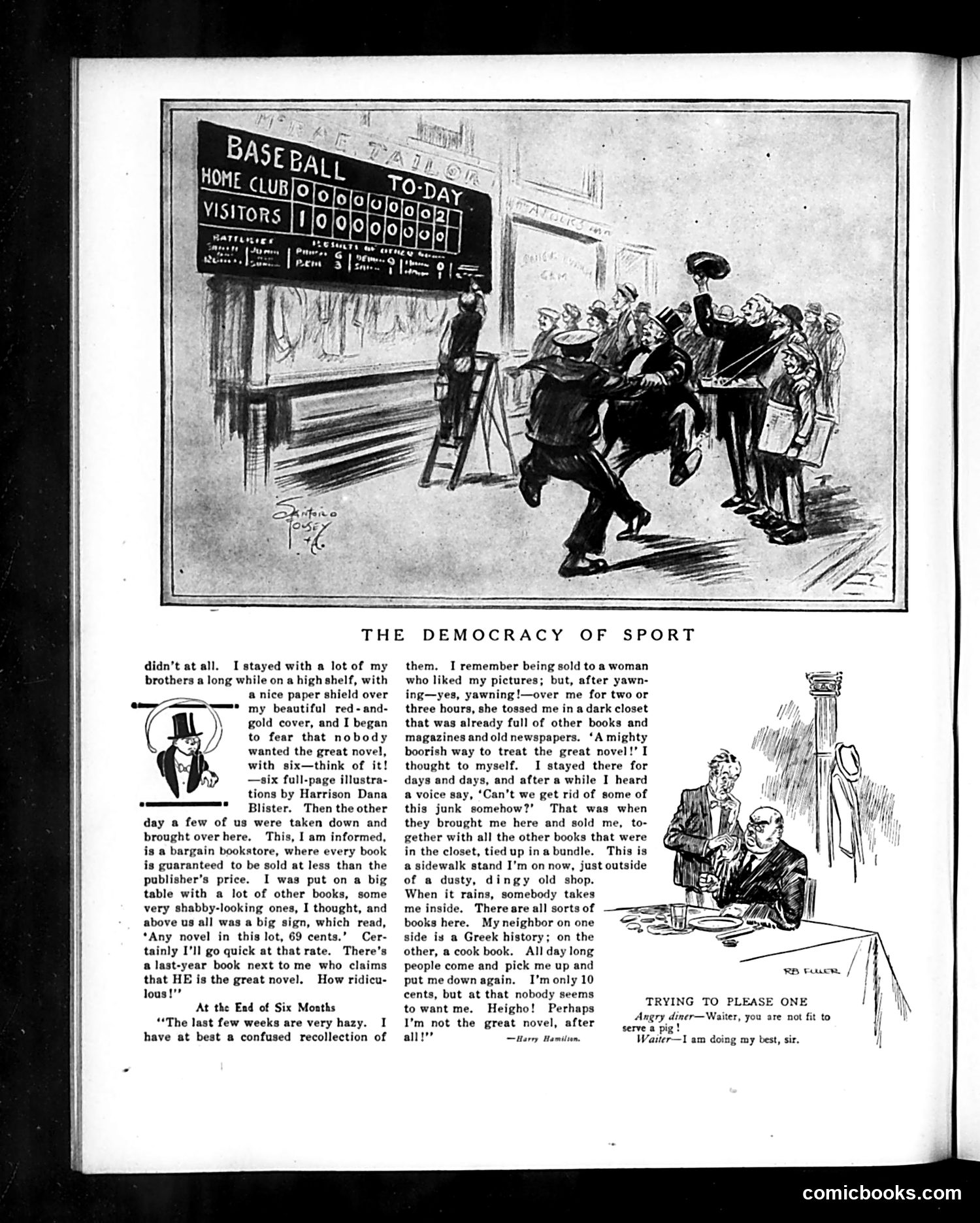
The top cartoon illustrates "the democracy of sport"—a baseball scoreboard showing a game in progress, with spectators of various social classes gathered together. The point: sports venues were genuinely democratic spaces where rich and poor mingled as equals, united by shared interest in the game. The text below is a satirical monologue from a rejected novel's perspective. An arrogant "great novel" (with six full-page illustrations) begins on a publisher's shelf, then gets sold to a bargain bookstore for 69 cents, purchased by a woman who finds it boring, relegated to a closet, and finally ends up on a 10-cent sidewalk stand where nobody wants it. The satire mocks literary pretension and wounded ego—what the novel thought was "great" proves utterly unmarketable and forgettable. The bottom cartoon, "Trying to Please One," shows a waiter accepting harsh criticism with humility, satirizing service industry dynamics.
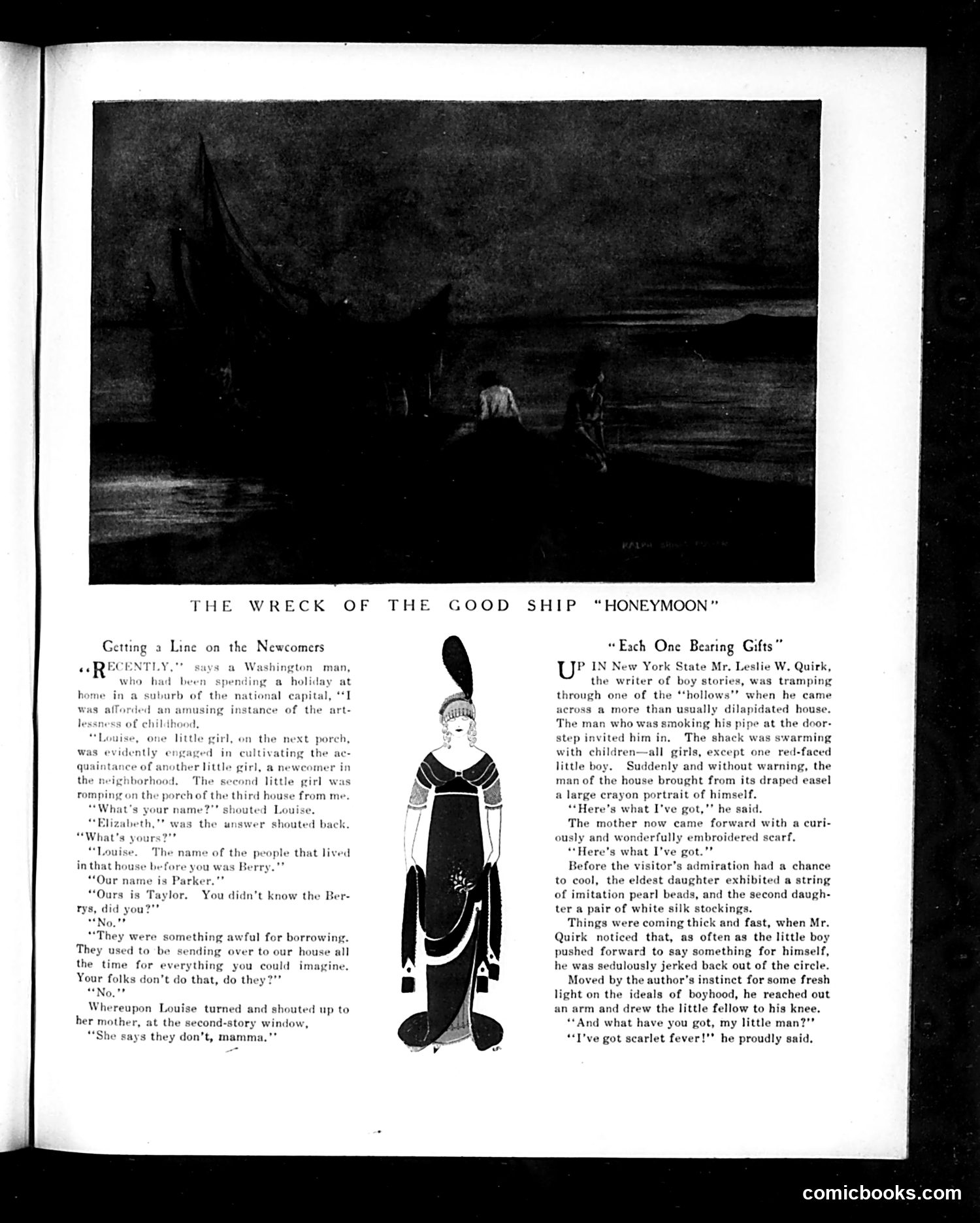
This page contains two unrelated stories from *Judge* magazine, not political cartoons. The left column, "Getting a Line on the Newcomers," is a humorous anecdote about children meeting neighbors. One girl asks another her name and family history, learning the previous residents (the Berrys) were chronic borrowers. It's gentle social satire about how neighborhoods evaluate newcomers based on reputation. The right column, "Each One Bearing Gifts," is a short story by Leslie W. Quirk about a writer visiting a poor rural family in Appalachia (a "hollow"). Each family member proudly displays a possession—a crayon portrait, embroidered scarf, pearl beads, silk stockings—attempting to impress the visitor. The twist: when finally asked what he has, the ignored young boy announces he has scarlet fever. The humor lies in the family's embarrassing attempt at respectability undermined by the boy's honest revelation of poverty and hardship. Neither contains overt political satire.
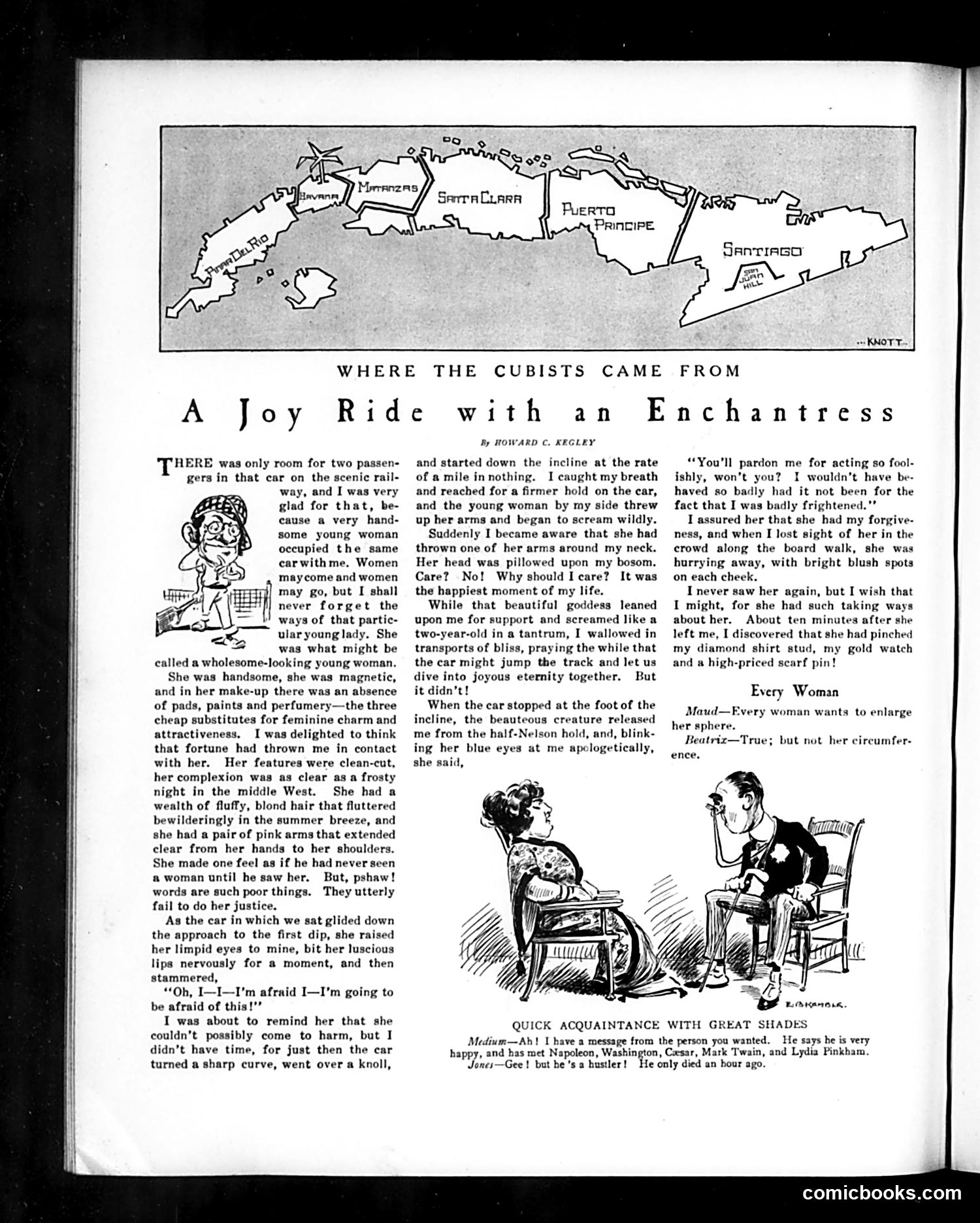
This story by Howard C. Kegley satirizes male romantic naïveté and women's cunning. The narrator describes meeting an attractive, "wholesome-looking" young woman on a scenic railway ride. When their car descends rapidly, she clings to him in apparent fear—a moment he romanticizes as blissful intimacy. The joke's punchline: after parting, he discovers she stole his diamond shirt stud, gold watch, and expensive scarf pin. The satire mocks how men mistake women's theatrical distress for genuine emotion, making them vulnerable to theft. The accompanying panel ("Every Woman") reinforces the theme that women deceive men about their true intentions and desires. The "Cubists" reference in the title remains unclear from the visible text, though it may reference artistic modernism or an unrelated headline.
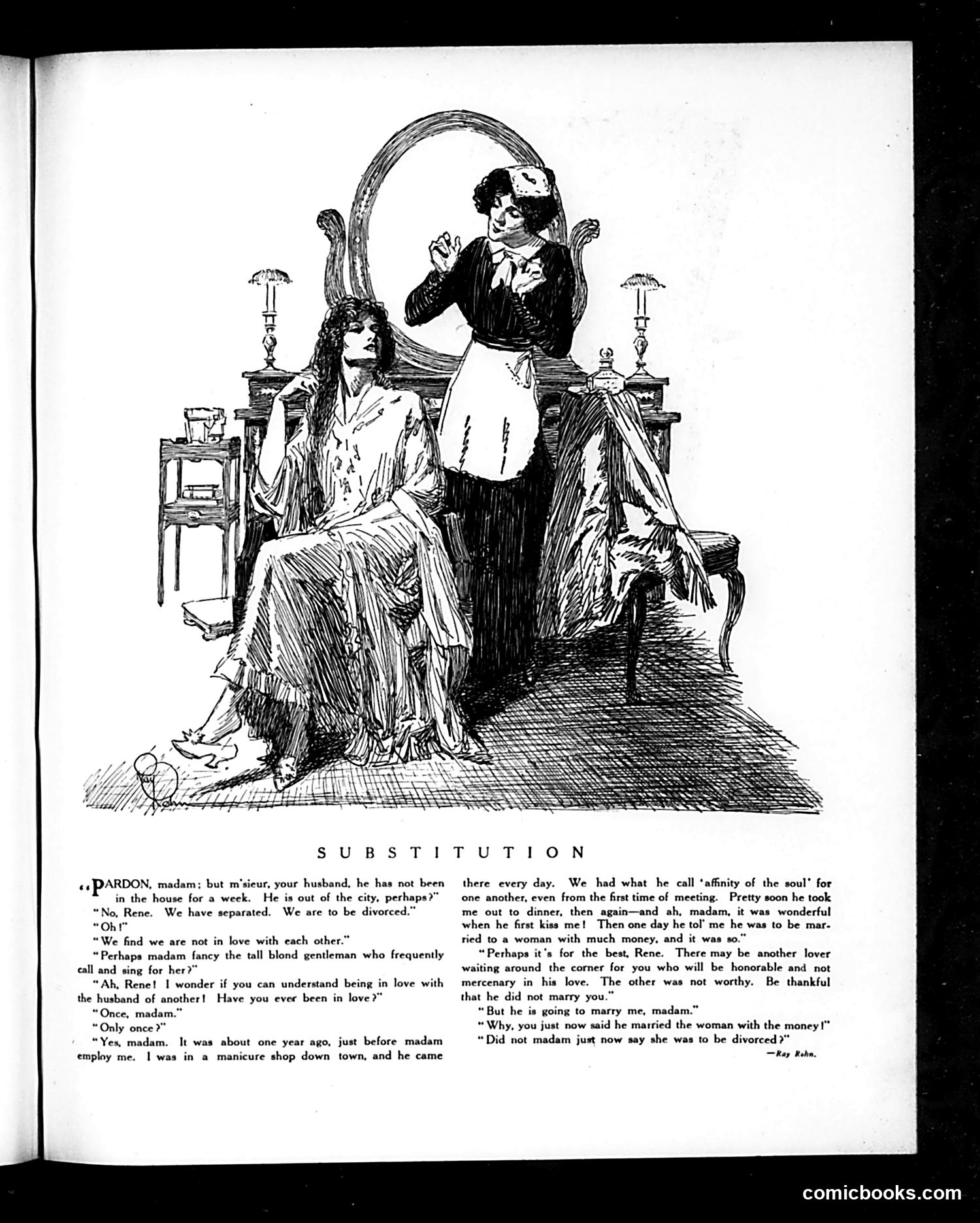
This satirical piece mocks the emerging divorce culture and moral inconsistency of wealthy society around the early 1900s. A lady of leisure discusses her impending divorce with her French maid, Rene, claiming she and her husband "are not in love with each other." The joke's bitter irony: Rene then reveals she was abandoned by a man who married for money instead of love. The lady offers platitudes about finding someone "honorable and not mercenary." Rene's final retort exposes the hypocrisy—the lady herself is divorcing to presumably pursue the "tall blond gentleman," essentially engaging in the same mercenary calculation she condemned. The cartoon satirizes how wealthy women rationalize divorce through romantic language ("affinity of the soul") while actually pursuing financial or social advantage. The "substitution" is one romantic entanglement simply replacing another.
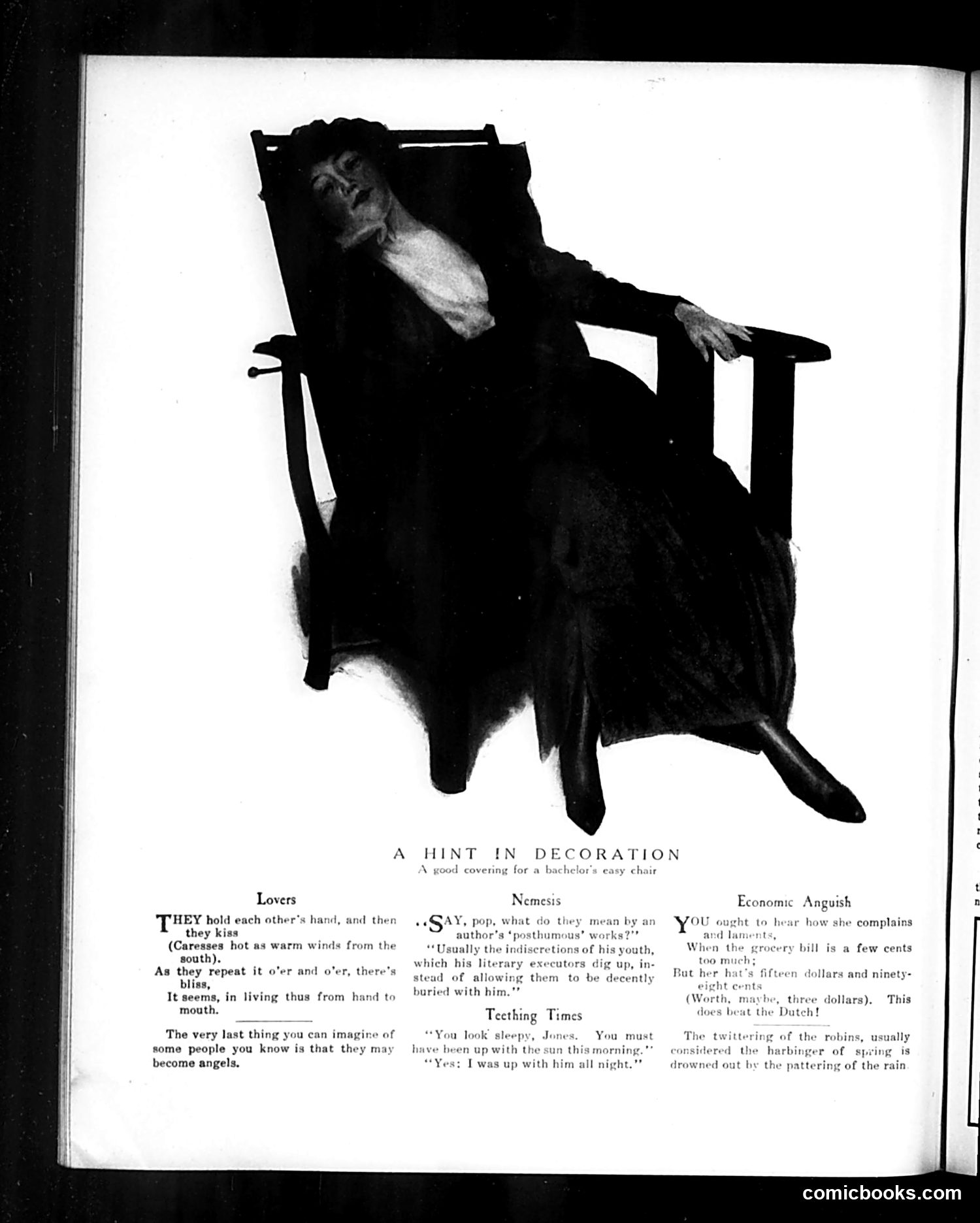
This page presents **domestic humor and social commentary** targeting early 20th-century middle-class life. The title illustration shows a man slouching in an easy chair—a visual gag about decorating tips for bachelor furniture. The accompanying text consists of **four brief satirical pieces**: 1. **"Lovers"**: Mock-romantic verses about couples kissing repeatedly, ending with cynical commentary that some people couldn't possibly become angels. 2. **"Nemesis"**: Jokes about an author's embarrassing unpublished works being discovered after death by literary executors—satirizing posthumous literary scandals. 3. **"Teething Times"**: A domestic dispute where a tired husband admits staying up all night, apparently with a sick child. 4. **"Economic Anguish"**: A wife complaining about grocery bills costing ninety-eight cents instead of ninety cents—mocking penny-pinching domestic anxiety. The satire targets **marital friction, literary vanity, parenting exhaustion, and household financial anxiety**—common concerns of the magazine's contemporary readership.
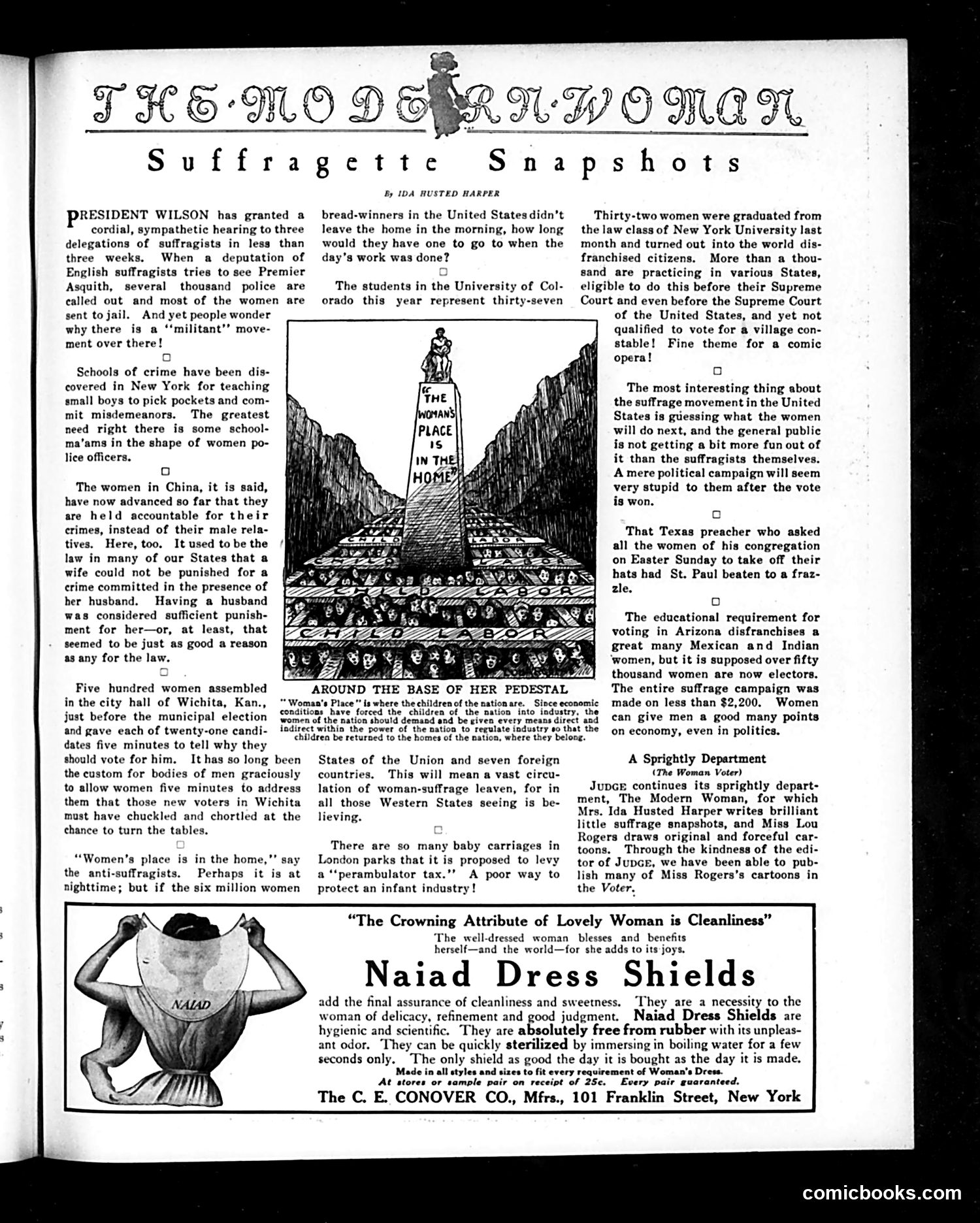
This page from *Judge* magazine presents pro-suffrage commentary by Ida Husted Harper, using humor and pointed arguments for women's voting rights. The central cartoon depicts a pedestal labeled "Woman's Place is in the Home," surrounded by what appear to be women activists at its base. The satire attacks anti-suffrage arguments by highlighting contradictions: women work as breadwinners but can't vote; law school graduates are disfranchised; women manage industries yet lack political power. Harper argues that if women's "place" is truly the home, society should regulate industry to return children there—implying this is impossible without women's political participation. The piece mocks British suffrage opposition (contrasting President Wilson's "cordial" American reception with violent British responses) and suggests women voters will accomplish more than "mere political campaigns." The tone combines wit with substantive economic and legal arguments for women's suffrage.
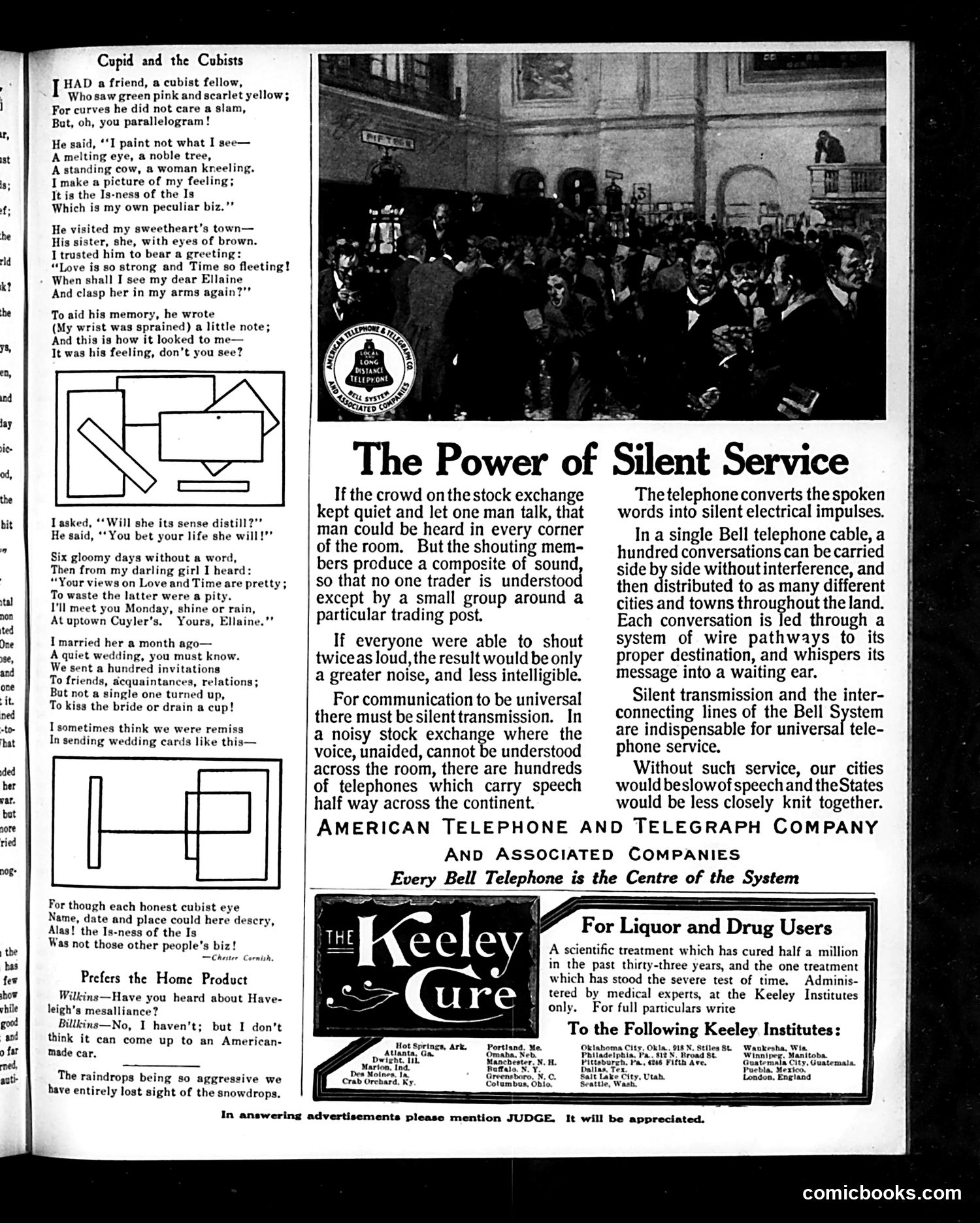
This poem satirizes Cubism, the early-20th-century art movement that rejected realistic representation in favor of geometric abstraction and subjective "feeling." The narrator's cubist friend visits his sweetheart and, unable to write normally due to an injured wrist, sends a love note rendered entirely in abstract geometric shapes—lines and rectangles with no recognizable content. The joke: the cubist insists the recipient will understand his "feeling" through pure form, but she only grasps it because she's practical and intelligent. The real punchline emerges at the wedding—their 100 invitations, presumably sent in similarly incomprehensible cubist style, resulted in *zero guests*, because abstract geometric designs cannot communicate actual information like dates and addresses. The satire targets Cubism as self-indulgent and useless for any real human purpose: fine as an artistic philosophy, but absurd when applied to actual communication. It's a period mockery of modernist art movements by mainstream satirists who found such experiments bewildering and pretentious.
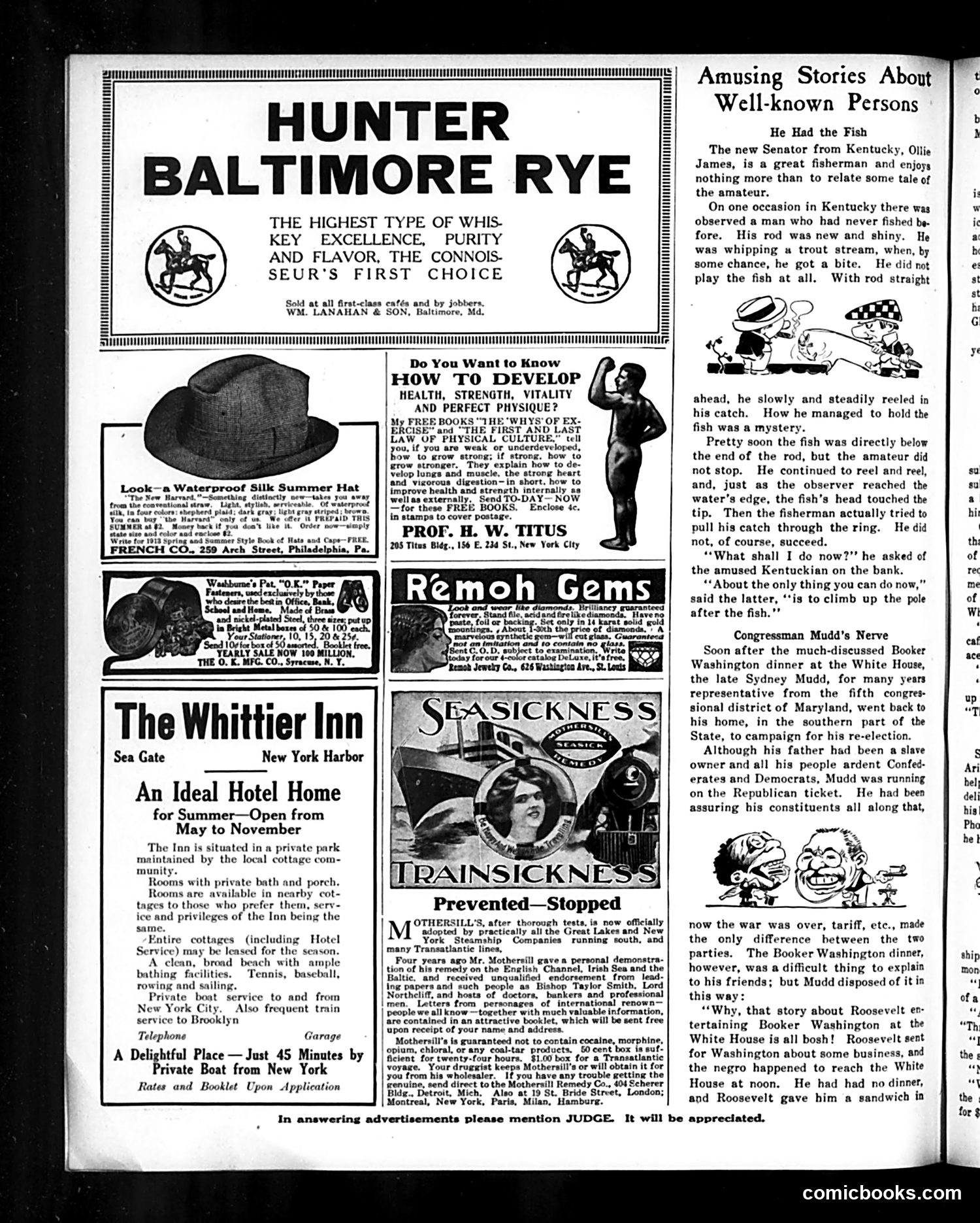
This page is primarily **advertisements and filler content**, not political satire. The main items include: **Top**: Hunter Baltimore Rye whiskey ad emphasizing quality and purity—typical period liquor marketing. **Middle section**: Various product ads (waterproof hats, physical culture books, patent medicines, hotel accommodations) targeting affluent readers. **Right column**: "Amusing Stories About Well-known Persons"—brief anecdotes about public figures. The visible story concerns Senator Ollie James of Kentucky, a fisherman who failed to catch a fish, with the humor deriving from his amateur incompetence. The page contains no political cartoons or satirical commentary on current events. It represents Judge's standard format: national advertising mixed with light humor and society gossip aimed at educated, wealthy audiences. The "Seasickness Prevented—Stopped" ad for Mothersill's remedy is the only item with editorial-style formatting, discussing its adoption by steamship lines.
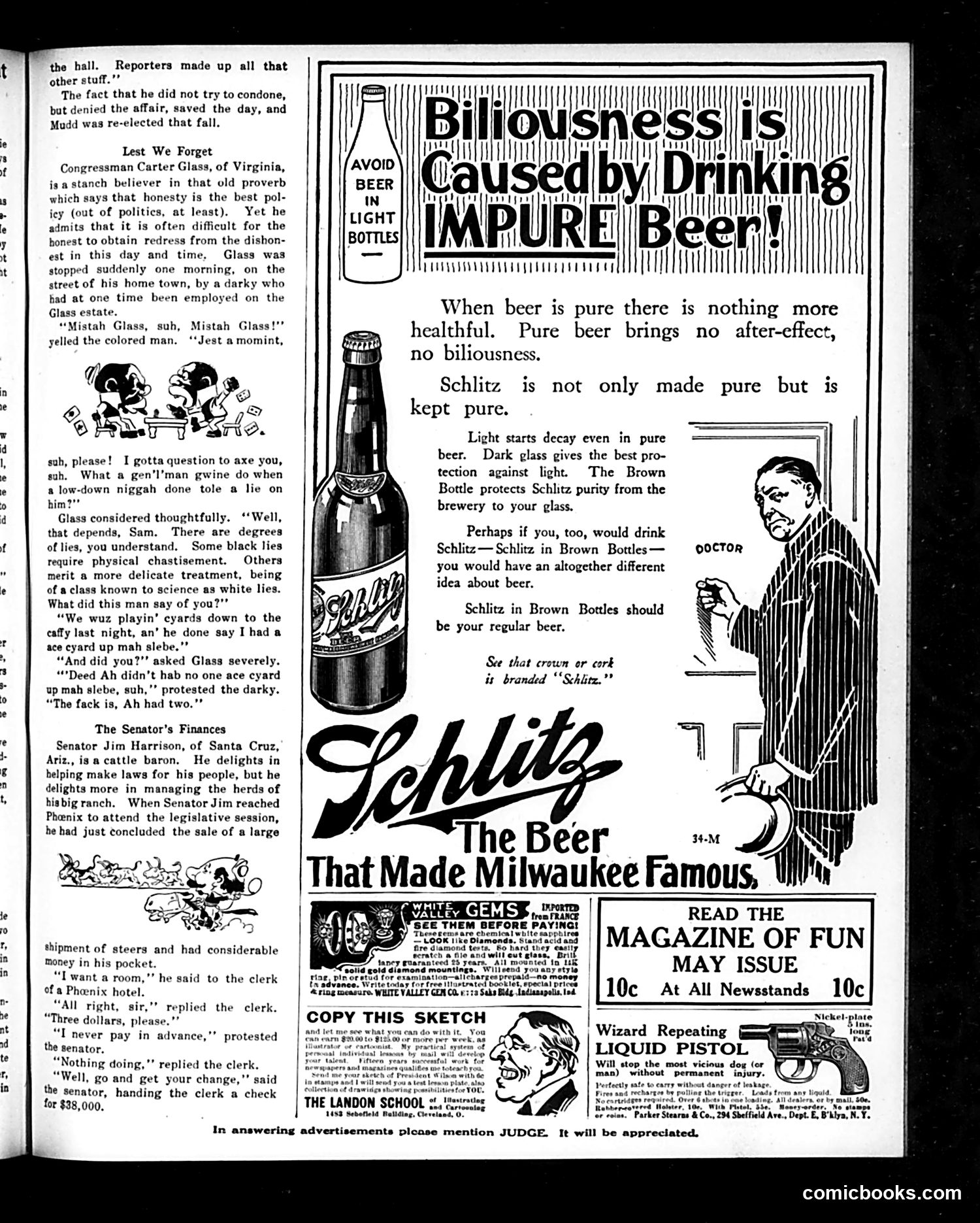
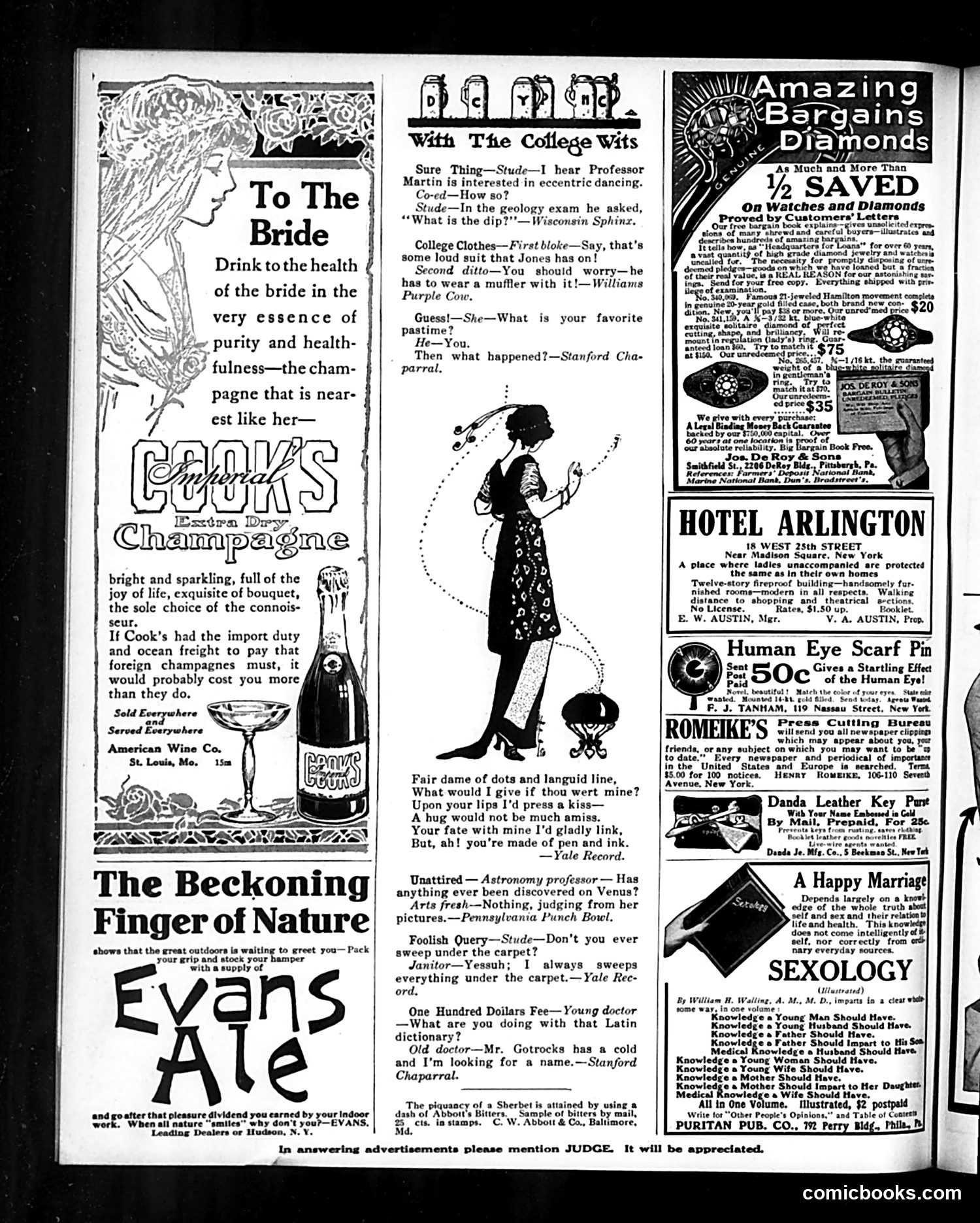
This page from Judge magazine contains college humor and advertisements typical of the early 20th century. **"With The College Wits"** presents brief jokes from college publications, poking fun at student life: a geology professor's double entendre about "dip," a student in loud clothing needing a muffler to hide it, and similar campus pranks and misunderstandings. **"The Beckoning Finger of Nature"** advertises Evans Ale as the ideal companion for outdoor recreation—reflecting the era's association of beer with leisure and "manly" activities. **"To The Bride"** is a Cook's champagne advertisement marketing their product as appropriate for wedding toasts, emphasizing its purity and sophistication. The remaining content is largely **advertising**: jewelry sales, hotel accommodations (notably one protecting "unaccompanied ladies"), scarf pins, and a book titled "Sexology"—which appears to be an educational guide about marriage and reproduction, reflecting early 20th-century attitudes toward such topics. The overall page reflects period advertising strategies and college humor conventions.
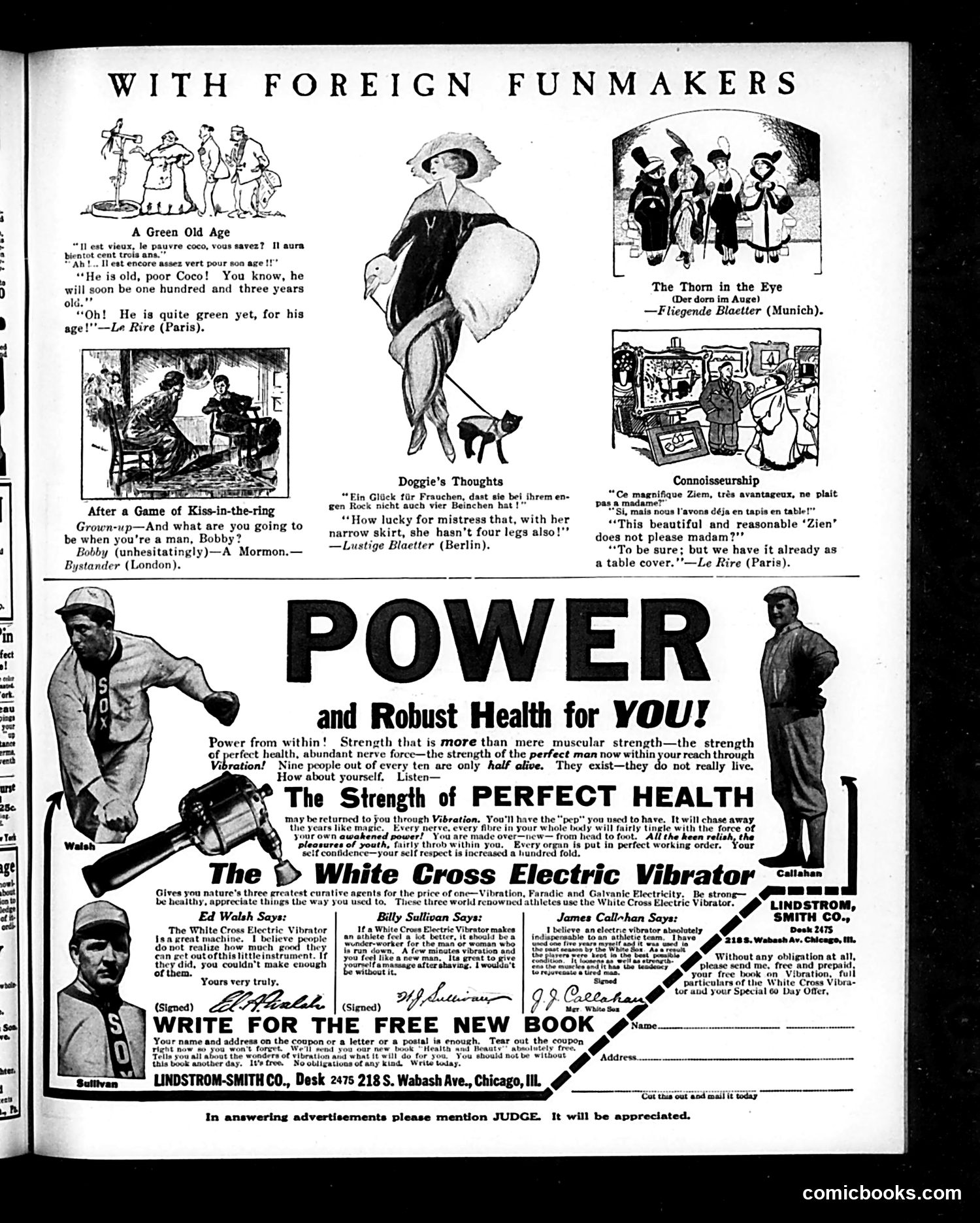
This page features **international satirical cartoons** from European humor magazines, presented for American readers' amusement at foreign customs and attitudes. **The cartoons mock:** - **"A Green Old Age"** (French): A Frenchman's longevity and continued vigor - **"After a Game of Kiss-in-the-ring"** (British): A boy's ambition to become Mormon, poking fun at polygamy - **"Doggie's Thoughts"** (German): A dog's observation that his mistress is lucky—unlike him—to have only four legs despite her narrow skirt - **"The Thorn in the Eye"** and **"Connoisseurship"** (Munich/Paris): Social pretension and interior design disputes The page primarily showcases **early 20th-century xenophobic humor**—laughing at perceived foreign eccentricities. The cartoons assume American readers found European customs bizarre and amusing. The **large advertisement below** for the White Cross Electric Vibrator (a dubious "health" device using electricity) was typical contemporary pseudoscience marketing, featuring endorsements from athletes.
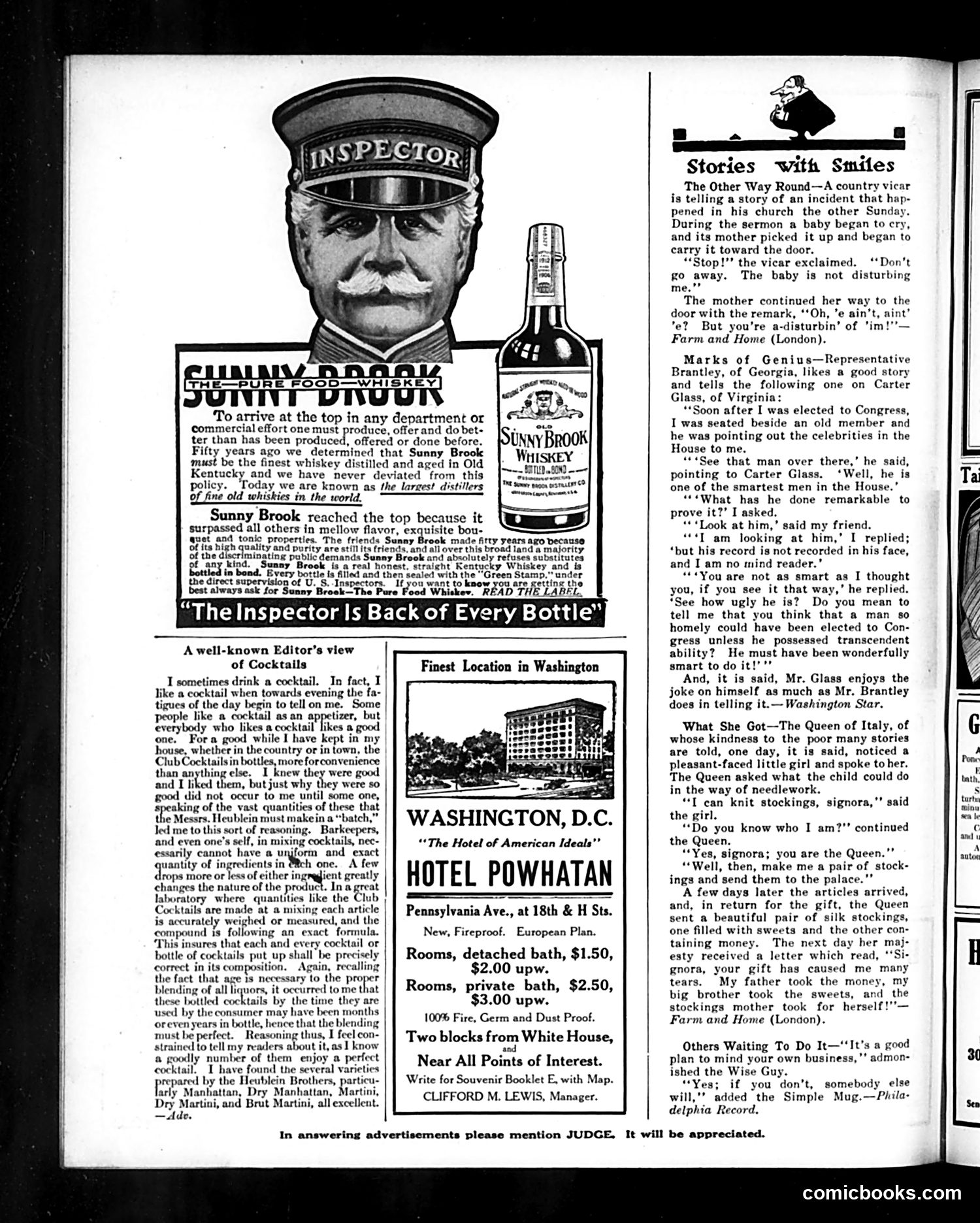
This page from the satirical magazine *Judge* contains mostly **advertisements and humorous anecdotes** rather than political cartoons. The main visual is a **Sunny Brook Whiskey advertisement** featuring an "Inspector" character—likely referencing the Pure Food and Drug Act of 1906, which mandated government inspection of food and alcohol products. The inspector's presence on the bottle reassures consumers of quality and purity, a selling point in the early 20th century when food safety was a public concern. The text sections are light humor pieces: one mocks a country vicar's poor listening skills; another jokes about Representative Brantley's inability to recognize intelligence in fellow congressman Carter Glass by appearance alone. The "Editor's View of Cocktails" advertisement discusses the superiority of pre-made cocktails (Heublein brand) over bartender-mixed drinks, emphasizing consistency and precise measurement—a modern efficiency argument appealing to readers. The page reflects early 1900s concerns: food regulation, political wit, and consumer convenience marketing.
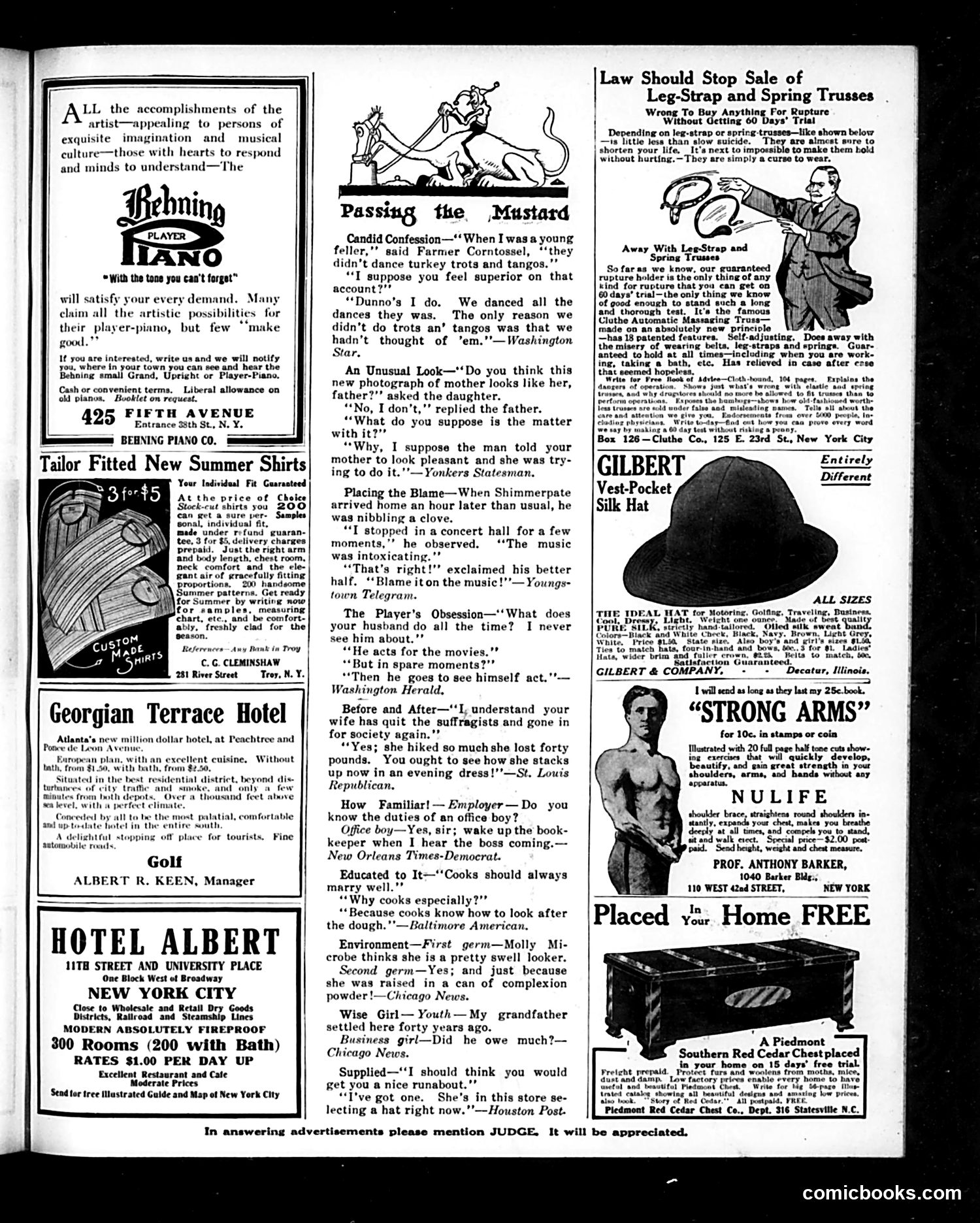
This page is primarily **advertisements** interspersed with brief **humorous anecdotes**, typical of Judge magazine's format. The cartoon "Passing the Mustard" depicts a man being thrown from a horse—a visual pun on the idiom. The accompanying joke contrasts old-fashioned dancing (which the farmer's generation didn't do simply because they hadn't invented it yet) with modern dances like turkey trots and tangos, poking fun at generational superiority claims. The other items are short joke columns typical of early 20th-century humor magazines: wordplay about photographs, movies, suffragists, office boys, and social pretension. The "Before and After" joke references the women's suffrage movement (the wife quit activism), reflecting contemporary social debates. The ads promote player pianos, custom shirts, and hotels—period products marketed to Judge's middle-to-upper-class readers. Nothing on this page carries overt political messaging beyond gentle satire of everyday social interactions and changing fashions.
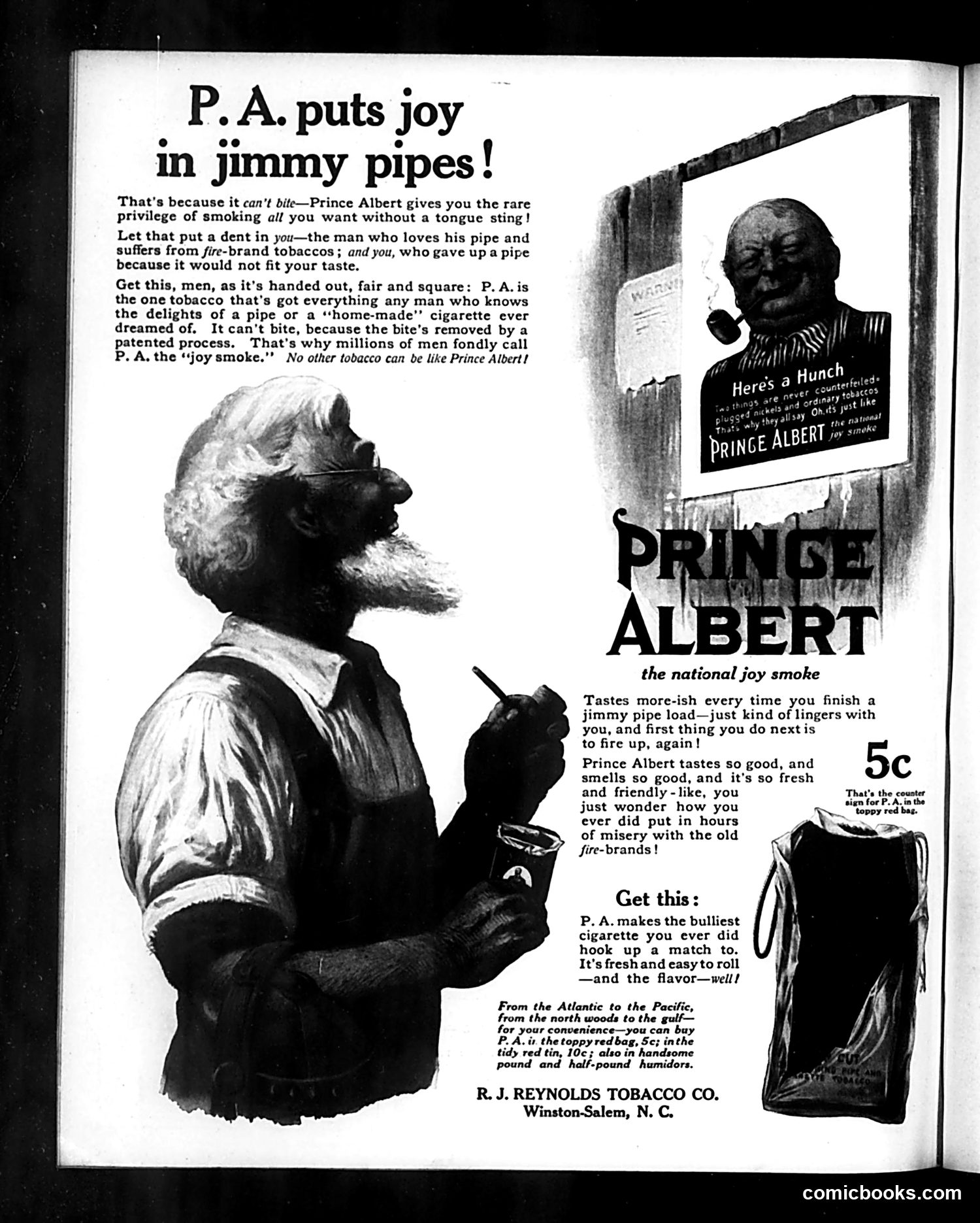
This is a full-page advertisement for Prince Albert tobacco, not satire or political commentary. The ad targets pipe and roll-your-own cigarette smokers by emphasizing that Prince Albert tobacco "can't bite"—meaning it doesn't irritate the tongue, unlike competing "fire-brand" tobaccos. The illustration shows an elderly bearded man contentedly smoking a pipe, representing the satisfied customer. The ad claims Prince Albert's patented process removes the bite, making it superior for both pipe smoking and hand-rolled cigarettes. "Jimmy pipes" is slang for pipes. The copy appeals to men who abandoned pipes due to harsh tobacco, promising them comfort. Pricing and availability (5¢ counter bag, 10¢ tin, larger humidors) are listed. This represents early 20th-century tobacco marketing before health warnings existed.