
Judge, 1913-05-03 · page 8 of 24
Judge — May 3, 1913 — page 8: what you’re looking at
What you’re looking at
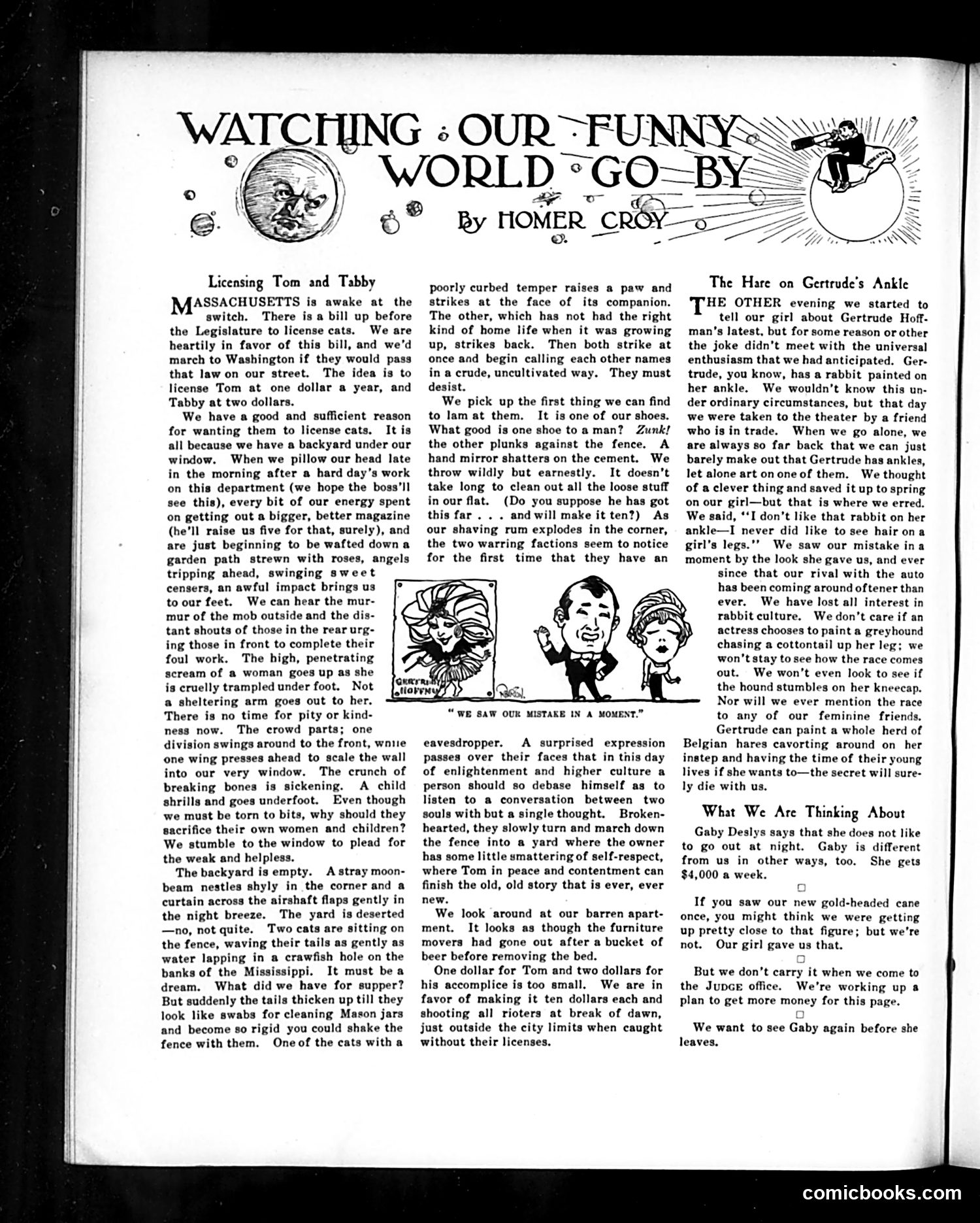
This is a humorous complaint disguised as social commentary. The author describes being awakened by a violent catfight in his backyard—the dramatic language ("scream of a woman," "breaking bones," "child shrills") parodies sensational newspaper coverage of urban riots or mob violence. The joke: cats fighting sound catastrophic, but the "tragedy" is just two cats quarreling. The author throws household items (shoes, mirror, shaving rum) trying to stop them, destroying his apartment in the process. The satire targets Massachusetts's proposed cat-licensing bill (requiring payment to own cats legally). The author supports it, arguing that licensing fees—one dollar for tom cats, two for females—are absurdly low compensation for the chaos cats cause. The cats, indifferent to the destruction, simply relocate to a neighbor's yard. It's gentle domestic humor about nuisance pets, not political satire, though it uses exaggerated riot-language for comic effect.
📄 Transcribed text from this page (OCR, searchable)
Machine-transcribed from the original scan — historical spelling and the odd misread are preserved.
HUNG «OUR =FUNNYS 3 \) WORLD *GO=BY:_— ®® By MOMER "RO Licensing Tom and Tabby MASSACHUSETTS is awake at the switch. There is a bill up before the Legislature to license cats. We are heartily in favor of this bill, and we'd march to Washington if they would pass that law on our street. The idea is to license Tom at one dollar a year, and Tabby at two dollars. We have a good and sufficient reason for wanting them to license cats. It is all because we have a backyard under our window. When we pillow our head late in the morning after a hard day’s work on this department (we hope the boss’ll , every bit of our energy spent on getting out a bigger, better magazine (he’ll raise us five for that, surely), and are just beginning to be wafted down a garden path strewn with roses, angels tripping ahead, swinging sweet censers, an awful impact brings us to our feet. We can hear the mur- mur of the mob outside and the dis- tant shouts of those in the rear urg- ing those in front to complete their foul work. The high, penetrating scream of a woman goes up as she is cruelly trampled under foot. Not a sheltering arm goes out to her. There is no time for pity or kind- ness now. The crowd parts; one division swings around to the front, woe one wing presses ahead to scale the wall into our very window. The crunch of breaking bones is sickening. A child shrills and goes underfoot. Even though we must be torn to bits, why should they sacrifice their own women and children? We stumble to the window to plead for the weak and helpless. The backyard is empty. A stray moon- beam nestles shyly in the corner and a curtain across the airshaft flaps gently in the night breeze. The yard is deserted —no, not quite. Two cats are sitting on the fence, waving their tails as gently as water lapping in fish hole on the banks of the Missi: |. It must bea dream. What did we have for supper? But suddenly the tails thicken up till they look like swabs for cleaning Mason jars and become so rigid you could shake the fence with them. One of the cats with a poorly curbed temper raises a paw and strikes at the face of its companion. The other, which has not had the right kind of home life when it was growing up, strikes back. Then both strike at once and begin calling each other names in a crude, uncultivated way. They must desist. We pick up the first thing we can find to lam at them. It is one of our shoes. What good is one shoe toaman? Zunk! the other plunks against the fence. A hand mirror shatters on the cement. We throw wildly but earnestly. It doesn’t take long to clean out all the loose stuff in our flat. (Do you suppose he has got this far . . . and will make it ten?) As our shaving rum explodes in the corner, the two warring factions seem to notice for the first time that they have an “WE SAW OUK MISTAKE IN A MOMENT.” eavesdropper. A surprised expri passes over their faces that in this day of enlightenment and higher culture a person should so debase himself as to listen to a conversation between two souls with but a single thought. Broken- hearted, they slowly turn and march down the fence into a yard where the owner has some little smattering of self-respect, where Tom in peace and contentment can finish the old, old story that is ever, ever new. We look ‘around at our barren apart- ment. It looks as though the furniture movers had gone out after a bucket of beer before removing the bed. One dollar for Tom and two dollars for his accomplice is too small. We are in favor of making it ten dollars each and shooting all rioters at break of dawn, just outside the city limits when caught without their licenses. The Hare on Gertrude’s Ankle THE OTHER evening we started to tell our girl about Gertrude Hoff- man’s latest, but for some reason or other the joke didn’t meet with the universal enthusiasm that we had anticipated. Ger- trude, you know, has a rabbit painted on her ankle. We wouldn’t know this un- der ordinary circumstances, but that day we were taken to the theater by a friend who is in trade. When we go alone, we are always so far back that we can just barely make out that Gertrude has ankles, let alone art ononeof them. We thought of a clever thing and saved it up to spring on our girl—but that is where we erred. We said don’t like that rabbit on her ankle—I never did like to see hair ona girl’s legs."”, We saw our mistake ina moment by the look she gave us, and ever since that our rival with the auto has been coming around oftener than ever. We have lost all inte: rabbit culture. We don’t care if an actress chooses to paint a greyhound chasing a cottontail up her leg; we won't stay to see how the race comes out. We won't even look to see if the hound stumbles on her kneecap. Nor will we ever mention the race to any of our feminine friends. Gertrude can paint a whole herd of Belgian hares cavorting around on her instep and having the time of their young lives if she wants to—the secret will sure- ly die with us. What We Are Thinking About Gaby Deslys says that she does not like to go out at night. Gaby is different from us in other ways, too. She gets $4,000 a week. If you saw our new gold-headed cane once, you might think we were getting up pretty close to that figure; but we're not. Our girl gave us that. But we don’t carry it when we come to the JupcE office. We're working up a plan to get more money for this page. We want to see Gaby again before she leaves, comicbooks.com