
Judge, 1913-05-03 · page 10 of 24
Judge — May 3, 1913 — page 10: what you’re looking at
What you’re looking at
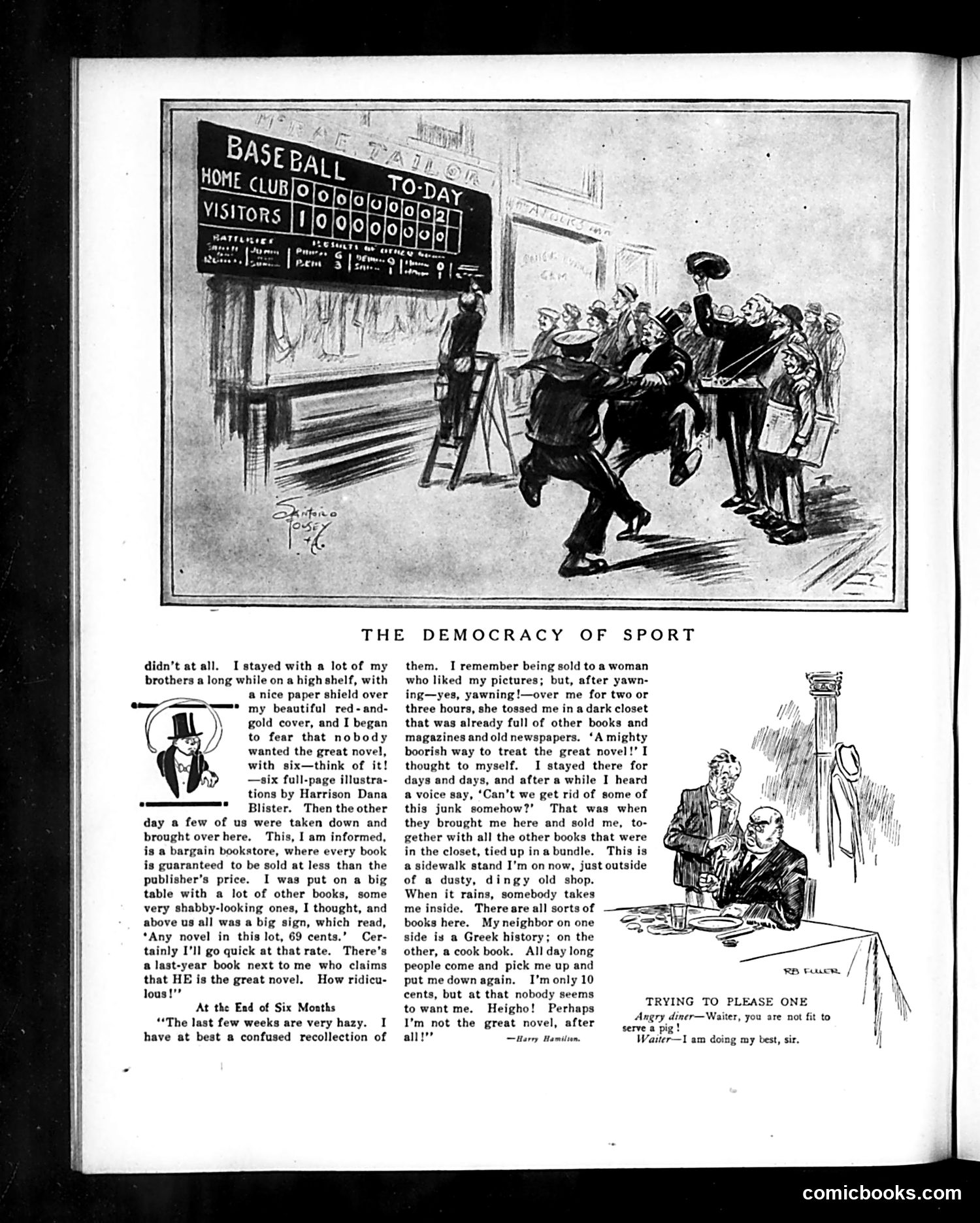
The top cartoon illustrates "the democracy of sport"—a baseball scoreboard showing a game in progress, with spectators of various social classes gathered together. The point: sports venues were genuinely democratic spaces where rich and poor mingled as equals, united by shared interest in the game. The text below is a satirical monologue from a rejected novel's perspective. An arrogant "great novel" (with six full-page illustrations) begins on a publisher's shelf, then gets sold to a bargain bookstore for 69 cents, purchased by a woman who finds it boring, relegated to a closet, and finally ends up on a 10-cent sidewalk stand where nobody wants it. The satire mocks literary pretension and wounded ego—what the novel thought was "great" proves utterly unmarketable and forgettable. The bottom cartoon, "Trying to Please One," shows a waiter accepting harsh criticism with humility, satirizing service industry dynamics.
📄 Transcribed text from this page (OCR, searchable)
Machine-transcribed from the original scan — historical spelling and the odd misread are preserved.
THE DEMOCRACY OF SPORT didn’t at all. I stayed with a lot of my brothers a long while on a high shelf, with a nice paper shield over my beautiful red-and- gold cover, and I began to fear that nobody wanted the great novel, with six—think of it! —six full-page illustra- tions by Harrison Dana Blister. Then the other day a few of us were taken down and brought overhere, This, I am informed, is a bargain bookstore, where every book is guaranteed to be sold at less than the publisher’s price. I was put on a big table with a lot of other books, some very shabby-looking ones, I thought, and above us all was a big sign, which read, ‘Any novel in this lot, 69 cents.’ Cer- tainly I'll go quick at that rate. There's a last-year book next tome who claims that HE is the great novel. How ridicu- lous!’” At the End of Six Months “The last few weeks are very hazy. I have at best a confused recollection of them. I remember being sold to a woman who liked my pictures; but, after yawn- ing—yes, yawning!—over me for two or three hours, she tossed me in a dark closet that already full of other books and magazines and old newspapers. ‘A mighty boorish way to treat the great novel!’ I thought to myself. I stayed there for days and days, and after a while I heard a voice say, ‘Can't we get rid of some of this junk somehow?’ That was when they brought me here and sold me, to- gether with all the other books that were in the closet, tied up ina bundle. This is a sidewalk stand I’m on now, just outside of a dusty, dingy old shop. When it rains, somebody takes me inside. There are all sorts of books here. My neighbor on one side is a Greek history; on the other, a cook book. All day long people come and pick me up and put me down again. I’m only 10 cents, but at that nobody seems to want me. Heigho! Perhaps I’m not the great novel, after all!’” Harry Hamilen, TRYING TO PLEASE ONE Angry diner—Waiter, you are not fit to serve a pig! Waiter—I am doing my best, sir. comicbooks.com