
Judge, 1913-05-03 · page 4 of 24
Judge — May 3, 1913 — page 4: what you’re looking at
What you’re looking at
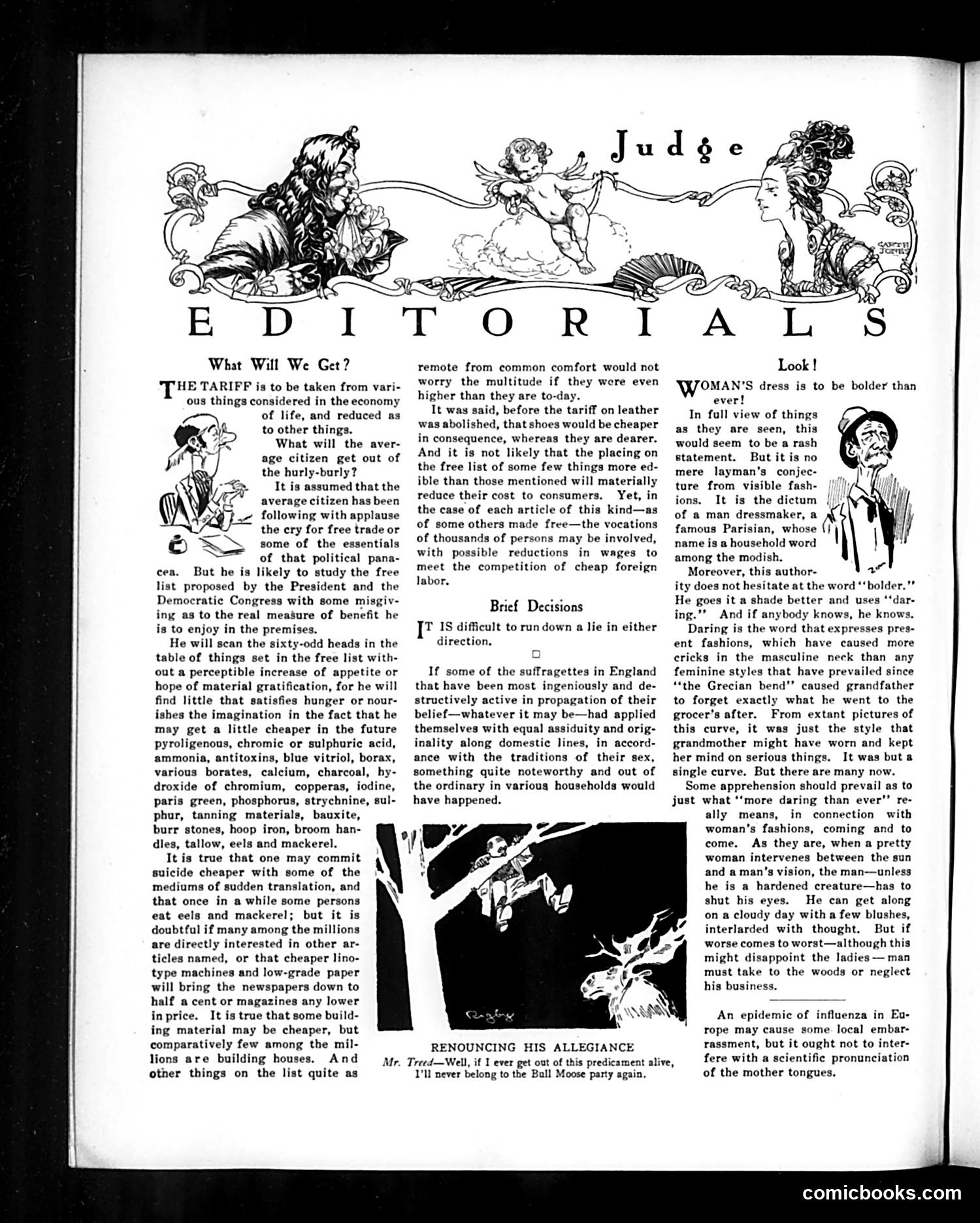
This page contains editorial commentary on tariff policy and fashion rather than traditional political cartoons. The main article "What Will We Get?" debates whether free trade or protective tariffs benefit consumers—arguing that cheap imports might reduce prices but could eliminate American jobs across industries (chemicals, metals, textiles, etc.). The sidebar "Look!" mocks women's fashion, specifically criticizing the "bolder" silhouettes and masculine styling of contemporary dresses. It suggests a Persian dressmaker deserves credit for these unflattering trends, humorously implying women's fashion has become absurdly exaggerated. The cartoon "Renouncing His Allegiance" shows someone abandoning the Bull Moose party—likely referencing Theodore Roosevelt's 1912 Progressive ("Bull Moose") Party split from Republicans.
📄 Transcribed text from this page (OCR, searchable)
Machine-transcribed from the original scan — historical spelling and the odd misread are preserved.
What Will We Get? THE TARIFF is to be taken from vari- ous things considered in the economy of life, and reduced as to other things. What will the aver- age citizen get out of the hurly-burly? It is assumed that the average citizen has been following with applause the cry for free trade or some of the essentials of that political pana- cea. But he is likely to study the free list proposed by the President and the Democratic Congress with some mis; ing as to the real measure of benefit he is to enjoy in the premises. He will scan the sixty-odd heads in the table of things set in the free list with- out a perceptible increase of appetite or hope of material gratification, for he will find little that satisfies hunger or nour- ishes the imagination in the fact that he may get a little cheaper in the future pyroligenous, chromic or sulphuric acid, ammonia, antitoxins, blue vitriol, borax, various borates, calcium, charcoal, hy- droxide of chromium, copperas, iodine, paris green, phosphorus, strychnine, sul- phur, tanning materials, bauxite, burr stones, hoop iron, broom han- dles, tallow, eels and mackerel. is true that one may commit suicide cheaper with some of the mediums of sudden translation, and that once in a while some persons eat eels and mackerel; but it is doubtful if many among the millions are directly interested in other ar- ticles named, or that cheaper lino- type machines and low-grade paper will bring the newspapers down to half a cent or magazines any lower in price. It is true that some build- ing material may be cheaper, but comparatively few among the mil- lions are building houses. And other things on the list quite as T O R I remote from common comfort would not worry the multitude if they were even higher than they are to-day. It was said, before the tariff on leather was abolished, that shoes would be cheaper in consequence, whereas they are dearer. And it is not likely that the placing on the free list of some few things more ed- ible than those mentioned will materially reduce their cost to consumers. Yet, in the case of each article of this kind: of some others made free—the vocations of thousands of persons may be involved, with possible reductions in wages to meet the competition of cheap foreign labor. Brief Decisions I" IS difficult to run down a lie in either direction, If some of the suffragettes in England that have been most ingeniously and de- structively active in propagation of their belief—whatever it may be—had applied themselves with equal assiduity and orig- inality along domestic lines, in accord- ance with the traditions of their sex, something quite noteworthy and out of the ordinary in various households would have happened. RENOUNCING HIS ALLEGIANCE Mr. Treed—Wel, if I ever get out of this predicament alive, I'll never belong to the Ball Moose party again. Woman's dress is to be bolder than ever! In full view of things as they are seen, this would seem to be a rash statement. But it is no mere layman's conjec- ture from visible fash- ions. It is the dictum of a man dressmaker, a famous Parisian, whose name is a household word among the modish. Moreover, this author- ity does not hesitate at the word ‘‘bolder.”” He goes it a shade better and uses ‘‘dar- ing.”? And if anybody knows, he knows. Daring is the word that expresses pres- ent fashions, which have caused more cricks in the masculine neck than any feminine styles that have prevailed since “the Grecian bend’’ caused grandfather to forget exactly what he went to the grocer’s after. From extant pictures of this curve, it was just the style that grandmother might have worn and kept her mind on serious things. It was but a single curve. But there are many now. Some apprehension should prevail as to just what ‘‘more daring than ever’’ re- ally means, in connection with woman’s fashions, coming and to come. As they are, when a pretty woman intervenes between the sun and a man’s vision, the man—unless he is a hardened creature—has to shut his eyes. He can get along on a cloudy day with a few blushes, interlarded with thought. But if worse comes to worst—although this might disappoint the ladies — man must take to the woods or neglect his business. An epidemic of influenza in Eu- rope may cause some. local embar- rassment, but it ought not to inter- fere with a scientific pronunciation of the mother tongues. comicbooks.com