
A complete issue · 24 pages · 1913
Judge — April 26, 1913
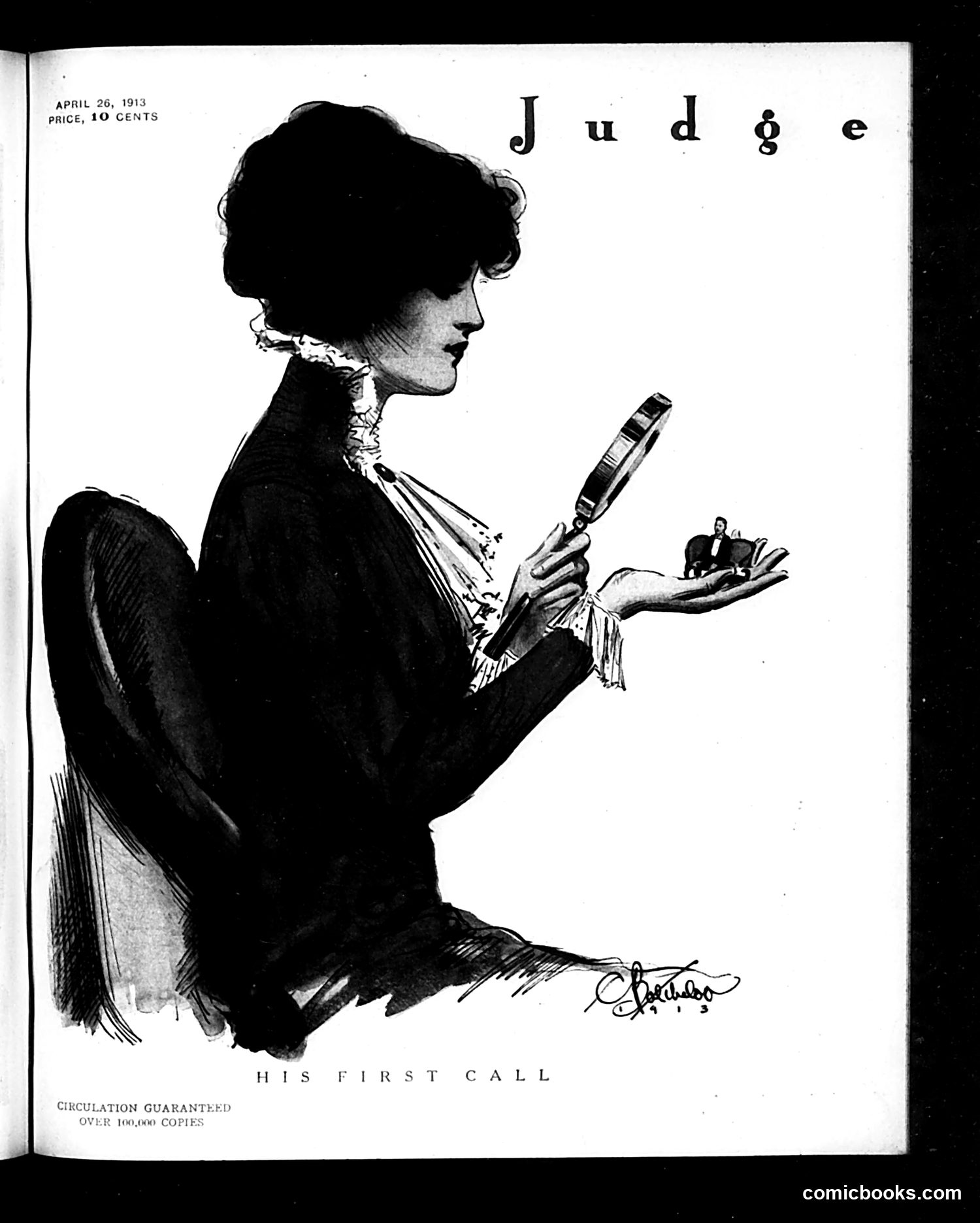
This cartoon satirizes the new technology of the telephone through a gender-based joke. The illustration shows an elegantly dressed woman holding an early telephone receiver, gesturing expressively with her other hand as if speaking. The title "His First Call" suggests she's receiving a call from a man—likely a suitor. The satire plays on contemporary anxieties about modern courtship technology and gendered telephone etiquette. The woman's animated pose implies she's talking excessively or dramatically, a common comic stereotype of women on phones in the early 1900s. The joke likely mocks how the telephone was changing social interactions and dating rituals, with the new device potentially enabling more direct (and to contemporary eyes, inappropriately forward) communication between unmarried men and women.
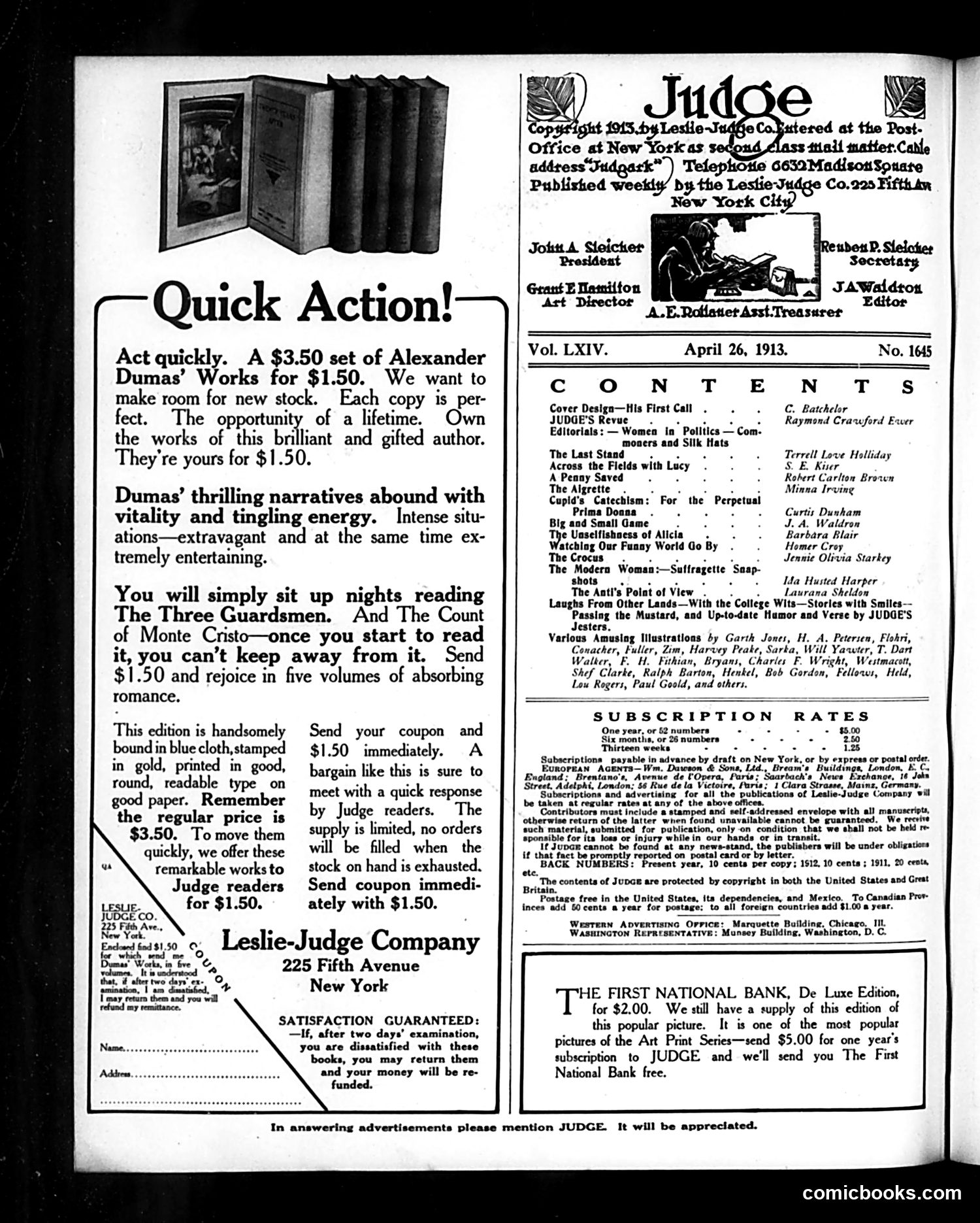
This page is primarily **advertising and masthead content** rather than political satire. The left side features a "Quick Action!" advertisement for Alexander Dumas' Works—a five-volume set being liquidated at $1.50 to clear inventory. The marketing copy emphasizes entertainment value ("thrilling narratives," "The Three Guardsmen," "The Count of Monte Cristo"). The right side contains the magazine's masthead, contents page, and subscription information dated **April 26, 1913**. Various article titles appear (women in politics, stories by established authors), but without accompanying illustrations, their satirical intent isn't visible here. A small advertisement at bottom mentions **The First National Bank's De Luxe Edition** for $2.00. The page demonstrates how early 20th-century magazines mixed editorial content with extensive advertising.
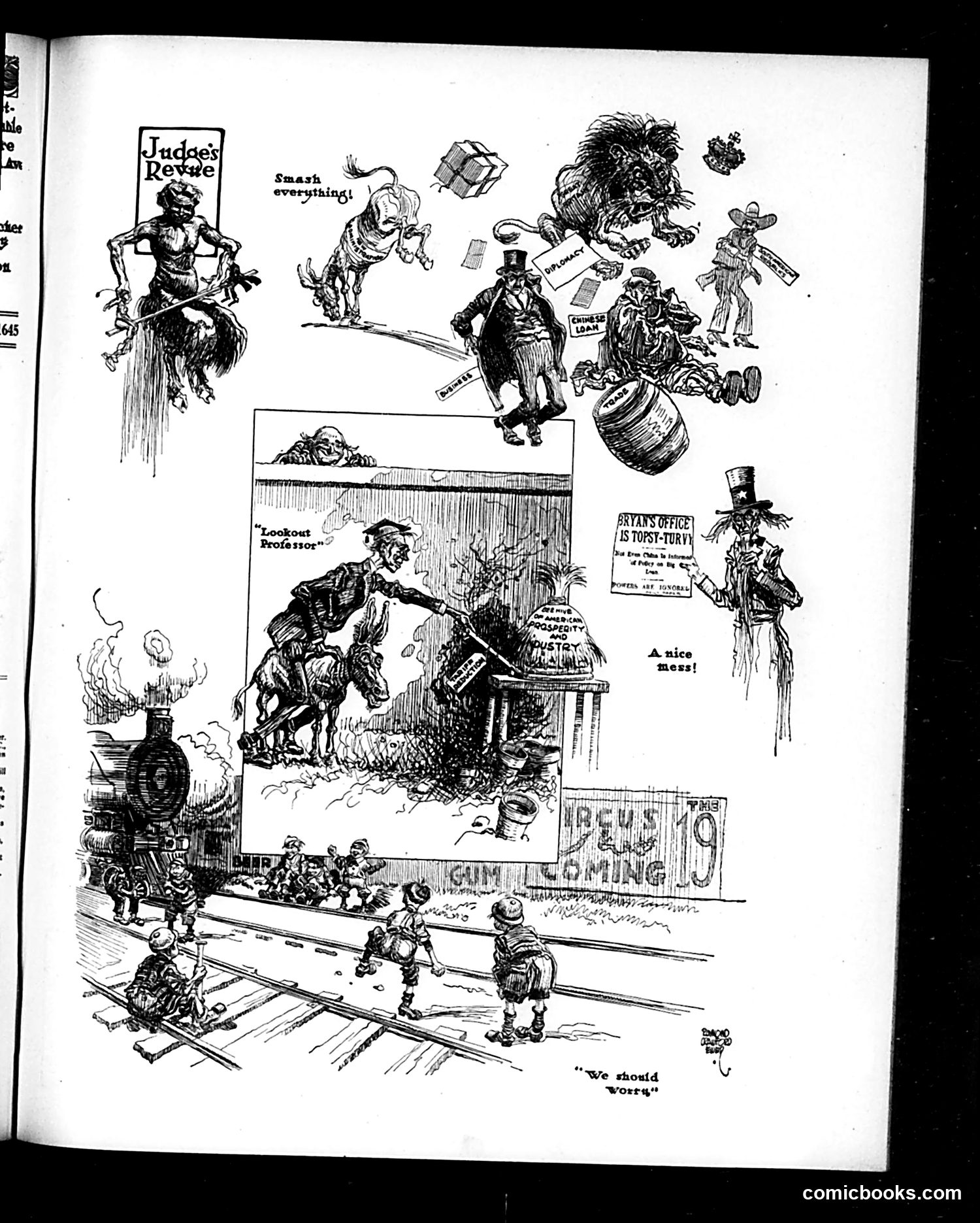
This Judge magazine page is a political satire attacking what appears to be corrupt government administration, likely from the early 1900s. The central cartoon shows a figure labeled "Lookout Professor" supervising chaos—a burning building, fleeing characters, and general disorder. The top-left panel shows "Judge's Revise" with a judicial figure. Other vignettes reference "Bryan's Office is Topsy-Turvy" and show various characters juggling or mishandling documents and responsibilities. The satire criticizes administrative incompetence and corruption—figures are depicted as unable to manage basic governance, with papers flying, fires burning, and things literally falling apart. The "we should work" caption at bottom suggests lazy or negligent officials. The overall message: government is in chaos due to mismanagement and corruption. Without clearer date context, the specific administration or scandal targeted remains unclear, though the style suggests early Gilded Age or Progressive Era criticism.
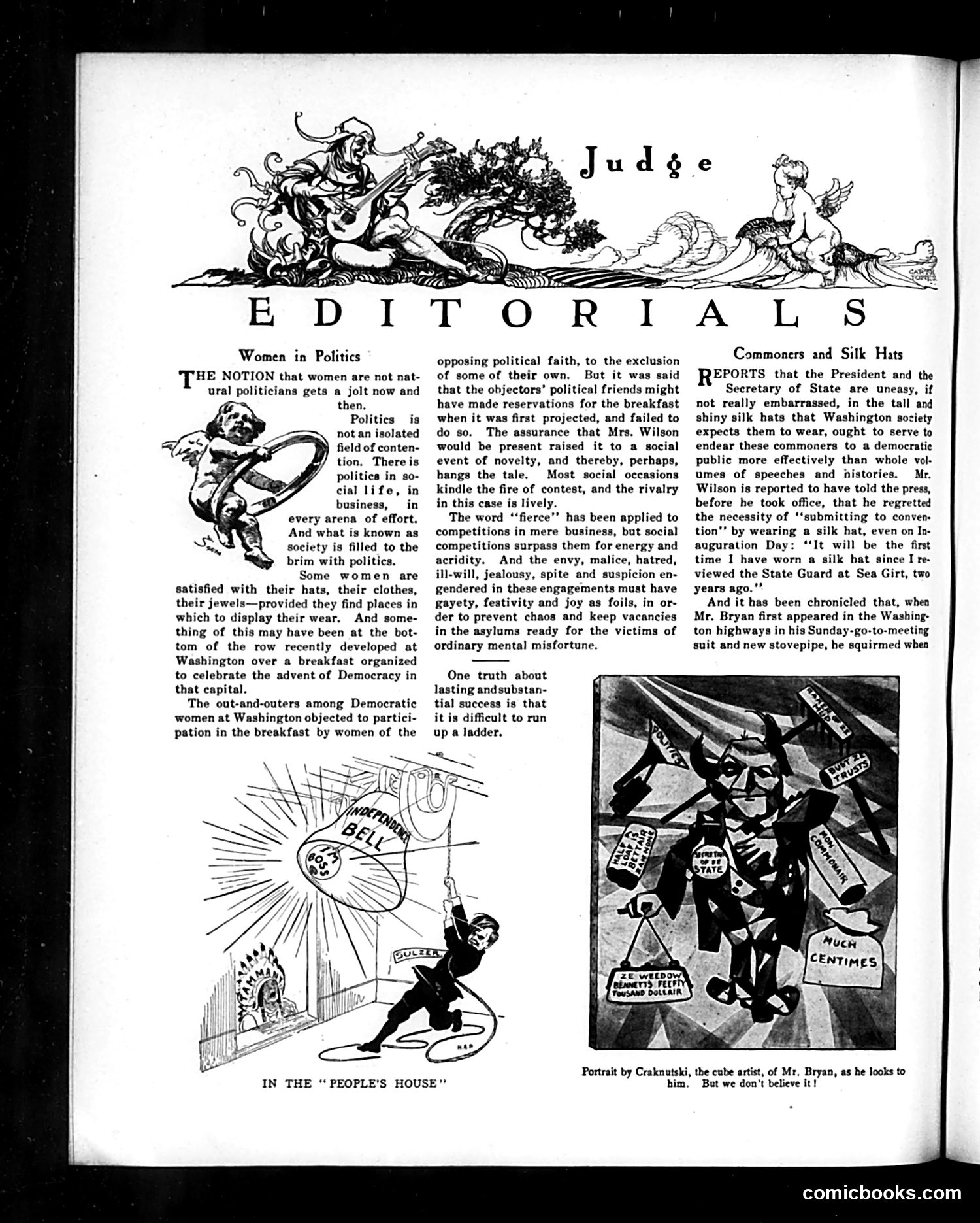
This editorial page from Judge satirizes two topics: **"Women in Politics"** (left): The article mocks Democratic women who objected to participating in a Washington breakfast celebrating Democracy's advent. The cartoon depicts a man struggling to climb a ladder labeled with political competition, illustrating the editorial's point that "it is difficult to run up a ladder" to political success. The satire suggests women lack the fortitude for serious politics. **"Commoners and Silk Hats"** (right): This critiques President Wilson and Secretary of State Bryan for wearing silk hats—symbols of upper-class formality—to democratic public occasions. A caricature (labeled as Bryan by Crakstski, the "cabe artist") shows him surrounded by labels mocking this contradiction between democratic rhetoric and aristocratic appearance.
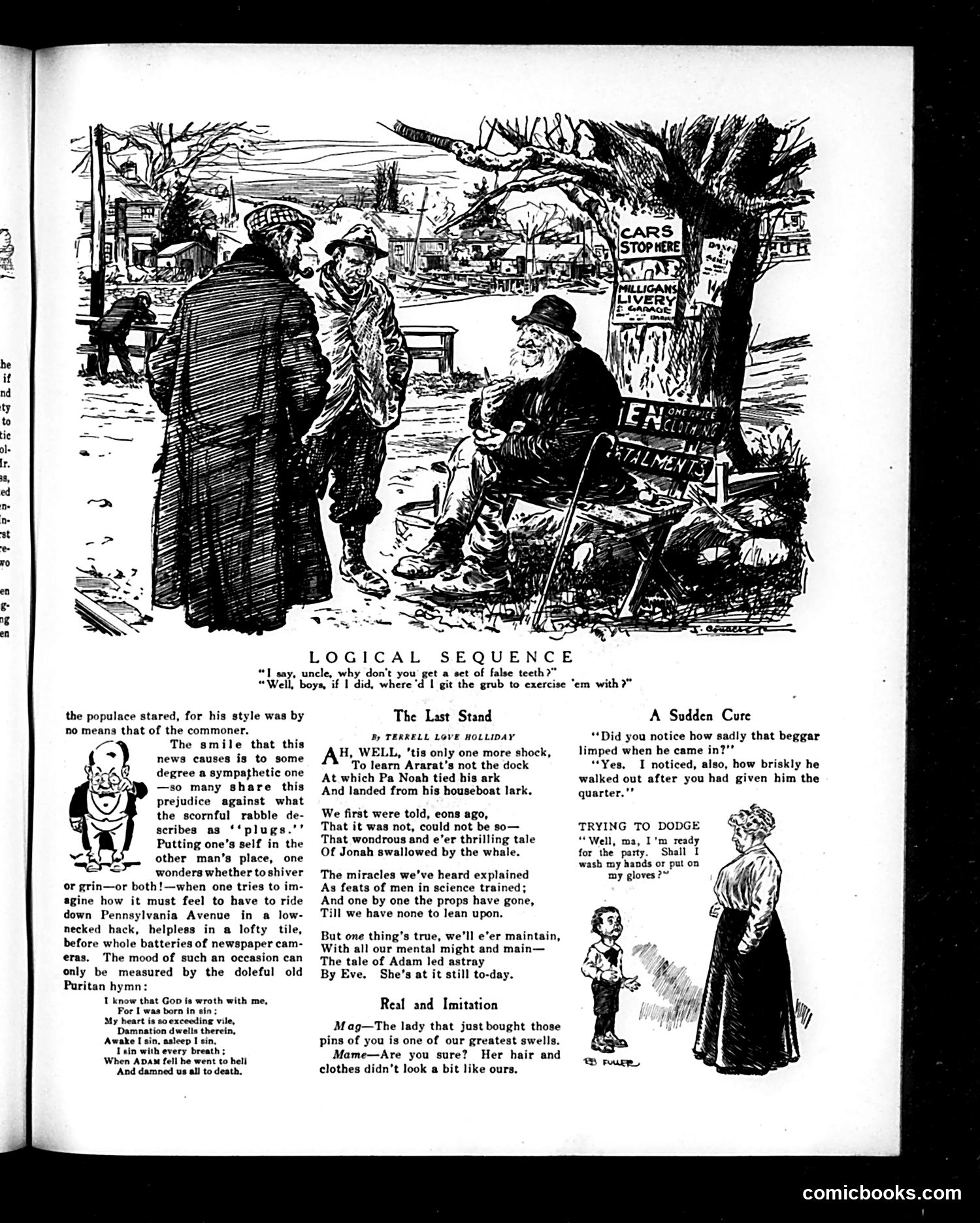
The main cartoon titled "Logical Sequence" depicts a social encounter where a well-dressed man asks a shabby beggar, "I say, uncle, why don't you get a set of false teeth?" The beggar replies, "Well, boys, if I did, where'd I get the grub to exercise 'em with?" This satirizes the paradox of poverty: the beggar lacks not just teeth but food itself, making dental care absurdly irrelevant to his survival. The joke targets the naive advice often given to poor people—assuming false teeth would improve their circumstances when basic sustenance remains inaccessible. The surrounding stories and smaller cartoons ("The Last Stand," "A Sudden Cure," "Trying to Dodge") appear to be unrelated satirical pieces on other social topics typical of Judge's humor.
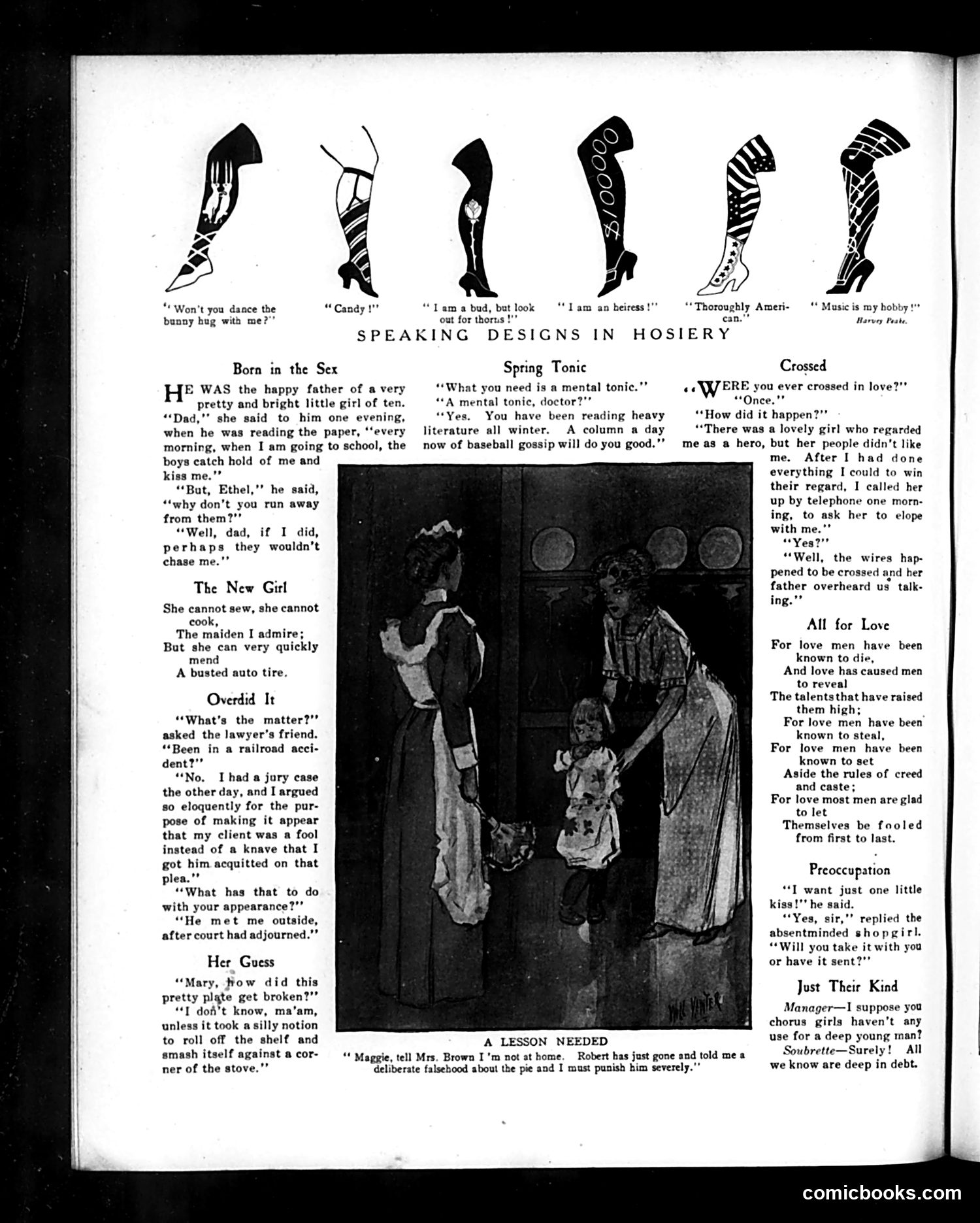
This page from Judge magazine combines humor pieces and advertisements typical of early 20th-century American satirical publishing. The content reflects contemporary social anxieties about changing gender roles and modern behavior. The hosiery advertisement at top uses suggestive quotes about women's independence ("I am an heiress," "Music is my hobby") paired with illustrated stockings—a commentary on how consumer goods were marketed to appeal to increasingly independent women. The humor pieces mock various targets: a father naive about his daughter's romantic encounters; a modern girl who can fix cars but can't cook (reflecting anxiety about women's changing roles); lawyers and their duplicitous rhetoric; a mother concerned about her son's honesty while lying to visitors; and the final joke about chorus girls prioritizing debt over intellectual men—a dig at both theatrical workers and pretentious intellectuals. The overall tone suggests mild, class-conscious social satire aimed at middle-class readers concerned about modernization, female independence, and moral standards.
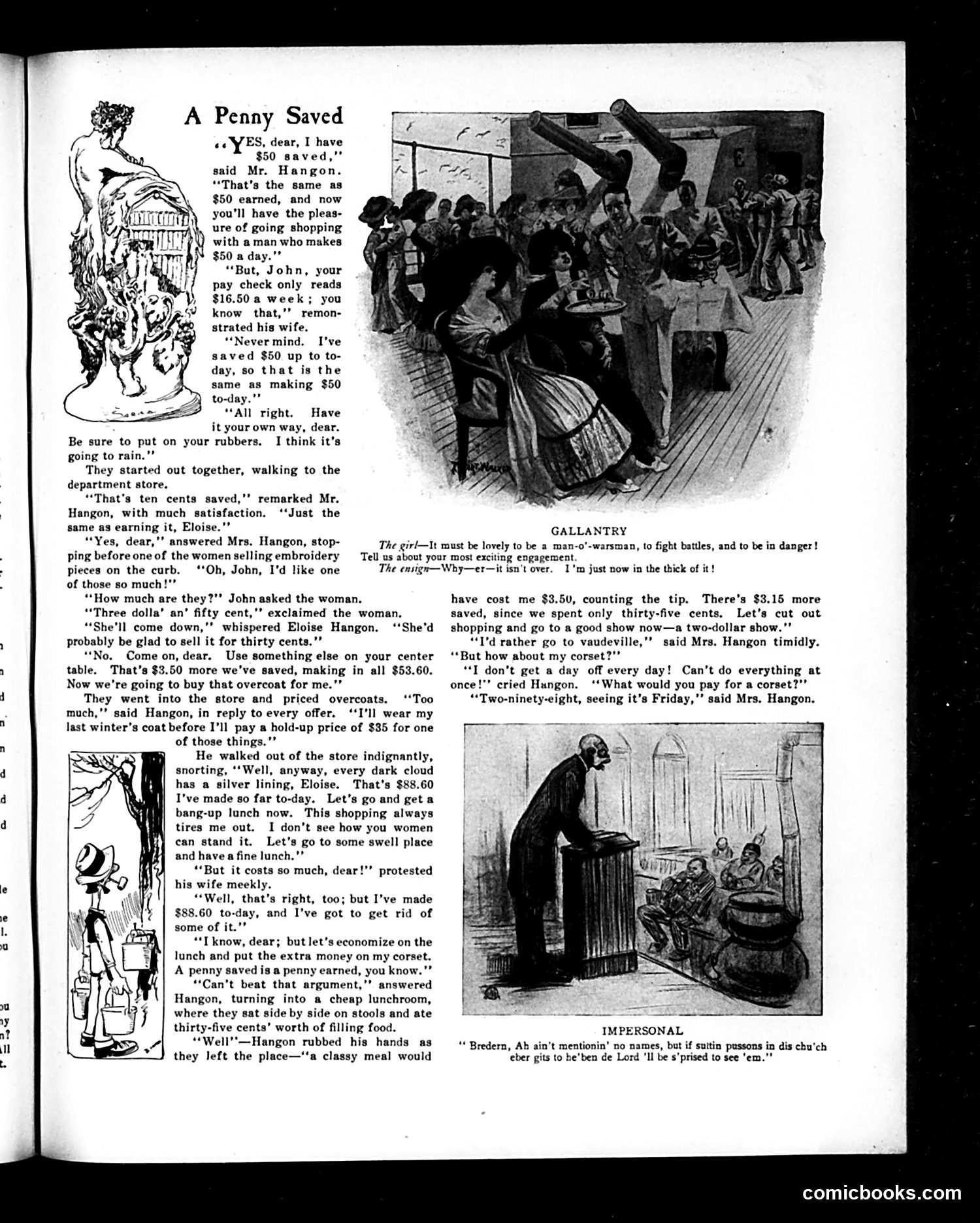
This story satirizes the flawed logic of a middle-class husband, Mr. Hangon, who conflates *saving money* with *earning money*. Earning only $16.50 weekly, he absurdly claims that avoiding a $3.50 purchase is "the same as making $50 to-day." The satire targets Victorian-era financial delusion and male condescension. Despite his wife's gentle protests about actual constraints, Hangon justifies wasteful spending (expensive lunch, theater tickets) while refusing necessary purchases (her corset) using his twisted savings arithmetic. The cartoon mocks both his rationalization and the era's gender dynamics—his wife meekly accepts his illogic while sacrificing her needs. The subsidiary "Gallantry" cartoon satirizes military men's evasiveness about danger, and "Impersonal" appears to be a separate religious joke about hypocrisy.
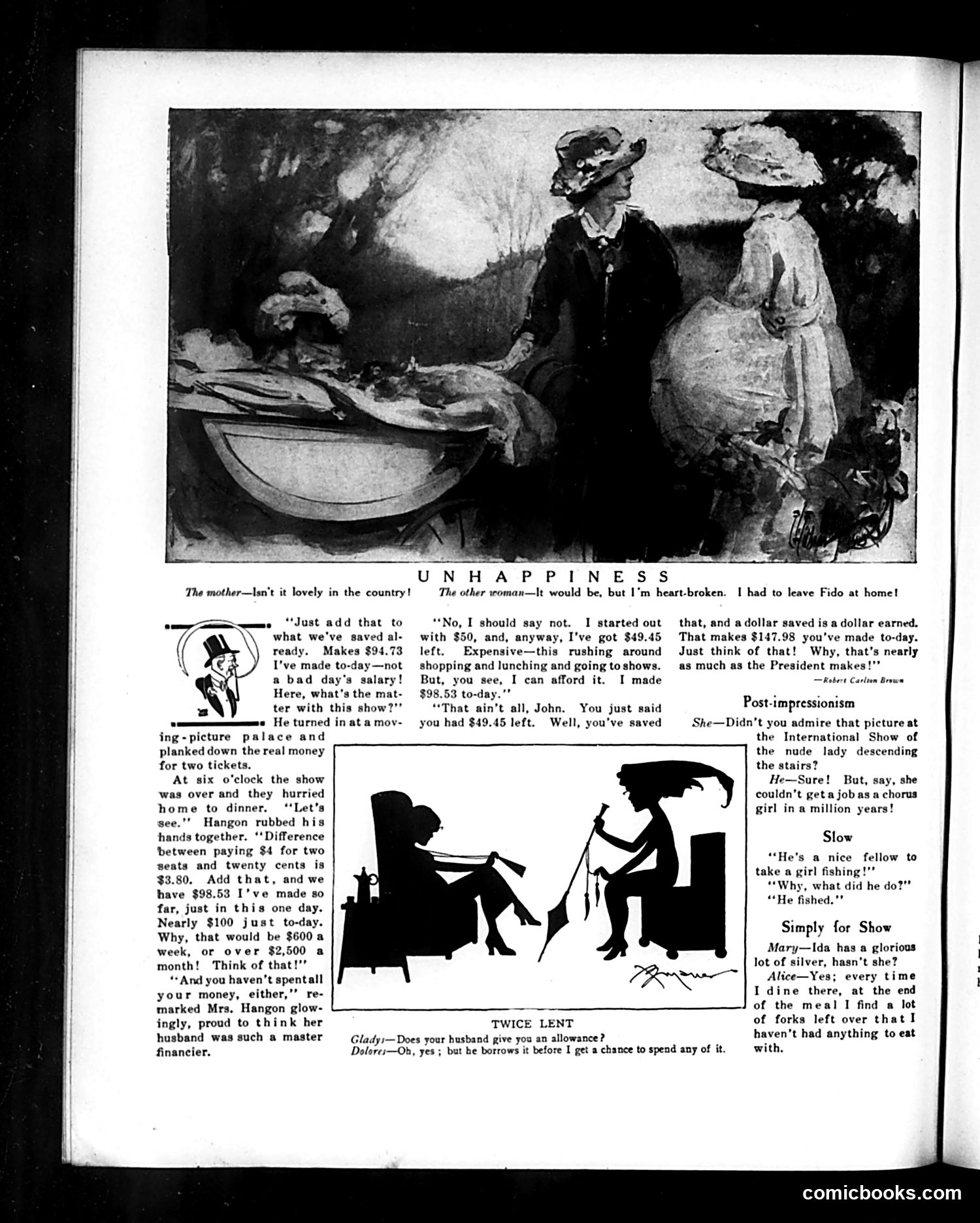
This page contains three separate satirical pieces mocking middle-class financial pretense: **"UNHAPPINESS"** (top): A couple calculates imaginary savings from a day out—$98.53 in "saved" money by comparing what they spent versus hypothetical costs. The satire targets self-deceptive accounting: they spent real money ($50 of a $49.45 remainder) while congratulating themselves on financial mastery. The wife's heartbreak over leaving her dog home undercuts the husband's boastful calculations. **"TWICE LENT"** (bottom left): A husband borrows his wife's allowance before she can spend it—mocking marital financial control and the fiction of women's "independence" in an allowance system. **The remaining shorts** mock pretentious taste ("Post-impressionism"), romantic incompetence, and ostentatious entertaining without substance. The common thread: Judge satirizes how the emerging middle class performed wealth and financial sophistication through consumption and flawed logic, while actual money management remained chaotic.
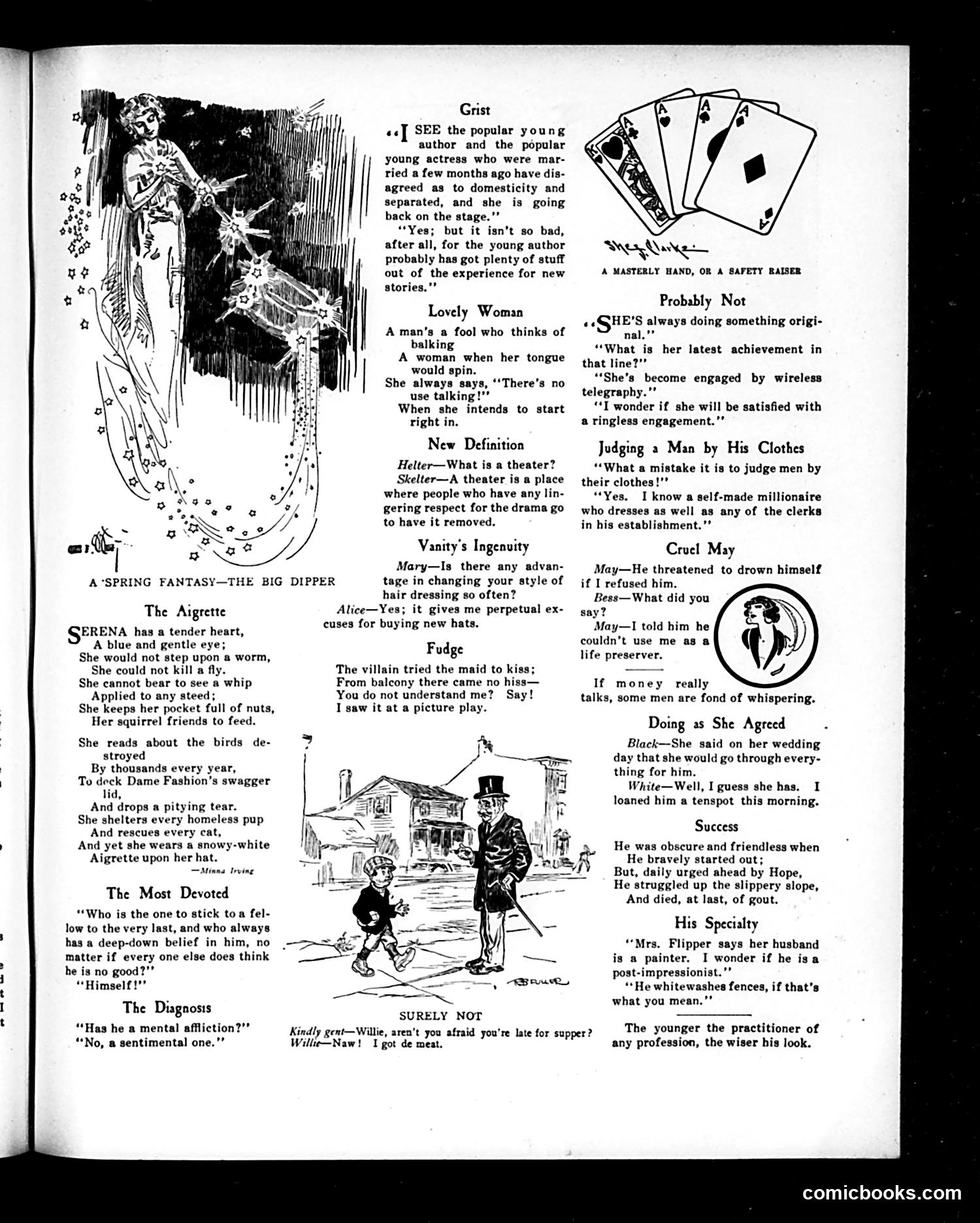
This page contains short humorous pieces typical of early 20th-century American satirical magazines. Key targets include: **"The Aigrette"**: Critiques the hypocrisy of fashionable women who claim to love animals yet wear feathered hats made from killed birds—a real controversy as aigrettes (egret plumes) were fashionable despite conservation concerns. **"Lovely Woman"** and similar brief jokes mock domestic life, women's chattiness, and marriage—standard period humor about gender relations. **"New Definition"**: Satirizes theater audiences' indifference to dramatic quality, suggesting they attend mainly to socialize. **Various one-liners**: Poke fun at vanity, wireless technology (then novel), self-made millionaires, and class pretension. The illustrations support the text with period-appropriate drawings. Overall, the page reflects turn-of-the-century concerns about fashion excess, technology, marriage compatibility, and social hypocrisy—delivered through quick, cynical quips typical of Judge's style.
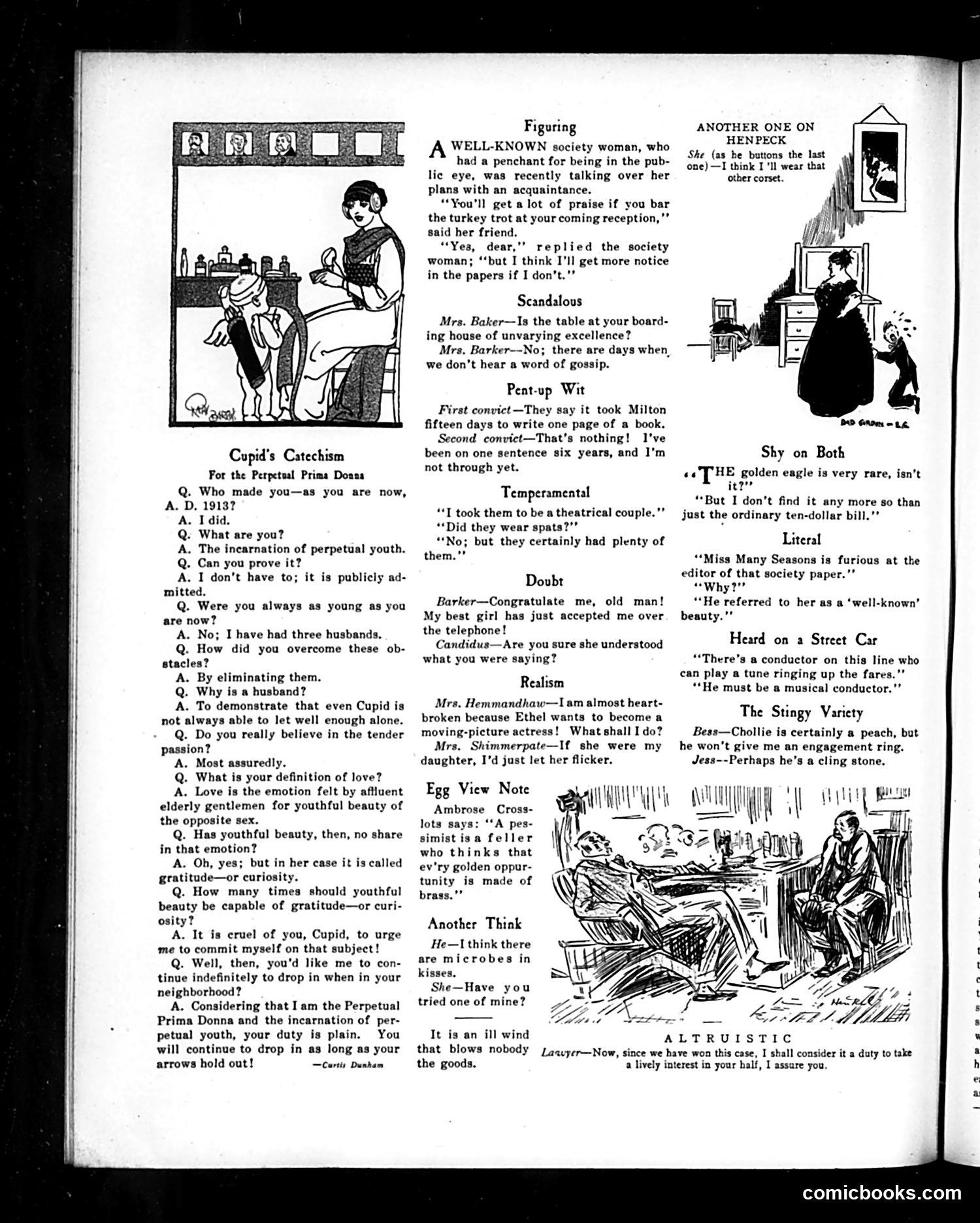
This 1913 page from *Judge* contains multiple short satirical pieces mocking contemporary social attitudes, particularly around wealth, gender relations, and class. The central "Cupid's Catechism" mockingly interviews a wealthy, aging society woman who has had three husbands. The satire targets her shameless materialism: she admits "love" is what rich old men feel for young beauty, while young women experience mere "gratitude—or curiosity" (implying mercenary motivation). The piece skewers both predatory wealthy men and gold-digging women. Other brief jokes target social pretension (a woman banning the "turkey trot" dance to gain newspaper notice by *not* banning it), theatrical temperament, and hypocrisy. "Altruistic" mocks a lawyer who claims interest in his client's welfare while clearly intending to overcharge. Overall, the page satirizes Gilded Age excess, shallow society women, transactional marriages between wealth and youth, and professional dishonesty—themes reflecting Progressive Era anxieties about inequality and moral decay among the wealthy.
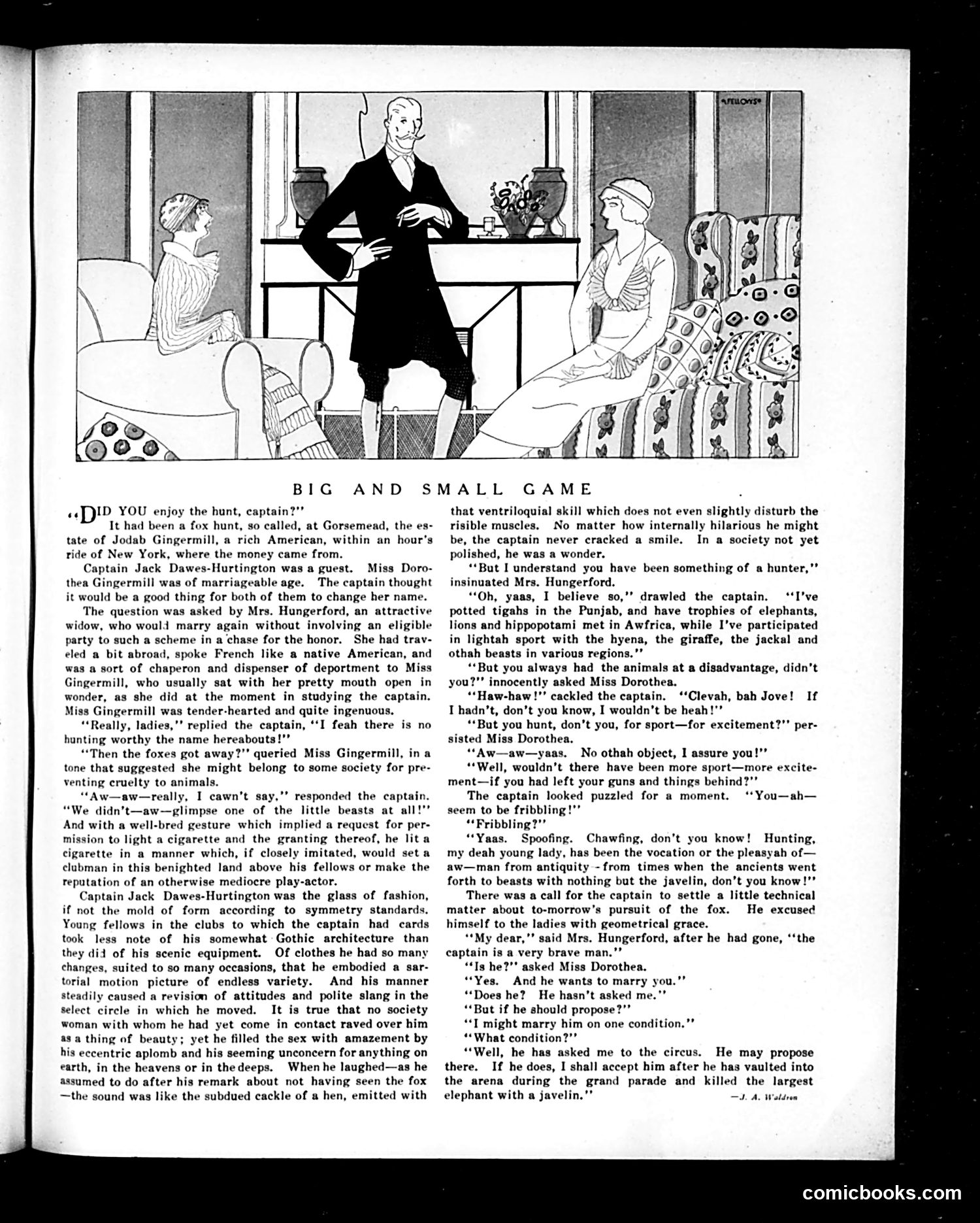
This story satirizes a pretentious British aristocrat, Captain Jack Dawes-Huntington, visiting a wealthy American estate. The "captain" is a caricature of the affected English gentleman—speaking in exaggerated drawl ("yaas," "Awfrica"), obsessed with fashion and manners, and displaying studied indifference through forced laughter. The joke centers on his hunting boasts: he claims to have killed tigers and elephants in Africa, yet couldn't even find a fox in a staged hunt. Miss Dorothea, the innocent American heiress, innocently points out the contradiction—true hunting requires genuine challenge, not killing defenseless animals. Her suggestion that he hunt *without* guns exposes his pretense as mere "fribbling" (trifling). The satire targets gilded-age Americans' fascination with European titles and manners, and mocks the shallow masculinity of aristocrats who perform sophistication while lacking actual courage or skill.
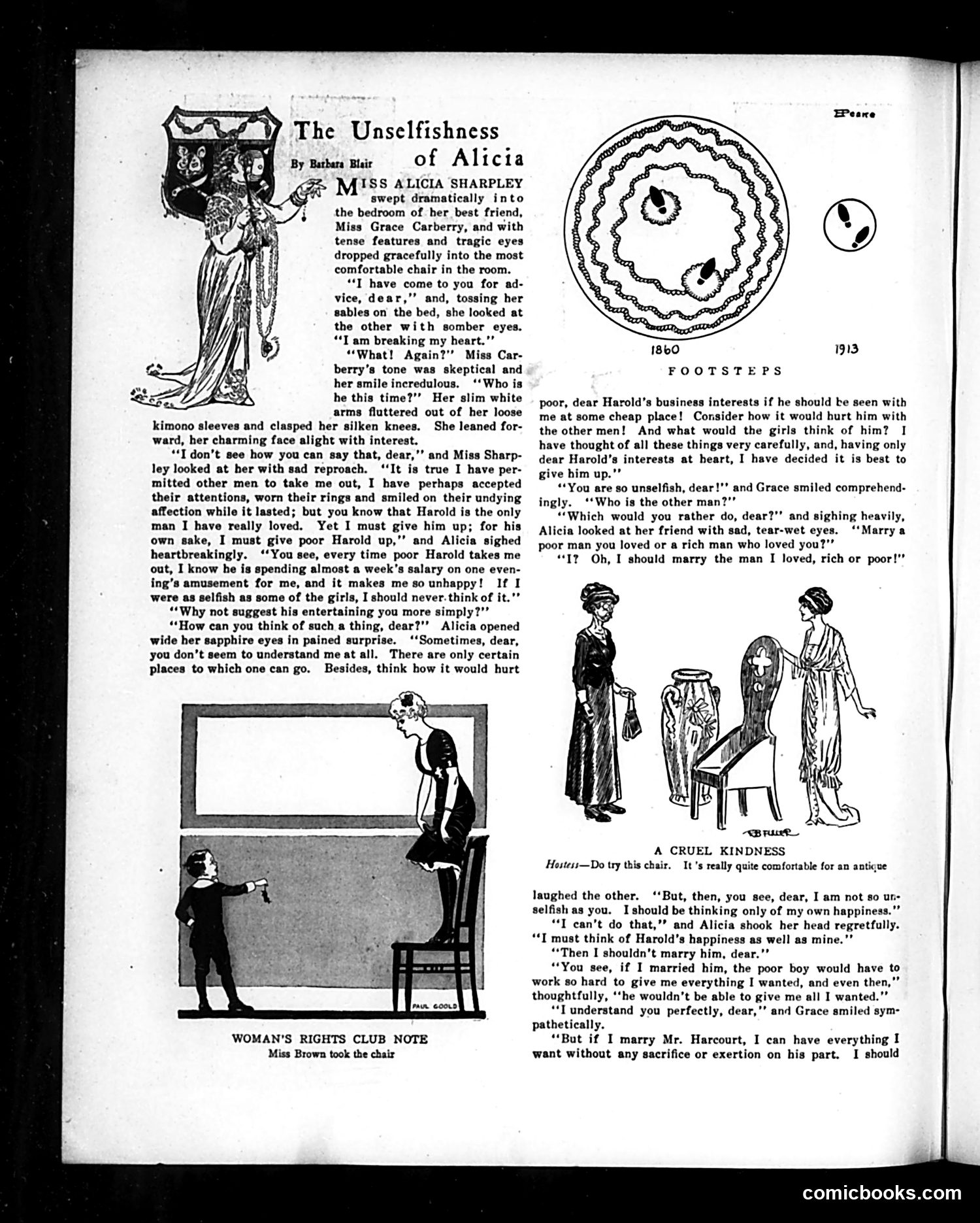
This story satirizes wealthy young women who rationalize selfish behavior as selflessness. Alicia Sharpley claims she must break up with her poor boyfriend Harold to spare *him* financial hardship—yet her real motivation is transparent: she wants to marry the wealthy Mr. Harcourt instead, who can provide luxuries without requiring her sacrifice. The satire works through ironic dialogue. Alicia's reasoning is absurdly circular: she won't date Harold because his spending on her would hurt his finances and reputation, but she'll gladly marry rich Harcourt to avoid exertion. Her friend Grace sees through the pretense immediately. The "Woman's Rights Club Note" cartoon (bottom left) appears to mock women's clubs of the era, though its specific point is unclear from the visible text. The piece targets the hypocrisy of privileged women who disguise mercenary motives as moral concern, and critiques the shallow materialism of the wealthy.
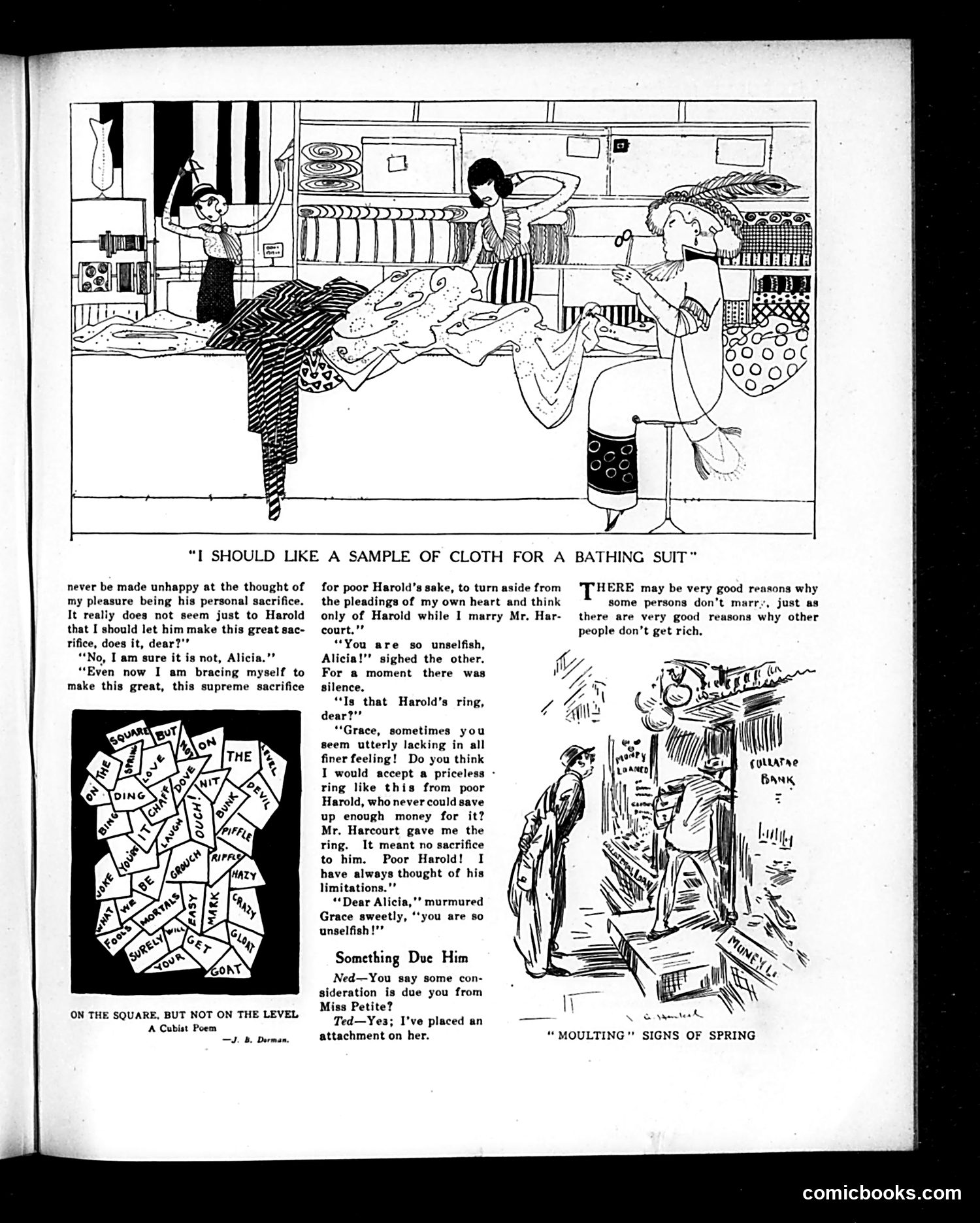
**Main Cartoon ("I Should Like a Sample of Cloth for a Bathing Suit"):** This satirizes female hypocrisy and materialism. A woman named Alicia claims she's nobly sacrificing her love for poor Harold to marry the wealthy Mr. Harcourt—framing this as selfless. However, the dialogue reveals her actual motivation: she accepts Harcourt's expensive ring while rejecting Harold's modest means. The satire exposes her rationalization of marrying for money as false virtue-signaling. She performatively mourns Harold's "limitations" while clearly valuing Harcourt's wealth over genuine affection. **Secondary Content:** - A Cubist poem ("On the Square, But Not On the Level") by J.B. Dorman plays with geometric abstraction - "Moulting Signs of Spring" appears to be an unrelated illustration - A brief joke about attachment (likely legal/financial) as romantic obligation The page targets early 20th-century courtship practices and women's claims of romantic idealism masking mercenary motivations.
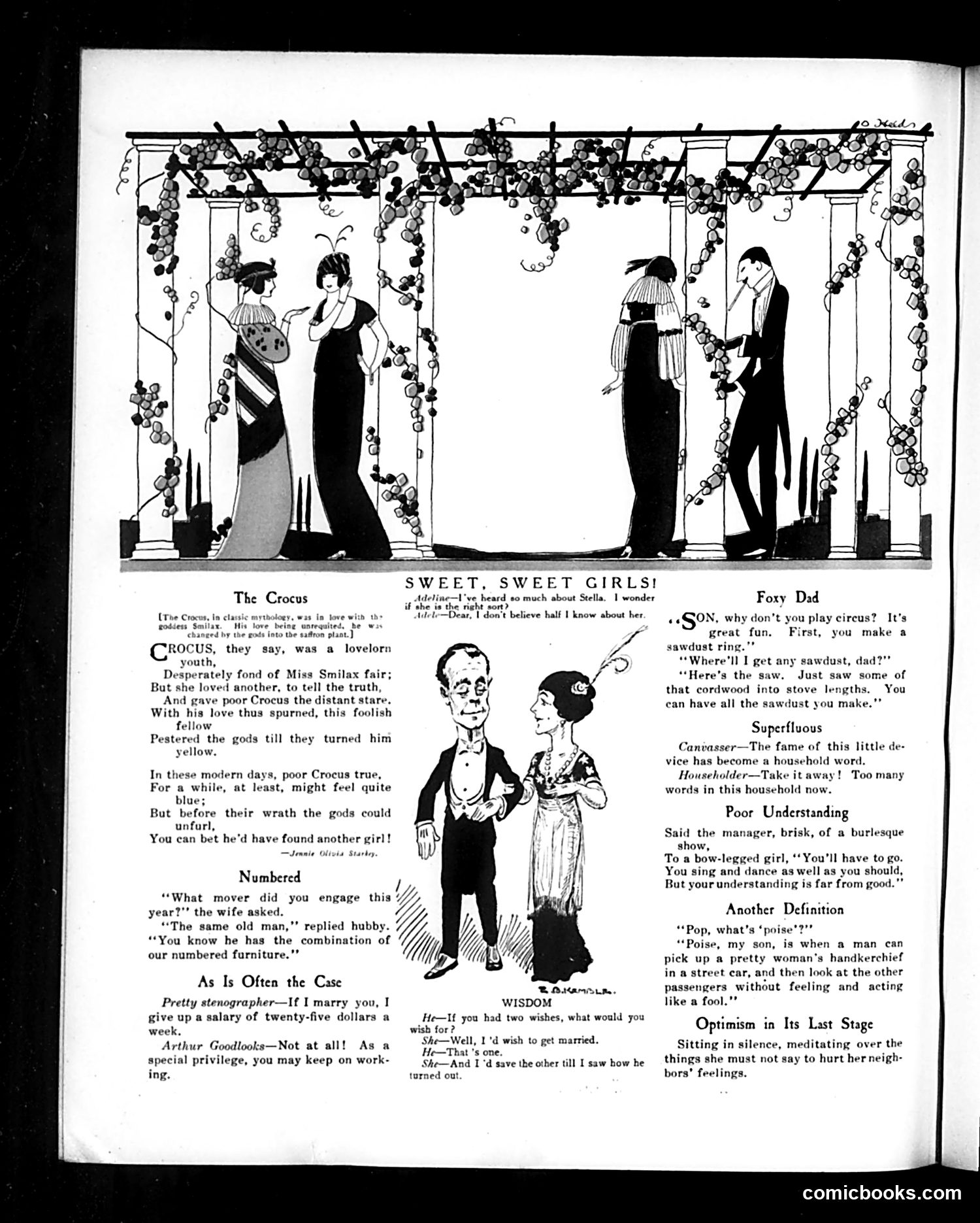
This page contains multiple short satirical pieces typical of early 20th-century American humor magazines. **"The Crocus"** retells the Greek myth of Crocus, a lovelorn youth transformed into a flower. The satire suggests that in modern times, a rejected lover wouldn't waste energy petitioning the gods—he'd simply find another woman. It mocks both romantic desperation and classical melodrama. **Other pieces mock domestic life and contemporary manners:** - A husband's obliviousness to his wife's complaints about movers - A stenographer accepting lower pay to marry - A father's trick to get free sawdust from his son - A traveling salesman overselling a product's "fame" - A burlesque manager's crude dismissal of a bow-legged dancer - A definition of "poise" as male composure when picking up an attractive woman's handkerchief The humor targets marital dynamics, workplace gender relations, consumer culture, and social pretense—reflecting period anxieties about changing gender roles and commercial life. The jokes rely on dated assumptions about masculinity, femininity, and class.
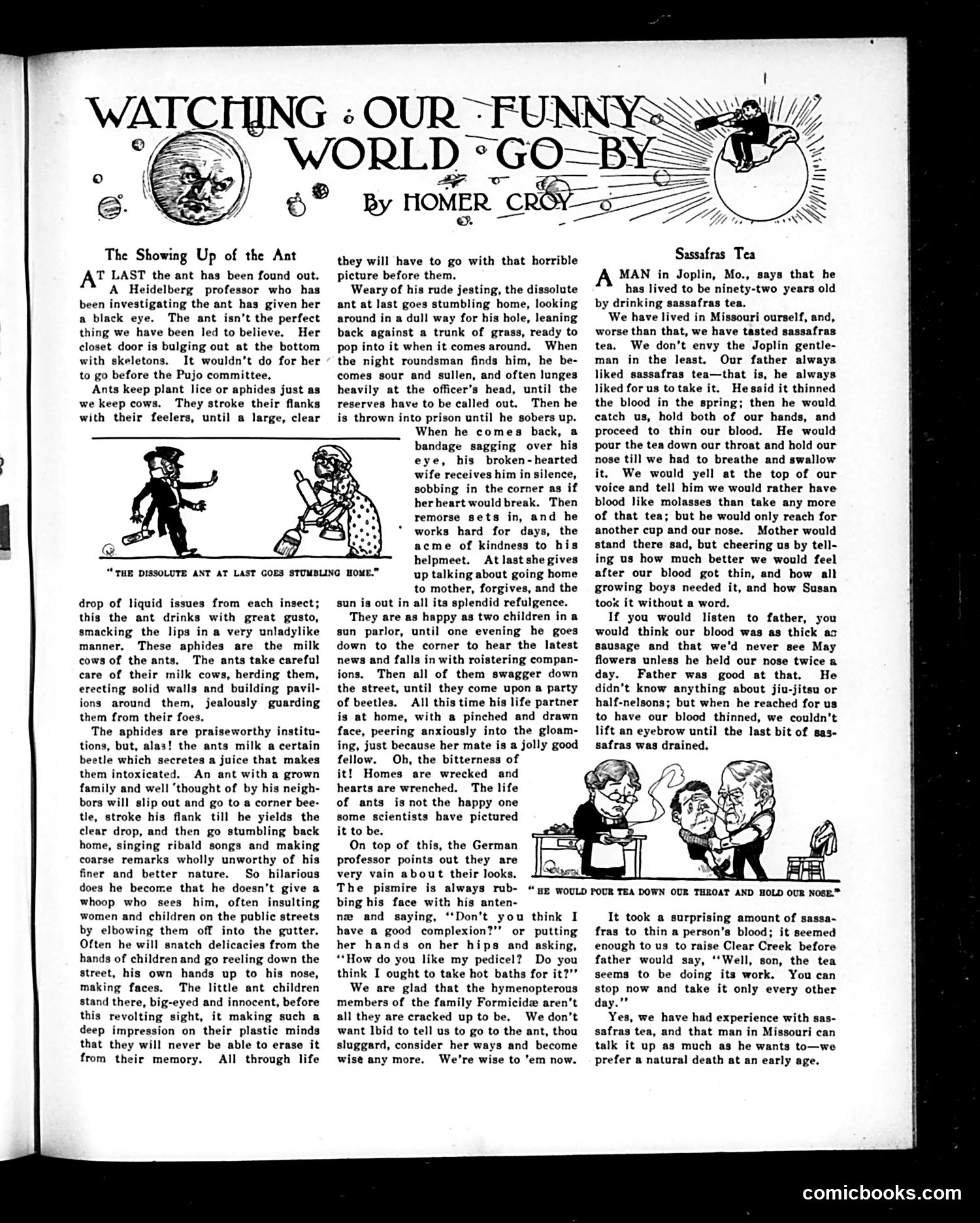
This is a humorous satire exposing that ants—long celebrated by scientists as model creatures of industry and virtue—are actually dissolute and vain. A German professor has revealed their flaws. The piece mocks both ants and human society: worker ants secretly visit beetles to get intoxicated on their secretions, then stumble home drunk, insulting women and children, getting arrested, and requiring their wives' forgiveness. The cycle repeats. Additionally, ants are vain about their appearance. The satire is social commentary—likely critiquing working-class or immigrant behavior (the German reference may be relevant). By exposing ants' hypocrisy, Croy suggests that celebrated institutions and role models often hide shameful realities. The cartoon illustrations show the "dissolute ant" stumbling home and (bottom) what appears to be a domestic confrontation.
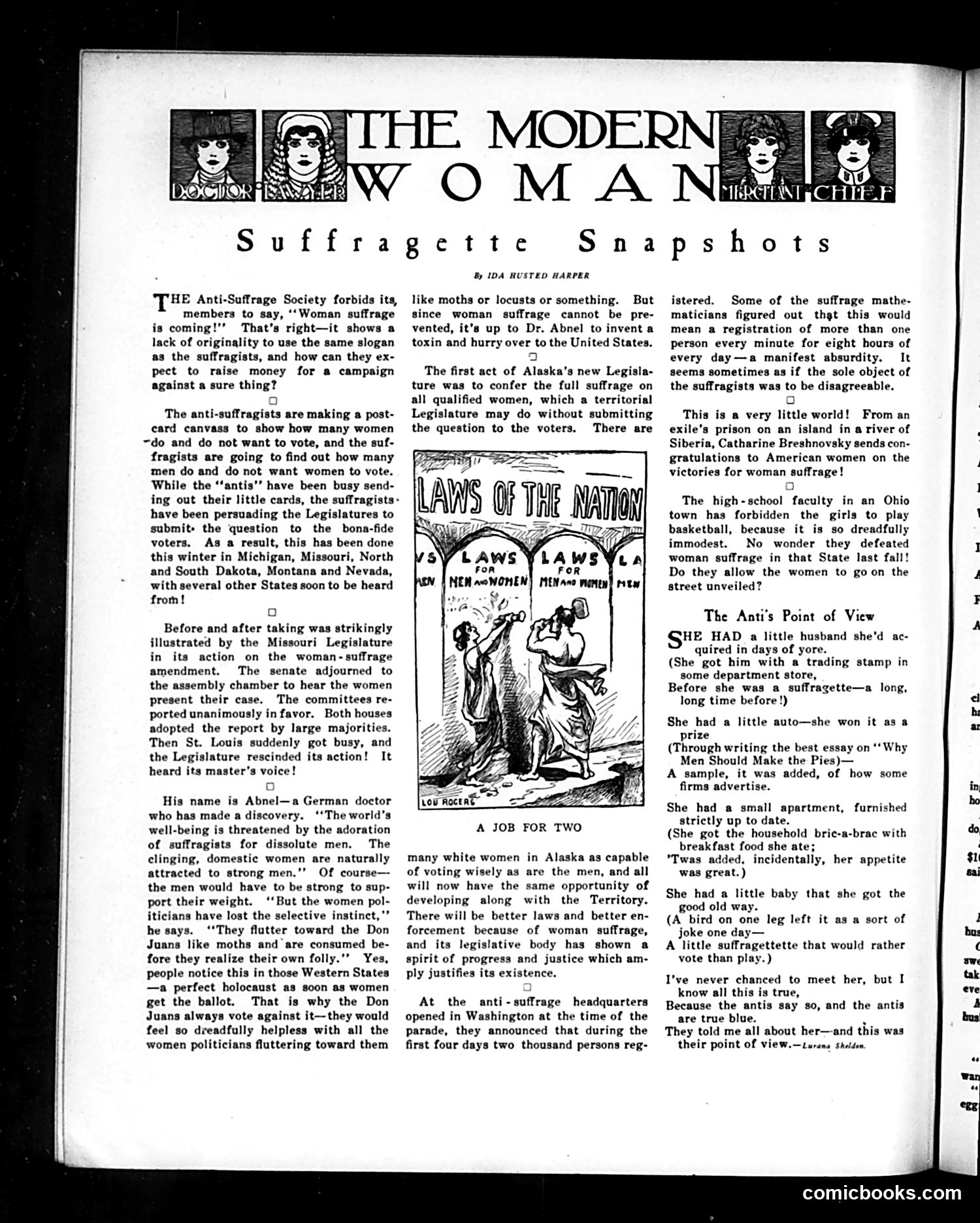
This anti-suffrage satire by Ida Husted Harper mocks women's suffrage advocates through several jabs: **The cartoon "A Job for Two"** appears to depict women as incompetent voters or activists, contrasting anti-suffragists' postcard campaign against suffragists' legislative persuasion efforts. **Key satirical points:** - Ridicules Dr. Abnel's pseudo-scientific claim that suffragists are attracted to "dissolute men" like "moths"—implying women voters lack judgment - Mocks Alaska's immediate suffrage grant as reckless - Questions suffragists' math about anti-suffrage registration numbers, suggesting dishonesty - Highlights an Ohio town forbidding girls' basketball as "immodest" while opposing suffrage—exposing the hypocrisy of those claiming to protect women's virtue The article's tone treats suffrage as inevitable while portraying suffragists as unreasonable and illogical, typical of anti-suffrage propaganda from the pre-1920 debate era.
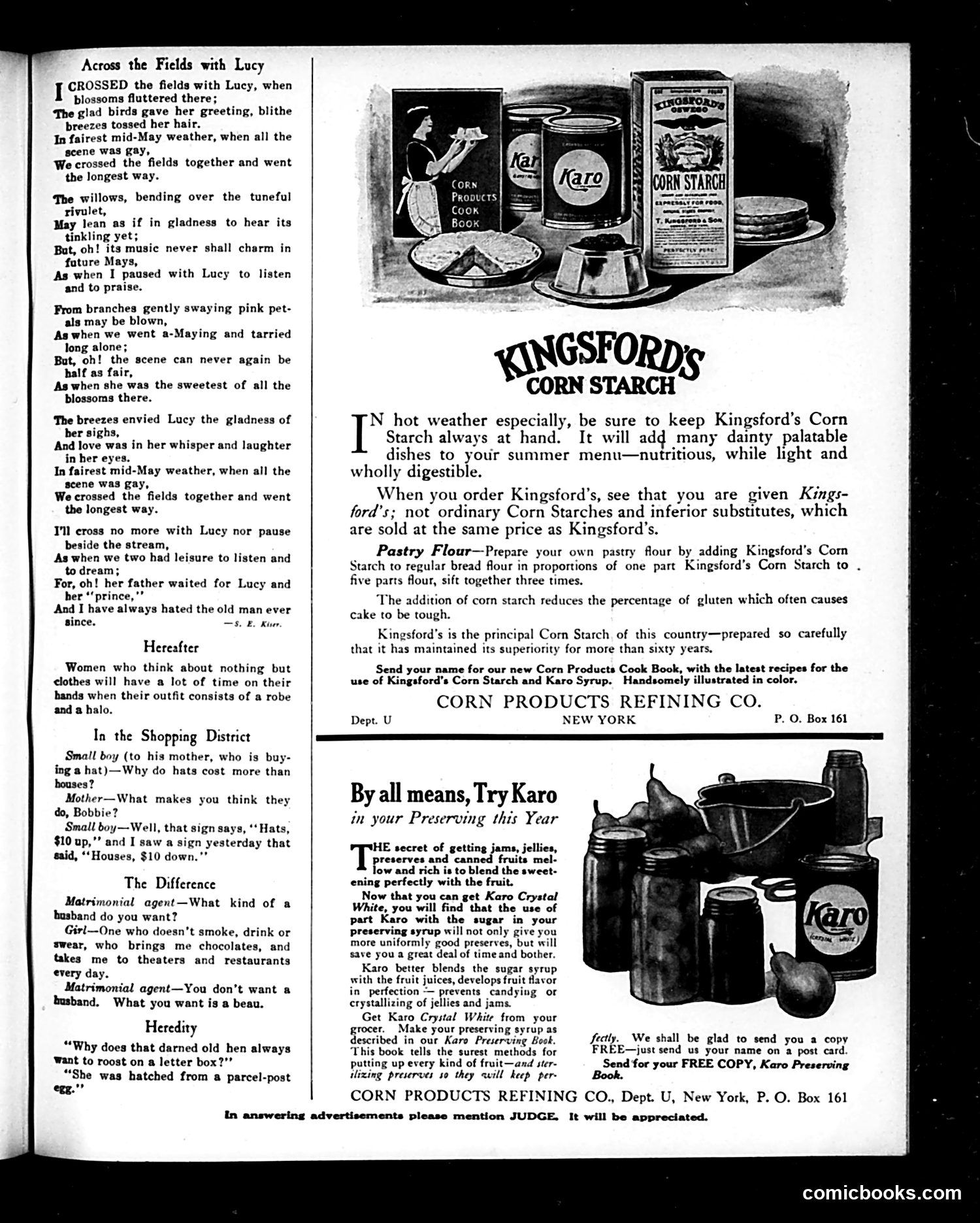
This page contains **primarily advertisements** interspersed with light satirical humor pieces typical of Judge magazine. The main content includes: **Satirical sketches** ("Across the Fields with Lucy," "In the Shopping District," etc.) offering gentle social comedy: a romantic poem interrupted by a stern father, jokes about hat prices exceeding house prices, and a matrimonial agent distinguishing between a husband and a "beau." These reflect early 20th-century social expectations around courtship, women's consumer habits, and gender roles. **Two large advertisements** for corn starch products (Kingsford's and Karo brand) dominate the page's visual space, targeting homemakers with promises of superior cooking results and convenience—reflecting how Judge monetized its readership by advertising household products to women. The "Heredity" joke about a hen hatched from a parcel-post egg is a pun on postal terminology, suggesting the magazine's audience appreciated wordplay. Overall, this page illustrates Judge's business model: delivering satirical content to middle-class readers while selling them consumer goods through strategically placed advertisements.
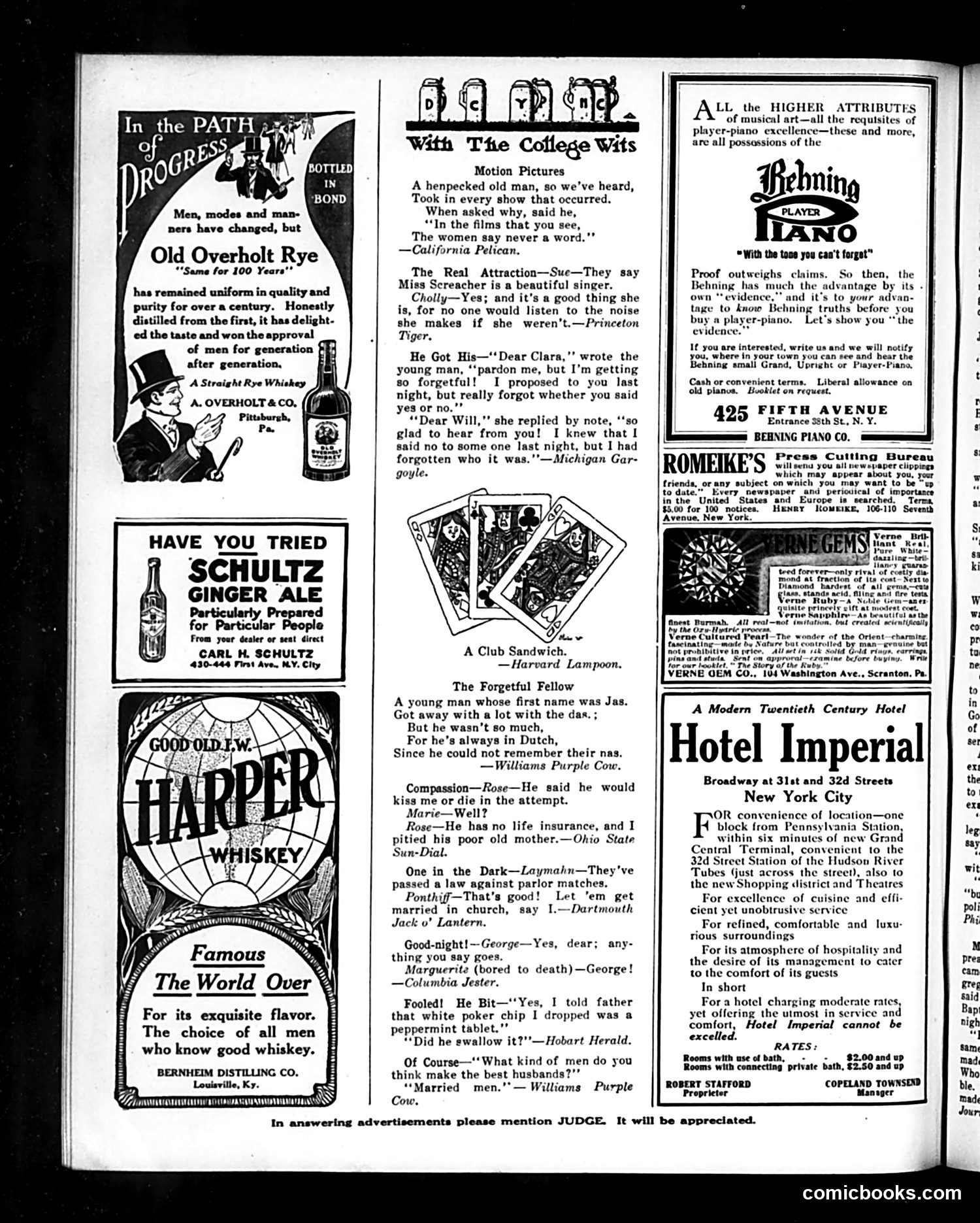
This page is primarily **advertising with humorous filler content**—typical of early 20th-century magazines. The cartoons are brief, joke-based items reprinted from college humor magazines (Princeton Tiger, Williams Purple Cow, etc.). They mock contemporary dating and marriage customs: a henpecked man escaping to silent films where women don't speak; a forgetful suitor who can't remember if his proposal was accepted; a woman cynically rejecting a marriage proposal from a man without life insurance. The satire targets predictable gender dynamics—women as nagging, men as forgetful or cowardly—rather than specific political figures or events. The page is dominated by **advertisements** for whiskey (Old Overholt, Harper, Schultz Ginger Ale), player pianos (Behning), hotels (Hotel Imperial), and cutting bureaus. These ads reflect Prohibition-era society (note the ginger ale alternative) and early consumer culture targeting middle-class leisure and refinement.
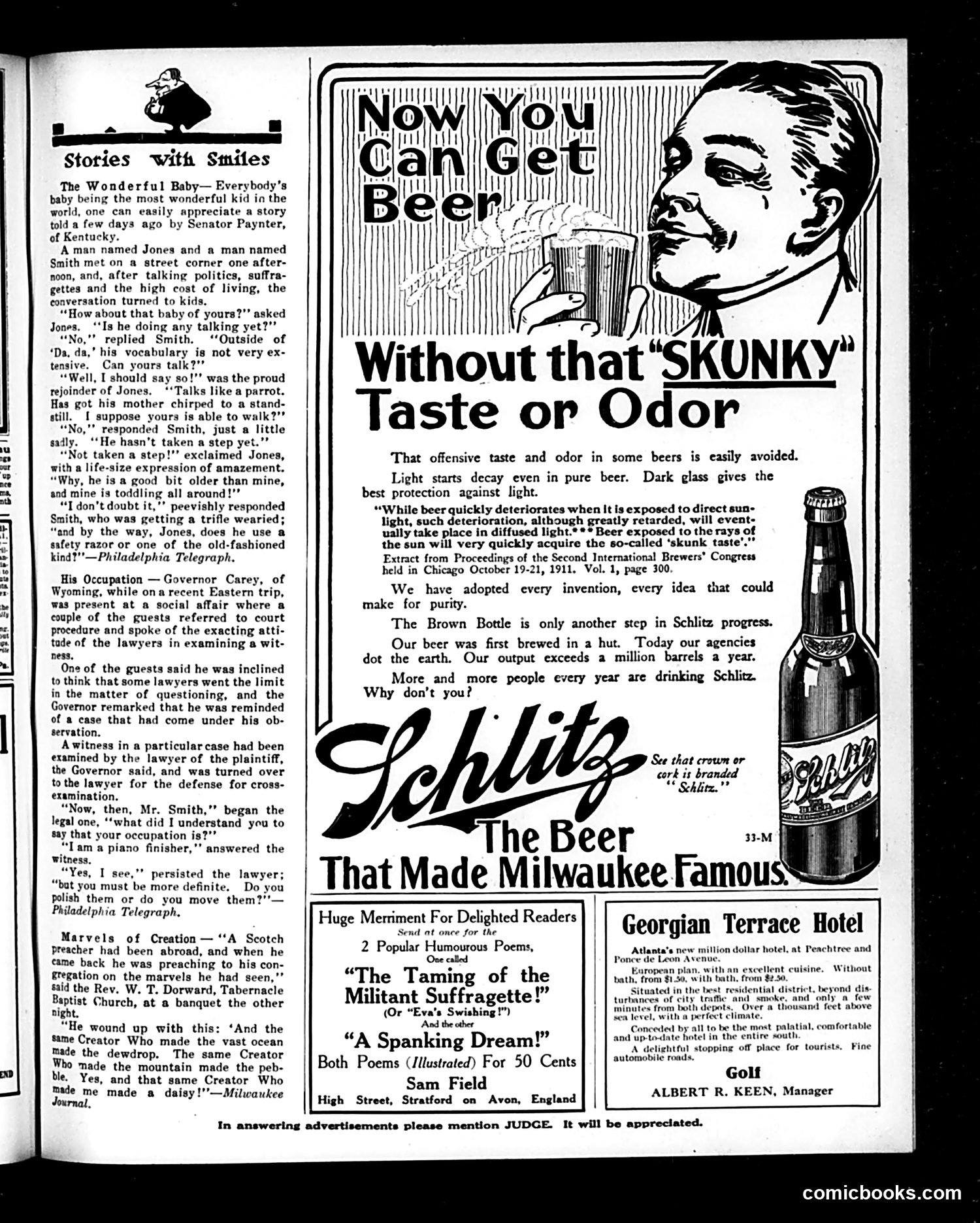
This page contains three unrelated humor pieces ("Stories with Smiles") and a full-page Schlitz beer advertisement. The three short jokes are genteel, turn-of-the-century anecdotes: one about a father boasting his baby talks while another's doesn't (ironic twist: the quiet baby is actually older); one about a lawyer's pedantic questioning of a "piano finisher" regarding whether he polishes or moves pianos; and one about a Scottish preacher marveling at God's creation of both oceans and daisies. The dominant content is the **Schlitz advertisement**, which addresses a scientific problem: beer develops an unpleasant "skunky" taste when exposed to light. Schlitz promotes its brown bottle as protection against light-induced deterioration, citing the 1911 International Brewers' Congress. The ad emphasizes purity and modern industrial progress—their beer evolved from a humble hut operation to a million-barrel-per-year enterprise with worldwide distribution. The advertisement reflects early 20th-century advertising conventions: scientific authority, manufacturing pride, and competitive differentiation through packaging innovation.
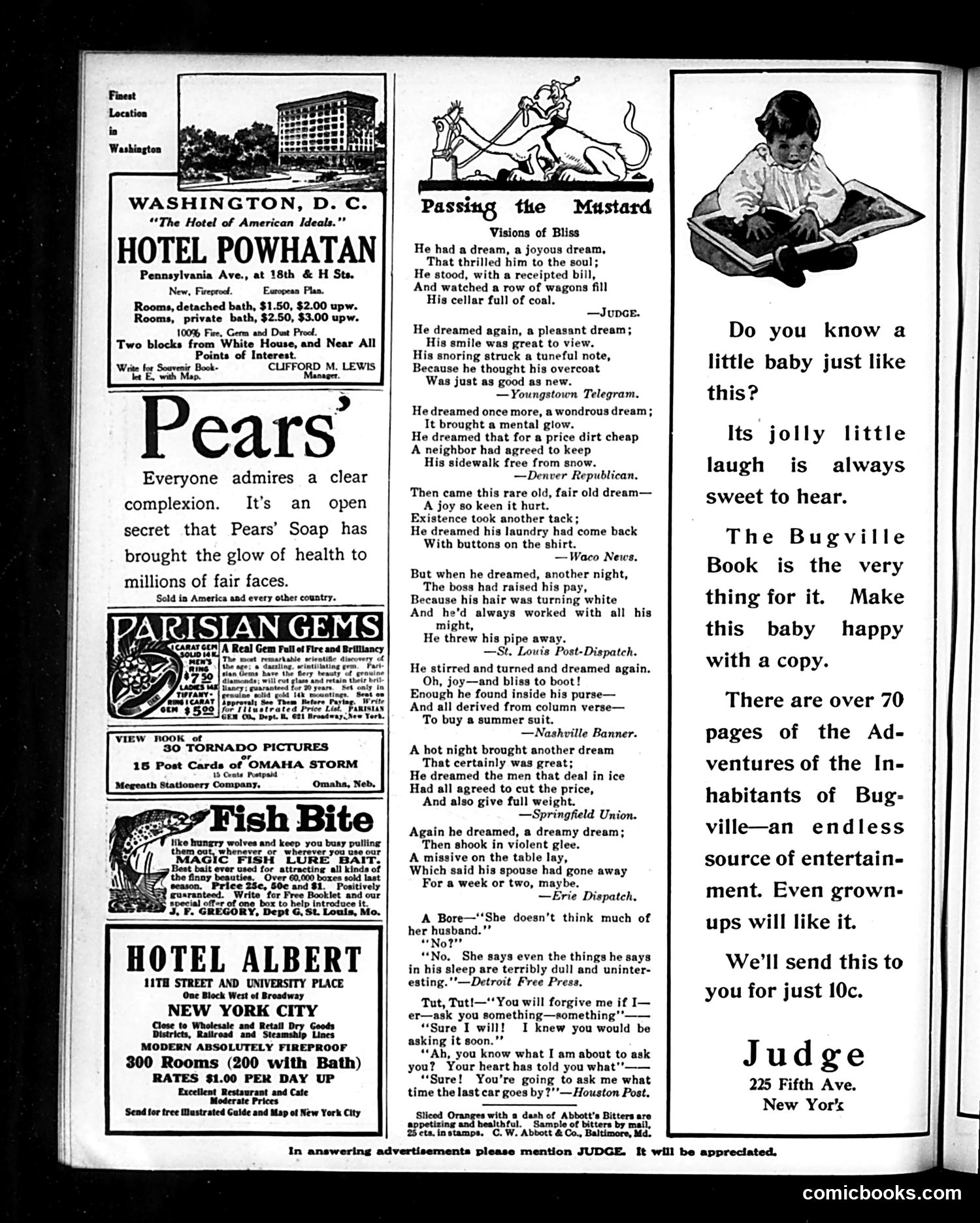
This page is primarily **advertisements interspersed with satirical verse**. The main content, "Passing the Mustard: Visions of Bliss," uses dreams as satirical commentary on working-class anxieties and desires of the early 20th century. The poem mocks a laborer's fantasies: a full coal cellar, a serviceable overcoat, avoiding snow-shoveling, getting laundry done properly, a rare wage increase, affording a summer suit, cheaper ice prices, and—most tellingly—his wife leaving town. The final joke frames these dreams as so mundane and uninspiring that even the man's sleep-talk bores his wife, sarcastically suggesting his imagination reflects the dull monotony of working life itself. The surrounding ads (hotels, soap, fish lure) are typical Judge fare—commercial content alongside humor aimed at middle-class readers.
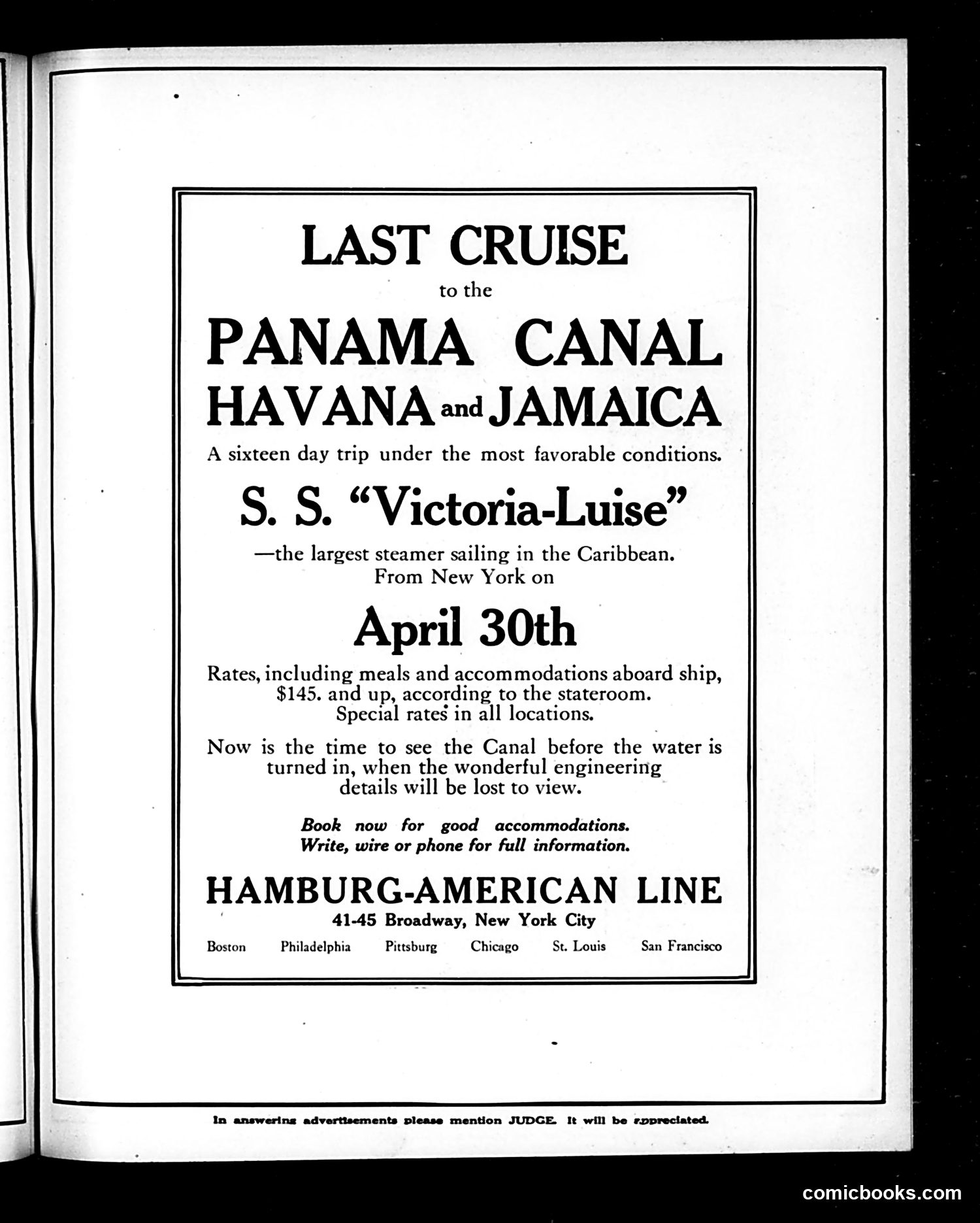
This page is **primarily an advertisement**, not satire or political cartoon. It's a Hamburg-American Line cruise booking ad from *Judge* magazine. The ad promotes the S.S. "Victoria-Luise" cruise departing April 30th to the Panama Canal, Havana, and Jamaica—a 16-day trip priced from $145 per person (meals included). The only notable rhetorical element is the marketing appeal: "Now is the time to see the Canal before the water is turned in, when the wonderful engineering details will be lost to view." This creates urgency by suggesting that once the canal becomes operational (water fills the locks), the visible construction/engineering won't be viewable anymore—a legitimate but time-sensitive tourist pitch. There is no evident political satire or caricature on this page. It's straightforward commercial advertising from the early 20th century.
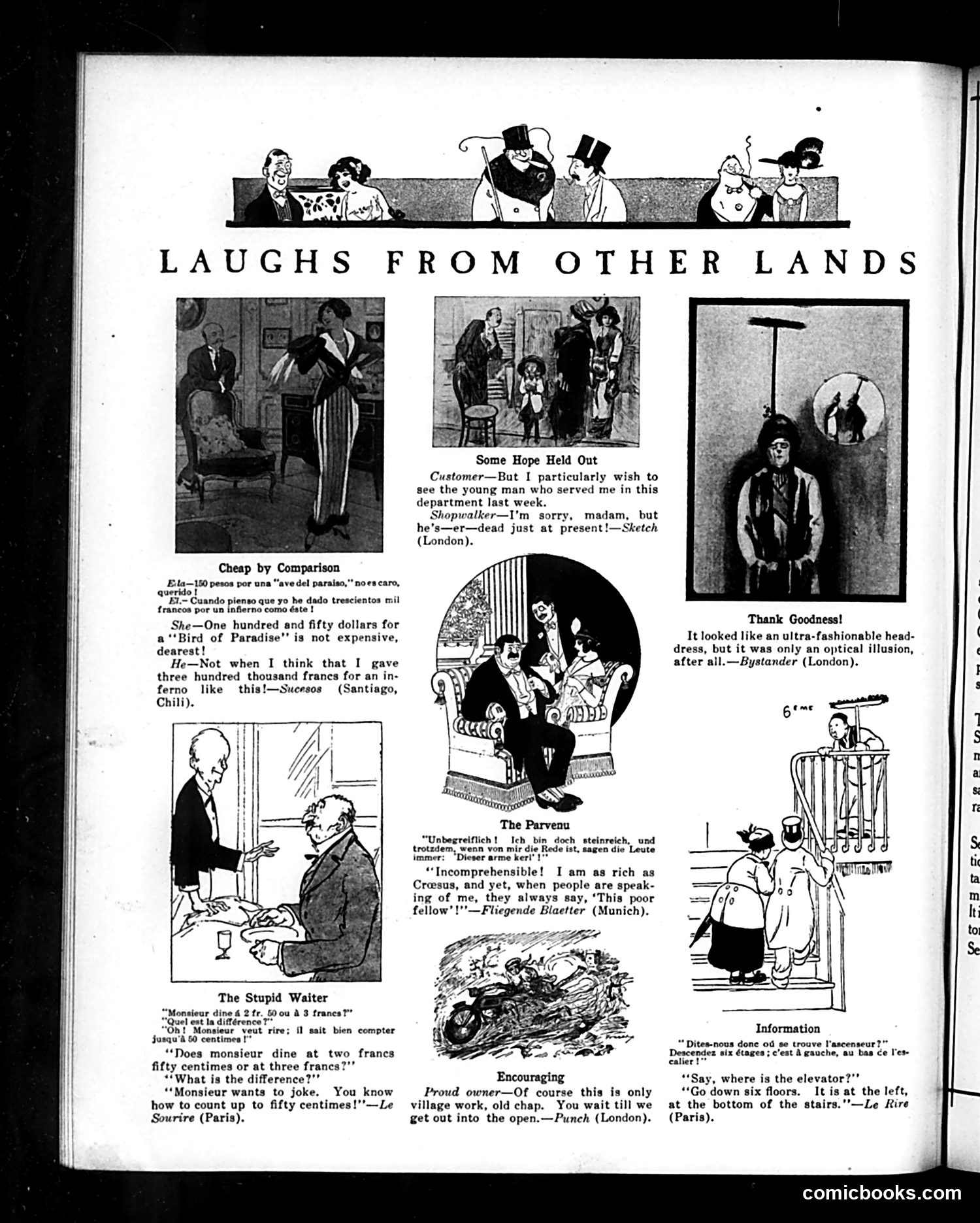
This page reprints brief comedic sketches from satirical magazines across Europe and Latin America—Spanish, French, German, and British sources. The humor relies on universal themes: **"Cheap by Comparison"**: A couple debates the cost of luxury items (a "Bird of Paradise" artwork), with the husband noting he once paid even more for something worse—satire on wealthy people's frivolous spending and poor judgment. **"The Stupid Waiter"**: A French restaurant joke about a waiter's condescension toward a customer asking about price differences, mocking working-class assumptions about the patron's mathematical abilities. **Other sketches** mock: a shopkeeper's dark humor about a dead employee, a wealthy man's ironic complaint that people call him "poor," and absurdly unhelpful directions to an elevator. The page's concept—celebrating "laughs from other lands"—suggests Judge's audience appreciated international humor and cosmopolitan sophistication, though the jokes are generally accessible: satire of class pretension, miscommunication, and human folly transcending borders.
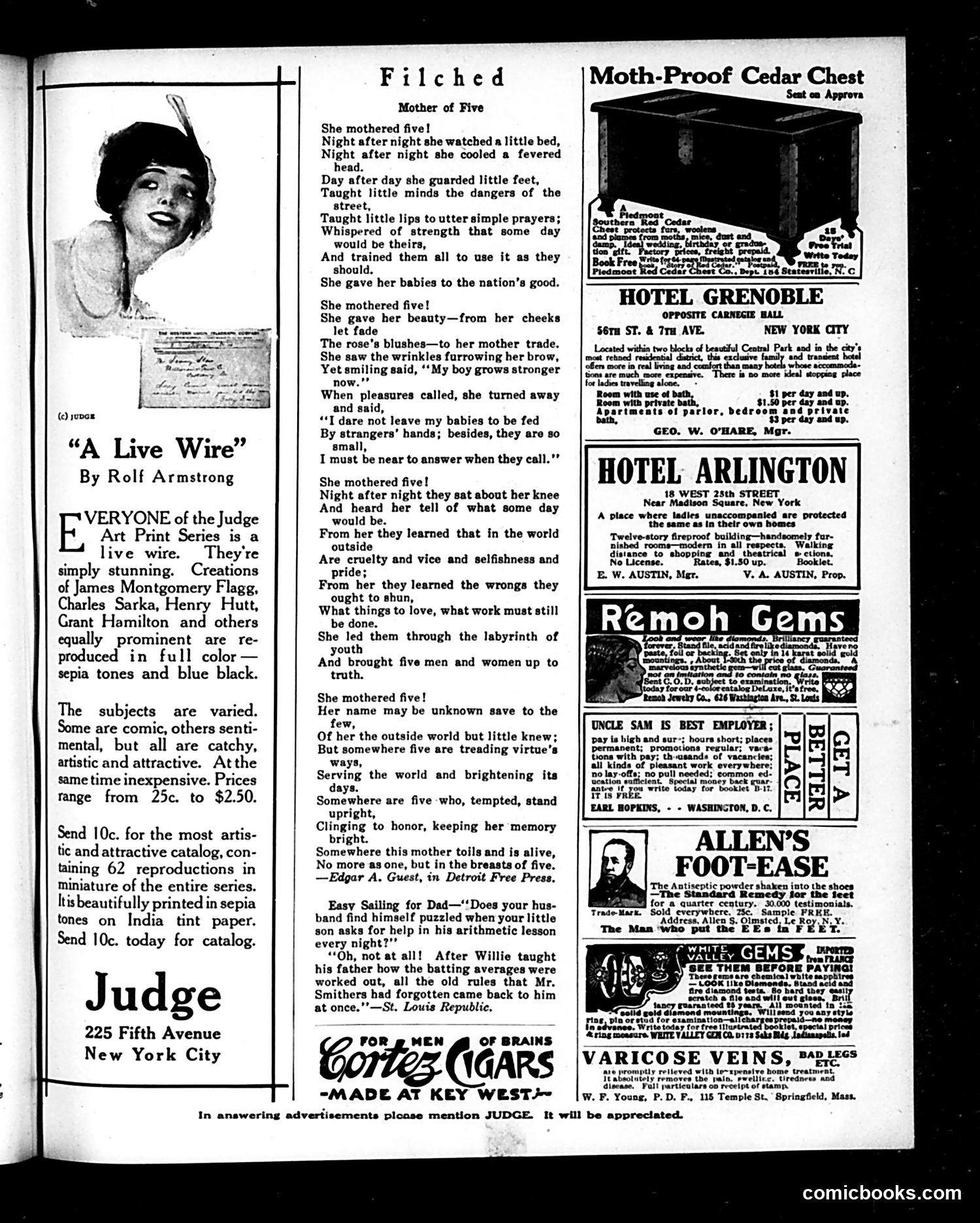
This page is primarily **advertising and promotional content** with a framing article about Judge magazine's art print series. **"A Live Wire"** is an advertisement promoting Judge's affordable art reproductions (25¢-$2.50) by prominent illustrators like James Montgomery Flagg and Charles Sarka. It's a straightforward promotional piece, not satire. **The main editorial content** is a sentimental poem titled "Filched: Mother of Five" (attributed to Edgar A. Guest). It celebrates maternal self-sacrifice—a mother who raised five children virtuously, sacrificing her beauty and personal pleasures. The poem appears designed to appeal to readers' patriotic and domestic sentiments, suggesting mothers contribute to the nation's good through child-rearing. **The humor section** includes a brief joke about a father learning arithmetic from his son's baseball averages—gentle, domestic humor. The **remaining space** contains hotel advertisements and product ads (cigars, foot powder, gems), typical of period magazine pages where editorial and advertising were heavily integrated.
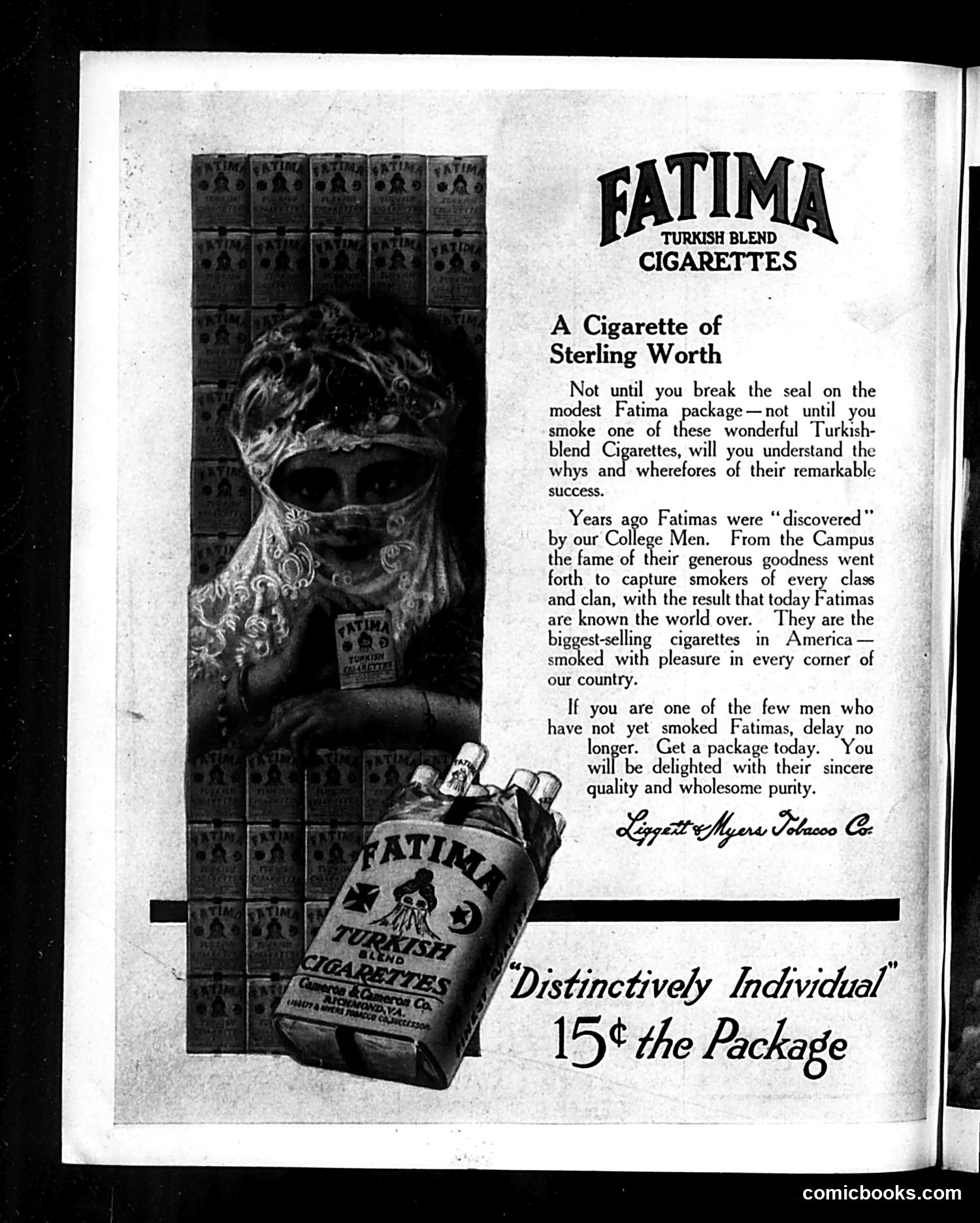
This is a **cigarette advertisement**, not political satire. The page features a Turkish woman in exotic dress alongside Fatima cigarette packages. The ad's appeal targets American male smokers by emphasizing: 1. **"College Men" marketing**: Claims the product was "discovered" by college students and spread from campus culture—a status-symbol pitch to aspirational smokers. 2. **Exoticism**: The turbaned woman imagery trades on early-20th-century fascination with "Oriental" imagery to suggest sophistication and worldliness. 3. **"Quality" messaging**: References "wholesome purity" to counter growing health concerns about smoking. 4. **Market dominance**: Claims Fatimas are "biggest-selling cigarettes in America." The "15¢ the Package" price point and "Distinctively Individual" slogan emphasize affordability and personal choice—key selling points in competitive cigarette marketing of this era.