
Judge, 1913-04-26 · page 15 of 24
Judge — April 26, 1913 — page 15: what you’re looking at
What you’re looking at
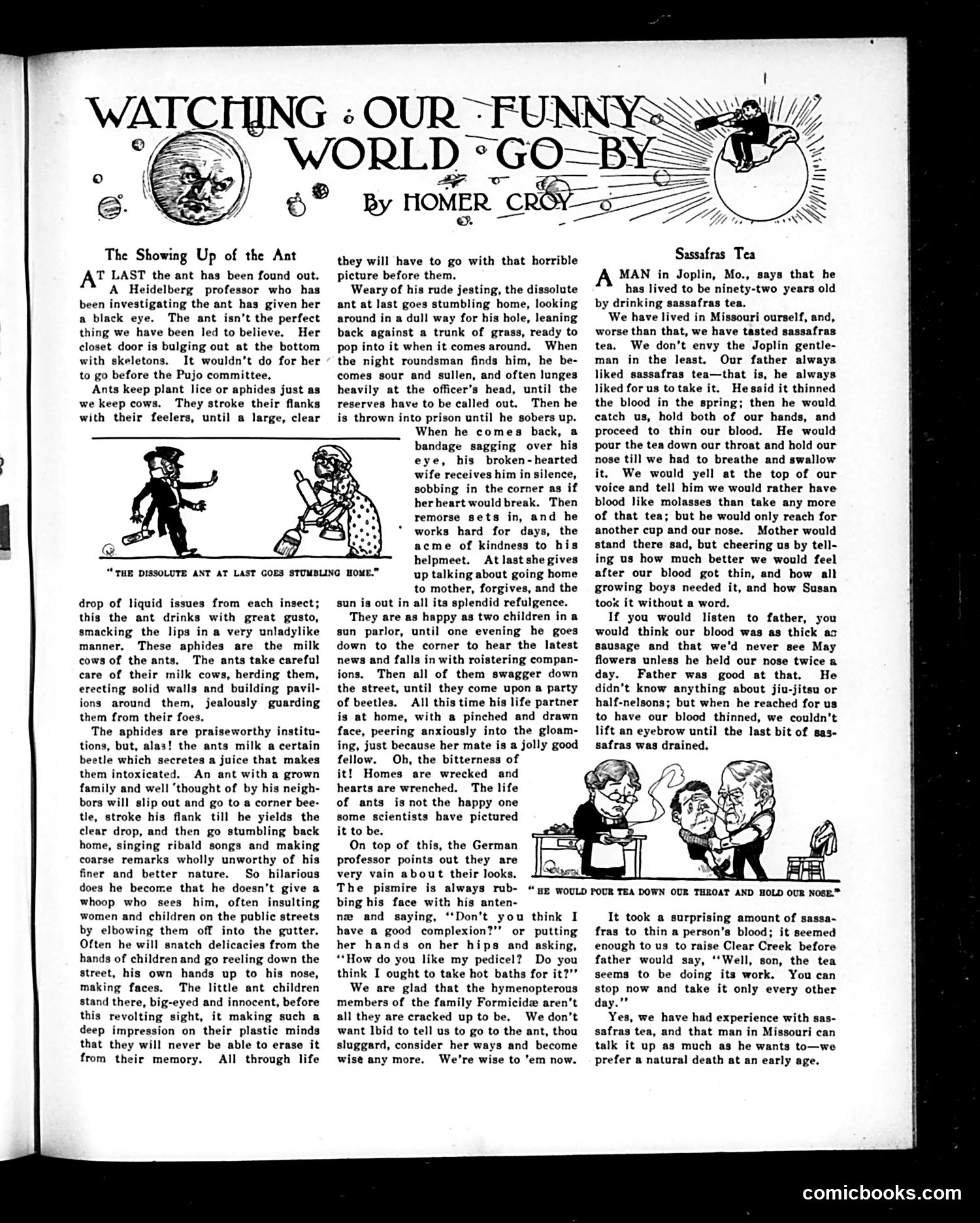
This is a humorous satire exposing that ants—long celebrated by scientists as model creatures of industry and virtue—are actually dissolute and vain. A German professor has revealed their flaws. The piece mocks both ants and human society: worker ants secretly visit beetles to get intoxicated on their secretions, then stumble home drunk, insulting women and children, getting arrested, and requiring their wives' forgiveness. The cycle repeats. Additionally, ants are vain about their appearance. The satire is social commentary—likely critiquing working-class or immigrant behavior (the German reference may be relevant). By exposing ants' hypocrisy, Croy suggests that celebrated institutions and role models often hide shameful realities. The cartoon illustrations show the "dissolute ant" stumbling home and (bottom) what appears to be a domestic confrontation.
📄 Transcribed text from this page (OCR, searchable)
Machine-transcribed from the original scan — historical spelling and the odd misread are preserved.
WATSINNG OUR -FUN WORLD °GO 6® By HOMER = The Showing Up of the Ant T LAST the ant has been found out. A Heidelberg professor who has been investigating the ant has given her a black eye. The ant isn’t the perfect thing we have been led to believe. Her closet door is bulging out at the bottom with skeletons. It wouldn't do for her to go before the Pujo committee. Ants keep plant lice or aphides just as we keep cows. They stroke their flanks with their feelers, until a large, clear “THE DISSOLUTE ANT AT LAST GOES STUMBLING HOME.” drop of liquid issues from each insect; this the ant drinks with great gusto, smacking the lips in a very unladylike manner. These aphides are the milk cows of the ants. The ants take careful care of their milk cows, herding them, erecting solid walls and building pavil- ions around them, jealously guarding them from their foes. The aphides are praiseworthy institu- tions, but, alas! the ants milk a certain beetle which secretes a juice that makes them intoxicated. An ant with a grown family and well ‘thought of by his neigh- bors will slip out and go to a corner bee- tle, stroke his flank till he yields the clear drop, and then go stumbling back home, singing ribald songs and making coarse remarks wholly unworthy of his finer and better nature. So hilarious does he become that he doesn’t give a whoop who sees him, often insulting women and children on the public streets by elbowing them off into the gutter. Often he will snatch delicacies from the hands of children and go reeling down the street, his own hands up to his nose, making faces. The little ant children stand there, big-eyed and innocent, before this revolting sight, it making such a deep impression on their plastic minds that they will never be able to erase it from their memory. All through life they will have to go with that horrible picture before them. Weary of his rude jesting, the dissolute ant at last goes stumbling home, looking around in a dull way for his hole, leaning back against a trunk of grass, ready to pop into it when it comes around. When the night roundsman finds him, he be- comes sour and sullen, and often lunges heavily at the officer’s head, until the reserves have to be called out. Then he is thrown into prison until he sobers up. When he comes back, a bandage sagging over his eye, his broken-hearted wife receives him in silence, sobbing in the corner as if her heart would break. Then remorse sets in, and he works hard for days, the acme of kindness to his helpmeet. At last she gives up talking about going home to mother, forgives, and the sun is out in all its splendid refulgence. They are as happy as two children ina sun parlor, until one evening he goes down to the corner to hear the latest news and falls in with roistering compan- ions. Then all of them swagger down the street, until they come upon a party of beetles. All this time his life partner is at home, with a pinched and drawn face, peering anxiously into the gloam- ing, just because her mate is a jolly good fellow. Oh, the bitterness of it! Homes are wrecked and hearts are wrenched. The life of ants is not the happy one some scientists have pictured it to be. On top of this, the German professor points out they are very vain about their looks. The pismire is always rub- bing his face with his anten- ne and saying, ‘Don’t you think I have a good complexion?” or putting her hands on her hips and asking, “*How do you like my pedicel? Do you think I ought to take hot baths for it?” We are glad that the hymenopterous members of the family Formicidz aren’t all they are cracked up to be. We don’t want Ibid to tell us to go to the ant, thou sluggard, consider her ways and become wise any more. We're wise to 'em now. SSS =By SS WLS dm Ms Sassafras Tea MAN in Joplin, Mo., says that he has lived to be ninety-two years old by drinking sassafras tea. We have lived in Missouri ourself, and, worse than that, we have tasted sassafras tea. We don’t envy the Joplin gentle- man in the least. Our father always liked sassafras tea—that is, he always liked for us to take it. He said it thinned the blood in the spring; then he would catch us, hold both of our hands, and proceed to thin our blood. He would pour the tea down our throat and hold our nose till we had to breathe and swallow it. We would yell at the top of our voice and tell him we would rather have blood like molasses than take any more of that tea; but he would only reach for another cup and our nose. Mother would stand there sad, but cheering us by tell- ing us how much better we would feel after our blood got thin, and how alt growing boys needed it, and how Susan took it without a word. If you would listen to father, you would think our blood was as thick ac sausage and that we'd never see May flowers unless he held our nose twice a day. Father was good at that. He didn't know anything about jiu-jitsu or half-nelsons; but when he reached for us to have our blood thinned, we couldn’t lift an eyebrow until the last bit of sas- safras was drained, “WE WOULD POUR TEA DOWN OUR THROAT AND HOLD OUR NOSE.” It took a surprising amount of sassa- fras to thin a person’s blood; it seemed enough to us to raise Clear Creek before father would say, ‘‘Well, son, the tea seems to be doing its work. You can stop now and take it only every other day.”” Yes, we have had experience with sas- safras tea, and that man in Missouri can talk it up as much as he wants to—we prefer a natural death at an early age. comicbooks.com