
Judge, 1913-04-26 · page 14 of 24
Judge — April 26, 1913 — page 14: what you’re looking at
What you’re looking at
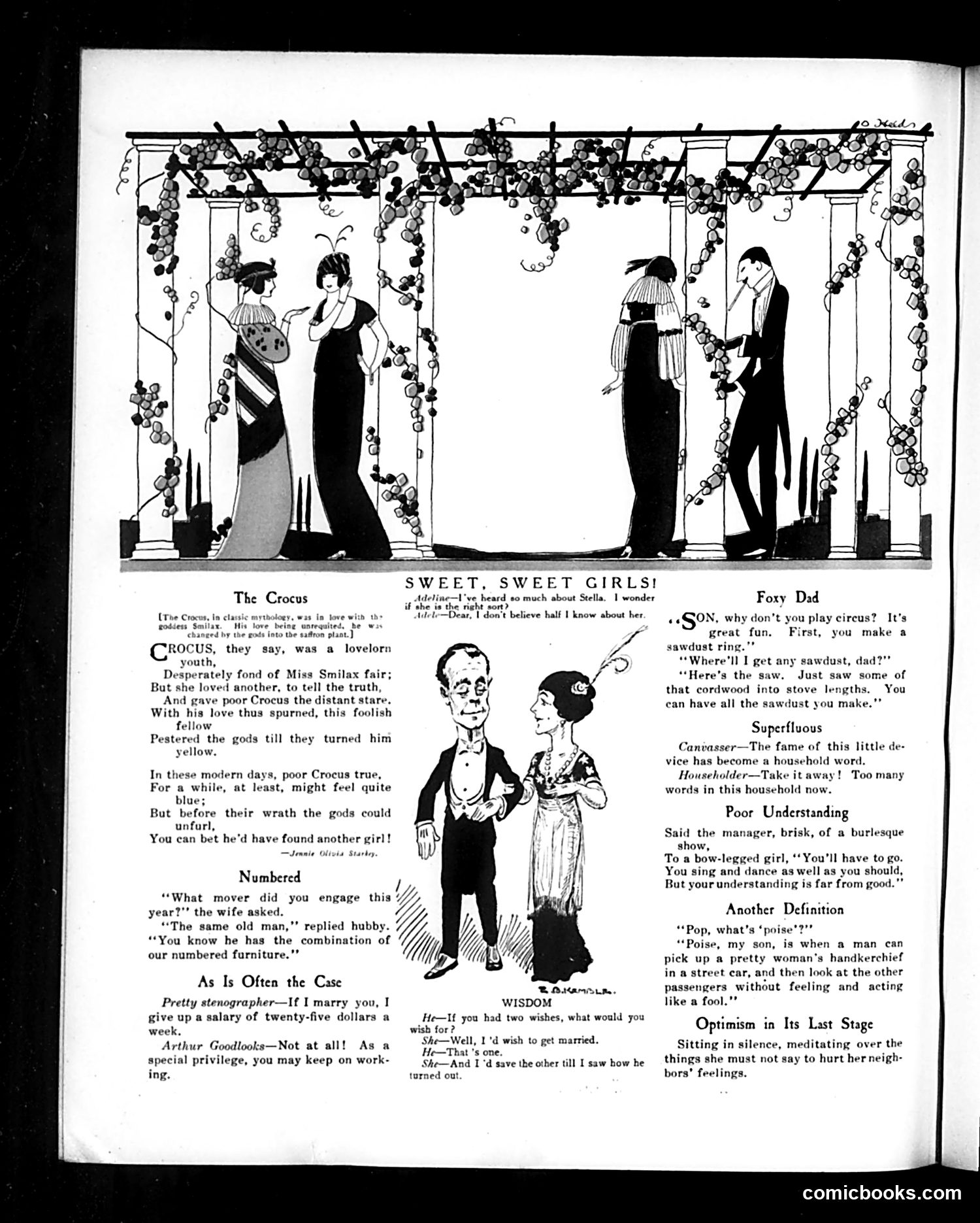
This page contains multiple short satirical pieces typical of early 20th-century American humor magazines. **"The Crocus"** retells the Greek myth of Crocus, a lovelorn youth transformed into a flower. The satire suggests that in modern times, a rejected lover wouldn't waste energy petitioning the gods—he'd simply find another woman. It mocks both romantic desperation and classical melodrama. **Other pieces mock domestic life and contemporary manners:** - A husband's obliviousness to his wife's complaints about movers - A stenographer accepting lower pay to marry - A father's trick to get free sawdust from his son - A traveling salesman overselling a product's "fame" - A burlesque manager's crude dismissal of a bow-legged dancer - A definition of "poise" as male composure when picking up an attractive woman's handkerchief The humor targets marital dynamics, workplace gender relations, consumer culture, and social pretense—reflecting period anxieties about changing gender roles and commercial life. The jokes rely on dated assumptions about masculinity, femininity, and class.
📄 Transcribed text from this page (OCR, searchable)
Machine-transcribed from the original scan — historical spelling and the odd misread are preserved.
; SWEET, SWEET GIRL ROCUS, lovelorn youth, Desperately fond of Miss Smilax fair; But she another, to tell the truth, And gave poor Crocus the distant stare. With his love thus spurned, this foolish fellow Pestered the gods till they turned him yellow. they say, was a , poor Crocus true, , might feel quite In these modern day: For a while, at le: blue But before their wrath the gods could unfurl, You can bet he'd have found another girl! Jennie Olivia Starkey Numbered “What mover did you year?’ the wife asked. “The same old man,’ replied hubby. “You know he has the combination of our numbered furniture."” As Is Often the Case Pretty stenographer—If I marry you, I give up a salary of twenty-five dollars a week. Arthur Goodlooks—Not at all! As a special privilege, you may keep on work- ing. engage this Ss! I wonder —I've heard so much about Stella. he right sort? ‘Dear, | don't believe half | know about her B Bsenrim. WISDOM He—If you had two wishes, what would you wish for? She—Well, 1''d wish to get married. He—That 's one. She—And I'd save the other till I saw how he turned out Foxy Dad ««QON, why don’t you play circus? It's great fun. First, you make a sawdust ring.”” “Where'll I get any sawdust, dad?"’ “Here's the saw, Just saw some of that cordwood into stove lengths. You can have all the sawdust you make.” Superfluous Canvasser—The fame of this little de- vice has become a household word. Householder—Take it away! Too many words in this household now. Poor Understanding Said the manager, brisk, of a burlesque show, To a bow-legged girl, ‘You'll have to go. You sing and dance as well as you should, But your understanding is far from good.” Another Definition “Pop, what's ‘poise’?”” “Poise, my son, is when a man can pick up a pretty woman's handkerchief in a street car, and then look at the other passengers without feeling and acting like a fool.'’ Optimism in Its Last Stage meditating over the things she must not say to hurt herneigh- bors’ feelings. Sitting in silence, comicbooks.com