
Judge, 1913-04-26 · page 11 of 24
Judge — April 26, 1913 — page 11: what you’re looking at
What you’re looking at
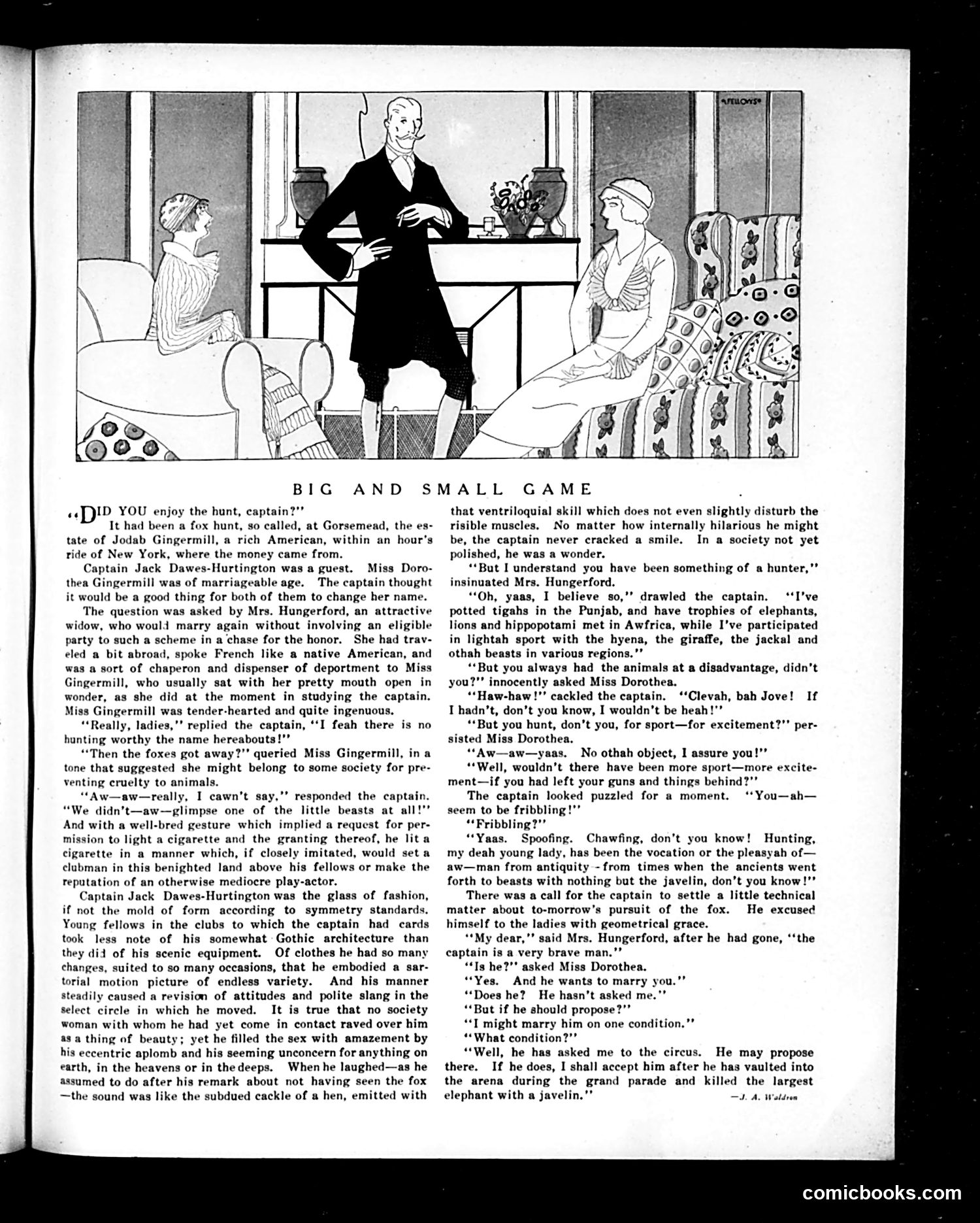
This story satirizes a pretentious British aristocrat, Captain Jack Dawes-Huntington, visiting a wealthy American estate. The "captain" is a caricature of the affected English gentleman—speaking in exaggerated drawl ("yaas," "Awfrica"), obsessed with fashion and manners, and displaying studied indifference through forced laughter. The joke centers on his hunting boasts: he claims to have killed tigers and elephants in Africa, yet couldn't even find a fox in a staged hunt. Miss Dorothea, the innocent American heiress, innocently points out the contradiction—true hunting requires genuine challenge, not killing defenseless animals. Her suggestion that he hunt *without* guns exposes his pretense as mere "fribbling" (trifling). The satire targets gilded-age Americans' fascination with European titles and manners, and mocks the shallow masculinity of aristocrats who perform sophistication while lacking actual courage or skill.
📄 Transcribed text from this page (OCR, searchable)
Machine-transcribed from the original scan — historical spelling and the odd misread are preserved.
BIG AND SMALL GAME sa] ID YOU enjoy the hunt, captain?’” It had been a fox hunt, so called, at Gorsemead, the es- tate of Jodab Gingermill, a rich American, hin an hour's ride of New York, where the money came from. Captain Jack Dawes-Hurtington was a guest. Miss Doro- thea Gingermill was of marriageable age. The captain thought it would be a good thing for both of them to change her name. The question was asked by Mrs. Hungerford, an attrac’ widow, who would marry again without involving an eligible party to such a scheme in a chase for the honor. She had trav- eled a bit abroad, spoke French like a native American, and was a sort of chaperon and dispenser of deportment to Miss Gingermill, who usually sat with her pretty mouth open in wonder, as she did at the moment in studying the captain. Miss Gingermill was tender-hearted and quite ingenuous, “Really, ladies,’’ replied the captain, ‘‘I feah there is no hunting worthy the name hereabouts!"’ “Then the foxes got away?’ queried Miss Gingermill, in a tone that suggested she might belong to some society for pre- venting cruelty to animals. ““Aw—aw—really, I cawn’t say,’? responded the captain. “We didn’t—aw—glimpse one of the little beasts at all!’’ And with a well-bred gesture which implied a request for per- mission to light a cigarette and the granting thereof, he lita cigarette in a manner which, if closely imitated, would set a clubman in this benighted land above his fellows or make the reputation of an otherwise mediocre play-actor. Captain Jack Dawes-Hurtington was the glass of fashion, if not the mold of form according to symmetry standards. Young fellows in the clubs to which the captain had cards took less note of his somewhat Gothic architecture than they did of his scenic equipment. Of clothes he had so many changes, suited to so many occasions, that he embodied a sar- torial motion picture of endless variety. And his manner steadily caused a revision of attitudes and polite slang in the select circle in which he moved. It is true that no society woman with whom he had yet come in contact raved over him asa thing of beauty; yet he filled the sex with amazement by his eccentric aplomb and his seeming unconcern for anything on earth, in the heavens or in thedeeps. When he laughed—as he assumed to do after his remark about not having seen the fox —the sound was like the subdued cackle of a hen, emitted with that ventriloquial skill which does not even slightly disturb the risible muscles. No matter how internally hilarious he might be, the captain never cracked a smile. In a society not yet polished, he was a wonder. **But I understand you have been something of a hunter,”” insinuated Mrs. Hungerford. “‘Oh, yaas, I believe so,’’ drawled the captain. ‘I’ve potted tigahs in the Punjab, and have trophies of elephants, lions and hippopotami met in Awfrica, while I’ve participated in lightah sport with the hyena, the giraffe, the jackal and othah beasts in various regions.’’ “But you always had the animals at a disadvantage, didn’t you?" innocently asked Miss Dorothea. “‘Haw-haw!’’ cackled the captain. ‘‘Clevah, bah Jove! If Thadn’t, don’t you know, I wouldn’t be heah!"’ “But you hunt, don’t you, for sport—for excitement?"’ per- sisted Miss Dorothea, “‘Aw—aw—yaas. No othah object, I assure you!’’ “Well, wouldn’t there have been more sport—more excite- ment—if you had left your guns and things behind The captain looked puzzled for a moment. seem to be fribbling!"’ “Fribbling?”” “Yaas. Spoofing. Chawfing, don't you know! Hunting, my deah young lady, has been the vocation or the pleasyah of — aw—man from antiquity -from times when the ancients went forth to beasts with nothing but the javelin, don’t you know!"’ There was a call for the captain to settle a little technical matter about to-morrow’s pursuit of the fox. He excused himself to the ladies with geometrical grace. “My dear,’’ said Mrs. Hungerford, after he had gone, ‘‘the captain is a very brave man.” “Is he?’’ asked Miss Dorothea. “Yes. And he wants to marry you.’” ‘Does he? He hasn’t asked me."’ “But if he should propose?” “T might marry him on one condition.”’ “What condition?”’ “Well, he has asked me to the circus. He may propose there. If he does, I shall accept him after he has vaulted into the arena during the grand parade and killed the largest elephant with a javelin.’’ J. A, Waldron You—ah— comicbooks.com