
A complete issue · 24 pages · 1913
Judge — March 29, 1913
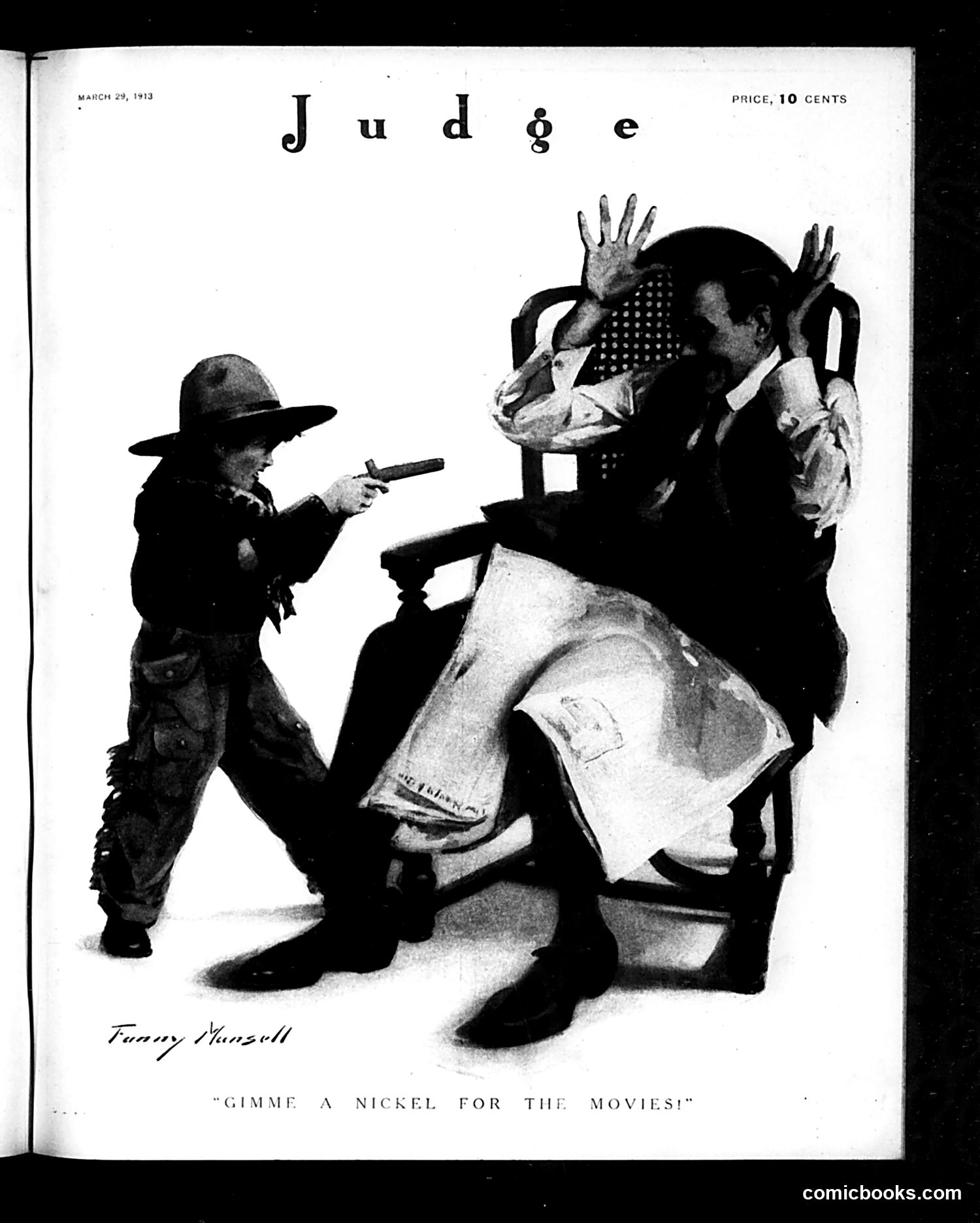
This satirical cartoon by Fuzzy Mansell depicts a small child dressed as a cowboy pointing a gun at an adult man sitting in a chair, who throws his hands up in alarm. The caption reads "Gimme a Nickel for the Movies!" The joke reflects early 20th-century concerns about nickelodeons—cheap movie theaters that charged a nickel for admission and were considered potentially corrupting influences on youth. The cartoon satirizes how movies, particularly Westerns with their gunplay and outlaw themes, were blamed for encouraging children to mimic violent behavior and become pests demanding money for entertainment. This captures period anxieties about mass media's impact on young people, a debate that would resurface throughout the 20th century.
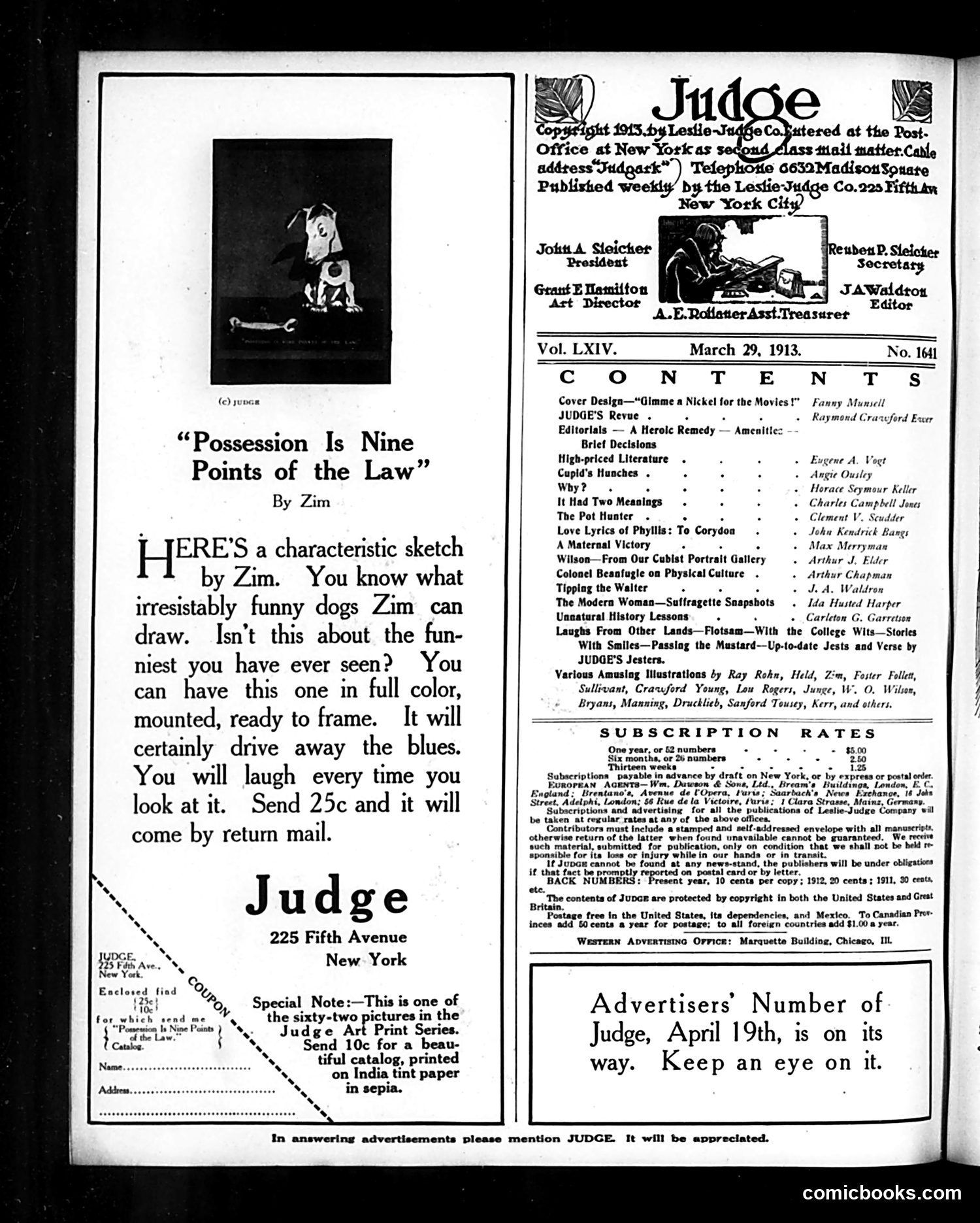
The main cartoon, titled "Possession Is Nine Points of the Law," is a humorous sketch by the cartoonist Zim depicting a dog—characteristic of Zim's style. The accompanying text suggests this is one of sixty-two pictures in Judge's Art Print Series, available for 25 cents by mail in full color and mounted for framing. The joke appears to play on the legal phrase about possession and ownership, applied to a dog as subject matter, though the specific satirical point isn't entirely clear from the image alone. The cartoon seems designed as lighthearted home décor rather than political commentary, emphasizing Zim's reputation for drawing "irresistibly funny dogs."
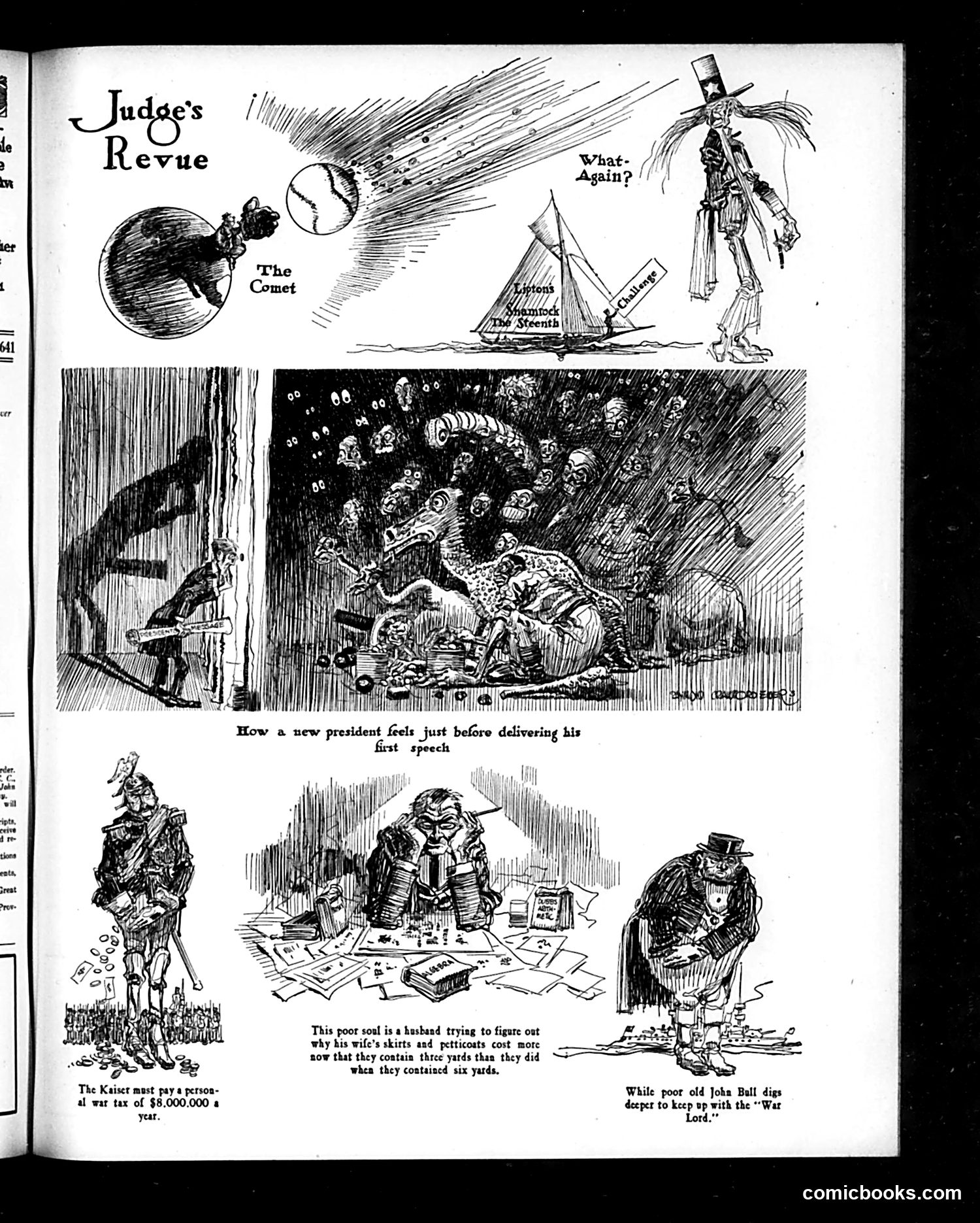
This page contains several satirical cartoons mocking contemporary political figures and events: **Top section:** References to a comet and ship ("The Slocum," "Shamrock") suggest disaster imagery, with a tall figure asking "What-Again?" — likely commentary on recurring crises. **Center cartoon:** Shows a new president surrounded by chaotic demons/monsters before his first speech — satirizing the overwhelming challenges facing a new administration. **Bottom cartoons:** - Left: A military figure (possibly Kaiser Wilhelm, given the uniform style) standing over masses, labeled regarding an $8,000,000 budget - Center: A figure overwhelmed by documents about textile costs - Right: "John Bull" (British personification) struggling with "War Lord" costs The overall theme appears to critique excessive military spending, imperial ambitions, and the economic burdens of early 20th-century geopolitics on ordinary citizens.
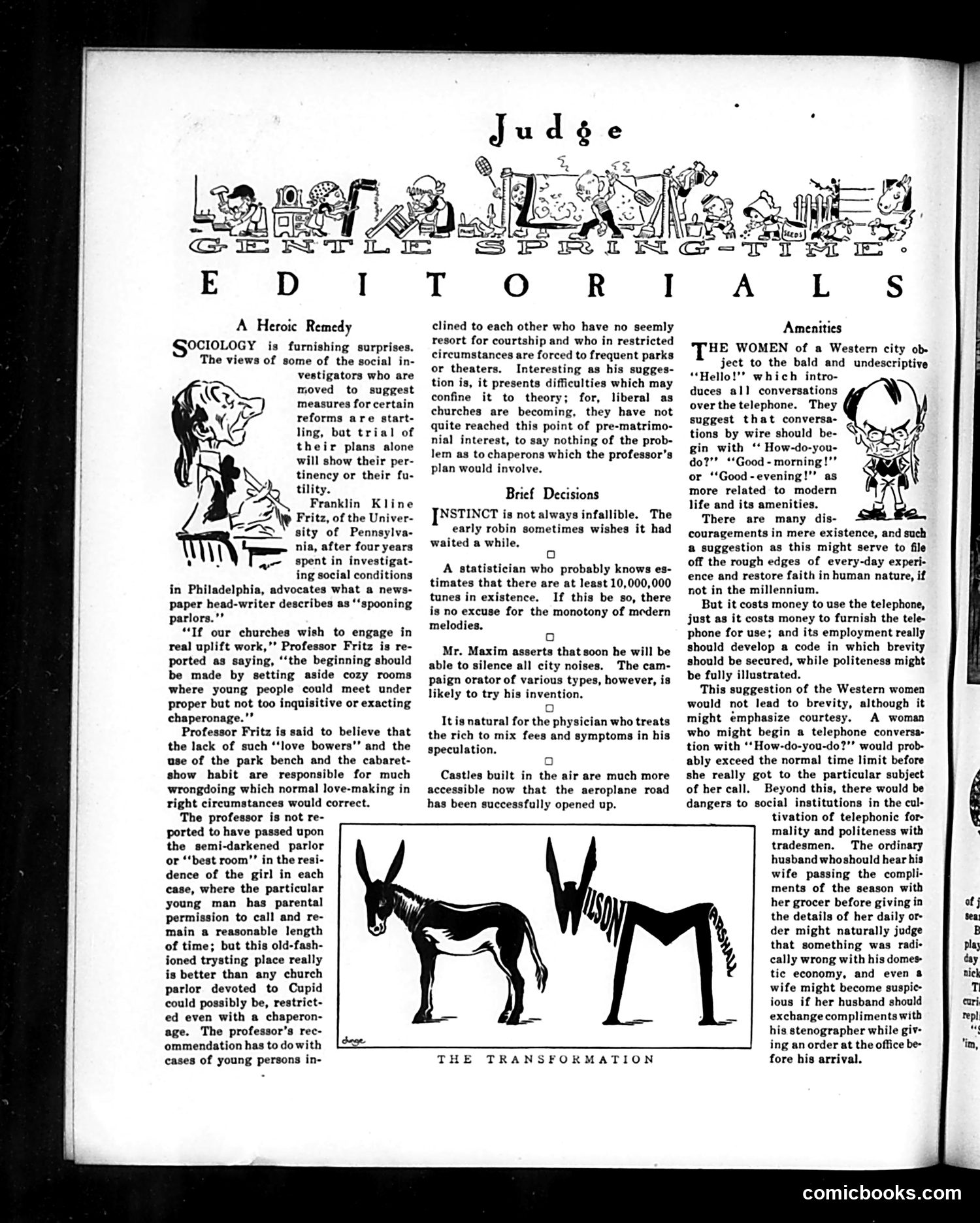
This page contains social commentary rather than political cartoons. The "Judge Editorials" section critiques early 20th-century urban social customs. **"The Transformation"** cartoon (bottom) appears to satirize the modern woman or changing gender roles, depicting what looks like a donkey transforming into something else—likely mocking contemporary anxieties about women's behavior or independence. The text articles discuss sociology, church reform, and courtship customs. One piece by Franklin Kline critiques churches' approach to "real uplift work," while another by Professor Fritz addresses young people's behavior in parks and parlors, suggesting concerns about unsupervised dating and "love-making." The "Amenities" section humorously warns against excessive telephone conversations between unmarried women and men, fearing breaches of propriety. Overall, the page reflects conservative anxieties about modernizing social conventions and changing courtship practices.
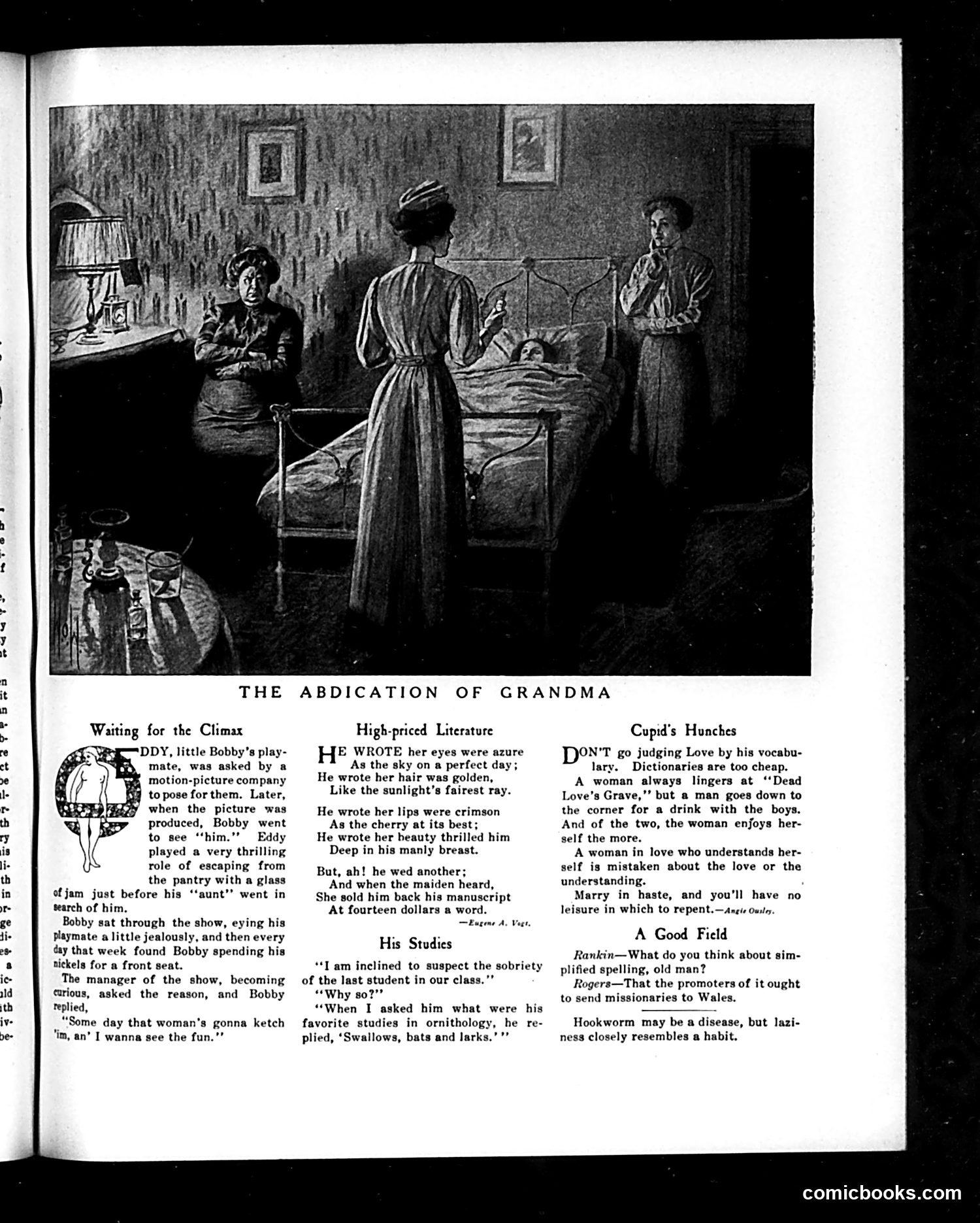
This satirical illustration depicts a domestic scene where an elderly woman appears to be relinquishing authority in a bedroom setting. The accompanying text suggests the humor centers on generational conflict over domestic control and modern values. The supporting comic snippets mock various social pretensions: "High-priced Literature" ridicules flowery romantic writing; "Cupid's Hunches" satirizes women's confusion about love versus materialism; "His Studies" jokes about academic pretension; and "A Good Field" contains wordplay about laziness versus disease. The overall theme appears to critique how traditional maternal/grandmotherly authority was being challenged by modern sensibilities in early 20th-century American society—a common Judge magazine theme mocking both old-fashioned and newly fashionable attitudes.
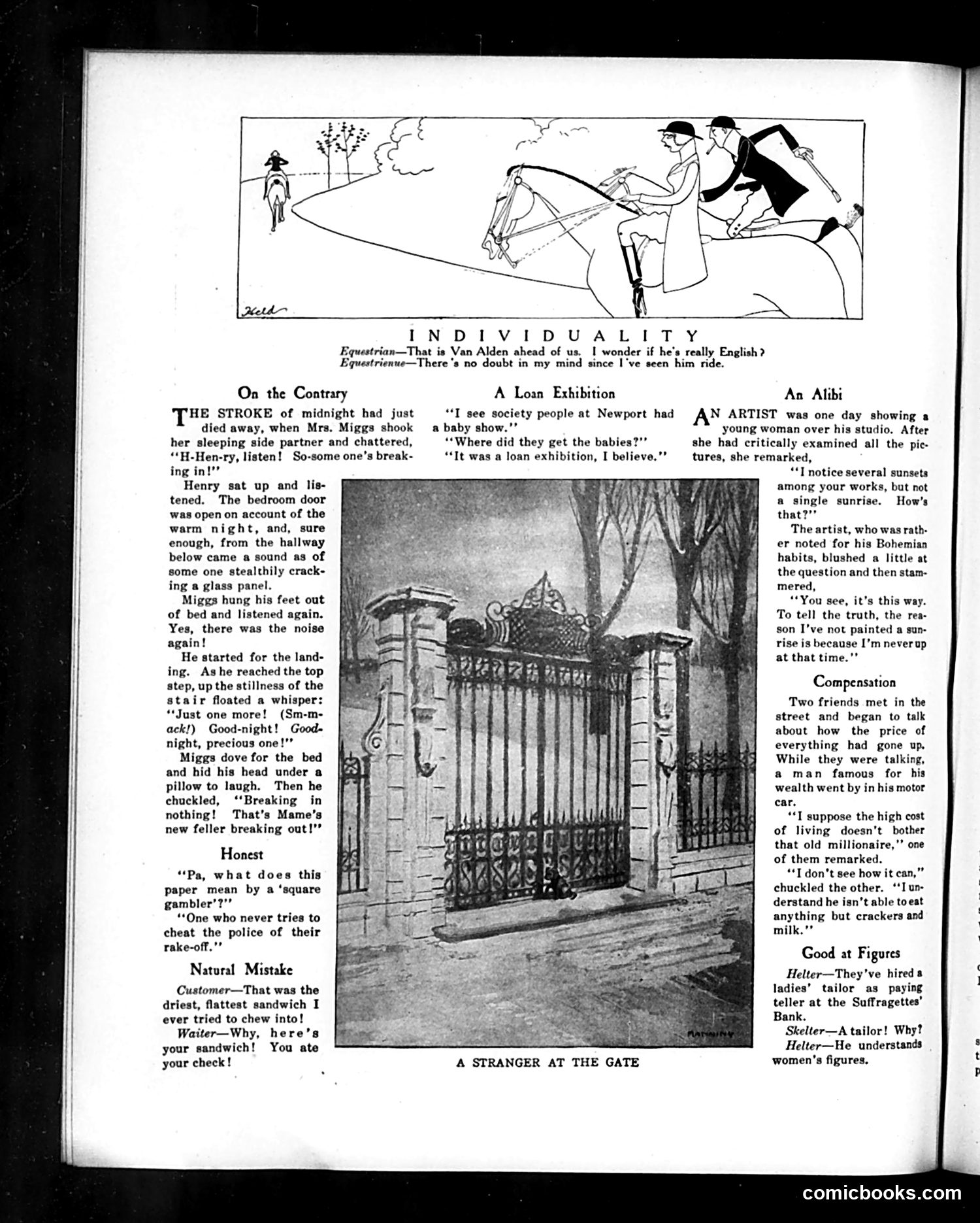
This page contains multiple short humorous pieces typical of early 20th-century satirical magazines: **"Individuality"** (top cartoon): Two riders discuss whether "Van Alden" is truly English. The joke relies on observing his riding style—apparently poor or unrefined, suggesting he's not actually English despite claims otherwise. **"A Loan Exhibition"** and **"An Alibi"**: Brief anecdotes about Newport society and an artist. The first jokes about borrowed babies for display; the second mocks a Bohemian artist who never paints sunrises because he never wakes early enough. **"On the Contrary"**, **"Honest"**, **"Natural Mistake"**, **"Compensation"**, and **"Good at Figures"**: Short joke pieces covering marital misunderstandings, political corruption ("square gambler"), waiter mishaps, wealth inequality, and a pun about women's suffrage (suffragettes hiring a tailor who "understands women's figures"). The humor is gentle, class-conscious social commentary typical of Judge's audience—wealthy, educated readers amused by servant behavior, moral lapses, and contemporary social movements like women's suffrage.
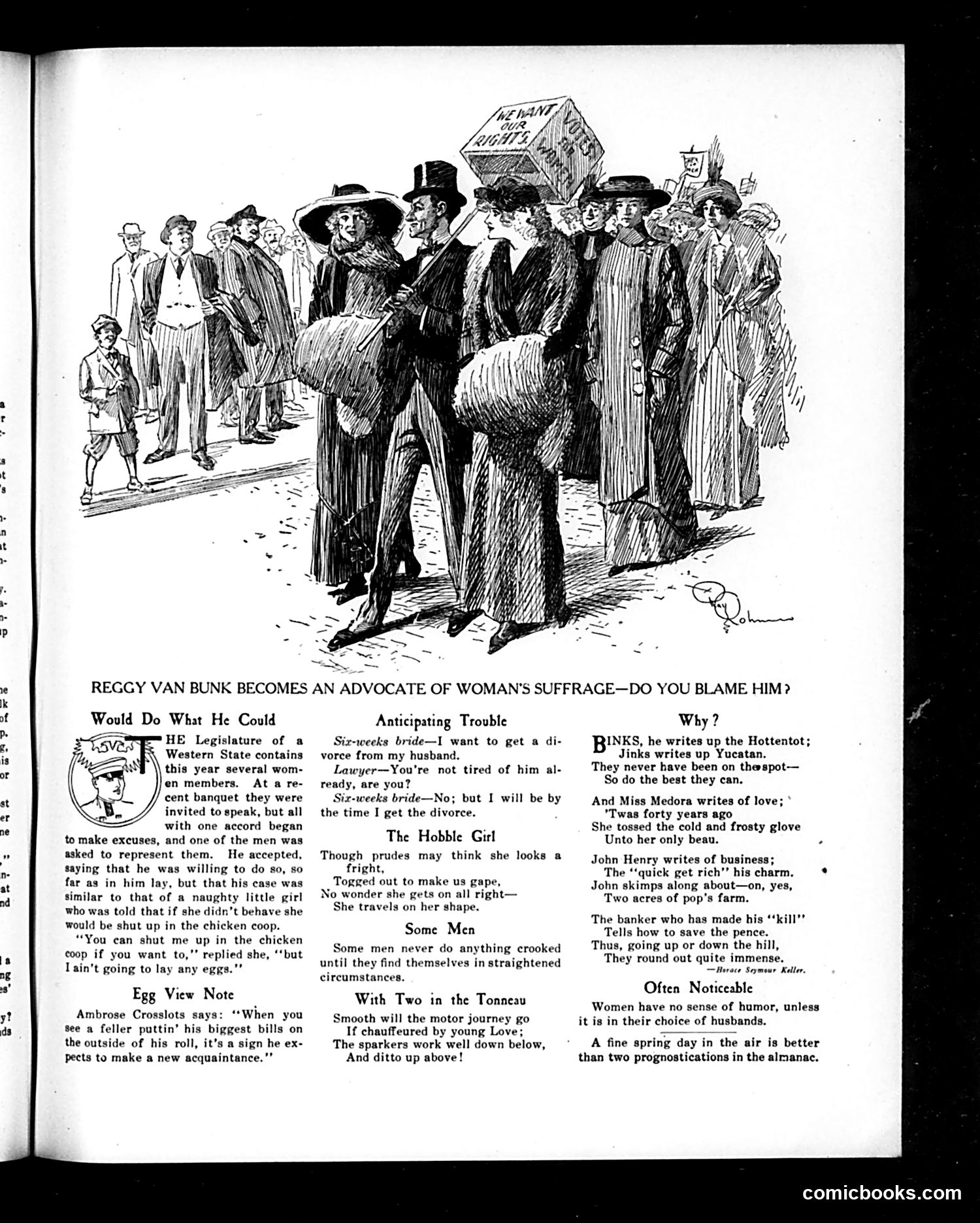
The main cartoon depicts a suffrage rally where a male legislator reluctantly speaks on behalf of female lawmakers who've declined to participate. His analogy—comparing himself to a girl threatened with the chicken coop who replies she won't "lay any eggs"—satirizes the perceived uselessness of women's political contributions. The cartoon's title ironically positions "Reggy Van Bunk" as a suffrage advocate, but the content mocks female legislators' timidity and suggests their participation in government would be ineffective. The surrounding text contains miscellaneous brief jokes and observations, including commentary on divorce, fashion ("hobble girl"), and various writers. One notable quip states: "Women have no sense of humor, unless it is in their choice of husbands"—revealing anti-feminist sentiment typical of *Judge* magazine's era. Overall, this page uses satire to belittle women's suffrage and political involvement, depicting female politicians as reluctant and incompetent while ridiculing women more broadly.
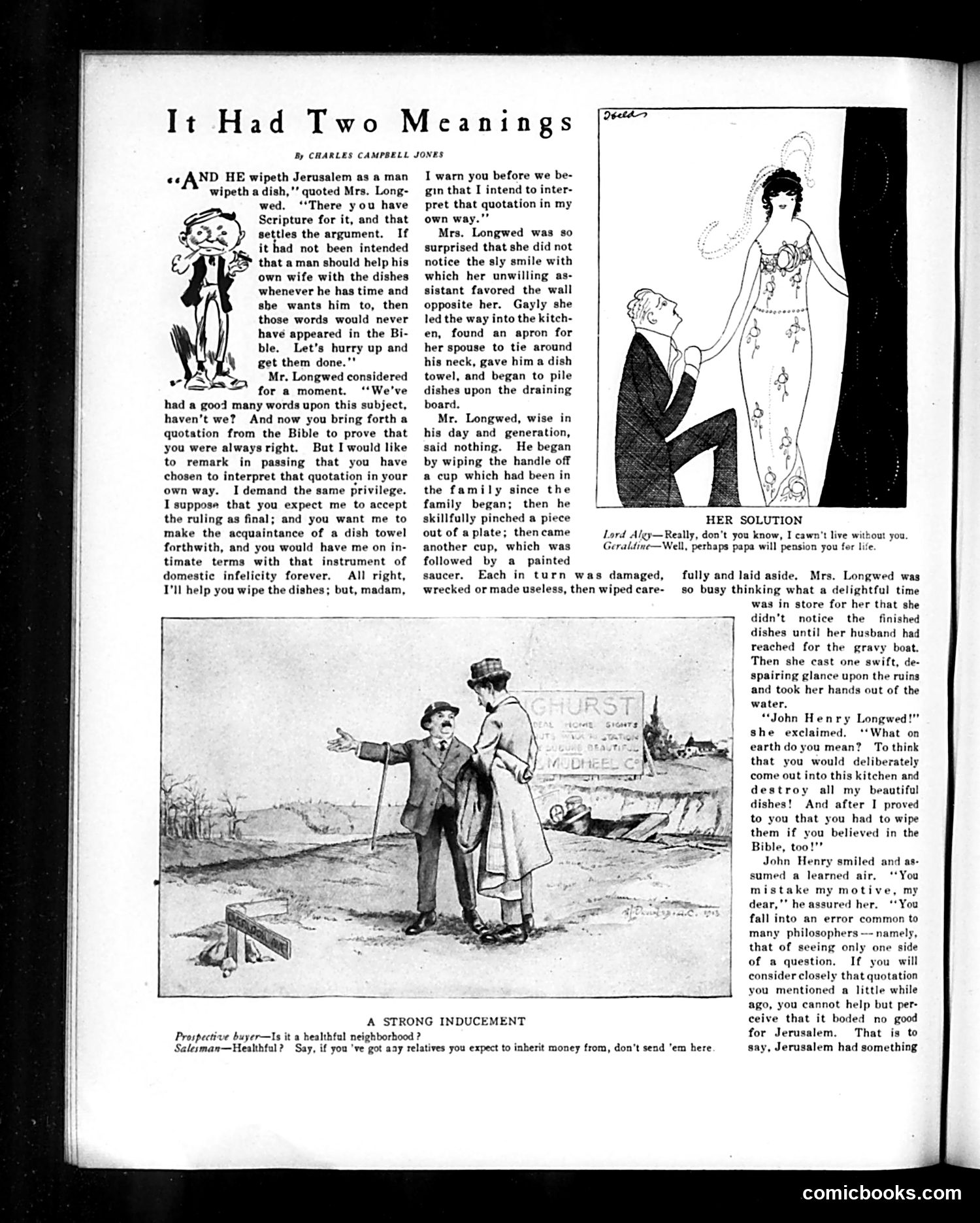
This domestic comedy satirizes marital argument tactics through a Bible dispute. Mrs. Longwed quotes Scripture ("he wipeth Jerusalem as a man wipeth a dish") to compel her husband to help with dishes. Mr. Longwed agrees—but announces he'll "interpret that quotation in my own way." He proceeds to deliberately break dishes while claiming to wipe them, then argues the quotation actually *warns against* Jerusalem's fate, therefore supporting his destructive behavior. The joke exploits selective Biblical interpretation: both spouses twist the same passage to justify opposite conclusions. The satire targets how people—particularly husbands avoiding domestic duties—use rhetorical cleverness and philosophical sophistry to escape obligations, even when trapped by their own logic. It's a humorous commentary on marital power struggles and bad-faith argumentation in early-20th-century households. The second cartoon (bottom) about a fortune-hunting suitor is unrelated.
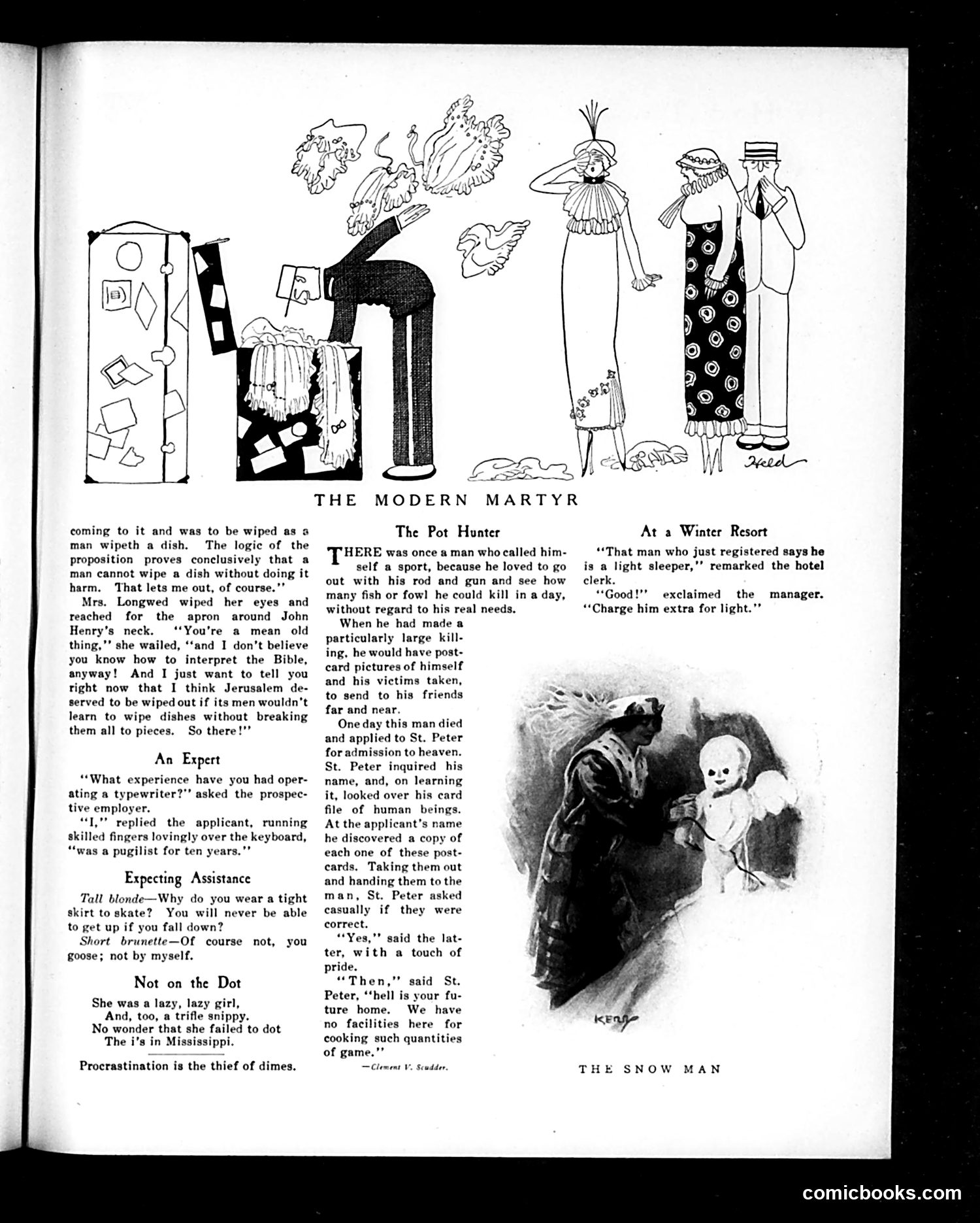
This page from the satirical magazine **Judge** contains several short humor pieces reflecting early-20th-century social attitudes: **"The Pot Hunter"** (main story) satirizes excessive hunting and boasting. A man who kills game indiscriminately—and sends postcards of his kills to friends—dies and is denied heaven because St. Peter jokes there are "no facilities for cooking such quantities of game." The satire targets wasteful hunting practices and vanity. **"An Expert"** jokes about a boxer applying as a typewriter operator, using "pugilist" (boxer) as a pun on manual dexterity. **"Not on the Dot"** mocks lazy women who can't perform basic tasks correctly. The shorter quips ("Expecting Assistance," "Not on the Dot") traffic in period stereotypes about women. **"The Modern Martyr"** cartoon (top) appears to satirize domestic life, though specifics are unclear from the image alone. The overall tone reflects Judge's satirical approach to contemporary social behaviors and gender roles of the era.
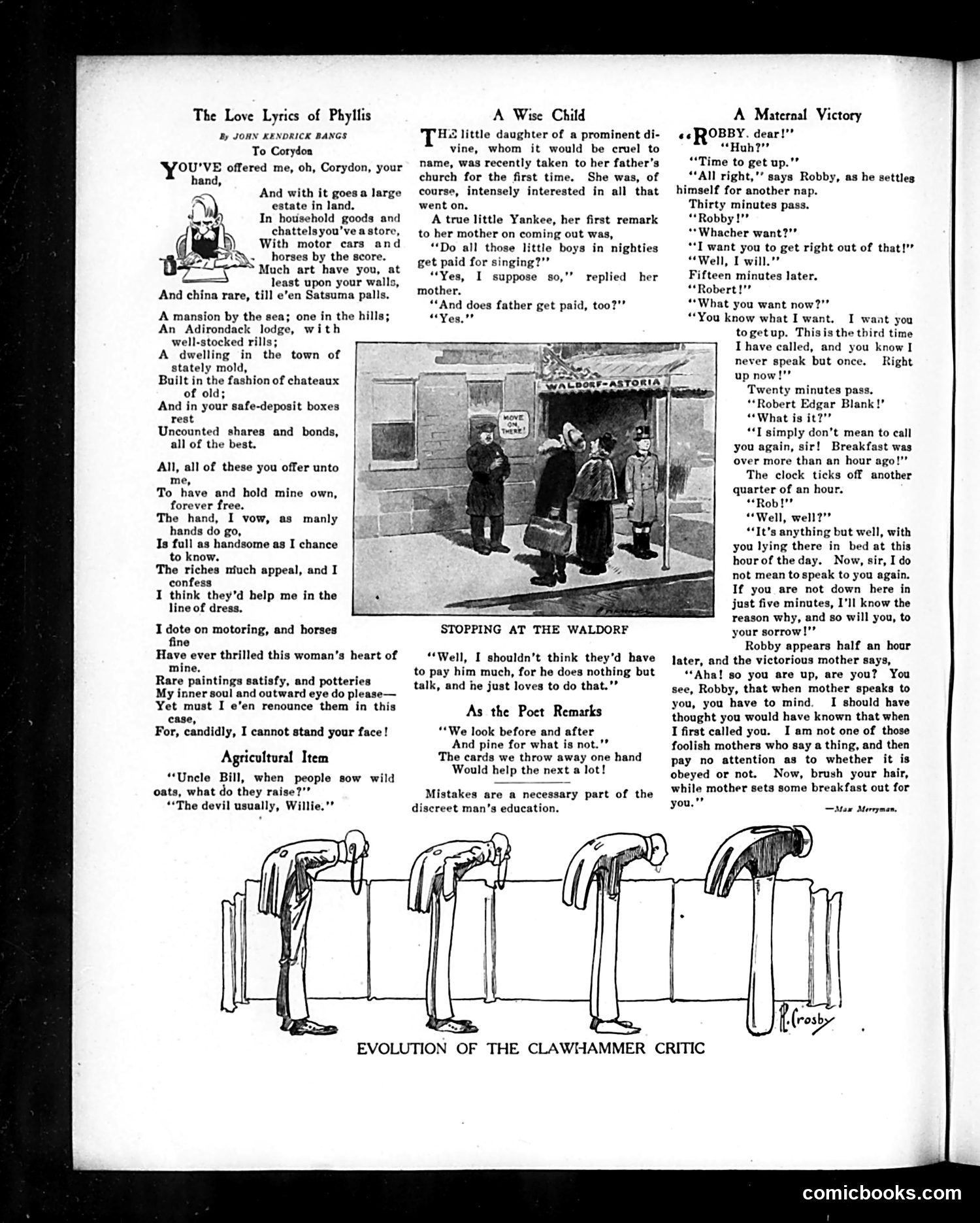
This Judge magazine page contains several satirical pieces targeting early 1900s social conventions: **"The Love Lyrics of Phyllis"** mocks wealthy suitors by having a woman reject a rich man's marriage proposal solely because she finds him physically unattractive—a radical position for the era, when women were expected to prioritize financial security. **"A Wise Child"** humorously depicts a minister's daughter attending church for the first time and making an innocent but cutting observation: she assumes the choir boys are paid employees and questions why her father (the clergyman) deserves payment when he "does nothing but talk." The joke critiques clergy compensation. **"A Maternal Victory"** shows a mother's battle getting her son out of bed, ultimately claiming "victory" through persistent nagging rather than obedience—satirizing both parental authority and child resistance. **"Evolution of the Clawhammer Critic"** (bottom cartoon) appears to show progressive stages of physical deterioration or posture change, likely satirizing theater critics, though the specific reference is unclear. The page reflects Judge's characteristic humor targeting gender relations, class pretensions, and family dynamics of the period.
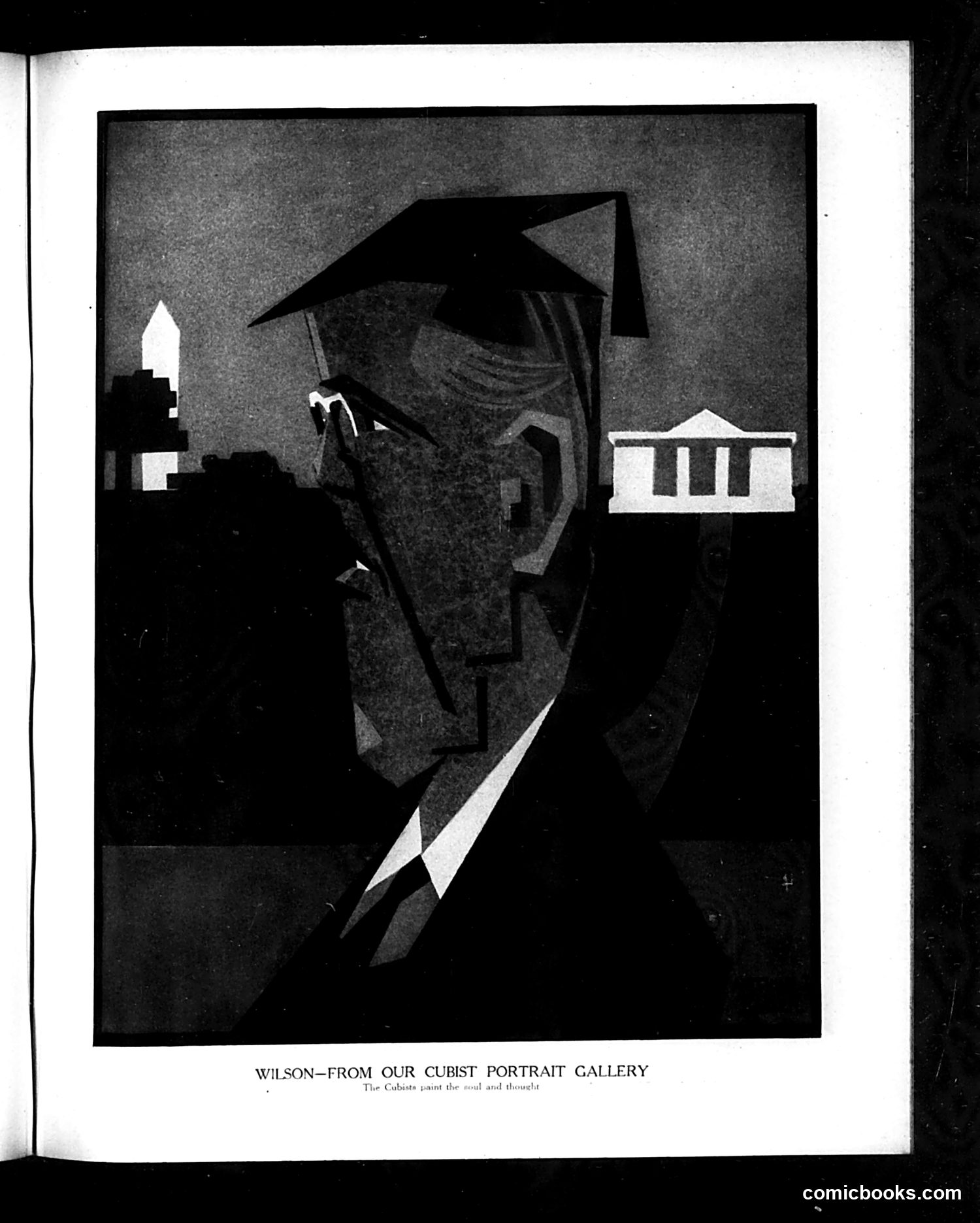
This is a cubist-style portrait of President Woodrow Wilson from Judge magazine's satirical "Portrait Gallery." The cubist technique—fragmented, geometric planes—was a modernist art movement that Judge's audience would have found deliberately distorted and absurd. The satire works on two levels: First, it mocks cubism itself as incomprehensible artistic pretension. Second, the fragmented portrait of Wilson suggests his fractured or contradictory nature—possibly referencing criticisms of his policies, leadership, or public persona during his presidency (1913-1921). The caption's incomplete text ("Cubists paint the soul and thought") implies that even if cubists claim depth, what emerges is merely confusion. The architectural silhouettes in the background (Capitol, White House) anchor this as political commentary on Wilson's Washington.
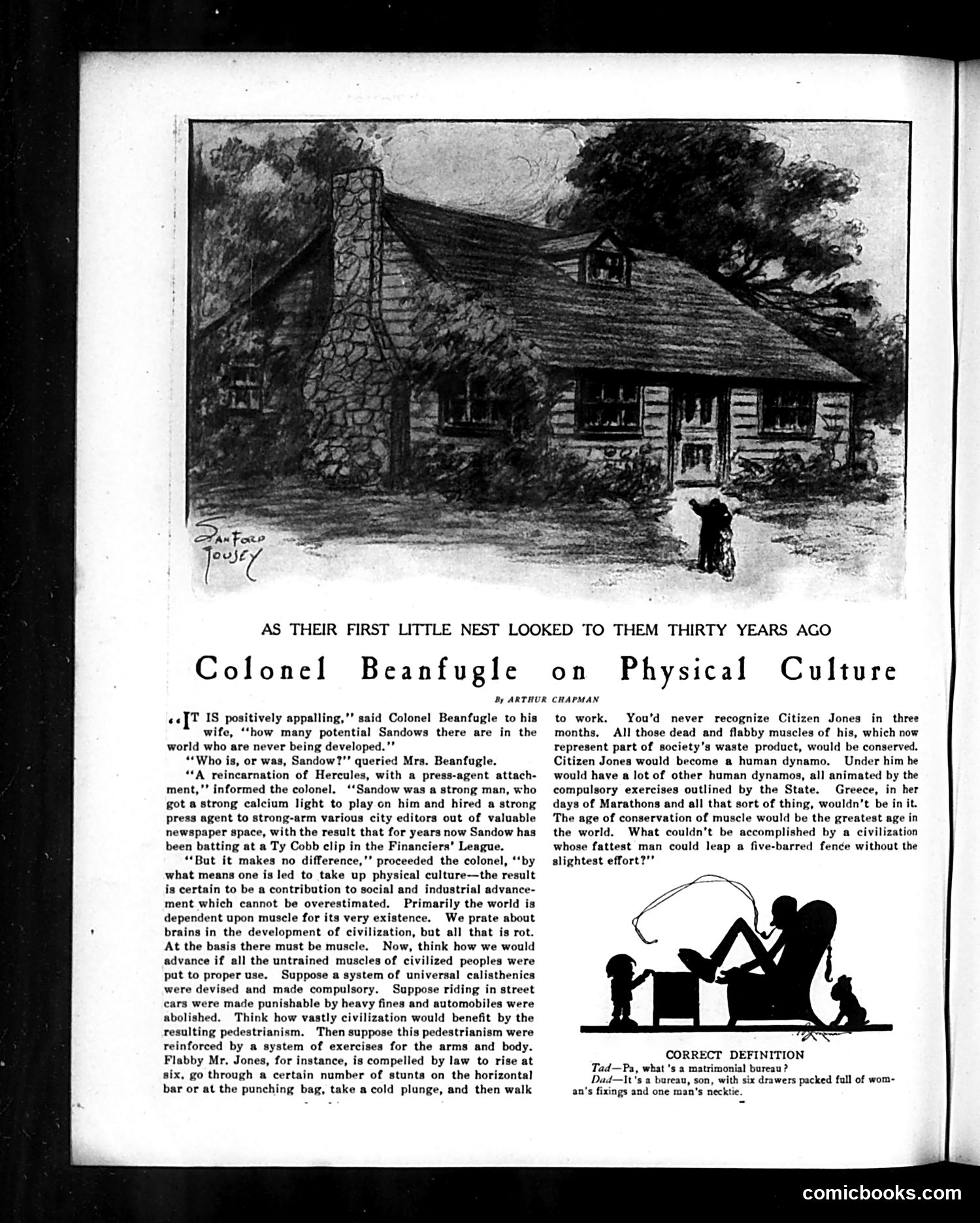
This is satirical commentary on the early-1900s obsession with physical fitness and eugenics-influenced ideas about muscular development. Colonel Beanfugle, a bombastic character, advocates for mandatory state-enforced calisthenics and pedestrianism, claiming muscle development is civilization's foundation—dismissing intellectual achievement as "rot." The satire targets several contemporary figures and trends: "Sandow" references Eugen Sandow, a famous strongman/bodybuilder whose success relied heavily on publicity; "Ty Cobb" references the baseball player's aggressive success. The colonel's extreme proposals—abolishing automobiles, mandatory dawn exercises, legal penalties for riding streetcars—mock the era's pseudo-scientific wellness movements and government paternalism. The lower cartoon, credited to Tad (likely cartoonist Tad Dorgan), provides comic relief with a domestic joke about marriage bureaus.
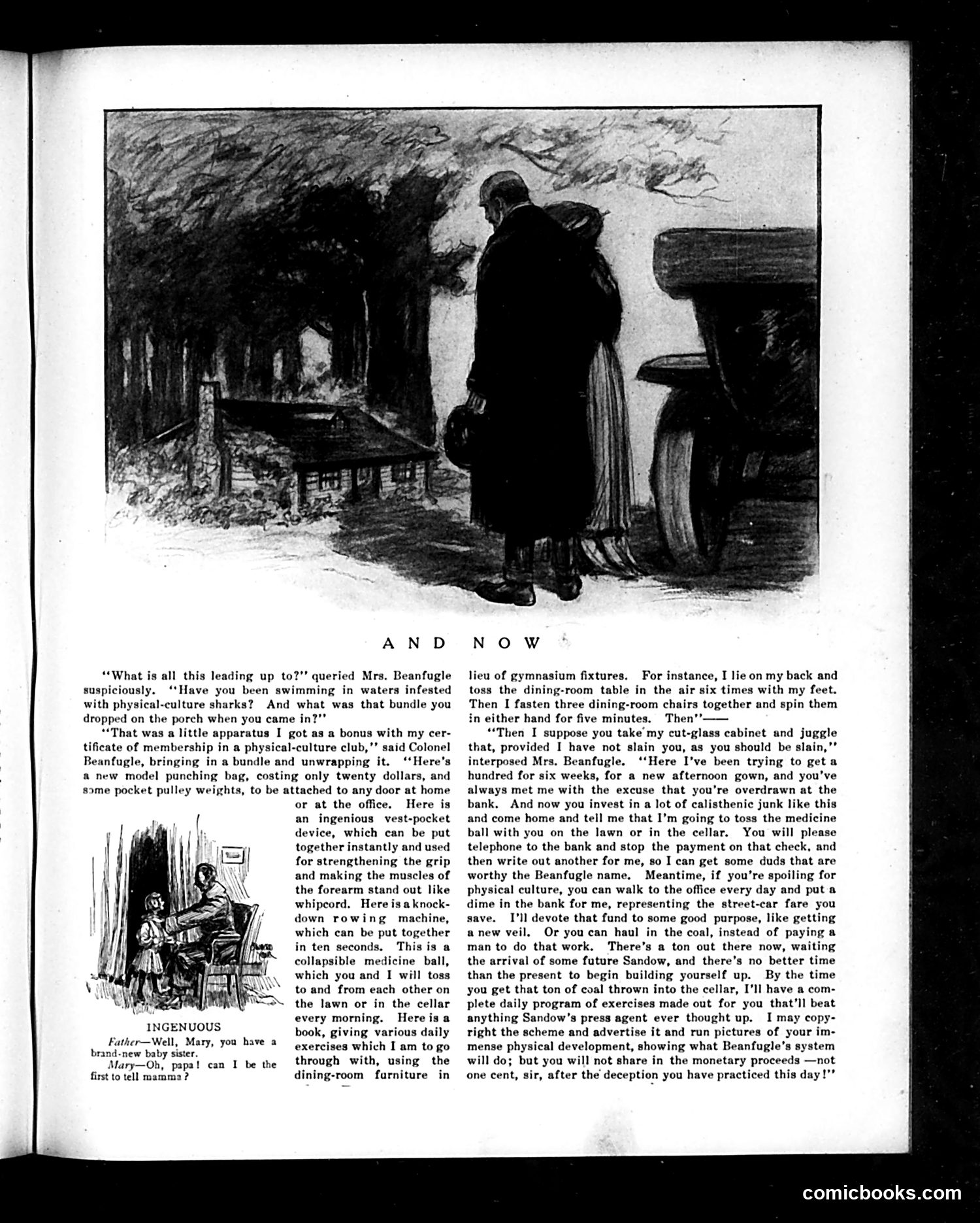
This page satirizes the early 1900s "physical culture" movement—a fitness fad promoted by celebrities like Eugen Sandow. Colonel Beanfugle has joined a physical-culture club and brings home expensive exercise equipment (punching bags, pulley weights, rowing machines, medicine balls) he's excited to use at home. His wife Mrs. Beanfugle responds with cutting sarcasm, exposing the absurdity: he claims poverty when she needs money for clothes, yet spends on gym gadgets. She sarcastically suggests using actual household furniture and labor (hauling coal) as "exercise," and threatens to patent his ridiculous regimen for profit while denying him any share. The joke mocks both the fitness-obsessed husband and the commercialization of the physical-culture industry—showing how such fads prey on vanity while draining household finances. The smaller cartoon below presents an unrelated domestic joke about a new baby.
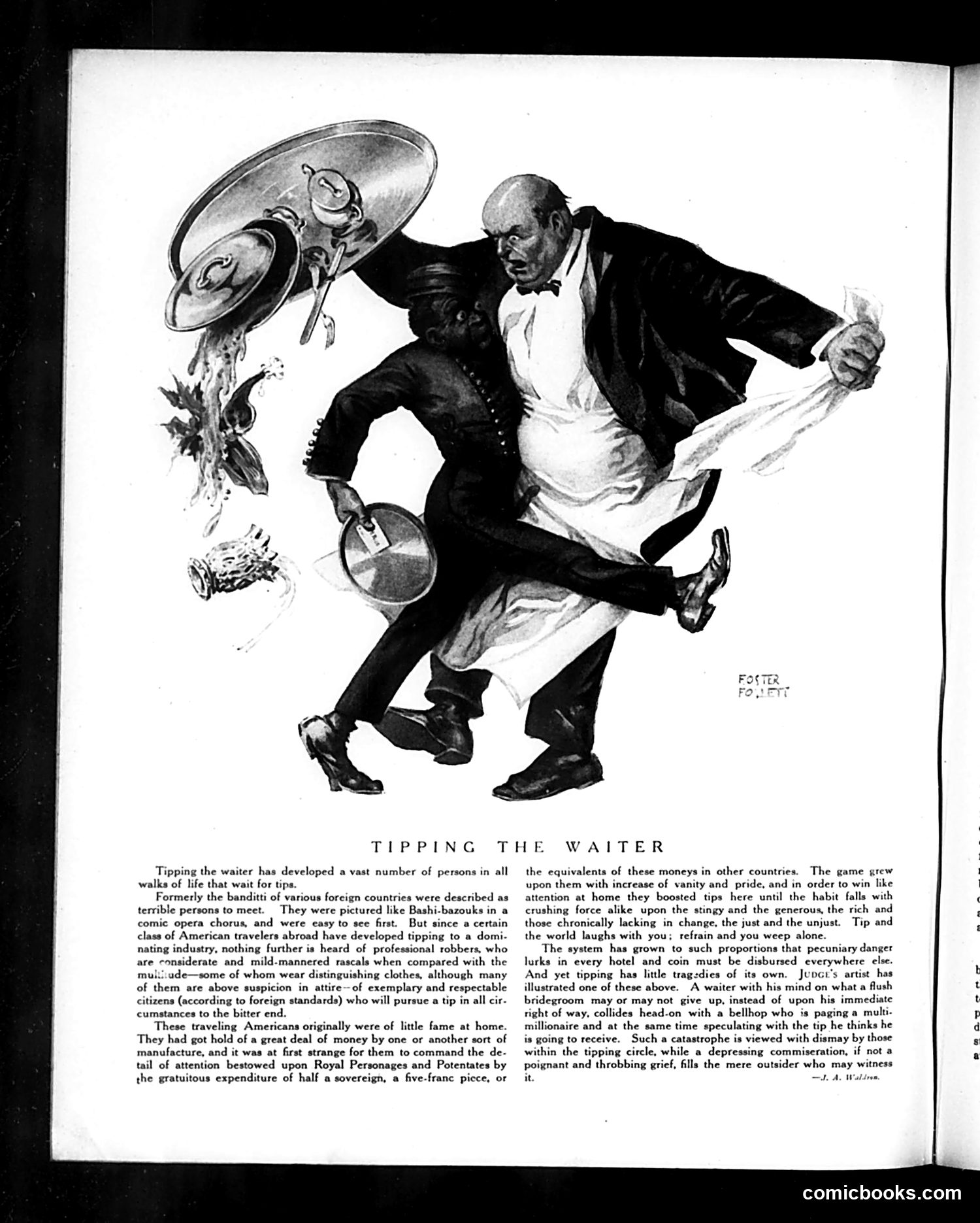
This cartoon satirizes the American tipping culture that had grown excessive by the early 20th century. The illustration shows a chaotic collision between a waiter and bellhop, both distracted by fantasies of tips rather than their duties—the waiter daydreaming about money while the bellhop imagines pleasing a wealthy patron. The text argues that wealthy American travelers abroad popularized extravagant tipping to gain attention, and this habit has metastasized at home. Now service workers of all kinds—many indistinguishable from ordinary citizens—aggressively pursue tips in "all circumstances to the bitter end." The satire mocks how this system has become a parasitic burden affecting everyone, from the stingy to the generous, while service workers remain perpetually anxious about potential earnings rather than performing their actual jobs competently.
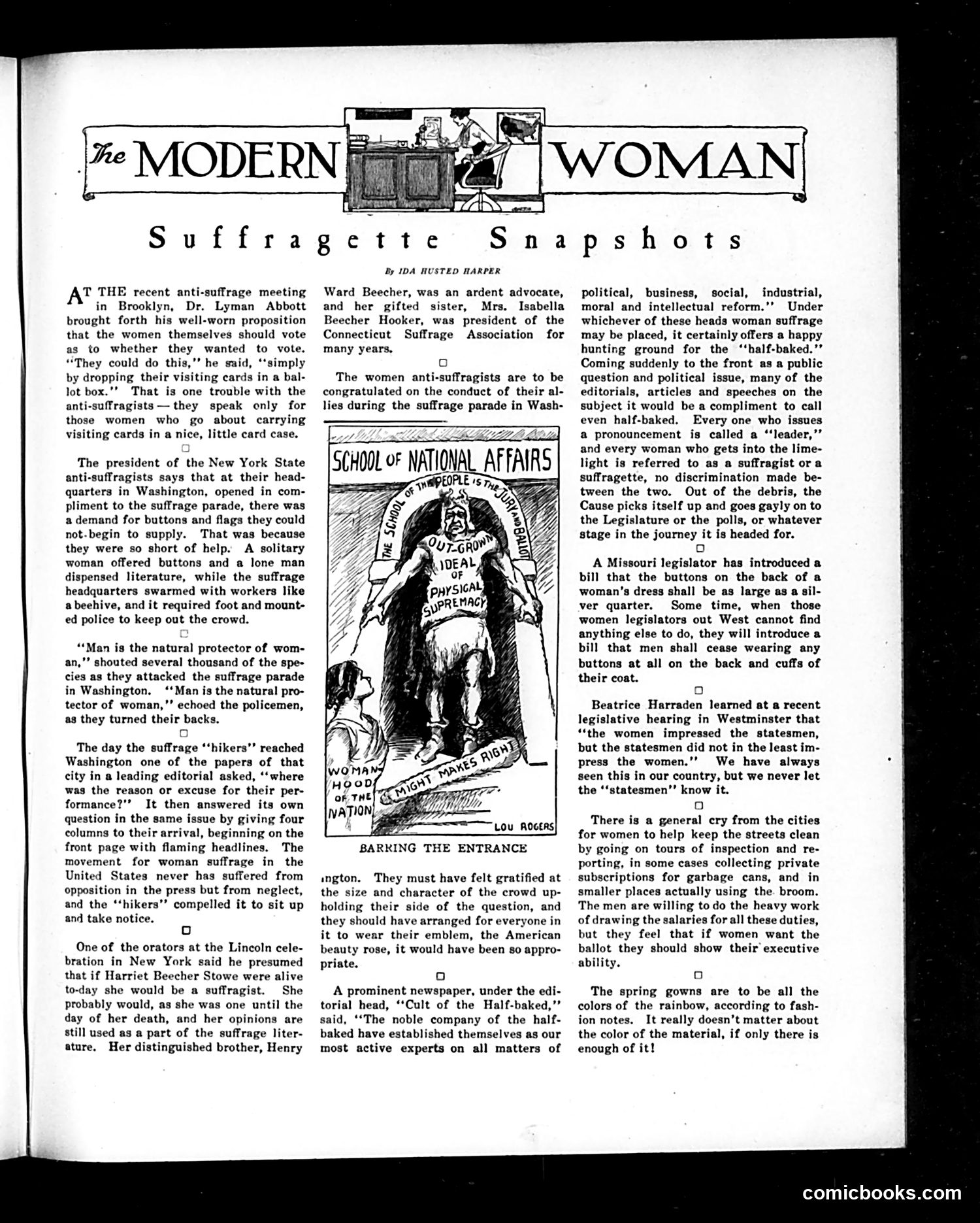
This page satirizes **anti-suffrage opposition** to women's voting rights, likely from around 1912-1913 (based on references to a Washington suffrage parade and "hikers"). The cartoon "Barking the Entrance" depicts a large dog (representing opposition/anti-suffragists) barking at the entrance to the "School of National Affairs," symbolizing how opponents obstruct women's political participation. **The satire's targets:** - Dr. Lyman Abbott's absurd proposal that women vote on voting via "visiting cards" - Anti-suffragists' lack of organizational support compared to suffragists' mobilization - The irony of men claiming to be "natural protectors of women" while attacking suffrage parades - Press coverage that simultaneously ignores and sensationalizes the movement - The hypocrisy of invoking Harriet Beecher Stowe as anti-suffrage authority when her own family championed women's rights Author Ida Husted Harper uses ridicule to expose anti-suffrage arguments as illogical and elitist, celebrating suffragists' superior grassroots organization.
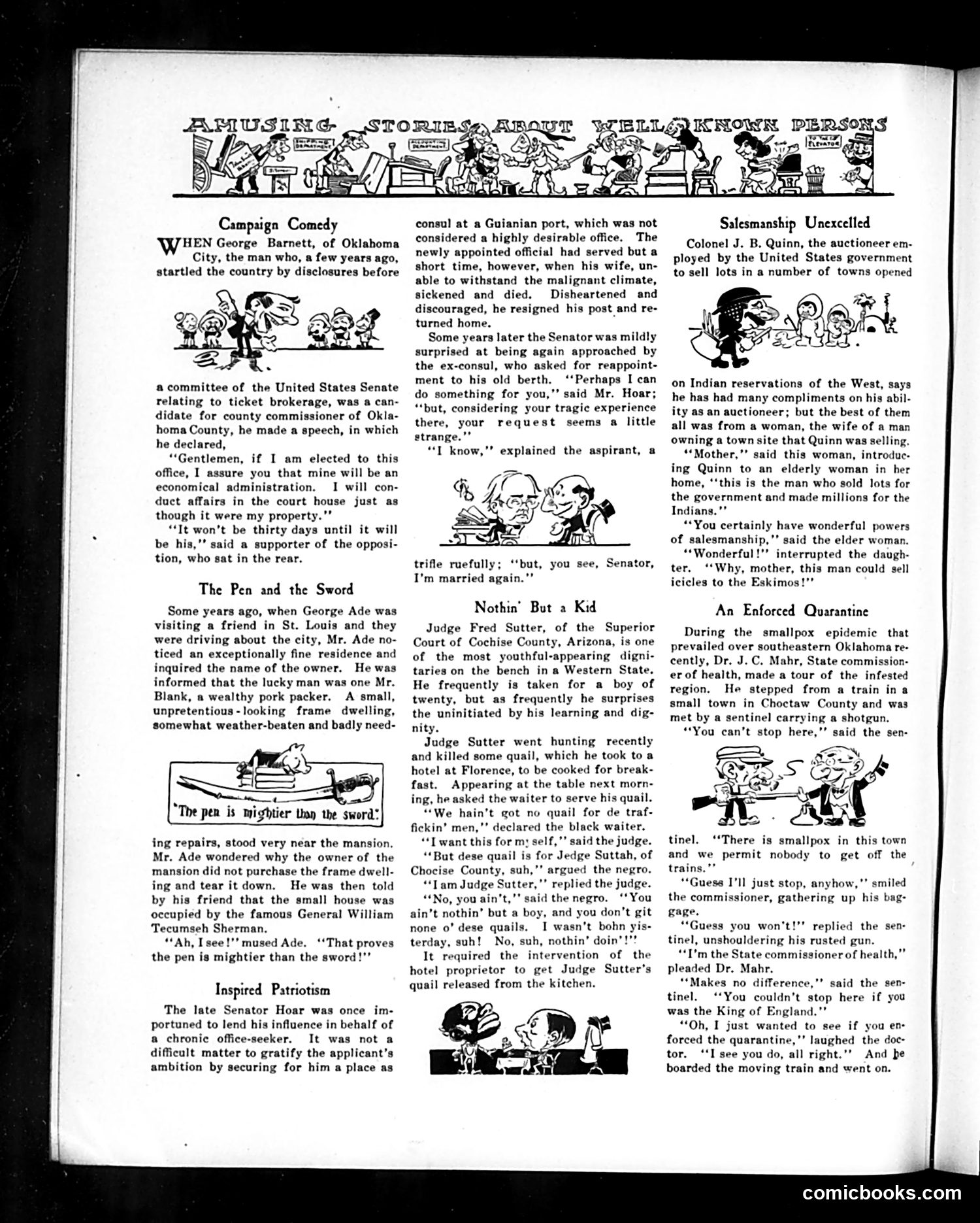
This page contains four humorous anecdotes satirizing American politics and social life, likely from the early 1900s. **"Campaign Comedy"** mocks politician George Barnett's claim he'll run county affairs "as though it were my property"—a supporter quips he'll actually *make* it his property, suggesting inevitable corruption. **"The Pen and the Sword"** contrasts wealthy pork magnate Mr. Blank's mansion with General William Tecumseh Sherman's modest nearby house, suggesting Sherman's literary/intellectual legacy ("the pen") outweighs material wealth or military power ("the sword"). **"Nothin' But a Kid"** humorously depicts young-looking Judge Fred Sutter being denied quail by a Black waiter who doesn't believe he's actually a judge, requiring the hotel owner's intervention—playing on stereotypes and the judge's youthful appearance. **"Inspired Patriotism"** presents a cynical anecdote: a man whose wife died at a consular post in Guiana seeks reappointment—Senator Hoar notes the tragic circumstances, but the man reveals he's remarried, implying self-interest trumps family tragedy.
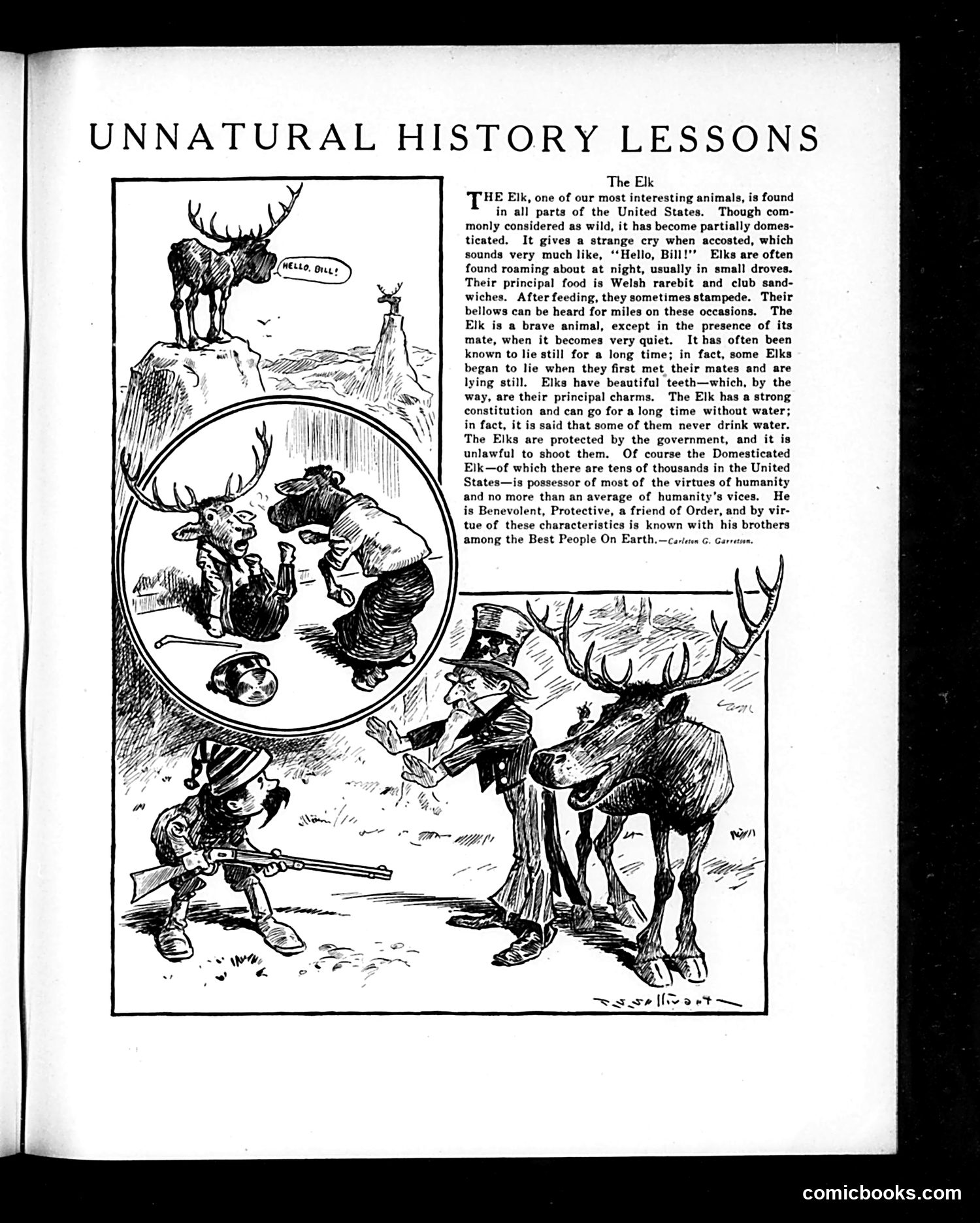
This satirical piece mocks wealthy American high society through a fake "natural history" of the elk. The text humorously describes elks eating "Welsh rarebit and club sandwiches"—fancy foods associated with gentlemen's clubs—rather than actual vegetation. The cartoons illustrate the joke: the upper panel shows elks behaving like humans (greeting each other with "Hello, Bill!"), while the lower panel depicts well-dressed gentlemen in top hats interacting with an actual elk, blurring the line between animal and "civilized" man. The satire suggests that wealthy "Domesticated Elk" possess only average human virtue despite their pretensions to being "Best People On Earth." It's a commentary on the artificiality and superficiality of the leisure class, implying they're barely more refined than animals despite their fashionable trappings and exclusive club culture.
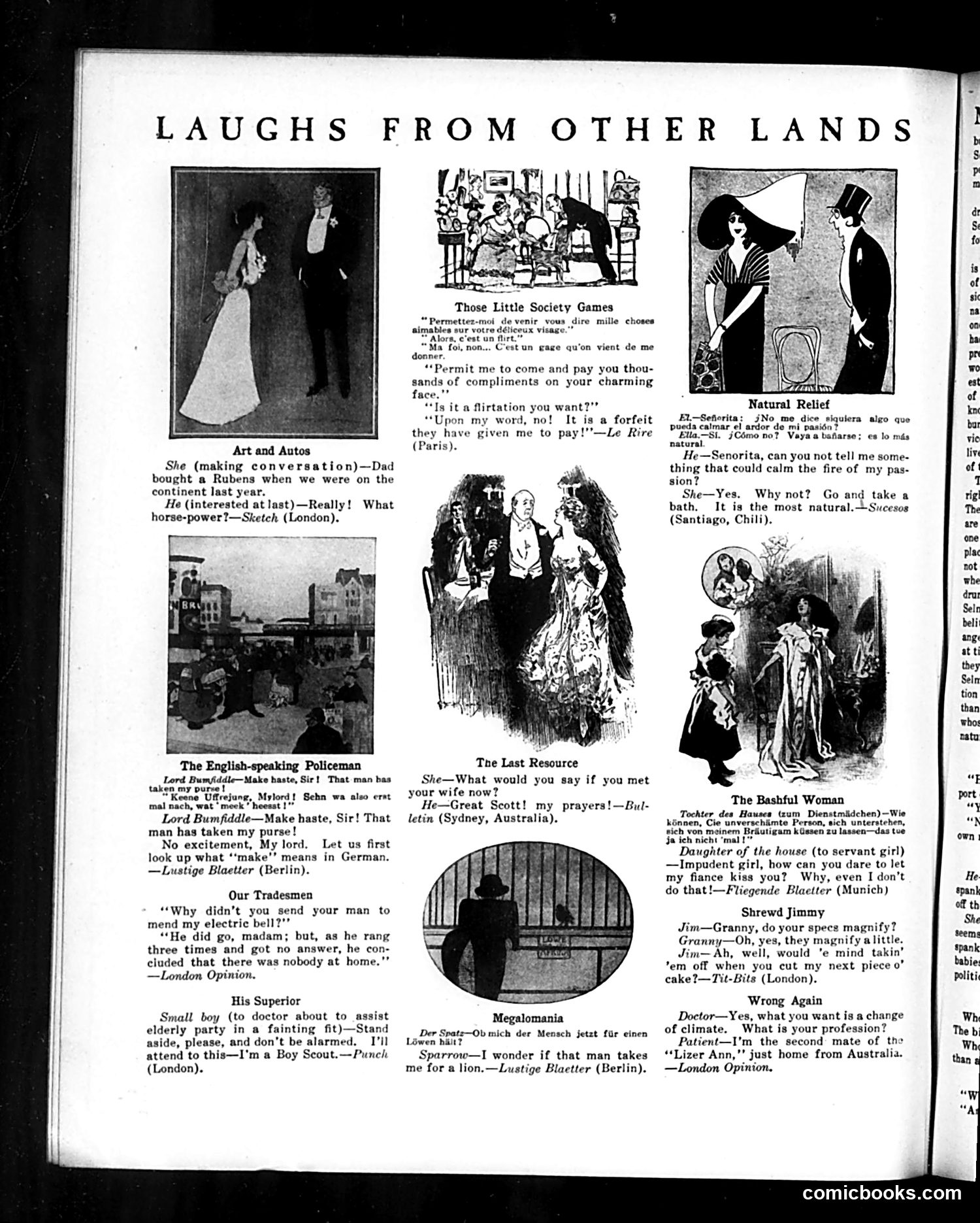
This page collects brief humorous anecdotes translated from European and Commonwealth publications, organized thematically. The satire targets universal human follies rather than specific political figures. Key jokes include: a husband confusing an art purchase (Rubens painting) with a horse's horsepower; a German policeman's literal-minded bureaucracy delaying crime response; a British doctor's class consciousness (a Boy Scout offers to help); and marital anxieties (a husband prays upon meeting his wife). The "bashful woman" bit mocks gender hypocrisy—a woman forbids her servant from kissing her fiancé while admitting she doesn't kiss him herself. A child cleverly removes his grandmother's magnifying glasses before asking her to cut cake. The page illustrates Judge's cosmopolitan approach, presenting humor from Berlin, London, Paris, Santiago, and Sydney as evidence of shared middle-class social embarrassments across cultures—marital discord, servant management, romantic awkwardness, and class pretension.
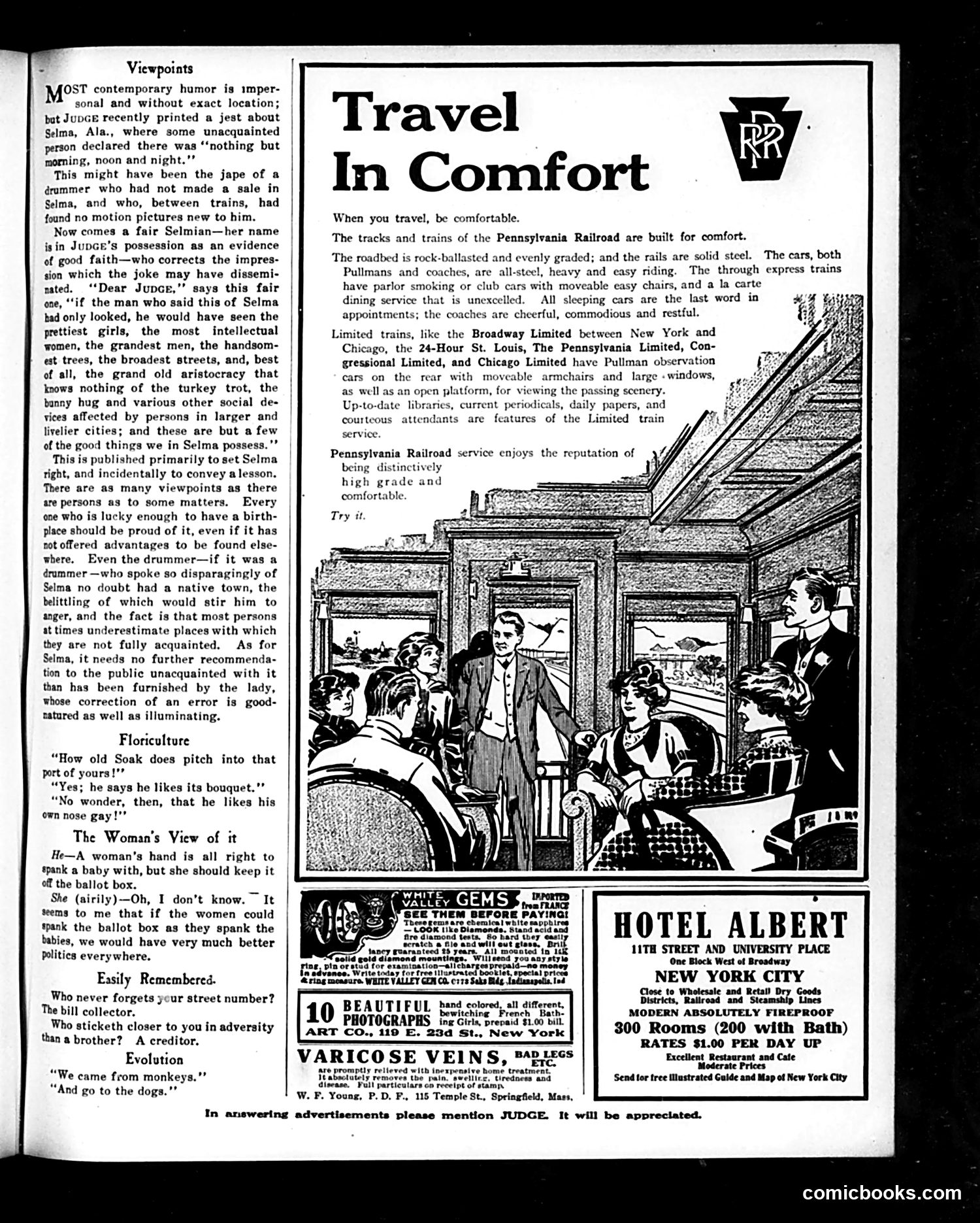
This page consists primarily of **advertisements and humor columns rather than political cartoons**. The main content includes: 1. **"Viewpoints" column**: A response defending Selma, Alabama against a previous joke claiming it offered "nothing but morning, noon and night." A Selma woman rebuts this, listing the town's attractions—pretty girls, intellectual women, handsome men, and notably "the grand old aristocracy" unfamiliar with modern dance crazes like the turkey trot and bunny hug. The piece uses this to make a broader point about local pride and perspective. 2. **Humor pieces**: Brief jokes about wine snobbery, women's suffrage (where a woman counters that women spanking the "ballot box" would improve politics), and debt collectors. 3. **Large Pennsylvania Railroad advertisement** for comfortable train travel, featuring an illustration of well-dressed passengers in a luxurious railcar. The Selma defense obliquely references contemporary anxieties about modern urban culture versus traditional Southern values, but the page is primarily commercial and light-hearted rather than sharply satirical.
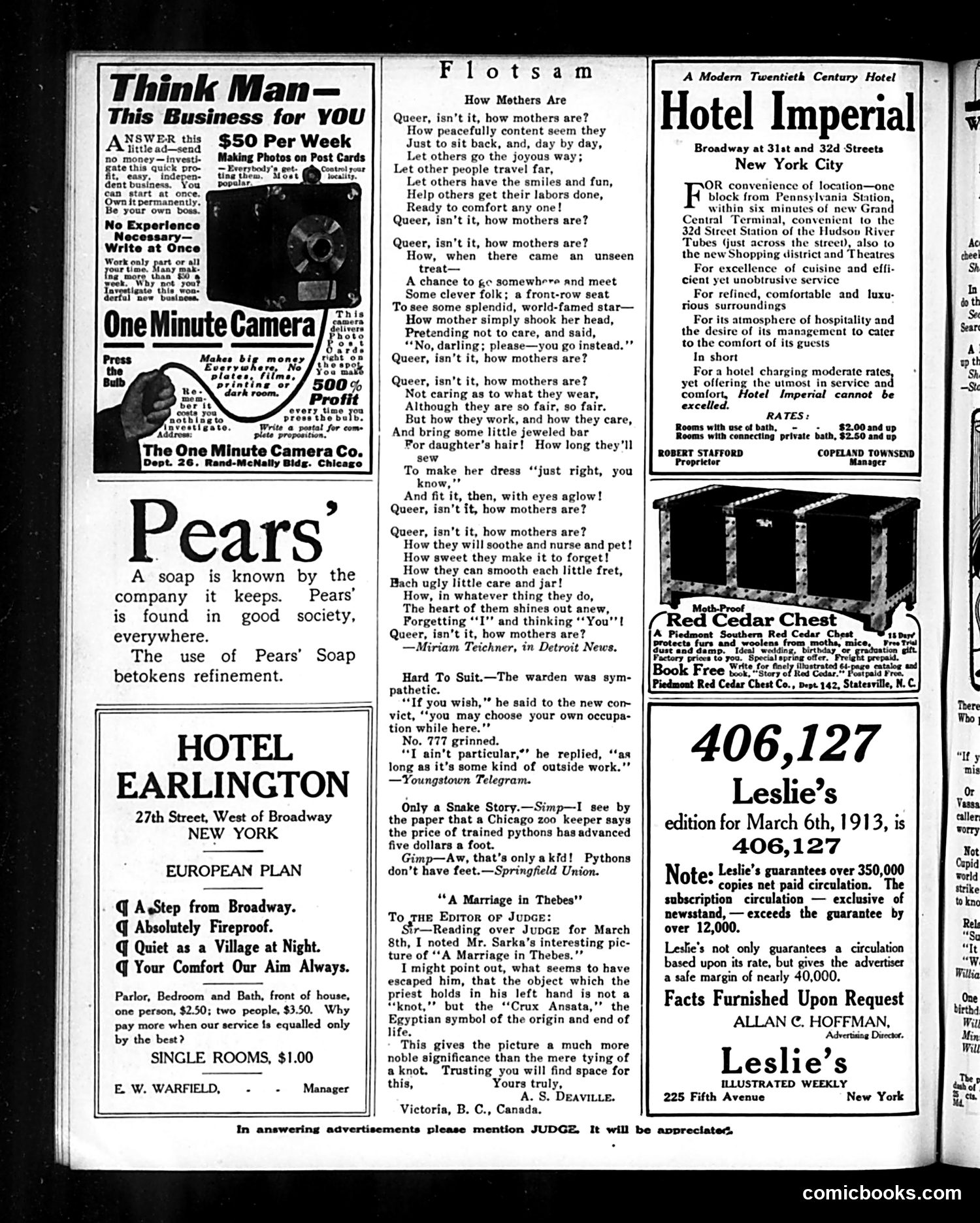
This page from Judge (March 6, 1913) is primarily **advertisements and light humor columns**, not political satire. **Main Content:** The centerpiece is "Flotsam: How Mothers Are," a sentimental poem by Miriam Teichner celebrating maternal self-sacrifice—mothers who forgo travel, fine clothes, and personal pleasures to care for their families. This reflects early 20th-century idealization of motherhood. **Supporting humor** includes two brief jokes: a prison warden offering an inmate job choice (the inmate wants "outside work"), and a discussion about trained pythons' prices (playing on the fact pythons have no feet). **Advertisements** fill the remaining space: The One Minute Camera Co. promises $50/week income; Pears' Soap emphasizes "good society" and "refinement"; and hotels advertise competitive rates and locations. **Historical context:** This reflects pre-WWI America's gender roles, consumer culture, and the magazine's mix of sentimental verse with gentle humor—not sharp political commentary.
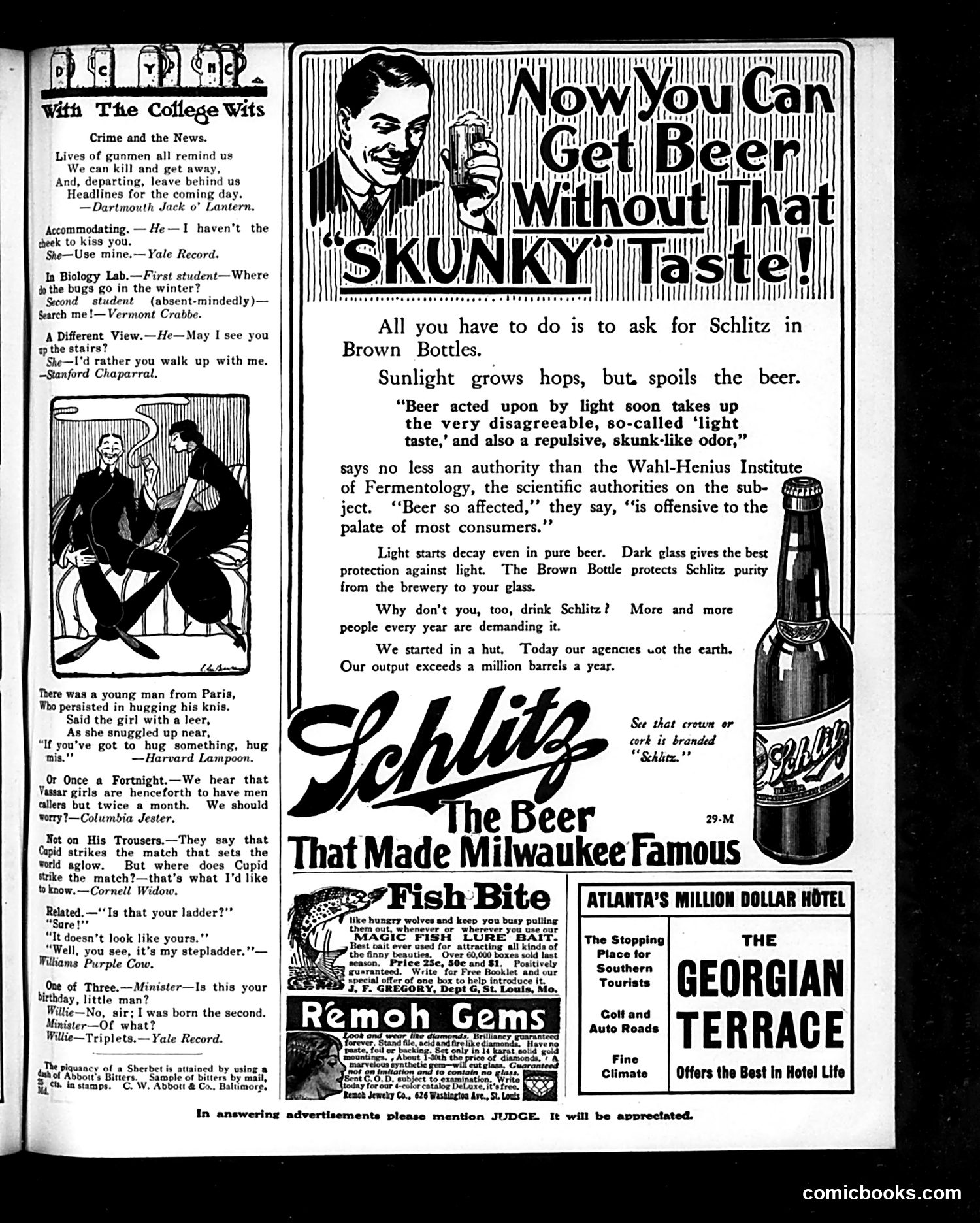
This page combines college humor with advertising. The left side features "College Wits"—brief, ribald jokes reprinted from various university publications (Harvard Lampoon, Yale Record, etc.). These jokes address typical college topics: kissing, romance, biology class, and courtship rules. The humor is mild by modern standards but reflects early 20th-century college culture's focus on heterosexual pursuit and flirtation. The dominant content is a **Schlitz beer advertisement** claiming brown bottles preserve beer quality better than clear glass, which allegedly causes "skunky" flavor. This references scientific authority (the Wahl-Henius Institute) to legitimize the marketing claim. The ad emphasizes Schlitz's growth from humble origins to massive production. Additional small ads promote fishing bait, jewelry, and Atlanta hotels. The page reflects Judge's dual purpose: satirical commentary through college humor, and revenue through advertising—particularly alcohol ads, legal during this pre-Prohibition era.
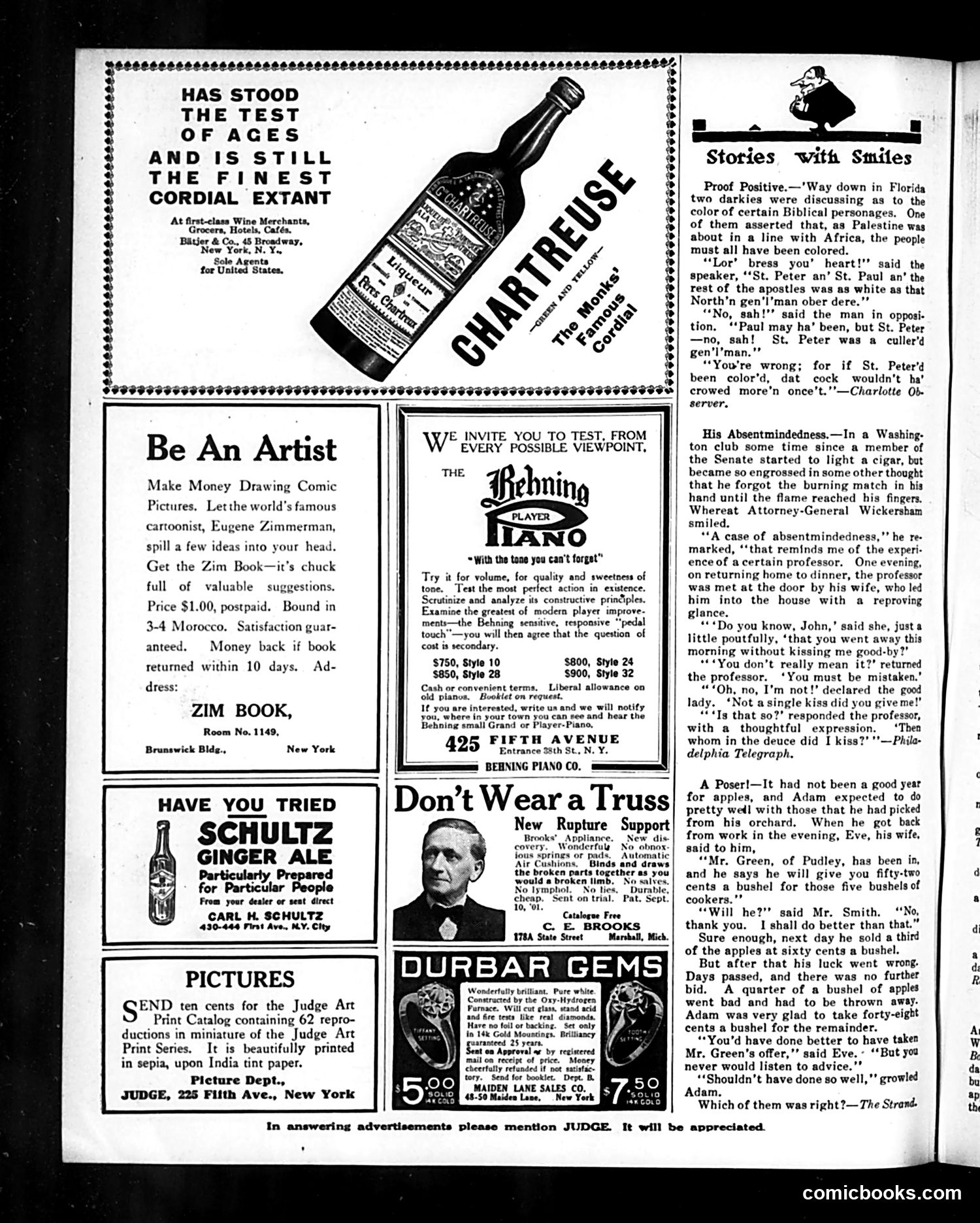
This is primarily an **advertising page** from Judge magazine, with a small humor section ("Stories with Smiles"). The page contains period product ads (cordial liqueur, pianos, ginger ale, rupture supports, art supplies, and gemstones) typical of early 20th-century publications. The humor section features short jokes using racial stereotypes prevalent in that era—specifically caricatured Black dialect ("darkies," "'Lor' bress you' heart!"). One joke plays on Biblical knowledge; another on absent-mindedness involving a U.S. Senator and Attorney-General Wickersham. These jokes are framed as light entertainment meant for educated readers. The ads themselves offer self-improvement materials (art lessons) and medical devices alongside luxury goods, reflecting the era's marketing approach to middle and upper-class audiences. The page provides insight into advertising practices and humor standards of the period, though modern readers would recognize the racial characterizations as offensive stereotypes rather than amusing content.
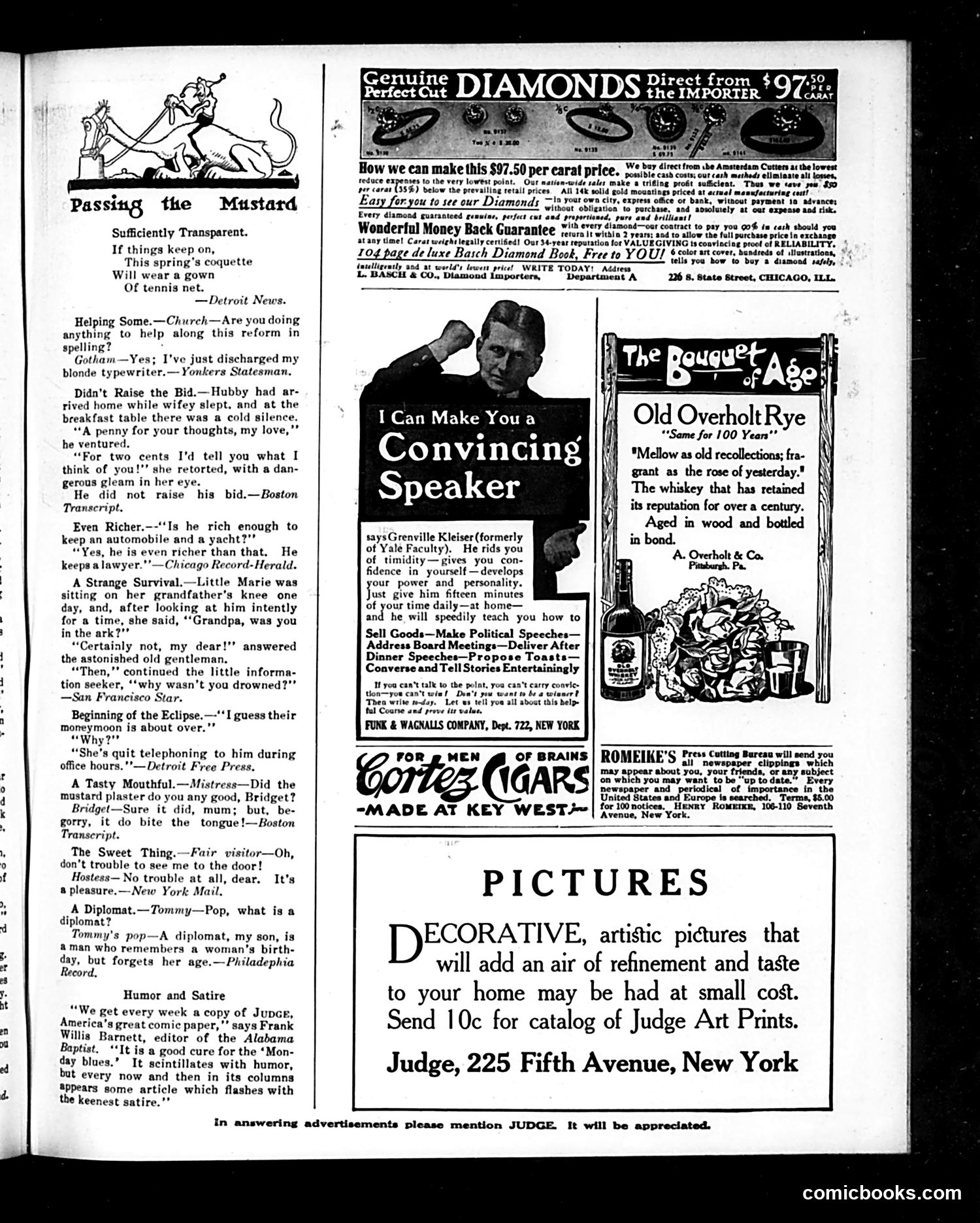
This page is primarily **advertisements and humor columns** rather than political cartoons. The small section titled "Passing the Mustard" is a cartoon showing someone passing mustard—a visual pun on the phrase "passing the mustard" (doing well). The accompanying text from the *Detroit News* jokes about fashion: "This spring's coquette will wear a gown of tennis net"—satirizing impractical women's fashion trends. The humor columns mock domestic life and gender relations typical of early 20th-century satire: a husband withholds affection ("didn't raise the bid"), spelling reform, and a grandfather figure. The ads promote diamonds, whiskey, speaking courses, and cigars. The page reflects **1920s consumer culture and traditional gender dynamics**—husbands, wives, courtship, and aspirational purchases dominate. The satire is gentle, domestic, and apolitical rather than addressing serious social or political issues.
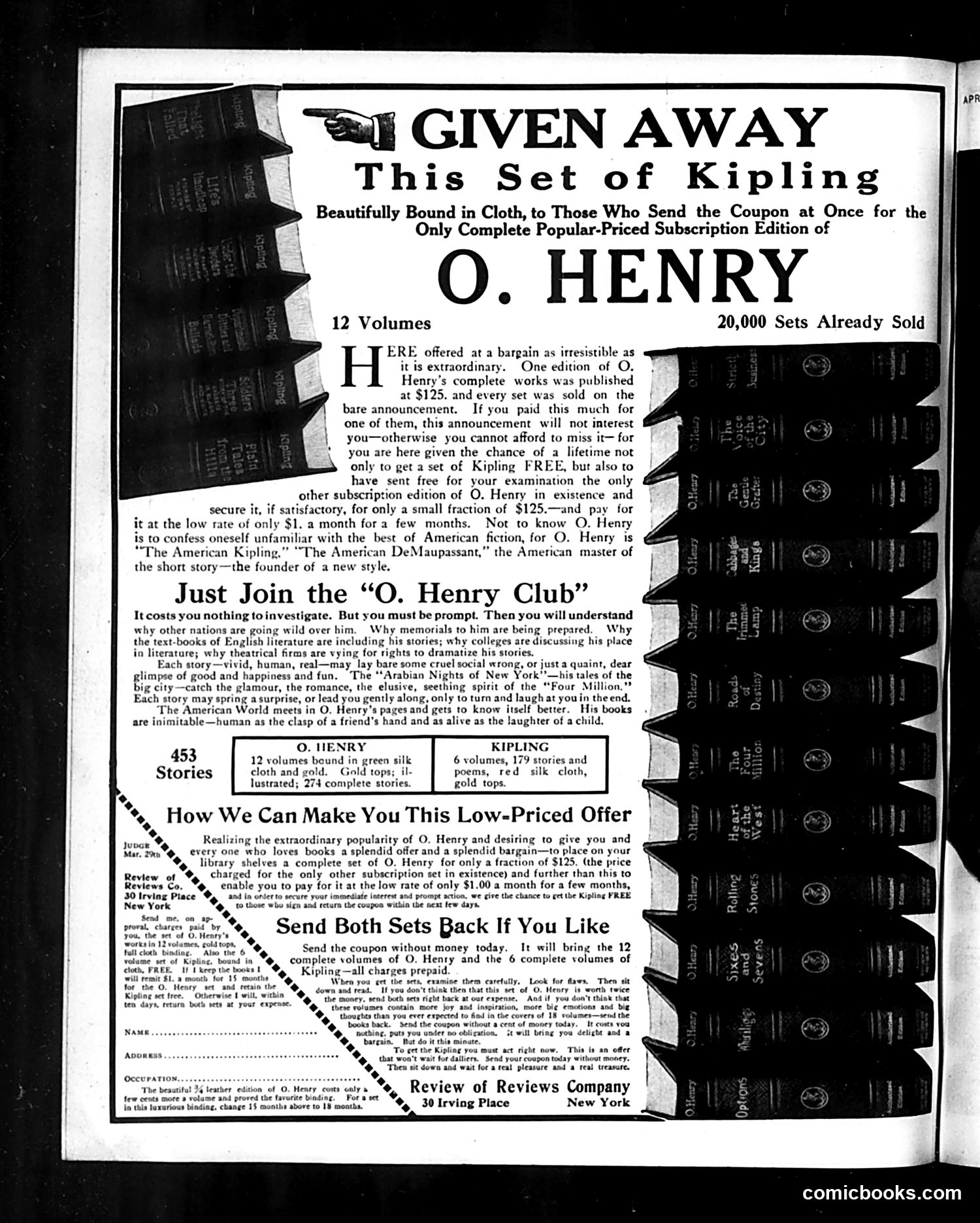
This is a **subscription advertisement**, not a political cartoon. It promotes O. Henry's 12-volume works by offering a free 6-volume Kipling poetry set as an incentive. **The Appeal:** Early 1900s marketing targeted middle-class readers by positioning O. Henry as "The American Kipling"—a master of short stories comparable to Rudyard Kipling's literary stature. The ad emphasizes O. Henry's relevance: his stories appear in textbooks, colleges discuss them, and theaters seek dramatization rights. **The Offer:** Customers could examine both sets risk-free, paying only $1/month if satisfied. The free Kipling set was the hook to prompt immediate action. **Why It Matters:** This reflects the era's subscription publishing model—companies competed for home library sales by bundling premium authors and offering payment plans. It also shows O. Henry's cultural prominence: he's presented as defining American literature, capturing "the Four Million" (his actual 1904 collection about New York City working-class life).