
Judge, 1913-03-29 · page 4 of 24
Judge — March 29, 1913 — page 4: what you’re looking at
What you’re looking at
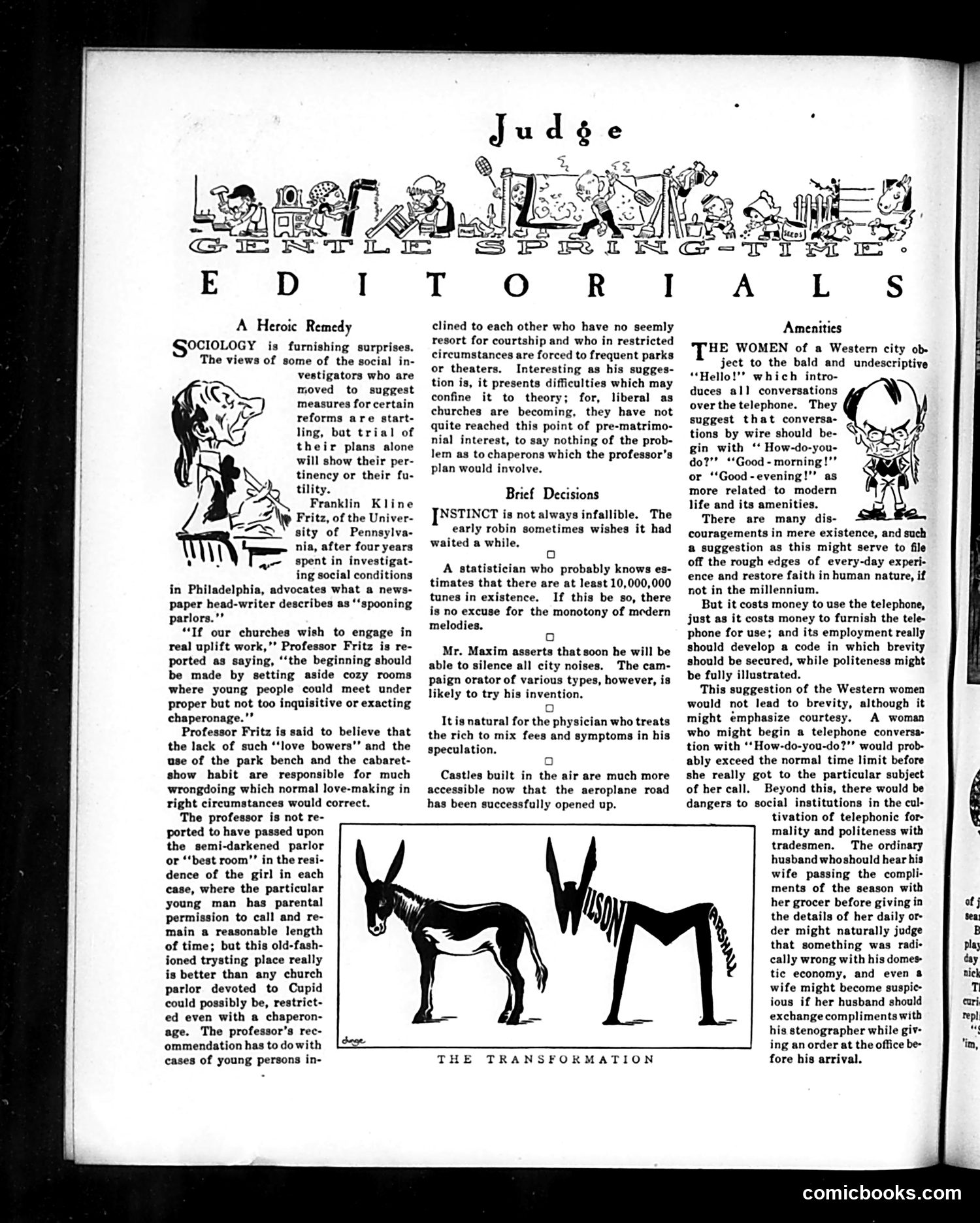
This page contains social commentary rather than political cartoons. The "Judge Editorials" section critiques early 20th-century urban social customs. **"The Transformation"** cartoon (bottom) appears to satirize the modern woman or changing gender roles, depicting what looks like a donkey transforming into something else—likely mocking contemporary anxieties about women's behavior or independence. The text articles discuss sociology, church reform, and courtship customs. One piece by Franklin Kline critiques churches' approach to "real uplift work," while another by Professor Fritz addresses young people's behavior in parks and parlors, suggesting concerns about unsupervised dating and "love-making." The "Amenities" section humorously warns against excessive telephone conversations between unmarried women and men, fearing breaches of propriety. Overall, the page reflects conservative anxieties about modernizing social conventions and changing courtship practices.
📄 Transcribed text from this page (OCR, searchable)
Machine-transcribed from the original scan — historical spelling and the odd misread are preserved.
A Heroic Remedy SocioLocy is furnishing surprises. The views of some of the social in- vestigators who are moved to suggest measures for certain reforms are start- ling, bat trial of their plans alone will show their per- tinency or their fu- NS tility. SQ Franklin Kline 2 \w Fritz, of the Univer- AN sity of Pennsylva- \\ = ni ‘ter four years . p spent in investigat- ing social conditions in Philadelphia, advocates what a news- paper head-writer describes as ‘‘spooning parlors.’’ “If our churches wish to engage in real uplift work,’ Professor Fritz is re- ported as saying, ‘‘the beginning should be made by setting aside cozy rooms where young people could meet under proper but not too inquisitive or exacting chaperonage.”” Professor Fritz is said to believe that the lack of such ‘‘love bowers’’ and the use of the park bench and the cabaret- show habit are responsible for much wrongdoing which normal love-making in right circumstances would correct. The professor is not re- ported to have passed upon the semi-darkened parlor or ‘‘best room”’ in the resi- dence of the girl in each case, where the particular young man has parental permission to call and re- main a reasonable length of time; but this old-fash- ioned trysting place really is better than any church parlor devoted to Cupid could possibly be, restrict- ed even with a chaperon- age. The professor’s rec- ommendation has to dowith cases of young persons in- clined to each other who have no seemly resort for courtship and who in restricted circumstances are forced to frequent parks or theaters, Interesting as his sugges- tion is, it presents difficulties which may confine it to theor for, liberal as churches are becoming, they have not quite reached this point of pre-matrimo- nial interest, to say nothing of the prob- lem as to chaperons which the professor’s plan would involve. Brief Decisions [NStTINcT is not always infallible. The early robin sometimes wishes it had waited a while. a A statistician who probably knows es- timates that there are at least 10,000,000 tunes in existence. If this be so, there is no excuse for the monotony of medern melodies. is) Mr. Maxim asserts that soon he will be able to silence all city noises. The cam- paign orator of various types, however, is likely to try his invention. Oo It is natural for the physician who treats the rich to mix fees and symptoms in his speculation. Castles built in the air are much more accessible now that the aeroplane road has been successfully opened up. Vi THE TRANSFORMATION Amenities THE WOMEN of a Western city ob ject to the bald and undescriptive “Hello!’’ which intro- duces all conversations over the telephone. They suggest that conversa- tions by wire should be- gin with ‘ How-do-you- do?”’ ‘*Good-morning!"’ or ‘‘Good-evening!"’ as more related to modern life and its amenities. There are many dis- couragements in mere existence, and such a@ suggestion as this might serve to file off the rough edges of every-day experi- ence and restore faith in human nature, if not in the millennium. But it costs money to use the telephone, just as it costs money to furnish the tele- phone for use; and its employment really should develop a code in which brevity should be secured, while politeness might be fully illustrated. This suggestion of the Western women would not lead to brevity, although it might emphasize courtesy. A woman who might begin a telephone conversa- tion with ‘*How-do-you-do?”’ would prob- ably exceed the normal time limit before she really got to the particular subject of her call. Beyond this, there would be dangers to social institutions in the cul- tivation of telephonic for- mality and politeness with tradesmen. The ordinai husband whoshould hear his wife passing the compli- ments of the season with her grocer before giving in the details of her daily or- der might naturally judge that something was radi- cally wrong with his domes tic economy, and even & wife might become suspic- ious if her husband should exchange compliments with his stenographer while giv- ing an order at the office be- fore his arrival. comicbooks.com