
Judge, 1913-03-29 · page 15 of 24
Judge — March 29, 1913 — page 15: what you’re looking at
What you’re looking at
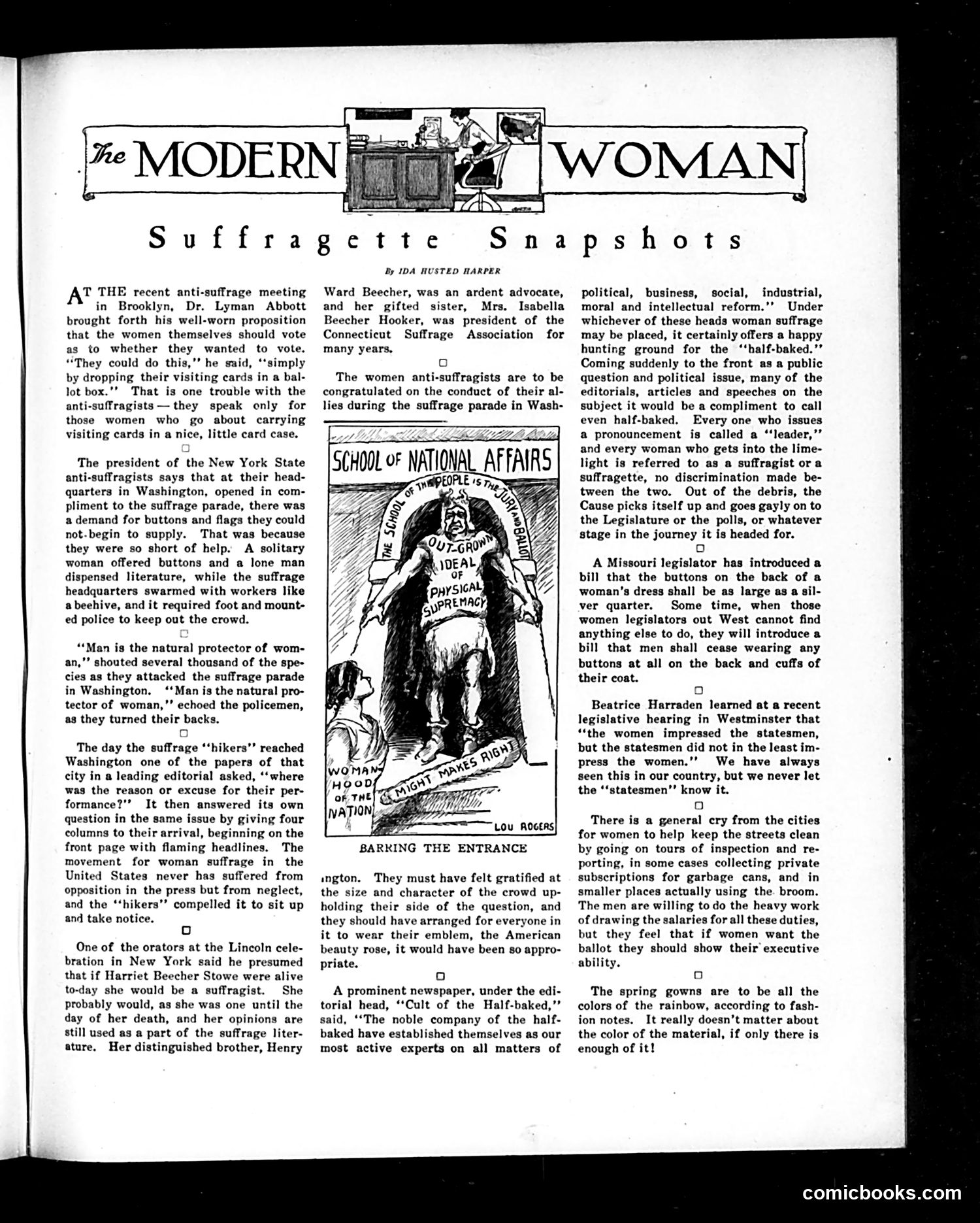
This page satirizes **anti-suffrage opposition** to women's voting rights, likely from around 1912-1913 (based on references to a Washington suffrage parade and "hikers"). The cartoon "Barking the Entrance" depicts a large dog (representing opposition/anti-suffragists) barking at the entrance to the "School of National Affairs," symbolizing how opponents obstruct women's political participation. **The satire's targets:** - Dr. Lyman Abbott's absurd proposal that women vote on voting via "visiting cards" - Anti-suffragists' lack of organizational support compared to suffragists' mobilization - The irony of men claiming to be "natural protectors of women" while attacking suffrage parades - Press coverage that simultaneously ignores and sensationalizes the movement - The hypocrisy of invoking Harriet Beecher Stowe as anti-suffrage authority when her own family championed women's rights Author Ida Husted Harper uses ridicule to expose anti-suffrage arguments as illogical and elitist, celebrating suffragists' superior grassroots organization.
📄 Transcribed text from this page (OCR, searchable)
Machine-transcribed from the original scan — historical spelling and the odd misread are preserved.
Suffragette T THE recent anti-suffrage meeting in Brooklyn, Dr. Lyman Abbott brought forth his well-worn proposition that the women themselves should vote as to whether they wanted to vote. “They could do this,” he said, ‘simply by dropping their visiting cards in a bal- lot box.’’ That is one trouble with the anti-suffragists— they speak only for those women who go about carrying visiting cards in a nice, little card case. The president of the New York State anti-suffragists says that at their head- quarters in Washington, opened in com- pliment to the suffrage parade, there was a demand for buttons and flags they could not-begin to supply. That was because they were so short of help. A solitary woman offered buttons and a lone man dispensed literature, while the suffrage headquarters swarmed with workers like a beehive, and it required foot and mount- ed police to keep out the crowd. “Man is the natural protector of wom- an,’’ shouted several thousand of the spe- cies as they attacked the suffrage parade in Washington. ‘‘Man is the natural pro- tector of woman,’’ echoed the policemen, as they turned their backs. The day the suffrage ‘‘hikers’’ reached Washington one of the papers of that city in a leading editorial asked, ‘‘where was the reason or excuse for their per- formance?"’ It then answered its own question in the same issue by giving four columns to their arrival, beginning on the front page with flaming headlines. The movement for woman suffrage in the United States never has suffered from opposition in the press but from neglect, and the ‘thikers’’ compelled it to sit up and take notice. One of the orators at the Lincoln cele- bration in New York said he presumed that if Harriet Beecher Stowe were alive to-day she would be a suffragist. She probably would, as she was one until the day of her death, and her opinions are still used as a part of the suffrage liter- ature. Her distinguished brother, Henry By IDA HUSTED HARPER Ward Beecher, was an ardent advocate, and her gifted sister, Mrs, Isabella Beecher Hooker, was president of the Connecticut Suffrage Association for many years, o The women anti-suffragists are to be congratulated on the conduct of their al- lies during the suffrage parade in Wash- BARKING THE ENTRANCE ington. They must have felt gratified at the size and character of the crowd up- holding their side of the question, and they should have arranged for everyone in it to wear their emblem, the American beauty rose, it would have been so appro- priate. o A prominent newspaper, under the edi- torial head, ‘‘Cult of the Half-baked,” said, ‘‘The noble company of the half- baked have established themselves as our most active experts on all matters of pshots political, business, social, industrial, moral and intellectual reform.’’ Under whichever of these heads woman suffrage may be placed, it certainly offers a happy hunting ground for the ‘‘half-baked.’* Coming suddenly to the front as a public question and political issue, many of the editorials, articles and speeches on the subject it would be a compliment to call even half-baked. Every one who issues @ pronouncement is called a ‘‘leader,’’ and every woman who gets into the lime- light is referred to as a suffragist ora suffragette, no discrimination made be- tween the two. Out of the debris, the Cause picks itself up and goes gayly on to the Legislature or the polls, or whatever stage in the journey it is headed for. o A Missouri legislator has introduced a bill that the buttons on the back of a woman's dress shall be as large as a sil- ver quarter. Some time, when those women legislators out West cannot find anything else to do, they will introduce a bill that men shall cease wearing any buttons at all on the back and cuffs of their coat. Oo Beatrice Harraden learned at a recent legislative hearing in Westminster that “the women impressed the statesmen, but the statesmen did not in the least im- press the women.’”” We have always seen this in our country, but we never let the ‘‘statesmen”’ know it. o There is a general cry from the cities for women to help keep the streets clean by going on tours of inspection and re- porting, in some cases collecting private subscriptions for garbage cans, and in smaller places actually using the. broom. The men are willing to do the heavy work of drawing the salaries for all these duties, but they feel that if women want the ballot they should show their executive ability. o The spring gowns are to be all the colors of the rainbow, according to fash- ion notes. It really doesn’t matter about the color of the material, if only there is enough of it! comicbooks.com