
A complete issue · 24 pages · 1913
Judge — February 8, 1913
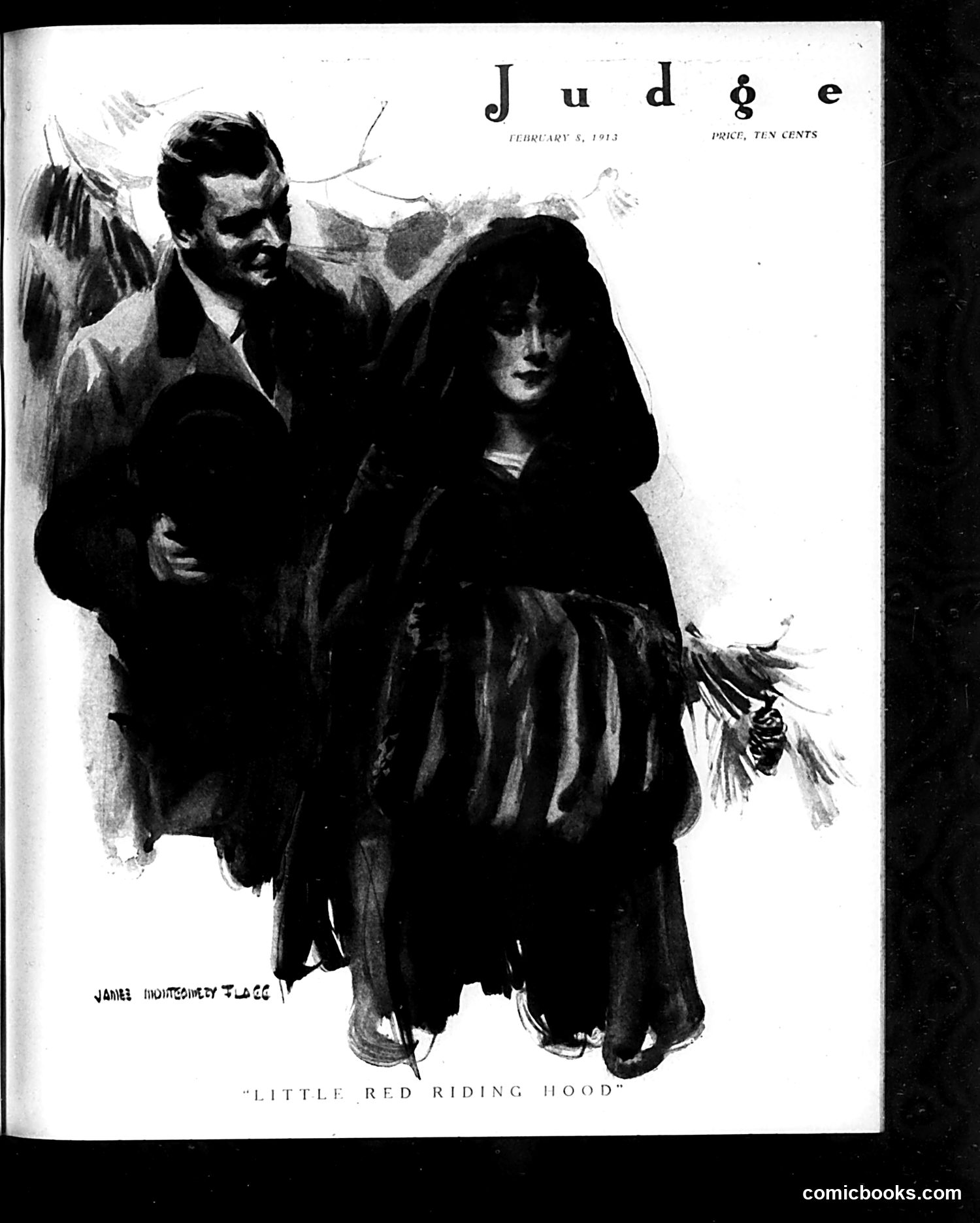
This illustration by James Montgomery Flagg adapts the fairy tale as political satire. The figure in the red hood appears to represent an innocent or vulnerable subject—possibly a nation or social group—being escorted by two darker figures who resemble wolves or predatory characters. The "Little Red Riding Hood" title suggests the cartoon warns of danger lurking beneath a seemingly protective escort. Without additional context from the magazine's surrounding articles, the specific political targets remain unclear, but the composition implies criticism of deceptive or exploitative protection—common Judge themes addressing imperialism, political corruption, or corporate manipulation during this Progressive Era period. The Flagg signature confirms this as professional editorial artwork.
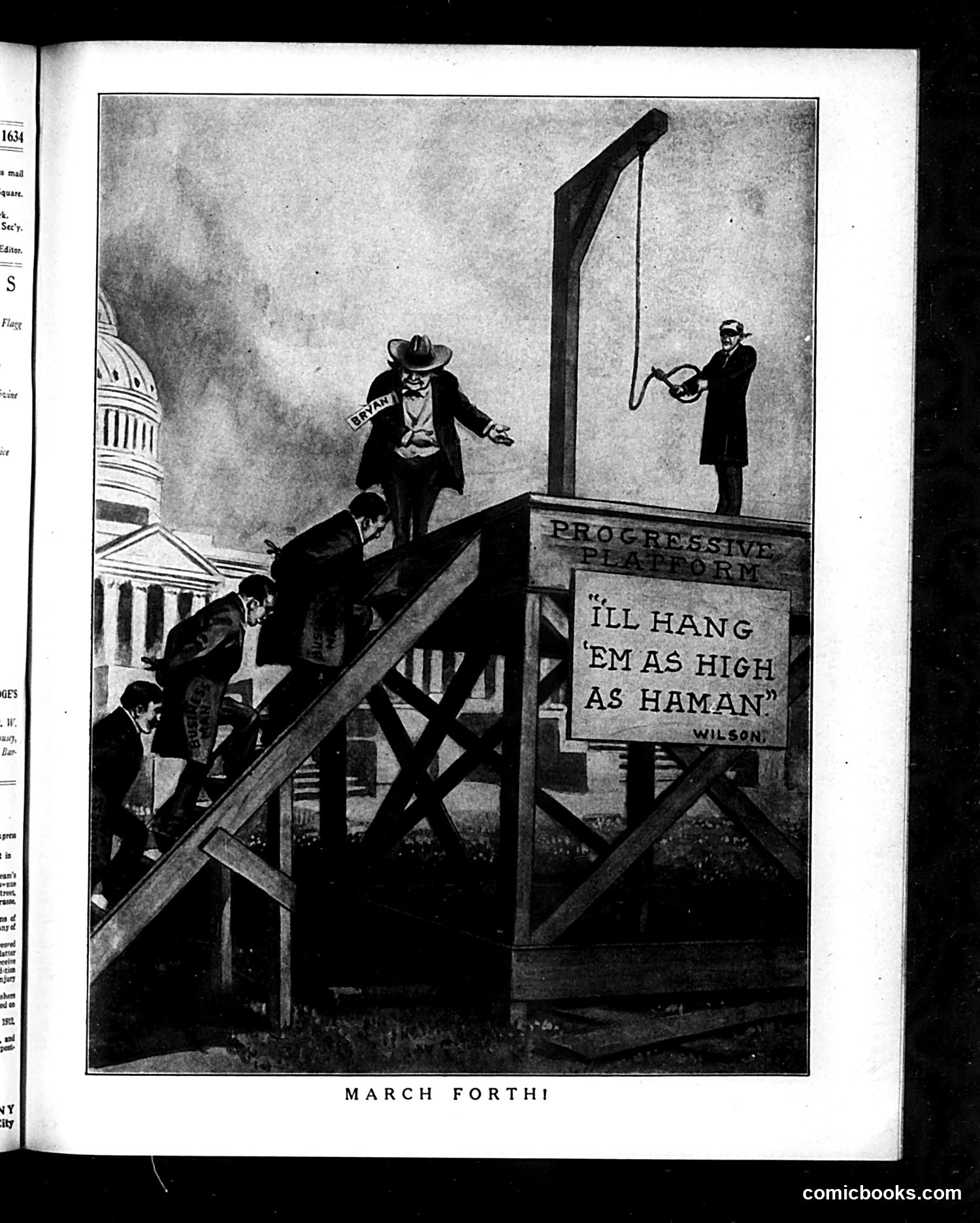
This **Judge** magazine cartoon depicts a "Progressive Platform" execution scene, satirizing progressive political promises. The scaffold references President **Wilson's** quoted vow to "Ill hang 'em as high as Haman" (a biblical reference to harsh punishment). The image shows figures ascending gallows steps while one figure operates the noose mechanism above—likely representing Wilson or progressive leadership. The Capitol building visible at left grounds this in federal politics. The satire appears to mock progressive rhetoric about aggressive action against political enemies or corruption, suggesting such bold promises are mere theater leading to execution rather than reform. The cartoon criticizes the gap between progressive campaign language and actual governance.
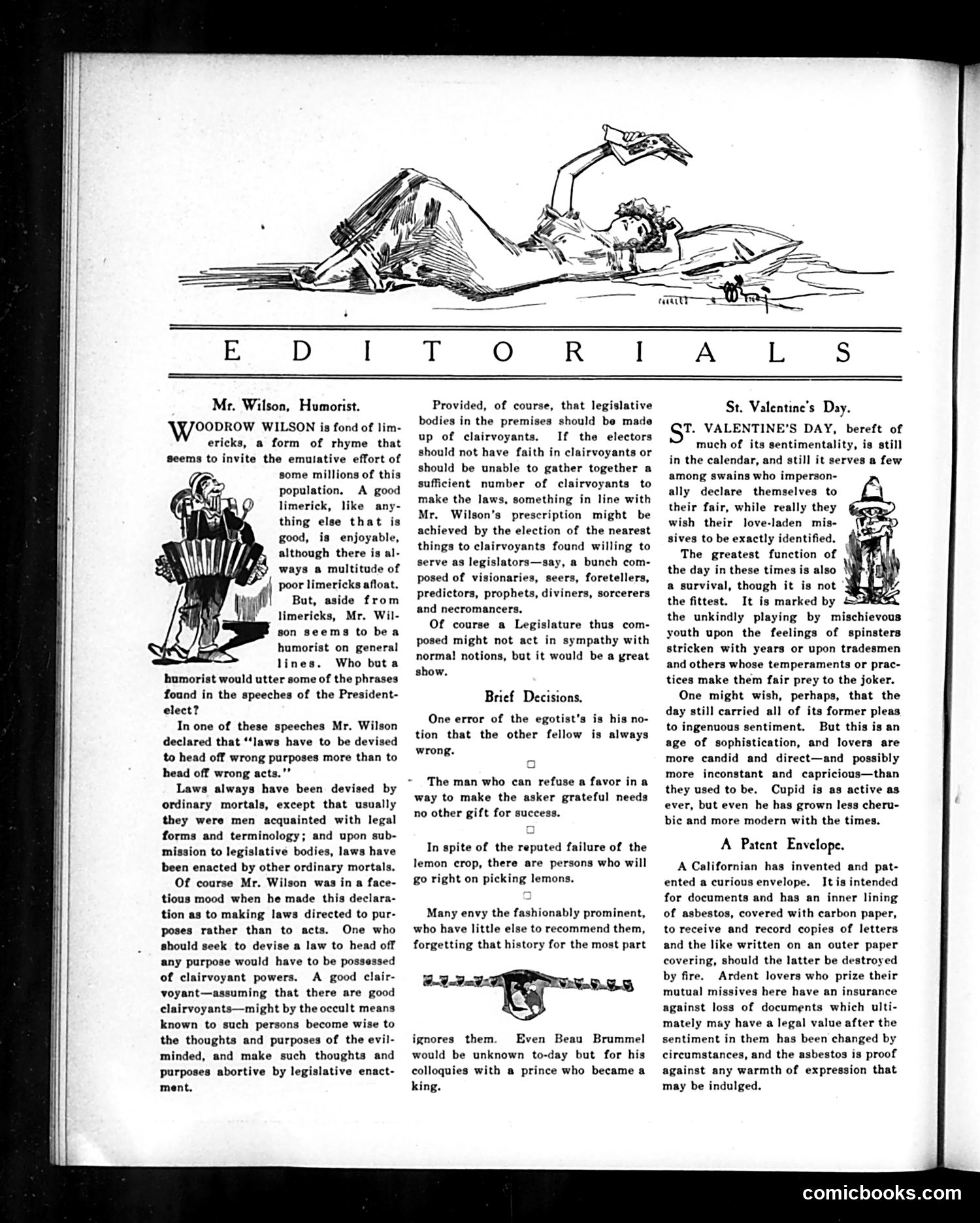
This editorial page satirizes **Woodrow Wilson** as a humorist, mocking his speeches and political pronouncements. The text suggests Wilson's rhetoric about "wrong purposes" and legislative matters reads like unintentional comedy—the satire being that his grandiose language obscures rather than clarifies policy. The **"Brief Decisions"** section offers aphorisms on human nature and social behavior, likely referencing contemporary issues. The **"St. Valentine's Day"** piece discusses how the holiday, traditionally romantic, has become cynical and commercialized in modern times—Cupid now "active as ever, but even less grown less heroic." The **"Patent Envelope"** describes a California inventor's document-preservation envelope with carbon-paper lining—a straightforward product announcement typical of Judge's mixed editorial and advertising content.
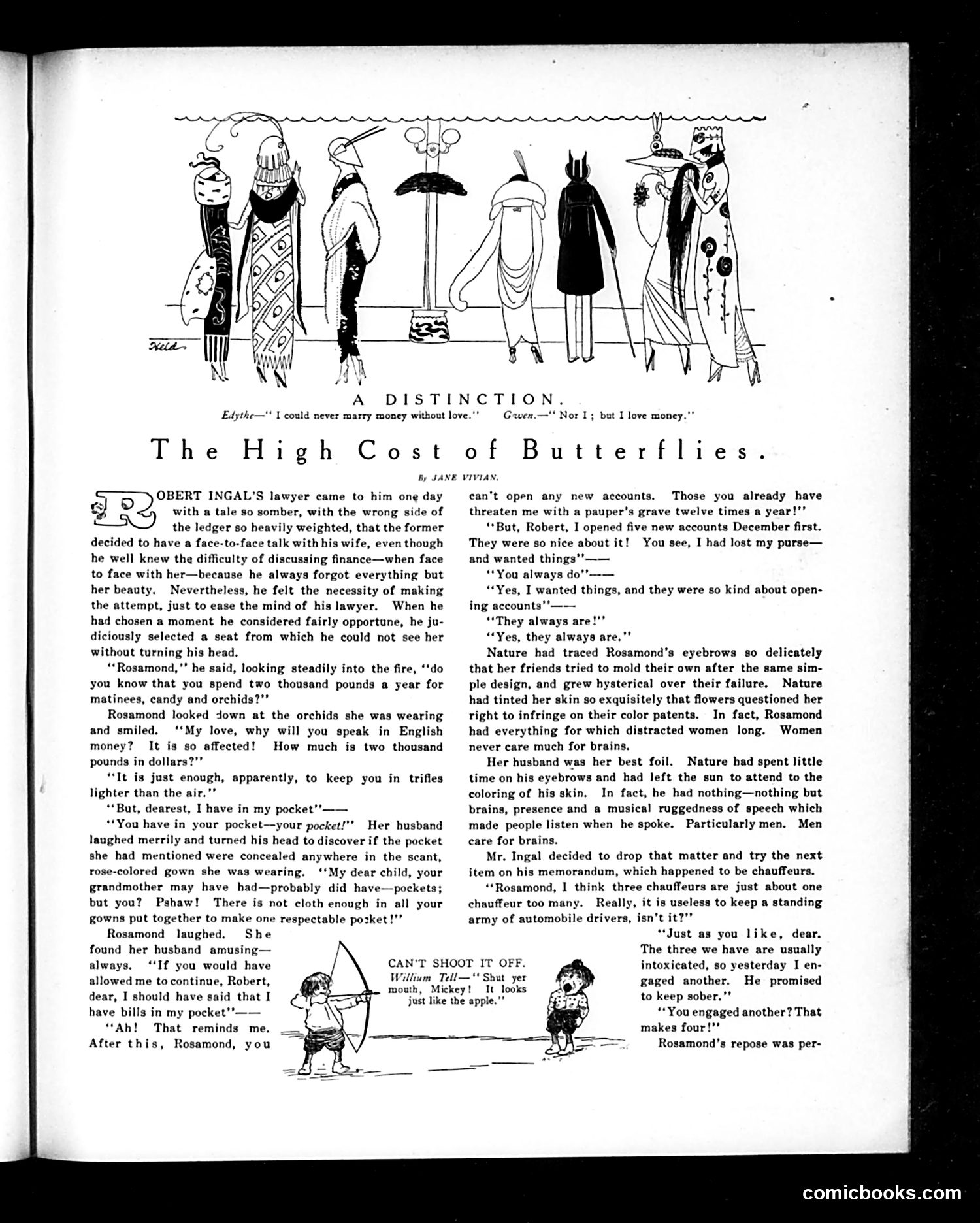
This satirical story by Jane Viveyan critiques wealthy women's extravagant spending habits. Robert Ingal's lawyer confronts him about his wife Rosamond's excessive expenses—£2,000 annually on "matinees, candy and orchids." The title "butterflies" is a period term for frivolous, flighty women. The humor lies in the marital tension: Robert complains of his wife's wasteful habits while she counters that his money enables her lifestyle. The story juxtaposes women's supposed superficiality with their actual intelligence—Rosamond is shrewd enough to manipulate her husband's guilt about their accounts. The top illustration shows fashionable women's clothing, emphasizing the consumerism the article mocks. The satire targets both husbands' financial weakness and wives' spending power during an era of changing gender economics.
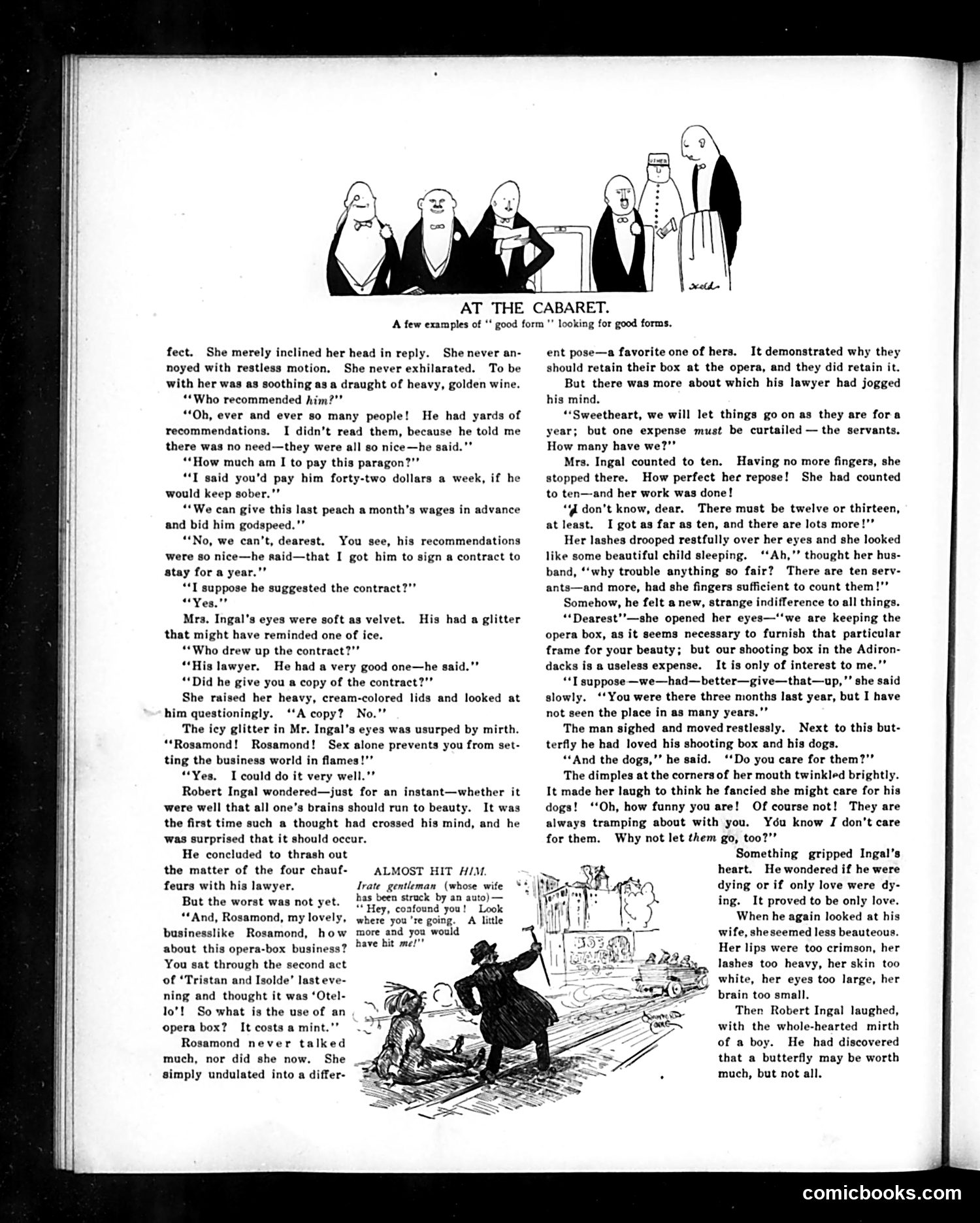
This story-cartoon mocks the stereotype of the beautiful but intellectually vapid society wife. Rosamond Ingal is portrayed as graceful and attractive ("soft as velvet" eyes, perfect composure) yet catastrophically incompetent in practical matters. She hires a servant without reading references, signs him to a year-long contract without obtaining a copy, misidentifies operas at the theater, and cannot count past ten. Her husband Robert repeatedly encounters her stunning naïveté with exasperation and resignation. The satire targets both the woman—whose aesthetic charm masks financial recklessness—and the man, who finds himself trapped between appreciating her beauty and enduring her uselessness. The accompanying cartoon ("Almost Hit Him") shows a couple at odds, reinforcing the marital discord theme. The piece critiques the Gilded Age practice of marrying for appearance alone, suggesting such matches breed mutual frustration regardless of social status.
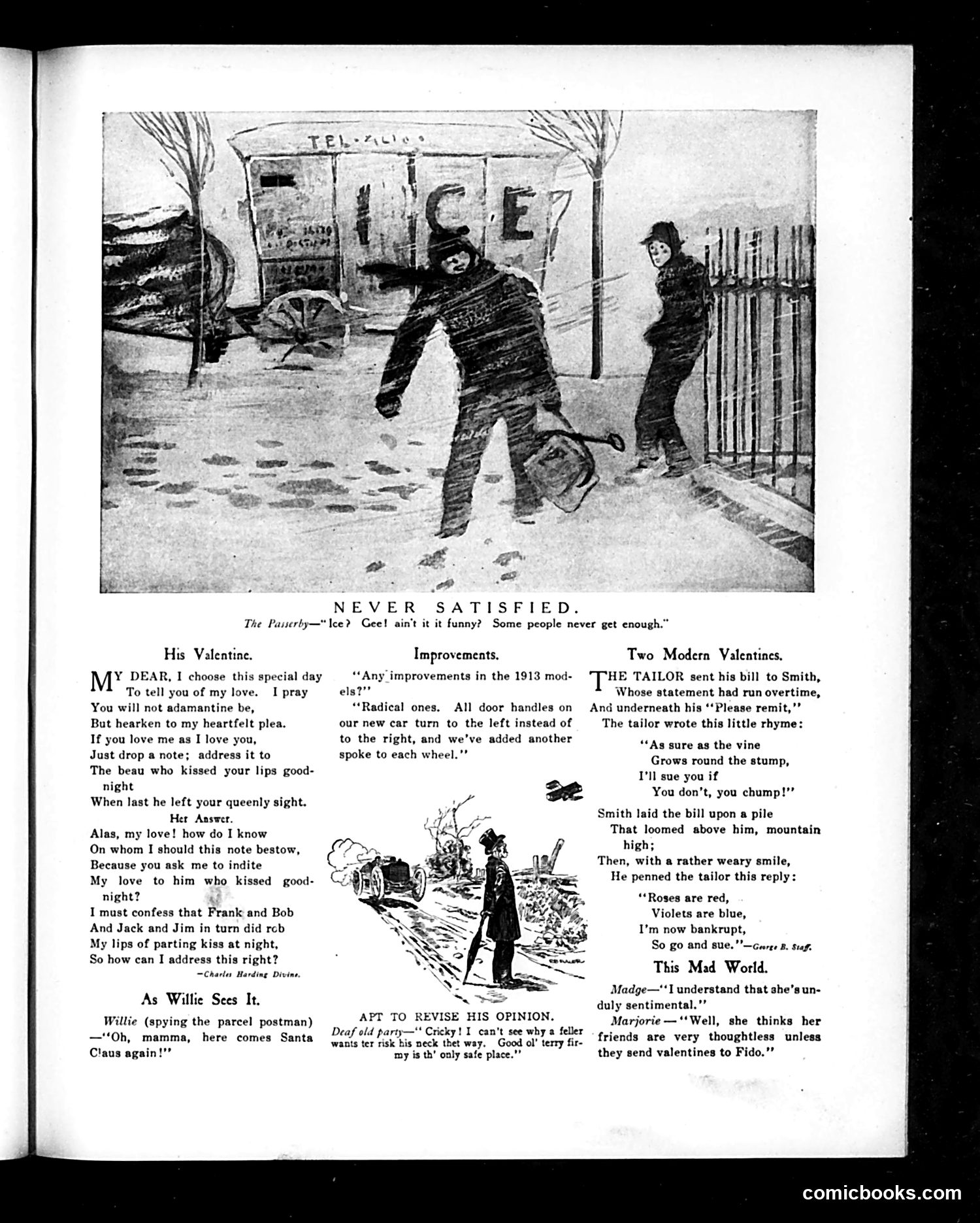
This page collects Valentine's Day humor reflecting early 1910s social attitudes. **"His Valentine"** satirizes casual courtship: a man asks his beloved to identify him among multiple suitors who've kissed her, exposing the era's social permissiveness (or loose morality, from the magazine's perspective). **"As Willie Sees It"** uses a child's innocent misidentification—confusing the postman with Santa Claus—to joke about frequent package deliveries, likely referencing the growing consumer culture and mail-order economy. **"Two Modern Valentines"** contrasts romantic verse with commercial debt: a tailor threatens legal action over unpaid bills in rhyming verse; the debtor responds with fake poetry admitting bankruptcy. The satire mocks how business has replaced genuine sentiment. **"This Mad World"** ridicules excessive sentimentality: a woman sends Valentine's cards to her dog rather than friends, suggesting absurd priorities. Overall, the page satirizes modern courtship and consumerism as destroying authentic emotion and replacing it with either moral laxity or commercial transaction.
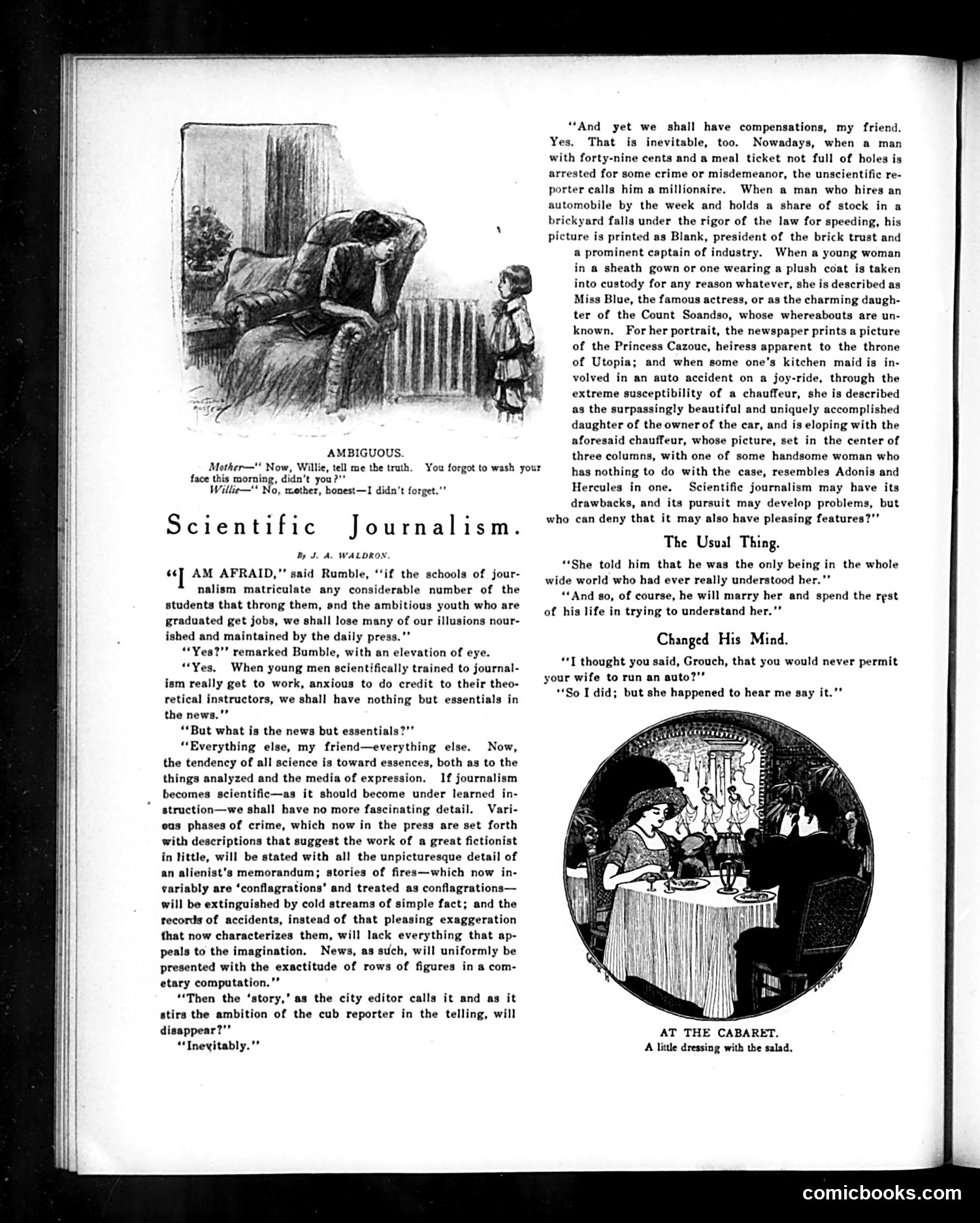
This satirical piece critiques newspapers' sensationalism versus the proposed alternative of scientifically rigorous reporting. Two characters debate whether journalism schools training students in objective, fact-based reporting would harm newspapers by eliminating the exaggerated detail readers enjoy. The satire's clever twist: the speaker argues that *despite* journalism becoming more truthful, newspapers still misrepresent people—calling arrested poor men "millionaires," depicting ordinary women as famous actresses or nobility. The implication is cutting: newspapers are already so dishonest that even "scientific" accuracy couldn't worsen their distortion of reality. The joke exposes how thoroughly newspapers fabricate identities and circumstances for dramatic effect, making the fear of losing "fascinating detail" actually a fear of losing their power to mislead. The cartoon "Ambiguous" simply shows a mother asking her son if he washed his face—his evasive answer playing on the double meaning of "forget."
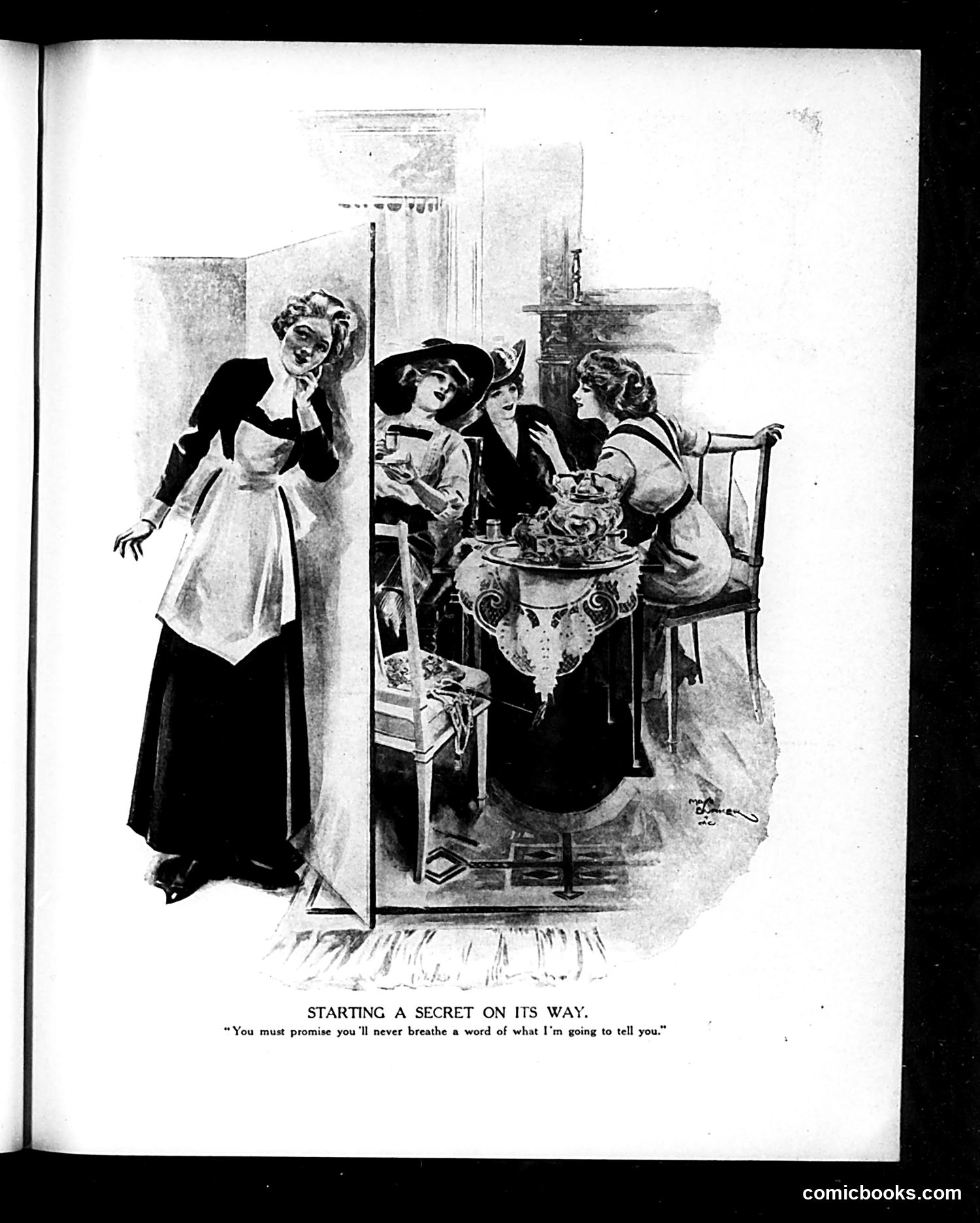
This illustration satirizes the nature of gossip and secrets among women. The caption presents the classic setup of sharing confidential information—a figure on the left extracts a promise of secrecy from three women gathered together. The satire's point is apparent: despite the solemn vow to keep quiet, the very act of telling multiple people ensures the "secret" will spread. The title "Starting a Secret on Its Way" captures this irony—the promise to keep silent virtually guarantees the opposite outcome. This reflects period attitudes about women's alleged tendency toward gossip, a common theme in early 20th-century humor magazines. The elegant dress and interior setting suggest this concerns matters of social importance within women's circles.
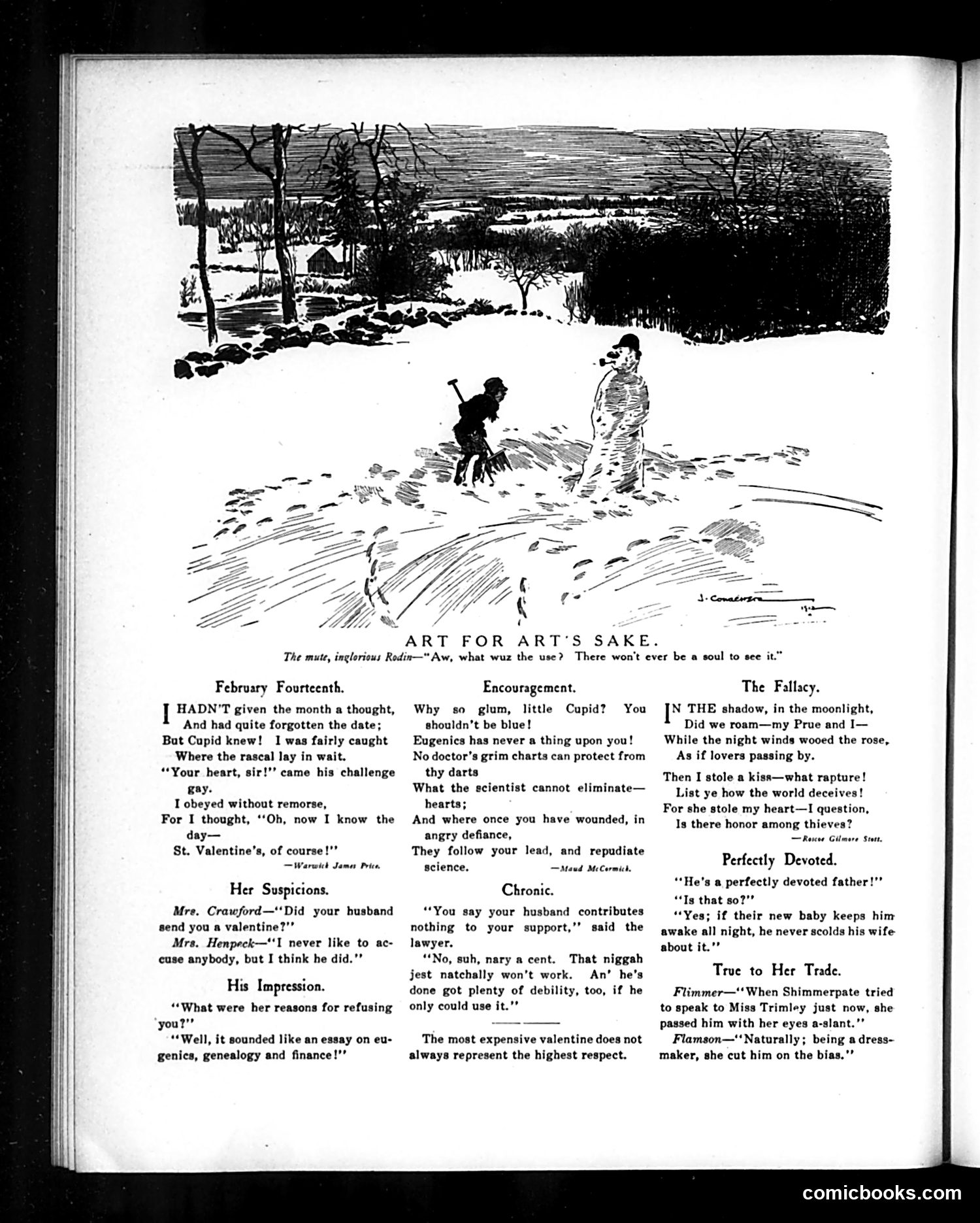
This page collects Valentine's Day-themed humor pieces (February 14th context). The top cartoon depicts a sculptor (referencing Rodin, famous for "The Thinker") complaining his work won't be seen—satirizing art for art's sake as impractical. The text pieces are brief jokes on romantic and marital themes typical of early 20th-century American humor: - Several mock romantic pretense ("The Fallacy" criticizes idealized moonlit romance) - Others jest about marriage dysfunction ("Her Suspicions," "Chronic") - One piece uses offensive racial dialect stereotyping a Black man's work ethic—reflecting the period's casual racism The humor relies on contemporary concerns: eugenics (mentioned as pseudo-scientific), gender dynamics, and economic hardship. "True to Her Trade" puns on a dressmaker "cutting" someone (social snubbing). The overall tone is cynical about love and marriage rather than sentimental—typical of Judge's satirical stance toward Victorian sentimentality.
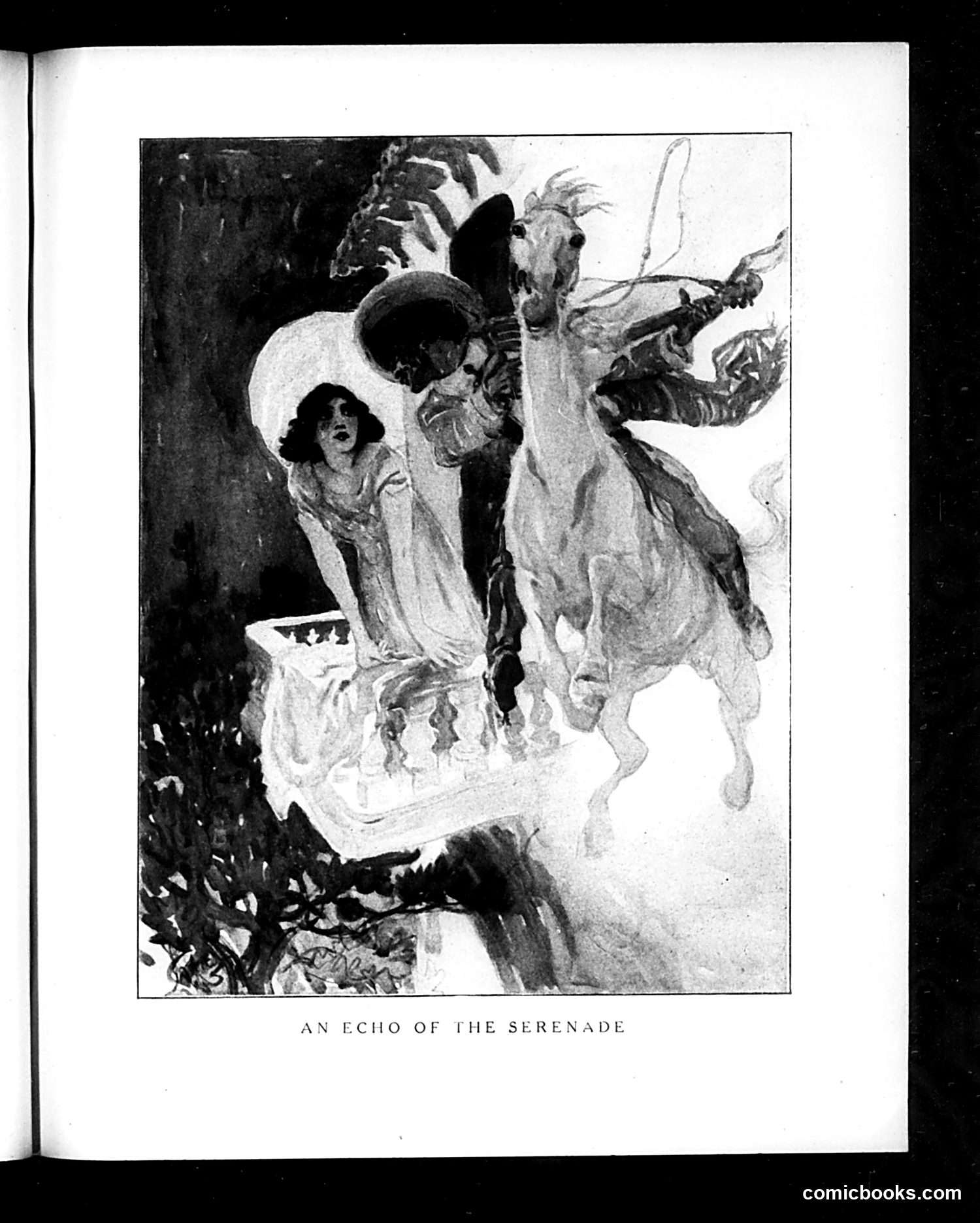
This illustration titled "An Echo of the Serenade" depicts a romantic scene with romantic/satirical undertones typical of Judge magazine's humor. A man on horseback serenades a woman at night; she wears a large, fashionable hat and leans from a window or balcony. The exaggerated scale of her hat and the theatrical poses suggest satire of romantic conventions and possibly of women's fashion excess in the period. The "echo" reference in the title likely jokes about the man's serenade being reflected or repeated in some way. Without additional context or visible artist attribution, the specific social commentary remains somewhat unclear, though it appears to mock either courtship rituals, fashion pretension, or both—common targets of Judge's satirical humor.
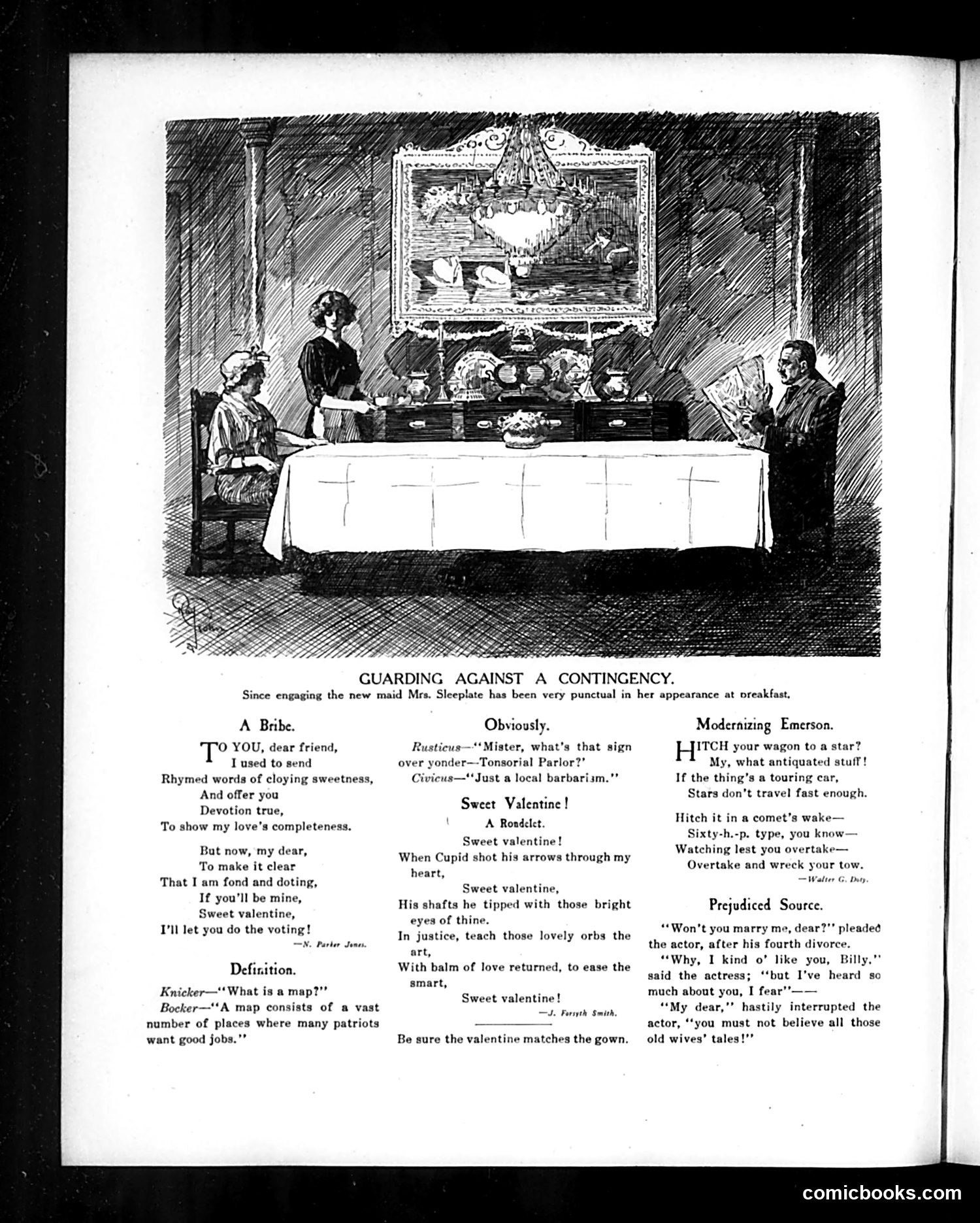
This page contains multiple satirical pieces reflecting early 20th-century American concerns: **Main Cartoon:** "Guarding Against a Contingency" depicts a dinner scene where a man appears to be monitoring a new maid's attendance at breakfast—suggesting he's ensuring she witnesses his attentiveness to his wife, likely to guard against infidelity rumors or marital discord. **Satirical Content:** - "A Bribe" mocks romantic gestures, reducing love to trading "voting rights"—likely commentary on women's suffrage debates of the era - "Definition" jokes that political maps are merely places where job-seekers gather, critiquing patronage and political corruption - "Modernizing Emerson" parodies Emerson's famous quote, replacing spiritual aspiration with automobile obsession—satire of early automotive culture replacing transcendentalist ideals - "Prejudiced Source" contains a divorce joke where an actor dismisses his ex-wife's warnings as "old wives' tales," mocking both theatrical types and gender dynamics The overall theme appears to be social commentary on modern marriage, politics, and changing values in contemporary America.
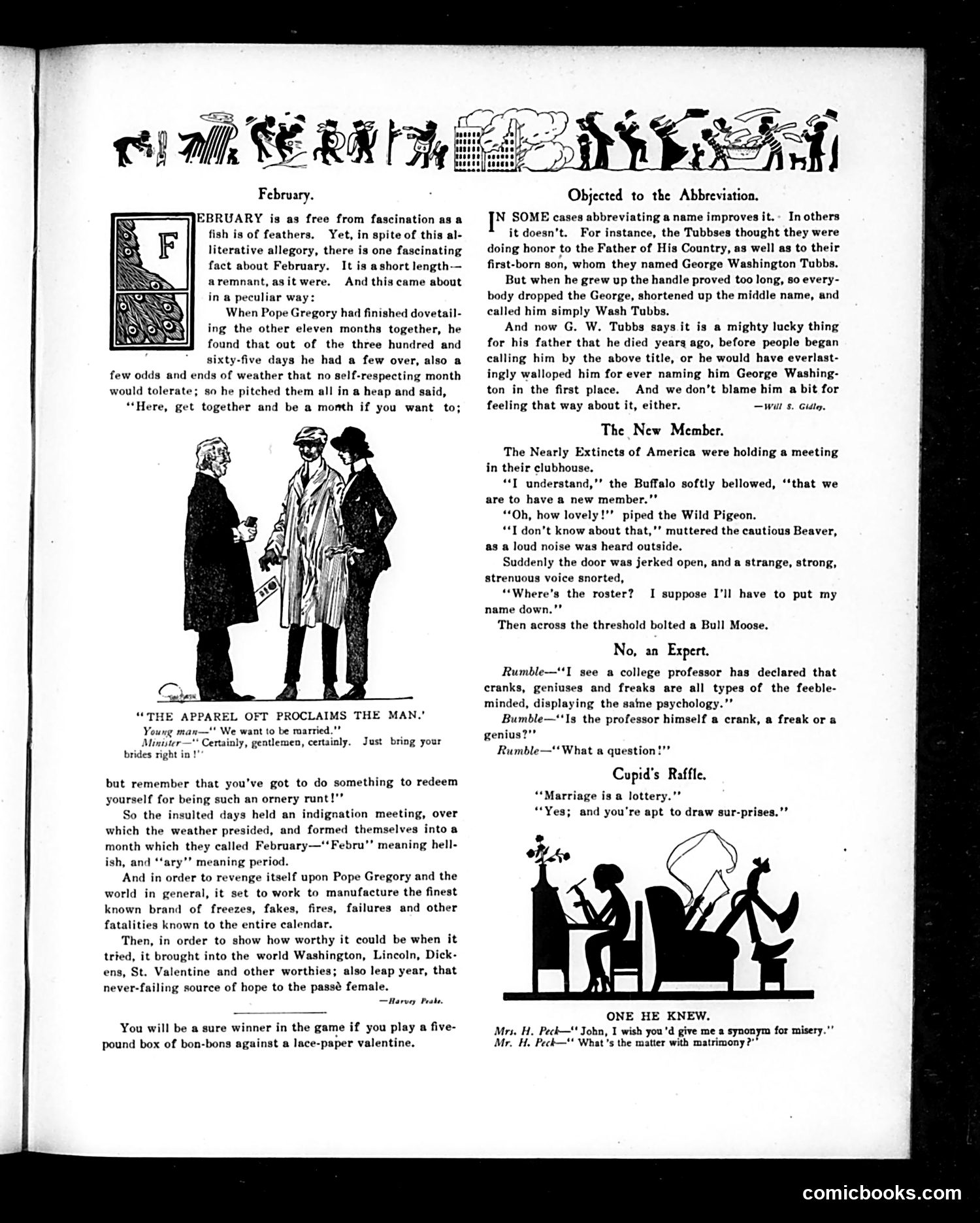
This page contains multiple satirical pieces typical of early 20th-century American humor: **"The Apparel Oft Proclaims the Man"** depicts a minister agreeing to marry two men, with the caption suggesting unconventional relationships were notable enough for satire. **"Objected to the Abbreviation"** mocks a family named Tubbs who named their son George Washington Tubbs, later shortened to "Wash Tubbs"—the joke being that shortening such a patriotic name seems absurd. **"The New Member"** features animals from a "Nearly Extincts of America" club suddenly joined by a "Bull Moose"—likely a satirical reference to Theodore Roosevelt's Bull Moose Party (Progressive Party), depicted as disruptively crashing established institutions. **Other brief humor pieces** include jokes about college professors being "feeble-minded," marriage as a lottery, and matrimony as "misery." The February introduction humorously blames Pope Gregory for creating an inadequate month, then credits it with producing Washington, Lincoln, and leap year—providing unmarried women "hope."
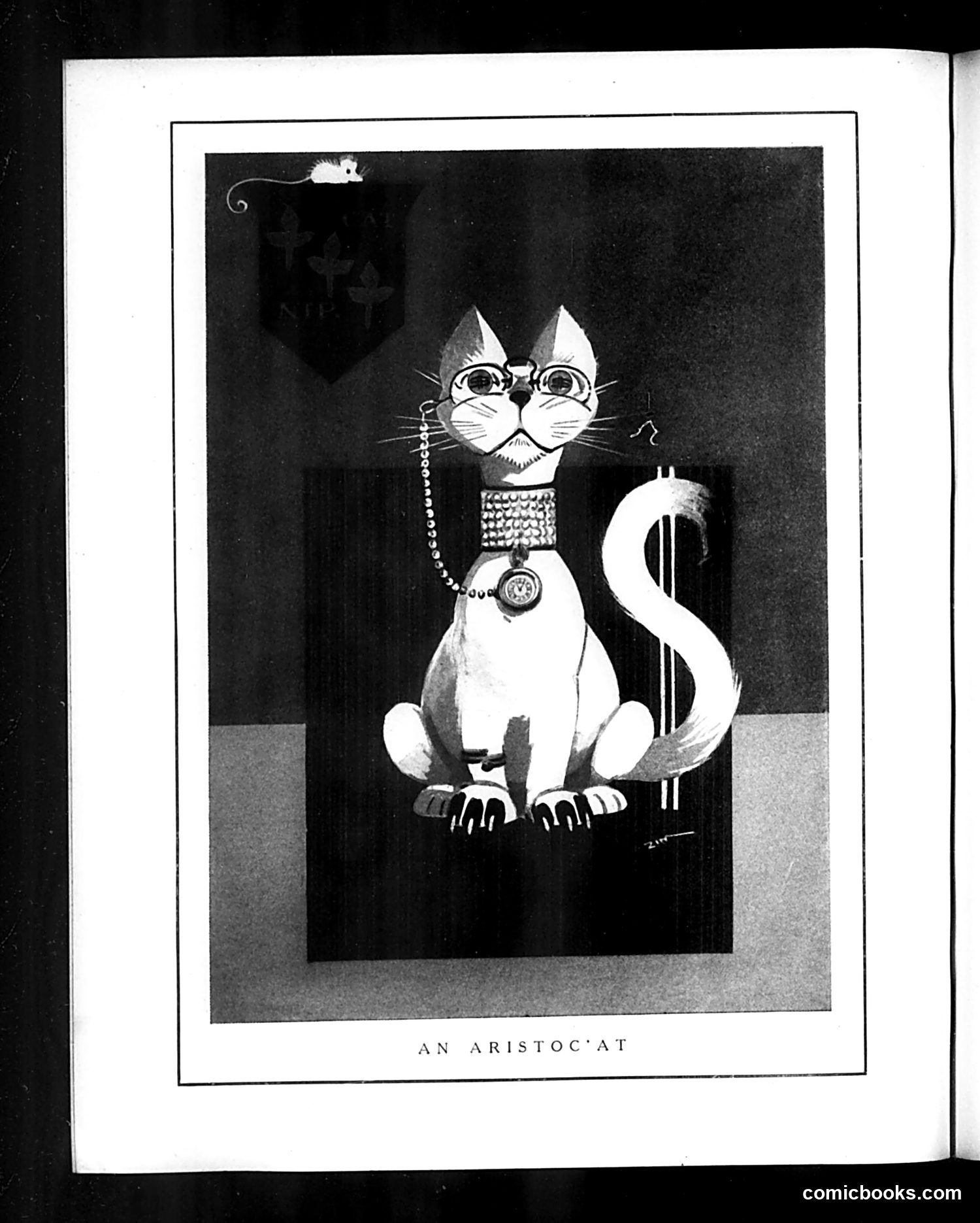
This illustration depicts a cat wearing glasses and dressed in finery—a beaded collar with a pendant and what appears to be formal attire. The cat is positioned against a dark background, sitting upright in a dignified pose. A small mouse appears in the upper left corner, seemingly observing or fleeing from the aristocratic feline. The satire plays on the contrast between the cat's pretentious appearance and accessories (suggesting wealth and refinement) and its fundamental nature as a predator of mice. The title "Aristocat" is a pun combining "aristocrat" with "cat." The joke likely mocks wealthy or upper-class individuals who adopt refined mannerisms while retaining base instincts or character flaws—they remain predatory despite their fashionable veneer.
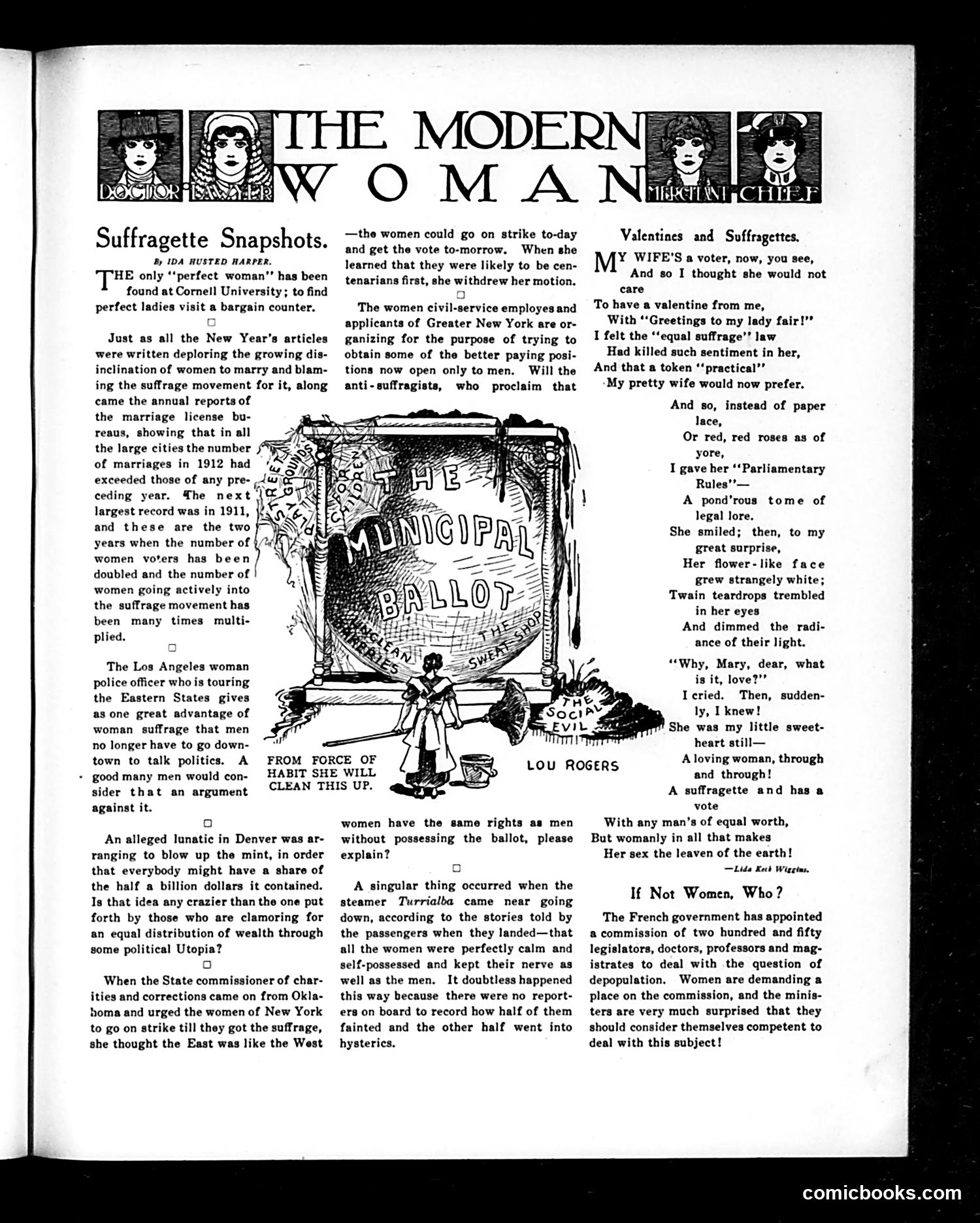
This Judge magazine page satirizes the women's suffrage movement circa 1912. The central cartoon depicts a woman figure labeled with "Municipal Ballot" being "cleaned up" by a maid figure "from force of habit"—suggesting suffrage advocates are naive, that women will revert to domestic roles regardless of voting rights. The accompanying articles by Ida Husted Harper present pro-suffrage arguments wrapped in sarcasm. Harper notes that marriage rates *increased* during years when female voters doubled, contradicting anti-suffrage claims that voting makes women unwilling to marry. She also highlights the hypocrisy: women civil servants are denied better-paying jobs "now open only to men," yet anti-suffragists claim women already have equal rights without the ballot. The "Valentines and Suffragettes" poem depicts a husband expecting his newly-enfranchised wife to reject romantic sentiment for "Parliamentary Rules," only to find she remains emotionally feminine—mocking the fear that suffrage would "unsex" women. Overall, the page uses satire to expose the contradictions and anxieties surrounding women's political participation in the pre-1920 suffrage debate.
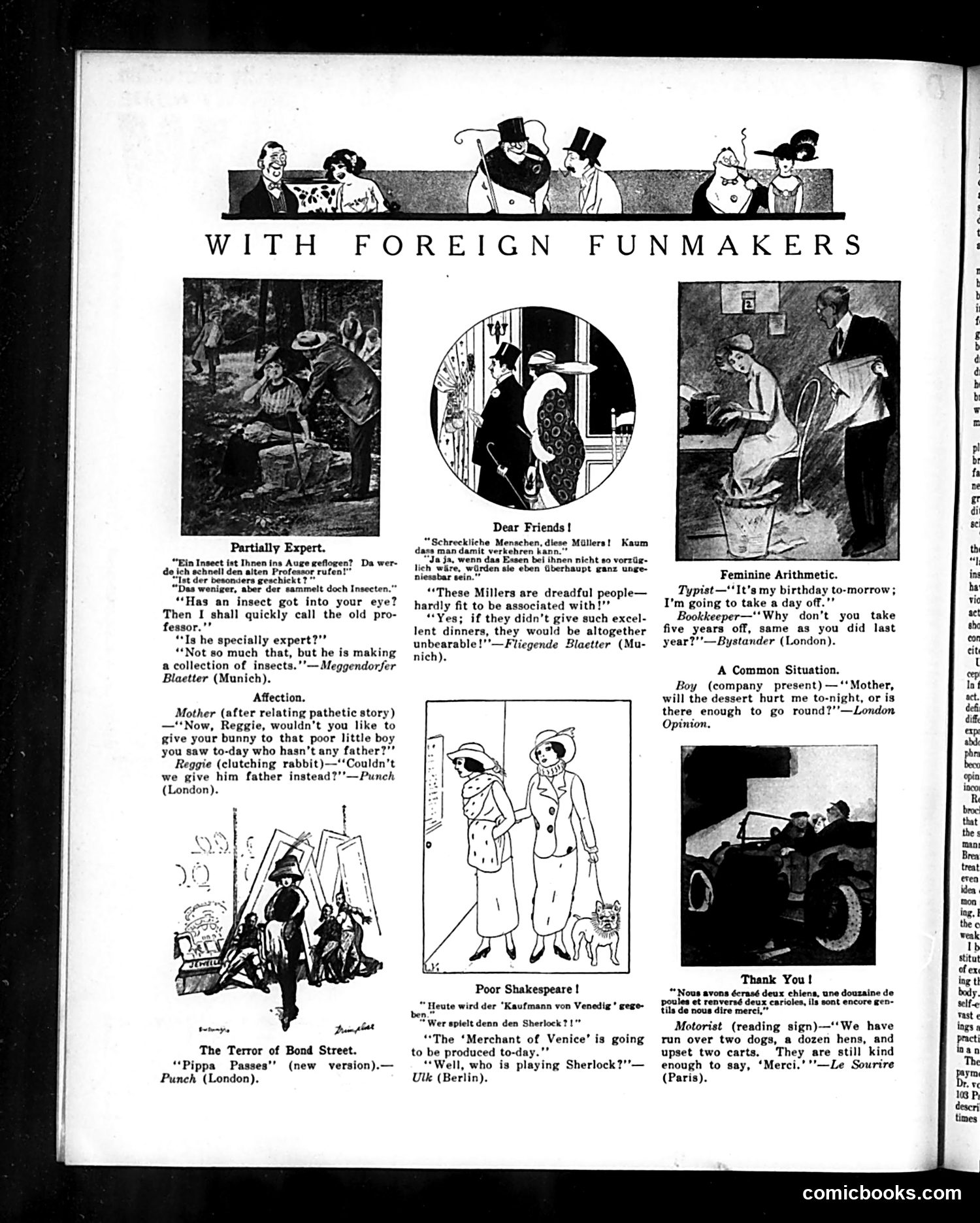
This page collects brief satirical jokes and cartoons from European humor magazines, translated for American readers. The content reflects early 20th-century social humor across several countries (Germany, Austria, Britain, France). The satire targets: - **Class hypocrisy**: The "Millers" joke mocks people who socialize with those they consider beneath them, tolerated only for their dinner parties. - **Parental absurdity**: A child logically suggests giving away his *father* rather than his pet rabbit to help a fatherless boy. - **Literary confusion**: A Berlin magazine jokes that *Sherlock Holmes* is somehow involved in a *Merchant of Venice* production. - **Workplace gender dynamics**: A female employee's request for a day off is met with sarcasm about her taking five years off previously. - **Continental courtesy**: French motorists hit animals but receive thanks anyway—satirizing exaggerated politeness. The page demonstrates how Judge showcased international humor to highlight universal human follies.
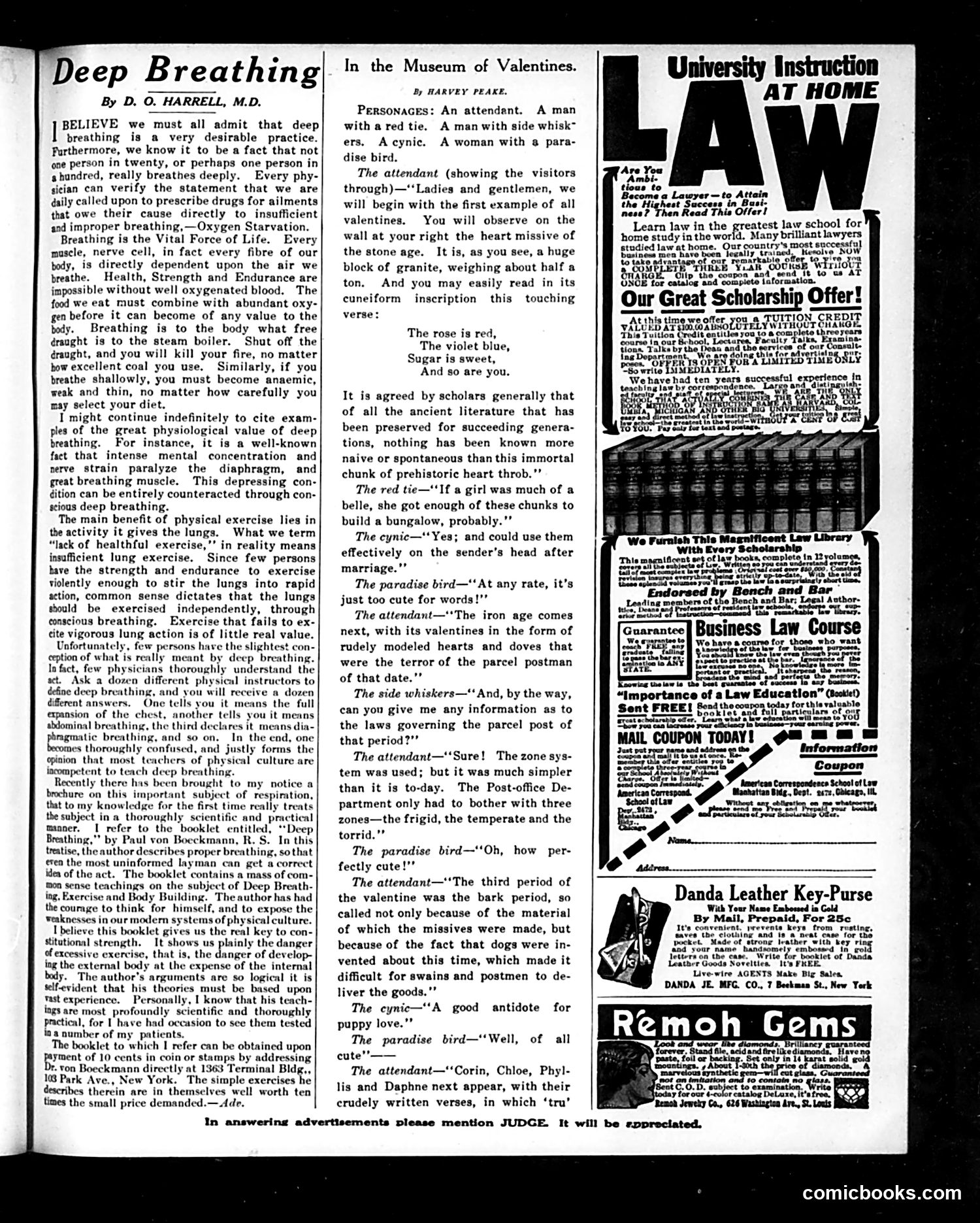
This page is **primarily educational and advertising content**, not political satire. The left column features "Deep Breathing" by Dr. D. O. Harrell—a legitimate medical article advocating deep breathing as essential to health, claiming most people breathe insufficiently and suffer "oxygen starvation" as a result. The piece endorses a booklet by Paul von Boeckmann on proper breathing technique. The right side contains **commercial advertisements**, including a "University Instruction at Home" law school offer and a "Business Law Course," typical of Judge's revenue model. There is **no identifiable political cartoon or satire** on this visible page. The content reflects early 20th-century wellness culture and mail-order education marketing, common to the era. The "Deep Breathing" article represents period health advice that would seem quaint to modern readers—attributing numerous ailments to improper respiration.
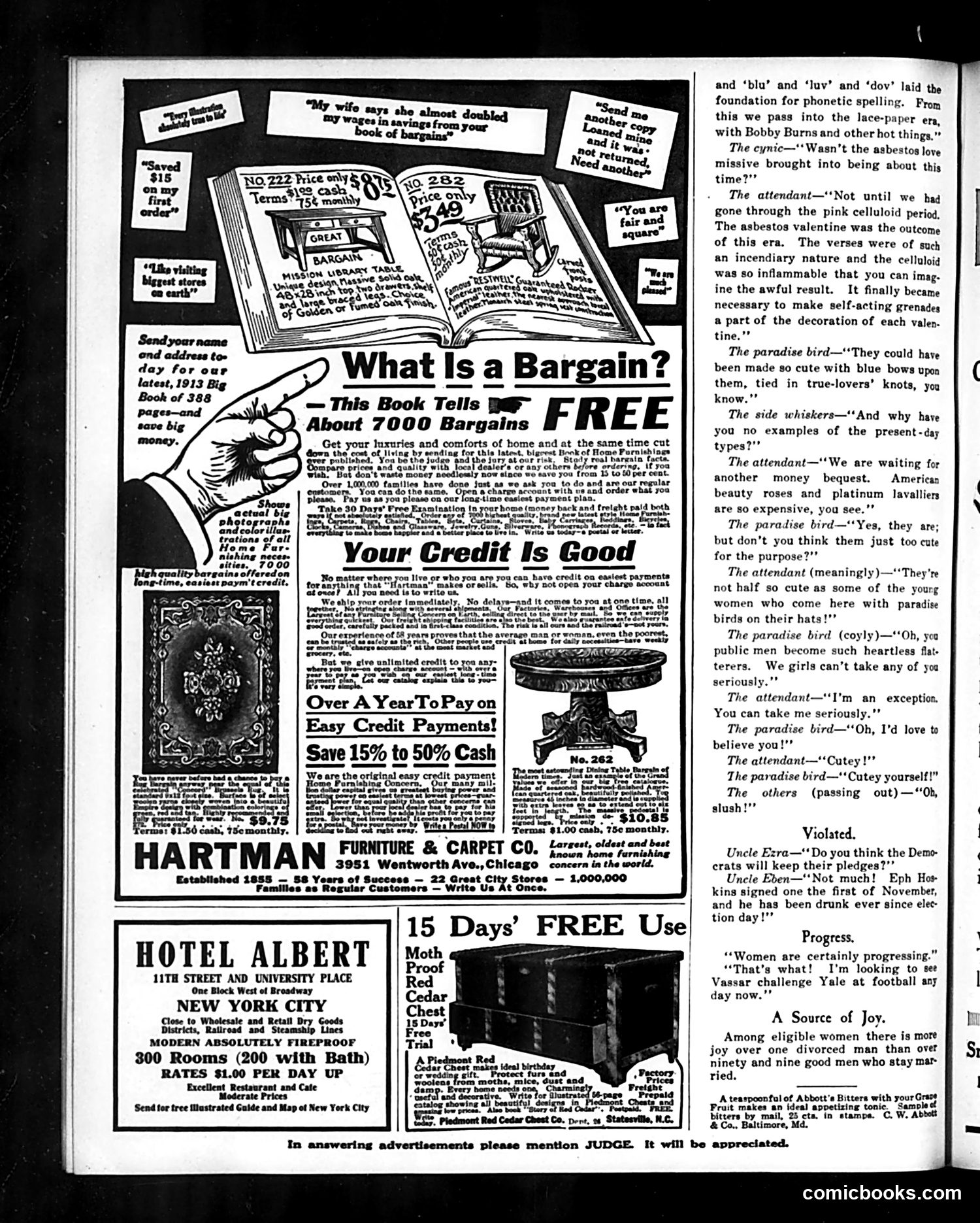
This page is primarily **advertising** for a 1913 mail-order catalog and furniture company (Hartman), with a small satirical dialogue at the bottom right. The cartoon dialogue "What Is a Valentine?" mocks the evolution of valentine traditions. It presents a museum-like discussion between characters (a "cynic," "attendant," and "paradise bird"—a woman wearing a feathered hat) about how valentines became progressively more dangerous and elaborate. The satire jokes that romantic valentines evolved from simple messages to flammable celluloid designs to literal "self-acting grenades" due to their inflammatory nature—a play on both literal fire hazards and the intensity of romantic sentiment. The "paradise bird" character represents a fashionable woman of the era, identifiable by her expensive feathered hat. The humor relies on period-specific details about valentine trends and a double meaning about passion being literally and figuratively "hot." The rest is commercial advertising typical of early 20th-century magazines.
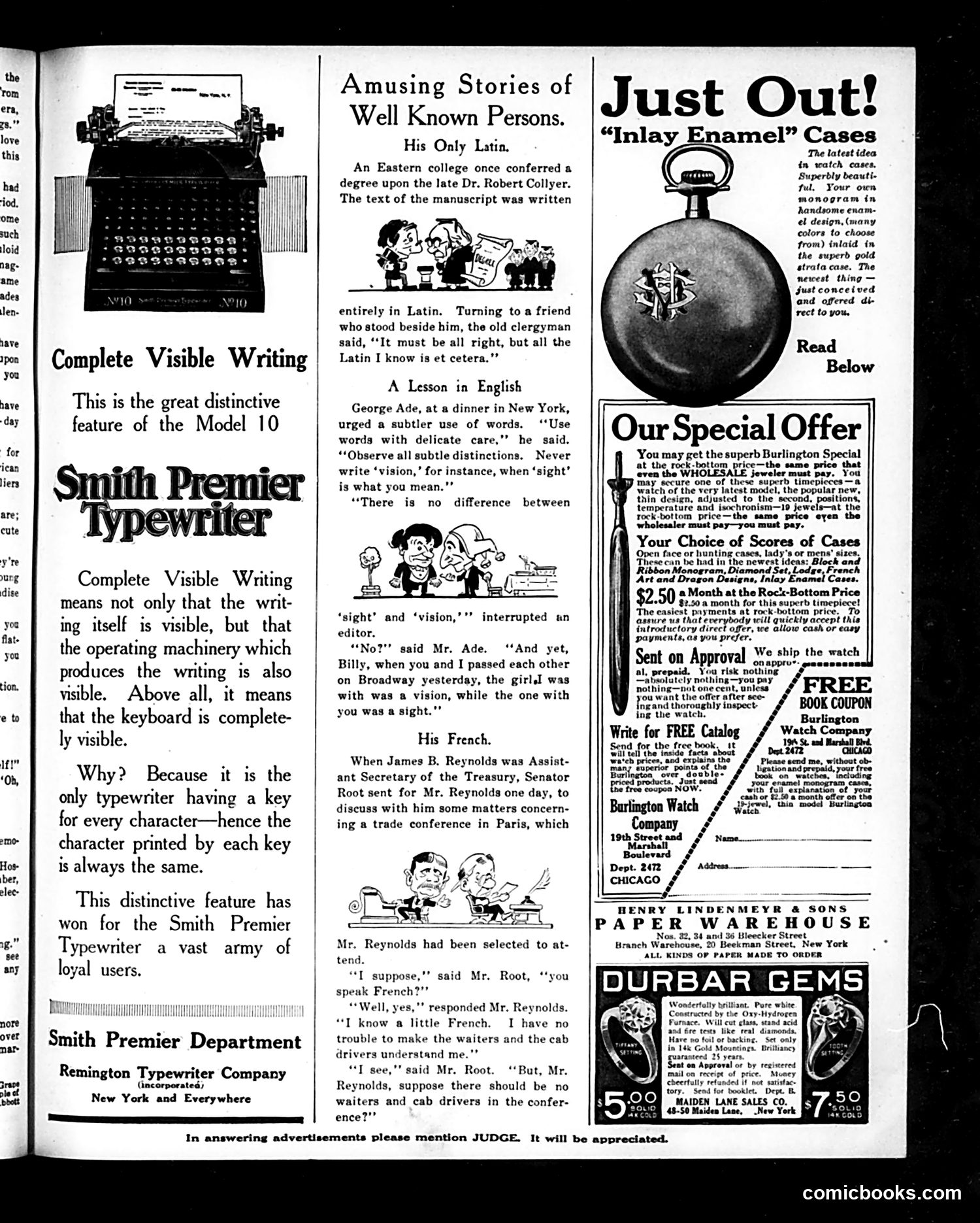
This page is primarily composed of **advertisements and anecdotal humor** rather than political satire. It contains: **Main Content: Typewriter & Watch Ads** - Left side promotes the Smith Premier typewriter (manufactured by Remington), emphasizing its "complete visible writing" feature - Right side advertises Burlington Special watches with "Inlay Enamel" cases available on monthly payment plans **Amusing Stories Section (Center)** This features three short humorous anecdotes about named public figures: 1. **Dr. Robert Collyer** — a clergyman who receives a Latin degree but admits he only knows "et cetera" 2. **George Ade** (American humorist) — jokes about the distinction between "sight" and "vision," implying a woman he passed was beautiful ("a vision") while one with an acquaintance named Billy was ugly ("a sight") 3. **James B. Reynolds** — Assistant Secretary of Treasury, discusses limited French skills with Senator Root, who sarcastically notes Reynolds can communicate with waiters/cab drivers, but a diplomatic conference might require more sophisticated language The humor relies on wordplay, linguistic mishaps, and gentle mockery of the figures' limitations—typical light satirical content for Judge magazine's audience.
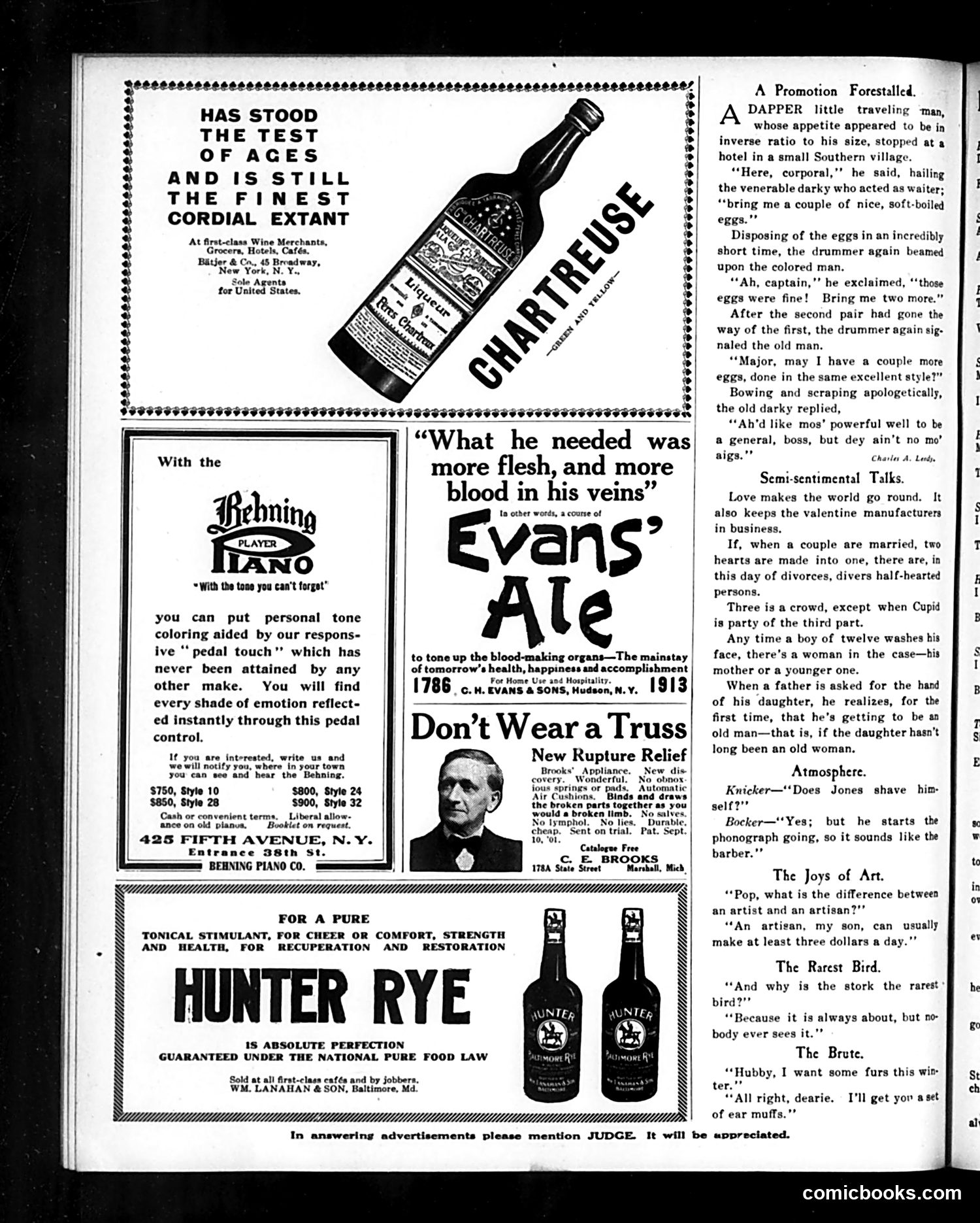
This page is primarily **advertisements** interspersed with light humor and brief comic anecdotes. The main content includes ads for alcoholic beverages (Chartreuse, Evans' Ale, Hunter Rye), a piano, and a medical truss device—typical of early 20th-century Judge magazine. The humor pieces are brief, genteel jokes: 1. **"A Promotion Forestalled"**: A traveling salesman compliments a Black waiter's egg-cooking by progressively addressing him as "corporal," "captain," and "major" (military ranks). The waiter declines further promotion to "general" because he's run out of eggs. This reflects period racial stereotypes and reflects on how flattery and status-seeking operate. 2. **"Semi-sentimental Talks"**: Brief aphorisms about love and marriage (hearts merging in matrimony, three being a crowd unless Cupid's involved). 3. Small quips about artists vs. artisans, and the rarest bird. The satire is gentle and the racial content reflects the publication's era and audience expectations, not endorsement.
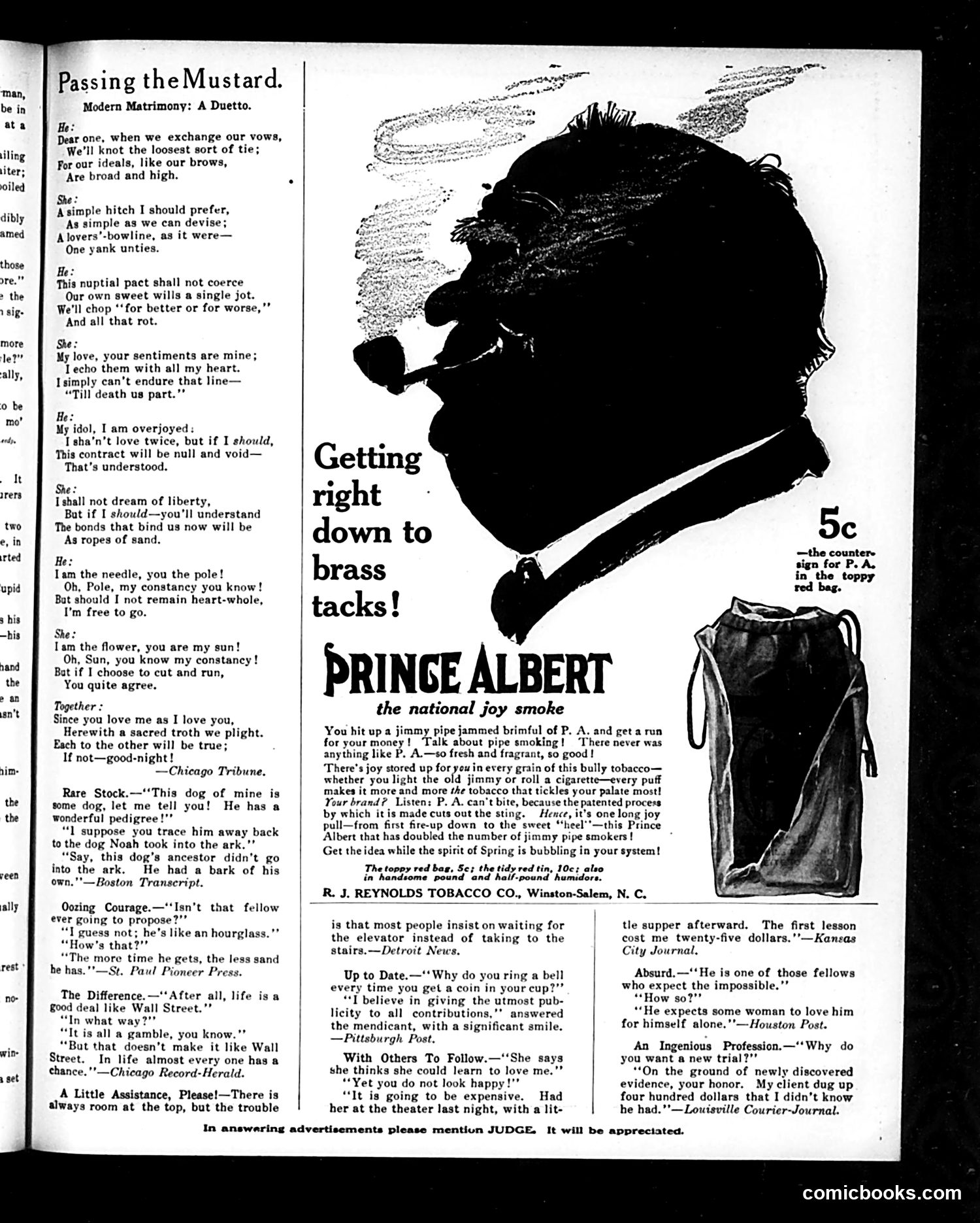
This page primarily contains two sections: **Left side - "Passing the Mustard" (Poetry/Satire):** A humorous duet mocking modern marriages where couples negotiate loose, conditional vows rather than traditional commitments. Each partner claims to love the other "as long as," with escape clauses—using metaphors like "ropes of sand" and "one yank unties." The satire targets early 20th-century attitudes toward marriage as a negotiable contract rather than a binding commitment. It's cynical commentary on contemporary relationships. **Right side - Prince Albert Tobacco Advertisement:** A full commercial advertisement (not satire) featuring silhouetted profile imagery and marketing copy emphasizing the tobacco's smoothness and quality. The ad plays on "getting down to brass tacks"—straightforward, no-nonsense messaging about product superiority. The page also contains several brief humorous anecdotes at bottom (jokes about dogs, Wall Street, proposals) typical of Judge's filler content. This is primarily an advertising and humor publication page from the early 1900s.
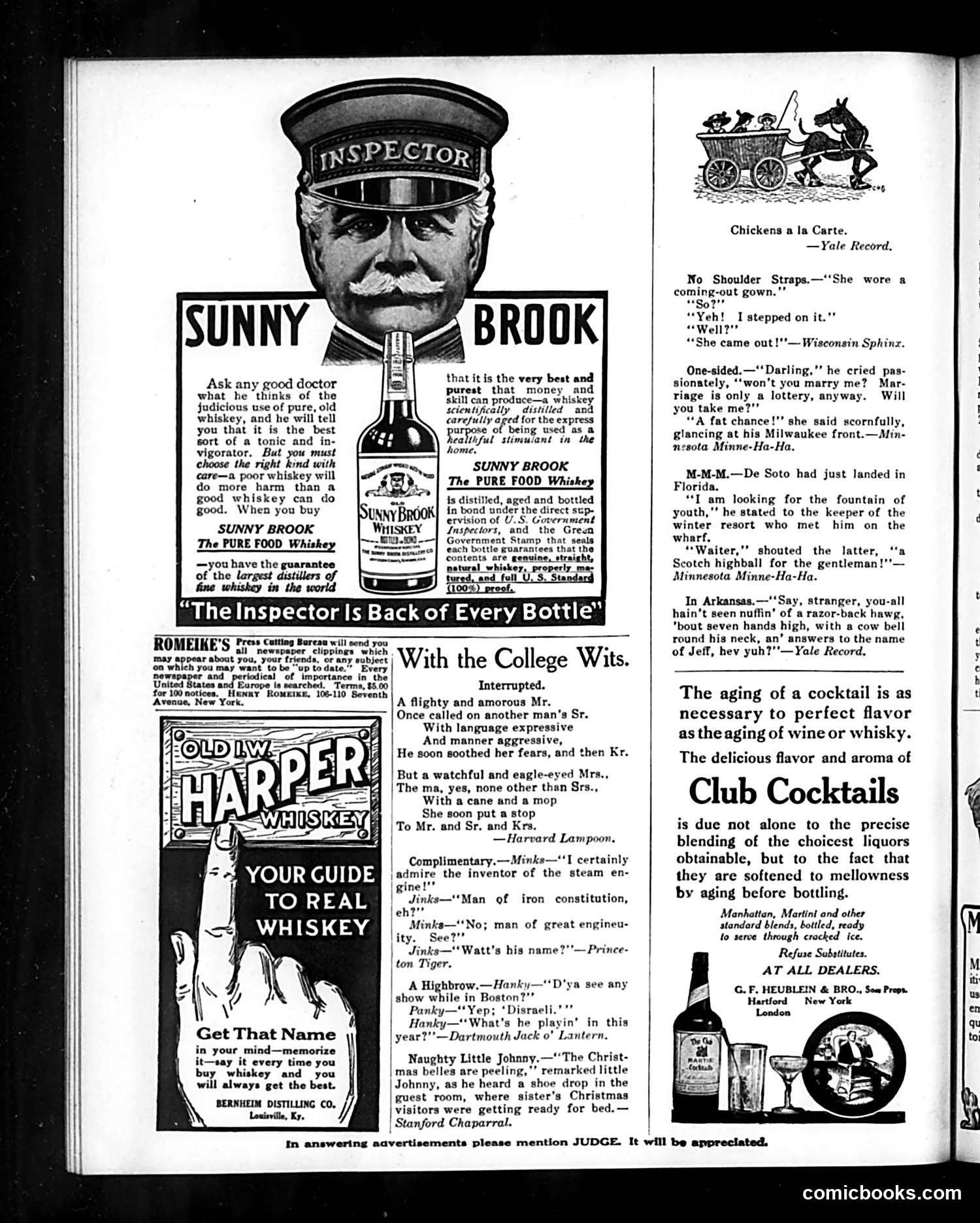
This page is primarily **advertising**, not political satire. The dominant content features whiskey advertisements (Sunny Brook, Old Harper) using the appeal of medical authority—doctors endorsing whiskey as a "healthful stimulant." This reflects pre-Prohibition era (likely early 1900s) when liquor marketing legitimized alcohol as medicinal. The right side contains typical Judge magazine humor: brief college jokes and witticisms from university publications (Yale, Harvard, Princeton). These are largely forgettable period humor with mild sexual innuendo ("the Christmas belles are peeling"). One notable item: "De Soto" searches for the fountain of youth in Florida and is offered a Scotch highball—a gentle jab at New World exploration mythology. The **"Inspector" figure** on Sunny Brook's label represents government oversight—the Pure Food and Drug Act (1906) era—meant to assure consumers of product quality and purity, a selling point then. Overall: advertising-heavy content with disposable college humor, reflecting early 20th-century American commercial and collegiate culture.
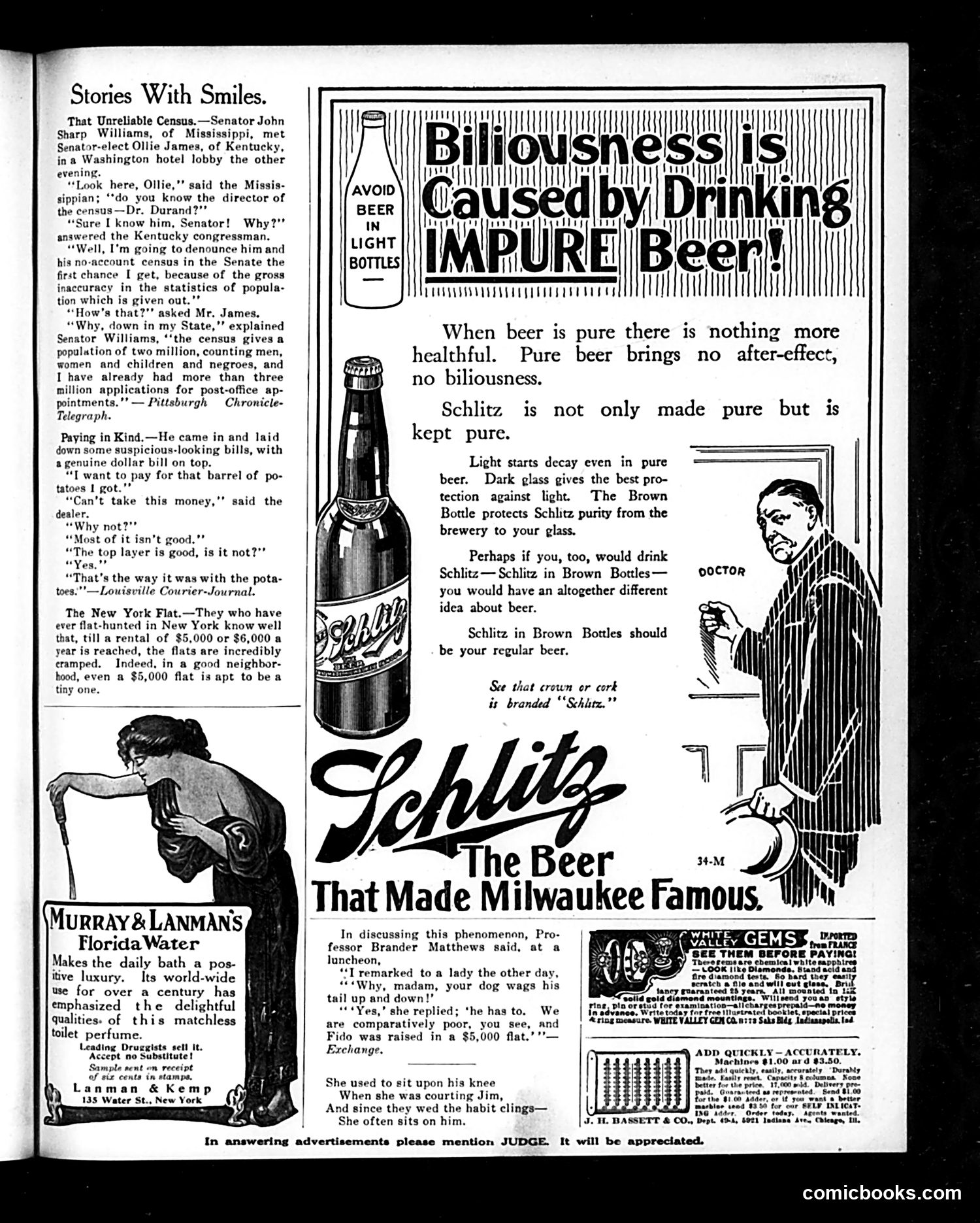
This page from *Judge* contains three brief humorous anecdotes and period advertising: **"The Unreliable Census"** mocks the 1910 U.S. Census accuracy through Mississippi Senator John Sharp Williams, who claims the census undercounted his state's population by millions—yet he's received "more than three million applications for post-office appointments" based on inflated numbers. The joke satirizes politicians' exaggeration and the gap between official statistics and political self-interest. **"Paying in Kind"** uses wordplay: a customer pays for potatoes with mostly counterfeit bills topped with one genuine dollar. The dealer rejects it; the customer notes the top layer is good—just like the potatoes were, implying both were deceptively packaged. **"The New York Flat"** jokes about cramped Manhattan housing, where even expensive ($5,000/year) apartments are tiny. The dominant advertising is for **Schlitz Beer**, claiming purity prevents "biliousness" (indigestion/nausea) and touting brown bottles' protection against light decay—a common early 20th-century beer marketing claim. A doctor figure endorses the product.
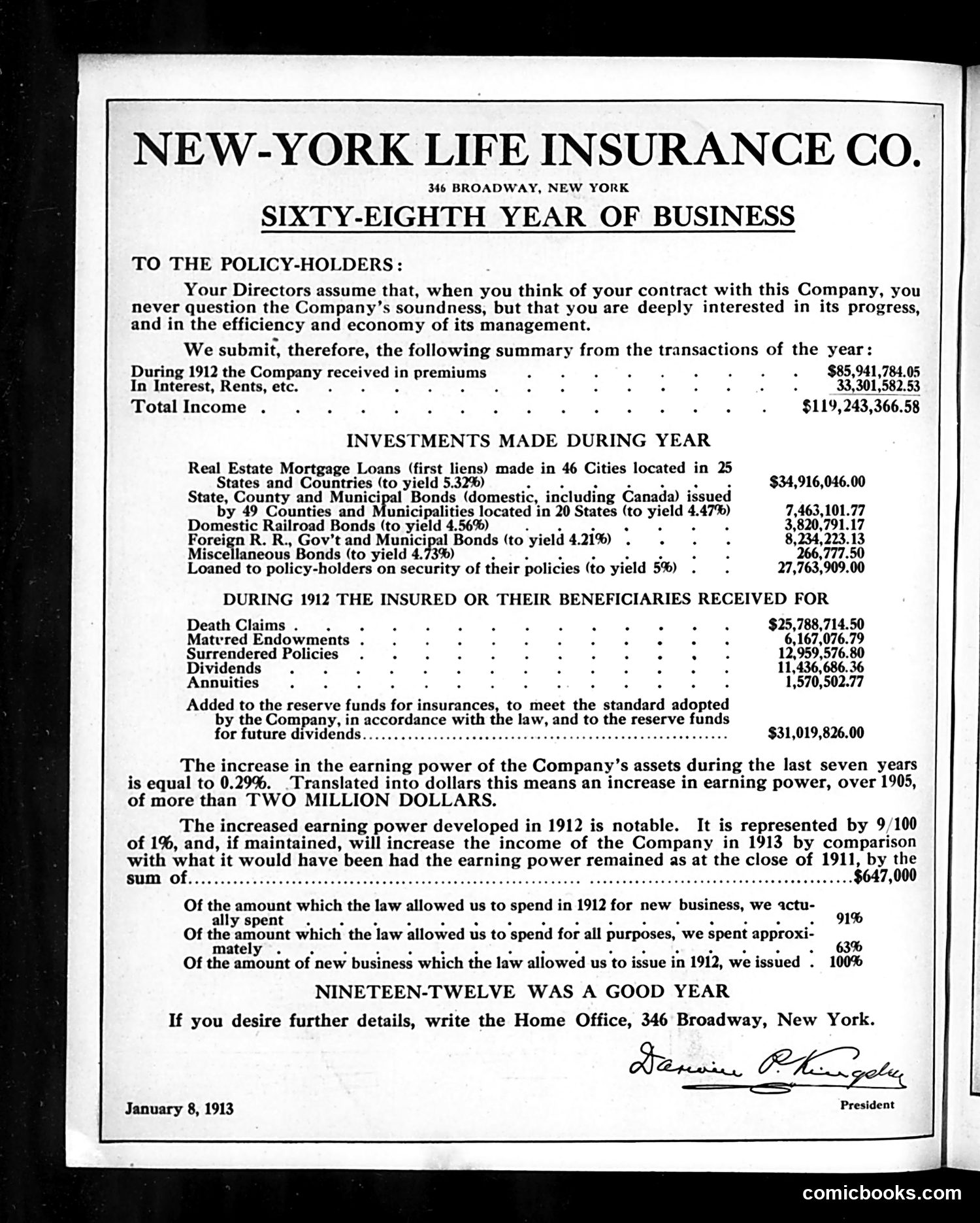
This is **not a cartoon or satire**—it's a corporate annual report to policyholders from New-York Life Insurance Company, dated January 8, 1913. The page presents the company's financial performance for 1912, their "sixty-eighth year of business." The document emphasizes the company's financial soundness and growth: $85.9 million in premiums received, nearly $120 million in total income, and substantial investments in mortgages, bonds, and railroad securities across 25+ states. It highlights payments to policyholders ($25.7 million in death claims alone) and reserve funds added for future obligations. The tone is reassuring and promotional—designed to convince policyholders of the company's stability and good management. The final statement, "NINETEEN-TWELVE WAS A GOOD YEAR," summarizes this message. This represents typical Progressive Era corporate communication, when insurance companies published detailed financial statements to build public confidence.