
Judge, 1913-02-08 · page 6 of 24
Judge — February 8, 1913 — page 6: what you’re looking at
What you’re looking at
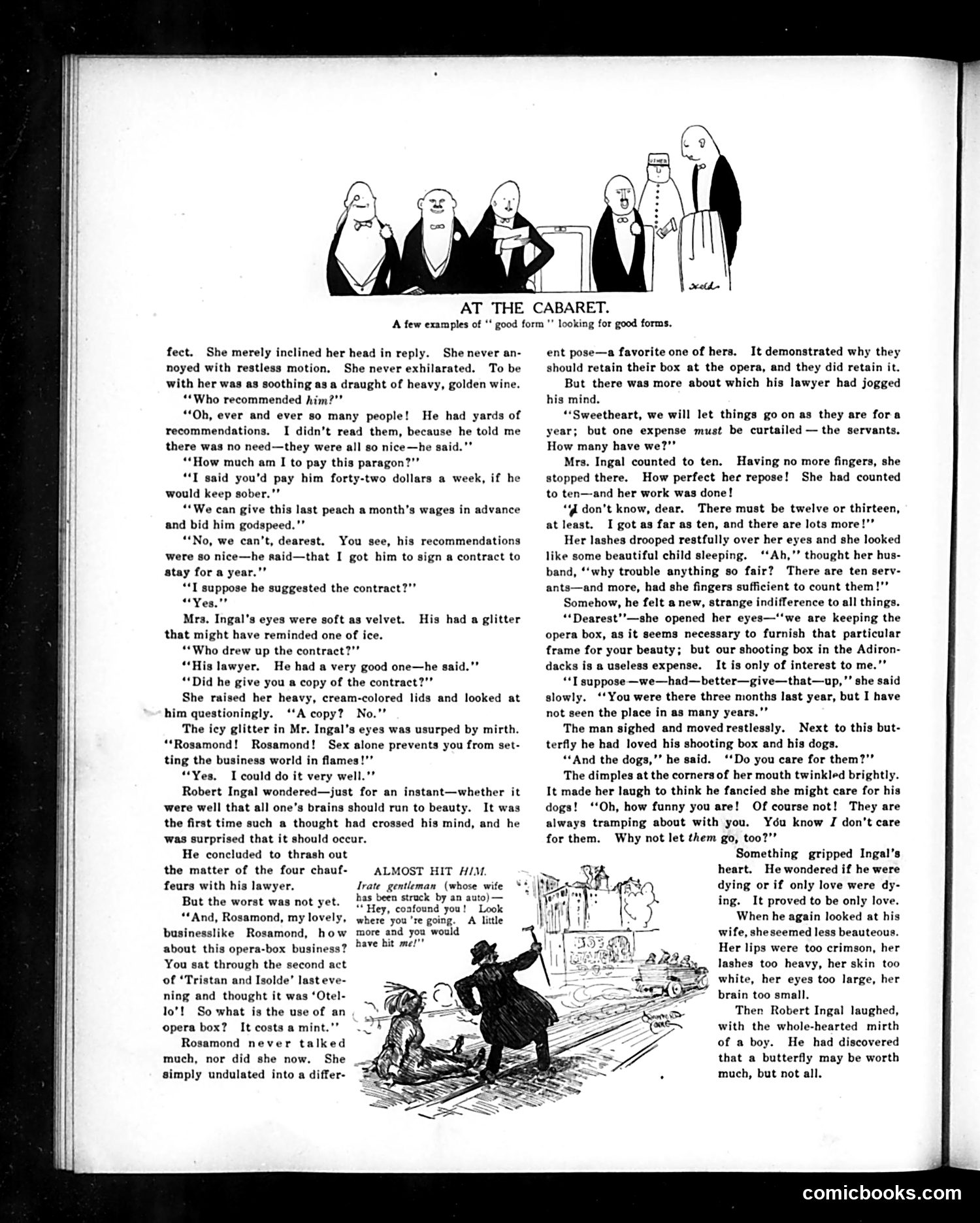
This story-cartoon mocks the stereotype of the beautiful but intellectually vapid society wife. Rosamond Ingal is portrayed as graceful and attractive ("soft as velvet" eyes, perfect composure) yet catastrophically incompetent in practical matters. She hires a servant without reading references, signs him to a year-long contract without obtaining a copy, misidentifies operas at the theater, and cannot count past ten. Her husband Robert repeatedly encounters her stunning naïveté with exasperation and resignation. The satire targets both the woman—whose aesthetic charm masks financial recklessness—and the man, who finds himself trapped between appreciating her beauty and enduring her uselessness. The accompanying cartoon ("Almost Hit Him") shows a couple at odds, reinforcing the marital discord theme. The piece critiques the Gilded Age practice of marrying for appearance alone, suggesting such matches breed mutual frustration regardless of social status.
📄 Transcribed text from this page (OCR, searchable)
Machine-transcribed from the original scan — historical spelling and the odd misread are preserved.
AT THE CABARET. A few examples of “good form "’ looking for good forms. fect. She merely inclined her head in reply. She never an- noyed with restless motion. She never exhilarated. To be with her was as soothing as a draught of heavy, golden wine. “*Who recommended him?"’ “Oh, ever and ever so many people! He had yards of recommendations. I didn’t read them, because he told me there was no need—they were all so nice—he said."" “*How much am I to pay this paragon?”’ “I said you'd pay him forty-two dollars a week, if he would keep sober. “We can give this last peach a month’s wages in advance and bid him godspeed."” “No, we can’t, dearest. You see, his recommendations were so nice—he said—that I got him to sign a contract to stay for a year."’ “TI suppose he suggested the contract?"’ “Yes."" Mrs. Ingal's eyes were soft as velvet. that might have reminded one of ice. **Who drew up the contract?’’ “His lawyer. He had a very good one—he said." “Did he give you a copy of the contract?” She raised her heavy, cream-colored lids and looked at him questioningly. ‘‘A copy? No."’ The icy glitter in Mr. Ingal’s eyes was usurped by mirth. “Rosamond! Rosamond! Sex alone prevents you from set- ting the business world in flames!’" “Yes. I could do it very well.”” Robert Ingal wondered—just for an instant—whether it were well that all one’s brains should run to beauty. It was the first time such a thought had crossed his mind, and he was surprised that it should occur. He concluded to thrash out the matter of the four chauf- feurs with his lawyer. But the worst was not yet. Maer coalemnd sont” bk ‘And, Rosamond, my lovely, where you're going. A little businesslike Rosamond, how more and you would about this opera-box business? Pave bit me! You sat through the second act of ‘Tristan and Isolde’ last eve- ning and thought it was ‘Otel- lo’! So what is the use of opera box? It costs a min Rosamond never talked much, nor did she now. She simply undulated into a differ- His had a glitter ALMOST HIT H/M. Irate gentleman (whose wite ent pose—a favorite one of hers. It demonstrated why they should retain their box at the opera, and they did retain it. But there was more about which his lawyer had jogged his mind. “Sweetheart, we will let things go on as they are fora year; but one expense must be curtailed — the servants. How many have we?”" Mrs. Ingal counted to ten. stopped there. How perfect her repose! to ten—and her work was done! “dG don't know, dear. There must be twelve or thirteen, at least. I got as far as ten, and there are lots more!’” Her lashes drooped restfully over her eyes and she looked like some beautiful child sleeping. ‘‘Ah,’’ thought her hus- band, ‘‘why trouble anything so fair? There are ten serv- ants—and more, had she fingers sufficient to count them!"’ Somehow, he felt a new, strange indifference to all things. “‘Dearest’’—she opened her eyes—‘‘we are keeping the opera box, as it seems necessary to furnish that particular frame for your beauty; but our shooting box in the Adiron- dacks is a useless expense. It is only of interest to me.” “T suppose —we—had—better—give—that—up,"’ she said slowly. ‘You were there three months last year, but I have not seen the place in as many years.’” The man sighed and moved restlessly. Next to this but- terfly he had loved his shooting box and his dogs. “And the dogs,’’ he said. ‘‘Do you care for them?’’ The dimples at the corners of her mouth twinkled brightly. It made her laugh to think he fancied she might care for his dogs! ‘‘Oh, how funny you are! Of course not! They are always tramping about with you. Ydu know J don’t care for them. Why not let them go, too?” Something gripped Ingal’s heart. He wondered if he were dying or if only love were dy- ing. It proved to be only love. When he again looked at his wife, sheseemed less beauteous. Her lips were too crimson, her lashes too heavy, her skin too white, her eyes too large, her brain too small. Then Robert Ingal laughed, with the whole-hearted mirth of a boy. He had discovered that a butterfly may be worth much, but not all. Having no more fingers, she She had counted comicbooks.com