
Judge, 1913-02-08 · page 15 of 24
Judge — February 8, 1913 — page 15: what you’re looking at
What you’re looking at
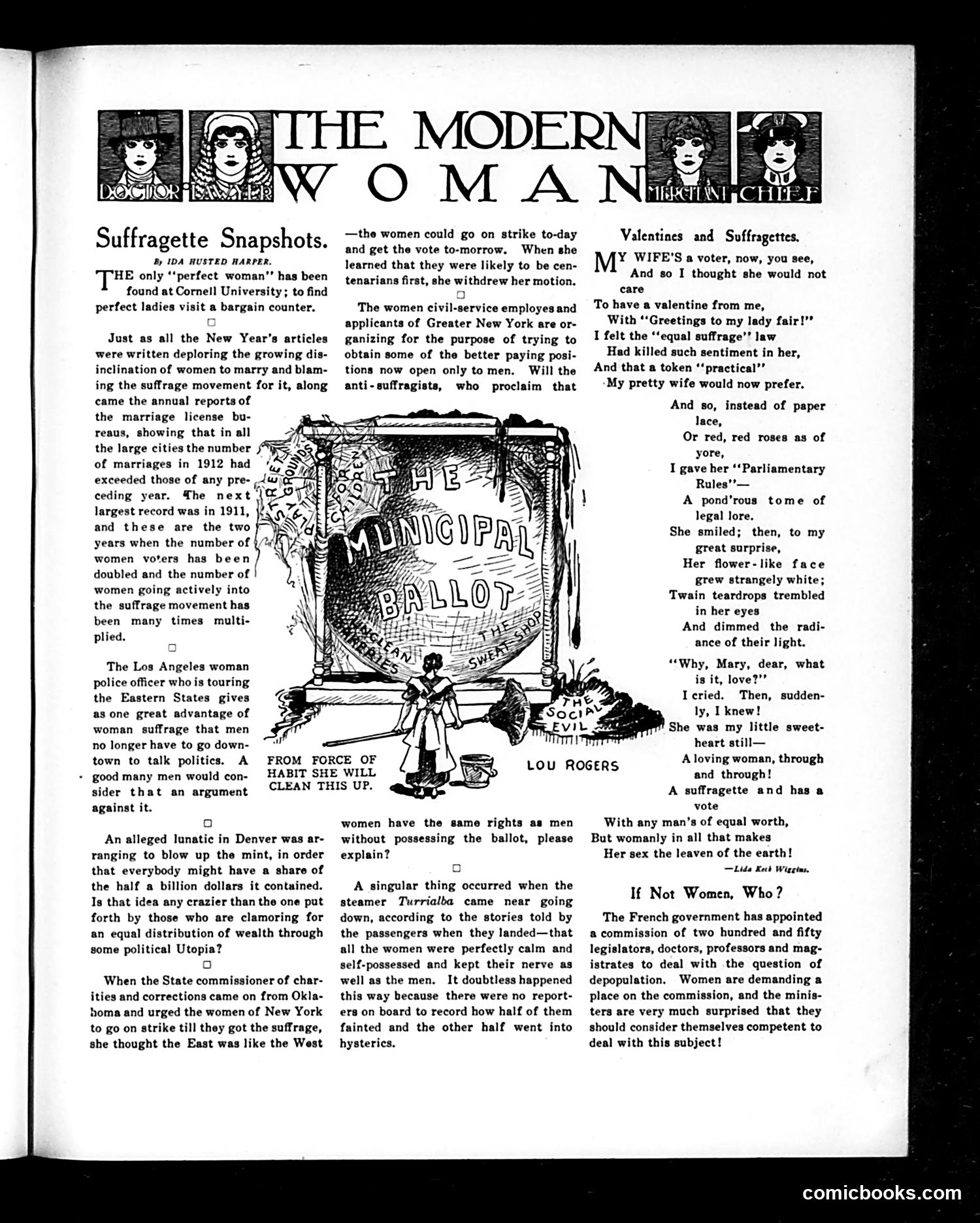
This Judge magazine page satirizes the women's suffrage movement circa 1912. The central cartoon depicts a woman figure labeled with "Municipal Ballot" being "cleaned up" by a maid figure "from force of habit"—suggesting suffrage advocates are naive, that women will revert to domestic roles regardless of voting rights. The accompanying articles by Ida Husted Harper present pro-suffrage arguments wrapped in sarcasm. Harper notes that marriage rates *increased* during years when female voters doubled, contradicting anti-suffrage claims that voting makes women unwilling to marry. She also highlights the hypocrisy: women civil servants are denied better-paying jobs "now open only to men," yet anti-suffragists claim women already have equal rights without the ballot. The "Valentines and Suffragettes" poem depicts a husband expecting his newly-enfranchised wife to reject romantic sentiment for "Parliamentary Rules," only to find she remains emotionally feminine—mocking the fear that suffrage would "unsex" women. Overall, the page uses satire to expose the contradictions and anxieties surrounding women's political participation in the pre-1920 suffrage debate.
📄 Transcribed text from this page (OCR, searchable)
Machine-transcribed from the original scan — historical spelling and the odd misread are preserved.
Suffragette Snapshots. By IDA HUSTED HARPER. HE only ‘‘perfect woman’’ has been found at Cornell University; to find perfect ladies visit a bargain counter. Just as all the New Year’s articles were written deploring the growing dis- inclination of women to marry and blam- ing the suffrage movement for it, along came the annual reports of the marriage license bu- reaus, showing that in all the large cities the number /* of marriages in 1912 had exceeded those of any pre- ,-4 ceding year, The next (© largest record was in 1911, \f and these are the two years when the number of women voters has been doubled and the number of women going actively into the suffrage movement has been many times multi- plied. The Los Angeles woman police officer who is touring the Eastern States gives asone great advantage of woman suffrage that men no longer have to go down- town to talk politics. A good many men would con- sider that an argument against it. vat o An alleged lunatic in Denver was ar- ranging to blow up the mint, in order that everybody might have a share of the half a billion dollars it contained. Is that idea any crazier than the one put forth by those who are clamoring for an equal distribution of wealth through some political Utopia? a When the State commissioner of char- ities and corrections came on from Okla- homa and urged the women of New York to go on strike till they got the suffrage, she thought the East was like the West —the women could go on strike to-day and get the vote to-morrow. When she learned that they were likely to be cen- tenarians first, she withdrew her motion. is} The women civil-service employes and applicants of Greater New York are or- ing for the purpose of trying to obtain some of the better paying posi- tions now open only tomen. Will the anti-suffragists, who proclaim that __ FROM FORCE OF HABIT SHE WILL CLEAN THIS UP. women have the same rights as men without possessing the ballot, please explain? A singular thing occurred when the steamer Turrialba came near going down, according to the stories told by the passengers when they landed—that all the women were perfectly calm and self-possessed and kept their nerve as well as the men. It doubtless happened this way because there were no report- ers on board to record how half of them fainted and the other half went into hysterics. Valentines and Soffragettes. Y WIFE'S a voter, now, you see, And so I thought she would not care To have a valentine from me, With ‘‘Greetings to my lady fair!’” I felt the ‘‘equal suffrage’’ law Had killed such sentiment in her, And that a token ‘‘practical’”” My pretty wife would now prefer. And so, instead of paper lace, Or red, red roses as of yore, I gave her ‘Parliamentary Rules’’— A pond’rous tome of legal lore. She smiled; then, to my great surprise, Her flower-like face grew strangely white; Twain teardrops trembled in her eyes And dimmed the radi- ance of their light. “‘Why, Mary, dear, what is it, love?” Icried. Then, sudden- ly, I knew! She was my little sweet- heart still— A loving woman, through and through! A suffragette and has a vote With any man’s of equal worth, But womanly in all that makes Her sex the leaven of the earth! —Lide Kut Wigetns. If Not Women, Who? The French government has appointed a commission of two hundred and fifty legislators, doctors, professors and mag- istrates to deal with the question of depopulation. Women are demanding a place on the commission, and the minis- ters are very much surprised that they should consider themselves competent to deal with this subject! comicbooks.com