
Judge, 1913-02-08 · page 4 of 24
Judge — February 8, 1913 — page 4: what you’re looking at
What you’re looking at
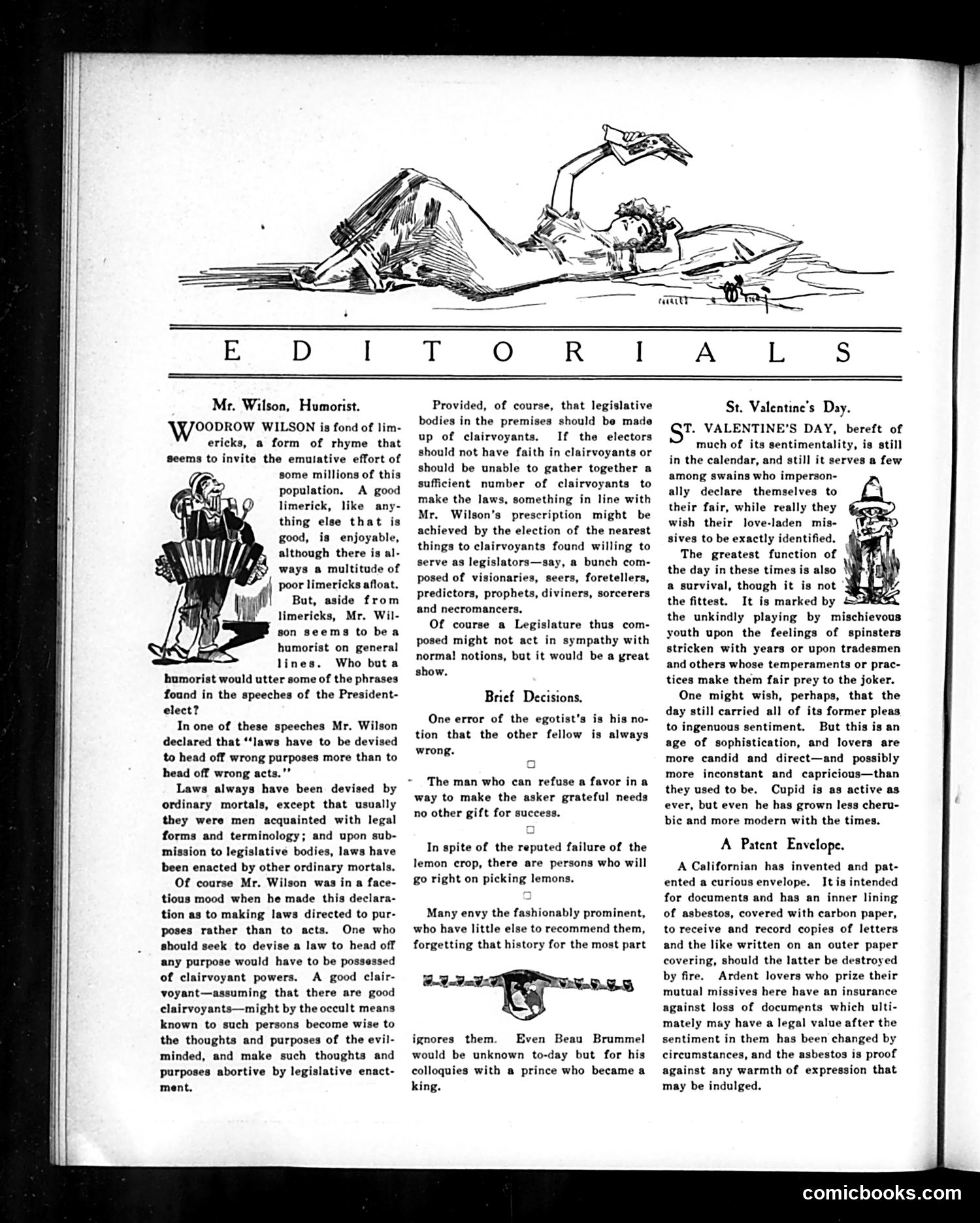
This editorial page satirizes **Woodrow Wilson** as a humorist, mocking his speeches and political pronouncements. The text suggests Wilson's rhetoric about "wrong purposes" and legislative matters reads like unintentional comedy—the satire being that his grandiose language obscures rather than clarifies policy. The **"Brief Decisions"** section offers aphorisms on human nature and social behavior, likely referencing contemporary issues. The **"St. Valentine's Day"** piece discusses how the holiday, traditionally romantic, has become cynical and commercialized in modern times—Cupid now "active as ever, but even less grown less heroic." The **"Patent Envelope"** describes a California inventor's document-preservation envelope with carbon-paper lining—a straightforward product announcement typical of Judge's mixed editorial and advertising content.
📄 Transcribed text from this page (OCR, searchable)
Machine-transcribed from the original scan — historical spelling and the odd misread are preserved.
E R T O Mr. Wilson, Humorist. OODROW WILSON is fond of lim- ericks, a form of rhyme that seems to invite the emulative effort of some millions of this population. A good limerick, like any- thing else that is good, is enjoyable, although there is al- ways a multitude of | poor limericks afloat. But, aside from limericks, Mr. Wil- son seems to bea humorist on general lines. Who buta humorist would utter some of the phrases found in the speeches of the President- elect? In one of these speeches Mr. Wilson declared that ‘laws have to be devised to head off wrong purposes more than to head off wrong acts." Laws always have been devised by ordinary mortals, except that usually they were men acquainted with legal forms and terminology; and upon sub- mission to legislative bodies, laws have been enacted by other ordinary mortals. Of course Mr. Wilson was in a face- tious mood when he made this declara- tion as to making laws directed to pur- poses rather than to acts. One who should seek to devise a law to head off any purpose would have to be possessed of clairvoyant powers. A good clair- voyant—assuming that there are good clairvoyants—might by the occult means known to such persons become wise to the thoughts and purposes of the evil- minded, and make such thoughts and purposes abortive by legislative enact- ment. Provided, of course, that legislative bodies in the premises should be made up of clairvoyants. If the electors should not have faith in clairvoyants or should be unable to gather together a sufficient number of clairvoyants to make the laws, something in line with Mr. Wilson's prescription might be achieved by the election of the nearest things to clairvoyants found willing to serve as legislators—say, a bunch com- posed of visionaries, seers, foretellers, predictors, prophets, diviners, sorcerers and necromancers, Of course a Legislature thus com- posed might not act in sympathy with norma! notions, but it would be a great show. Brief Decisions. One error of the egotist’s is his no- tion that the other fellow is always wrong. The man who can refuse a favor ina way to make the asker grateful needs no other gift for success. In spite of the reputed failure of the lemon crop, there are persons who will go right on picking lemons. Many envy the fashionably prominent, who have little else to recommend them, forgetting that history for the most part O-9a92923 a aN ignores them. Even Beau Brummel would be unknown to-day but for his colloquies with a prince who became a king. St. Valentine's Day. T. VALENTINE’S DAY, bereft of much of its sentimentality, is still in the calendar, and still it serves a few among swains who imperson- ally declare themselves to their fair, while really they wish their love-laden mis- sives to be exactly identified. The greatest function of the day in these times is also a survival, though it is not the fittest. It is marked by the unkindly playing by mischievous youth upon the feelings of spinsters stricken with years or upon tradesmen and others whose temperaments or prac- tices make them fair prey to the joker. One might wish, perhaps, that the day still carried all of its former pleas to ingenuous sentiment. But this is an age of sophistication, and lovers are more candid and direct—and possibly more inconstant and capricious—than they used to be. Cupid is as active as ever, but even he has grown less cheru- bic and more modern with the times, A Patent Envelope. A Californian has invented and pat- ented a curious envelope. Itis intended for documents and has an inner lining of asbestos, covered with carbon paper, to receive and record copies of letters and the like written on an outer paper covering, should the latter be destroyed by fire. Ardent lovers who prize their mutual missives here have an insurance against loss of documents which ulti- mately may have a legal value after the sentiment in them has been changed by circumstances, and the asbestos is proof against any warmth of expression that may be indulged. comicbooks.com