
Judge, 1913-02-08 · page 8 of 24
Judge — February 8, 1913 — page 8: what you’re looking at
What you’re looking at
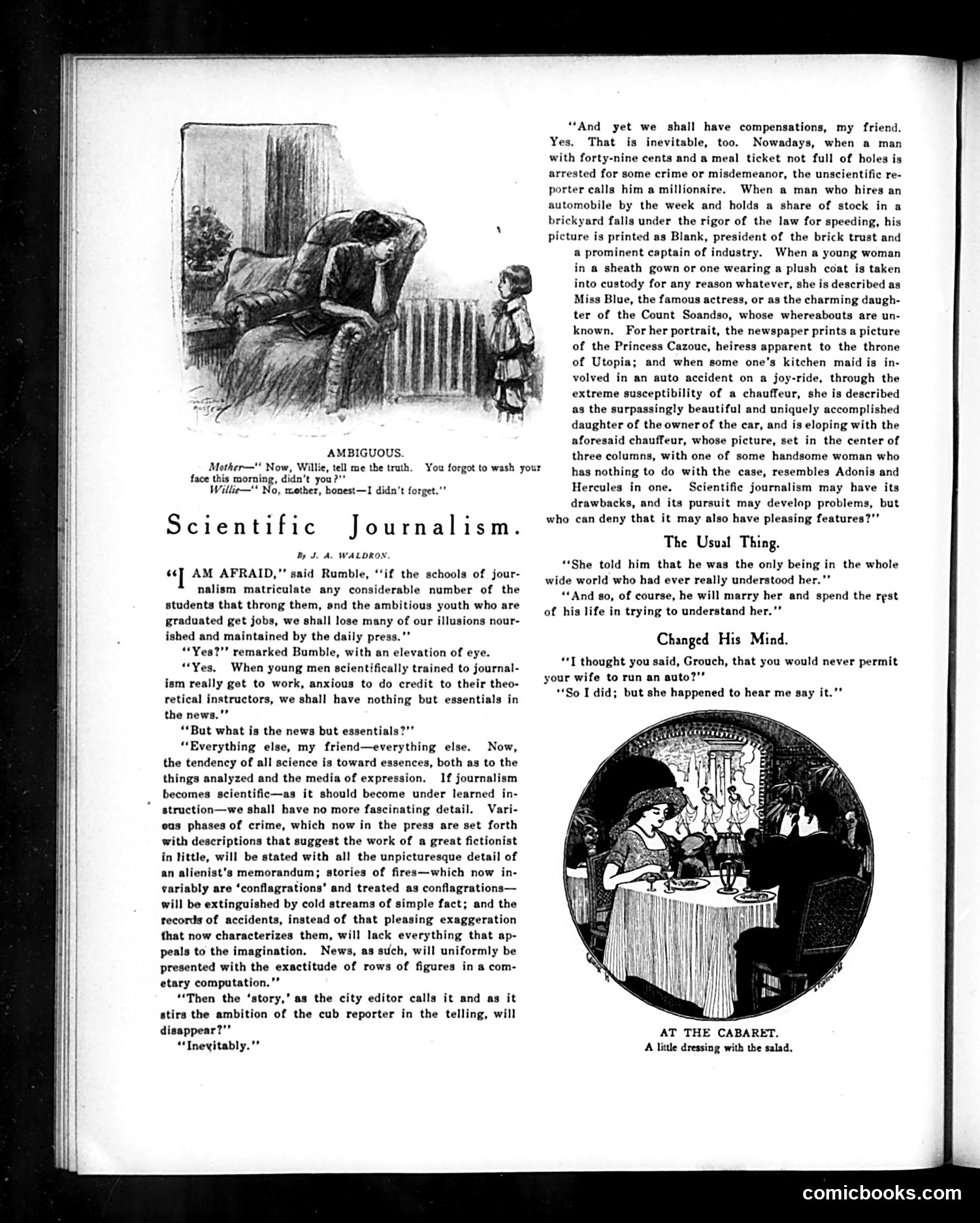
This satirical piece critiques newspapers' sensationalism versus the proposed alternative of scientifically rigorous reporting. Two characters debate whether journalism schools training students in objective, fact-based reporting would harm newspapers by eliminating the exaggerated detail readers enjoy. The satire's clever twist: the speaker argues that *despite* journalism becoming more truthful, newspapers still misrepresent people—calling arrested poor men "millionaires," depicting ordinary women as famous actresses or nobility. The implication is cutting: newspapers are already so dishonest that even "scientific" accuracy couldn't worsen their distortion of reality. The joke exposes how thoroughly newspapers fabricate identities and circumstances for dramatic effect, making the fear of losing "fascinating detail" actually a fear of losing their power to mislead. The cartoon "Ambiguous" simply shows a mother asking her son if he washed his face—his evasive answer playing on the double meaning of "forget."
📄 Transcribed text from this page (OCR, searchable)
Machine-transcribed from the original scan — historical spelling and the odd misread are preserved.
AMBIGUOUS. Mother—"' Now, Willie, tell me the truth. face this morning, didn’t you?"" Willie—" No, mother, honest—I didn’t forget."” You forgot to wash your Scientific Journalism. By J. A, WALDRON 6s] AM AFRAID," said Rumble, ‘‘if the schools of jour- nalism matriculate any considerable number of the students that throng them, and the ambitious youth who are graduated get jobs, we shall lose many of our illusions nour- ished and maintained by the daily press.’” “Yes?’’ remarked Bumble, with an elevation of eye. “Yes, When young men scientifically trained to journal- ism really get to work, anxious to do credit to their theo- retical instructors, we shall have nothing but essentials in the news.” “But what is the news but essentials?"’ “Everything else, my friend—everything else. Now, the tendency of all science is toward essences, both as to the things analyzed and the media of expression. If journalism becomes scientific—as it should become under learned in- struction—we shall have no more fascinating detail. Vari- ous phases of crime, which now in the press are set forth with descriptions that suggest the work of a great fictionist in little, will be stated with all the unpicturesque detail of an alienist’s memorandum; stories of fires—which now in- variably are ‘conflagrations’ and treated as conflagrations— will be extinguished by cold streams of simple fact; and the tecords of accidents, instead of that pleasing exaggeration fhat now characterizes them, will lack everything that ap- peals to the imagination. News, as such, will uniformly be presented with the exactitude of rows of figures in a com- etary computation.’’ “Then the ‘story,’ as the city editor calls it and as it stirs the ambition of the cub reporter in the telling, will disappear?’’ “Inevitably.’” “And yet we shall have compensations, my friend. Yes. That is inevitable, too. Nowadays, when a man with forty-nine cents and a meal ticket not full of holes is arrested for some crime or misdemeanor, the unscientific re- porter calls him a millionaire. When a man who hires an automobile by the week and holds a share of stock in a brickyard falls under the rigor of the law for speeding, his picture is printed as Blank, president of the brick trust and a prominent captain of industry. When a young woman in a sheath gown or one wearing a plush coat is taken into custody for any reason whatever, she is described as Miss Blue, the famous actress, or as the charming daugh- ter of the Count Soandso, whose whereabouts are un- known. For her portrait, the newspaper prints a picture of the Princess Cazouc, heiress apparent to the throne of Utopia; and when some one's kitchen maid is in- volved in an auto accident on a joy-ride, through the extreme susceptibility of a chauffeur, she is described as the surpassingly beautiful and uniquely accomplished daughter of the owner of the car, and is eloping with the aforesaid chauffeur, whose picture, set in the center of three columns, with one of some handsome woman who has nothing to do with the case, resembles Adonis and Hercules in one. Scientific journalism may have its drawbacks, and its pursuit may develop problems, but who can deny that it may also have pleasing features?"’ The Usual Thing. “She told him that he was the only being in the whole wide world who had ever really understood her.”” “And so, of course, he will marry her and spend the rest of his life in trying to understand her.’” Changed His Mind. “T thought you said, Grouch, that you would never permit your wife to run an auto?”” “So I did; but she happened to hear me say it.’’ AT THE CABARET. A little dressing with the salad. comicbooks.com