
A complete issue · 26 pages · 1913
Judge — January 4, 1913
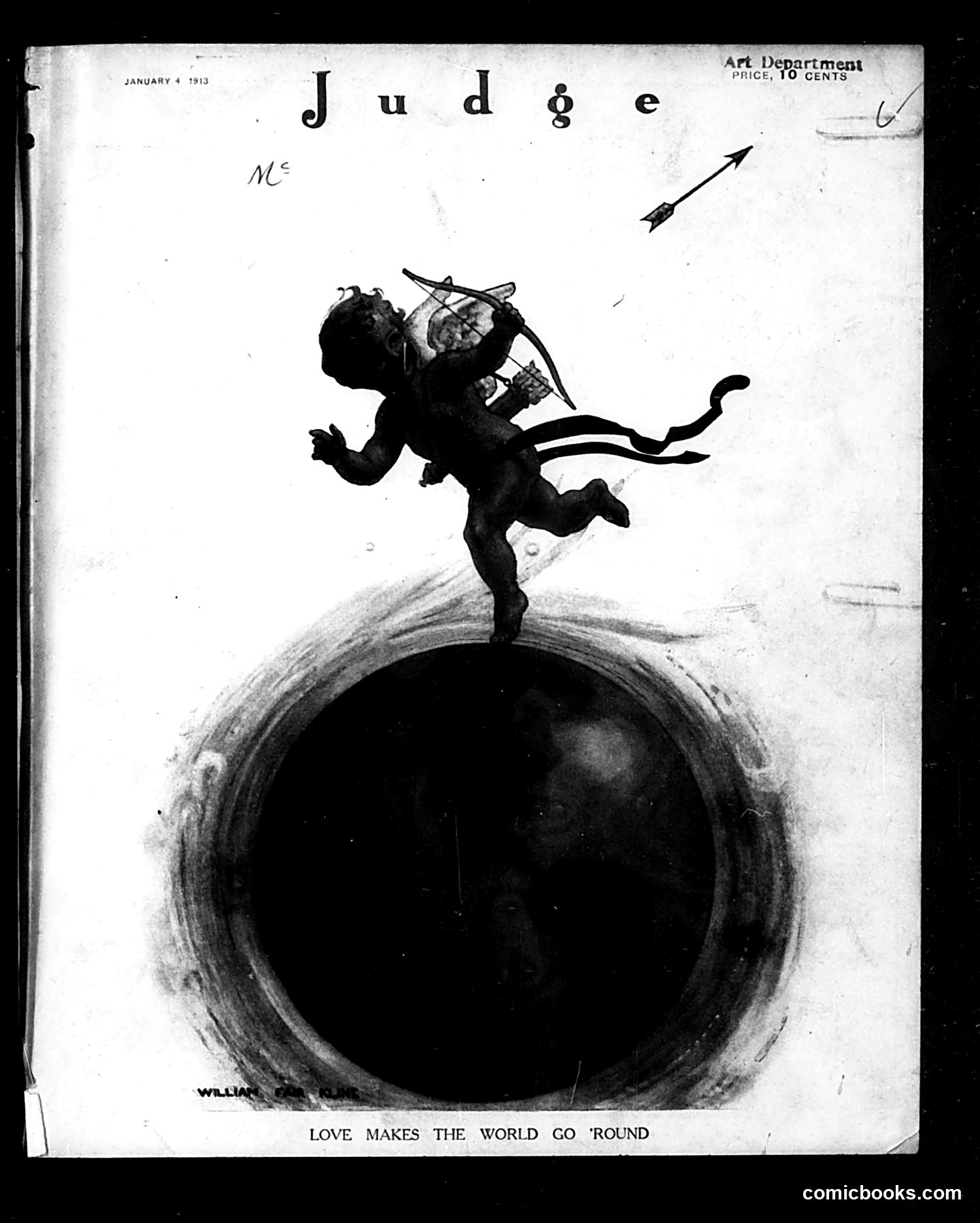
This cover depicts Cupid (the winged cherub) balancing precariously atop a large globe, juggling what appears to be a bow and arrow while maintaining his footing. The caption reads "Love Makes the World Go 'Round." The satire appears to comment on romantic love as an unstable, precarious force governing human affairs. The cherub's precarious one-legged stance suggests that love—while portrayed as driving civilization—is actually fragile and poorly balanced. The juggling implies humanity struggles to manage romantic impulses. This reflects early 20th-century social attitudes questioning whether sentiment and romance should guide society, or whether more rational forces should prevail. The image satirizes the romantic idealization prevalent in popular culture of that era.
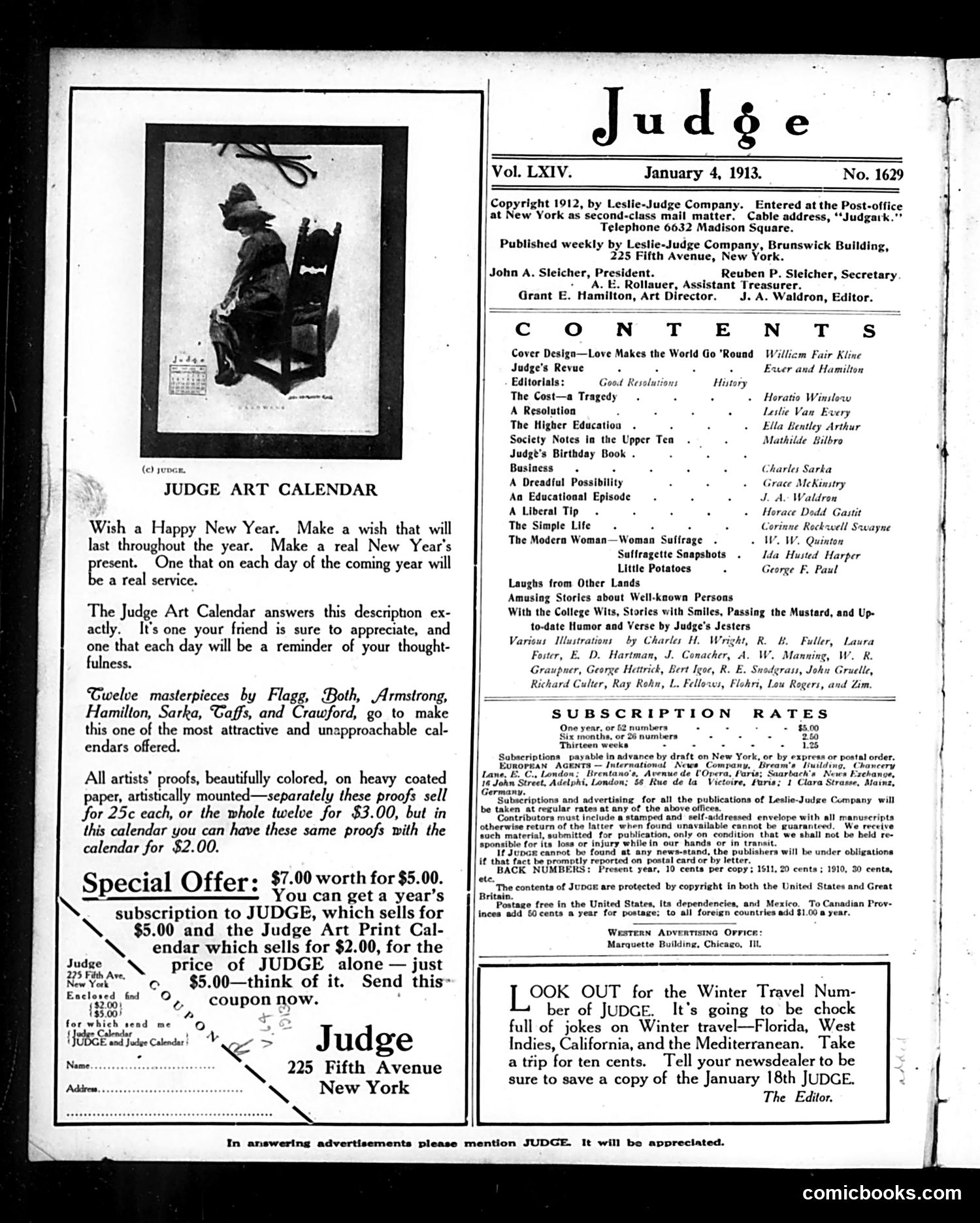
The cover image shows a figure in dark clothing sitting in a chair, appearing distressed or contemplative. The accompanying text describes it as part of the "Judge Art Calendar," promoting their 1913 publication. **What we can determine:** This is primarily a **magazine cover and advertisement page** rather than political satire. The main content promotes Judge's calendar and subscription offers—12 art prints by notable illustrators (Flagg, Roth, Armstrong, Sarka, etc.) for $3.00 or individual prints for 25¢. The actual satirical cartoons referenced in the table of contents ("Love Makes the World Go Round," "The Cost—a Tragedy," "A Resolution") are not visible on this page. **Takeaway:** This appears to be Judge's self-promotional New Year's issue emphasizing their artistic quality and affordable pricing for subscribers.
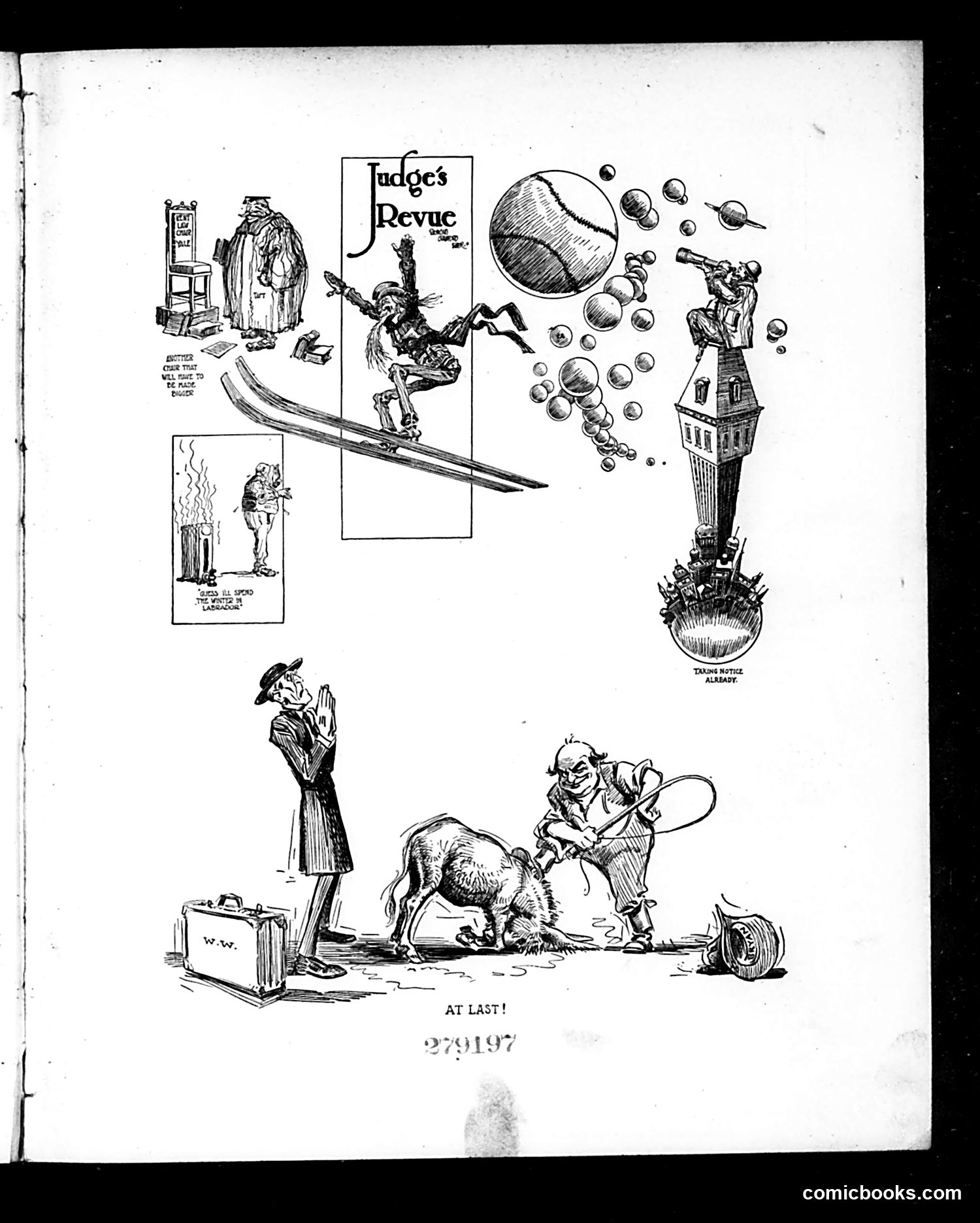
This page from Judge magazine presents several satirical sketches under the heading "Judge's Revue." The central image shows a figure on a sword spanning various celestial bodies and spheres, suggesting ambitions or fantasies of cosmic scale. The bottom panel, captioned "AT LAST!", depicts what appears to be a domestic scene with a woman, a man with a net, and a dog—likely satirizing the effort or triumph of catching something (possibly a spouse or romantic partner, given the period's humor conventions). The smaller panels in the upper left appear to reference other contemporary situations, though specific details are unclear without additional context. The overall tone suggests commentary on aspirations, ambitions, or social situations common to Judge's readership of the era.
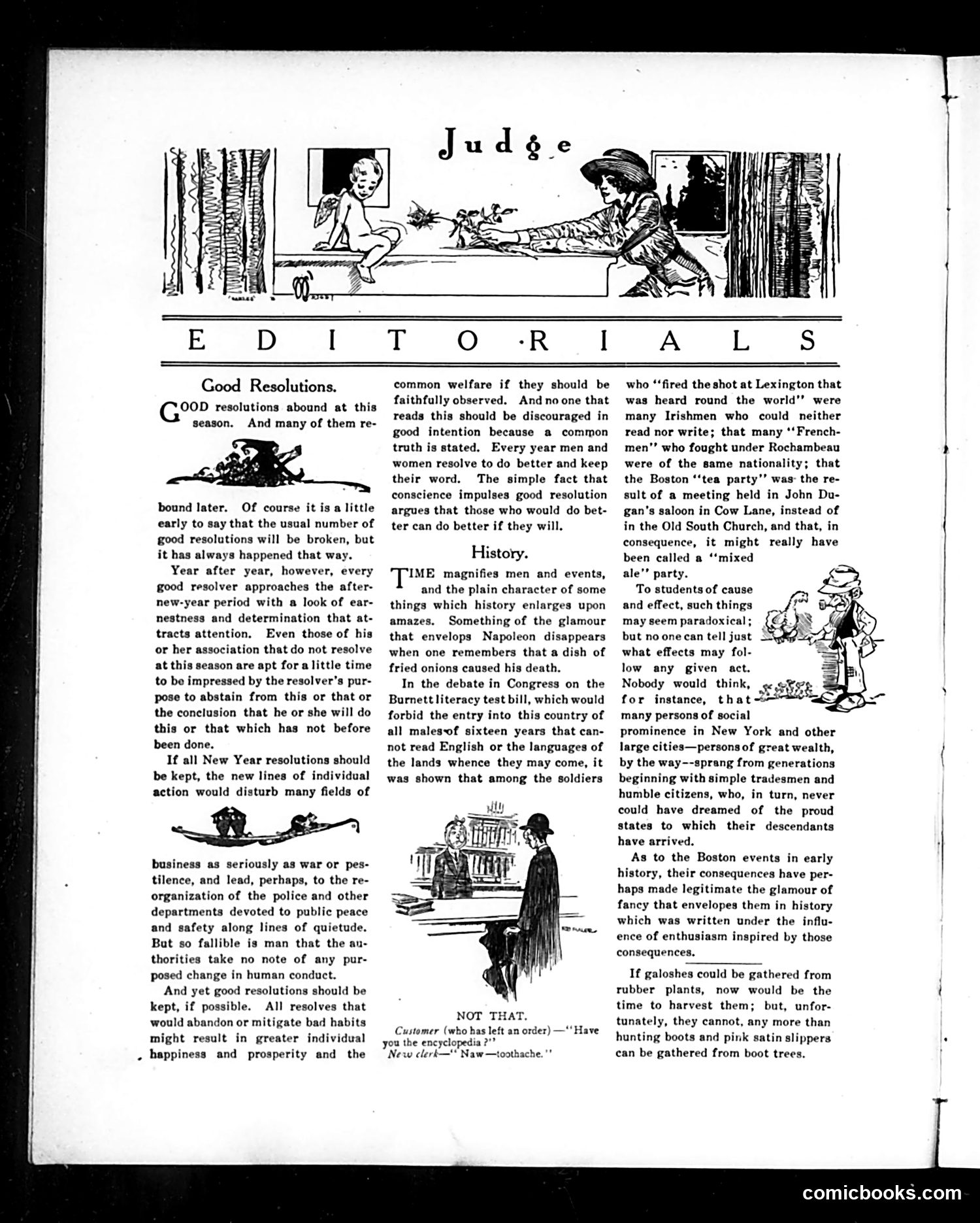
This editorial page from Judge magazine contains two main sections: **"Good Resolutions"** advocates keeping New Year's resolutions seriously, arguing they could improve public conduct, police organization, and social order if actually maintained—rather than being broken within weeks as typically happens. **"History"** section satirizes how history glamorizes mundane events. It mocks Congress's debate over a "Burnett literacy test bill" (restricting immigration based on reading ability), references the Boston Tea Party being exaggerated as historically significant, and jokes that minor figures from New York became "prominent" simply through historical narrative and descendants' enthusiasm—suggesting history inflates importance of ordinary events through retrospective storytelling and ancestor pride. The page's cartoons appear to illustrate these editorial points with humorous domestic and office scenes.
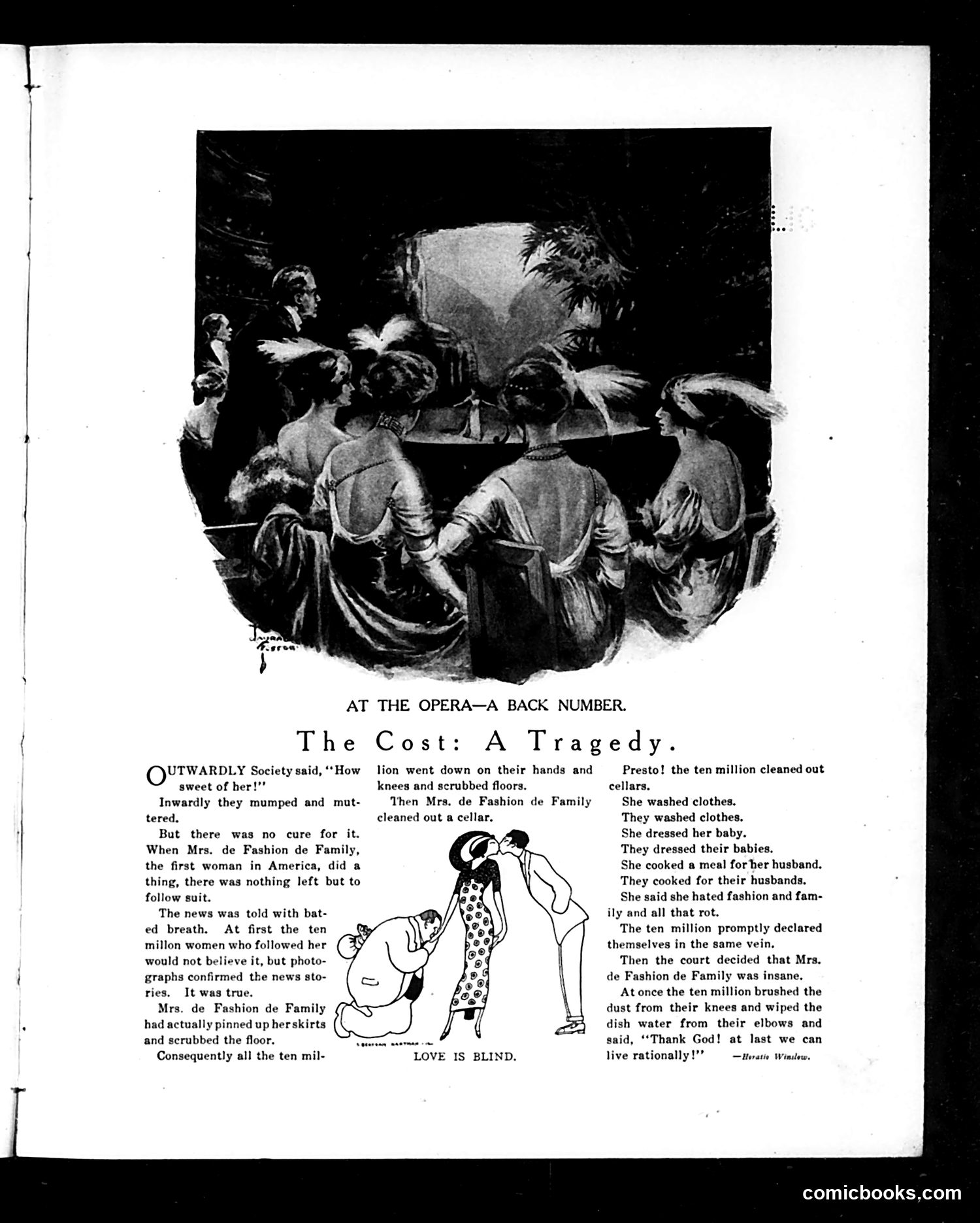
This satirical piece mocks wealthy high-society women who adopted elaborate fashion and social pretensions. "Mrs. de Fashion de Family," described as "the first woman in America" to follow a particular trend, supposedly inspired ten million women to imitate her—with disastrous consequences. The joke: these wealthy women became so obsessed with fashion that they neglected domestic duties entirely. They "pinned up her skirts and scrubbed the floor," abandoning their servants' roles. The satire suggests that blind devotion to fashion icons causes women to abandon practical responsibilities and rationality itself. The cartoon ridicules both conspicuous consumption and women's susceptibility to social pressure, presenting fashionable society women as foolishly herd-like rather than independent thinkers.
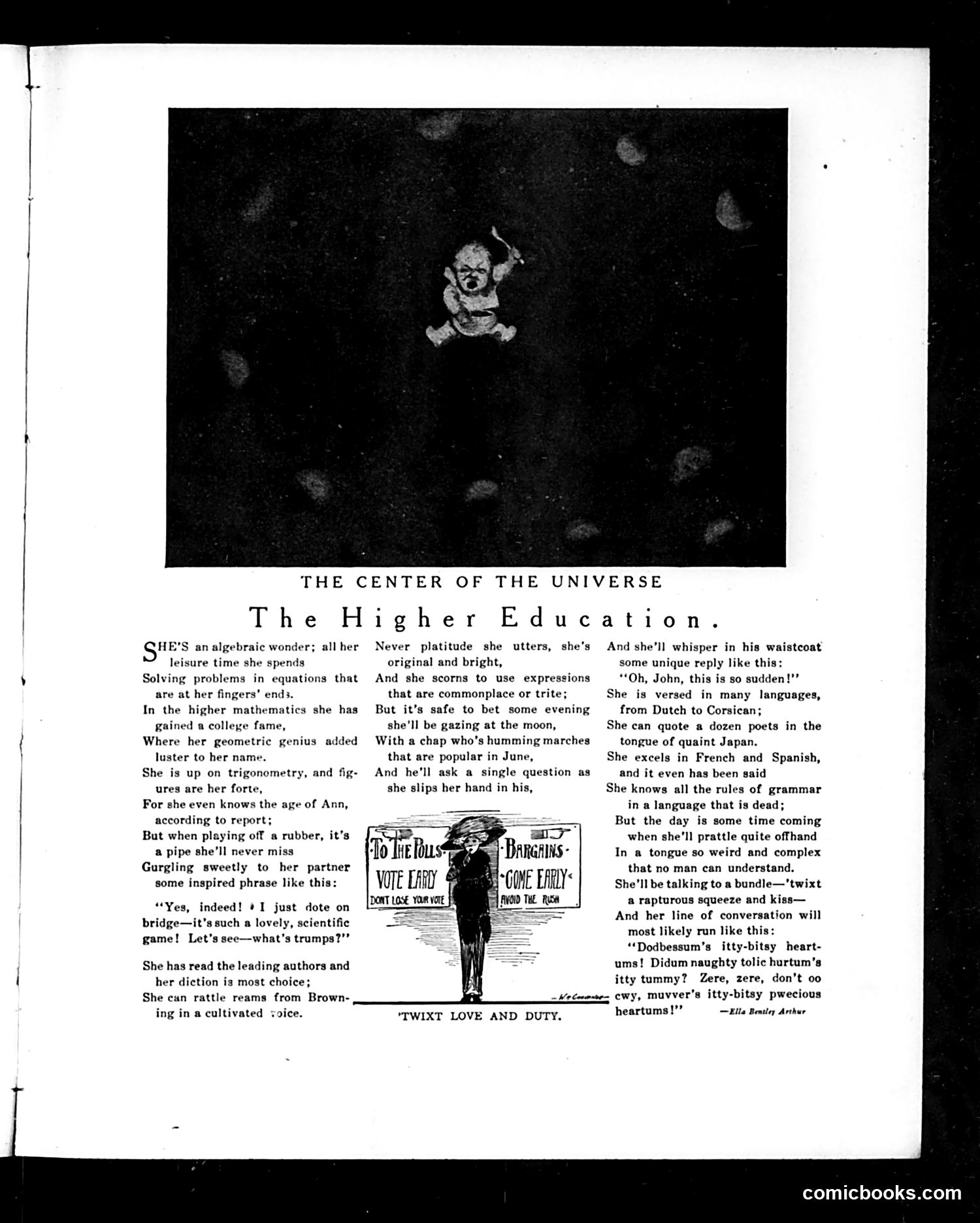
This page satirizes the "New Woman" of the early 20th century—educated, intellectually accomplished, and independent. The top illustration shows a woman floating in space like "the center of the universe," establishing the satirical premise. The text celebrates her genuine achievements: mathematical brilliance, mastery of multiple languages, literary knowledge, and grammatical expertise. However, the satire reveals the contradiction: despite all this education, when romantically involved, she abandons her cultivated intellect entirely. The central cartoon ("'Twixt Love and Duty") depicts her torn between duty (intellectual pursuits) and love (romance). The poem's punchline reveals the joke: her sophisticated mind becomes utterly infantilized around men. The final stanza mocks how she'll resort to absurd baby-talk ("Dodbessum's itty-bitsy heart-ums"), suggesting that no amount of education can overcome women's supposedly innate sentimentality. The satire critiques both educated women and contemporary attitudes about femininity—implying women cannot maintain intellectual credibility in romantic contexts.
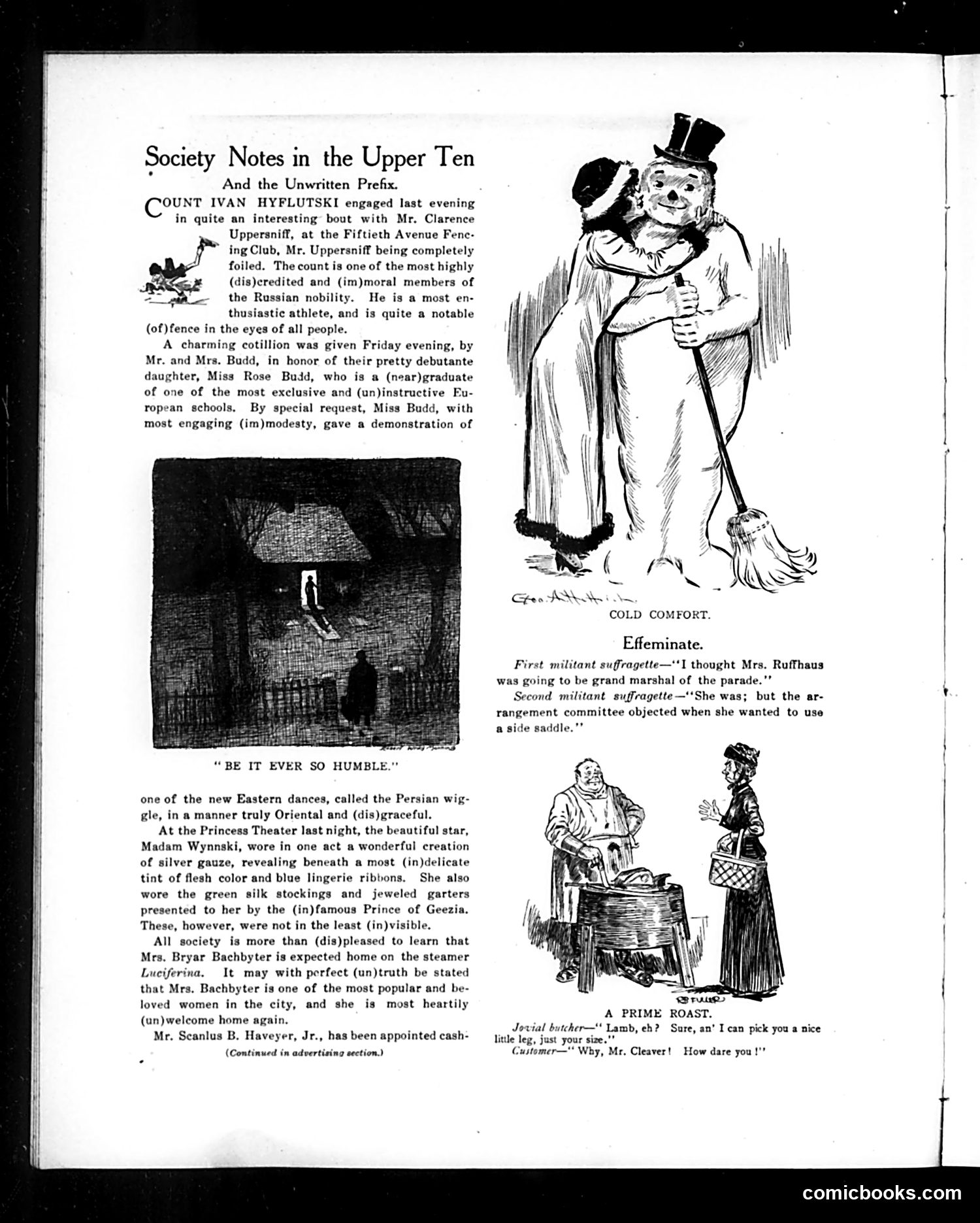
This page satirizes New York high society through mocking "society notes" about wealthy elites. The main targets include Count Ivan Hyflutski (a fictional Russian nobleman, likely mocking affected European aristocrats), and real figures like Miss Rosa Budd and Mrs. Bryar Bachbyter. The satire ridicules pretentious behavior: Hyflutski is described as "disreputable" and "immoral" yet admired; Miss Budd gave an "immodest" dance demonstration; and Mrs. Bachbyter was excluded from leading a parade because she wanted to use a "side saddle." The cartoons below mock class pretension—one shows a butcher and customer disagreeing over lamb quality ("A Prime Roast"). Judge's message: society's wealthy are hypocritical, ridiculous, and undeserving of their status.
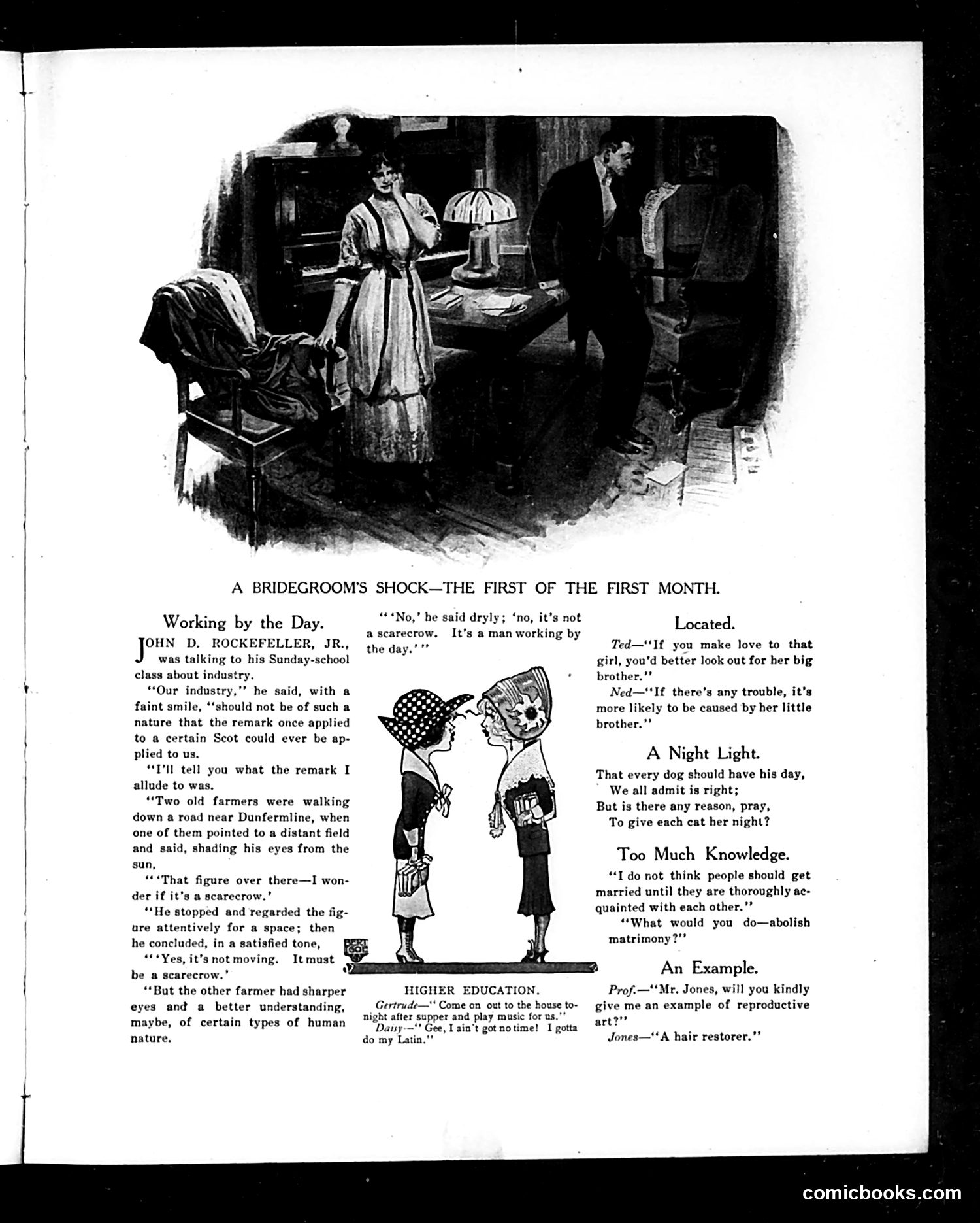
**Main Cartoon:** "A Bridegroom's Shock" depicts a newlywed couple's first domestic conflict—the bride's brother is present/intrusive. The joke plays on marital awkwardness: the groom is warned to avoid flirtation because her brother may cause trouble, suggesting the bride's family will remain problematic in married life. **Anecdote by Rockefeller Jr.:** This extended moral tale compares industrial practices to Scottish farmers distinguishing a scarecrow from a laborer. The "moral industry" point contrasts appearance with reality—suggesting Rockefeller's Sunday-school lesson warns against mistaking exploitative labor practices for something acceptable. **Sidebar Jokes:** Brief comic quips on unrelated topics (cats' nocturnal habits, marriage compatibility, a professor's joke about hair restorers as "reproductive art"). These are typical magazine filler humor. The page exemplifies Judge's characteristic blend of domestic satire and social commentary embedded in anecdotal humor, targeting both personal relationships and industrial ethics.
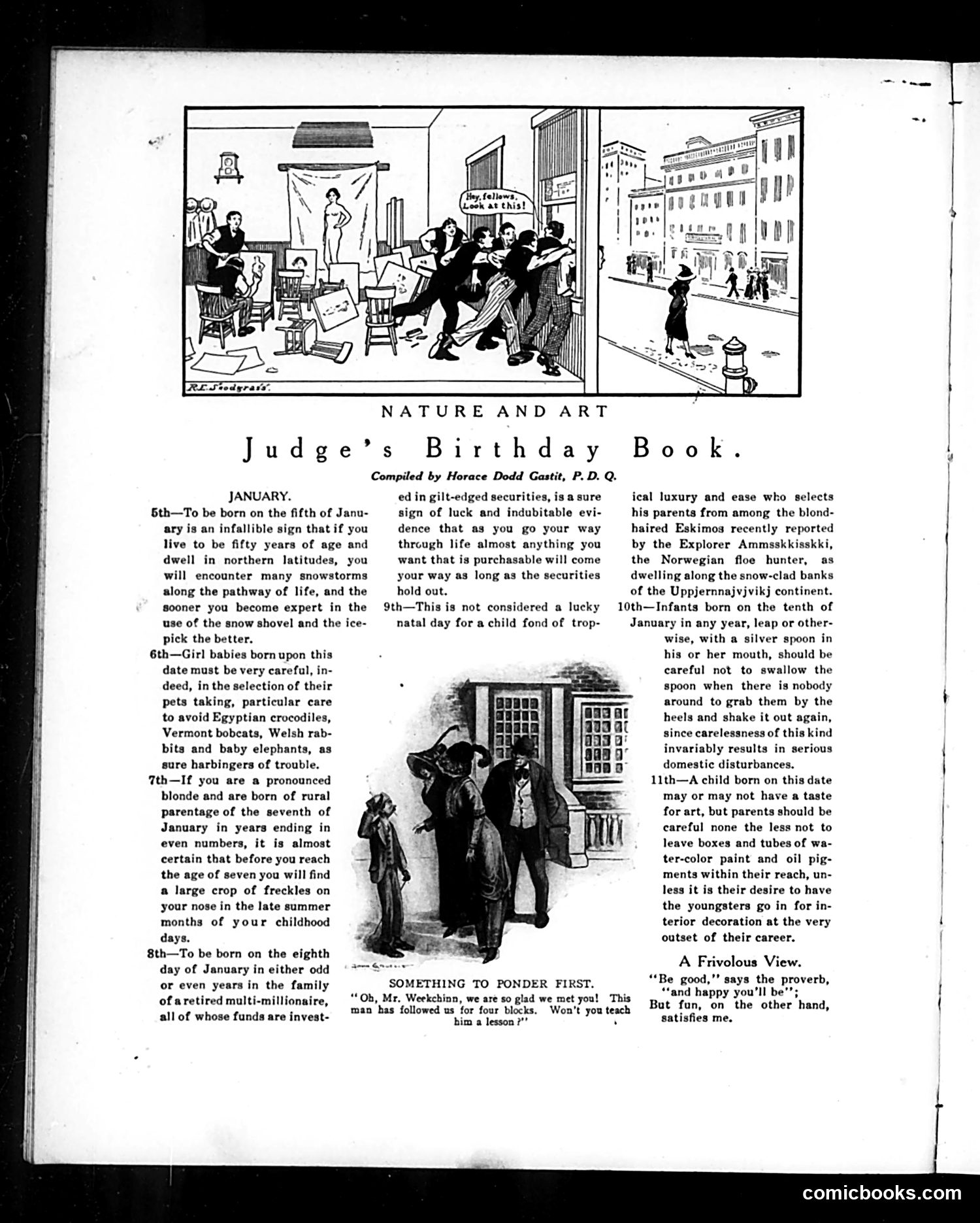
This is a satirical "Judge's Birthday Book" for January—a parody of actual Victorian-era birthday books that claimed to predict character and fortune based on birth dates. The humor lies in absurdist, deliberately ridiculous "predictions." The page mocks superstitious belief in natal destiny by offering increasingly nonsensical advice: babies born January 5th will encounter snowstorms; those born January 6th must avoid "Egyptian crocodiles" and "Welsh rabbits" (a cheese dish); January 7th blondes will get freckles. The most biting satire appears in the January 8th entry, which facetiously suggests that being born into a wealthy family with "gilt-edged securities" guarantees lifelong luxury—a cynical jab at inherited privilege. The cartoons above show chaotic domestic scenes, likely reinforcing the absurdity. The page overall satirizes both superstition and class privilege through exaggerated, deadpan mock-prophecy.
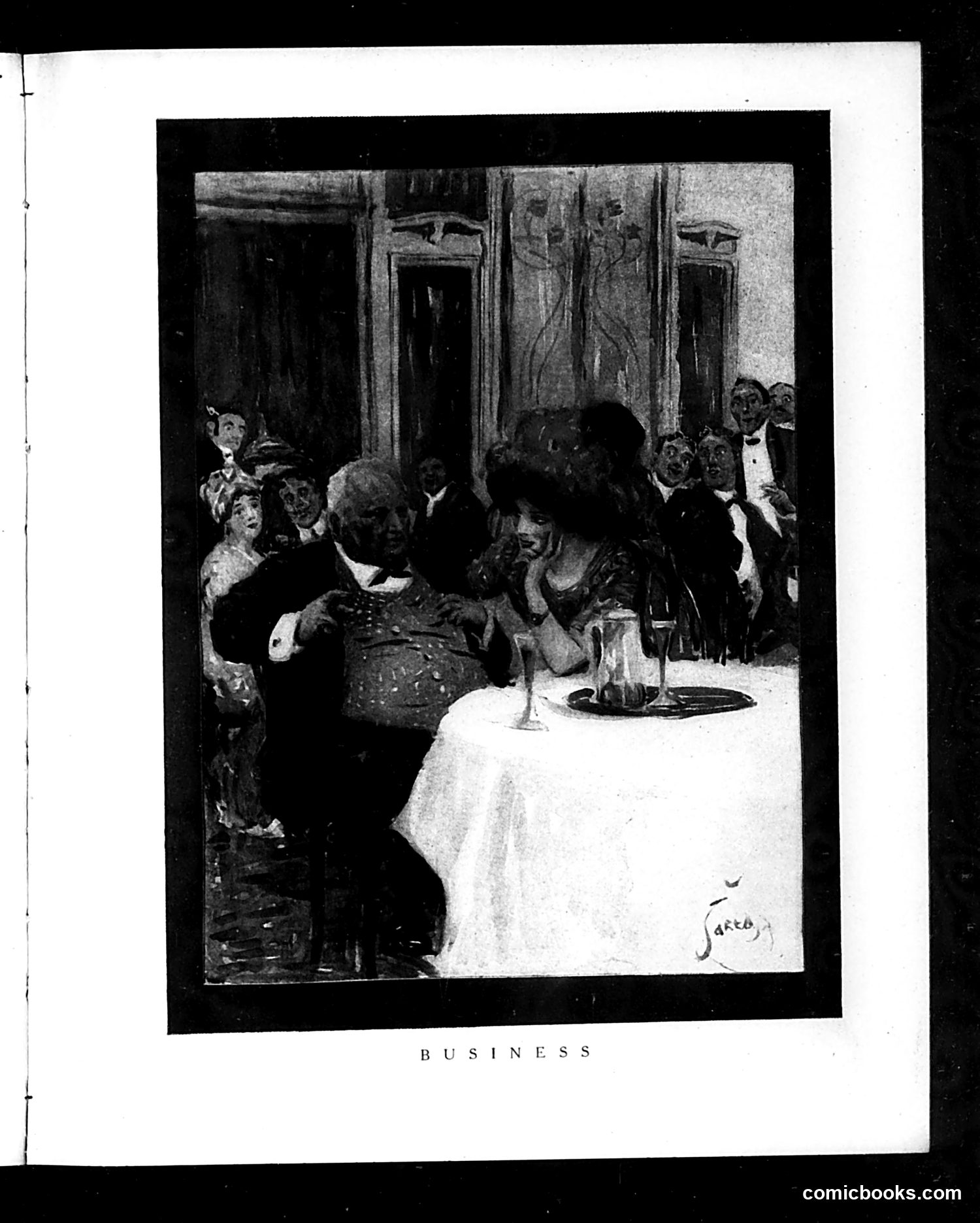
This satirical illustration depicts an elegant formal gathering or dinner party, labeled simply "BUSINESS." The cartoon appears to critique how high society conducts commerce—showing well-dressed men and women in formal attire (tuxedos, evening gowns) socializing around a white-tablecloth dining setup rather than conducting actual business. The satire likely mocks the early 20th-century practice of mixing social gatherings with business dealings, suggesting that "business" among the wealthy elite occurs through informal socializing rather than professional conduct. The ornate interior and formal dress emphasize the pretense involved in such arrangements. The artist's signature appears in the lower right corner. Without additional context or visible text identifying specific figures, the cartoon's general target appears to be elite business culture and its social conventions.
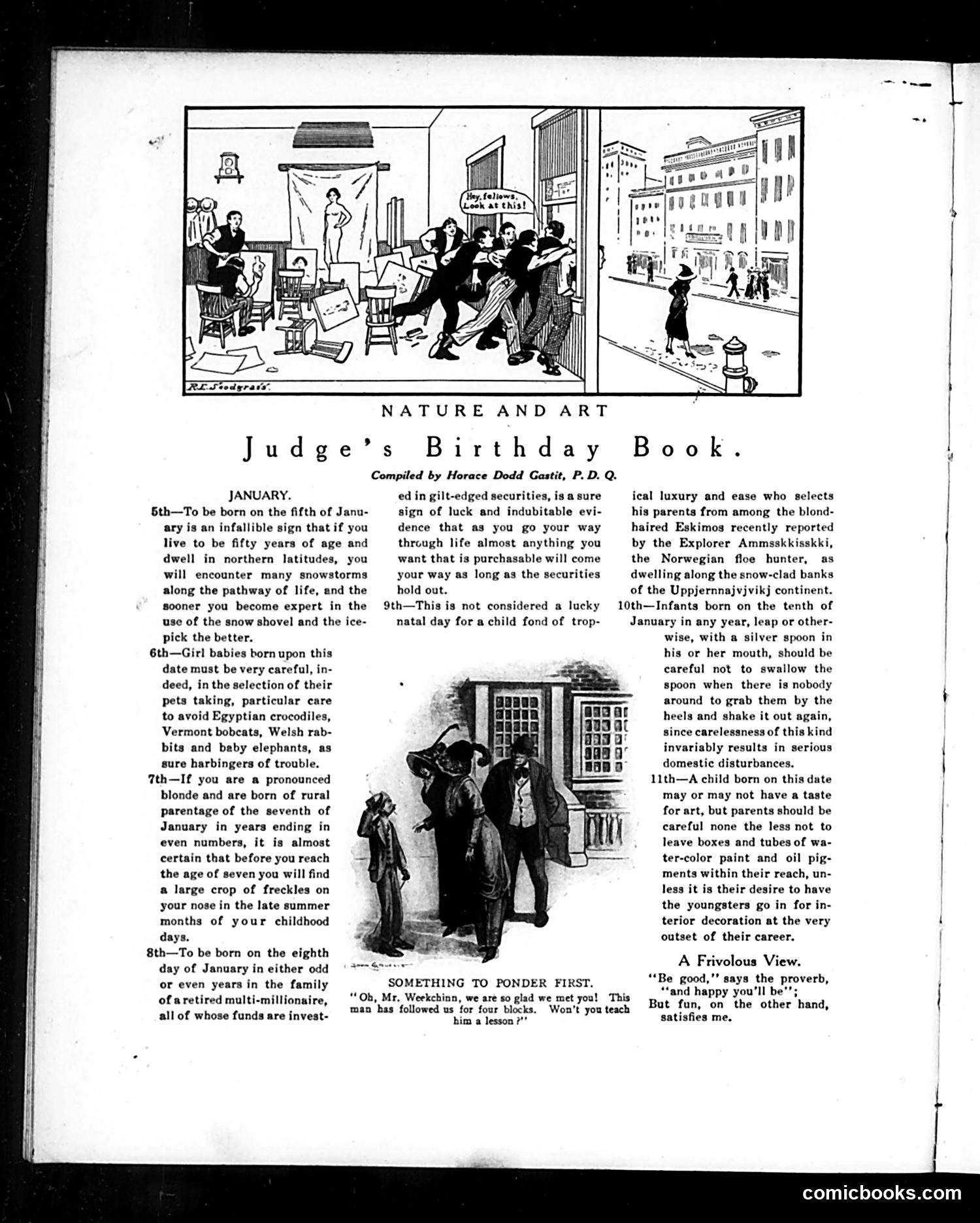
This is a humorous "advice" column parodying pseudoscientific fortune-telling and superstitious birth-date predictions. Each entry mocks the era's tendency to claim that birth dates determine character and fate. The satire targets: 1. **Phrenology/astrology craze**: The absurd specificity (blonde + rural + even-numbered years = freckles) mimics pseudo-scientific racial and hereditary claims popular in the period. 2. **Class anxiety**: The entries about wealthy parents selecting "blond-haired Eskimos" and the cartoon showing a poor man pestering a millionaire ("Won't you teach him a lesson?") reflect anxieties about wealth, immigration, and social hierarchy. 3. **Parental overprotection**: Warnings about crocodiles, paint tubes, and swallowing silver spoons satirize anxious middle-class parenting. The cartoon's caption suggests class resentment—the wealthy man is harassed by someone following him, implying social instability and envy of the rich during an economically volatile era.
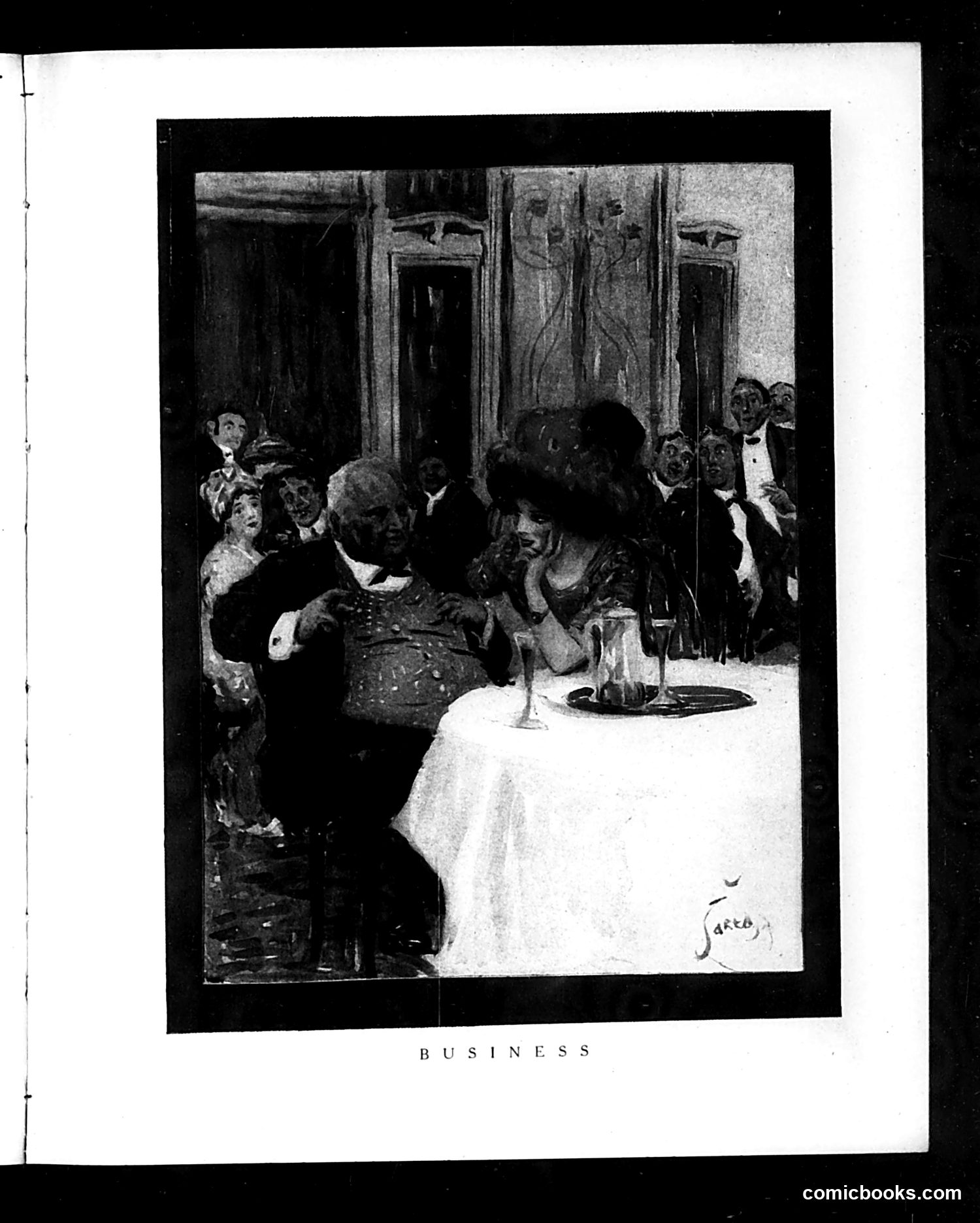
This illustration depicts an elegant social gathering—likely a formal dinner or business reception—where wealthy, well-dressed figures in evening wear interact around a table. The caption simply reads "BUSINESS," suggesting satire about how commercial dealings occur within high society. The cartoon appears to mock the blurred line between formal social etiquette and actual business transactions among the elite. By showing "business" conducted in a luxurious parlor setting rather than an office, Judge satirizes how the wealthy class conducts commerce through social networking and personal connections rather than transparent, formal channels. The specific identities of the figures remain unclear from the image alone, but the overall point critiques the insider nature of elite business practices of the era.
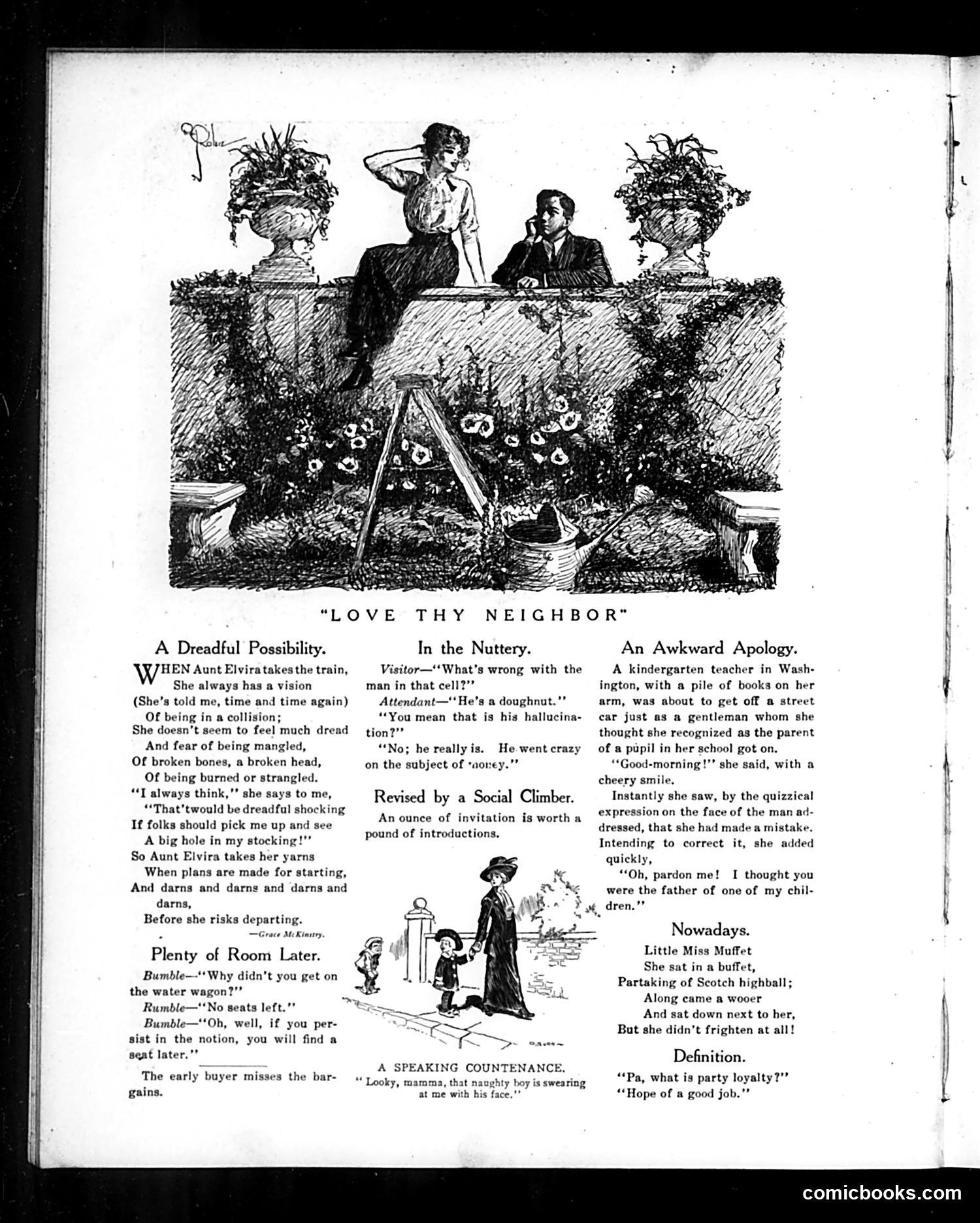
This page collects humorous anecdotes and jokes reflecting turn-of-the-century American social anxieties and changing mores. **Key content:** - **"A Dreadful Possibility"**: Satirizes anxious aunt Elvira, who obsesses over modest appearance (a hole in her stocking) rather than actual train crash dangers—mocking Victorian propriety's distorted priorities. - **"In the Nuttery"**: A man institutionalized for monetary obsession; likely commentary on Gilded Age greed. - **"An Awkward Apology"**: A teacher mistakes a stranger for a student's parent, highlighting social awkwardness of urban anonymity. - **"Nowadays"**: Parodies the nursery rhyme "Little Miss Muffet," showing "modern" women drinking scotch highball without fear—satire of changing female behavior and the erosion of Victorian femininity. - **"Definition"**: Cynical quip equating political loyalty to job-seeking, reflecting Progressive Era skepticism about corruption. The overall theme mocks both Victorian excess and modern social transformation.
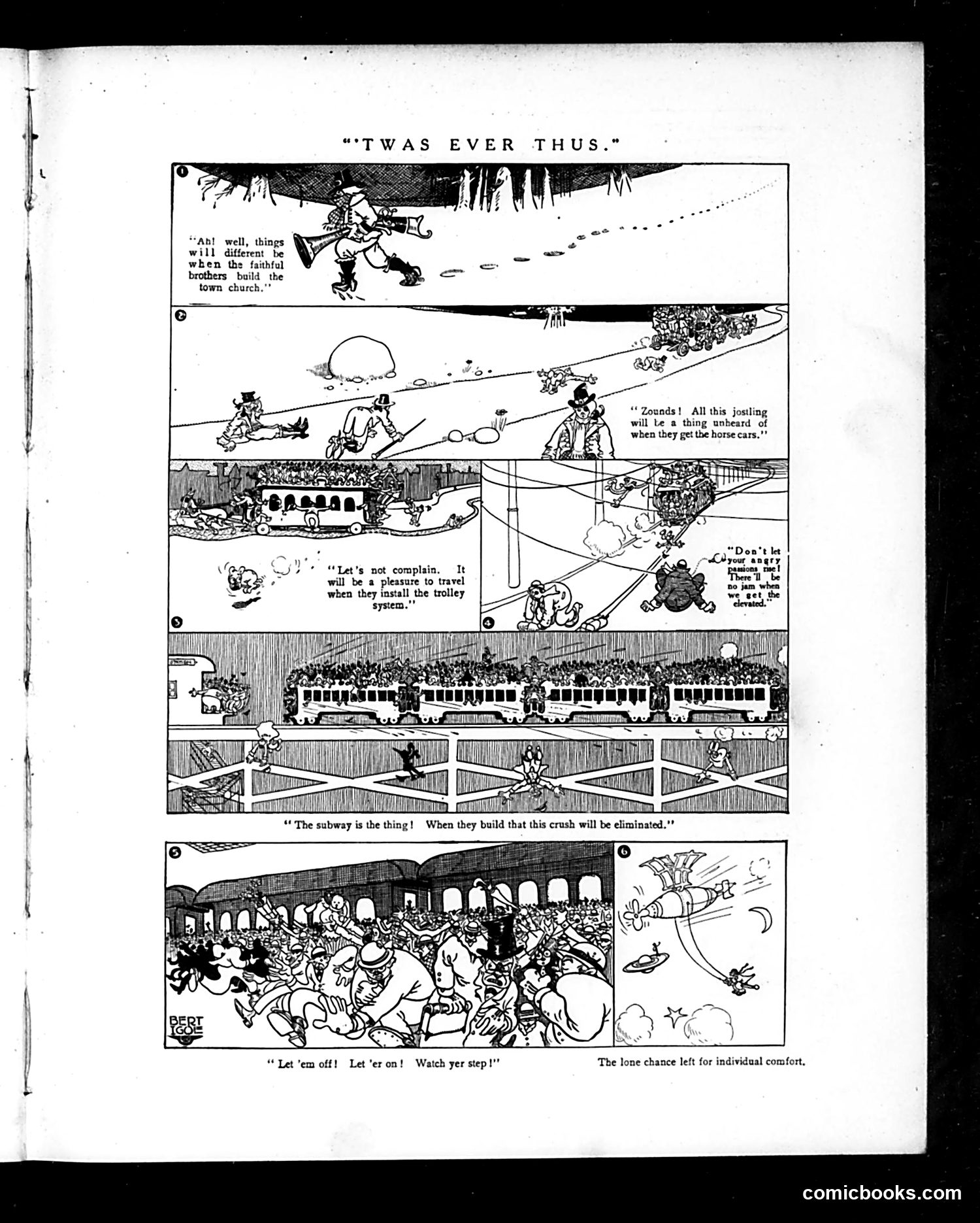
This Judge cartoon satirizes the false promise that new transportation technologies will improve city life. Characters optimistically predict that future infrastructure—a church, horse cars, and trolleys—will reduce crowding and chaos. However, the visual progression shows the opposite: each "improvement" brings *more* congestion, not less. The final panels depict increasingly packed vehicles and platforms, culminating in a chaotic subway scene where passengers are crushed together with the ironic caption about "individual comfort." The satire's point: urban development and mechanization, promoted as solutions to overcrowding, actually worsen it by enabling more people to crowd into the same spaces. The title "Twas Ever Thus" suggests this cycle of disappointed expectations is timeless—a cynical comment on progress and human nature.
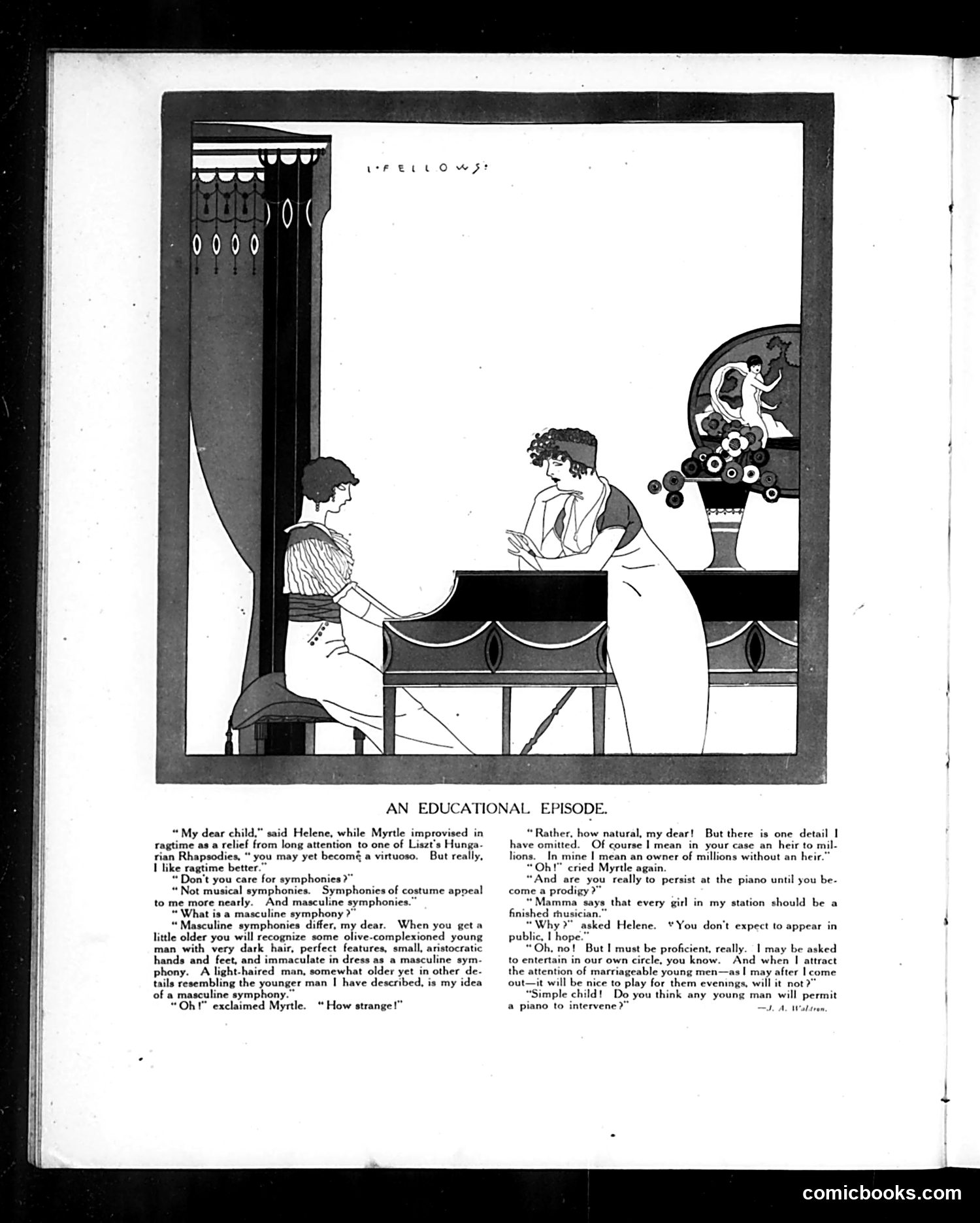
This satirical piece, titled "An Educational Episode," mocks the social priorities of upper-class women in the early 20th century. Two women—Helene (an older, wealthy widow) and Myrtle (a younger woman learning piano)—discuss musical education. The satire targets how young women were trained: ostensibly to become cultured "virtuosos," but actually to attract wealthy husbands. Myrtle confesses she prefers "masculine symphonies"—her code for handsome, well-dressed men with either dark or light hair and, crucially, *money*. Helene reveals the brutal truth: a woman needs a rich husband, preferably one with an heir (or lacking heirs, one with millions to inherit). The final joke undercuts all pretense: Myrtle imagines playing piano to entertain suitors after her social debut. Helene scoffs—no young man will tolerate a piano "intervening" between himself and courtship. The cartoon illustrates this conversation, showing the performance of culture masking transactional marriage-hunting. The satire critiques how women's education served patriarchal economic interests rather than genuine intellectual development.
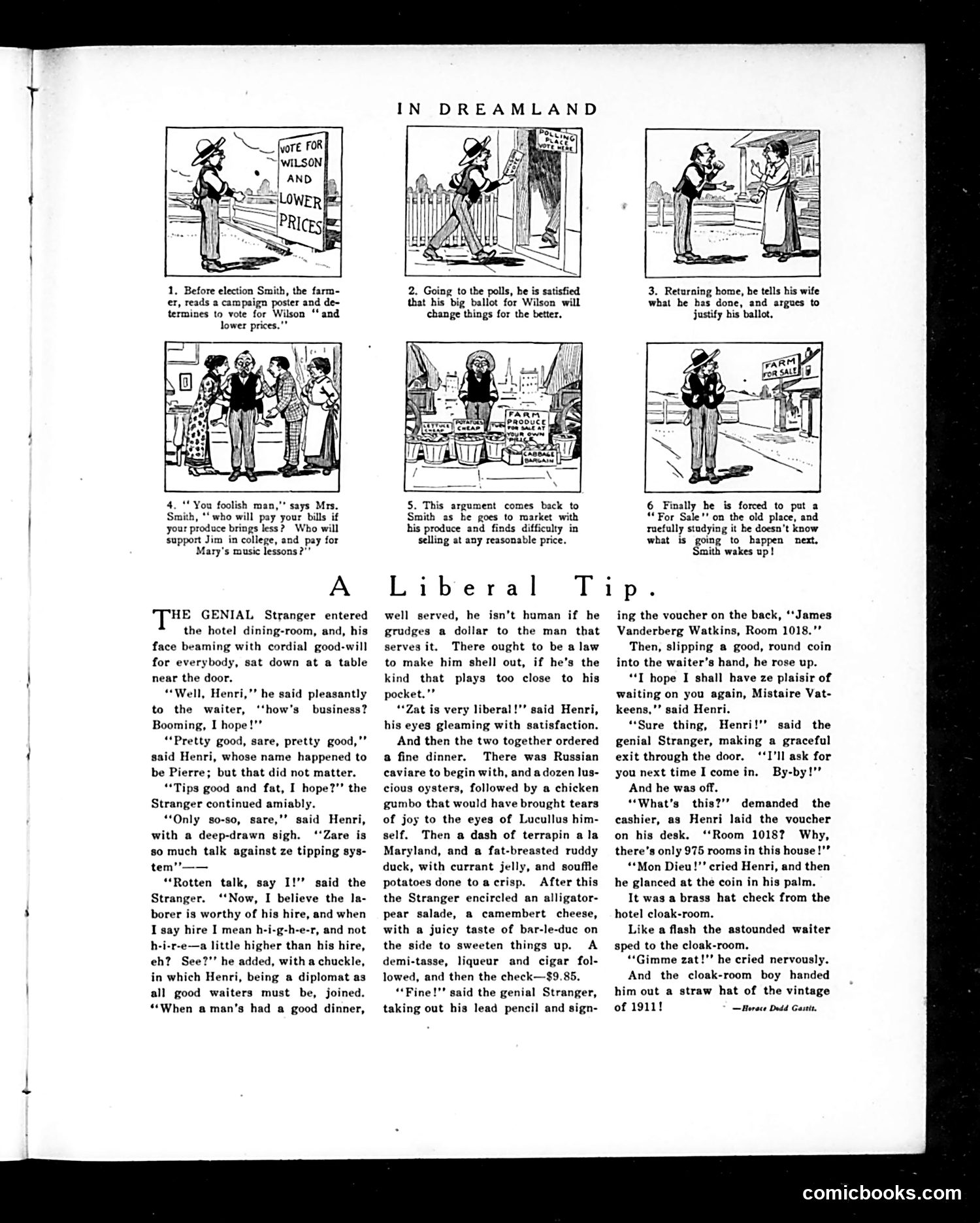
**Top Comic Strip:** This satirizes farmers who voted for Woodrow Wilson on the promise of "lower prices." Panel 1 shows a farmer convinced by campaign rhetoric. Panels 2-3 depict his optimistic voting and explanation to his skeptical wife. Panels 5-6 reveal the cruel irony: produce prices actually fell, forcing him to sell his farm. The "dreamland" is the false hope of political promises—the farmer's naive belief that voting alone solves economic problems. **"A Liberal Tip" Story:** This satirizes performative generosity and class hypocrisy. A wealthy stranger lectures waiter Henri about tipping being morally obligatory ("the laborer is worthy of his hire"), orders an extravagant $9.85 dinner, then leaves a worthless brass hat-check as payment instead of money. The joke mocks the Stranger's sanctimonious talk about workers' rights while stiffing the actual worker—exposing the gap between progressive rhetoric and actual behavior toward laboring classes.
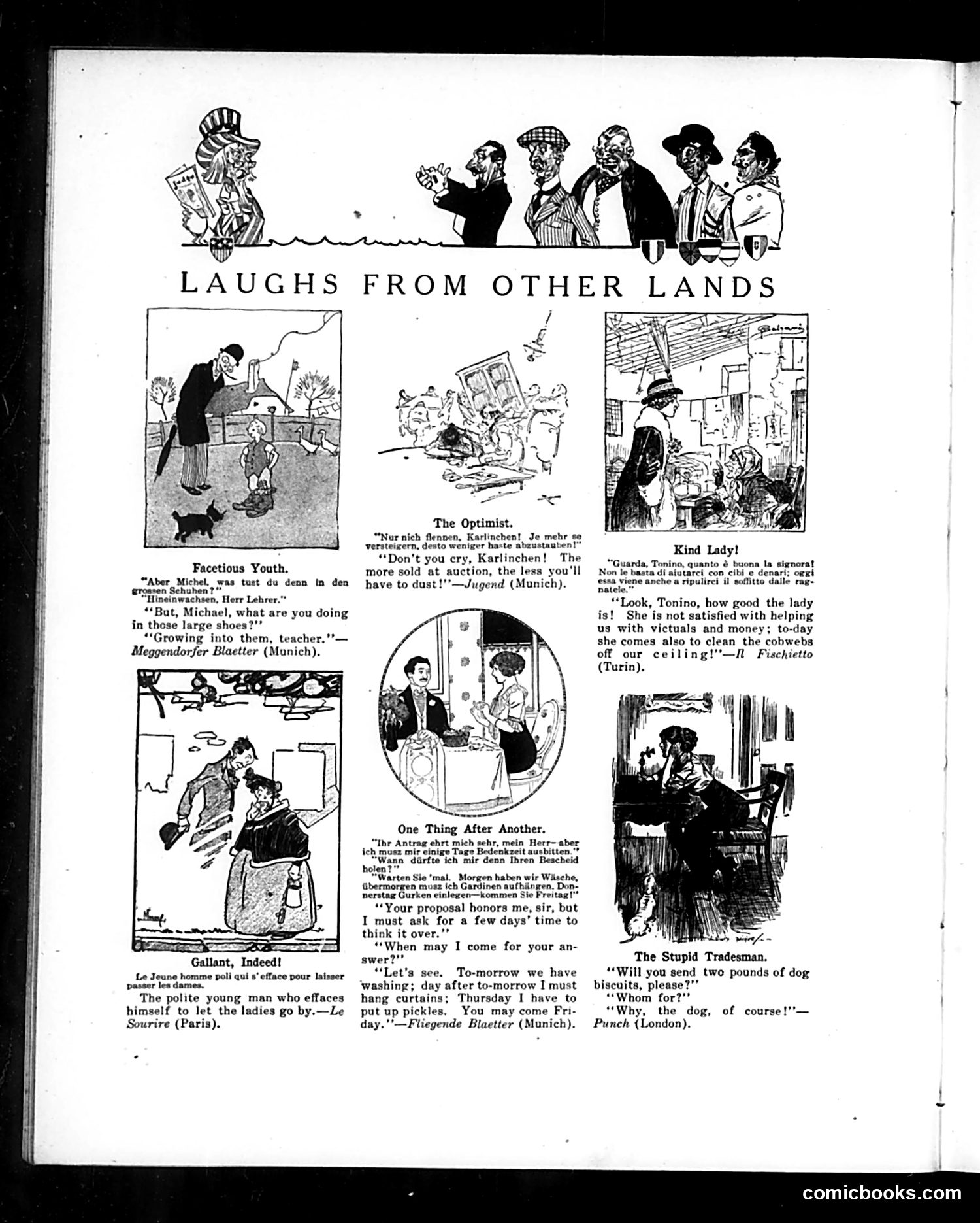
This page collects translated jokes and cartoons from European satirical magazines (Munich, Paris, London, Turin). Each item presents brief humorous scenarios: **"Facetious Youth"** mocks a boy wearing oversized shoes, claiming he's "growing into them"—poking fun at childhood logic. **"Gallant, Indeed!"** satirizes exaggerated politeness: a man squeezing himself against a wall to let ladies pass, criticizing performative chivalry. **"The Optimist"** depicts a mother consoling her crying child by noting that the more items sold at auction, the less she'll have to dust—dark humor about poverty. **"One Thing After Another"** shows a woman rejecting a marriage proposal due to household chores, subverting romantic expectations with domestic realities. **"Kind Lady!"** portrays an Italian woman helping poor people, then cleaning their ceiling—sarcastically questioning whether condescension accompanies charity. **"The Stupid Tradesman"** offers a simple pun: a customer orders dog biscuits "for the dog," which the tradesman finds absurd. The page reflects Judge magazine's practice of sharing international humor, emphasizing how different cultures addressed similar social observations.
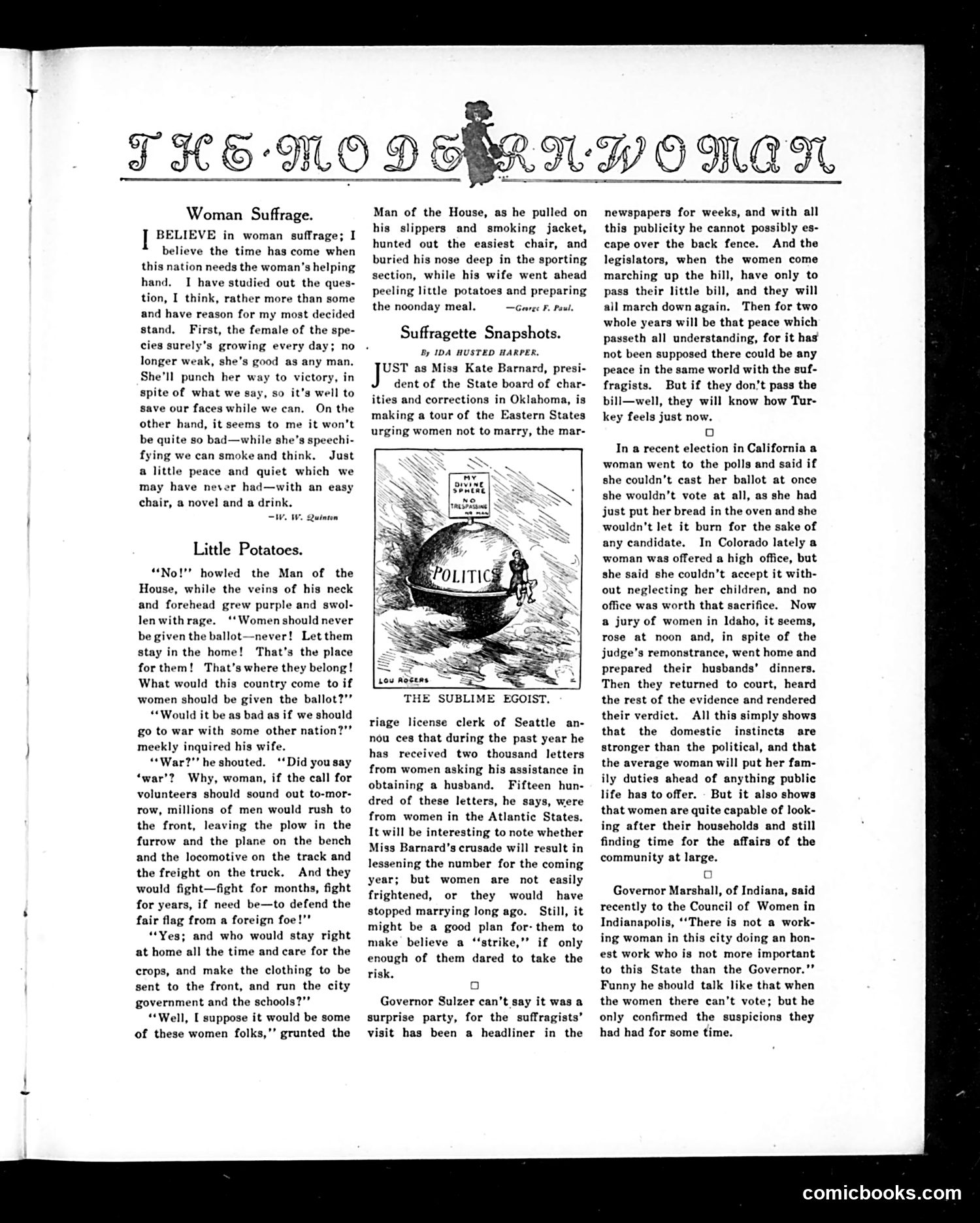
This Judge magazine page satirizes anti-suffrage arguments through contrasting pieces. **"Little Potatoes"** depicts a hypocritical husband who vehemently opposes women voting, insisting they belong only at home—yet when his wife logically points out that women would necessarily run farms, factories, and government if men went to war, he cannot counter her argument. The title suggests his objection is petty. **"The Sublime Egoist"** (the cartoon) shows a man labeled "POLITICS" drowning in domestic responsibilities, satirizing male resistance to sharing power. **"Suffragette Snapshots"** reports on Miss Kate Barnard's anti-marriage campaign while a Seattle clerk received 2,000 letters from women seeking husbands—mocking the contradiction. The final item notes Governor Sulzer cannot avoid suffragists' lobbying efforts. Collectively, the page argues that anti-suffrage men rely on weak, self-contradictory reasoning and that women's practical competence makes voting rights logical and inevitable.
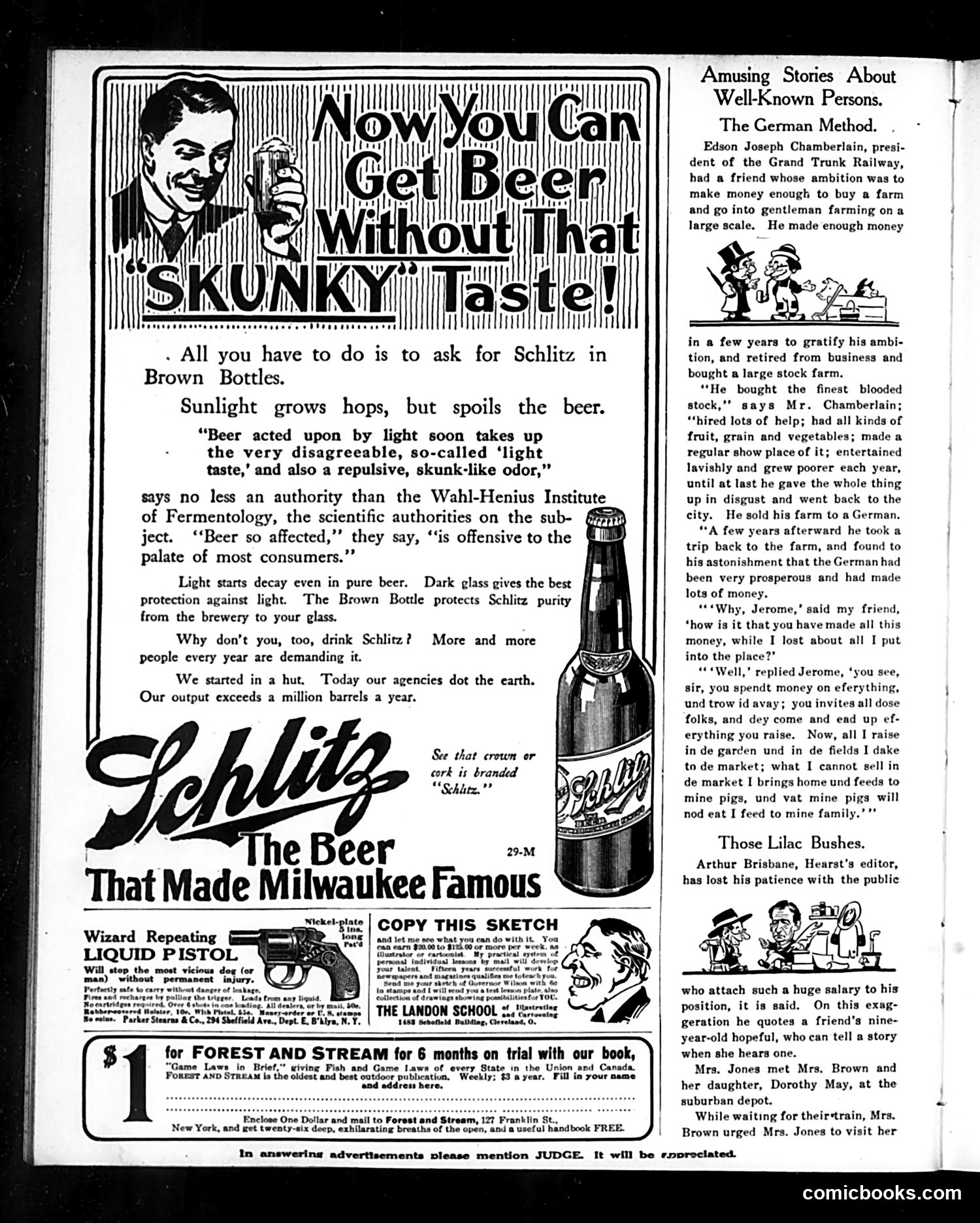
The main content is a **Schlitz beer advertisement** claiming brown bottles protect beer from light damage (which causes "skunk-like odor"). It cites the Wahl-Henius Institute of Fermentology as scientific authority and boasts of massive production growth. The page also contains two **humorous anecdotes**: 1. **"The German Method"**: A story about an American gentleman farmer who loses money through lavish entertaining and wasteful spending, while a German immigrant tenant who buys the same farm prospers by selling everything and feeding unsold crops to pigs. The satire mocks American extravagance versus immigrant frugality—a common early 20th-century stereotype. 2. **"Those Lilac Bushes"**: An incomplete story (cut off) about Arthur Brisbane, Hearst's editor, losing patience with public criticism of his high salary. A child apparently tells a relevant story about lilac bushes. The page is primarily advertising with satirical filler content typical of Judge magazine's mixed editorial-commercial format.
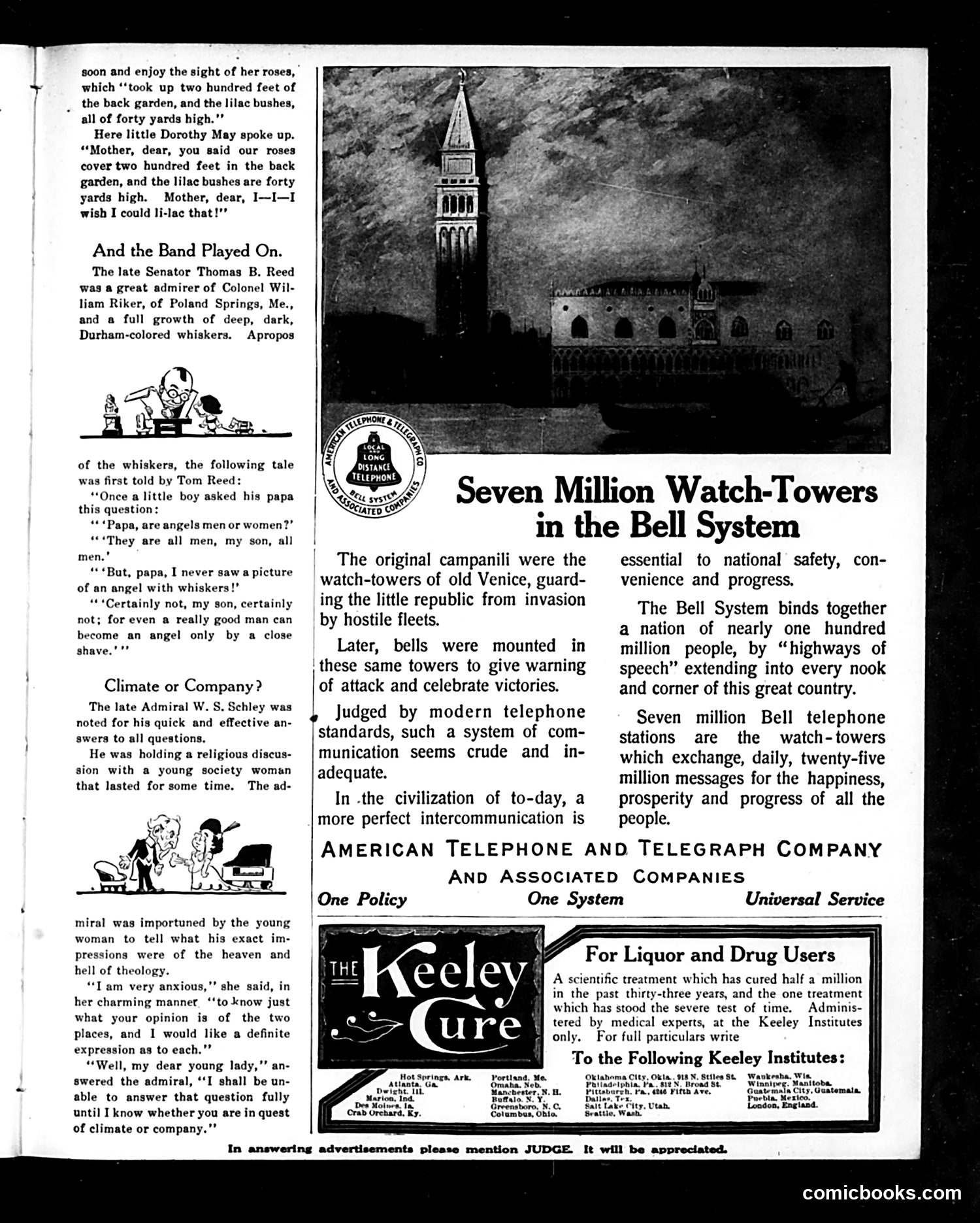
This page contains three distinct humor pieces typical of Judge's satirical style: **"And the Band Played On"** features a child's literal interpretation of exaggerated claims about garden sizes—a simple pun joke playing on "li-lac" (lilac bushes). **"Climate or Company?"** is a witty anecdote attributed to late Admiral W.S. Schley, presenting his sardonic response to a society woman's theological questions. The joke: when she asks his opinion on heaven versus hell, he deflects by saying he can't answer until knowing whether she seeks *climate* or *company*—a backhanded insult implying she wouldn't qualify for heaven regardless. **The main advertisement** for AT&T's Bell System compares telephone exchanges to Venice's ancient campanili (watch-towers), framing the modern telephone network as essential infrastructure binding the nation together—a corporate propaganda piece dressed as cultural commentary. The page also advertises the Keeley Cure, a purported treatment for alcohol and drug addiction, a legitimate (if questionable) medical offering of the era.
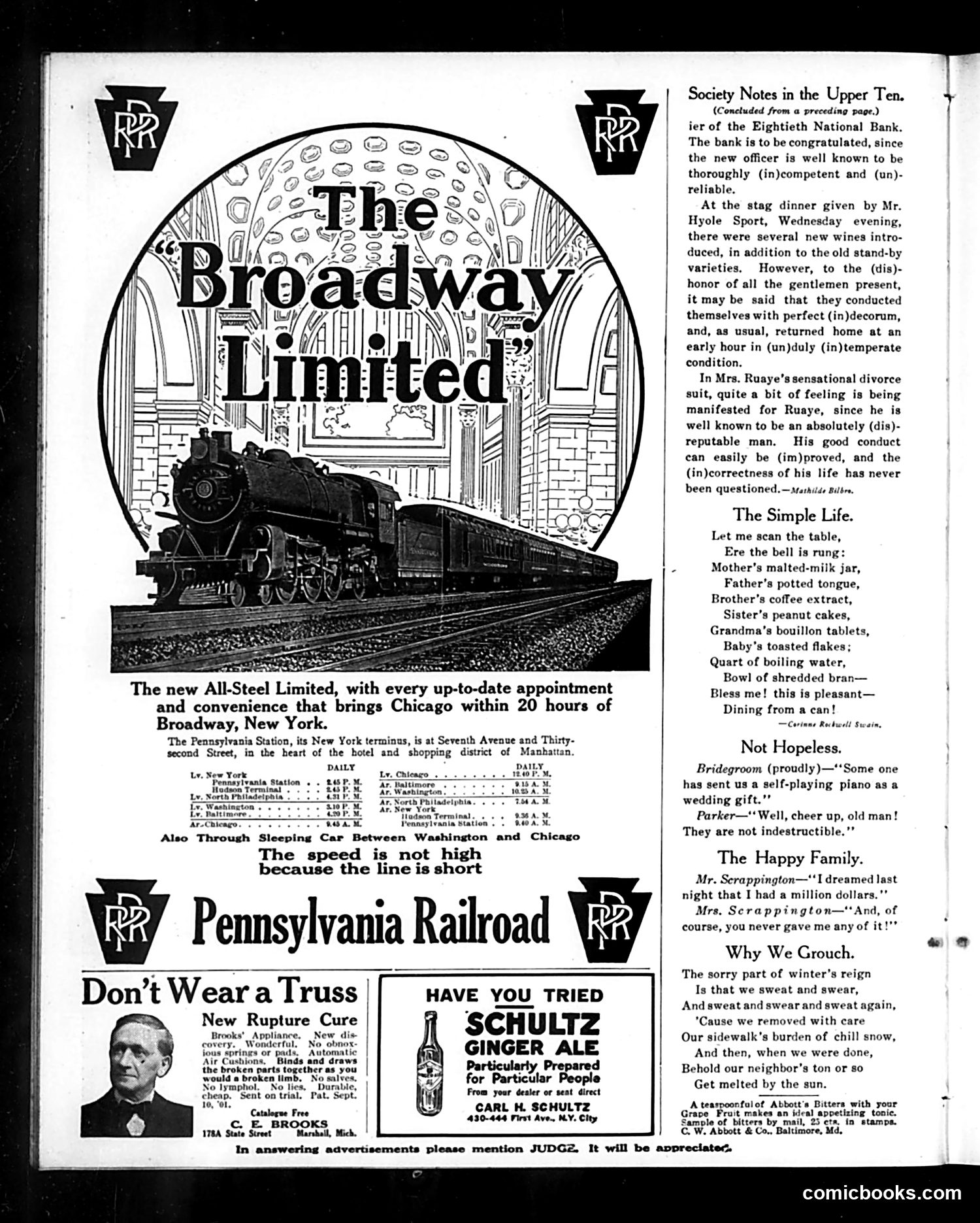
This page is primarily **advertisements and light humor**, not political satire. The dominant content is a Pennsylvania Railroad ad for "The Broadway Limited" train service connecting New York and Chicago—emphasizing speed and luxury appointments. The satirical humor appears in the right column's "Society Notes in the Upper Ten," which uses parenthetical wordplay to mock high society. By inserting opposite words in parentheses (e.g., "thoroughly (in)competent," "perfect (in)decorum"), Judge satirizes the hypocrisy of wealthy elites—suggesting bankers are incompetent, wealthy men behave indecorously despite pretense, and divorce defendants are actually disreputable despite appearing respectable. The technique is whimsical rather than sharp political critique. The remaining items—poems about simple living and winter complaints, plus patent medicine and ginger ale ads—are filler content typical of early 20th-century magazines. No specific political figures or events are referenced.
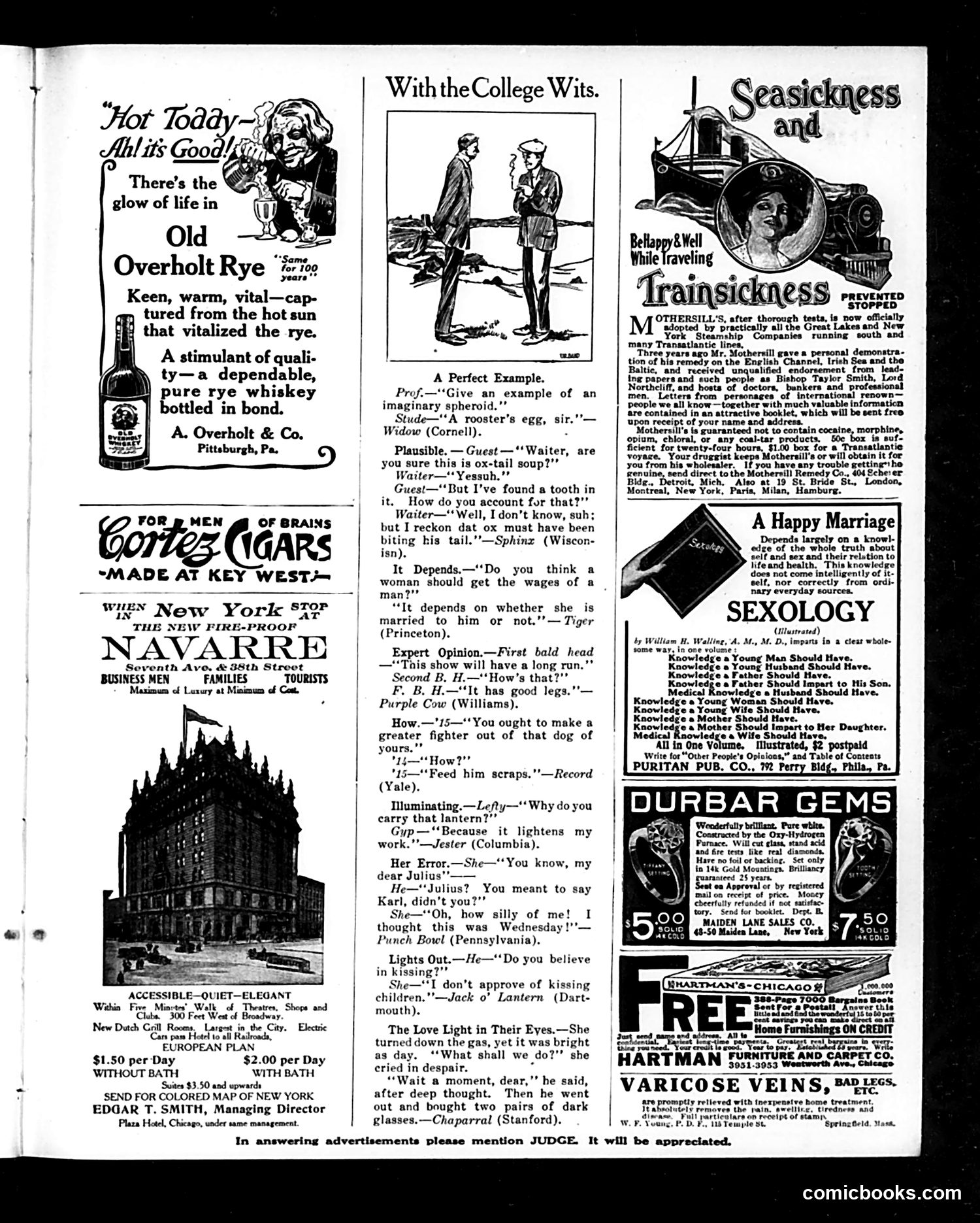
This page is primarily **advertising with some collegiate humor content**, typical of Judge magazine. The main ads include Old Overholt Rye whiskey ("the glow of life"), the Navarre hotel in New York, Cortez cigars, and Mothersill's seasickness remedy (marketed to steamship passengers). The "College Wits" section contains brief humorous exchanges supposedly from college publications. These jokes depend on wordplay and student pranks (a rooster's egg, an ox biting its tail, a lantern that "lightens" work). They're gentle, innocent humor characteristic of early 20th-century college culture. The "Sexology" book advertisement (by William H. Walling) promotes sex education literature—notable for this era when such topics were often censored or taboo. It promises to teach young men and husbands "what they should have" knowledge about. The page reflects period attitudes: alcohol consumption as normal/desirable, travel anxieties (seasickness), and emerging acceptance of sexual education as legitimate.
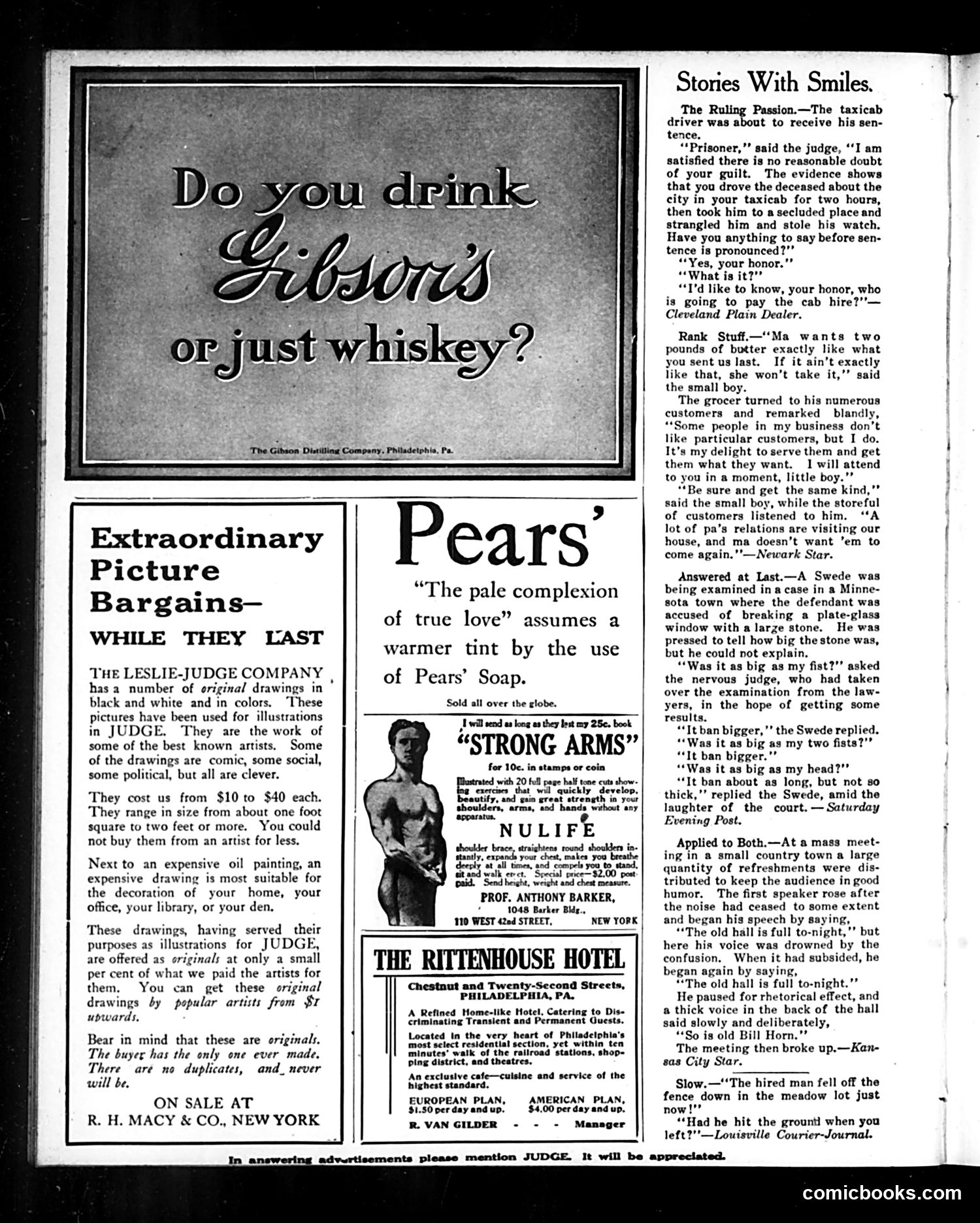
This page is primarily **advertising and humorous short stories**, not political cartoons. The top features a **Gibson whiskey advertisement** asking "Do you drink Gibson's of just whiskey?" — a product placement joke. The bulk of the page contains **three brief humorous anecdotes**: 1. **"The Ruling Passion"**: A taxicab driver convicted of murdering a passenger is sentenced, but his only concern is who will pay his cab fare—satirizing mercenary self-interest even in extremity. 2. **"Rank Stuff"**: A mother sends her son to demand butter "exactly like last time," but the boy reveals the real reason—visiting relatives dislike it so much she hopes they'll stop coming. The joke mocks both maternal passive-aggression and the boy's innocent candor. 3. **"Answered at Last"**: A Swedish defendant struggles to describe a stone's size to a judge, who attempts comparisons. The anecdote appears to play on ethnic stereotypes common to the era. The remaining content is **commercial advertising** (art sales, soap, hotel, exercise equipment) typical of magazine filler. There are **no political references or caricatures**.
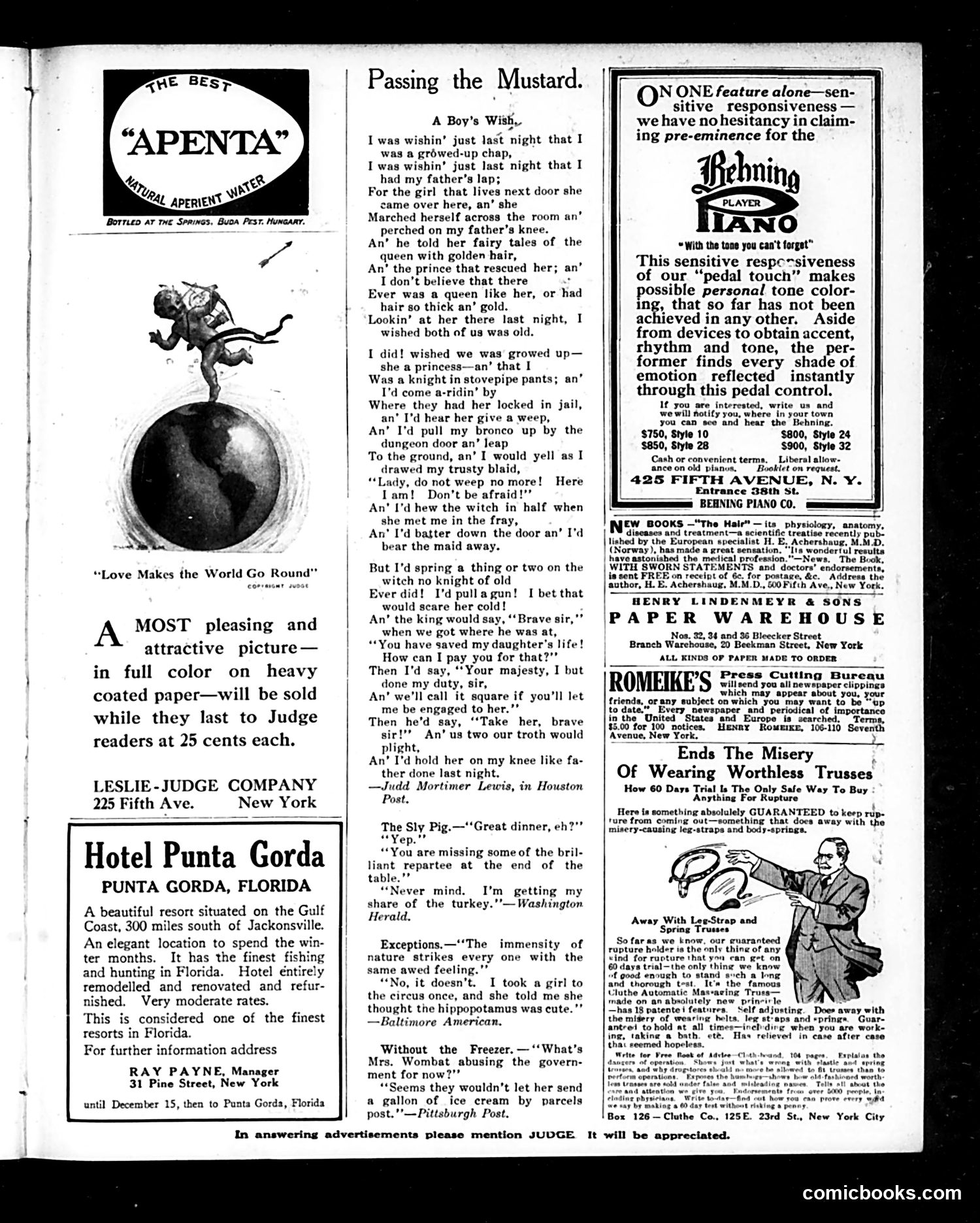
This Judge magazine page is primarily **advertising and light humor**, not political satire. The main content includes: 1. **"Passing the Mustard"** — A sentimental poem by Judd Mortimer Lewis depicting a boy's romantic fantasy. Jealous when a neighbor girl sits on his father's knee, he daydreams of rescuing her as a knight, ultimately winning her hand. It's a nostalgic, comedic take on childhood crushes and the gap between reality and imagination. 2. **Short humor pieces** — Three brief jokes about everyday social situations: a dinner guest missing witty banter while eating turkey, a woman unmoved by nature's "immensity" (finding a hippopotamus "cute"), and Mrs. Wombat upset about postal restrictions on ice cream. 3. **Extensive advertising** — For Apenta aperitif water, Behning pianos, Hotel Punta Gorda, Leslie-Judge Company prints, and other products. The page reflects early 20th-century middle-class American values: romance, domesticity, and consumer goods. No specific political figures or events are referenced.
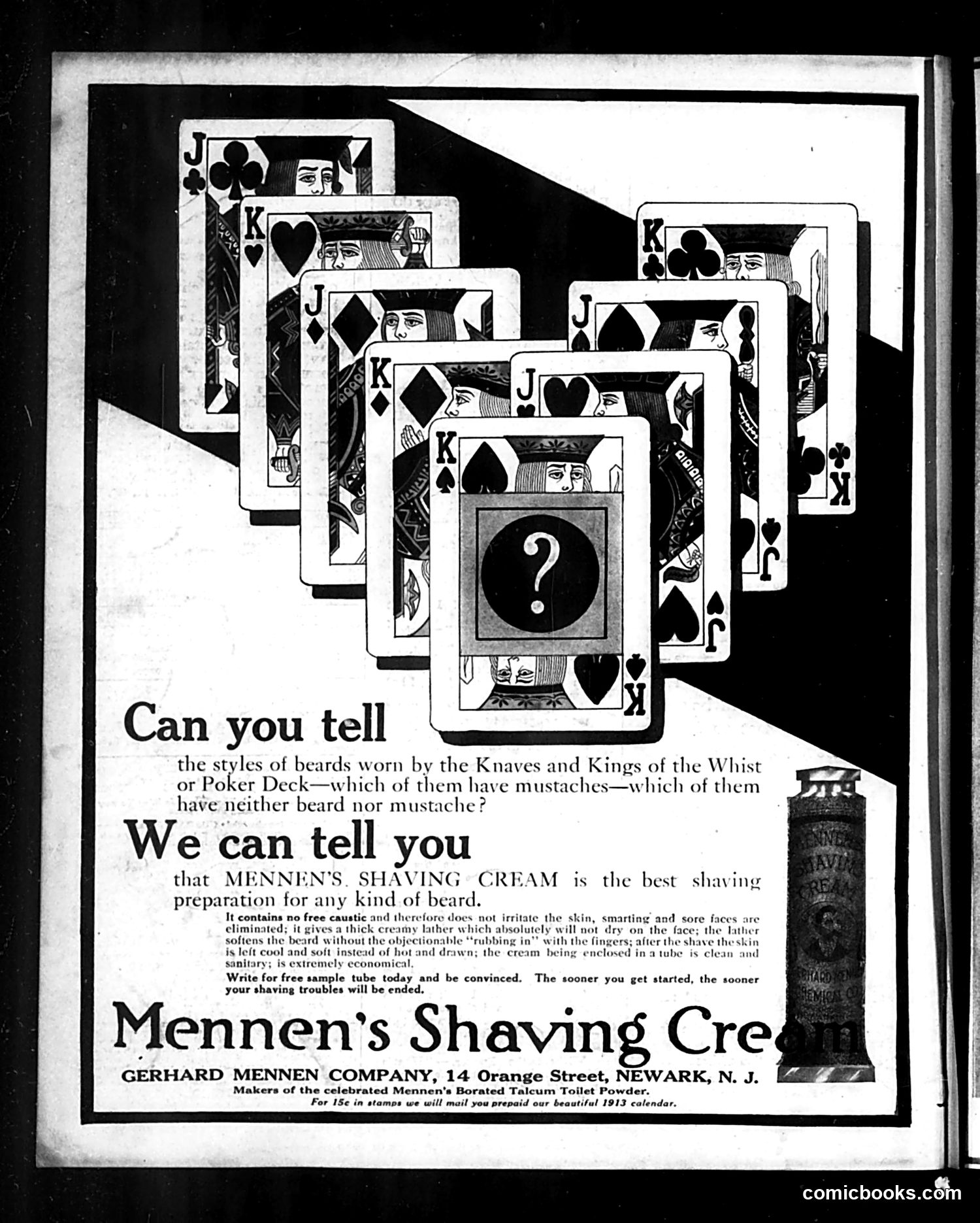
This is primarily **an advertisement for Mennen's Shaving Cream**, not a political cartoon. The page uses a playful visual puzzle rather than satire. The ad displays face cards from a standard playing deck (Knaves/Jacks and Kings) with a question mark covering one card, asking readers to identify which cards have beards, mustaches, or neither. This serves as a lighthearted engagement device. The "joke" is minimal—it's essentially a riddle to draw attention. The real purpose is advertising copy emphasizing that Mennen's cream works for any beard type. The product claims include: non-irritating formula, thick lather that won't dry out, skin-softening properties, and economical value. The ad concludes with a sales pitch offering free sample tubes and a 1913 calendar premium. This represents early 20th-century advertising strategy—using interactive puzzles and giveaways to attract consumer interest before delivering product benefits.