
Judge, 1913-01-04 · page 4 of 26
Judge — January 4, 1913 — page 4: what you’re looking at
What you’re looking at
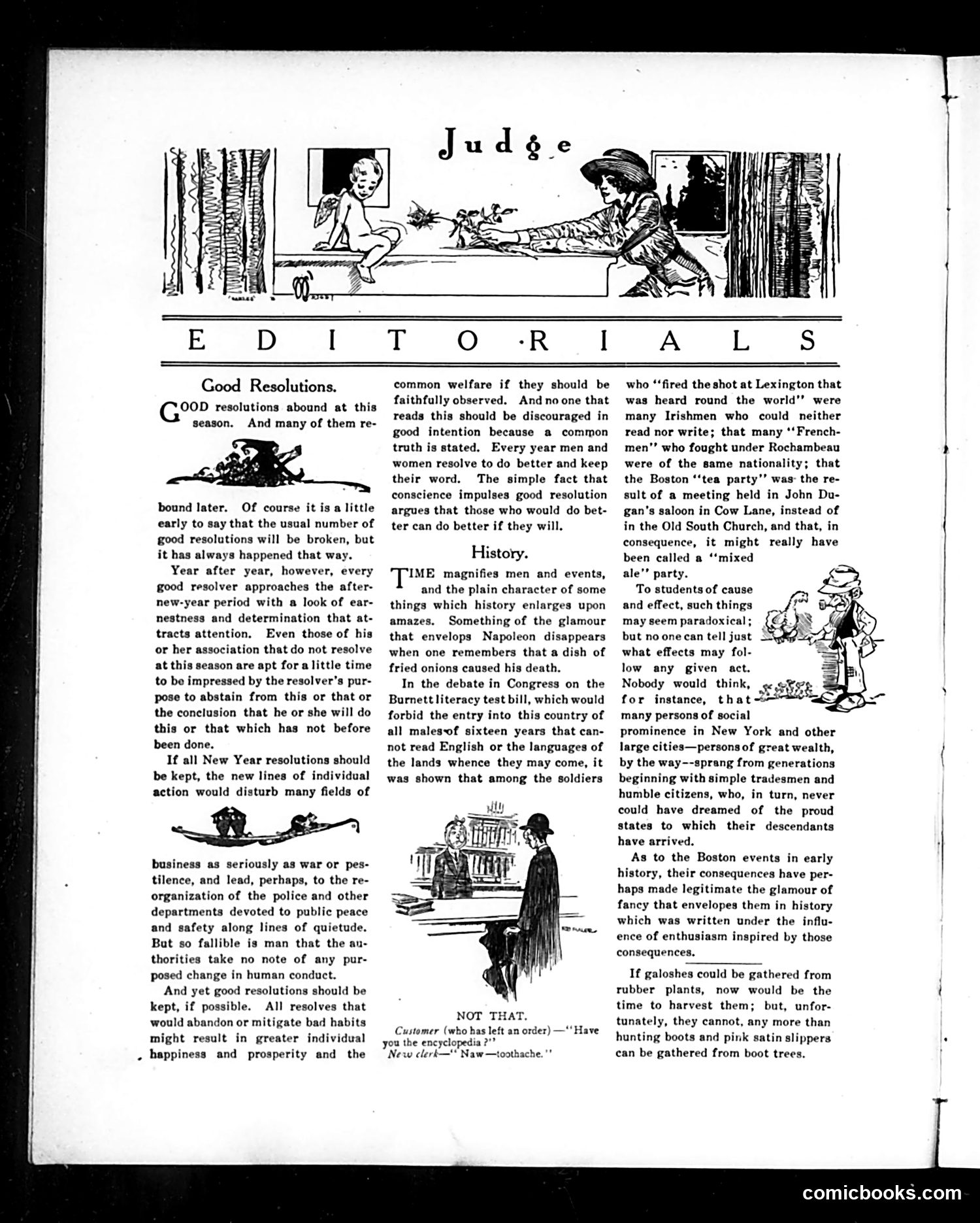
This editorial page from Judge magazine contains two main sections: **"Good Resolutions"** advocates keeping New Year's resolutions seriously, arguing they could improve public conduct, police organization, and social order if actually maintained—rather than being broken within weeks as typically happens. **"History"** section satirizes how history glamorizes mundane events. It mocks Congress's debate over a "Burnett literacy test bill" (restricting immigration based on reading ability), references the Boston Tea Party being exaggerated as historically significant, and jokes that minor figures from New York became "prominent" simply through historical narrative and descendants' enthusiasm—suggesting history inflates importance of ordinary events through retrospective storytelling and ancestor pride. The page's cartoons appear to illustrate these editorial points with humorous domestic and office scenes.
📄 Transcribed text from this page (OCR, searchable)
Machine-transcribed from the original scan — historical spelling and the odd misread are preserved.
Good Resolutions. OOD resolutions abound at this season. And many of them re- bound later. Of course it is a little early to say that the usual number of good resolutions will be broken, but it has always happened that way. Year after year, however, every good resolver approaches the after- new-year period with a look of ear- nestness and determination that at- tracts attention. Even those of his or her association that do not resolve at this season are apt fora little time to be impressed by the resolver’s pur- pose to abstain from this or that or the conclusion that he or she will do this or that which has not before been done. If all New Year resolutions should be kept, the new lines of individual action would disturb many fields of ae business as seriously as war or pes- tilence, and lead, perhaps, to the re- organization of the police and other departments devoted to public peace and safety along lines of quietude. Bat so fallible is man that the au- thorities take no note of any pur- posed change in human conduct. And yet good resolutions should be kept, if possible. All resolves that would abandon or mitigate bad habits might result in greater individual _ happiness and prosperity and the you common welfare if they should be faithfully observed. And noone that reads this should be discouraged in good intention because a common truth is stated, Every year men and women resolve to do better and keep their word. The simple fact that conscience impulses good resolution argues that those who would do bet- ter can do better if they will. History. IME magnifies men and events, and the plain character of some things which history enlarges upon amazes. Something of the glamour that envelops Napoleon disappears when one remembers that a dish of fried onions caused his death. In the debate in Congress on the Burnett literacy test bill, which would forbid the entry into this country of all malesof sixteen years that can- not read English or the languages of the lands whence they may come, it was shown that among the soldiers NOT THAT. Customer (who has left an order) —‘‘ Have he encyclopedia ?”” New clerk—"" Naw—toothache."" who ‘‘fired the shot at Lexington that was heard round the world’’ were many Irishmen who could neither read nor write; that many ‘‘French- men’’ who fought under Rochambeau were of the same nationality; that the Boston ‘‘tea party’’ was: the re- sult of a meeting held in John Du- gan’s saloon in Cow Lane, instead of in the Old South Church, and that, in consequence, it might really have been called a ‘‘mixed ale’’ party. To students of cause and effect, such things may seem paradoxical ; but noone can tell just what effects may fol- low any given act. Nobody would think, for instance, that many persons of social prominence in New York and other large cities—persons of great wealth, by the way--sprang from generations beginning with simple tradesmen and humble citizens, who, in turn, never could have dreamed of the proud states to which their descendants have arrived. As to the Boston events in early history, their consequences have per- haps made legitimate the glamour of fancy that envelopes them in history which was written under the influ- ence of enthusiasm inspired by those consequences. Ne If galoshes could be gathered from rubber plants, now would be the time to harvest them; but, unfor- tunately, they cannot, any more than hunting boots and pink satin slippers can be gathered from boot trees. comicbooks.com