
Judge, 1913-01-04 · page 19 of 26
Judge — January 4, 1913 — page 19: what you’re looking at
What you’re looking at
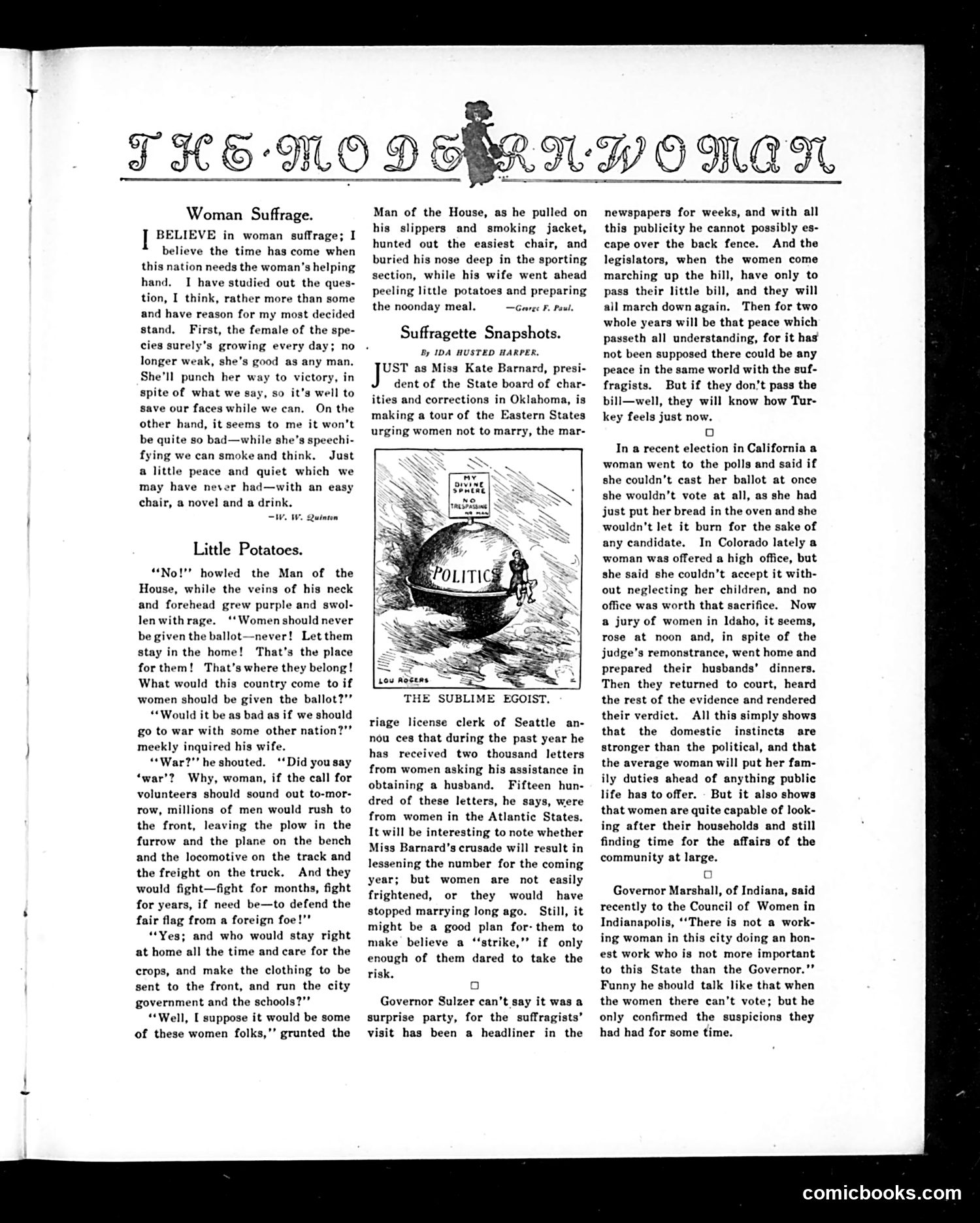
This Judge magazine page satirizes anti-suffrage arguments through contrasting pieces. **"Little Potatoes"** depicts a hypocritical husband who vehemently opposes women voting, insisting they belong only at home—yet when his wife logically points out that women would necessarily run farms, factories, and government if men went to war, he cannot counter her argument. The title suggests his objection is petty. **"The Sublime Egoist"** (the cartoon) shows a man labeled "POLITICS" drowning in domestic responsibilities, satirizing male resistance to sharing power. **"Suffragette Snapshots"** reports on Miss Kate Barnard's anti-marriage campaign while a Seattle clerk received 2,000 letters from women seeking husbands—mocking the contradiction. The final item notes Governor Sulzer cannot avoid suffragists' lobbying efforts. Collectively, the page argues that anti-suffrage men rely on weak, self-contradictory reasoning and that women's practical competence makes voting rights logical and inevitable.
📄 Transcribed text from this page (OCR, searchable)
Machine-transcribed from the original scan — historical spelling and the odd misread are preserved.
THE WO DS Woman Suffrage. BELIEVE in woman suffrage; I believe the time has come when this nation needs the woman's helping hand. I have studied out the ques- tion, I think, rather more than some and have reason for my most decided stand, First, the female of the spe- cies surely’s growing every day; no longer weak, she's good as any man. She'll punch her way to victory spite of what we say, so it's well to save our faces while we can. On the other hand, it seems to me it won't be quite so bad—while she’s speechi- fying we can smoke and think. Just a little peace and quiet which we may have never had—with an easy chair, a novel and a drink. WW. W. Quinton Little Potatoes. “No!’’ howled the Man of the House, while the veins of his neck and forehead grew purple and swol- len with rage. ‘*Women should never be given the ballot—never! Letthem stay inthe home! That's the place forthem! That's where they belong! What would this country come to if women should be given the ballot?’’ “Would it be as bad as if we should go to war with some other nation?” meekly inquired his wife. ““War?'’ he shouted. “Did you say ‘war’? Why, woman, if the call for volunteers should sound out to-mor- row, millions of men would rush to the front, leaving the plow in the furrow and the plane on the bench and the locomotive on the track and the freight on the truck. And they would fight—fight for months, fight for years, if need be—to defend the fair flag from a foreign foe!"" “Yes; and who would stay right at home all the time and care for the crops, and make the clothing to be sent to the front, and run the city government and the schools?” “Well, [ suppose it would be some of these women folks,’’ grunted the Jt Man of the House, as he pulled on his slippers and smoking jacket, hunted out the easiest chair, and buried his nose deep in the sporting section, while his wife went ahead peeling little potatoes and preparing the noonday meal. —Garec F. Paul. Suffragette Snapshots. By IDA HUSTED HARPER, UST as Miss Kate Barnard, presi- dent of the State board of char- ities and corrections in Oklahoma, is making a tour of the Eastern States urging women not to marry, the mar- Lou Aocens THE SUBLIME EGOIST. riage license clerk of Seattle an- nou ces that during the past year he has received two thousand letters from women asking his assistance in obtaining a husband, Fifteen hun- dred of these letters, he says, were from women in the Atlantic States. It will be interesting to note whether Miss Barnard’s crusade will result in lessening the number for the coming year; but women are not easily frightened, or they would have stopped marrying long ago. Still, it might be a good plan for- them to make believe a ‘‘strike,”” if only enough of them dared to take the risk, [a] Governor Sulzer can’t say it was a surprise party, for the suffragists’ visit has been a headliner in the YOMAI newspapers for weeks, and with all this publicity he cannot possibly es- cape over the back fence. And the legislators, when the women come marching up the hill, have only to pass their little bill, and they will ail march down again. Then for two whole years will be that peace which passeth all understanding, for it has not been supposed there could be any peace in the same world with the suf- fragists. But if they don’t pass the bill—well, they will know how Tur- key feels just now. o In a recent election in California a woman went to the polls and said if she couldn’t cast her ballot at once she wouldn’t vote at all, as she had just put her bread in the oven and she wouldn't let it burn for the sake of any candidate. In Colorado lately a woman was offered a high office, but she said she couldn’t accept it with- out neglecting her children, and no office was worth that sacrifice. Now a jury of women in Idaho, it seems, rose at noon and, in spite of the judge’s remonstrance, went home and prepared their husbands’ dinners. Then they returned to court, heard the rest of the evidence and rendered their verdict. All this simply shows that the domestic instincts are stronger than the political, and that the average woman will put her fam- ily duties ahead of anything public life has to offer. - But it also shows that women are quite capable of look- ing after their households and still finding time for the affairs of the community at large. a Governor Marshall, of Indiana, said recently to the Council of Women in Indianapolis, ‘‘There is not a work- ing woman in this city doing an hon- est work who is not more important to this State than the Governor.’’ Funny he should talk like that when the women there can’t vote; but he only confirmed the suspicions they had had for some time. comicbooks.com