
A complete issue · 26 pages · 1912
Judge — December 14, 1912
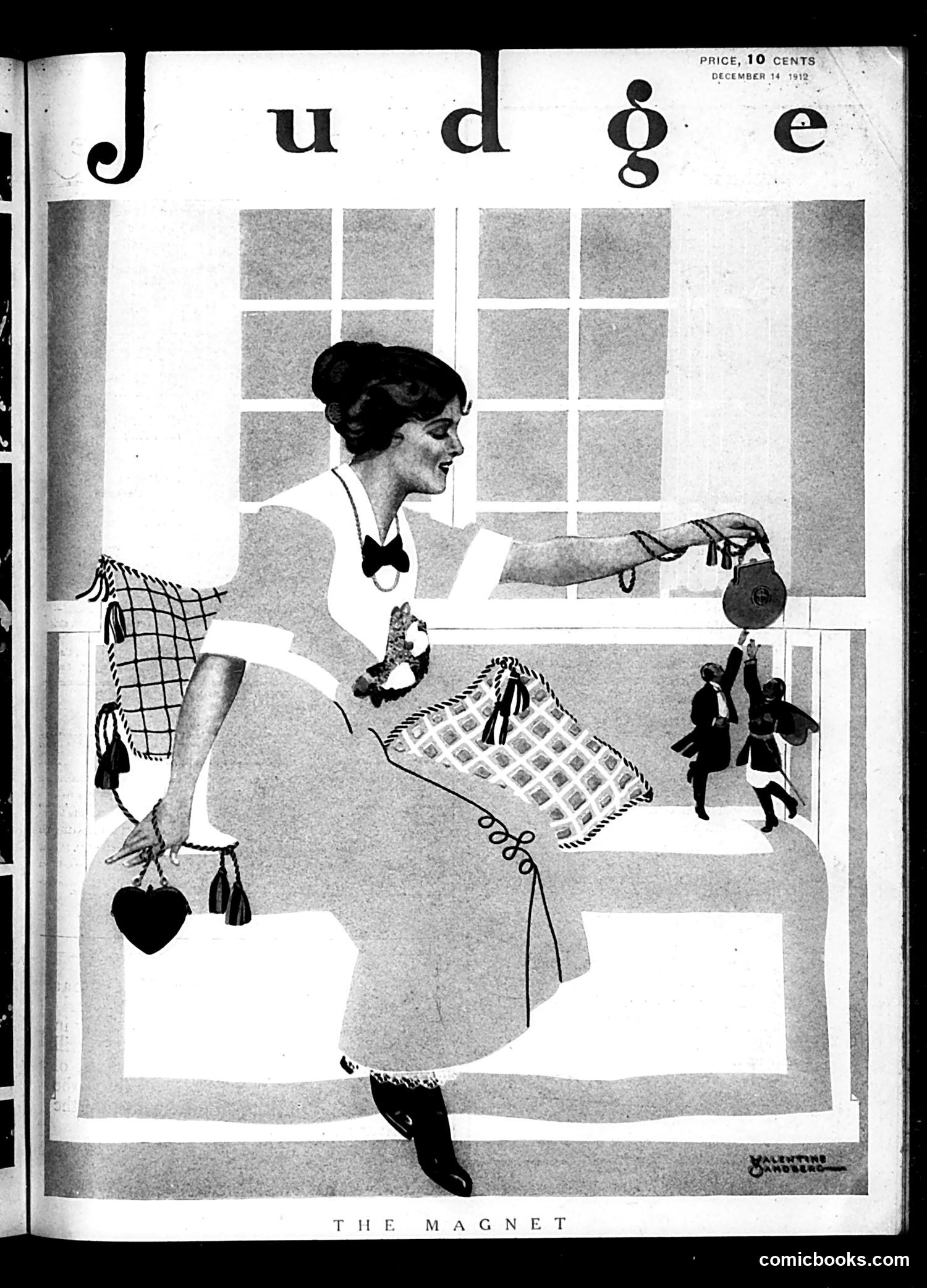
This satirical cartoon depicts a well-dressed woman as a "magnet" attracting various figures and objects. The woman holds a magnet in one hand while surrounded by drawn items—purses, hearts, and small male figures being pulled toward her. The imagery suggests commentary on feminine attraction and its economic power over men, a common satirical theme of the early 1900s. The cartoon likely plays on contemporary anxieties about women's increasing social independence and consumer power during the Progressive Era. The "magnet" metaphor humorously suggests women's supposedly irresistible pull on male wallets and attention—reflecting period attitudes about gender relations, courtship, and consumption patterns among the middle class.
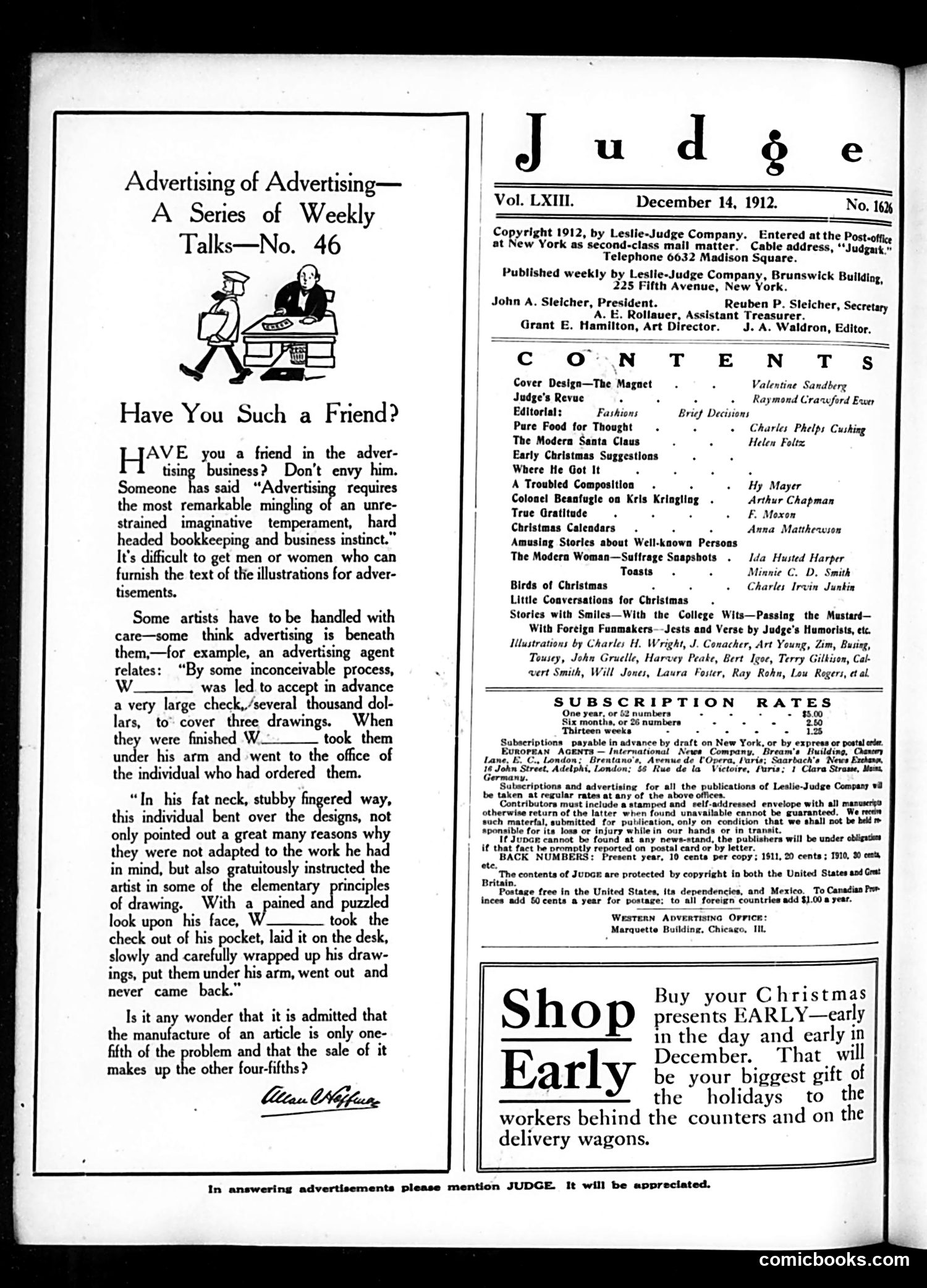
The left page features "Have You Such a Friend?"—an advertising column (No. 46 in a weekly series) about advertising work. It describes an anecdote where an advertising agent accepts a large check for designs, then pockets it and vanishes without delivering the work. The piece satirizes the problem that manufacturing a product is only "one-fifth of the problem" while sales/advertising comprises "the other four-fifths"—implying advertising professionals often exploit this imbalance through dishonesty. The right page is primarily the magazine's masthead and table of contents, with a holiday advertisement encouraging readers to "Shop Early" for Christmas gifts. The satire targets unscrupulous advertising practices and the vulnerability of clients to fraud in the emerging advertising industry.
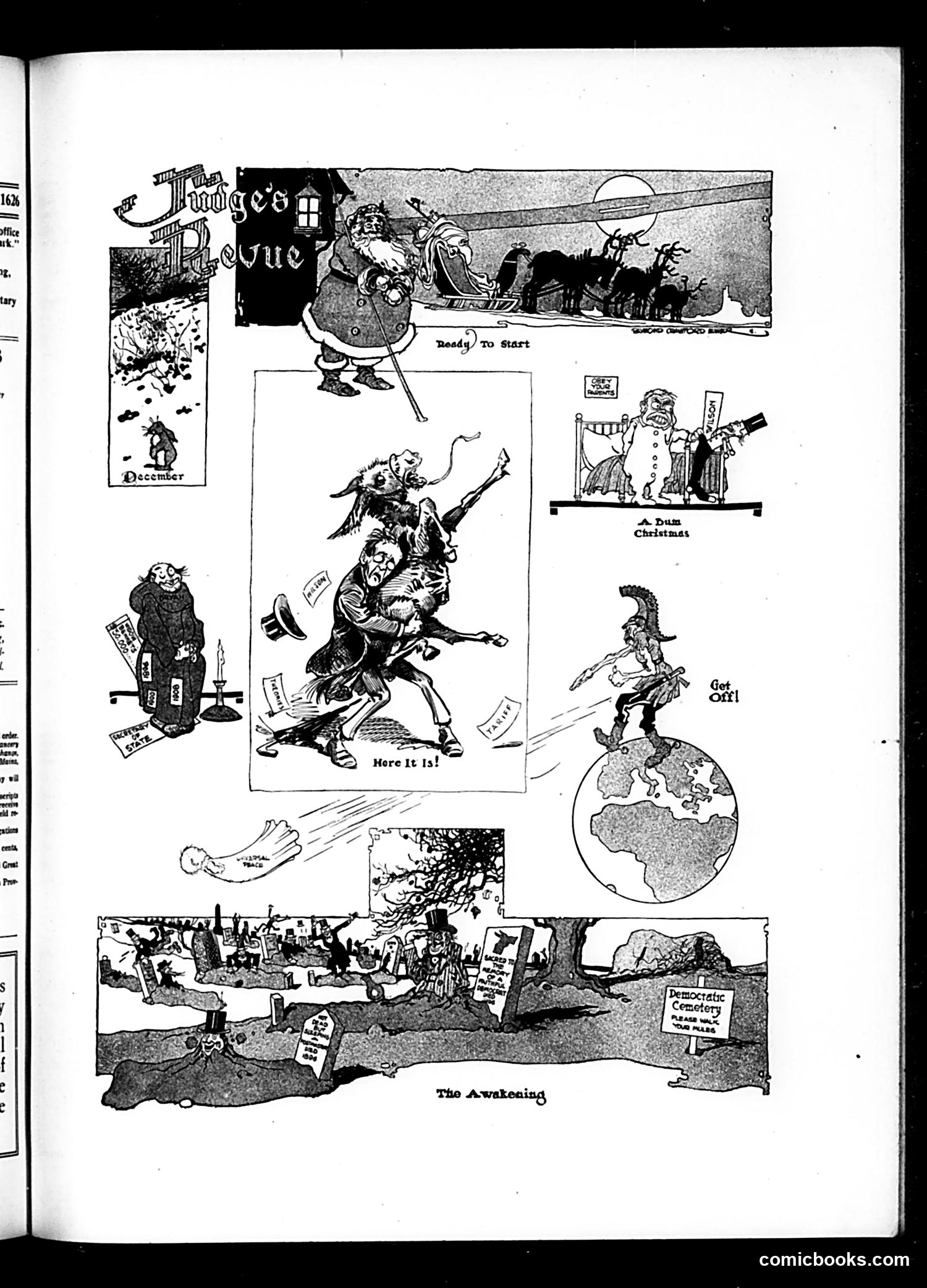
This appears to be a Christmas-themed satirical page from Judge magazine featuring multiple cartoons about early 20th-century politics and social issues. The central cartoon titled "Here It Is!" depicts a chaotic figure juggling multiple objects, likely representing political turmoil or competing demands on leadership. "Ready to Start" (top) shows Santa with reindeer, possibly contrasting holiday preparation with political readiness. "A Dim Christmas" portrays holiday figures, while "Get Off!" shows a devil-like creature on a globe, suggesting removal of corruption or harmful influence. "The Awakening" (bottom) depicts a cemetery or graveyard scene with tombstones and flags, likely representing post-election political upheaval or the consequences of political movements. Without clearer identifying labels or dates visible, the specific political figures or events referenced remain unclear.
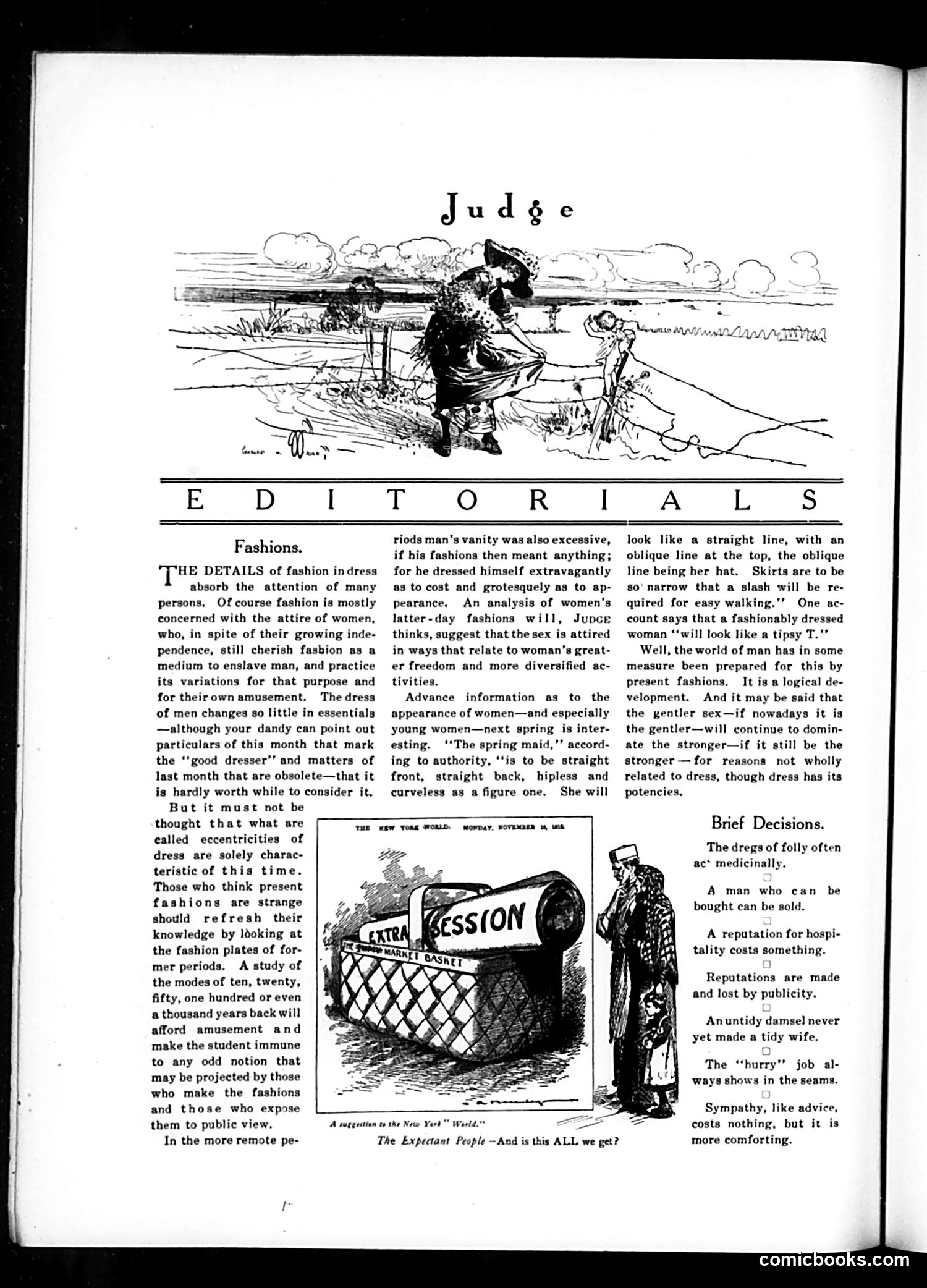
The page contains two distinct sections: **"Fashions" Editorial**: Discusses women's fashion trends, particularly the emerging "spring maid" style featuring straight, hipless silhouettes that were becoming fashionable. The author mocks fashion's constant eccentricities and notes that studying past fashion trends reveals how arbitrary current styles appear. **"Session" Cartoon**: Shows a large wicker basket labeled "EXTRA SESSION" with a figure (appearing to be a politician) gesturing helplessly. The caption reads "A magazine to the New York World" and "The Expectant People—And is this ALL we get?" This satirizes what appears to be a Congressional extra session, mocking its limited accomplishments or output—the basket being ironically full of nothing substantial. The "Brief Decisions" section offers cynical aphorisms about society.
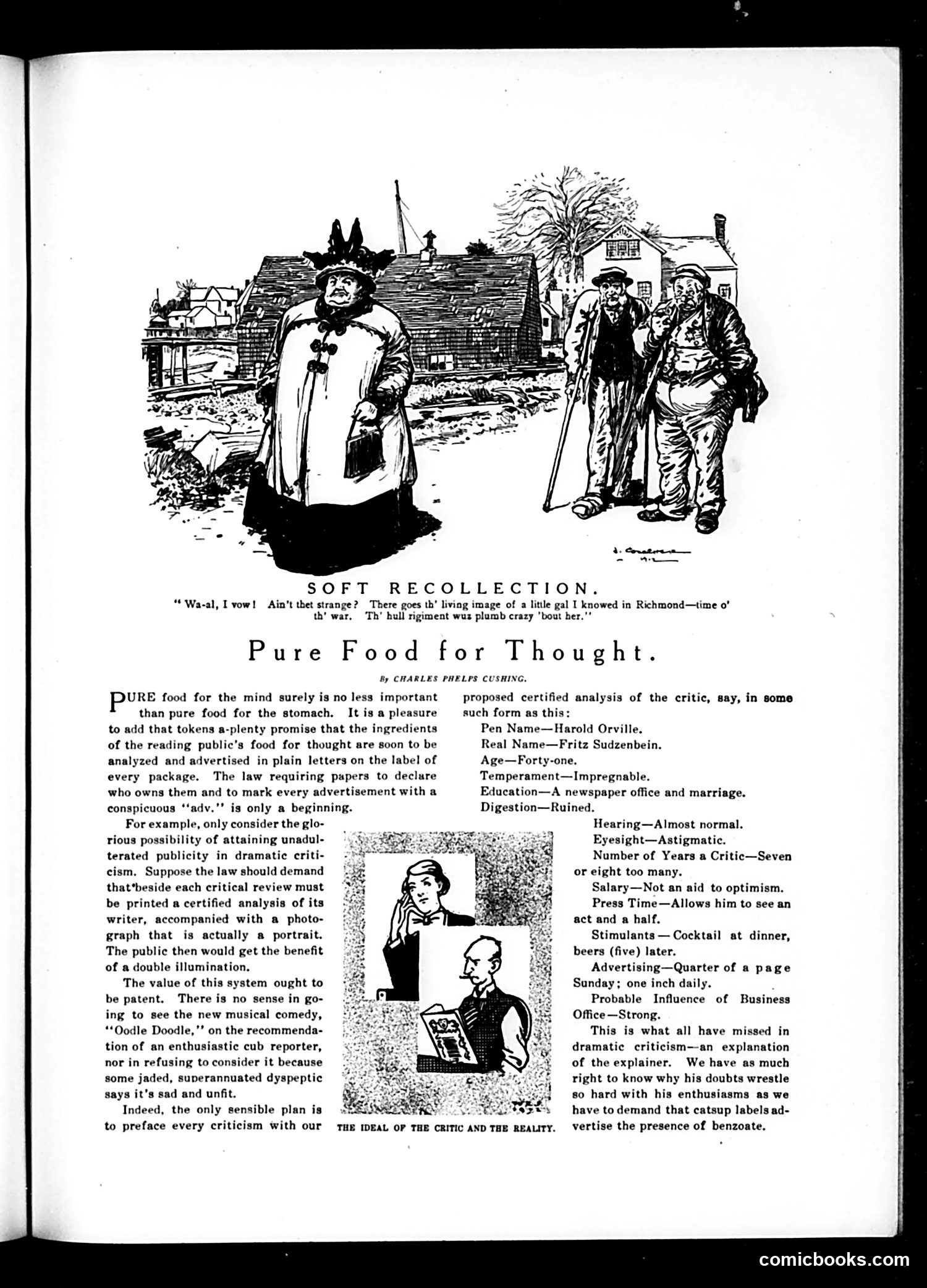
The top cartoon satirizes selective memory about war. A woman in Richmond recalls a "little gal" she knew during wartime whose "judgment was plumb crazy 'bout her"—suggesting romanticized nostalgia for Civil War romance rather than its actual horrors. The main article by Charles Phelps Cushing mocks food labeling laws through satire. It proposes that critics themselves should be labeled and analyzed like packaged goods, listing unflattering details (age: forty-one, temperament: impregnable, salary: not optimistic). The accompanying illustration shows "The Ideal of the Critic and the Beauty"—contrasting a scowling critic with someone reading, implying critics are joyless killjoys unable to appreciate art's pleasures.
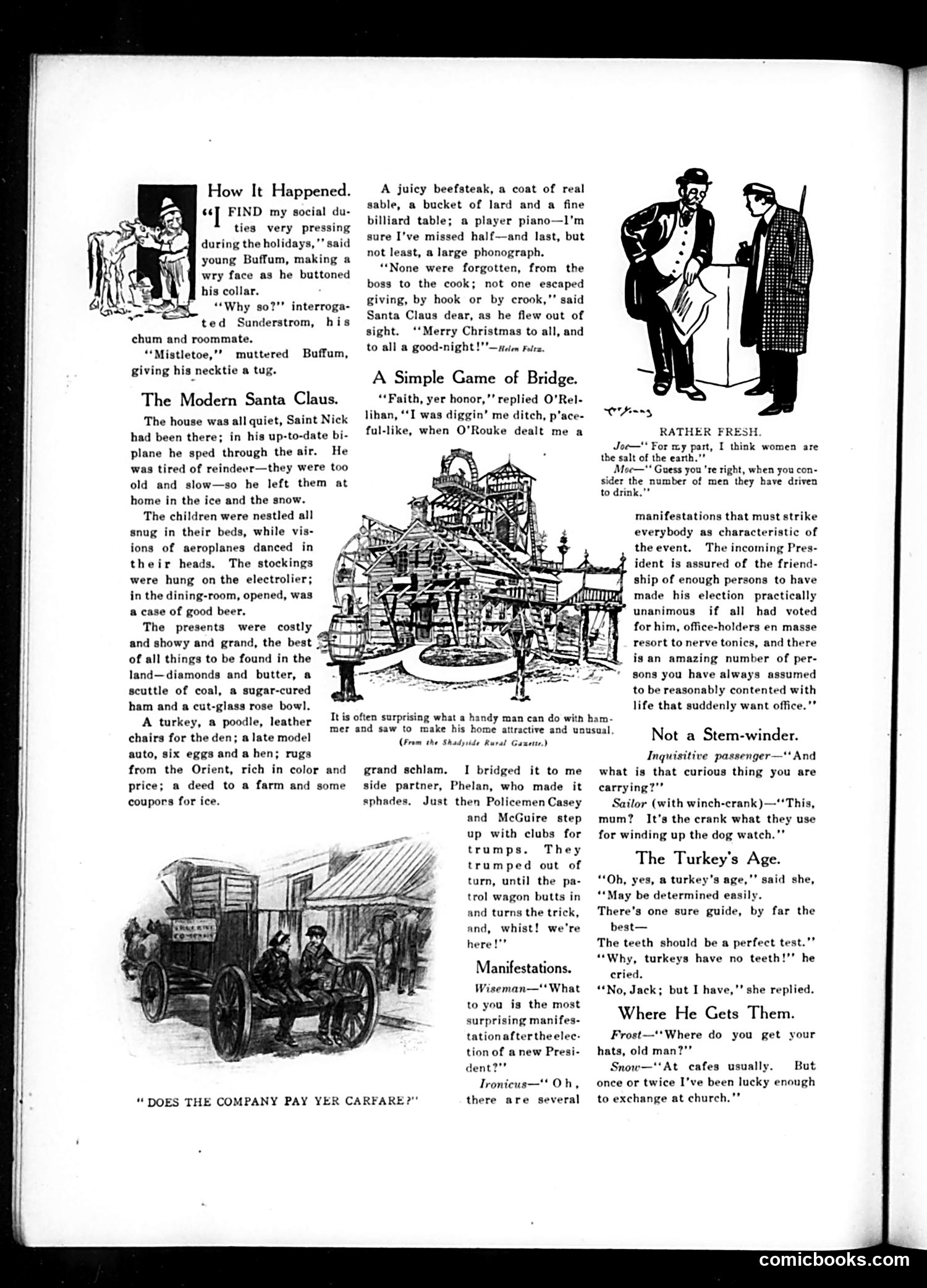
This page contains multiple brief comic sketches typical of early-20th-century satirical humor: **"How It Happened"** and **"Rather Fresh"**: Simple domestic humor playing on mistletoe and gender relations—common tropes of the era. **"The Modern Santa Claus"**: Satire of wealthy materialism. Santa now travels by biplane instead of reindeer, distributing extravagant consumer goods (automobiles, phonographs, diamonds) to all social classes "from boss to cook." This reflects anxieties about rapid industrialization and changing consumption patterns in early-1900s America. **"A Simple Game of Bridge"**: Irish-accented working-class characters (O'Rellihan, Phelan, Casey, McGuire) comically misunderstand bridge card-game terminology as a literal fight requiring police intervention. Reflects period ethnic stereotyping. **"Manifestations"** and **"Not a Stem-winder"**: Brief political and naval humor. **"The Turkey's Age"** and **"Where He Gets Them"**: Wordplay jokes typical of the magazine's filler content. The page is primarily entertainment with light social observation rather than hard political satire.
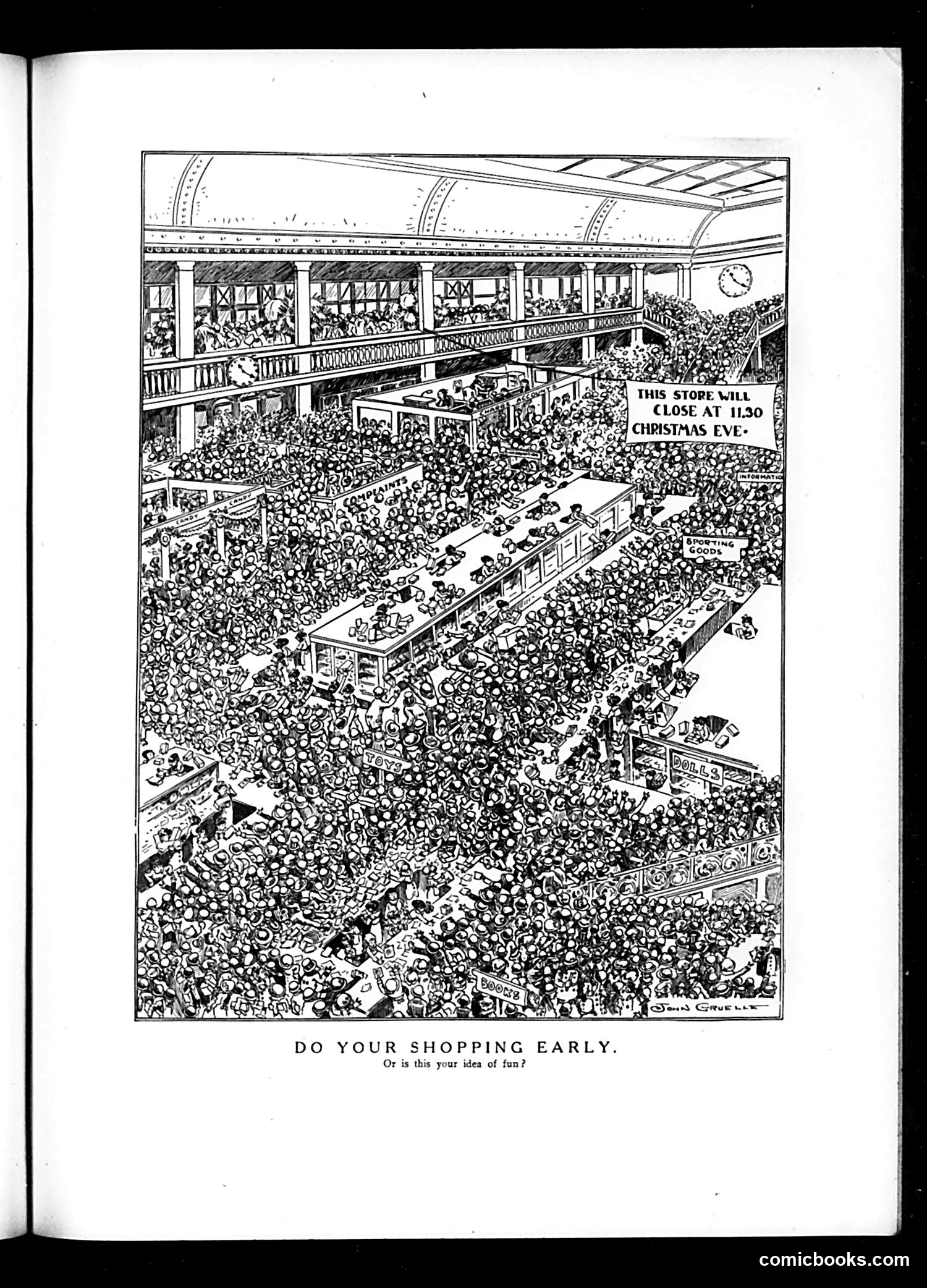
This is a satirical cartoon critiquing Christmas Eve shopping chaos. The image depicts an extremely crowded department store interior, packed wall-to-wall with shoppers during the holiday rush. A sign announces early closing at 11:30 PM. The satire operates on two levels: First, it mocks the frenzied consumer behavior of last-minute Christmas shoppers. Second, the caption "Do your shopping early. Or is this your idea of fun?" sarcastically suggests that the depicted chaos represents people's idea of entertainment—implying that holiday shopping has become an absurd, overcrowded spectacle rather than a practical activity. The cartoon criticizes both retailers' limited hours and the public's procrastination and willingness to endure such pandemonium for Christmas purchases. It's social commentary on commercialism and holiday consumerism.
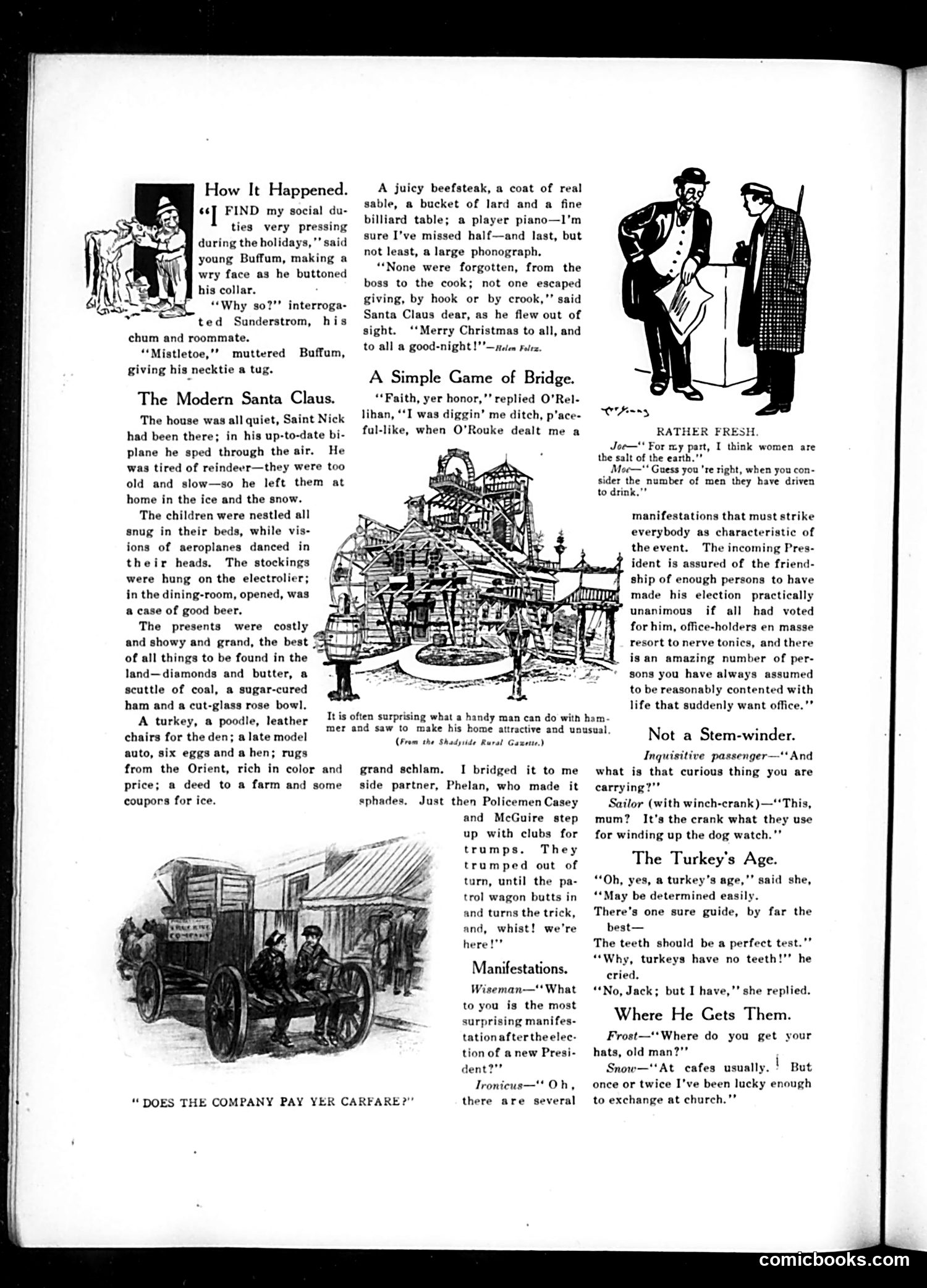
This page contains several humorous short pieces typical of early 20th-century satirical magazines: **"The Modern Santa Claus"** satirizes technological progress and consumer excess. Santa has abandoned his traditional reindeer for a biplane, and Christmas gifts now emphasize luxurious materialism—diamonds, automobiles, phonographs—rather than simple joy. The excessive inventory of presents mocks wealthy holiday excess. **"A Simple Game of Bridge"** is a pun-heavy joke featuring Irish-accented characters (O'Relihan, O'Rouke, Phelan) whose card game is disrupted by police. "Bridge," "trumps," and "slam" are both bridge terminology and slang for street brawling, creating wordplay confusion. **"Manifestations"** satirizes post-election behavior, mocking how suddenly everyone claims friendship with the newly elected president, office-seekers become anxious, and previously content people suddenly want government positions. The smaller jokes mock social pretension ("Rather Fresh," "Not a Stem-winder") and exchange worn-out clothing for new hats at church charity exchanges.
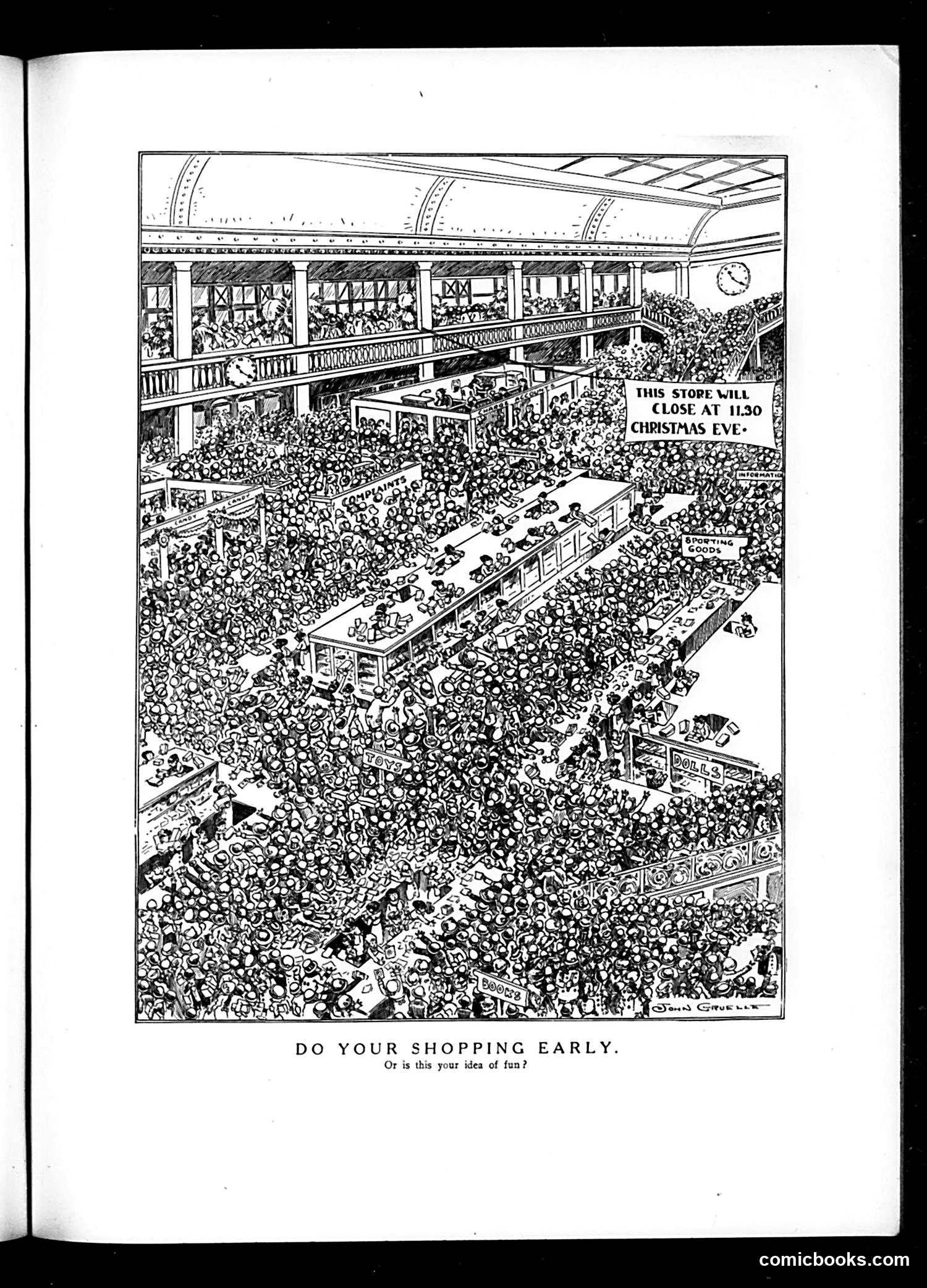
This is a satirical commentary on Christmas Eve shopping culture. The image depicts an enormous, chaotic crowd packed into a department store, with masses of people shopping frantically on the final shopping day before Christmas. The sign reading "THIS STORE WILL CLOSE AT 11:30 CHRISTMAS EVE" establishes the time pressure creating the frenzy. The caption "DO YOUR SHOPPING EARLY" sarcastically asks readers if they prefer this pandemonium to shopping ahead of time. The satire targets two things: consumer behavior during the holiday season and last-minute shopping habits. The cartoonist critiques both the shopper's poor planning and implicitly the retail culture that encourages this mad rush. The dense crowd illustrates the absurdity and unpleasantness of procrastination.
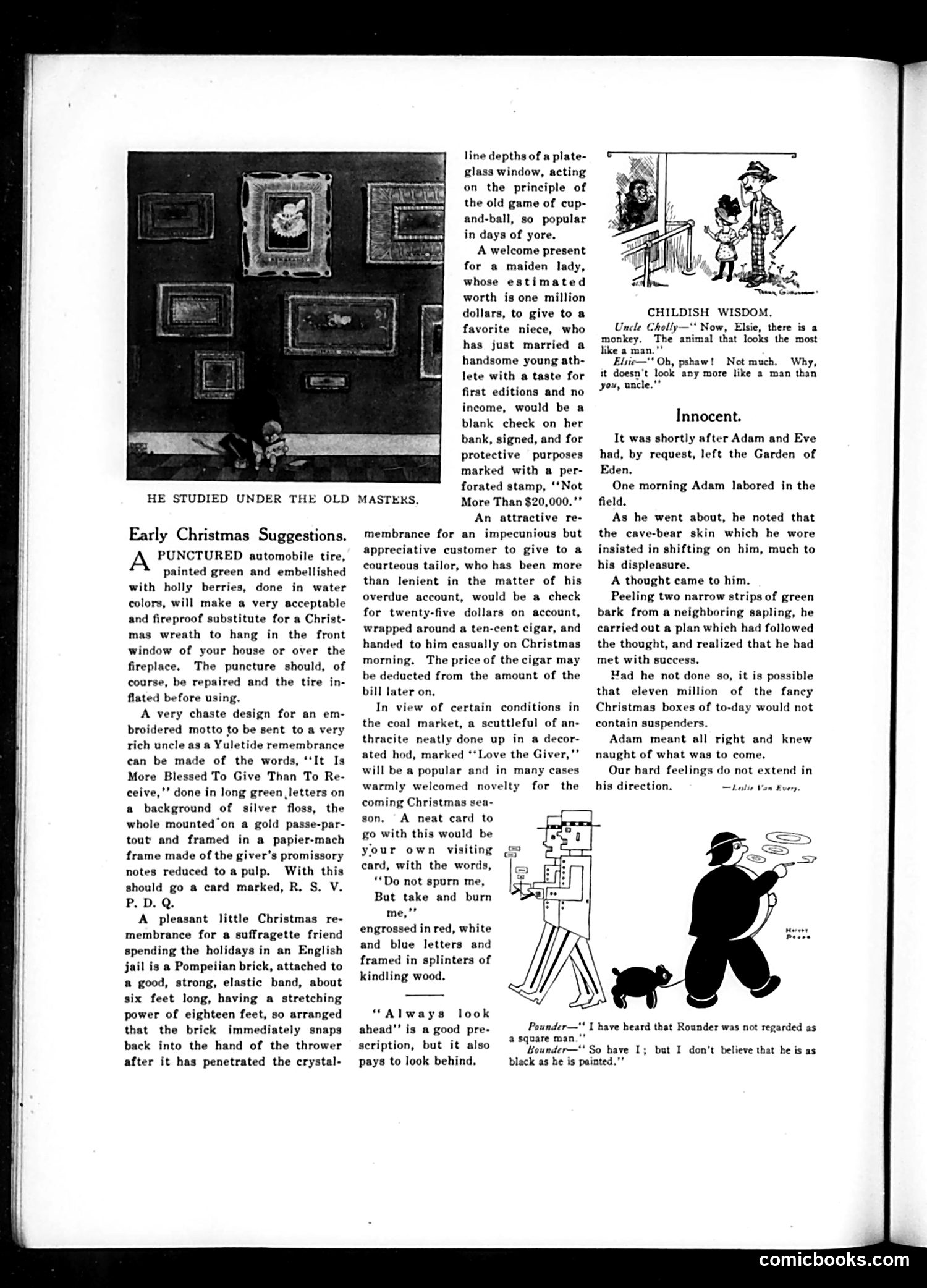
This page contains **satirical Christmas gift suggestions** mocking both consumer culture and contemporary social issues. The main "Early Christmas Suggestions" section presents absurd gift ideas that ridicule: 1. **Wealthy pretension**: A blank check (limited to $20,000) for a rich maiden lady's niece married to a poor but cultured athlete 2. **Labor disputes**: A coal hod as a gift during coal market troubles 3. **Suffragettes**: A brick attached to an elastic band—a cruel joke about imprisoned suffragettes (women jailed for voting rights activism), suggesting they could use it to smash windows and have it snap back 4. **Social climbing**: Various passive-aggressive gifts for tailors, customers, and servants The page also includes unrelated humor: a "Childish Wisdom" joke comparing a monkey to Uncle Cholly, an "Innocent" story about Adam inventing suspenders, and a pun about "Rounder" being a "square man." The overall tone is cynical commentary on holiday gift-giving as expressions of class anxiety and social obligation rather than genuine generosity.
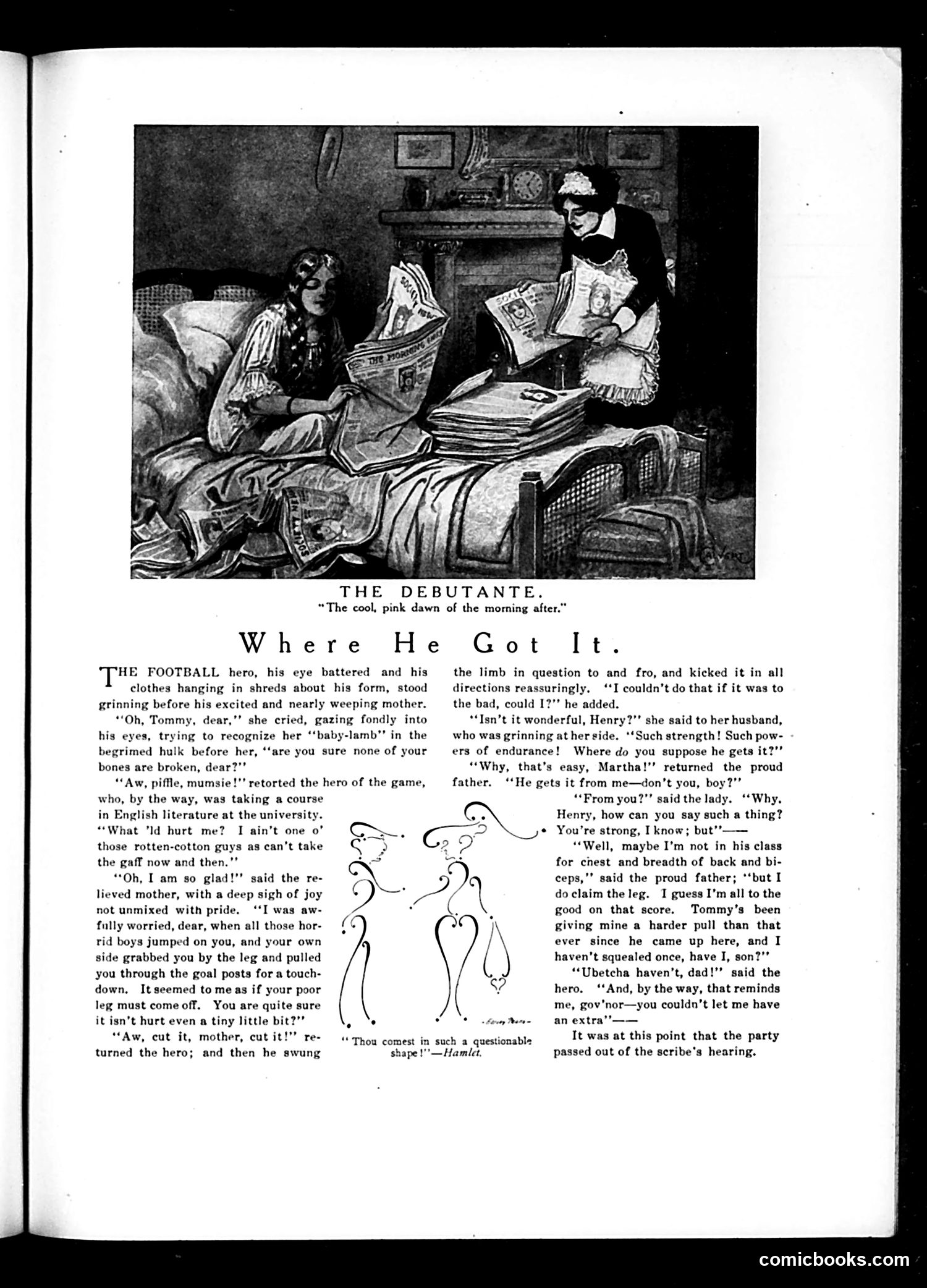
This satirical story mocks the absurdity of American football culture and parental pride in the early 1900s. A college football player arrives home battered and injured from a brutal game, yet his mother celebrates his toughness while fearing for his safety—a contradiction the narrative highlights. The joke deepens when the father claims credit for his son's strength, boasting about his own "leg" that the boy has been "pulling" harder since arriving at college. The innuendo—suggesting the father has been financially supporting (or being financially drained by) his son—culminates perfectly when the hero immediately asks for money ("an extra"), cutting off before he can finish. The satire targets both glorification of violent sports and the vanity of fathers who take undeserved credit for their sons' accomplishments while being exploited financially. The Hamlet quote emphasizes the questionable morality of the entire scenario.
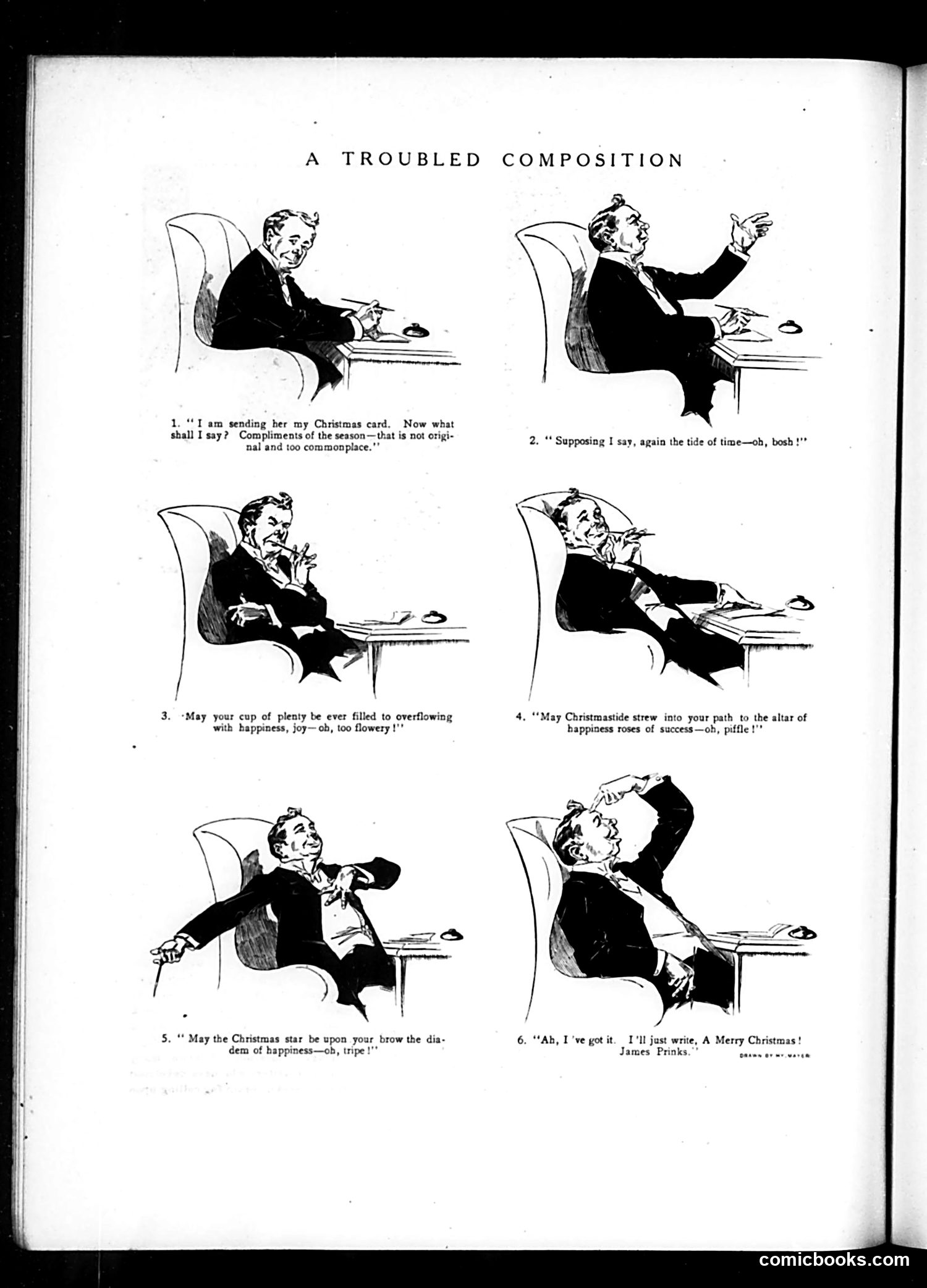
This six-panel comic satirizes the difficulty of writing sincere Christmas greetings. A man struggles to compose an original message for a Christmas card, repeatedly rejecting his own attempts as either too clichéd or too flowery. The humor lies in the escalating absurdity of his efforts: he dismisses "Compliments of the season" as commonplace, rejects overwrought phrases about "cups of plenty" and "Christmastide," and criticizes his own metaphors as "piffle" and "tripe." The punchline subverts this elaborate struggle: he ultimately settles on the simple, direct phrase "A Merry Christmas!"—the very kind of conventional greeting he initially rejected. The satire mocks both pretentious over-writing and the futility of trying to be original when conventions exist for good reason.
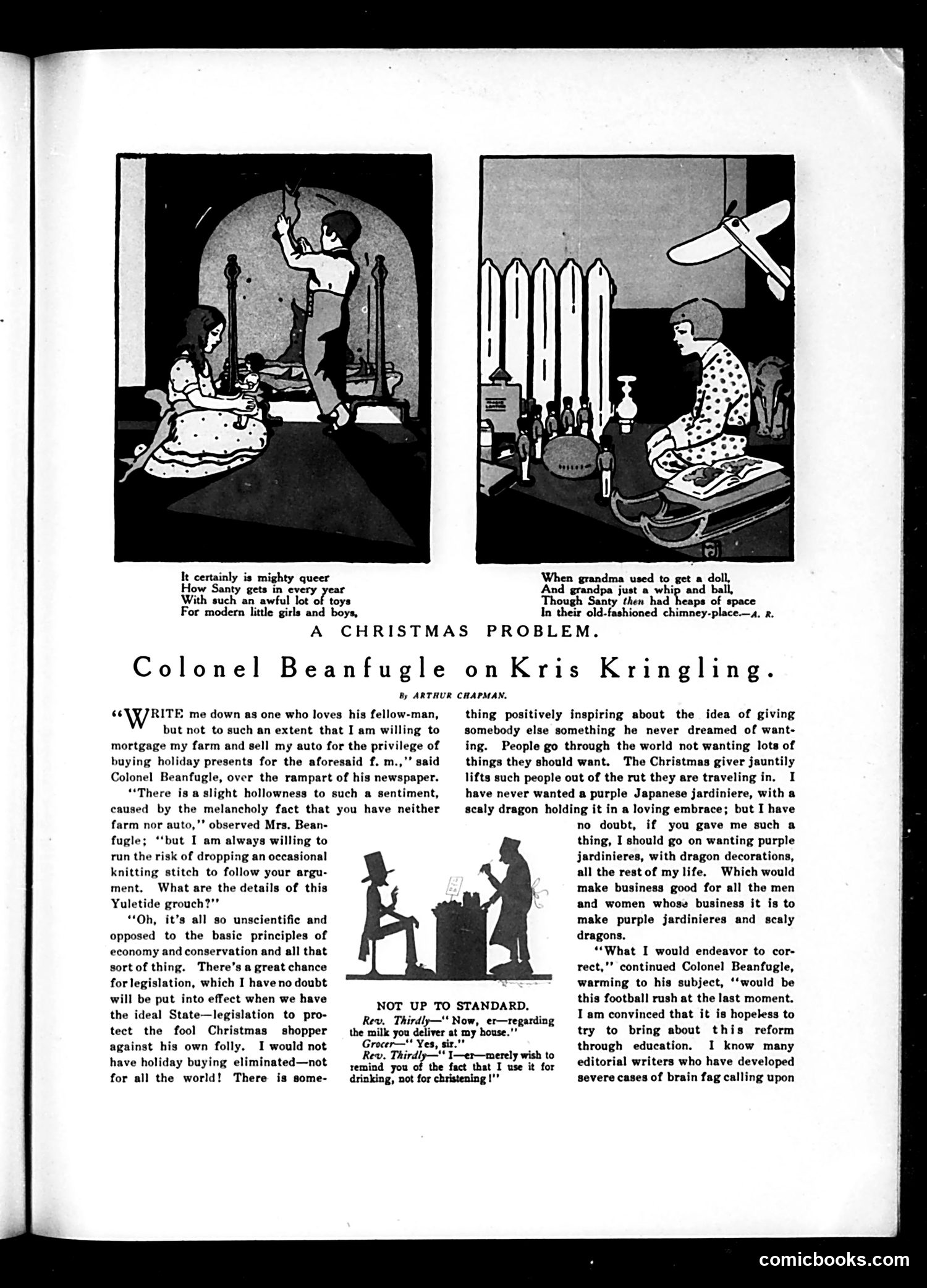
This page satirizes excessive Christmas consumerism. The top cartoons humorously contrast modern children's toy abundance with their grandparents' simpler gifts (dolls, whips, balls), implying gift-giving has become wasteful. The main article features Colonel Beanfugle lamenting that Christmas shopping violates principles of "economy and conservation"—likely referencing early 20th-century reform movements. His complaint: people give unwanted gifts (like a purple Japanese jardiniere with dragons) that create artificial desires, boosting commercial interests rather than serving genuine needs. Beanfugle advocates legislation to "protect the fool Christmas shopper against his own folly," viewing holiday buying as economically irrational despite acknowledging its inevitability. The small "Not Up to Standard" joke satirizes a pastor scolding his grocer about milk quality—a minor aside about standards and expectations. Overall, the piece critiques holiday commercialism as wasteful and contrary to conservation principles, positioning gift-giving as manufactured desire rather than genuine kindness.
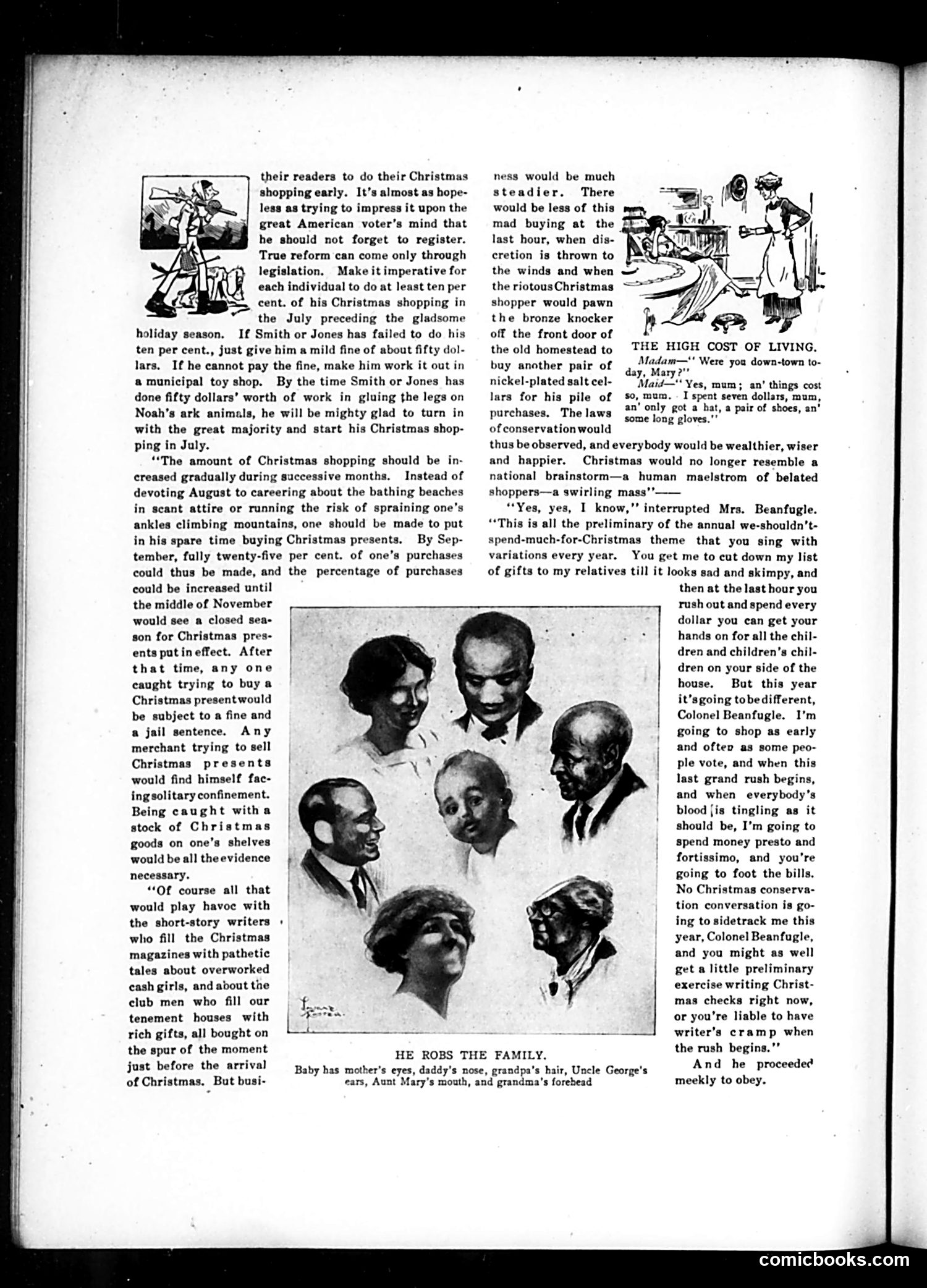
This page satirizes Christmas shopping excess and economic inefficiency in early 20th-century America. The main editorial argues facetiously that Christmas shopping should be legally mandated year-round to stabilize the economy—proposing fines or forced labor for those who procrastinate. The satire mocks both holiday consumer madness (people pawning possessions for last-minute gifts) and government regulation as solutions. The dialogue between Mrs. and Colonel Beanfugle illustrates the contradiction: reform-minded talk about spending less immediately dissolves when the Christmas rush arrives, resulting in frenzied overspending anyway. The cartoon "He Robs the Family" uses physical caricature to satirize how family traits—depicted through exaggerated facial features—are inherited across generations, suggesting hereditary patterns of foolish behavior. The small illustration "The High Cost of Living" shows a maid's complaint about inflation: seven dollars purchased only a hat, shoes, and gloves—criticizing the rising cost of basic goods.
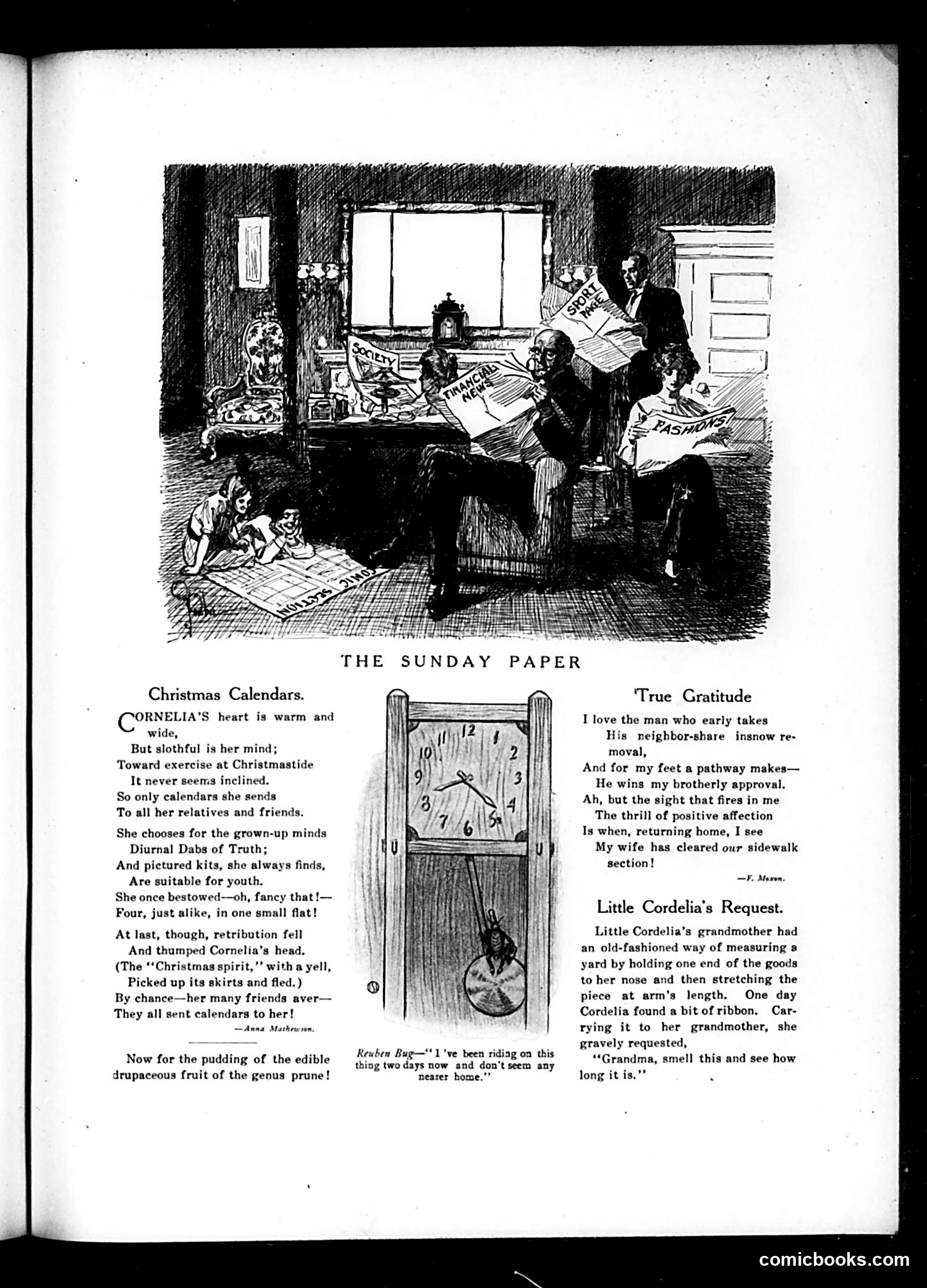
This page contains three separate humorous pieces typical of early 20th-century Judge magazine: **"Christmas Calendars"**: A poem mocking Cornelia, a lazy woman who sends cheap calendars as gifts to all relatives instead of thoughtful presents. The joke is karmic retribution—everyone sends her calendars in return. **"True Gratitude"**: A brief poem celebrating considerate neighbors who help remove snow, with an amusing twist: the speaker's greatest appreciation comes from his *wife* clearing their sidewalk section. **"Little Cordelia's Request"**: A humorous anecdote about a child asking her grandmother to measure ribbon by smell—misunderstanding the grandmother's old-fashioned measuring method (holding fabric to her nose and stretching it). The joke relies on the child's innocent literal interpretation. The central illustration shows a family reading newspapers indoors, likely depicting the "Sunday Paper" context. These are gentle, domestic humor pieces reflecting turn-of-the-century American life and social customs.
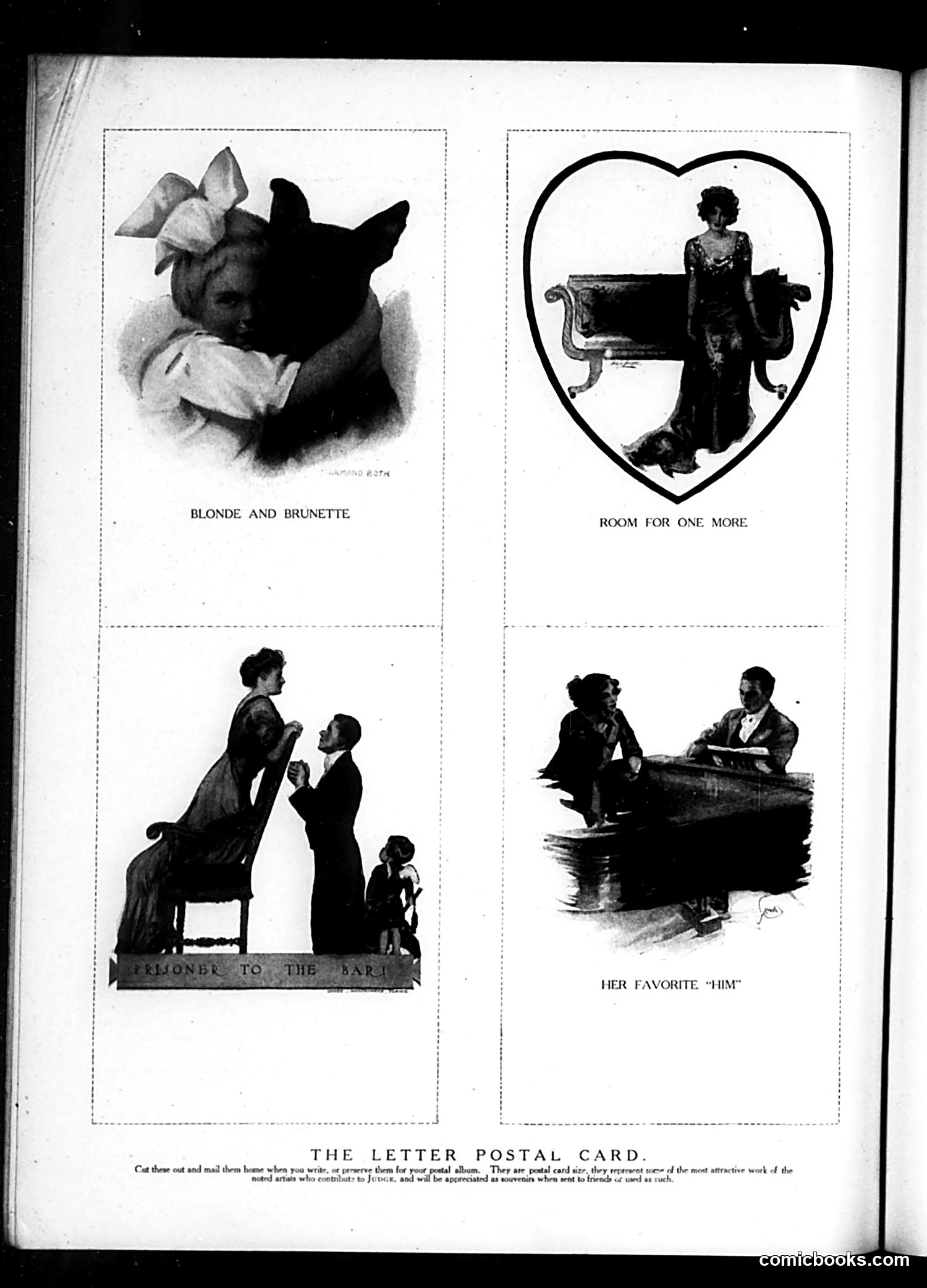
This page presents four illustrated postal cards from *Judge* magazine featuring romantic and domestic scenes typical of early 20th-century sentiment: 1. **"Blonde and Brunette"** - shows two women (contrasting hair colors) in an affectionate pose 2. **"Room for One More"** - depicts an elegant woman at a sofa, suggesting romantic availability 3. **"Prisoner to the Bar"** - shows a woman playfully "arresting" a man while a child watches 4. **"Her Favorite 'Him'"** - depicts a couple in a boat, likely referencing romantic attachment The text explains these are cut-out postal cards featuring work by *Judge*'s contributing artists, meant for mailing or collecting. The satire is gentle—poking fun at romantic conventions and gender dynamics of the era through sentimental illustrations. The humor relies on viewers recognizing stock romantic scenarios and the ironic framing of women as strategically managing male attention.
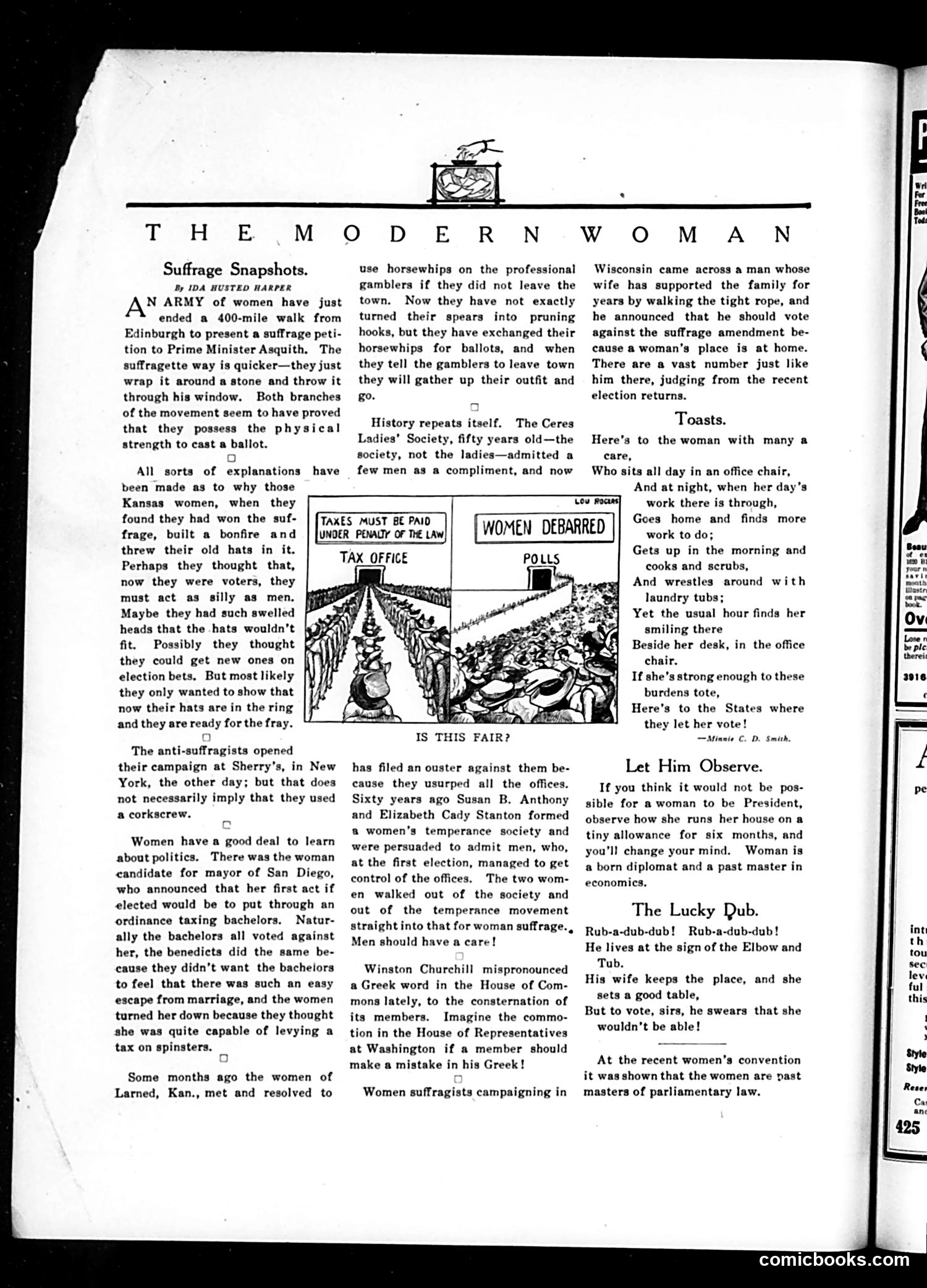
This satirical article by Ida Husted Harper mocks anti-suffrage arguments by highlighting the physical and mental demands women already endure. The central cartoon "IS THIS FAIR?" contrasts two images: one showing women at a tax office (forced to pay taxes) and another showing women debarred from polls (denied voting rights)—the core suffrage argument that taxation without representation is unjust. The article uses ironic anecdotes to expose anti-suffragist hypocrisy: Kansas women who used horsewhips on gamblers now want ballots; a man whose wife financially supported the family opposes suffrage because "a woman's place is at home"; and men who infiltrated a women's temperance society seized control—proving women need voting power to protect their interests. The "Toasts" poem celebrates working women juggling office jobs and household labor, sarcastically asking if they're strong enough for these burdens, why not voting? The satire argues: women already demonstrate capability and strength; denying them votes while collecting their taxes is fundamentally unfair.
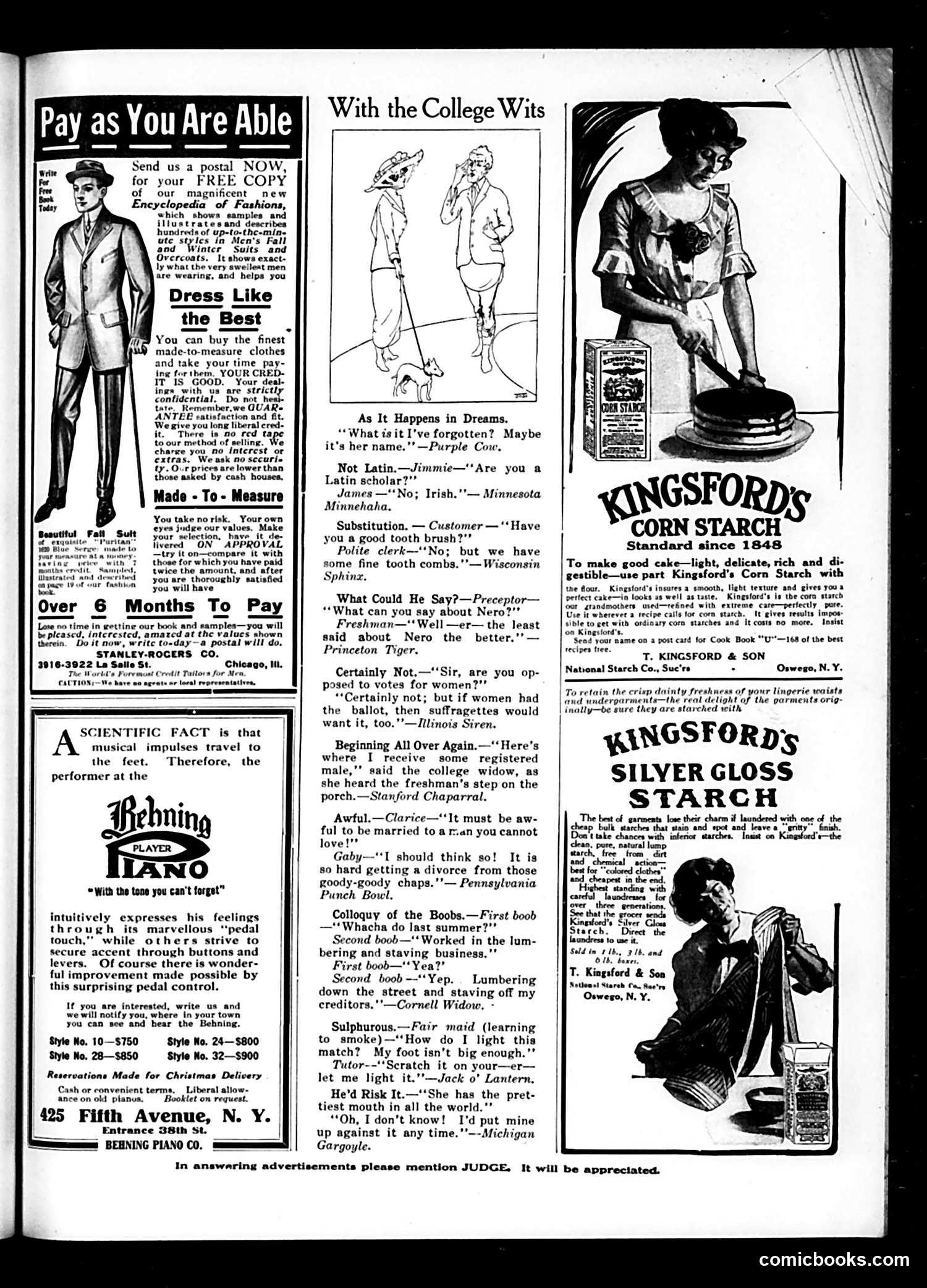
This page is primarily **advertising mixed with college humor**. The main satirical content consists of short jokes sourced from various college publications (Wisconsin Sphinx, Princeton Tiger, Stanford Chaparral, etc.). The humor relies on wordplay and mild social commentary: - "Not Latin" jokes about ethnic Irish identity - "Substitution" plays on homonyms (tooth brush/combs) - References to contemporary debates like **women's suffrage** ("Certainly Not"), presented skeptically—the joke suggests suffragettes would be insatiable if granted voting rights - Gender dynamics and dating ("college widow" pursuing freshmen) - Crude romantic/physical humor typical of 1910s-era college publications The advertisements—for made-to-measure suits, pianos, and corn starch—occupy substantial space. The Kingsford's Corn Starch ads feature illustrations of women performing domestic tasks, reflecting period gender expectations. **Modern context**: These jokes would be considered mildly offensive today; the suffrage joke particularly reflects anti-feminist sentiment common in the era.
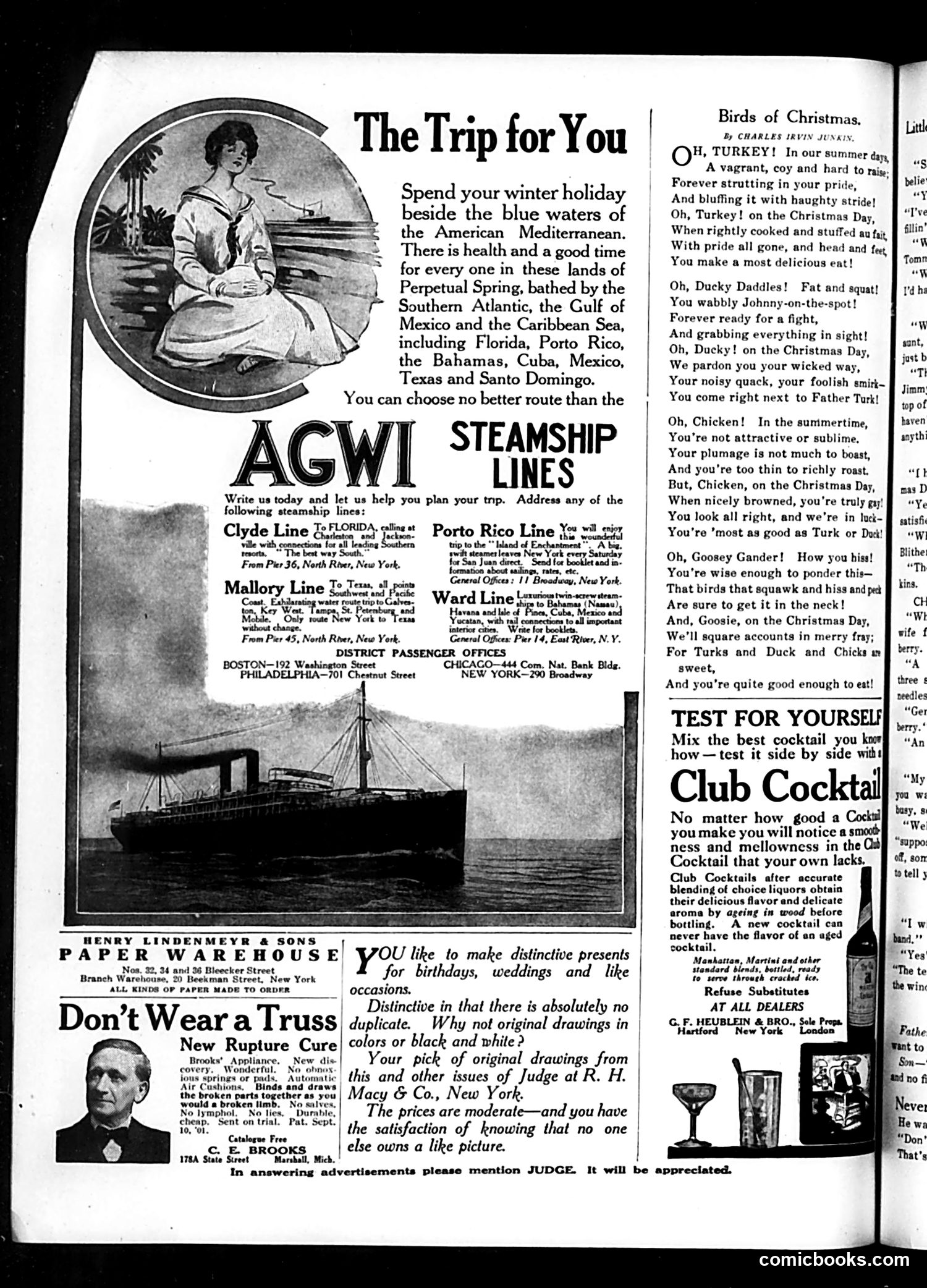
This page is primarily **advertisements and filler content**, not political satire. The main elements are: **"The Trip for You"** advertises steamship lines (Clyde, Mallory, Ward, Porto Rico lines) offering winter Caribbean cruises to Florida, Cuba, Mexico, and other destinations—standard travel marketing for the era. **"Birds of Christmas"** is humorous light verse by Charles Irvin Junkin that personifies poultry (turkeys, ducks, chickens, geese) with exaggerated character traits, then jokes that these birds will be eaten at Christmas—a gentle, whimsical poem with no satirical intent. Additional ads promote a "New Rupture Cure," Club Cocktail spirits, and distinctive art prints from Judge magazine itself. The page contains **no political cartoons or social satire**—it's a typical interior magazine page mixing travel promotion, product advertising, and filler verse to fill space and generate revenue. The tone is lighthearted consumerism rather than commentary.
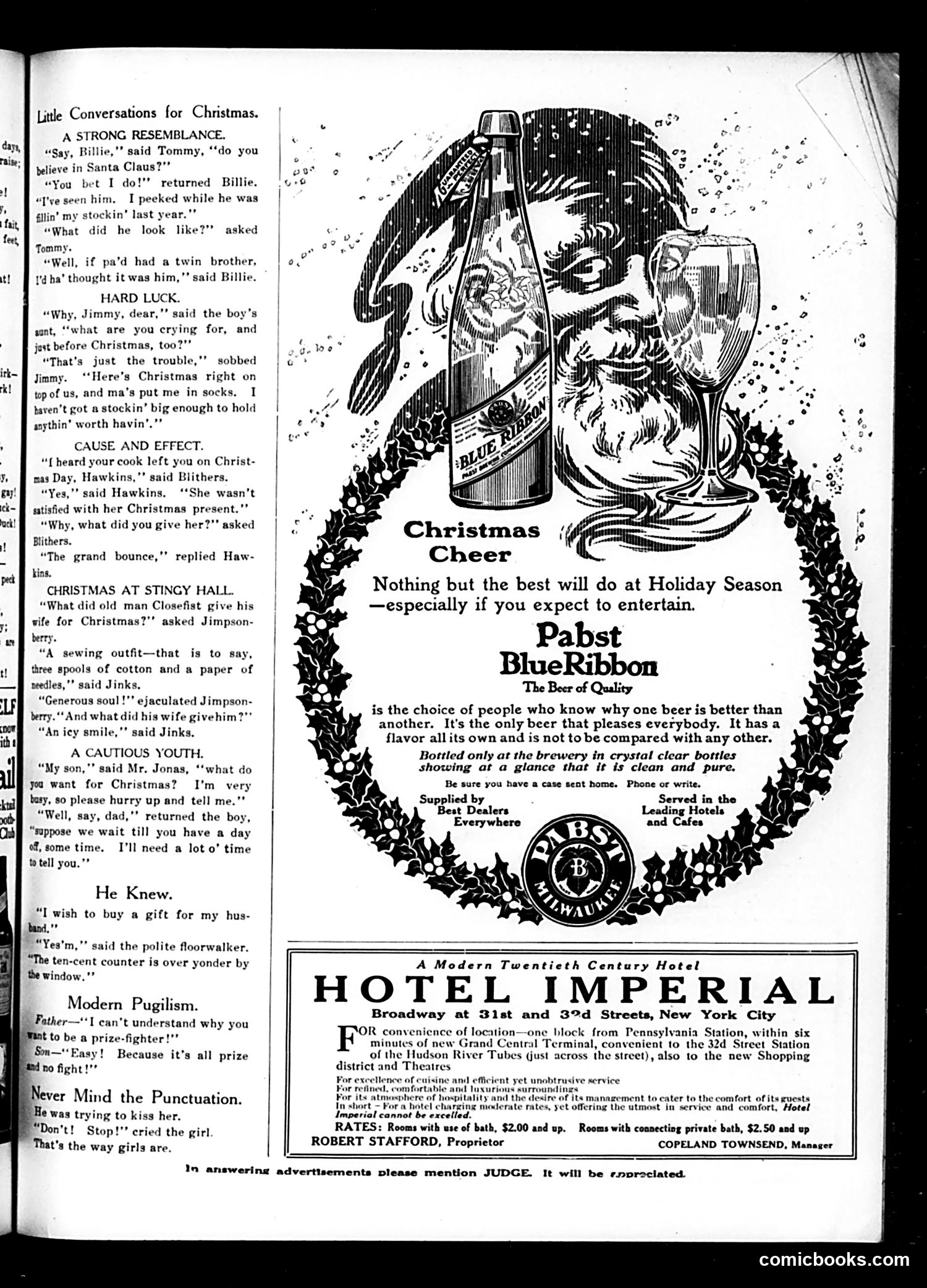
This page from *Judge* magazine consists primarily of **light holiday humor and advertisements** rather than political satire. The left side contains six short, gentle comedic sketches about Christmas: - Children discussing Santa Claus - A boy disappointed about getting socks instead of exciting gifts - A servant quitting after receiving a meager Christmas bonus - A stingy employer giving his wife minimal gifts (she responds with "an icy smile") - A boy asking his father for an expensive Christmas present but needing time to explain it - A woman looking for an inexpensive gift at the "ten-cent counter" These jokes mock **stinginess during Christmas** and the contrast between children's expectations and parents' willingness to spend. The right side features **two full-page advertisements**: Pabst Blue Ribbon beer (marketed as superior quality for holiday entertaining) and the Hotel Imperial in New York City. The humor is domestic and sentimental rather than satirical—typical of early 20th-century popular magazines mixing light entertainment with advertising.
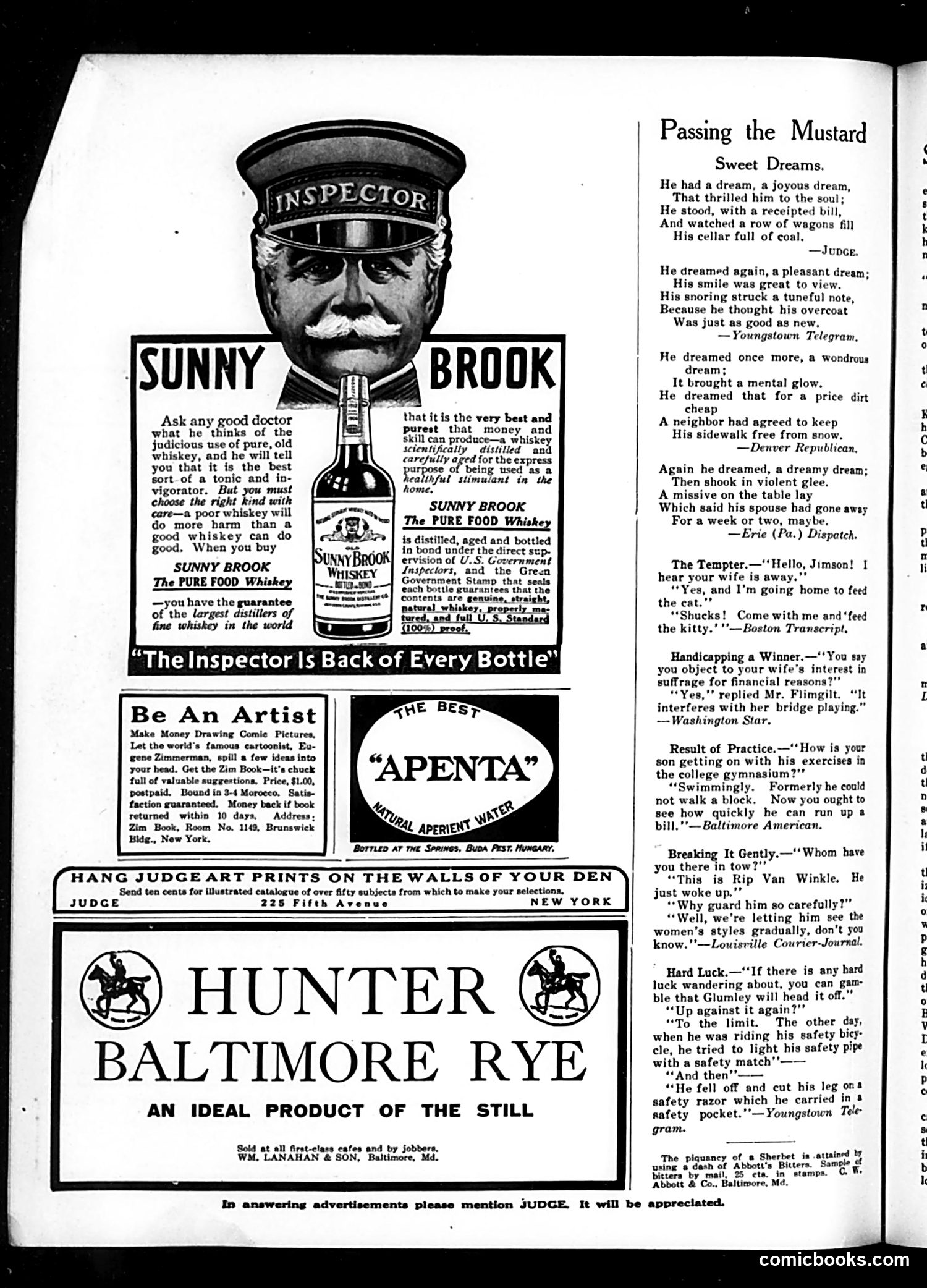
This page is primarily **advertising and humor content** rather than political commentary. The main advertisements promote **Sunny Brook whiskey** and **Hunter Baltimore Rye**, leveraging early 20th-century marketing tactics: doctors' endorsements for medicinal alcohol use and government inspection stamps to assure quality—common claims during the Pre-Prohibition era when whiskey was marketed as a health tonic. The right column, "Passing the Mustard," contains humorous short anecdotes mocking everyday frustrations: a man dreaming of heating his cellar, his wife leaving town, financial complaints about suffrage, and physical decline. These represent typical middle-class anxieties of the period. The page includes a **"Be An Artist" instructional advertisement** and a **Judge Art Prints promotion**—standard revenue sources for magazines. The content reflects **no significant political satire**—instead offering light domestic humor and commercial promotion typical of Judge's mixed editorial-advertising format during this era.
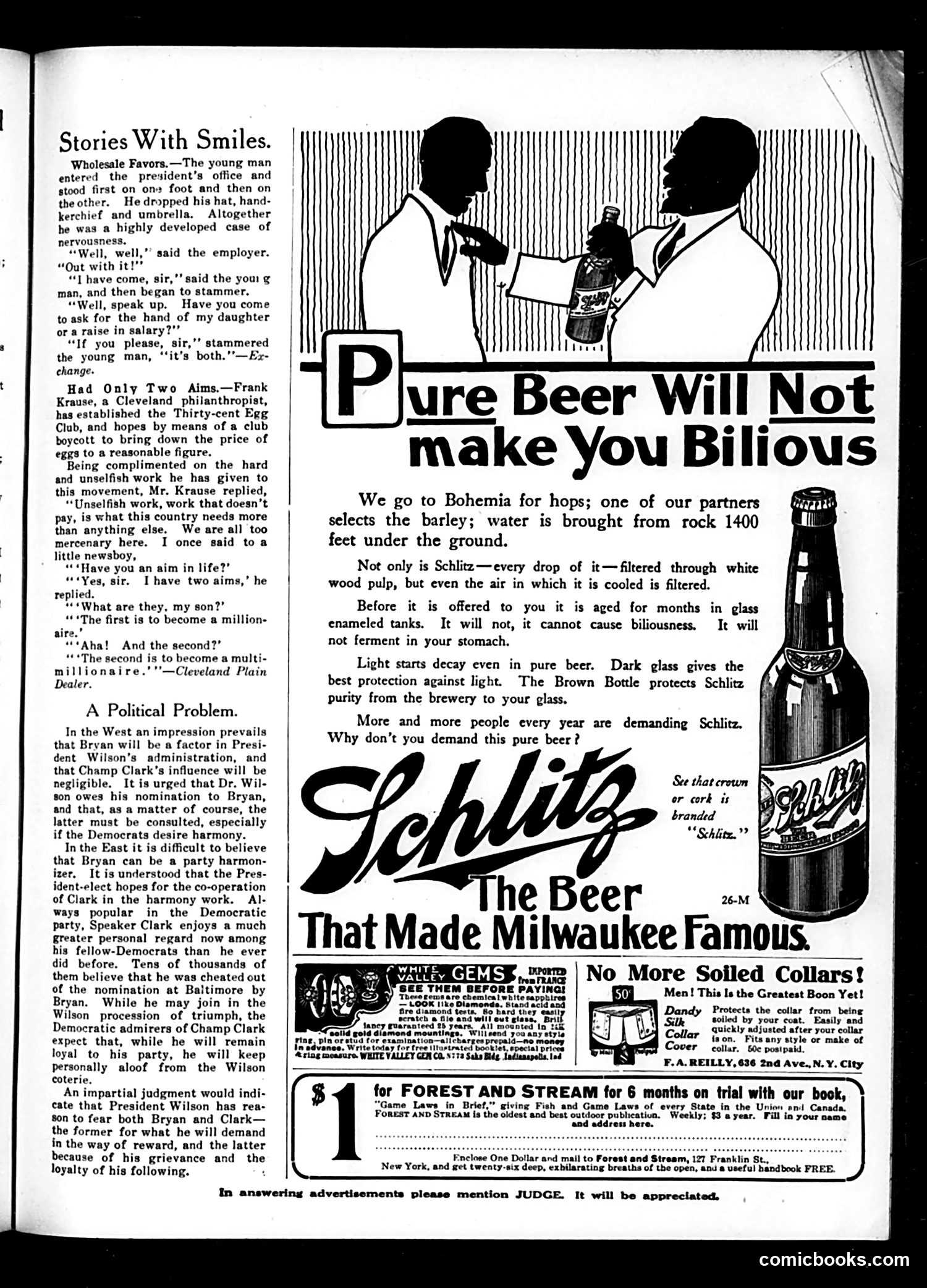
This page contains three distinct elements: **"Stories With Smiles"** — Three brief humorous anecdotes typical of early 20th-century magazines, focusing on nervousness, charitable egg-price reduction, and personal ambition. **"A Political Problem"** — Commentary on President Wilson's incoming administration (appears to reference 1913). The piece analyzes tension between William Jennings Bryan and House Speaker Champ Clark regarding their influence over Wilson. It notes Western observers expect Bryan to be rewarded for supporting Wilson's nomination, while Eastern observers fear both men pose problems—Bryan through demands for position, Clark through lingering resentment over losing the nomination. **Schlitz Beer Advertisement** — The dominant content. This full-page ad emphasizes the beer's purity through multiple filtration steps and claims it "will not make you bilious" (cause stomach upset), a common concern with beer consumption at the time. The page is primarily advertising-driven, with political commentary as secondary content.
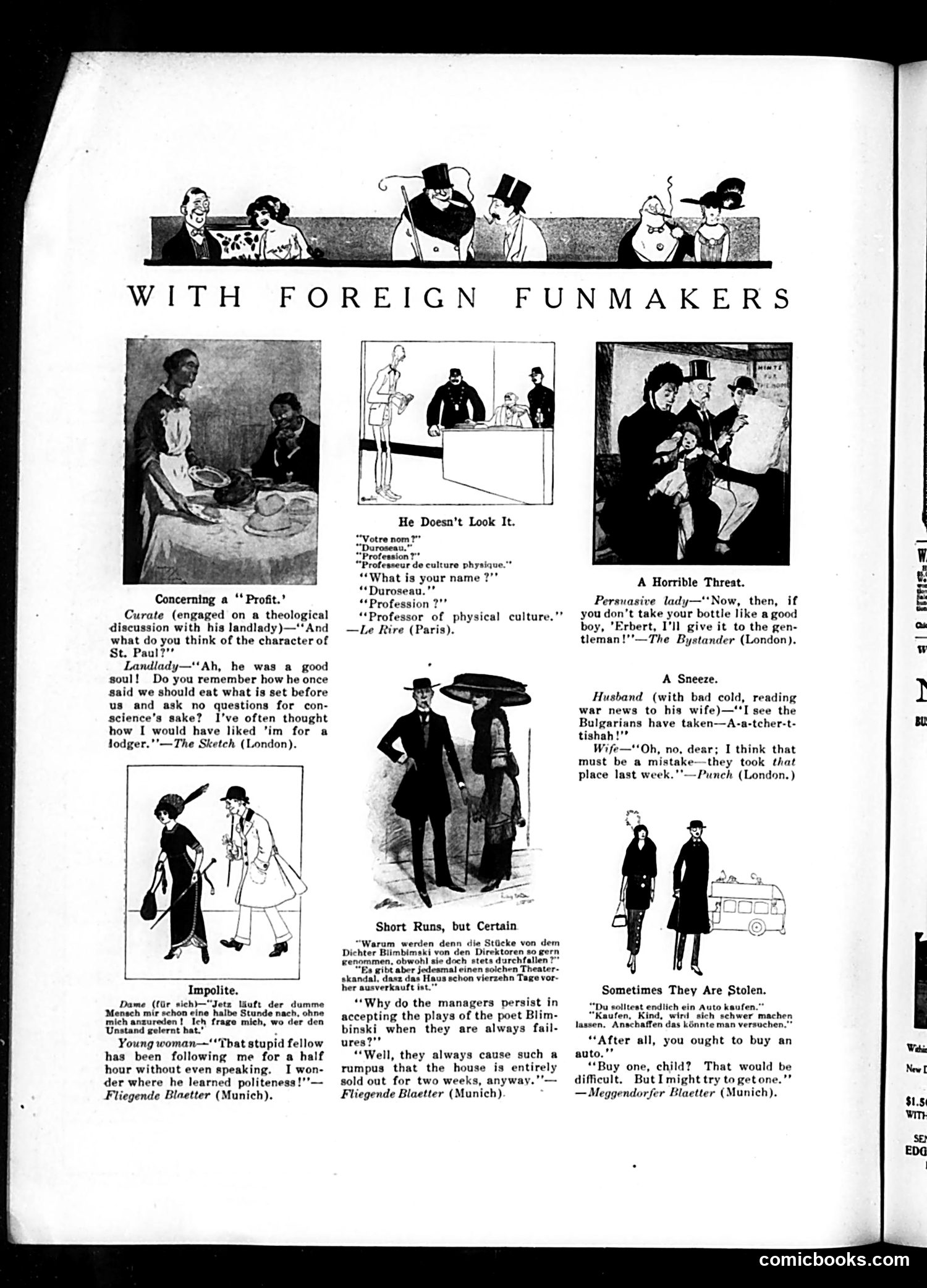
This page collects brief satirical jokes translated from European humor magazines (Le Rire from Paris, Punch from London, Munich's Fliegende Blaetter, and others), presenting them as exotic foreign humor for American readers. The jokes target universal subjects: clerical hypocrisy (a curate's landlady praising St. Paul's advice to eat without question), social awkwardness (a man following a woman silently for half an hour), theatrical economics (a playwright's terrible plays that still fill theaters due to scandal), wartime miscommunication, and petty crime (suggesting "acquiring" rather than buying an automobile—implying theft). The satire is gentle, class-conscious, and relies on wordplay and domestic scenarios. The framing suggests these European jokes represent a sophisticated, cosmopolitan humor that American Judge readers should appreciate. The cartoons emphasize national differences in comedy styles while mining shared middle-class anxieties about propriety, relationships, and economics.
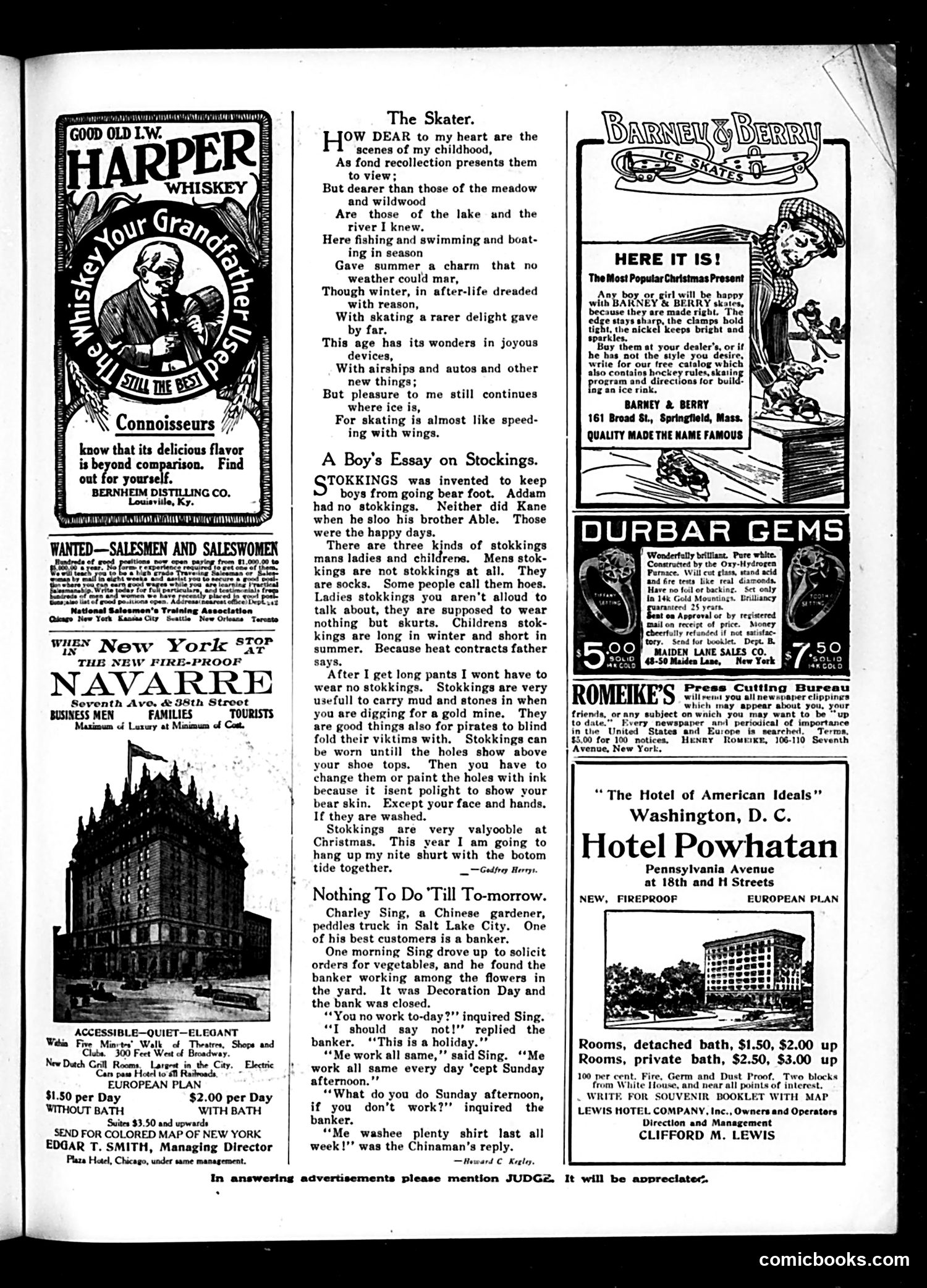
This page is primarily **advertising and filler content** rather than political satire. The dominant features are: **Editorial Content:** - "The Skater": A nostalgic poem celebrating ice-skating as superior to modern inventions (airships, autos) - "A Boy's Essay on Stockings": Humorous piece mimicking a child's misspelled, rambling thoughts on different types of stockings and their uses - "Nothing To Do 'Till To-morrow": A brief anecdote about a Chinese gardener who works every day except Sunday afternoons (when he does laundry) **Social Context:** The piece uses period-appropriate ethnic humor (the Chinese laborer character "Charley Sing" speaks in stereotypical broken English). This reflects early-20th-century American magazine conventions. **Advertising:** The page is dominated by ads for whiskey, hotels, skating equipment, and other commercial products—typical of Judge's revenue model. No significant political satire or sophisticated cartooning is evident on this particular page.
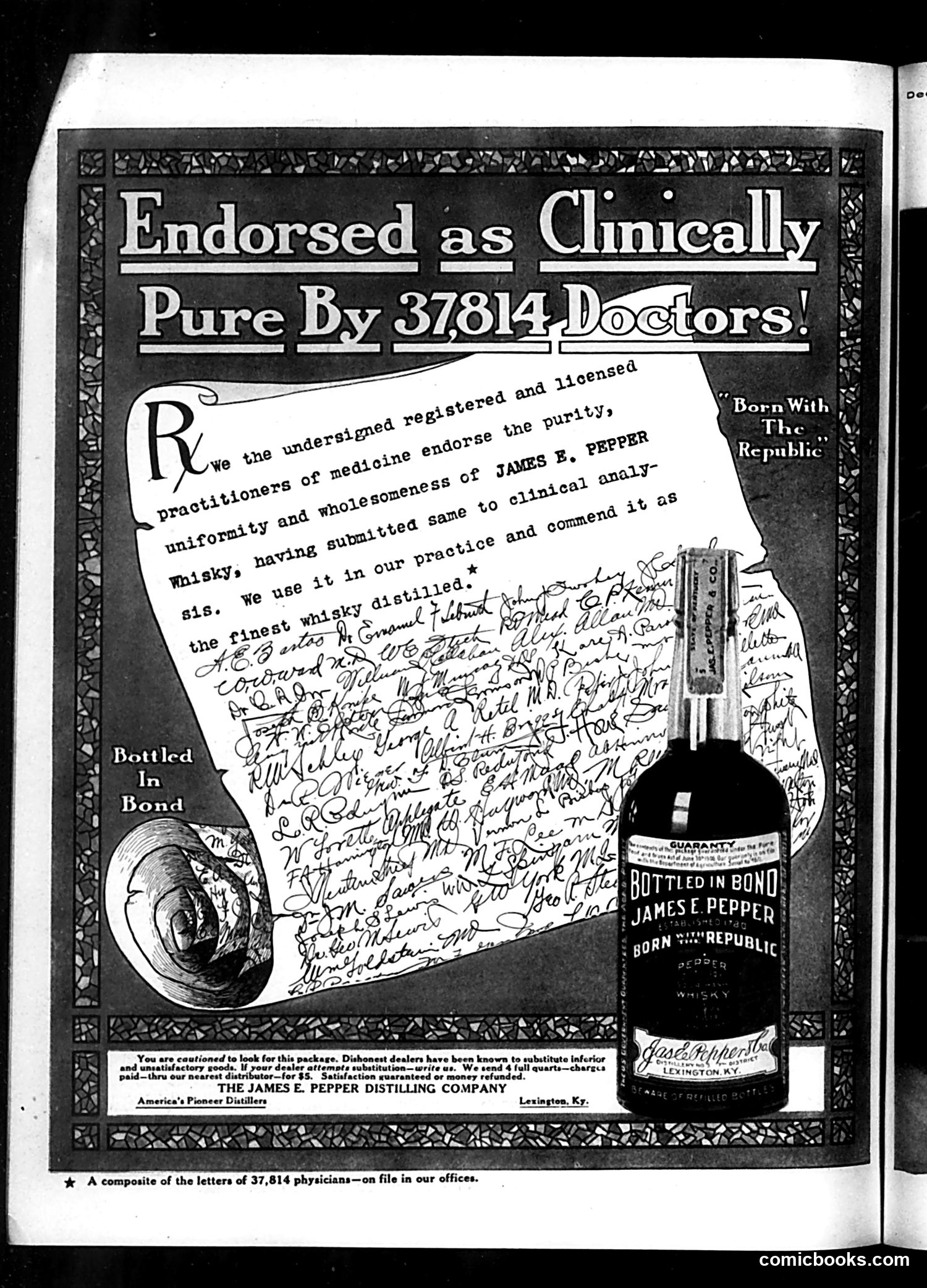
It advertises James E. Pepper whiskey "Born With The Republic" and "Bottled in Bond." The ad claims endorsement by 37,814 doctors—a composite of physician letters displayed on the map of the United States shown in the image. **The satirical element**: This reflects the **pre-Prohibition era** (before 1920) when alcohol was legally marketed as medicine. Manufacturers routinely claimed medical endorsements to boost sales. The ad's emphasis on "clinically pure" and physicians' support exploits a common marketing tactic of the time—using pseudoscientific medical claims to legitimize alcohol consumption. The warning at bottom about "dishonest dealers" and substitution reflects genuine concerns about product authenticity in an unregulated market. **For modern readers**: This represents how differently alcohol was marketed before Prohibition, when whiskey was openly sold as a health product with dubious medical backing.