
Judge, 1912-12-14 · page 5 of 26
Judge — December 14, 1912 — page 5: what you’re looking at
What you’re looking at
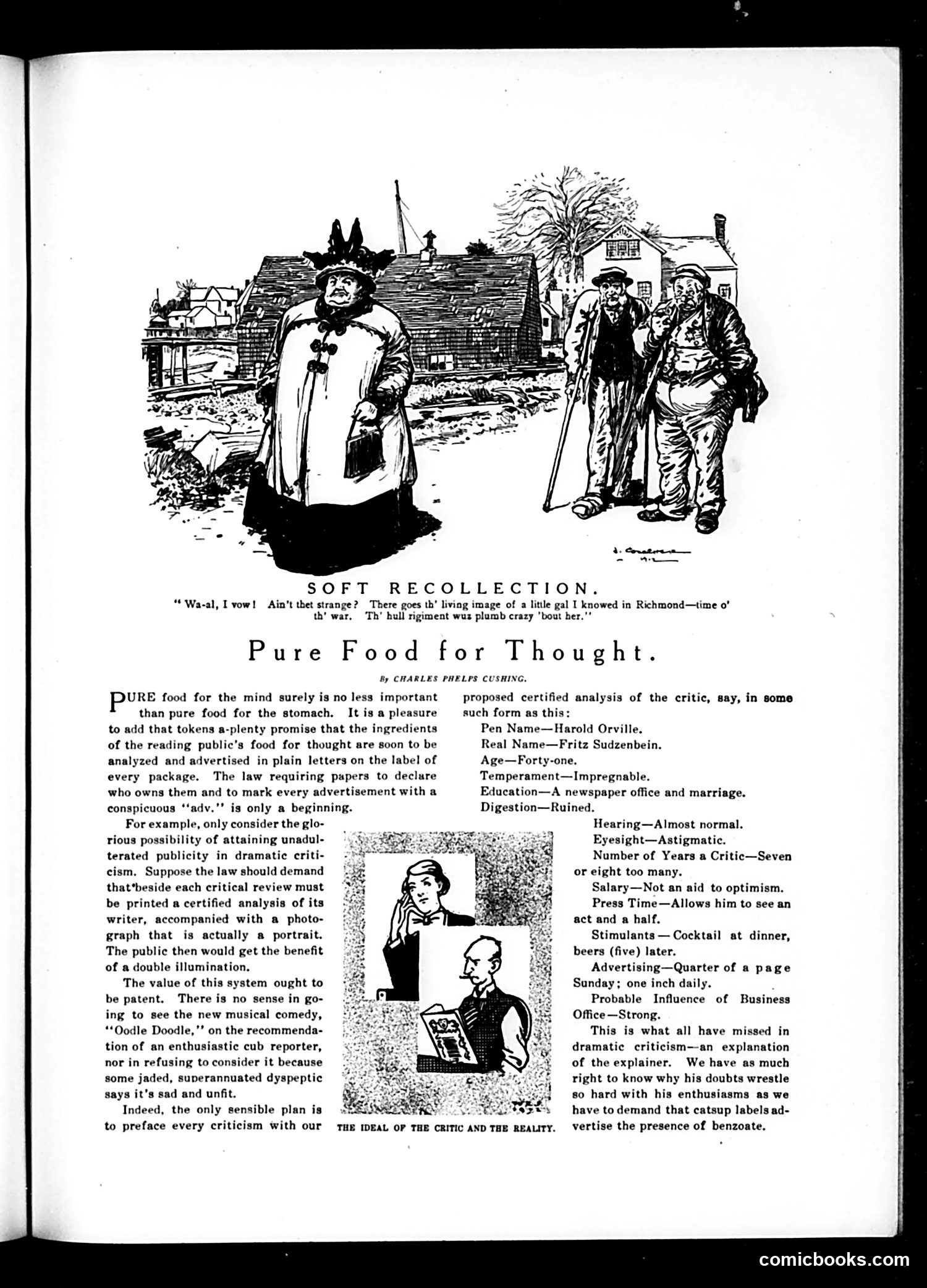
The top cartoon satirizes selective memory about war. A woman in Richmond recalls a "little gal" she knew during wartime whose "judgment was plumb crazy 'bout her"—suggesting romanticized nostalgia for Civil War romance rather than its actual horrors. The main article by Charles Phelps Cushing mocks food labeling laws through satire. It proposes that critics themselves should be labeled and analyzed like packaged goods, listing unflattering details (age: forty-one, temperament: impregnable, salary: not optimistic). The accompanying illustration shows "The Ideal of the Critic and the Beauty"—contrasting a scowling critic with someone reading, implying critics are joyless killjoys unable to appreciate art's pleasures.
📄 Transcribed text from this page (OCR, searchable)
Machine-transcribed from the original scan — historical spelling and the odd misread are preserved.
SOFT RECOLLECTION. “Waal, I vow! Ain't thet strange? th’ war, ‘There goes th’ living image of a litle gal I knowed in Richmond—time o! ‘Th’ bull rigiment wus plumb crazy ‘bout her."* Pure Food for Thought. URE food for the mind surely is no less important than pure food for the stomach. to add that tokens a-plenty promise that the ingredients of the reading public's food for thought are soon to be analyzed and advertised in plain letters on the label of The law requiring papers to declure who owns them and to mark every advertisement with a conspicuous ‘‘adv.’’ is only a beginning. every package. For example, only consider the glo- rious possibility of attaining unadul- terated publicity in dramatic criti- cism. Suppose the law should demand that*beside each critical review must be printed a certified analysis of its writer, accompanied with a photo- graph that is actually a portrait. The public then would get the benefit of a double illumination. The value of this system ought to be patent. There is no sense in go- ing to see the new musical comedy, “Oodle Doodle,’’ on the recommenda- tion of an enthusiastic cub reporter, nor in refusing to consider it because some jaded, superannuated dyspeptic says it’s sad and unfit. Indeed, the only sensible plan is to preface every criticism with our By CHARLES PHELPS CUSHING. It is a pleasure THE IDEAL OP THE CRITIC AND THE REALITY. proposed certified analysis of the critic, say, in some such form as this: Pen Name—Harold Orville. Real Name—Fritz Sudzenbein. Age—Forty-one. Temperament—Impregnable. Education—A newspaper office and marriage. Digestion—Ruined. Hearing—Almost normal. Eyesight—Astigmatic. Number of Years a Critic—Seven or eight too many. Salary—Not an aid to optimism. Press Time—Allows him to see an act and a half. Stimulants — Cocktail at dinner, beers (five) later. Advertising—Quarter of a page Sunday; one inch daily. . Probable Influence of Business Office —Strong. This is what all have missed in dramatic criticism—an explanation of the explainer. We have as much right to know why his doubts wrestle so hard with his enthusiasms as we have to demand that catsup labels ad- vertise the presence of benzoate. comicbooks.com