
Judge, 1912-12-14 · page 24 of 26
Judge — December 14, 1912 — page 24: what you’re looking at
What you’re looking at
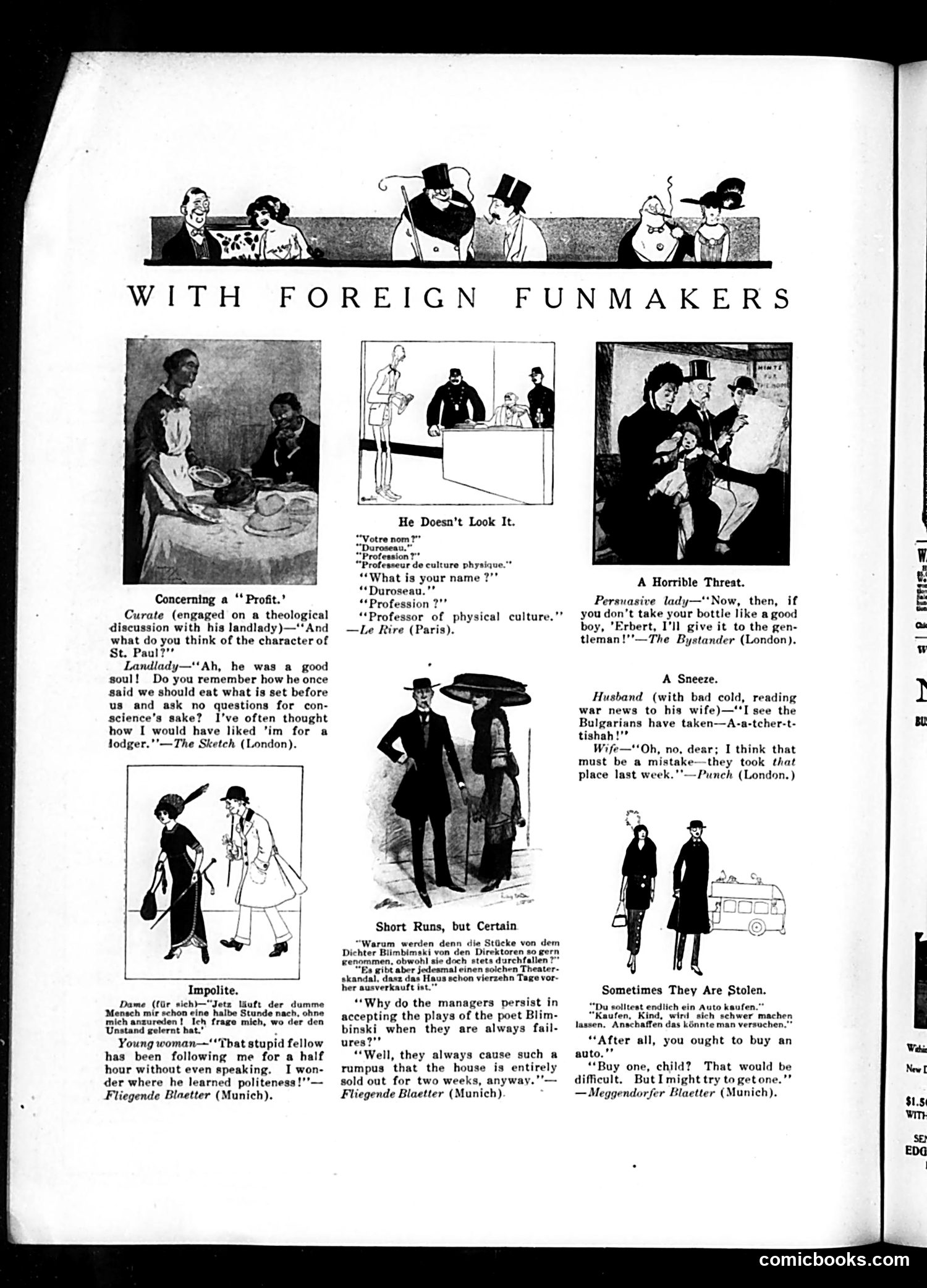
This page collects brief satirical jokes translated from European humor magazines (Le Rire from Paris, Punch from London, Munich's Fliegende Blaetter, and others), presenting them as exotic foreign humor for American readers. The jokes target universal subjects: clerical hypocrisy (a curate's landlady praising St. Paul's advice to eat without question), social awkwardness (a man following a woman silently for half an hour), theatrical economics (a playwright's terrible plays that still fill theaters due to scandal), wartime miscommunication, and petty crime (suggesting "acquiring" rather than buying an automobile—implying theft). The satire is gentle, class-conscious, and relies on wordplay and domestic scenarios. The framing suggests these European jokes represent a sophisticated, cosmopolitan humor that American Judge readers should appreciate. The cartoons emphasize national differences in comedy styles while mining shared middle-class anxieties about propriety, relationships, and economics.
📄 Transcribed text from this page (OCR, searchable)
Machine-transcribed from the original scan — historical spelling and the odd misread are preserved.
Concerning a ‘‘ Profit.’ Curate (engaged on a theological discussion with his landlady)—‘‘ And what do you think of the character of St. Paul?’’ Landlady—‘‘Ah, he was a good soul! Do you remember how he once said we should eat what is set before us and ask no questions for con- science’s sake? I've often thought how I would have liked ’im for a lodger.’’—The Sketch (London). \\ Impolite. Dame (Cir sich\—"Jetz liuft der dumme Mensch mir schon eine halbe Stunde nach, ohne mich angureden ! Ich frage mich, wo der den Unstand gelernt hat.’ Young woman—'*‘That stupid fellow has been following me for a half hour without even speaking. I won- der where he learned politeness !""— Fliegende Blaetter (Munich). He Doesn't Look It. “Votre nom ?”* “Durosea: “Profession “Professeur de culture physic “What is your name ? “Duroseau."" “*Profession ?"" “Professor of physical culture. —Le Rire (Paris). Short Runs, but Certain “Warum werden denn die StGcke von dem Dichter Blimbimski von den Direktoren so gern genommen, obwohl sie doch stets durchfallen 7” einen soichen Theater- schon vierzehn Tage vor- “‘Why do the managers persist in accepting the plays of the poet Blim- binski when they are always fail- ures?” “Well, they always cause such a rumpus that the house is enti sold out for two weeks, anyway.'’— Fliegende Blaetter (Munich) A Horrible Threat. Persnasive lady—'Now, then, if you don’t take your bottle like a good boy, ’Erbert, I’ll give it to the gen- tleman!"’"—The Bystander (London). A Sneeze. Husband (with bad cold, reading war news to his wife)—‘'I see the Bulgarians have taken—A-a-tcher-t- tishah Wife—‘Oh, no, dear; I think that must be a mistake—they took that place last week.''"—Punch (London.) _* 42 Sometimes They Are Stolen. “Du solltest endlich ein Auto kaufen.” “Kaufen, Kind, wird sich schwer machen lassen. Anschaffen das kinnte man versuchen,”” “After all, you ought to buy an auto.”’ “Buy one, child? That would difficult. But I might try to getone. —Meggendorfer Blaetter (Munich). comicbooks.com